
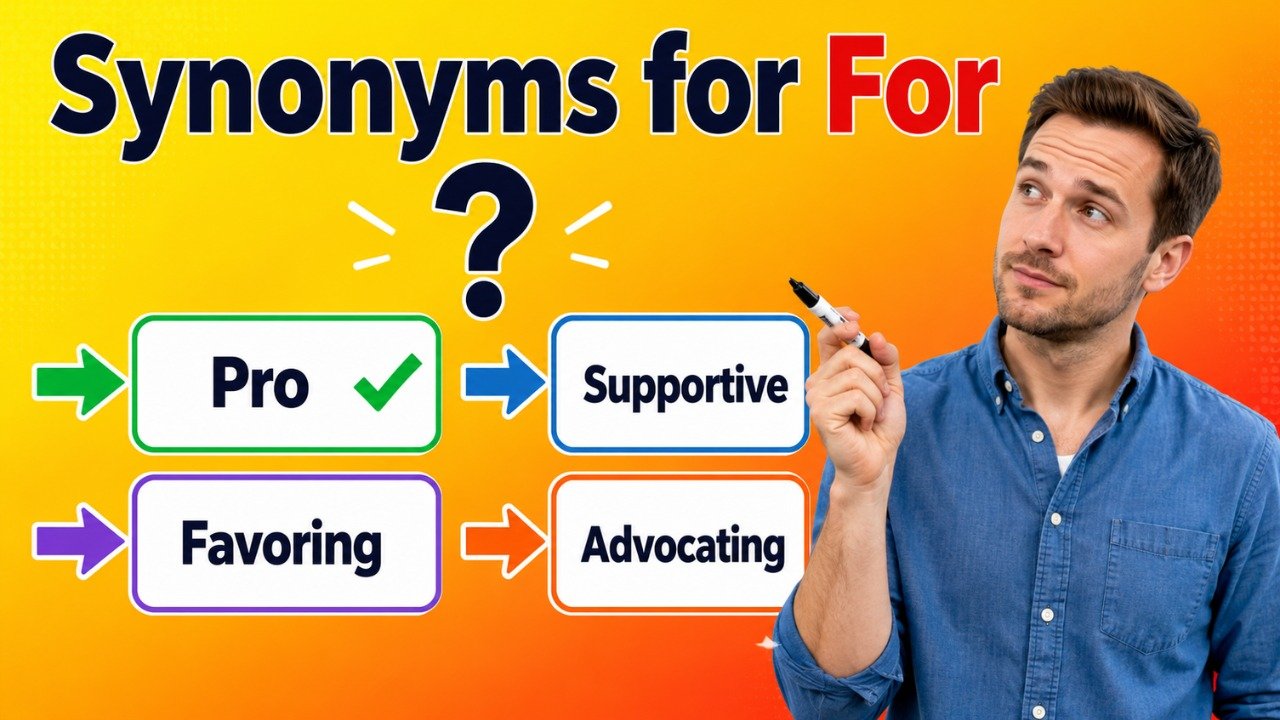
Quick Answer: The best synonyms for for include in favor of, intended for, because of, during, toward, on behalf of, regarding, in exchange for, meant for, and to. Use in favor of when showing support, intended for when describing purpose, because of when explaining a reason, during when referring to time, toward when showing direction, and regarding when introducing a topic. Because for has several grammatical meanings, the correct replacement always depends on the sentence.
Pronunciation and Word Details
Word: For
Pronunciation: /fɔːr/ or /fər/
Part of Speech: Preposition and conjunction
Meaning: Used to show purpose, support, reason, duration, direction, exchange, benefit, representation, or intended use.
US Pronunciation:
UK Pronunciation:
What Does “For” Mean?
For is a common preposition and conjunction used to connect one idea with another. It can show who receives something, why an action happens, how long something continues, what an object is intended to do, or which opinion someone supports.
In the sentence “This gift is for you,” for identifies the recipient. In “We waited for an hour,” it expresses duration. In “She was praised for her honesty,” it introduces the reason. In “He voted for the proposal,” it expresses support.
The meaning of for changes according to the words surrounding it. This is why there is no single synonym that can replace it in every sentence.
Meaning, Tone, and Context of “For”
For has a neutral tone and appears naturally in formal writing, casual conversation, academic explanations, instructions, business communication, and everyday speech. It is one of the most flexible words in English.
In formal contexts, for may be replaced by phrases such as regarding, on behalf of, because of, or in favor of. In casual speech, simpler choices such as to, about, during, or toward may sound more natural.
The word can express practical purpose, emotional support, personal benefit, time, price, responsibility, destination, or cause. Choosing the right alternative requires understanding the exact relationship between the ideas in the sentence.
When and How to Use “For”
For Purpose: Use for to explain what something is intended to do.
Example: This brush is for cleaning small spaces.
For a Recipient: Use for to identify the person who receives something.
Example: I bought these flowers for my mother.
For Support: Use for to show agreement with a person, plan, decision, or idea.
Example: Most members voted for the proposal.
For Duration: Use for to state how long an action or condition continues.
Example: They stayed in the city for three weeks.
For a Reason: Use for to explain why someone is praised, blamed, punished, or remembered.
Example: She received an award for her courage.
For Exchange: Use for to show what is given, paid, or received in return.
Example: He sold the chair for fifty dollars.
For Direction: Use for when someone or something moves toward a destination.
Example: The family left for the airport early.
For Representation: Use for when someone acts in another person’s place.
Example: The lawyer spoke for the client.
For a Topic: Use for when identifying a subject, request, or concern.
Example: We received several questions for the manager.
Best Synonyms for For
In Favor Of
Synonym: In favor of
Meaning: Supporting or approving a person, idea, plan, or decision.
Example: The committee voted in favor of the new policy.
Intended For
Synonym: Intended for
Meaning: Created, planned, or prepared for a particular person or purpose.
Example: This guide is intended for new learners.
Because Of
Synonym: Because of
Meaning: Used to introduce the cause or reason for something.
Example: The event was delayed because of heavy rain.
During
Synonym: During
Meaning: At some point within a particular period.
Example: No one was allowed to leave during the meeting.
Toward
Synonym: Toward
Meaning: Moving or pointing in the direction of something.
Example: She walked toward the entrance.
On Behalf Of
Synonym: On behalf of
Meaning: Acting as the representative of another person or group.
Example: He accepted the award on behalf of the entire team.
Regarding
Synonym: Regarding
Meaning: About or concerning a particular subject.
Example: I am writing regarding your recent request.
In Exchange For
Synonym: In exchange for
Meaning: Given or received as part of a trade.
Example: She offered assistance in exchange for advice.
Meant For
Synonym: Meant for
Meaning: Designed or considered suitable for someone or something.
Example: This room is meant for private meetings.
To
Synonym: To
Meaning: Used in some sentences to identify a recipient, purpose, or destination.
Example: Please deliver the package to the front desk.
50 Synonyms for For with Short Meanings
The following words and phrases are synonyms or close alternatives for for. They are not interchangeable in every sentence, so their meanings should guide your choice.
- In Favor Of: Supporting or approving something.
- Supportive Of: Showing encouragement or approval.
- Backing: Giving support to a person or proposal.
- Pro: Supporting a particular position or idea.
- On the Side Of: Agreeing with or defending someone.
- Intended For: Created for a particular use or person.
- Meant For: Designed or planned for someone or something.
- Designed For: Made to perform a specific function.
- Suitable For: Appropriate for a certain purpose.
- Reserved For: Kept available for a particular person or use.
- To: Identifying a recipient, destination, or purpose.
- Toward: Moving in the direction of something.
- In the Direction Of: Moving or pointing toward a place.
- Bound For: Travelling toward a particular destination.
- Headed For: Moving toward a place or likely result.
- On Behalf Of: Acting as another person’s representative.
- In Place Of: Replacing someone or something.
- As a Representative Of: Speaking or acting for another party.
- Representing: Acting or speaking in another person’s interest.
- For the Benefit Of: Intended to help or improve something for someone.
- Because Of: Introducing a cause or reason.
- Due To: Caused by a particular condition or event.
- Owing To: Happening because of something.
- As a Result Of: Occurring as the consequence of something.
- On Account Of: Because of a stated reason.
- Through: By means of or because of something.
- During: Within a particular period.
- Throughout: From the beginning to the end of a period.
- Over: Continuing across a period of time.
- For the Duration Of: Continuing for the complete period.
- In Exchange For: Given or received as part of a trade.
- In Return For: Received as repayment or compensation.
- At the Price Of: Available in exchange for a stated amount.
- Costing: Having a particular price.
- Worth: Having a stated financial or practical value.
- Concerning: Relating to a particular subject.
- Regarding: About a particular topic or issue.
- About: Connected with a subject.
- Relating To: Having a connection with something.
- With Respect To: Concerning a particular matter.
- As: Acting in a particular role or function.
- In the Role Of: Performing a particular position or duty.
- In the Capacity Of: Acting with a stated responsibility or authority.
- Serving As: Performing the purpose or role of something.
- Used As: Performing a particular function.
- To Obtain: Used with the purpose of receiving something.
- In Order To Get: Acting with the aim of gaining something.
- With the Purpose Of: Intended to achieve a particular result.
- In Pursuit Of: Trying to achieve or obtain something.
- In Search Of: Looking for a person, object, answer, or opportunity.
Read Also:
Synonyms for Gentle
Synonyms for For by Context
When For Shows Support
When for expresses approval, agreement, or support, the strongest alternatives include in favor of, supportive of, backing, pro, and on the side of.
Example With For: She voted for the proposal.
Example With a Synonym: She voted in favor of the proposal.
Example With For: The residents are for the new safety plan.
Example With a Synonym: The residents are supportive of the new safety plan.
When For Shows Purpose
When for identifies an intended purpose, use intended for, meant for, designed for, suitable for, or with the purpose of.
Example With For: This tool is for cutting glass.
Example With a Synonym: This tool is designed for cutting glass.
Example With For: The instructions are for beginners.
Example With a Synonym: The instructions are intended for beginners.
When For Shows a Recipient
When for identifies who should receive something, to is often the simplest alternative. For the benefit of can be used when an action is intended to help someone.
Example With For: Please save a seat for Maria.
Example With a Synonym: Please reserve a seat intended for Maria.
Example With For: The program was created for local families.
Example With a Synonym: The program was created for the benefit of local families.
When For Shows a Reason
When for introduces a cause or explanation, use because of, due to, owing to, on account of, or as a result of.
Example With For: He was admired for his patience.
Example With a Synonym: He was admired because of his patience.
Example With For: The player was removed for breaking the rules.
Example With a Synonym: The player was removed due to a rule violation.
When For Shows Duration
When for introduces a period of time, possible alternatives include throughout, over, for the duration of, and sometimes during.
Example With For: She lived there for ten years.
Example With a Synonym: She lived there over a period of ten years.
Example With For: The road remained closed for the entire weekend.
Example With a Synonym: The road remained closed throughout the weekend.
When For Shows Exchange or Price
When for describes payment, trade, or compensation, use in exchange for, in return for, at the price of, costing, or worth.
Example With For: He repaired the fence for two hundred dollars.
Example With a Synonym: He repaired the fence in exchange for two hundred dollars.
Example With For: The painting sold for a high price.
Example With a Synonym: The painting sold at a high price.
When For Shows Direction
When for introduces a destination, use toward, bound for, headed for, or in the direction of.
Example With For: They left for the coast before sunrise.
Example With a Synonym: They headed for the coast before sunrise.
Example With For: She reached for the door.
Example With a Synonym: She moved her hand toward the door.
When For Introduces a Topic
When for relates to a subject, request, or concern, use regarding, concerning, about, relating to, or with respect to.
Example With For: We have a question for the director.
Example With a Synonym: We have a question regarding the director’s decision.
Example With For: The company issued guidelines for workplace safety.
Example With a Synonym: The company issued guidelines concerning workplace safety.
When For Shows Representation
When someone acts or speaks for another person, use on behalf of, representing, as a representative of, or in place of.
Example With For: She spoke for the entire department.
Example With a Synonym: She spoke on behalf of the entire department.
Another Word for For
The best single replacement for for is often to, but only when the sentence identifies a recipient, direction, or destination. In other contexts, a phrase such as because of, regarding, during, or in favor of may be more accurate.
Original: I gave the document for the manager.
Better Option: I gave the document to the manager.
Original: They voted for the new proposal.
Better Option: They voted in favor of the new proposal.
Original: The flight was cancelled for bad weather.
Better Option: The flight was cancelled because of bad weather.
Original: We discussed plans for the upcoming event.
Better Option: We discussed plans regarding the upcoming event.
When Not to Use “For”
For should not be used when it makes the relationship between ideas vague. A more precise preposition or phrase can clarify whether you mean purpose, reason, direction, duration, support, or topic.
Avoid repeating for several times in one sentence. Repetition can make otherwise clear writing sound awkward.
Weak: This guide is for students for learning grammar for examinations.
Better: This guide helps students learn grammar for examinations.
Use to instead of for when describing a direct transfer to a recipient.
Weak: Please send the message for the manager.
Better: Please send the message to the manager.
Use because of when stating a clear cause.
Weak: The road was closed for flooding.
Better: The road was closed because of flooding.
Use regarding or concerning when introducing a formal topic.
Weak: I am contacting you for your recent application.
Better: I am contacting you regarding your recent application.
Use toward when describing physical movement in a direction.
Weak: She moved for the window.
Better: She moved toward the window.
Words Commonly Confused With For
For vs To: For often shows purpose, benefit, support, or intended use. To usually shows direction, transfer, or a recipient. “This gift is for Anna” means Anna is the intended recipient. “Give this gift to Anna” describes the act of transferring it.
For vs Since: For introduces a length of time, while since introduces the starting point. Say “for three years” but “since 2023.”
For vs Because: For can function as a formal conjunction meaning because, but it often sounds literary. Because is clearer in most everyday sentences.
For vs During: For describes how long something continues. During identifies when something happens within a period. Say “I studied for two hours” and “I took notes during the lesson.”
For vs Of: For commonly shows purpose or benefit, while of shows belonging, composition, connection, or origin. A “book for children” is intended for children. A “book of stories” contains stories.
For vs Regarding: For has many broad uses. Regarding specifically introduces a subject or topic and is often clearer in formal communication.
For vs Toward: For can introduce a destination after verbs such as leave or depart. Toward emphasizes movement in a direction and does not always imply arrival.
Which Synonym Should You Choose?
Choose in favor of when expressing support for an idea, decision, proposal, or candidate.
Choose intended for when explaining the audience, user, or purpose of an object, message, or service.
Choose designed for when emphasizing how something was created to perform a specific task.
Choose because of when explaining a clear reason or cause.
Choose due to in formal reports when introducing a cause connected to a noun.
Choose during when something happens within a particular event or period.
Choose throughout when something continues across an entire period.
Choose toward when describing physical or figurative direction.
Choose on behalf of when one person represents another person or group.
Choose regarding or concerning in formal writing when introducing a topic.
Choose in exchange for when describing trade, payment, compensation, or return.
Choose to when identifying a recipient or destination.
Choose meant for in casual conversation when explaining intended use.
Choose for the benefit of when emphasizing that an action is designed to help someone.
Real Life Examples of “For” in Sentences
Original: This course is for advanced learners.
Better Option: This course is intended for advanced learners.
Original: She voted for the new community plan.
Better Option: She voted in favor of the new community plan.
Original: We stayed at the hotel for four nights.
Better Option: We stayed at the hotel over a period of four nights.
Original: The match was delayed for heavy rain.
Better Option: The match was delayed because of heavy rain.
Original: He spoke for the entire group.
Better Option: He spoke on behalf of the entire group.
Original: They left for the station at noon.
Better Option: They headed for the station at noon.
Original: She exchanged the old lamp for a new table.
Better Option: She exchanged the old lamp in return for a new table.
Original: I am calling for information about the course.
Better Option: I am calling to obtain information about the course.
Original: The instructions are for operating the machine safely.
Better Option: The instructions are designed to help users operate the machine safely.
Original: We received a letter for the recent policy change.
Better Option: We received a letter regarding the recent policy change.
Synonym Groups and Usage Differences
Support Group
In favor of, supportive of, backing, pro, and on the side of all express approval. In favor of is the clearest formal choice, while pro is shorter and more conversational.
Example: Most members were in favor of the revised plan.
Purpose Group
Intended for, meant for, designed for, suitable for, and with the purpose of explain why something exists or who should use it.
Example: The activity is designed for younger learners.
Cause Group
Because of, due to, owing to, on account of, and as a result of introduce causes. Because of is natural in most contexts, while due to and owing to sound more formal.
Example: The journey was postponed because of severe weather.
Time Group
During, throughout, over, and for the duration of relate to time. During identifies when something happens, while throughout emphasizes the complete period.
Example: The building remained quiet throughout the afternoon.
Direction Group
Toward, headed for, bound for, and in the direction of describe movement. Toward emphasizes direction, while bound for often suggests a planned destination.
Example: The train was bound for the capital.
Representation Group
On behalf of, representing, as a representative of, and in place of describe someone acting for another party.
Example: The assistant signed the document on behalf of the director.
Topic Group
Regarding, concerning, about, relating to, and with respect to introduce a subject. Regarding and concerning are useful in formal writing, while about is more conversational.
Example: She asked several questions regarding the schedule.
Exchange Group
In exchange for, in return for, at the price of, costing, and worth relate to payment, trade, or value.
Example: He offered his services in exchange for accommodation.
Antonyms of For
The opposite of for changes according to its meaning. When for means support, the opposite may be against. When it means benefit, the opposite may involve harm or disadvantage.
Against: Opposed to a person, plan, idea, or decision.
Opposed To: Expressing disagreement or resistance.
Contrary To: In conflict with an idea, rule, or expectation.
Anti: Actively opposing a policy, position, or movement.
In Opposition To: Acting against a proposal or belief.
Without: Lacking the intended object, person, or purpose.
Despite: Happening even though a difficulty exists.
Away From: Moving in the opposite direction.
To the Disadvantage Of: Producing an unfavorable result for someone.
At the Expense Of: Benefiting one thing while harming another.
Comparison of For and Related Words
For vs To
For often identifies purpose, benefit, or an intended recipient. To describes movement, direction, or direct transfer.
Example With For: I bought a notebook for Elena.
Example With To: I gave the notebook to Elena.
For vs Because Of
For can introduce a reason, but because of usually makes the cause clearer.
Example With For: He was rewarded for his honesty.
Example With Because Of: He was rewarded because of his honest behavior.
For vs During
For focuses on duration. During focuses on an event or period in which something happens.
Example With For: We talked for thirty minutes.
Example With During: We talked during the lunch break.
For vs Regarding
For is broad and flexible. Regarding specifically means about or concerning a subject.
Example With For: I have a question for the new policy.
Example With Regarding: I have a question regarding the new policy.
For vs Toward
For can identify a destination after movement verbs. Toward emphasizes direction without guaranteeing arrival.
Example With For: They left for the mountains.
Example With Toward: They drove toward the mountains.
For vs On Behalf Of
For may mean representing someone, but on behalf of is more precise in formal contexts.
Example With For: She accepted the prize for her brother.
Example With On Behalf Of: She accepted the prize on behalf of her brother.
For vs In Favor Of
For can express support in short statements. In favor of makes the supportive meaning explicit.
Example With For: Ten members voted for the motion.
Example With In Favor Of: Ten members voted in favor of the motion.
Common Phrases and Expressions With “For”
For Example: Used to introduce an illustration or specific case.
For Good: Permanently or forever.
For Now: Until a later time or decision.
For Sure: Certainly or without doubt.
For Sale: Available to be purchased.
For Free: Available without payment.
For a While: During a limited period.
For the Most Part: Generally or mainly.
For Better or Worse: Regardless of whether the result is positive or negative.
For the Sake Of: To support, protect, or achieve something important.
Common Mistakes to Avoid
One common mistake is assuming that every use of for has the same meaning. It may express purpose in one sentence and reason, time, support, exchange, or direction in another.
Avoid replacing for with to without checking the meaning. “I bought a gift for Sam” and “I gave a gift to Sam” describe related but different actions.
Do not confuse for and since in time expressions. Use for with a duration, such as “for six months.” Use since with a starting point, such as “since January.”
Avoid using during when you need to state a complete duration. “We waited for two hours” is correct because two hours describes length. “We waited during the meeting” identifies when the waiting happened.
Do not overuse for in a single sentence. Rewrite repeated phrases to improve flow and clarity.
Choose a precise alternative in formal writing. Regarding is clearer for topics, because of is clearer for causes, on behalf of is clearer for representation, and in favor of is clearer for support.
Conclusion
The best synonyms for for depend entirely on its meaning in the sentence. Use intended for or designed for to express purpose, in favor of to show support, because of to explain a reason, during or throughout for time, toward for direction, and regarding for a topic. On behalf of works best for representation, while in exchange for clarifies trade or payment. Understanding these context differences will help you use synonyms for for naturally, avoid vague wording, and create clearer sentences.
FAQs About Synonyms for For
What Is the Best Synonym for For?
There is no single replacement for every use. Intended for, because of, in favor of, during, toward, regarding, and on behalf of are common choices based on context.
Can To Replace For?
To can replace for when identifying a recipient or destination, but it cannot replace for when expressing support, duration, reason, purpose, or exchange.
What Is Another Word for For When Showing Support?
In favor of is the clearest alternative. Supportive of, backing, and on the side of may also work.
What Can Replace For When Explaining a Reason?
Because of, due to, owing to, on account of, and as a result of can introduce a reason or cause.
What Is a Formal Alternative to For?
Regarding, concerning, on behalf of, in favor of, due to, and with respect to are useful formal alternatives in the correct context.
What Is the Difference Between For and Since?
For introduces a period of time, while since introduces the starting point. Use “for five years” and “since 2021.”
Are All Synonyms for For Interchangeable?
No. For has several meanings, and each alternative fits only certain contexts. Always identify whether the sentence expresses purpose, support, time, cause, direction, exchange, benefit, or representation.
