
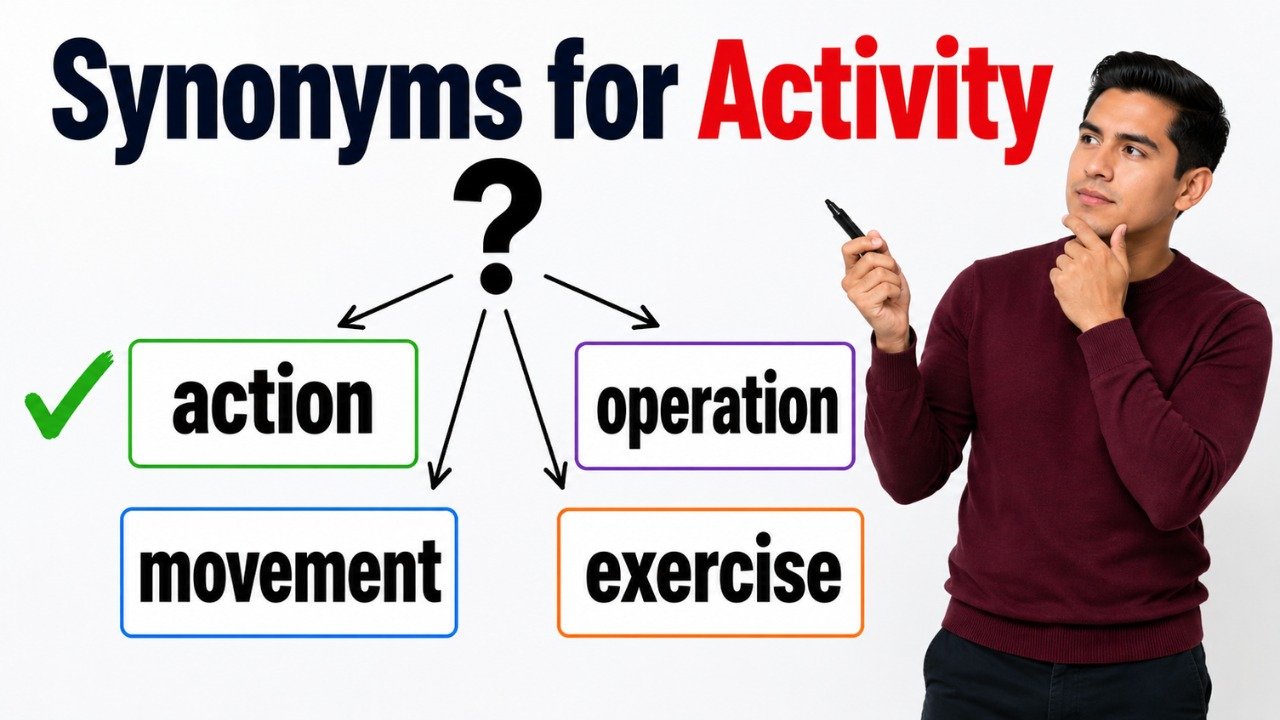
Quick Answer: The best synonyms for activity include action, task, work, exercise, movement, event, operation, pursuit, engagement, and participation. Use action for something a person does, task for an assigned piece of work, and exercise for physical or mental training. Movement is best when referring to motion, while event suits an organized occasion. Operation works well in formal, business, and technical contexts. Engagement and participation emphasize active involvement, while pursuit describes an interest or goal followed over time.
Pronunciation and Word Details
Word: Activity.
Pronunciation: /ækˈtɪvəti/.
Part of Speech: Noun.
Meaning: Something that a person, group, system, or organization does, or a state of movement and action.
US Pronunciation:
UK Pronunciation:
What Does “Activity” Mean?
Activity means an action, task, event, movement, or process involving effort, participation, or change.
Activity is mainly used as a noun. It can describe something a person does, such as reading, gardening, exercising, or completing an assignment.
Example: Reading is a useful activity for improving vocabulary.
The word can also refer to physical movement or exercise.
Example: Regular physical activity supports strength and mobility.
Activity may describe organized events, lessons, games, or recreational experiences.
Example: The teacher planned a group activity for the class.
In business and technical contexts, activity can mean operations, transactions, processes, or work performed by an organization or system.
Example: Business activity increased during the holiday period.
The word may also describe visible movement, energy, or busyness in a place.
Example: There was a great deal of activity at the station.
In scientific contexts, activity can describe processes occurring within the body, brain, cells, chemicals, or natural systems.
Example: Researchers measured brain activity during the experiment.
The exact meaning depends on whether the sentence refers to action, work, movement, exercise, participation, events, operations, or a measurable process.
Meaning, Tone, and Context of “Activity”
Activity is a neutral and widely used word. It appears naturally in everyday conversation, education, business, science, health writing, reports, instructions, and formal documents.
In casual conversation, activity often means something that a person does for enjoyment, learning, exercise, or practical value.
Example: Cooking is one of her favorite weekend activities.
In education, activity commonly describes a planned task designed to help learners practice a skill or understand a topic.
Example: The students completed a vocabulary activity.
In health and fitness contexts, activity usually refers to physical movement or exercise.
Example: Walking is a gentle form of physical activity.
In business writing, activity may refer to work, operations, transactions, production, or economic behavior.
Example: The report showed increased commercial activity in the region.
In scientific and technical writing, activity can describe measurable functions, reactions, signals, or processes.
Example: The medicine affected electrical activity in the muscles.
The word is useful because it is broad, but that broadness can also make it vague. A more precise synonym such as task, movement, exercise, event, operation, or process may communicate the intended meaning more clearly.
When and How to Use “Activity”
For an Action Someone Performs
Use activity to describe something a person does intentionally.
Example: Writing in a journal can be a calming activity.
In this context, action, pursuit, or practice may also work.
For an Assigned Task
Activity can describe a structured piece of work given to students, employees, or participants.
Example: Complete the listening activity before answering the questions.
Task, assignment, or exercise may be more precise when the work has a clear goal.
For Physical Exercise
Use activity when referring broadly to body movement that requires energy.
Example: Swimming is an enjoyable physical activity.
Exercise, movement, workout, and exertion are useful alternatives depending on intensity and purpose.
For a Recreational Experience
Activity can describe something done for relaxation, pleasure, or entertainment.
Example: Painting is a relaxing indoor activity.
Pastime, hobby, recreation, or pursuit may provide a more specific meaning.
For an Organized Event
Use activity for a planned event, game, session, or group experience.
Example: The community center offers several evening activities.
Event, program, session, or gathering may be better when the organized nature matters.
For Work and Business Operations
Activity can describe the work performed by a person, department, company, or industry.
Example: Construction activity slowed during the heavy rain.
Operation, work, production, trade, or transaction may suit formal reports.
For Active Participation
Use activity when referring to involvement in a group, discussion, program, or project.
Example: Her activity in the committee increased during the final month.
Engagement, involvement, or participation may express this meaning more directly.
For Movement in a Place
Activity can describe busyness, motion, or visible action within an area.
Example: The market was full of activity early in the morning.
Bustle, movement, action, or commotion may create a more vivid description.
For Scientific Processes
Use activity when discussing biological, chemical, electrical, or mental processes.
Example: The scan recorded unusual brain activity.
Process, function, reaction, or behavior may be appropriate depending on the subject.
For Digital or Recorded Behavior
Activity can refer to actions recorded by a device, system, account, or service.
Example: The report showed unusual account activity during the night.
Usage, behavior, actions, transactions, or operations may be more precise.
Best Synonyms for Activity
Action
Synonym: Something that a person, group, or system does.
Example: Immediate action was needed to prevent further damage.
Task
Synonym: A specific piece of work that must be completed.
Example: Her first task was to organize the documents.
Work
Synonym: Effort or labor performed to achieve a result.
Example: Repairing the roof required several days of work.
Exercise
Synonym: Physical or mental activity performed for training, health, or practice.
Example: The lesson included a short grammar exercise.
Movement
Synonym: A change in position or the act of moving.
Example: The camera detected movement near the entrance.
Event
Synonym: An organized occasion or something that happens.
Example: The school held a cultural event for families.
Operation
Synonym: An organized process, function, or series of actions.
Example: The factory began normal operation after the inspection.
Pursuit
Synonym: An activity, interest, or goal followed over time.
Example: Photography became a serious creative pursuit.
Engagement
Synonym: Active attention, participation, or involvement.
Example: The new lesson encouraged greater student engagement.
Participation
Synonym: The act of joining or taking part in something.
Example: Participation in the workshop was voluntary.
50 Synonyms for Activity with Short Meanings
- Action: Something done by a person, group, or system.
- Task: A specific piece of work to complete.
- Work: Effort used to achieve a result.
- Exercise: Physical or mental practice performed for improvement.
- Movement: The act or process of changing position.
- Motion: Continuous or noticeable movement.
- Operation: An organized function or working process.
- Pursuit: An interest, goal, or activity followed over time.
- Occupation: Regular work or an activity that fills time.
- Event: An organized occasion or notable happening.
- Undertaking: A task or project requiring effort and responsibility.
- Endeavor: A serious and determined effort.
- Enterprise: An organized project or ambitious undertaking.
- Project: Planned work designed to produce a result.
- Assignment: A task officially given to someone.
- Duty: Work or responsibility that a person is expected to perform.
- Job: A particular piece of work or paid occupation.
- Function: The purpose, role, or normal activity of something.
- Process: A series of actions or changes leading to a result.
- Procedure: An established method for completing an activity.
- Practice: Repeated activity used to improve a skill.
- Engagement: Active attention or involvement in something.
- Involvement: The state of taking part in an activity.
- Participation: The act of joining and contributing.
- Recreation: Activity performed for relaxation and enjoyment.
- Pastime: An enjoyable activity used to pass time.
- Hobby: A regular activity pursued for pleasure.
- Sport: Physical activity involving skill, exercise, or competition.
- Workout: A planned period of physical exercise.
- Exertion: Physical or mental effort requiring energy.
- Labor: Hard physical or mental work.
- Effort: Energy used to complete or achieve something.
- Busyness: A state of having much to do.
- Bustle: Energetic movement and noisy activity.
- Commotion: Confused, noisy, or sudden activity.
- Animation: Liveliness, energy, or active movement.
- Vitality: Physical or mental energy and strength.
- Energy: The ability or enthusiasm needed for activity.
- Behavior: The way a person, animal, or system acts.
- Conduct: A person’s manner of acting or behaving.
- Performance: The act of completing or presenting something.
- Program: An organized set of planned activities.
- Session: A fixed period devoted to an activity.
- Routine: A regular and repeated pattern of activity.
- Campaign: A planned series of activities for a goal.
- Initiative: A planned action intended to solve a problem or create change.
- Transaction: A business, financial, or recorded activity.
- Proceeding: An organized activity, event, or formal action.
- Occurrence: Something that happens or takes place.
- Happening: An event or activity that occurs.
Read Also:
Synonyms for Fundamental

Synonyms for Activity by Context
When Activity Means an Action
Use action, behavior, conduct, performance, or undertaking when activity refers to something a person or group does.
Action Example: The situation required immediate action.
Behavior Example: The teacher observed the child’s classroom behavior.
Conduct Example: Professional conduct is expected during the meeting.
Undertaking Example: Restoring the old building was a major undertaking.
Action is the broadest replacement. Behavior and conduct focus on how someone acts, while undertaking suggests a larger or more demanding activity.
When Activity Means a Task
Use task, assignment, duty, job, project, exercise, or procedure when referring to work that has a clear purpose.
Task Example: The first task was to check the equipment.
Assignment Example: Each student received a research assignment.
Duty Example: Checking the doors was part of his duty.
Project Example: The class completed a science project.
Task is best for a specific piece of work. Assignment suggests that the work was given by someone, while project often involves several steps.
When Activity Means Physical Exercise
Use exercise, movement, workout, sport, exertion, or motion when the meaning involves physical movement.
Exercise Example: Gentle exercise can improve flexibility.
Movement Example: Regular movement helps prevent stiffness.
Workout Example: She completed a thirty minute workout.
Sport Example: Tennis is a popular outdoor sport.
Exercise is the most general fitness related alternative. Workout usually describes a planned session, while sport may include competition and rules.
When Activity Means an Event
Use event, happening, program, session, proceeding, or occurrence when activity describes something organized or something that takes place.
Event Example: The library hosted a reading event.
Program Example: The summer program includes art and music.
Session Example: The training session begins at noon.
Occurrence Example: Heavy snowfall is an unusual occurrence in the area.
Event works for organized occasions. Occurrence is more formal and may refer to something unplanned.
When Activity Means Recreation
Use recreation, pastime, hobby, pursuit, sport, or entertainment when the activity is done for enjoyment.
Recreation Example: The park provides space for outdoor recreation.
Pastime Example: Reading was his favorite evening pastime.
Hobby Example: Gardening became a rewarding hobby.
Pursuit Example: Music remained her main creative pursuit.
Hobby usually refers to a regular personal interest. Pastime emphasizes relaxation, while pursuit can sound more serious or long term.
When Activity Means Work
Use work, labor, job, occupation, effort, endeavor, enterprise, or project when referring to productive activity.
Work Example: The repair work continued throughout the week.
Labor Example: Harvesting the crops required intense labor.
Endeavor Example: The research was a collaborative endeavor.
Enterprise Example: The new farming enterprise created local jobs.
Work is neutral and broad. Labor emphasizes effort, while endeavor and enterprise suggest ambition or organization.
When Activity Means Participation
Use engagement, involvement, participation, contribution, or cooperation when activity refers to taking part.
Engagement Example: Classroom engagement improved after the lesson changed.
Involvement Example: Parent involvement supported the school project.
Participation Example: Active participation was encouraged.
Cooperation Example: The activity succeeded because of strong cooperation.
Engagement often includes attention and interest. Participation simply means taking part, while involvement may suggest deeper responsibility.
When Activity Means an Operation
Use operation, function, process, procedure, transaction, or practice in business, technical, and scientific contexts.
Operation Example: The warehouse returned to normal operation.
Function Example: Digestion is an important bodily function.
Process Example: The hiring process took several weeks.
Transaction Example: Every financial transaction was recorded.
Operation is useful for organized systems. Function refers to a normal purpose, while process describes a series of connected stages.
When Activity Means Busyness
Use bustle, busyness, action, commotion, animation, energy, or movement when describing a lively place or situation.
Bustle Example: The morning bustle began before sunrise.
Commotion Example: A loud commotion came from the hallway.
Animation Example: The children spoke with great animation.
Energy Example: The festival brought new energy to the town.
Bustle suggests energetic and often pleasant movement. Commotion usually suggests confusion or noise.
When Activity Means a Scientific Process
Use function, process, reaction, behavior, response, motion, or operation when discussing measurable natural or technical activity.
Function Example: The test measured liver function.
Process Example: The process begins when the temperature rises.
Reaction Example: Heat increased the chemical reaction.
Response Example: The researchers recorded the body’s response.
The best choice depends on what is being measured. Function suits organs and systems, while reaction works for chemical change.
Another Word for Activity
Action is often the best general replacement for activity because it describes something that a person, group, or system does.
However, the best alternative depends on context. Use task for assigned work, exercise for physical or mental training, event for an organized occasion, and operation for a formal or technical process.
Original: The teacher prepared an activity for the students.
Better Option: The teacher prepared an exercise for the students.
Original: Walking is a healthy activity.
Better Option: Walking is a healthy form of exercise.
Original: The center planned a family activity.
Better Option: The center planned a family event.
Original: Business activity increased during the summer.
Better Option: Business operations increased during the summer.
When Not to Use “Activity”
Activity should not be used when it is too broad, repetitive, or less accurate than a more specific word.
When the Type of Action Is Clear
Use a precise noun when readers need to know exactly what happened.
Weak: The workers completed several activities.
Better: The workers inspected the equipment, repaired the roof, and cleaned the site.
The better sentence identifies each action instead of using a vague general term.
When Referring to a Specific Assignment
Task or assignment is clearer when the work has been formally given.
Weak: Your next activity is to prepare the report.
Better: Your next assignment is to prepare the report.
When Referring to Exercise
Physical activity is correct, but exercise may sound more direct when the sentence clearly concerns fitness.
Weak: She does an activity every morning to stay fit.
Better: She exercises every morning to stay fit.
When Referring to an Organized Occasion
Event is clearer for a scheduled celebration, meeting, competition, or gathering.
Weak: The wedding activity begins at six.
Better: The wedding event begins at six.
When Referring to Technical Operations
Operation or process may be more precise in formal writing.
Weak: The machine’s activity stopped suddenly.
Better: The machine’s operation stopped suddenly.
When Describing Personal Conduct
Behavior or conduct is better when the sentence concerns how someone acts.
Weak: His activity during the meeting was inappropriate.
Better: His conduct during the meeting was inappropriate.
When Repetition Makes Writing Dull
Repeated use of activity can make a paragraph sound mechanical.
Weak: The morning activity was followed by a group activity and an outdoor activity.
Better: The morning exercise was followed by a group discussion and an outdoor game.
When a Casual Word Sounds Too Informal
Happening may be too casual for reports, academic writing, or official documents.
Weak: The report describes every happening in the department.
Better: The report describes every significant activity in the department.
Words Commonly Confused With Activity
Activity vs Action: Activity can describe a general state of doing, movement, or organized work. Action usually refers to a specific thing that is done.
Activity vs Task: Activity is broad and may be enjoyable, physical, educational, or professional. Task is a specific piece of work that must be completed.
Activity vs Exercise: Activity includes many forms of action. Exercise specifically refers to physical or mental practice intended to improve health or skill.
Activity vs Event: Activity may be one part of an event or a repeated action. Event refers to an organized occasion or notable happening.
Activity vs Movement: Activity may include work, tasks, or processes. Movement specifically refers to changing position or physical motion.
Activity vs Operation: Activity is a broad general term. Operation is more formal and describes organized work, a functioning system, or a planned procedure.
Activity vs Behavior: Activity describes what is being done. Behavior describes the way a person, animal, or system acts.
Activity vs Occupation: Activity can be temporary or recreational. Occupation usually refers to regular employment or something that takes up a person’s time.
Activity vs Engagement: Activity describes an action or event. Engagement emphasizes attention, interest, or active involvement.
Activity vs Process: Activity may be a single action or general busyness. Process is a connected series of steps or changes.
Which Synonym Should You Choose?
Choose action when referring to something a person, group, or system does.
Choose task for a specific piece of work with a clear goal.
Choose assignment when the task has been given by a teacher, employer, or supervisor.
Choose work when describing productive effort in a general way.
Choose labor when the activity requires significant physical or mental effort.
Choose exercise for physical fitness, mental training, or classroom practice.
Choose movement when the meaning involves a change of position.
Choose motion when describing continuous physical movement.
Choose event for an organized occasion, competition, celebration, or gathering.
Choose session for a planned period devoted to one activity.
Choose program for an organized collection of activities.
Choose pursuit for a long term interest, ambition, or personal goal.
Choose hobby for a regular activity done for pleasure.
Choose pastime for a relaxing activity used to fill free time.
Choose recreation for enjoyable activity intended to refresh or entertain.
Choose engagement for active attention and meaningful involvement.
Choose participation when simply describing the act of taking part.
Choose operation for formal business, technical, industrial, or organizational activity.
Choose process for a series of stages or actions leading to a result.
Choose function when referring to the normal purpose or activity of an organ, system, or object.
Choose transaction for financial or commercial activity.
Choose behavior when describing how a person, animal, or system acts.
Choose conduct for personal behavior in formal or professional contexts.
Choose bustle when a place is lively and full of movement.
Choose commotion when activity is noisy, confused, or disruptive.
Real Life Examples of “Activity” in Sentences
Original: The teacher planned a reading activity.
Better Option: The teacher planned a reading exercise.
Original: Walking is her favorite physical activity.
Better Option: Walking is her favorite form of exercise.
Original: The office was full of activity before the meeting.
Better Option: The office was full of bustle before the meeting.
Original: The police investigated unusual activity near the building.
Better Option: The police investigated unusual movement near the building.
Original: Business activity increased in the city center.
Better Option: Commercial operations increased in the city center.
Original: The children chose a creative activity.
Better Option: The children chose a creative pursuit.
Original: The activity will begin after lunch.
Better Option: The event will begin after lunch.
Original: Her activity in the discussion was appreciated.
Better Option: Her participation in the discussion was appreciated.
Original: The device recorded brain activity.
Better Option: The device recorded brain function.
Original: Completing the form was a simple activity.
Better Option: Completing the form was a simple task.
Synonym Groups and Usage Differences
Action Group
This group includes action, behavior, conduct, performance, undertaking, and endeavor.
Action is the most general word for something done. Behavior and conduct describe how someone acts. Undertaking and endeavor suggest greater effort or responsibility.
Example: The rescue operation required immediate action.
Task and Work Group
This group includes task, assignment, work, job, duty, labor, project, and procedure.
Task and assignment describe specific work. Duty suggests responsibility, while project usually includes several connected stages.
Example: Preparing the final report was her main assignment.
Exercise and Movement Group
This group includes exercise, movement, motion, workout, sport, and exertion.
Exercise and workout usually have a health or training purpose. Movement and motion simply describe physical change, while exertion emphasizes effort.
Example: Gentle movement reduced the stiffness in his shoulders.
Event and Program Group
This group includes event, program, session, proceeding, occurrence, and happening.
Event and program are useful for organized occasions. Session describes a fixed period, while occurrence can describe something that happens unexpectedly.
Example: The final training session lasted two hours.
Recreation Group
This group includes recreation, pastime, hobby, pursuit, and sport.
Hobby suggests a regular personal interest. Pastime is usually casual and relaxing. Pursuit can sound more serious and goal focused.
Example: Woodworking became a rewarding hobby.
Participation Group
This group includes engagement, involvement, participation, and cooperation.
Participation means taking part. Engagement includes attention and interest, while involvement may suggest deeper responsibility.
Example: Student engagement increased during the practical lesson.
Operations Group
This group includes operation, function, process, procedure, transaction, and practice.
Operation describes organized work or functioning. Process involves connected stages, while procedure refers to an established method.
Example: The payment process was completed securely.
Energy and Busyness Group
This group includes bustle, busyness, animation, vitality, energy, and commotion.
Bustle and animation often create a lively image. Commotion suggests disorder, while vitality describes strength and energetic life.
Example: The market was filled with noise and bustle.
Antonyms of Activity
The opposite of activity depends on whether the word refers to movement, work, participation, energy, or operation.
Inactivity: The state of doing little or nothing.
Inaction: Failure to act when action is possible or necessary.
Idleness: A state of not working or being occupied.
Rest: A period without work or physical effort.
Stillness: Complete absence of movement.
Immobility: Inability or failure to move.
Passivity: Lack of active participation or response.
Dormancy: A temporary state of suspended activity.
Quiet: An absence of noise, disturbance, or visible action.
Calm: A peaceful state without excitement or commotion.
Stagnation: A lack of progress, development, or movement.
Cessation: The act of stopping an activity or process.
Pause: A temporary break in action.
Repose: A state of peaceful rest.
Unemployment: The state of being without paid work.
Comparison: Activity vs Related Words
Activity vs Action
Activity is broader and can describe repeated work, movement, events, or general busyness. Action usually refers to one specific thing done.
Example With Activity: The center provides an activity for every age group.
Example With Action: Immediate action prevented further damage.
Activity vs Task
Activity can be enjoyable, physical, educational, or professional. Task refers to a defined piece of work that must be completed.
Example With Activity: Drawing is a relaxing activity.
Example With Task: Her task was to finish the drawing before noon.
Activity vs Exercise
Activity includes any action, event, or form of movement. Exercise is performed specifically for health, training, or skill development.
Example With Activity: Gardening is an outdoor activity.
Example With Exercise: Stretching is a gentle exercise.
Activity vs Event
Activity may be one part of an organized occasion. Event refers to the complete occasion or happening.
Example With Activity: The children enjoyed the painting activity.
Example With Event: The art event attracted many families.
Activity vs Movement
Activity can include thinking, working, participating, or exercising. Movement specifically involves a change in physical position.
Example With Activity: There was increased activity in the office.
Example With Movement: The sensor detected movement near the window.
Activity vs Operation
Activity is common and general. Operation is more formal and often describes organized business, industrial, medical, or technical work.
Example With Activity: Production activity resumed in the morning.
Example With Operation: Factory operations resumed in the morning.
Activity vs Engagement
Activity describes what is done. Engagement describes how actively and attentively someone participates.
Example With Activity: The lesson included a group activity.
Example With Engagement: The group discussion improved student engagement.
Activity vs Behavior
Activity concerns actions, work, or movement. Behavior concerns the manner in which a person, animal, or system acts.
Example With Activity: The animal showed increased activity at night.
Example With Behavior: The animal displayed unusual behavior at night.
Activity vs Process
Activity can be a single action or a broad category of work. Process is a sequence of connected steps or changes.
Example With Activity: Testing was an important activity.
Example With Process: Testing was part of the approval process.
Activity vs Occupation
Activity may be temporary, recreational, or unpaid. Occupation usually means a person’s regular job or a pursuit that fills time.
Example With Activity: Reading is a useful evening activity.
Example With Occupation: Teaching is her main occupation.
Common Phrases and Expressions With Activity
Physical Activity: Bodily movement that uses energy.
Daily Activity: Something regularly done during the day.
Group Activity: A task, game, or experience completed with other people.
Learning Activity: A task designed to develop knowledge or skills.
Business Activity: Work, trade, production, or transactions performed by a business.
Economic Activity: Production, trade, spending, employment, or other actions connected with an economy.
Social Activity: An event or action involving interaction with other people.
Outdoor Activity: Something done outside for exercise, work, learning, or enjoyment.
Brain Activity: Electrical, chemical, or functional processes occurring in the brain.
Activity Level: The amount of movement, work, or participation shown by a person or system.
Common Mistakes to Avoid
Using Activity Too Vaguely
Activity can hide the exact meaning when a more specific word is available.
Vague: The team completed several activities.
Clear: The team reviewed the records, interviewed witnesses, and prepared a report.
Confusing Activity With Action
Action often describes one specific act, while activity may refer to repeated action, general work, or a state of busyness.
Incorrect: The first activity he took was calling for help.
Correct: The first action he took was calling for help.
Confusing Activity With Exercise
Not every activity is exercise. Reading, cooking, and attending a meeting are activities, but they are not usually forms of physical exercise.
Incorrect: Reading is a physical exercise.
Correct: Reading is a mental activity.
Using Event When Task Is Intended
An event is an occasion, while a task is work that must be completed.
Incorrect: Your first event is to answer the questions.
Correct: Your first task is to answer the questions.
Using Activity as an Uncountable Noun in Every Context
Activity can be countable or uncountable.
Use activity without an article when describing general action or busyness.
Example: There was increased activity in the building.
Use an activity when referring to one specific task, event, or pursuit.
Example: Painting is an enjoyable activity.
Use activities for several separate tasks or experiences.
Example: The club offers many outdoor activities.
Using Make With Activity
In most contexts, people do, complete, organize, plan, or participate in an activity. Make an activity often sounds unnatural.
Unnatural: The teacher made an activity for the class.
Natural: The teacher planned an activity for the class.
Repeating Activity Too Often
Repeated use can make writing sound dull and imprecise.
Repetitive: The first activity was a writing activity, and the second activity was a speaking activity.
Improved: The lesson began with a writing exercise and continued with a speaking task.
Choosing an Overly Formal Synonym
Enterprise, proceeding, and operation may sound unnatural in casual descriptions.
Awkward: Watching a film is a pleasant enterprise.
Natural: Watching a film is a pleasant pastime.
Using Hobby for Paid Work
A hobby is normally pursued for pleasure rather than as a main occupation.
Incorrect: Nursing is her favorite hobby.
Correct: Nursing is her occupation.
Confusing Participation With Engagement
Participation means taking part, but engagement suggests active interest and attention.
Example: A student may participate by attending, but genuine engagement requires attention and contribution.
Conclusion
The strongest synonyms for activity include action, task, work, exercise, movement, event, operation, pursuit, engagement, and participation. Choose task for assigned work, exercise for physical or mental training, event for an organized occasion, and movement for physical motion. Operation and process suit formal or technical writing, while hobby, pastime, and recreation describe enjoyable pursuits. Understanding these context differences makes it easier to use synonyms for activity naturally, accurately, and effectively in conversations, essays, reports, lessons, and professional writing.
FAQs About Synonyms for Activity
What Is the Best Synonym for Activity?
Action is the best general synonym for activity. Task, exercise, event, movement, and operation may be better in more specific contexts.
What Is Another Word for Physical Activity?
Exercise, movement, workout, sport, and exertion are useful alternatives for physical activity.
What Is a Formal Synonym for Activity?
Operation, undertaking, endeavor, process, procedure, and engagement are suitable formal alternatives, depending on the meaning.
Can Task Replace Activity?
Task can replace activity when referring to a specific piece of work. It does not usually replace activity when the meaning is exercise, recreation, or general movement.
What Is Another Word for a Fun Activity?
Hobby, pastime, recreation, pursuit, game, and entertainment can describe an enjoyable activity.
What Is the Opposite of Activity?
Common opposites include inactivity, inaction, idleness, stillness, passivity, rest, and dormancy.
Is Activity Countable or Uncountable?
Activity can be both. Use an activity for one specific task or event, activities for several, and activity without an article when referring to general action or busyness.
