
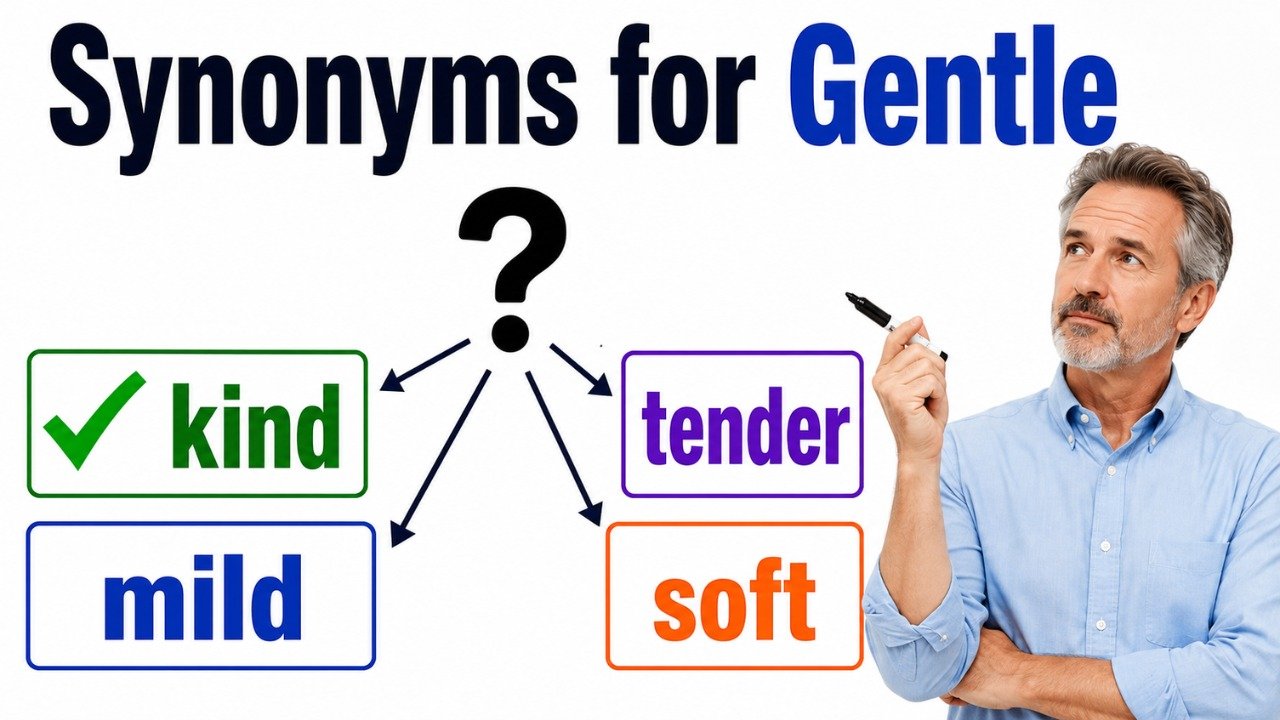
Quick Answer: Common synonyms for gentle include mild, soft, tender, kind, calm, delicate, soothing, considerate, compassionate, and peaceful. Use mild for something that is not strong or severe, soft for touch, sound, or movement, tender for affection and sensitivity, kind for caring behavior, and delicate for something requiring careful handling. Calm and peaceful describe quiet behavior, while soothing works best for voices, music, treatments, and experiences that reduce discomfort or worry.
Pronunciation and Word Details
Word: Gentle
Pronunciation: /ˈdʒen.təl/
Part of Speech: Adjective and verb
Meaning: Kind, calm, soft, or mild in behavior, movement, effect, or strength.
US Pronunciation:
UK Pronunciation:
What Does “Gentle” Mean?
Gentle means kind, calm, soft, careful, or not severe. It is most commonly used as an adjective to describe a person, action, sound, touch, movement, condition, or treatment.
A gentle person behaves with patience and care. A gentle touch uses little force. Gentle weather is mild rather than harsh. Gentle exercise does not place too much pressure on the body.
As a verb, gentle can mean to calm, train, or handle someone or something carefully. However, this verb form is less common in everyday conversation.
Person: She has a gentle and caring personality.
Touch: He placed a gentle hand on the child’s shoulder.
Sound: A gentle melody played in the background.
Movement: Use a gentle motion when cleaning the surface.
Condition: A gentle breeze moved through the garden.
Meaning, Tone, and Context of “Gentle”
Gentle usually has a positive, warm, and reassuring tone. It suggests kindness, control, softness, patience, or a lack of force.
The word is neutral enough for everyday conversation but also suitable for essays, instructions, professional writing, product descriptions, healthcare guidance, and literary writing.
Emotional Context: Gentle describes kindness, patience, compassion, and emotional sensitivity.
Physical Context: Gentle refers to light pressure, smooth movements, or careful handling.
Environmental Context: Gentle can describe mild rain, wind, sunlight, slopes, or waves.
Professional Context: Gentle may describe a careful method, polite approach, gradual process, or mild treatment.
Literary Context: Writers use gentle to create a peaceful, delicate, affectionate, or comforting mood.
When and How to Use “Gentle”
For Kind Behavior
Use gentle when describing someone who treats others with patience, warmth, and care.
Example: The gentle teacher helped the nervous student feel comfortable.
For Soft Touch
Use gentle when an action involves little pressure or force.
Example: Clean the material with gentle circular movements.
For Mild Conditions
Use gentle for weather, exercise, slopes, waves, or effects that are not harsh or intense.
Example: We enjoyed a gentle breeze during the afternoon.
For Calm Communication
Gentle can describe a voice, tone, explanation, or response that sounds peaceful and respectful.
Example: She answered the difficult question in a gentle tone.
For Careful Treatment
Use gentle when something should be handled without causing damage, pain, or discomfort.
Example: This fabric requires gentle washing.
For Gradual Movement
Gentle can describe movement that is smooth, slow, and controlled.
Example: The boat moved with a gentle rocking motion.
Best Synonyms for Gentle
Mild: Not strong, severe, or extreme.
Example: The medicine may cause only mild discomfort.
Soft: Smooth, quiet, light, or pleasant rather than hard or forceful.
Example: She spoke in a soft voice.
Tender: Showing affection, sensitivity, or loving care.
Example: He gave his daughter a tender smile.
Kind: Caring and helpful toward other people.
Example: The kind nurse stayed with the worried patient.
Calm: Peaceful and free from strong emotion or excitement.
Example: His calm manner helped everyone relax.
Delicate: Light, sensitive, or easily damaged.
Example: Handle the delicate glass carefully.
Soothing: Making someone feel calmer, more comfortable, or less worried.
Example: The soothing music helped her sleep.
Considerate: Thoughtful about the feelings and needs of others.
Example: It was considerate of him to lower his voice.
Compassionate: Showing sympathy and concern for someone who is suffering.
Example: The compassionate volunteer listened without judgment.
Peaceful: Quiet, calm, and free from conflict or disturbance.
Example: They spent a peaceful evening near the lake.
50 Synonyms for Gentle with Short Meanings
- Mild: Not strong, harsh, or severe.
- Soft: Pleasant, smooth, or light in force.
- Tender: Loving, sensitive, and caring.
- Kind: Helpful and considerate toward others.
- Calm: Peaceful and emotionally controlled.
- Delicate: Light, sensitive, or easily damaged.
- Soothing: Able to reduce worry or discomfort.
- Considerate: Thoughtful about other people’s feelings.
- Compassionate: Showing sympathy and concern.
- Peaceful: Calm and free from conflict.
- Caring: Showing concern and affection.
- Patient: Able to remain calm while waiting.
- Warm: Friendly, affectionate, and welcoming.
- Gracious: Polite, kind, and pleasant.
- Courteous: Respectful and well mannered.
- Thoughtful: Showing attention to someone’s needs.
- Understanding: Patient and sympathetic toward others.
- Sympathetic: Showing concern for another person’s difficulty.
- Humane: Showing kindness and avoiding cruelty.
- Benevolent: Kind and willing to help others.
- Amiable: Friendly, pleasant, and easy to approach.
- Affectionate: Openly showing love and fondness.
- Nurturing: Supporting growth, comfort, or development.
- Forgiving: Willing to stop feeling anger or blame.
- Lenient: Not strict or severe.
- Tolerant: Patient with differences or mistakes.
- Merciful: Showing kindness instead of punishment.
- Benign: Harmless, mild, or kindly.
- Light: Using little pressure or force.
- Easy: Not demanding, harsh, or forceful.
- Moderate: Neither strong nor extreme.
- Subtle: Delicate and not immediately obvious.
- Smooth: Even, controlled, and without sudden force.
- Gradual: Developing slowly rather than suddenly.
- Mellow: Pleasantly calm, soft, or relaxed.
- Quiet: Making little noise or disturbance.
- Serene: Peaceful and free from worry.
- Tranquil: Calm, still, and undisturbed.
- Placid: Calm and not easily upset.
- Docile: Calm and easy to guide or control.
- Meek: Quiet, mild, and not forceful.
- Peaceable: Inclined to avoid conflict.
- Restrained: Controlled and not excessive.
- Careful: Acting to avoid harm or damage.
- Cautious: Taking care to prevent problems.
- Sensitive: Aware of feelings or easily affected.
- Comforting: Making someone feel safe or supported.
- Reassuring: Helping someone feel less worried.
- Polite: Respectful and considerate in behavior.
- Mild mannered: Calm, quiet, and not aggressive.
Read Also:
Synonyms for Argue
Synonyms for Gentle by Context
When Gentle Means Kind and Caring
Use kind, compassionate, caring, considerate, humane, sympathetic, thoughtful, and benevolent when gentle describes how someone treats another person.
Example: She offered the frightened child a compassionate response.
Example: His considerate manner made the conversation easier.
When Gentle Means Soft in Touch or Movement
Use soft, light, careful, delicate, smooth, restrained, and cautious for actions involving little pressure or controlled movement.
Example: Apply light pressure to the injured area.
Example: Use a smooth motion when polishing the surface.
When Gentle Means Mild or Not Severe
Use mild, moderate, easy, benign, lenient, and gradual when something is not intense, strict, painful, or extreme.
Example: The region experienced mild weather throughout the week.
Example: The instructor introduced a gradual exercise routine.
When Gentle Means Calm and Peaceful
Use calm, peaceful, serene, tranquil, placid, quiet, mellow, and peaceable for moods, places, voices, and behavior.
Example: Her serene expression made the room feel peaceful.
Example: A tranquil atmosphere surrounded the small garden.
When Gentle Means Comforting
Use soothing, comforting, reassuring, warm, tender, nurturing, and affectionate when something creates emotional comfort or safety.
Example: His reassuring words reduced her anxiety.
Example: The mother spoke in a soothing voice.
Another Word for Gentle
Mild is often the best general replacement for gentle when describing weather, effects, exercise, criticism, or physical conditions. However, the best alternative depends on the intended meaning.
Use soft for touch and sound, kind for behavior, tender for affection, calm for temperament, and delicate for sensitive objects or movements.
Original: A gentle wind moved through the trees.
Better Option: A mild wind moved through the trees.
Original: She gave him a gentle reply.
Better Option: She gave him a kind reply.
Original: Use a gentle touch when handling the flower.
Better Option: Use a delicate touch when handling the flower.
Original: His gentle voice comforted the child.
Better Option: His soothing voice comforted the child.
When Not to Use “Gentle”
Gentle may sound unclear when the reader needs to know exactly whether something is kind, soft, mild, slow, quiet, or careful. A more specific synonym can make the meaning stronger.
Avoid repeating gentle several times in the same paragraph. Replace it with words that match the exact context.
Weak: She had a gentle voice and gave a gentle answer with a gentle smile.
Better: She had a soothing voice and gave a kind answer with a tender smile.
Gentle may also be too vague in technical instructions.
Weak: Use a gentle amount of pressure.
Better: Apply light and controlled pressure.
Do not use gentle when something is merely weak. Gentle often suggests controlled softness or kindness, while weak suggests a lack of strength.
Weak: The building had a gentle structure.
Better: The building had a weak structure.
Words Commonly Confused With Gentle
Gentle vs Kind: Gentle describes calm, soft, or careful behavior. Kind focuses on helpful and caring actions.
Gentle vs Soft: Gentle can describe behavior, treatment, movement, weather, or touch. Soft usually describes texture, sound, light, or physical pressure.
Gentle vs Mild: Gentle often suggests care or smoothness. Mild means something is not strong, severe, spicy, painful, or extreme.
Gentle vs Tender: Gentle is broader and can describe actions, voices, weather, or people. Tender usually expresses affection, emotional sensitivity, or physical soreness.
Gentle vs Delicate: Gentle describes the careful action. Delicate often describes the sensitive object or situation requiring that care.
Gentle vs Calm: Gentle suggests mildness and kindness. Calm describes freedom from excitement, anger, or anxiety.
Gentle vs Quiet: Gentle can describe a pleasant and controlled sound. Quiet simply means making little or no noise.
Which Synonym Should You Choose?
Choose mild when describing weather, symptoms, exercise, flavors, criticism, or effects that are not severe.
Choose soft when describing voices, textures, sounds, light, or physical contact.
Choose kind when describing helpful and caring behavior.
Choose tender when describing affection, emotional warmth, or sensitive feelings.
Choose delicate when describing careful movement, fine detail, or something easily damaged.
Choose soothing when describing music, voices, treatments, or experiences that reduce discomfort.
Choose considerate when emphasizing respect for another person’s feelings.
Choose compassionate when discussing sympathy for pain, hardship, or suffering.
Choose calm when describing emotional control, peaceful behavior, or a relaxed manner.
Choose gradual when describing a slow and controlled change or process.
Real Life Examples of “Gentle” in Sentences
Original: She gave the baby a gentle kiss.
Better Option: She gave the baby a tender kiss.
Original: A gentle breeze entered through the window.
Better Option: A mild breeze entered through the window.
Original: Please use a gentle voice in the library.
Better Option: Please use a soft voice in the library.
Original: The doctor offered a gentle explanation.
Better Option: The doctor offered a reassuring explanation.
Original: He remained gentle during the disagreement.
Better Option: He remained calm during the disagreement.
Original: Use a gentle movement when lifting the object.
Better Option: Use a careful movement when lifting the object.
Original: She is gentle with new employees.
Better Option: She is considerate toward new employees.
Original: The music had a gentle rhythm.
Better Option: The music had a soothing rhythm.
Original: They followed a gentle exercise routine.
Better Option: They followed a mild exercise routine.
Original: His gentle nature made him easy to trust.
Better Option: His compassionate nature made him easy to trust.
Synonym Groups and Usage Differences
Kindness Group
Kind, caring, compassionate, considerate, humane, thoughtful, and sympathetic describe concern for other people.
Kind is the most general word. Compassionate is stronger because it suggests awareness of suffering. Considerate focuses on respecting another person’s needs.
Example: Her compassionate response helped the family feel supported.
Softness Group
Soft, light, delicate, smooth, and careful describe touch, movement, pressure, sound, or handling.
Soft is common for voices and textures. Light describes limited pressure. Delicate suggests precision and sensitivity.
Example: Use a delicate movement to avoid damaging the design.
Mildness Group
Mild, moderate, benign, easy, lenient, and gradual describe something that is not strong, severe, strict, or sudden.
Mild works for symptoms and weather. Lenient describes rules or punishment. Gradual describes slow change.
Example: The manager took a lenient approach to the minor mistake.
Calmness Group
Calm, peaceful, quiet, serene, tranquil, placid, and mellow describe emotional or environmental peace.
Calm is the most versatile choice. Serene and tranquil create a stronger sense of complete peace.
Example: The tranquil setting allowed everyone to relax.
Comfort Group
Soothing, reassuring, comforting, nurturing, warm, tender, and affectionate describe emotional support or relief.
Soothing reduces stress. Reassuring removes doubt or fear. Tender expresses loving care.
Example: Her reassuring words gave him confidence.
Antonyms of Gentle
The opposite of gentle changes according to whether gentle means kind, soft, mild, calm, or careful.
Harsh: Unpleasantly rough, strict, or severe.
Rough: Not smooth, careful, or soft.
Cruel: Intentionally causing pain or suffering.
Aggressive: Forceful, hostile, or ready to attack.
Violent: Using extreme physical force.
Severe: Very serious, intense, or strict.
Strong: Powerful in force, effect, taste, or intensity.
Loud: Producing a large amount of sound.
Abrupt: Sudden and not gradual.
Forceful: Using strong pressure or influence.
Careless: Not giving enough attention to safety or detail.
Insensitive: Not aware of other people’s feelings.
Unkind: Not caring, friendly, or considerate.
Strict: Demanding exact obedience to rules.
Intense: Extremely strong or concentrated.
Comparison: Gentle vs Related Words
Gentle vs Mild
Gentle often suggests softness, kindness, or careful control. Mild mainly describes something that is not strong or severe.
Example With Gentle: She used a gentle tone with the upset customer.
Example With Mild: He experienced mild pain after the exercise.
Gentle vs Soft
Gentle describes the manner in which something is done. Soft often describes the physical or sensory quality of something.
Example With Gentle: Use a gentle touch when applying the cream.
Example With Soft: The blanket feels soft against the skin.
Gentle vs Kind
Gentle describes a calm and careful manner. Kind focuses on actions intended to help, comfort, or support someone.
Example With Gentle: The horse became comfortable with her gentle approach.
Example With Kind: It was kind of her to offer assistance.
Gentle vs Tender
Gentle can describe many kinds of mild or careful behavior. Tender usually communicates affection, emotional sensitivity, or physical soreness.
Example With Gentle: He gave the door a gentle push.
Example With Tender: She gave her child a tender hug.
Gentle vs Delicate
Gentle usually describes an action or manner. Delicate often describes something sensitive, fragile, fine, or easily damaged.
Example With Gentle: Wash the garment using a gentle motion.
Example With Delicate: The delicate fabric requires special care.
Gentle vs Calm
Gentle includes kindness, mildness, and softness. Calm focuses on emotional peace and the absence of excitement or anger.
Example With Gentle: She offered a gentle correction.
Example With Calm: She remained calm during the emergency.
Common Phrases and Expressions With “Gentle”
Gentle Touch: Light and careful physical contact.
Gentle Reminder: A polite message that helps someone remember something.
Gentle Breeze: A light and pleasant movement of air.
Gentle Voice: A soft, calm, and comforting way of speaking.
Gentle Nature: A naturally kind and peaceful personality.
Gentle Smile: A soft expression showing warmth or affection.
Gentle Exercise: Physical activity that does not place heavy stress on the body.
Gentle Slope: A surface that rises or falls gradually.
Gentle Approach: A careful and considerate method.
Gentle Pressure: Light and controlled physical force.
Common Mistakes to Avoid
A common mistake is using gentle as a general replacement for every word related to kindness or softness. Gentle, kind, soft, mild, calm, and delicate have different meanings.
Do not use soft when you mean compassionate. Soft usually relates to sound, texture, light, or force, while compassionate describes concern for suffering.
Avoid using delicate for every gentle action. Delicate may suggest fragility, precision, or sensitivity rather than kindness.
Do not confuse mild with weak. A mild effect is limited in strength, while a weak effect may be ineffective.
Avoid unnecessary repetition. Using gentle too many times makes writing sound vague.
Repetitive: The gentle woman used a gentle voice and made a gentle movement.
Improved: The compassionate woman used a soothing voice and made a careful movement.
Choose the synonym according to the noun it describes. A soothing voice, mild weather, tender smile, delicate touch, and considerate response sound more precise than using gentle in every case.
Conclusion
Understanding synonyms for gentle helps you express kindness, softness, calmness, mildness, and careful movement more precisely. Kind and compassionate work well for caring behavior, while soft and delicate describe touch, sound, or handling. Mild suits weather, symptoms, and effects, while soothing and reassuring communicate comfort. Calm, peaceful, and serene describe quiet moods or settings. The best synonym always depends on what is gentle, why it feels gentle, and how specific your sentence needs to be.
FAQs About Synonyms for Gentle
What Is the Best Synonym for Gentle?
Mild is a useful general synonym, but the best choice depends on context. Use kind for behavior, soft for touch, calm for temperament, and delicate for careful movement.
What Is Another Word for a Gentle Person?
Kind, compassionate, caring, mild mannered, patient, considerate, and peaceful can all describe a gentle person.
Is Soft a Synonym for Gentle?
Yes. Soft is a synonym when gentle describes a voice, touch, sound, light, texture, or movement. It does not always replace gentle when discussing kindness.
What Is a Formal Synonym for Gentle?
Considerate, compassionate, humane, benevolent, moderate, and restrained are useful formal alternatives, depending on the intended meaning.
What Word Means Gentle and Kind?
Compassionate is a strong choice for someone who is both gentle and kind. Caring, tender, humane, and considerate are also suitable.
What Is the Difference Between Gentle and Mild?
Gentle often describes kindness, careful action, or softness. Mild usually means not strong, severe, intense, or extreme.
What Is the Opposite of Gentle?
Common opposites include harsh, rough, cruel, aggressive, severe, forceful, careless, and violent. The correct antonym depends on the sentence context.
