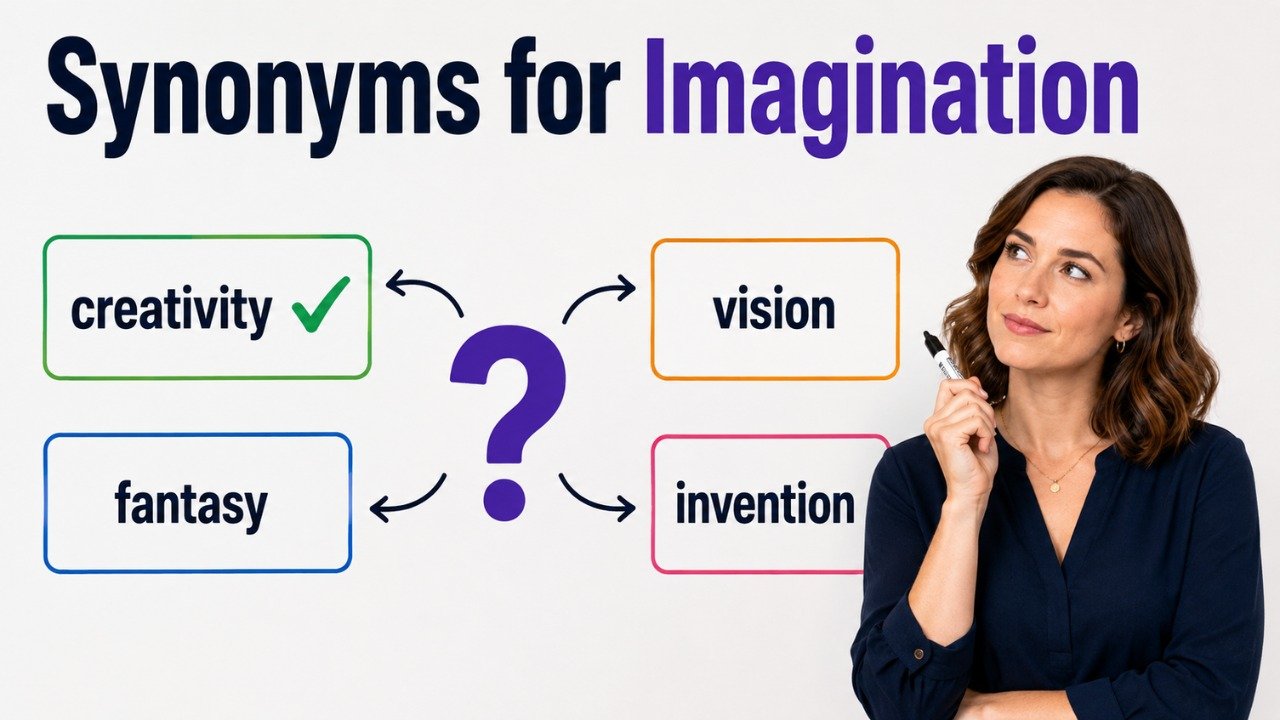
Quick Answer: The best synonyms for imagination include creativity, fantasy, vision, inventiveness, originality, inspiration, conception, visualization, ingenuity, and resourcefulness. Use creativity for producing original ideas, fantasy for imagined worlds or unreal situations, vision for seeing future possibilities, inventiveness for creating clever new ideas, inspiration for ideas that motivate creation, visualization for forming mental pictures, and ingenuity for solving problems in original ways. The best choice depends on whether imagination refers to creativity, mental imagery, possibility, invention, fantasy, or innovative thought.
Pronunciation and Word Details
Word: Imagination
Pronunciation: /ɪˌmædʒɪˈneɪʃən/
Part of Speech: Noun
Meaning: Imagination is the ability to form new ideas, mental pictures, possibilities, or creative thoughts that are not directly present to the senses.
US Pronunciation:
UK Pronunciation:
What Does “Imagination” Mean?
Imagination means the ability to create ideas, pictures, situations, or possibilities in the mind.
It is a noun that can describe creative thinking, mental visualization, invention, fantasy, and the ability to consider things that do not yet exist.
Example: Her imagination helped her create an original story.
Imagination may refer to forming mental images.
Example: He could see the entire scene clearly in his imagination.
It can also describe the ability to think creatively.
Example: Solving the problem required imagination and patience.
In another context, imagination may refer to fantasy or unreal thoughts.
Example: The frightening sound was only a product of his imagination.
The word therefore has several related meanings. A suitable synonym depends on whether the sentence emphasizes creativity, mental imagery, invention, fantasy, originality, or future possibilities.
Meaning, Tone, and Context of “Imagination”
Imagination is generally a positive and neutral word, although its tone can change depending on context.
Creative Context: Imagination refers to the ability to generate original ideas.
Example: Great storytelling depends on imagination.
Artistic Context: Writers, painters, musicians, designers, and other creators often use imagination to develop original work.
Example: The artist combined observation with imagination.
Academic Context: Imagination may describe creative thinking, mental representation, or the ability to explore hypothetical possibilities.
Example: The exercise encouraged imagination and critical thinking.
Conversational Context: Imagination can refer casually to ideas or thoughts that are not based on reality.
Example: You are letting your imagination run wild.
Professional Context: Imagination can describe innovative thinking, planning, and problem solving.
Example: The project needed both technical knowledge and imagination.
Emotional Context: Imagination can shape hopes, fears, expectations, and dreams.
The word is usually positive when connected with creativity and innovation. It can sound less positive when it refers to unrealistic fears, invented problems, or ideas without evidence.
When and How to Use “Imagination”
For Creativity: Use imagination when referring to the ability to produce original ideas.
Example: The assignment encouraged students to use their imagination.
For Mental Pictures: Use imagination when someone forms images or scenes in the mind.
Example: She pictured the distant landscape in her imagination.
For Storytelling: Imagination works naturally when describing fictional ideas, characters, or worlds.
Example: The novel reveals the writer’s remarkable imagination.
For Problem Solving: Use imagination when a challenge requires an original approach.
Example: The team used imagination to find a practical solution.
For Future Possibilities: Imagination can describe the ability to picture what might happen or exist later.
Example: It takes imagination to envision a different future.
For Fantasy: Use imagination when thoughts are unreal, invented, or fanciful.
Example: The strange creature existed only in his imagination.
For Innovation: Imagination can describe inventive thinking that leads to new methods or ideas.
Example: Progress often begins with imagination.
Best Synonyms for Imagination
Creativity
Synonym: Creativity means the ability to produce original and valuable ideas.
Example: Her creativity transformed a simple concept into something memorable.
Fantasy
Synonym: Fantasy means an imagined situation, world, or idea that may not exist in reality.
Example: The story combines history with fantasy.
Vision
Synonym: Vision means the ability to imagine future possibilities or goals.
Example: His vision helped the team understand what the project could become.
Inventiveness
Synonym: Inventiveness means the ability to create new and clever ideas.
Example: Her inventiveness led to an unusual solution.
Originality
Synonym: Originality means the quality of being fresh, distinctive, and unlike existing ideas.
Example: The design impressed everyone with its originality.
Inspiration
Synonym: Inspiration means an idea or influence that encourages creative thought or action.
Example: Nature became a source of inspiration for her writing.
Conception
Synonym: Conception means the formation of an idea or mental understanding.
Example: The project began with a simple conception.
Visualization
Synonym: Visualization means forming a clear mental image of something.
Example: Visualization helped her imagine the finished room.
Ingenuity
Synonym: Ingenuity means cleverness and originality in creating or solving something.
Example: The solution showed impressive ingenuity.
Resourcefulness
Synonym: Resourcefulness means the ability to find clever ways to overcome difficulties.
Example: Their resourcefulness helped them solve the problem with limited materials.
50 Synonyms for Imagination with Short Meanings
- Creativity: Ability to produce original ideas.
- Fantasy: Imagined ideas or unreal situations.
- Vision: Ability to imagine future possibilities.
- Inventiveness: Skill in creating new ideas.
- Originality: Quality of being fresh and distinctive.
- Inspiration: Creative influence or motivating idea.
- Conception: Formation of an idea in the mind.
- Visualization: Creation of mental images.
- Ingenuity: Cleverness in creating or solving.
- Resourcefulness: Ability to find inventive solutions.
- Fancy: Playful or imaginative thought.
- Creativeness: Ability to think or produce creatively.
- Innovation: Introduction of new ideas or methods.
- Invention: Creation of something new.
- Idea: A thought or concept formed in the mind.
- Thought: A mental idea or consideration.
- Concept: A general idea or mental representation.
- Notion: An idea, belief, or impression.
- Dream: An imagined hope, idea, or possibility.
- Reverie: Pleasant imaginative daydreaming.
- Daydream: A pleasant series of imagined thoughts.
- Envisioning: The act of imagining something clearly.
- Imagery: Mental pictures or descriptive images.
- Foresight: Ability to imagine or anticipate future needs.
- Insight: Deep understanding that can support creative thought.
- Intuition: Immediate understanding without deliberate reasoning.
- Perception: Mental awareness or interpretation.
- Ideation: Process of developing new ideas.
- Brainstorming: Generating many possible ideas.
- Conceptualization: Forming a clear idea or concept.
- Improvisation: Creating or responding without advance planning.
- Cleverness: Ability to think quickly and effectively.
- Wit: Quick and inventive mental ability.
- Genius: Exceptional creative or intellectual ability.
- Flair: Natural talent or imaginative style.
- Artistry: Creative skill and expressive ability.
- Expression: Communication of ideas or feelings.
- Creation: Something produced through creative thought.
- Possibility: Something that can be imagined or considered.
- Speculation: Thinking about possible situations or outcomes.
- Projection: Mental representation of a possible future.
- Expectation: Mental idea of what may happen.
- Anticipation: Thinking ahead to a future event.
- Illusion: A misleading or imagined perception.
- Delusion: A firmly held false belief or imagined idea.
- Fancifulness: Tendency toward imaginative or unrealistic ideas.
- Romanticism: Idealized or imaginative way of viewing something.
- Impression: Mental idea or feeling about something.
- Mentality: Characteristic way of thinking.
- Mind’s Eye: Ability to picture something mentally.
Read Also:
Synonyms for Catastrophe
Synonyms for Imagination by Context
When Imagination Means Creativity
Creativity, inventiveness, originality, ingenuity, innovation, artistry, flair, and creativeness work well when imagination refers to producing something new.
Example: Her creativity helped her develop an unusual design.
Example: The solution demonstrated remarkable ingenuity.
Example: His originality made the story stand out.
Creativity is the broadest choice. Ingenuity often emphasizes clever problem solving, while originality emphasizes uniqueness.
When Imagination Means Mental Imagery
Visualization, imagery, envisioning, mind’s eye, conception, and conceptualization are useful when imagination refers to forming pictures or ideas mentally.
Example: Visualization helped him picture the final result.
Example: She saw the entire scene in her mind’s eye.
Example: The architect’s conception gradually became more detailed.
Visualization focuses on deliberately forming mental pictures, while imagery can refer to the pictures themselves.
When Imagination Means Fantasy
Fantasy, fancy, reverie, daydream, dream, fancifulness, and romanticism fit contexts involving invented or idealized ideas.
Example: The child became absorbed in a fantasy world.
Example: She drifted into a pleasant reverie.
Example: His dream was to build a peaceful life near the sea.
Fantasy may refer to unreal ideas or fictional worlds. Reverie and daydream usually describe pleasant wandering thoughts.
When Imagination Means Future Vision
Vision, foresight, anticipation, projection, expectation, and possibility work when imagination refers to thinking about what might happen.
Example: Her vision shaped the long term plan.
Example: Foresight helped the team prepare for future challenges.
Example: They considered every possibility before making a decision.
Vision often sounds ambitious and positive, while foresight emphasizes practical awareness of future needs.
When Imagination Means Idea Formation
Idea, concept, notion, ideation, conceptualization, conception, thought, and brainstorming fit situations involving the creation or development of ideas.
Example: The idea began as a simple sketch.
Example: Brainstorming produced several useful possibilities.
Example: The concept eventually developed into a complete plan.
Ideation is especially useful in professional and creative contexts, while notion is more general and informal.
When Imagination Means Inventive Problem Solving
Ingenuity, resourcefulness, cleverness, improvisation, inventiveness, and wit are strong choices when imagination helps solve problems.
Example: Their resourcefulness kept the project moving.
Example: Quick improvisation solved the unexpected problem.
Example: The invention required considerable ingenuity.
These words emphasize practical creativity rather than fantasy.
Another Word for Imagination
Another word for imagination is creativity when the meaning involves producing original ideas. However, the best replacement depends on the sentence.
Use fantasy for unreal imagined situations, vision for future possibilities, visualization for mental pictures, ingenuity for clever problem solving, and originality for distinctive creative thinking.
Original: Her imagination helped her write unusual stories.
Better Option: Her creativity helped her write unusual stories.
Original: He could see the room clearly in his imagination.
Better Option: He could see the room clearly through visualization.
Original: The project required imagination to overcome limited resources.
Better Option: The project required ingenuity to overcome limited resources.
Original: She used her imagination to picture a better future.
Better Option: She used her vision to picture a better future.
When Not to Use “Imagination”
Imagination is broad, so it may sound vague when a more precise word better explains the type of thinking involved.
Weak: The engineer used imagination to fix the problem.
Better: The engineer used ingenuity to fix the problem.
The second sentence emphasizes clever problem solving.
Avoid using imagination when the meaning is specifically about planning a future direction.
Weak: The leader’s imagination guided the organization.
Better: The leader’s vision guided the organization.
Do not use imagination when visualization is clearly the intended meaning.
Weak: She practiced imagination before the performance.
Better: She practiced visualization before the performance.
Imagination can also sound overly positive if the idea is false or unrealistic.
Weak: His fears came from his creativity.
Better: His fears came from his imagination.
Avoid repeating imagination too often when different meanings are involved.
Weak: Her imagination produced imaginative ideas through imagination.
Better: Her creativity produced original ideas through vivid visualization.
Words Commonly Confused With Imagination
Imagination vs Creativity: Imagination is the ability to form ideas or mental pictures, while creativity is the ability to turn original ideas into meaningful expression or solutions.
Imagination vs Fantasy: Imagination can be realistic or unrealistic, while fantasy usually involves invented or impossible situations.
Imagination vs Vision: Imagination is broad, while vision often refers to seeing future possibilities or goals.
Imagination vs Inspiration: Imagination creates or develops ideas, while inspiration is something that stimulates those ideas.
Imagination vs Ingenuity: Imagination includes broad mental creativity, while ingenuity emphasizes clever practical solutions.
Imagination vs Originality: Imagination is an ability, while originality describes how unique or fresh an idea is.
Imagination vs Visualization: Imagination may involve ideas, possibilities, or stories, while visualization specifically involves creating mental pictures.
Imagination vs Innovation: Imagination creates possibilities mentally, while innovation usually refers to applying new ideas in practice.
Which Synonym Should You Choose?
Choose creativity when discussing original ideas, artistic work, writing, design, or expression.
Choose fantasy when describing fictional, unreal, or impossible situations.
Choose vision when referring to future goals, possibilities, leadership, or planning.
Choose inventiveness when someone consistently creates clever new ideas.
Choose originality when the emphasis is on uniqueness.
Choose inspiration when an idea or influence sparks creative action.
Choose visualization when someone deliberately creates a mental picture.
Choose ingenuity when creativity is used to solve a practical problem.
Choose resourcefulness when someone finds effective solutions with limited resources.
Choose conception when discussing the formation of a new idea.
Choose ideation in professional settings involving the generation and development of ideas.
Choose reverie in literary writing for pleasant imaginative thought.
For essays and reports, creativity, innovation, conception, visualization, and ingenuity often provide greater precision.
For casual conversation, imagination, idea, dream, fantasy, and creativity usually sound natural.
Real Life Examples of “Imagination” in Sentences
Original: Her imagination helped her create a beautiful story.
Better Option: Her creativity helped her create a beautiful story.
Original: The inventor relied on imagination to solve the mechanical problem.
Better Option: The inventor relied on ingenuity to solve the mechanical problem.
Original: The children used their imagination during the game.
Better Option: The children used their creativity during the game.
Original: His imagination allowed him to picture the completed building.
Better Option: His visualization allowed him to picture the completed building.
Original: The leader’s imagination shaped the future plan.
Better Option: The leader’s vision shaped the future plan.
Original: The unusual design revealed her imagination.
Better Option: The unusual design revealed her originality.
Original: The story came entirely from his imagination.
Better Option: The story came entirely from his fantasy.
Original: The team needed imagination to work with limited materials.
Better Option: The team needed resourcefulness to work with limited materials.
Original: Her imagination produced several new approaches.
Better Option: Her inventiveness produced several new approaches.
Original: The idea first appeared in his imagination.
Better Option: The idea first appeared as a conception in his mind.
Synonym Groups and Usage Differences
Creativity Group
Creativity, originality, inventiveness, artistry, flair, and creativeness describe the ability to generate original ideas or expressions.
Example: Her creativity made the project distinctive.
Creativity is broad, originality emphasizes uniqueness, and artistry emphasizes creative skill.
Fantasy Group
Fantasy, fancy, reverie, daydream, dream, and fancifulness describe imagined experiences that may be removed from reality.
Example: He escaped into a pleasant daydream.
Fantasy is broad, while reverie often suggests peaceful and reflective thought.
Vision Group
Vision, foresight, anticipation, projection, expectation, and possibility relate to thinking about the future.
Example: Her vision helped shape the new plan.
Vision is often aspirational, while foresight is more practical.
Mental Image Group
Visualization, imagery, envisioning, mind’s eye, and conception relate to forming pictures or structures in the mind.
Example: Through visualization, she pictured herself completing the task successfully.
Visualization describes the process, while imagery refers to the mental pictures produced.
Innovation Group
Innovation, invention, ingenuity, resourcefulness, improvisation, and cleverness relate to producing useful new ideas or solutions.
Example: The team’s ingenuity solved the technical challenge.
Innovation often refers to applying new ideas, while ingenuity emphasizes clever thinking.
Idea Formation Group
Idea, notion, concept, ideation, conceptualization, thought, and conception describe mental development of ideas.
Example: The concept began as a rough idea.
These words are useful when imagination refers to the formation rather than the artistic expression of thought.
Antonyms of Imagination
The opposite of imagination depends on whether the word refers to creativity, mental imagery, innovation, or fantasy.
Reality: Things as they actually exist.
Fact: Information known to be true.
Literalness: Focus on direct and exact meaning.
Practicality: Concern with realistic and useful action.
Conformity: Following established ideas or patterns.
Imitation: Copying rather than creating something original.
Unoriginality: Lack of fresh or distinctive ideas.
Dullness: Lack of interest, creativity, or excitement.
Rigidity: Inability or unwillingness to think flexibly.
Conventionality: Reliance on familiar or traditional ideas.
Routine: Regular action without much creative variation.
Realism: Focus on what is realistic or actual.
Certainty: Confidence based on known facts rather than possibilities.
Literal Thinking: Thinking based mainly on direct meanings and facts.
Lack of Creativity: Absence of original or inventive thought.
Comparison: Imagination vs Related Words
Imagination vs Creativity
Imagination is the ability to form ideas or pictures mentally. Creativity usually involves producing something original from those ideas.
Example With Imagination: His imagination allowed him to picture an unusual world.
Example With Creativity: His creativity helped him turn that world into a compelling story.
Imagination vs Fantasy
Imagination can include realistic possibilities, while fantasy often involves unreal or impossible situations.
Example With Imagination: Her imagination helped her picture a redesigned garden.
Example With Fantasy: The novel is filled with magical creatures and fantasy.
Imagination vs Vision
Imagination is broad, while vision often focuses on future direction or possibility.
Example With Imagination: His imagination generated many possible solutions.
Example With Vision: His vision gave the team a clear sense of direction.
Imagination vs Inspiration
Imagination is a mental ability. Inspiration is the influence or idea that stimulates creativity.
Example With Imagination: Her imagination transformed the idea into a story.
Example With Inspiration: The landscape provided inspiration for the story.
Imagination vs Ingenuity
Imagination can involve any kind of mental creation. Ingenuity specifically emphasizes clever and useful problem solving.
Example With Imagination: The children used imagination to invent a game.
Example With Ingenuity: The engineer used ingenuity to repair the device.
Imagination vs Visualization
Imagination includes ideas, possibilities, stories, and mental images. Visualization specifically involves forming a clear picture in the mind.
Example With Imagination: She used imagination to develop the fictional character.
Example With Visualization: She used visualization to picture the character’s appearance.
Imagination vs Originality
Imagination is the ability to create mentally. Originality is the quality of being unusual, fresh, or distinctive.
Example With Imagination: His imagination produced several possibilities.
Example With Originality: The final idea stood out because of its originality.
Common Phrases and Expressions With “Imagination”
Use Your Imagination: Think creatively or inventively.
Example: Use your imagination to create a different ending to the story.
Vivid Imagination: A strong ability to form detailed mental pictures.
Example: She has a vivid imagination and describes scenes beautifully.
Wild Imagination: A tendency to imagine unusual or unlikely possibilities.
Example: His wild imagination produced extraordinary stories.
Active Imagination: A strong and frequently used imaginative ability.
Example: Children often have an active imagination.
Creative Imagination: The ability to develop original ideas.
Example: The exercise encouraged creative imagination.
Product of the Imagination: Something created mentally rather than based on reality.
Example: The mysterious creature was a product of his imagination.
Beyond Imagination: More remarkable than someone can easily imagine.
Example: The landscape was beautiful beyond imagination.
Capture the Imagination: Strongly attract someone’s interest or creative thought.
Example: The unusual story captured the imagination of young readers.
Fire the Imagination: Stimulate creative thinking or excitement.
Example: The discovery fired the imagination of the students.
Stretch the Imagination: Encourage thinking beyond familiar limits.
Example: The exercise was designed to stretch the imagination.
Common Mistakes to Avoid
Using Imagination and Creativity as Exact Synonyms: They overlap, but they are not identical. Imagination forms possibilities mentally, while creativity often turns those possibilities into original ideas or work.
Weak: The machine was repaired through artistic imagination.
Better: The machine was repaired through technical ingenuity.
Using Fantasy for Every Type of Imagination: Fantasy usually implies unreal or fictional ideas.
Incorrect: The architect used fantasy to calculate the building dimensions.
Better: The architect used visualization to picture the completed building.
Confusing Vision With Imagination: Vision often emphasizes future goals or direction.
Weak: Her imagination for the organization guided its long term strategy.
Better: Her vision for the organization guided its long term strategy.
Using Inspiration When Ability Is Meant: Inspiration is usually a source or stimulus for creativity rather than the ability itself.
Weak: His inspiration allowed him to invent solutions quickly.
Better: His inventiveness allowed him to create solutions quickly.
Overusing Imagination: Repetition can make writing sound vague.
Weak: Her imagination created imaginative ideas because she had a strong imagination.
Better: Her creativity produced original ideas because she could visualize possibilities clearly.
Using Vague Language: Choose a precise synonym when the type of imagination matters.
Vague: The team showed imagination.
Clearer: The team showed ingenuity by developing a practical solution from limited resources.
Conclusion
The most useful synonyms for imagination depend on the kind of thinking being described. Creativity and originality work well for producing new ideas, while fantasy and reverie suit imagined or unreal experiences. Vision and foresight are stronger for future possibilities, visualization describes mental pictures, and ingenuity or resourcefulness fits practical problem solving. Choosing the right alternative helps distinguish between artistic creativity, mental imagery, invention, fantasy, planning, and innovative thought while making writing clearer and more precise.
FAQs About Synonyms for Imagination
What Is the Best Synonym for Imagination?
Creativity is one of the best general synonyms when imagination refers to producing original ideas. Fantasy, vision, ingenuity, and visualization may be better in other contexts.
What Is Another Word for Creative Imagination?
Creativity, inventiveness, originality, ingenuity, artistry, and creative thinking are useful alternatives.
What Is a Formal Synonym for Imagination?
Conception, visualization, conceptualization, ideation, ingenuity, and creative thinking can work well in formal or academic contexts.
What Is a Synonym for a Vivid Imagination?
Fantasy, imagery, visualization, mind’s eye, and creative vision can describe the ability to form strong mental pictures.
Are Imagination and Creativity the Same?
Not exactly. Imagination is the ability to form ideas and possibilities mentally, while creativity usually involves developing or expressing those ideas in original ways.
What Is a Synonym for Imagination in Problem Solving?
Ingenuity, resourcefulness, inventiveness, innovation, cleverness, and improvisation are strong choices.
What Is the Opposite of Imagination?
Possible opposites include reality, literalness, conformity, unoriginality, rigidity, conventionality, and lack of creativity, depending on the context.
