
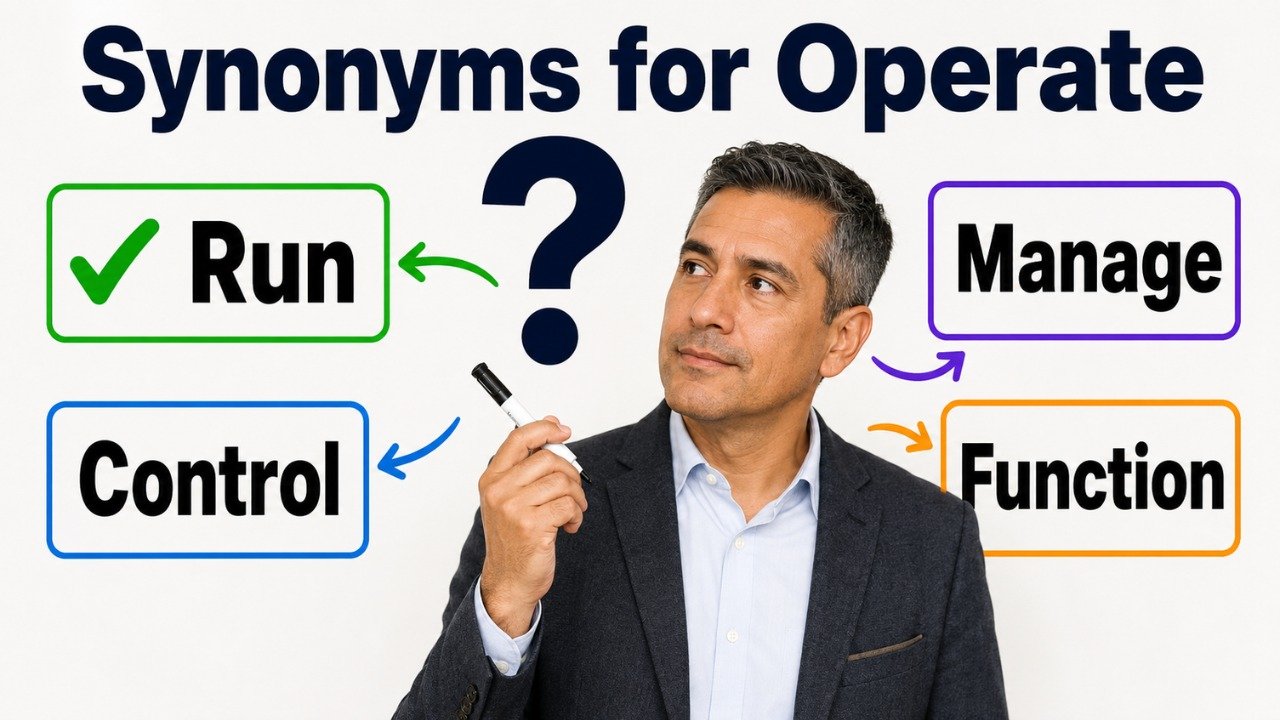
Quick Answer: Synonyms for operate include run, manage, function, control, use, handle, perform, conduct, administer, and work. The best choice depends on context. Use run for managing a business or system, function when something works correctly, control for directing equipment, handle for using machinery, perform for carrying out a task or procedure, and conduct when organizing an activity or operation.
Pronunciation and Word Details
Word: Operate
Pronunciation: /ˈɑːpəreɪt/
Part of Speech: Verb
Meaning: To control, manage, use, function, or perform an activity, process, machine, business, or medical procedure.
US Pronunciation:
UK Pronunciation:
What Does “Operate” Mean?
Operate means to control, use, manage, run, or make something function.
As a verb, operate can describe several different actions. A person may operate a machine, operate a business, operate a system, or operate on a patient.
When a machine operates, it functions or works. When a manager operates a company, the meaning is closer to runs or manages. When a surgeon operates, the word refers to performing surgery.
Because operate has several meanings, the best synonym depends on what is being controlled, managed, performed, or made to function.
Meaning, Tone, and Context of “Operate”
Operate is generally neutral and somewhat formal.
It appears frequently in professional, technical, medical, business, industrial, scientific, and instructional writing.
In everyday conversation, simpler alternatives such as run, use, work, manage, or control may sound more natural.
In technical writing, operate often refers to controlling equipment, machinery, systems, or devices.
In business writing, operate can mean run, manage, administer, or conduct.
In medical contexts, operate means to perform surgery.
The word can therefore sound technical, practical, professional, or procedural depending on the sentence.
When and How to Use “Operate”
For Machines: Use operate when someone controls or uses machinery or equipment.
Example: Only trained employees may operate the equipment.
For Businesses: Operate can mean to run or manage a company, organization, or service.
Example: They operate several stores across the region.
For Systems: Use operate when a system functions or is controlled.
Example: The new system operates automatically.
For Medical Procedures: Operate can refer to performing surgery on a patient.
Example: The surgeon decided to operate immediately.
For Services: Use operate when a service, route, facility, or organization functions regularly.
Example: The transport service operates throughout the week.
For Processes: Operate can describe how a process works.
Example: The mechanism operates through a simple pressure system.
Best Synonyms for Operate
Run: To manage, control, or keep something functioning.
Example: She runs a successful consulting business.
Manage: To organize, direct, or control something.
Example: He manages the department efficiently.
Function: To work or perform as intended.
Example: The device functions correctly in cold conditions.
Control: To direct or regulate the operation of something.
Example: The operator controls the machine from a central panel.
Use: To employ something for a particular purpose.
Example: Staff use the equipment during inspections.
Handle: To control or use something skillfully.
Example: Only experienced workers should handle the machinery.
Perform: To carry out a task, action, or procedure.
Example: The surgeon performed the procedure successfully.
Conduct: To organize or carry out an activity.
Example: The team conducted several safety tests.
Administer: To manage or oversee an organization, system, or process.
Example: The department administers the program.
Work: To function or operate properly.
Example: The machine works without difficulty.
50 Synonyms for Operate with Short Meanings
- Run: Manage or keep something functioning.
- Manage: Organize and control an activity or organization.
- Function: Work in the intended way.
- Control: Direct or regulate a machine or process.
- Use: Employ something for a purpose.
- Handle: Operate or control something skillfully.
- Perform: Carry out a task or procedure.
- Conduct: Organize or carry out an activity.
- Administer: Manage or supervise a system or organization.
- Work: Function or perform correctly.
- Execute: Carry out a plan, command, or operation.
- Carry Out: Complete or perform an action.
- Direct: Control or guide an activity.
- Supervise: Oversee work or operations.
- Oversee: Watch and manage an activity.
- Command: Exercise control or authority over something.
- Regulate: Control according to rules or conditions.
- Activate: Cause a system or device to start working.
- Start: Cause something to begin functioning.
- Engage: Put a mechanism or process into operation.
- Drive: Control or power a vehicle or machine.
- Steer: Guide the direction of a vehicle or process.
- Pilot: Control or guide a vehicle or operation.
- Manipulate: Control something with skill or precision.
- Employ: Use something for a particular purpose.
- Utilize: Make practical use of something.
- Apply: Put a method, system, or tool into use.
- Implement: Put a plan, process, or system into action.
- Maintain: Keep something functioning properly.
- Process: Carry out a sequence of operations.
- Execute Functions: Perform required operations or tasks.
- Perform Functions: Carry out assigned purposes or activities.
- Run Systems: Keep systems active and functional.
- Administer Operations: Manage ongoing organizational activities.
- Coordinate: Organize different parts of an operation.
- Direct Operations: Control activities or processes.
- Manage Operations: Organize and supervise ongoing work.
- Control Equipment: Direct how machinery or devices work.
- Use Machinery: Employ mechanical equipment.
- Work Machinery: Control machinery during use.
- Perform Surgery: Carry out a surgical procedure.
- Carry Out Surgery: Perform a medical operation.
- Practice: Work professionally in a particular activity.
- Serve: Function or work in a particular role.
- Act: Function or behave in a particular way.
- Proceed: Continue functioning or carrying out an activity.
- Move: Function through mechanical motion.
- Power: Supply energy that allows something to operate.
- Control a System: Direct the functions of a system.
- Keep Running: Maintain continued operation.
Read Also:
Synonyms for Visit

Synonyms for Operate by Context
When Operate Means Run a Business
Useful alternatives include run, manage, administer, direct, oversee, supervise, and conduct.
Example: She operates a small publishing company.
Alternative: She runs a small publishing company.
Run is one of the most natural alternatives when talking about businesses, organizations, services, shops, or departments.
When Operate Means Use a Machine
Useful alternatives include control, handle, use, manipulate, drive, pilot, and work.
Example: He operates heavy machinery at the construction site.
Alternative: He handles heavy machinery at the construction site.
Handle works well when skill is required, while control emphasizes directing the machine.
When Operate Means Function
Useful alternatives include function, work, run, perform, serve, and act.
Example: The device operates without electricity.
Alternative: The device functions without electricity.
Function is especially useful in technical or formal writing.
When Operate Means Perform a Procedure
Useful alternatives include perform, conduct, execute, carry out, and implement.
Example: The team operated the testing process carefully.
Alternative: The team conducted the testing process carefully.
Conduct is useful for tests, studies, inspections, and organized procedures.
When Operate Means Perform Surgery
Useful alternatives include perform surgery, carry out surgery, perform a procedure, and treat surgically.
Example: The surgeon operated on the patient that evening.
Alternative: The surgeon performed surgery on the patient that evening.
In medical writing, perform surgery is often more direct when clarity matters.
Another Word for Operate
Another word for operate is run, especially when referring to a business, service, system, or organization.
However, the best replacement depends on context. Use function when a machine works, control when directing equipment, manage for administration, and perform when carrying out a task or medical procedure.
Original: She operates the family business.
Better Option: She runs the family business.
Original: The machine operates automatically.
Better Option: The machine functions automatically.
Original: He operates the control panel.
Better Option: He controls the control panel.
Original: The surgeon will operate tomorrow.
Better Option: The surgeon will perform surgery tomorrow.
When Not to Use “Operate”
Operate can sound unnecessarily formal in simple everyday situations.
Weak: Can you operate this television remote?
Better: Can you use this television remote?
When talking about a business, run often sounds more natural.
Weak: She operates a small bakery with her sister.
Better: She runs a small bakery with her sister.
Do not use function when you mean actively controlling something.
Weak: He functions the machine every morning.
Better: He operates the machine every morning.
Avoid use when technical skill or control is the central idea.
Weak: She uses the aircraft during training.
Better: She pilots the aircraft during training.
In medical writing, operate should clearly identify whether a surgeon is performing surgery or whether equipment is functioning.
Weak: The medical team operated successfully.
Better: The surgical team performed the procedure successfully.
Words Commonly Confused With Operate
Operate vs Run: Run is broader and more conversational. It can mean manage a business or keep a system functioning.
Operate vs Function: Operate can describe both active control and automatic working. Function usually means to work as intended.
Operate vs Manage: Manage focuses on organizing people, resources, or activities. Operate can also refer to machinery and systems.
Operate vs Control: Control emphasizes directing or regulating something, while operate includes the broader act of using or running it.
Operate vs Use: Use is general. Operate often suggests controlling a machine, system, or process.
Operate vs Perform: Perform means carry out an action or procedure. Operate is more closely associated with machinery, organizations, systems, and surgery.
Operate vs Administer: Administer refers mainly to managing systems, programs, organizations, or services rather than machinery.
Which Synonym Should You Choose?
Choose run when talking about businesses, organizations, services, software, or systems.
Choose manage for departments, teams, resources, organizations, and ongoing responsibilities.
Choose function when describing how a machine, system, or device works.
Choose control when someone actively directs machinery, equipment, or a process.
Choose handle when using something requires skill or care.
Choose perform when referring to a task, procedure, operation, or surgery.
Choose conduct for research, tests, inspections, investigations, and organized activities.
Choose administer in formal writing about programs, services, systems, or organizations.
Choose execute for commands, instructions, procedures, and planned operations.
Choose use when the sentence simply means employing a tool or object.
Real Life Examples of “Operate” in Sentences
Original: She operates a small design company.
Better Option: She runs a small design company.
Original: The machine operates quietly.
Better Option: The machine functions quietly.
Original: He knows how to operate the equipment.
Better Option: He knows how to handle the equipment.
Original: The system operates automatically.
Better Option: The system works automatically.
Original: They operate several regional offices.
Better Option: They manage several regional offices.
Original: The technician operates the control system.
Better Option: The technician controls the system.
Original: The team operates the testing program.
Better Option: The team administers the testing program.
Original: The researchers operated several trials.
Better Option: The researchers conducted several trials.
Original: The surgeon operated on the patient.
Better Option: The surgeon performed surgery on the patient.
Original: The service operates throughout the night.
Better Option: The service runs throughout the night.
Synonym Groups and Usage Differences
Business Management Group
Run, manage, administer, direct, supervise, oversee, and coordinate are useful when operate refers to controlling an organization or activity.
Example: She manages the regional office.
Machine Control Group
Control, handle, use, manipulate, drive, steer, and pilot describe active control of equipment or machinery.
Example: Only trained workers may control the equipment.
Functioning Group
Function, work, run, serve, act, and perform describe how something works.
Example: The system functions correctly under pressure.
Procedure Group
Perform, conduct, execute, carry out, implement, and process describe performing planned actions.
Example: The laboratory conducted the test carefully.
Medical Group
Perform surgery, carry out surgery, perform a procedure, and treat surgically describe the medical meaning of operate.
Example: The surgeon performed the procedure successfully.
Antonyms of Operate
The opposite of operate depends on the meaning being used.
Stop: Cease functioning or activity.
Halt: Bring an operation to an end.
Shut Down: Stop a system, machine, or organization from operating.
Deactivate: Make a device or system inactive.
Disable: Prevent something from functioning.
Disconnect: Separate something from its power or operating system.
Close: Stop a business or service from functioning.
Cease: Bring an activity or process to an end.
Fail: Stop functioning correctly.
Malfunction: Operate incorrectly or unsuccessfully.
Idle: Remain inactive rather than operating.
Suspend: Temporarily stop an activity or operation.
Comparison: Operate vs Related Words
Operate vs Run
Operate is slightly more formal and technical. Run sounds more natural for businesses, services, machines, and systems.
Example With Operate: The company operates five regional centers.
Example With Run: The company runs five regional centers.
Operate vs Function
Operate may involve active control, while function usually means to work correctly.
Example With Operate: She operates the machine.
Example With Function: The machine functions normally.
Operate vs Manage
Operate can describe systems, machinery, businesses, or services. Manage focuses more on organizing people, resources, and activities.
Example With Operate: They operate several stores.
Example With Manage: She manages the largest store.
Operate vs Control
Operate means use or make something work. Control places stronger emphasis on directing its actions.
Example With Operate: He operates the crane.
Example With Control: He controls the crane from the cabin.
Operate vs Use
Use is a general word for employing something. Operate often suggests a device, machine, or system with controls.
Example With Operate: Only trained staff may operate the equipment.
Example With Use: Staff use the equipment for daily inspections.
Operate vs Perform
Operate has several meanings, including running machinery and performing surgery. Perform mainly means carrying out an action, task, or procedure.
Example With Operate: The doctor will operate tomorrow.
Example With Perform: The doctor will perform the procedure tomorrow.
Common Phrases and Expressions With “Operate”
Operate a Business: Run or manage a commercial activity.
Example: They operate a family business in the city.
Operate Machinery: Control or use mechanical equipment.
Example: Workers must receive training before they operate machinery.
Operate a System: Control or run a technical system.
Example: The technician knows how to operate the system.
Operate Normally: Function in the expected way.
Example: The device should operate normally after the repair.
Operate Efficiently: Function with minimal waste or difficulty.
Example: The updated process allows the facility to operate efficiently.
Operate Independently: Function without outside assistance.
Example: Each unit can operate independently.
Operate Safely: Use or control something without unnecessary risk.
Example: Employees are trained to operate the equipment safely.
Operate on a Patient: Perform surgery on a person.
Example: The surgical team prepared to operate on the patient.
Operate Under Pressure: Continue functioning effectively in difficult conditions.
Example: The system can operate under pressure.
Operate Within Limits: Function according to defined restrictions.
Example: The machine must operate within safe temperature limits.
Common Mistakes to Avoid
One common mistake is using operate when a simpler word such as use would sound more natural.
Weak: She operated the pen carefully.
Better: She used the pen carefully.
Another mistake is confusing operate with function. A person operates a machine, while the machine functions.
Incorrect: The machine operates the technician.
Correct: The technician operates the machine.
Avoid using manage when the sentence is about mechanical control.
Weak: He manages the forklift.
Better: He operates the forklift.
Do not use run in every formal or technical context. Although run is natural, operate may be more precise when safety, controls, machinery, or technical procedures are involved.
Be careful in medical contexts. Operate on normally refers to surgery performed on a patient, while perform can describe the procedure itself.
Correct: The surgeon operated on the patient.
Correct: The surgeon performed the procedure.
Writers should also avoid repeating operate several times in the same paragraph. Use run, manage, function, control, conduct, administer, or perform when they accurately match the intended meaning.
Conclusion
Synonyms for operate include run, manage, function, control, handle, perform, conduct, administer, and work. Run is a strong choice for businesses and services, while function fits machines and systems. Control and handle work well for equipment, and perform or conduct suits procedures and organized activities. In medical contexts, operate commonly means to perform surgery. Choosing the right synonym based on whether the sentence involves management, machinery, systems, or procedures makes writing clearer and more precise.
FAQs About Synonyms for Operate
What Is the Best Synonym for Operate?
Run is one of the best general alternatives when operate refers to a business, service, or system. Function, manage, control, or perform may be better in other contexts.
What Is Another Word for Operate a Business?
Run, manage, administer, direct, oversee, and supervise can replace operate when talking about a business or organization.
What Is Another Word for Operate a Machine?
Control, handle, use, manipulate, drive, or work may fit depending on the type of machinery.
What Is a Formal Synonym for Operate?
Administer, execute, conduct, implement, regulate, and perform are useful formal alternatives depending on context.
What Is the Difference Between Operate and Function?
Operate can describe someone controlling something or something working. Function mainly means to work or perform as intended.
Can Run Replace Operate?
Yes. Run is a natural replacement for operating businesses, services, machines, systems, and programs, although operate may sound more technical.
What Is the Opposite of Operate?
Stop, halt, shut down, deactivate, disable, cease, and malfunction can serve as opposites depending on whether operate means functioning, controlling, or running something.
