
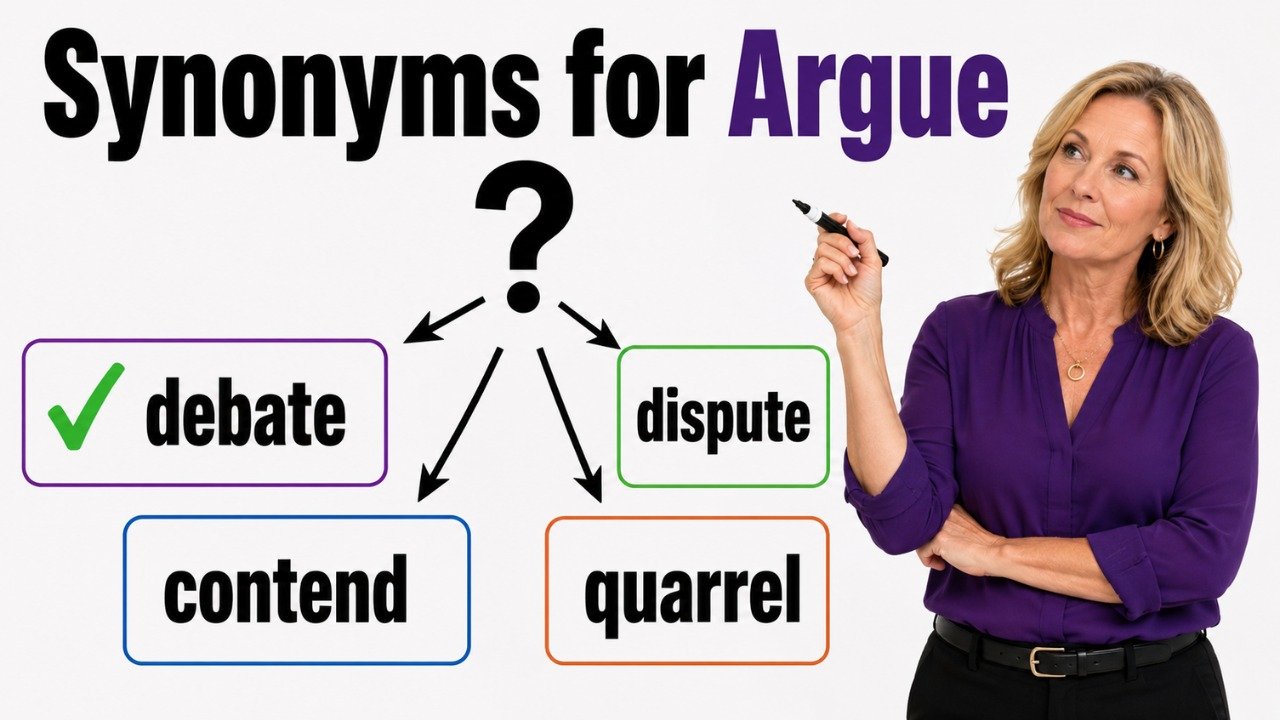
Quick Answer: Common synonyms for argue include debate, dispute, quarrel, contend, claim, assert, reason, disagree, challenge, and maintain. Use debate for a structured exchange of opinions, quarrel for an emotional disagreement, and dispute when people reject each other’s statements. Contend, maintain, and assert work well in formal writing when someone presents a position. Reason is suitable when ideas are supported with logic, while challenge is best when questioning a claim, decision, or belief.
Pronunciation and Word Details
Word: Argue
Pronunciation: /ˈɑːrɡjuː/
Part of Speech: Verb
Meaning: To express disagreement or present reasons supporting or opposing an idea.
US Pronunciation:
UK Pronunciation:
What Does “Argue” Mean?
Argue means to express disagreement or give reasons supporting a particular opinion, conclusion, or action. It is a verb that can describe both emotional conflict and logical discussion.
People argue when they disagree about decisions, beliefs, responsibilities, facts, or personal matters. In this sense, the word may suggest anger, tension, or opposition.
Argue can also mean presenting evidence or reasoning. A writer may argue that a policy should change, while a lawyer may argue a case. In these situations, the word does not necessarily describe a hostile disagreement. It refers to building and defending a position.
Disagreement: They argued about who should complete the task.
Reasoned Position: The researcher argued that the results supported a different conclusion.
Support for an Idea: She argued for improving access to education.
Opposition to an Idea: He argued against reducing the safety requirements.
Meaning, Tone, and Context of “Argue”
Argue can have a neutral, formal, emotional, academic, or conversational tone depending on the context.
In everyday conversation, argue often describes a tense disagreement between people. It may suggest raised voices, frustration, or repeated conflict.
In essays, reports, debates, and professional discussions, argue has a more neutral meaning. It describes presenting a claim and supporting it with facts, examples, evidence, or logical reasoning.
In legal contexts, argue can mean presenting a case before a court or responding to another person’s position.
Casual Context: The brothers argued over the television.
Emotional Context: The couple argued about their finances.
Academic Context: The essay argues that early education improves long term outcomes.
Formal Context: The committee member argued for stricter standards.
Legal Context: The lawyer argued that the evidence was incomplete.
When and How to Use “Argue”
For Personal Disagreement
Use argue when two or more people express opposing opinions, especially when the conversation becomes tense.
Example: They argued about how the money should be spent.
For Presenting a Position
Use argue when someone states an opinion and provides reasons to support it.
Example: The author argues that public spaces improve community life.
For Supporting a Proposal
Use argue for when presenting reasons why an idea, plan, or action should be accepted.
Example: Residents argued for building a new health center.
For Opposing a Proposal
Use argue against when explaining why an idea or action should be rejected.
Example: Several experts argued against removing the safety checks.
For Academic Writing
Use argue when stating the central position of an essay, article, or research paper.
Example: This essay argues that regular reading strengthens communication skills.
For Legal Reasoning
Use argue when a lawyer or representative presents reasons supporting a legal position.
Example: The attorney argued that the agreement was unclear.
For Reaching a Conclusion
Use argue when facts or evidence appear to support a particular interpretation.
Example: The falling sales figures argue for a change in strategy.
Best Synonyms for Argue
Debate
Synonym: To discuss opposing opinions in a structured or thoughtful way.
Example: The students debated whether the new rule was necessary.
Dispute
Synonym: To question the truth, accuracy, or validity of something.
Example: The company disputed the customer’s version of events.
Quarrel
Synonym: To have an angry or emotional disagreement.
Example: The neighbors quarreled over the property boundary.
Contend
Synonym: To state firmly that something is true, especially in formal writing.
Example: The researcher contends that the earlier explanation was incomplete.
Assert
Synonym: To express an opinion or claim confidently.
Example: She asserted that every applicant deserved equal consideration.
Claim
Synonym: To state that something is true, sometimes without complete proof.
Example: The witness claimed that he had seen the incident.
Maintain
Synonym: To continue expressing that a belief or statement is correct.
Example: The manager maintained that the decision was necessary.
Reason
Synonym: To think, explain, or discuss something through logical ideas.
Example: He reasoned that delaying the launch would prevent larger problems.
Disagree
Synonym: To have a different opinion from another person.
Example: The two experts disagreed about the meaning of the results.
Challenge
Synonym: To question or oppose a statement, belief, decision, or authority.
Example: The report challenged the assumption that costs would remain stable.
50 Synonyms for Argue with Short Meanings
- Debate: To discuss opposing views in a structured way.
- Dispute: To question or deny the truth of something.
- Quarrel: To have an angry personal disagreement.
- Contend: To state a position firmly and formally.
- Assert: To express a belief confidently.
- Claim: To state that something is true.
- Maintain: To continue defending a particular position.
- Reason: To use logic when explaining an opinion.
- Plead: To present a serious or emotional argument.
- Allege: To claim something without confirmed proof.
- Insist: To state something firmly despite opposition.
- Protest: To express strong disagreement or objection.
- Object: To express opposition to an idea or action.
- Challenge: To question the truth or authority of something.
- Oppose: To act or speak against something.
- Disagree: To hold a different opinion.
- Bicker: To argue repeatedly about small matters.
- Squabble: To have a noisy argument about something minor.
- Wrangle: To argue for a long time about a difficult issue.
- Clash: To experience a strong disagreement.
- Spar: To exchange opposing remarks or arguments.
- Feud: To continue a serious disagreement over time.
- Fight: To engage in an angry verbal conflict.
- Remonstrate: To protest strongly through reasoned speech.
- Expostulate: To express serious disagreement while trying to persuade.
- Counter: To respond with an opposing argument.
- Rebut: To answer a claim with evidence or reasoning.
- Refute: To prove that a statement or argument is incorrect.
- Defend: To support a position against criticism.
- Advocate: To publicly support an idea or action.
- Advance: To present an idea for consideration.
- Propose: To put forward an idea or explanation.
- Posit: To present an idea as the basis of an argument.
- State: To express an opinion or fact clearly.
- Declare: To express a position openly and firmly.
- Affirm: To state positively that something is true.
- Hold: To have and express a particular opinion.
- Suggest: To present an idea for consideration.
- Demonstrate: To show that a conclusion is true through evidence.
- Show: To provide evidence supporting an idea.
- Establish: To prove or confirm something through facts.
- Prove: To demonstrate that a claim is correct.
- Justify: To provide acceptable reasons for something.
- Persuade: To convince someone through reasons or evidence.
- Deliberate: To discuss an issue carefully before deciding.
- Discuss: To exchange ideas about a subject.
- Negotiate: To discuss differences in order to reach an agreement.
- Contest: To challenge a statement, decision, or result.
- Controvert: To deny or oppose a claim through argument.
- Make a Case: To present reasons supporting a position.
Read Also:
Synonyms for Fundamental

Synonyms for Argue by Context
When Argue Means Disagree or Quarrel
Argue often describes a personal disagreement that may involve frustration, anger, or tension. Quarrel, bicker, squabble, clash, and fight are useful alternatives in this context.
Use quarrel for a serious personal disagreement. Use bicker when people repeatedly argue about unimportant matters. Squabble suggests a noisy but relatively minor conflict.
Example With Argue: The children argued over the last piece of cake.
Example With Squabble: The children squabbled over the last piece of cake.
Example With Quarrel: The business partners quarreled about their responsibilities.
When Argue Means Debate
Argue can describe an exchange of opposing ideas without suggesting anger. Debate, discuss, deliberate, reason, and negotiate are more neutral alternatives.
Debate is appropriate when both sides present organized positions. Discuss is softer and does not always involve disagreement. Deliberate emphasizes careful consideration.
Example With Argue: The committee argued about the proposed changes.
Example With Debate: The committee debated the proposed changes.
Example With Deliberate: The committee deliberated before approving the changes.
When Argue Means State a Position
In academic and formal writing, argue often means to present a claim. Contend, assert, maintain, claim, propose, and posit are useful alternatives.
Contend is formal and confident. Assert is strong and direct. Maintain suggests that a person continues defending the same position despite disagreement.
Example With Argue: The author argues that the law requires revision.
Example With Contend: The author contends that the law requires revision.
Example With Maintain: The author maintains that the law requires revision.
When Argue Means Support With Evidence
Argue may refer to using evidence or logic to establish a conclusion. Demonstrate, show, establish, prove, justify, and make a case are suitable alternatives.
Use demonstrate when evidence clearly supports a result. Use justify when explaining why a decision or action was reasonable.
Example With Argue: The results argue that the treatment was effective.
Example With Demonstrate: The results demonstrate that the treatment was effective.
Example With Show: The results show that the treatment was effective.
When Argue Means Oppose
Argue can describe speaking against a decision, position, or proposal. Oppose, object, challenge, protest, dispute, and contest express this meaning.
Object is suitable for formal disagreement. Challenge means questioning an assumption or accepted position. Protest expresses stronger and more public opposition.
Example With Argue: Several members argued against the proposal.
Example With Oppose: Several members opposed the proposal.
Example With Object: Several members objected to the proposal.
Another Word for Argue
Debate is often the best general alternative to argue when people exchange different opinions calmly and thoughtfully. However, the best replacement depends on the intended meaning.
Use quarrel for emotional conflict, contend for a formal claim, dispute for questioning a statement, and demonstrate when evidence supports a conclusion.
Original: The students argued about the new policy.
Better Option: The students debated the new policy.
Original: The two friends argued over a small misunderstanding.
Better Option: The two friends quarreled over a small misunderstanding.
Original: The report argues that the system needs improvement.
Better Option: The report contends that the system needs improvement.
Original: The evidence argues that the original estimate was incorrect.
Better Option: The evidence demonstrates that the original estimate was incorrect.
When Not to Use “Argue”
Avoid using argue when a more precise word can show whether the situation involves emotional conflict, formal reasoning, evidence, or calm discussion.
Argue may sound unnecessarily negative when the conversation is respectful. In such cases, debate or discuss may be more accurate.
It can also sound vague in academic writing when the writer actually means demonstrate, establish, claim, or contend.
Weak: The report argues the results.
Better: The report explains the results.
Weak: The evidence argues that the method is reliable.
Better: The evidence demonstrates that the method is reliable.
Weak: We argued about possible solutions during the meeting.
Better: We discussed possible solutions during the meeting.
Weak: The author argues many facts about the issue.
Better: The author presents several facts about the issue.
Weak: She argued him to accept the offer.
Better: She persuaded him to accept the offer.
Argue is not normally followed directly by a person when the intended meaning is persuade. Use argue with someone for disagreement and persuade someone for successful influence.
Words Commonly Confused With Argue
Argue vs Debate: Argue can describe either emotional conflict or reasoned disagreement. Debate usually suggests an organized and controlled exchange of opposing ideas.
Argue vs Quarrel: Argue is broad and may be neutral. Quarrel almost always suggests personal tension, anger, or emotional conflict.
Argue vs Discuss: Argue involves disagreement or support for a position. Discuss simply means exchanging ideas and does not require opposing opinions.
Argue vs Dispute: Argue describes expressing opposing views. Dispute often means rejecting the truth, accuracy, ownership, or validity of something.
Argue vs Contend: Argue is common in speech and writing. Contend is more formal and usually means stating a firm position.
Argue vs Claim: Argue normally suggests reasons or evidence. Claim may describe a statement that has not yet been proven.
Argue vs Persuade: Argue means presenting reasons or disagreeing. Persuade means successfully convincing someone to believe or do something.
Argue vs Prove: Argue means making a case. Prove means establishing that something is true through sufficient evidence.
Which Synonym Should You Choose?
Choose debate when two sides exchange organized opinions.
Choose quarrel when describing an angry personal disagreement.
Choose bicker when people repeatedly disagree about small or unimportant matters.
Choose dispute when questioning the truth, accuracy, ownership, or validity of something.
Choose contend in formal essays, reports, and academic discussions.
Choose assert when someone states a position strongly and confidently.
Choose maintain when a person continues defending the same view.
Choose claim when reporting a statement that may still require proof.
Choose demonstrate when facts or results clearly support a conclusion.
Choose rebut when responding directly to an opposing argument.
Choose refute when evidence proves that an opposing claim is false.
Choose advocate when actively supporting a policy, cause, proposal, or action.
Choose discuss when the conversation is calm and disagreement is not the main focus.
Choose reason when the speaker uses logic to reach or explain a conclusion.
Choose negotiate when people discuss opposing interests to reach an agreement.
Real Life Examples of “Argue” in Sentences
Original: The siblings argued about who should wash the dishes.
Better Option: The siblings quarrelled about who should wash the dishes.
Original: The candidates argued about the proposed budget.
Better Option: The candidates debated the proposed budget.
Original: The writer argues that the character acted out of fear.
Better Option: The writer contends that the character acted out of fear.
Original: The customer argued that the charge was incorrect.
Better Option: The customer maintained that the charge was incorrect.
Original: The lawyer argued against admitting the document.
Better Option: The lawyer objected to admitting the document.
Original: The report argues that demand is increasing.
Better Option: The report demonstrates that demand is increasing.
Original: The employees argued for more flexible working hours.
Better Option: The employees advocated more flexible working hours.
Original: The witness argued that she had arrived before noon.
Better Option: The witness asserted that she had arrived before noon.
Original: They argued over minor details throughout the meeting.
Better Option: They bickered over minor details throughout the meeting.
Original: The reviewer argued against the author’s conclusion.
Better Option: The reviewer challenged the author’s conclusion.
Synonym Groups and Usage Differences
Disagreement Group
Argue, disagree, clash, quarrel, bicker, squabble, and fight describe opposing opinions. Their emotional strength differs.
Disagree is neutral. Argue may be neutral or emotional. Quarrel and fight suggest stronger conflict. Bicker and squabble usually concern minor issues.
Example: The roommates bickered about cleaning responsibilities.
Debate and Discussion Group
Debate, discuss, deliberate, negotiate, and reason describe exchanging ideas. These words are usually calmer than quarrel or fight.
Debate involves opposing views. Discuss is more general. Deliberate involves careful thought, while negotiate aims to produce an agreement.
Example: The board deliberated before making its final decision.
Formal Claim Group
Contend, assert, maintain, posit, propose, allege, and claim describe presenting a position.
Contend is common in analytical writing. Assert sounds confident. Maintain suggests continued support. Allege is often used for an unproven accusation or statement.
Example: The researcher contends that the previous study used incomplete data.
Evidence Group
Demonstrate, show, establish, prove, justify, rebut, and refute connect arguments with evidence.
Demonstrate and show reveal support for a conclusion. Prove and establish suggest stronger confirmation. Rebut responds to an opposing point, while refute proves it wrong.
Example: The new evidence refuted the earlier explanation.
Support and Opposition Group
Advocate, defend, oppose, object, protest, challenge, and contest describe taking a side.
Advocate and defend support a position. Oppose and object reject it. Challenge and contest question its truth, fairness, or authority.
Example: Local residents opposed the construction plan.
Antonyms of Argue
The opposite of argue depends on whether the word means disagreeing, opposing, or presenting a position.
Agree: To share the same opinion.
Accept: To recognize a statement or decision as satisfactory.
Concede: To admit that another person’s point is correct.
Consent: To give permission or express agreement.
Approve: To support or officially accept something.
Support: To agree with and help strengthen a position.
Confirm: To establish that a statement is correct.
Assent: To express formal agreement.
Reconcile: To restore agreement after a conflict.
Comply: To act according to a request, rule, or decision.
Withdraw: To remove a claim, objection, or argument.
Yield: To stop resisting another position.
Comparison: Argue vs Related Words
Argue vs Debate
Argue is broader and can describe emotional conflict or logical reasoning. Debate normally refers to an organized exchange of opposing ideas.
Example With Argue: The neighbors argued about the noise.
Example With Debate: The council members debated the new noise regulations.
Argue vs Quarrel
Argue may be neutral, formal, or emotional. Quarrel describes a personal disagreement involving tension or anger.
Example With Argue: The researchers argued about the correct interpretation.
Example With Quarrel: The brothers quarrelled over their inheritance.
Argue vs Contend
Argue is common in both conversation and writing. Contend is more formal and usually introduces a position that the speaker believes is correct.
Example With Argue: The article argues that the policy is ineffective.
Example With Contend: The article contends that the policy is ineffective.
Argue vs Claim
Argue suggests that reasons or evidence are being presented. Claim only means stating that something is true.
Example With Argue: The scientist argued that the pattern had a natural cause.
Example With Claim: The scientist claimed that the pattern had a natural cause.
Argue vs Dispute
Argue focuses on expressing opposing opinions. Dispute focuses on denying or questioning a statement, result, fact, or right.
Example With Argue: They argued about the final score.
Example With Dispute: They disputed the accuracy of the final score.
Argue vs Persuade
Argue describes presenting reasons, but it does not mean the listener was convinced. Persuade describes a successful result.
Example With Argue: She argued that he should reconsider the offer.
Example With Persuade: She persuaded him to reconsider the offer.
Common Phrases and Expressions With Argue
Argue a Case: To present reasons supporting a legal or formal position.
Argue a Point: To defend a particular opinion or statement.
Argue For: To give reasons supporting an idea or action.
Argue Against: To give reasons opposing an idea or action.
Argue With Someone: To express disagreement directly with another person.
Argue About Something: To disagree concerning a particular subject.
Argue Over Something: To disagree about ownership, responsibility, or a specific issue.
Argue Convincingly: To present reasons in a believable and effective way.
Argue Both Sides: To examine the supporting and opposing positions.
Argue From Evidence: To form or defend a conclusion using available facts.
Common Mistakes to Avoid
Using Argue for Every Discussion: Not every exchange of ideas is an argument. Use discuss when people calmly share information without taking opposing sides.
Ignoring Emotional Tone: Quarrel, fight, bicker, and squabble communicate more tension than argue. Select them only when the disagreement is personal or emotional.
Choosing an Unproven Claim Word: Claim and allege do not necessarily suggest strong evidence. Use demonstrate, establish, or prove when facts clearly support the conclusion.
Confusing Argue With Persuade: A person can argue without convincing anyone. Use persuade only when the argument successfully changes someone’s opinion or action.
Using Argue With the Wrong Structure: Say argue with someone, argue about an issue, argue for a proposal, or argue against a decision.
Repeating Argue Too Often: In essays and reports, rotate precise alternatives such as contend, maintain, assert, demonstrate, challenge, and advocate.
Using Strong Conflict Words for Minor Differences: Fight and feud may exaggerate a calm disagreement. Debate, differ, or disagree may be more accurate.
Replacing Argue Without Checking Context: A synonym that works for personal conflict may not work in academic writing. Quarrel cannot normally replace contend when introducing a research position.
Conclusion
Synonyms for argue can describe personal conflict, structured debate, formal claims, logical reasoning, support, or opposition. Debate works best for organized discussions, while quarrel, bicker, and squabble describe emotional disagreements. Contend, assert, and maintain are effective in formal writing. Dispute and challenge question a statement, while demonstrate and prove connect conclusions with evidence. Choosing the right alternative makes your meaning clearer and helps readers understand whether the situation involves anger, discussion, persuasion, or careful analysis.
FAQs About Synonyms for Argue
What Is the Best Synonym for Argue?
Debate is a strong general synonym when people exchange opposing opinions calmly. Quarrel is better for emotional conflict, while contend is more suitable for formal writing.
What Is a Formal Synonym for Argue?
Contend, assert, maintain, posit, and submit are formal alternatives. Contend is especially useful when presenting a position in an essay or report.
What Is Another Word for an Angry Argument?
Quarrel, fight, clash, squabble, and wrangle can describe an angry argument. Fight and quarrel are stronger than bicker or squabble.
Can Discuss Be a Synonym for Argue?
Discuss can replace argue when people exchange ideas calmly. However, discuss does not necessarily imply disagreement, so it is not suitable in every sentence.
What Is the Difference Between Argue and Debate?
Argue can refer to emotional conflict or logical reasoning. Debate usually describes a more organized and controlled exchange of opposing views.
Which Synonym for Argue Is Best in an Essay?
Contend is often the best formal choice. Assert, maintain, propose, and argue are also appropriate when introducing and supporting a central claim.
What Synonym Means Proving an Argument Wrong?
Refute means proving that an argument is incorrect. Rebut means responding to it with opposing evidence or reasoning, but it does not always mean the original argument has been completely disproved.
