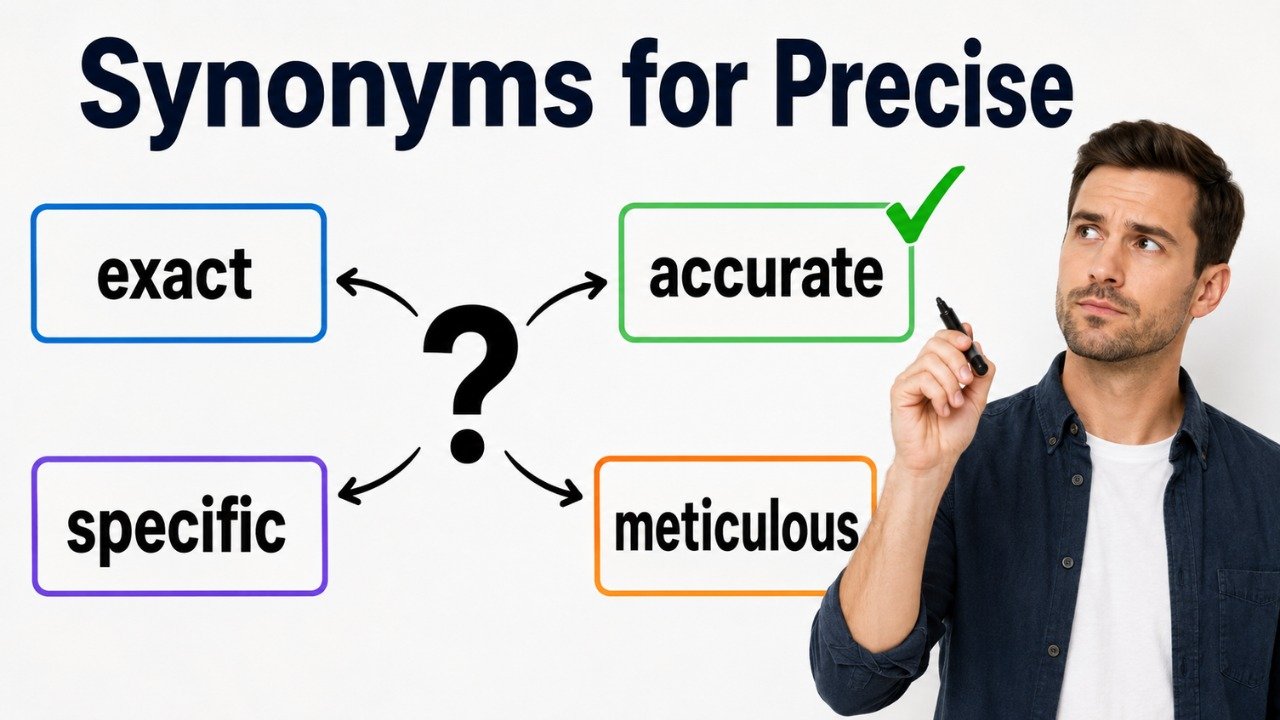
Quick Answer: Synonyms for precise include exact, accurate, specific, definite, explicit, meticulous, detailed, rigorous, careful, and unambiguous. Use exact for measurements, numbers, or locations. Choose accurate when information is correct. Specific works best when referring to a clearly identified detail. Meticulous and careful describe close attention to small details, while explicit and unambiguous are useful when instructions or statements must be completely clear.
Pronunciation and Word Details
Word: Precise
Pronunciation: /prɪˈsaɪs/
Part of Speech: Adjective
Meaning: Exact, accurate, clearly defined, or carefully expressed without unnecessary vagueness.
US Pronunciation:
UK Pronunciation:
What Does “Precise” Mean?
Precise means exact, accurate, and clearly defined. It is an adjective used to describe information, measurements, language, actions, or methods that contain very little uncertainty or error.
The word can describe an exact number, a clearly identified location, a carefully performed action, or a statement that communicates one specific meaning.
Measurement Context: A precise measurement gives an exact or closely calculated value.
Language Context: Precise language communicates an idea clearly and directly.
Instruction Context: Precise instructions explain exactly what someone should do.
Action Context: A precise movement is controlled and performed with great accuracy.
Technical Context: A precise process follows carefully defined standards or calculations.
Precise often suggests more than general correctness. It emphasizes exactness, clear boundaries, careful detail, and freedom from vagueness.
Meaning, Tone, and Context of “Precise”
Precise has a neutral to formal tone. It is common in academic writing, technical explanations, scientific discussions, professional reports, instructions, measurements, and analytical communication.
In everyday conversation, precise can describe someone who communicates clearly or performs an action carefully.
Formal Use: The report provides a precise explanation of the results.
Academic Use: Researchers need precise definitions for important terms.
Technical Use: The machine requires precise calibration.
Professional Use: Please provide a precise estimate of the total cost.
Conversational Use: Can you be more precise about where you left the keys?
The word usually has a positive meaning because it suggests care, clarity, correctness, and attention to detail. However, describing someone as overly precise can suggest that the person focuses too heavily on minor details.
When and How to Use “Precise”
For Exact Measurements
Use precise when a number, amount, distance, or measurement must be exact or carefully calculated.
Example: The technician recorded the precise temperature of the liquid.
For Clear Information
Use precise when information is clearly stated and leaves little room for misunderstanding.
Example: The teacher gave a precise explanation of the assignment.
For Specific Details
Use precise when referring to one clearly identified detail, place, time, or condition.
Example: She could not remember the precise date of the meeting.
For Careful Actions
Use precise when someone performs a movement or task with control and accuracy.
Example: The surgeon made a precise incision.
For Technical Processes
Use precise when a process requires strict measurements, calculations, or controlled steps.
Example: The device depends on precise electronic signals.
For Professional Writing
Use precise when writing reports, instructions, policies, or explanations that must be clear and specific.
Example: The proposal needs more precise language.
For Directions
Use precise when directions identify an exact location or route.
Example: He gave us precise directions to the building.
For Word Choice
Use precise when a word communicates the intended meaning accurately.
Example: Choose a more precise adjective to describe the reaction.
Best Synonyms for Precise
Exact
Synonym: Exact means completely correct in every detail, number, measurement, or position.
Example: Please provide the exact time of your arrival.
Accurate
Synonym: Accurate means correct and free from factual or measurement errors.
Example: The article contains accurate information about the event.
Specific
Synonym: Specific means clearly identified rather than general or vague.
Example: The manager requested specific examples of the problem.
Definite
Synonym: Definite means clearly decided, established, or known.
Example: We need a definite answer before Friday.
Explicit
Synonym: Explicit means stated clearly and directly, leaving no uncertainty.
Example: The instructions were explicit about the required format.
Meticulous
Synonym: Meticulous means extremely careful about small details.
Example: She kept meticulous records of every payment.
Detailed
Synonym: Detailed means containing many clear and specific facts.
Example: The witness gave a detailed description of the vehicle.
Rigorous
Synonym: Rigorous means extremely careful, thorough, and based on strict standards.
Example: The researchers followed a rigorous testing process.
Careful
Synonym: Careful means giving close attention to accuracy and avoiding mistakes.
Example: A careful examination revealed a small crack.
Unambiguous
Synonym: Unambiguous means having only one clear meaning.
Example: The contract should use unambiguous language.
50 Synonyms for Precise with Short Meanings
- Exact: Completely correct in every detail.
- Accurate: Free from mistakes or factual errors.
- Specific: Clearly identified and not general.
- Definite: Clearly known, fixed, or decided.
- Explicit: Expressed clearly and directly.
- Clear: Easy to understand without confusion.
- Correct: In agreement with facts or accepted standards.
- Meticulous: Extremely careful about small details.
- Rigorous: Thorough and based on strict standards.
- Particular: Referring to one distinct person, thing, or detail.
- Detailed: Containing many specific facts or features.
- Careful: Showing close attention and caution.
- Exacting: Requiring great care, accuracy, or effort.
- Fine: Small, delicate, or carefully distinguished.
- Sharp: Clearly defined or highly accurate.
- Measured: Carefully considered, controlled, or calculated.
- Pinpoint: Extremely exact in position or identification.
- Unambiguous: Having only one clear interpretation.
- Determinate: Having clearly established limits or meaning.
- Strict: Following exact rules or standards.
- Literal: Following the exact meaning of words.
- Faithful: Accurately representing the original.
- Factual: Based on facts rather than assumptions.
- True: Correct and consistent with reality.
- Right: Correct in judgment, detail, or calculation.
- Reliable: Consistently accurate and dependable.
- Valid: Logically or factually acceptable.
- Sound: Based on reliable reasoning or evidence.
- Well defined: Clearly described with firm boundaries.
- Narrow: Limited to a specific area or meaning.
- Focused: Directed toward one particular subject or purpose.
- Concise: Expressing information clearly in few words.
- Succinct: Brief while remaining clear and complete.
- Articulate: Able to express ideas clearly and effectively.
- Controlled: Carefully managed or directed.
- Calibrated: Adjusted according to an exact standard.
- Standardized: Made consistent according to established rules.
- Systematic: Organized according to a clear method.
- Methodical: Performed in an orderly and careful way.
- Orderly: Arranged or completed in a controlled manner.
- Scrupulous: Extremely careful to remain correct and fair.
- Painstaking: Completed with great care and effort.
- Thorough: Complete and attentive to every important detail.
- Attentive: Closely observing details and requirements.
- Discriminating: Able to recognize small differences accurately.
- Refined: Improved through careful adjustment.
- Delicate: Requiring careful and exact handling.
- Minute: Extremely small, detailed, or exact.
- Close: Very near to an exact amount or result.
- Spot on: Completely correct or accurate in casual speech.
Read Also:
Synonyms for Factors
Synonyms for Precise by Context
When Precise Means Exact
Exact is the strongest replacement when something matches a number, amount, time, position, or description perfectly.
Useful alternatives include exact, pinpoint, definite, determinate, strict, and literal.
Example With Precise: We need the precise dimensions of the table.
Example With Exact: We need the exact dimensions of the table.
Example With Pinpoint: Investigators identified the pinpoint location of the signal.
When Precise Means Accurate
Accurate works best when information, calculations, descriptions, or results are correct.
Useful alternatives include accurate, correct, factual, true, reliable, valid, and sound.
Example With Precise: The instrument produced a precise reading.
Example With Accurate: The instrument produced an accurate reading.
Example With Reliable: The instrument produced reliable results throughout the test.
When Precise Means Specific
Specific is appropriate when something is clearly identified rather than broad or general.
Useful alternatives include specific, particular, definite, explicit, focused, and narrow.
Example With Precise: She asked for the precise reason behind the decision.
Example With Specific: She asked for the specific reason behind the decision.
Example With Particular: He referred to one particular section of the report.
When Precise Means Clear
Clear is suitable when a statement, instruction, or definition is easy to understand.
Useful alternatives include clear, explicit, unambiguous, articulate, concise, and succinct.
Example With Precise: The policy needs more precise wording.
Example With Clear: The policy needs clearer wording.
Example With Unambiguous: The policy must contain unambiguous instructions.
When Precise Means Careful
Careful describes work completed with close attention to detail.
Useful alternatives include meticulous, careful, scrupulous, painstaking, thorough, attentive, and methodical.
Example With Precise: The watchmaker performed precise work.
Example With Meticulous: The watchmaker performed meticulous work.
Example With Painstaking: The restoration required painstaking attention to detail.
When Precise Means Controlled
Controlled is useful for physical movements, mechanical actions, or carefully managed processes.
Useful alternatives include controlled, measured, calibrated, refined, systematic, and orderly.
Example With Precise: The dancer made a precise movement.
Example With Controlled: The dancer made a controlled movement.
Example With Measured: He responded in a measured and thoughtful manner.
Another Word for Precise
The best general replacement for precise is exact. However, the most suitable alternative depends on whether you are describing measurements, facts, instructions, language, actions, or attention to detail.
Use exact for numbers and measurements, accurate for facts and results, specific for details, explicit for instructions, and meticulous for careful work.
Original: Please give me the precise address.
Better Option: Please give me the exact address.
Original: Her description of the incident was precise.
Better Option: Her description of the incident was accurate.
Original: The manager provided precise instructions.
Better Option: The manager provided explicit instructions.
Original: He is precise when checking financial records.
Better Option: He is meticulous when checking financial records.
When Not to Use “Precise”
Precise should not be used when a simpler or more context appropriate word communicates the meaning better.
When Referring to Factual Correctness
Accurate is often better than precise when discussing facts, reports, descriptions, or information.
Weak: The article gives precise information about the law.
Better: The article gives accurate information about the law.
When Referring to One Identified Detail
Specific is often more natural when asking for one clearly identified example, reason, or requirement.
Weak: Please provide a precise example of the problem.
Better: Please provide a specific example of the problem.
When Describing Clear Instructions
Explicit or clear may communicate the intended meaning more naturally.
Weak: The teacher gave precise rules about attendance.
Better: The teacher gave explicit rules about attendance.
When Describing Careful Work
Meticulous or careful may be stronger when the focus is attention to detail rather than exact measurement.
Weak: She is precise when organizing the records.
Better: She is meticulous when organizing the records.
When Writing Casual Conversation
Precise can sound overly formal in relaxed conversation.
Weak: At what precise moment will you arrive?
Better: What exact time will you arrive?
When the Information Is Only Approximate
Do not describe an estimate as precise unless it is based on exact data or careful calculation.
Weak: We made a precise guess about the total cost.
Better: We made a reasonable estimate of the total cost.
Words Commonly Confused With Precise
Precise vs Exact: Precise suggests close accuracy, careful definition, or controlled detail. Exact means completely correct with no difference.
Precise vs Accurate: Precise focuses on exact detail or consistency. Accurate focuses on being correct and free from error.
Precise vs Specific: Precise emphasizes exactness. Specific identifies one particular detail, subject, or requirement.
Precise vs Detailed: Precise information is exact and clearly defined. Detailed information contains many facts, but those facts are not automatically accurate.
Precise vs Concise: Precise language uses the most accurate words. Concise language communicates meaning in as few words as necessary.
Precise vs Explicit: Precise means exact and carefully defined. Explicit means directly and clearly stated.
Precise vs Meticulous: Precise describes the accuracy of a result, statement, or movement. Meticulous describes the careful person or process producing it.
Precise vs Correct: Correct means not wrong. Precise adds the idea of exact detail, clear limits, or careful measurement.
Which Synonym Should You Choose?
Choose exact when discussing numbers, times, measurements, addresses, locations, or matching details.
Choose accurate when discussing facts, information, reports, calculations, descriptions, data, or results.
Choose specific when identifying one particular reason, example, requirement, person, or detail.
Choose explicit when instructions, rules, warnings, or expectations must be stated directly.
Choose meticulous when describing a person who pays close attention to small details.
Choose detailed when information contains many facts, features, steps, or explanations.
Choose rigorous when discussing research, testing, analysis, standards, or academic methods.
Choose unambiguous when wording must have only one possible interpretation.
Choose concise when information should be brief and direct.
Choose controlled when describing movement, machinery, physical actions, or managed processes.
Choose precise in formal writing when both exactness and clarity are important.
Real Life Examples of “Precise” in Sentences
Original: The engineer recorded the precise width of the opening.
Better Option: The engineer recorded the exact width of the opening.
Original: Her summary gave a precise account of the discussion.
Better Option: Her summary gave an accurate account of the discussion.
Original: Please provide a precise reason for your decision.
Better Option: Please provide a specific reason for your decision.
Original: The manual contains precise instructions for installation.
Better Option: The manual contains explicit instructions for installation.
Original: The editor made precise corrections throughout the document.
Better Option: The editor made meticulous corrections throughout the document.
Original: The speaker used precise language to explain the concept.
Better Option: The speaker used clear language to explain the concept.
Original: The laboratory follows a precise testing procedure.
Better Option: The laboratory follows a rigorous testing procedure.
Original: The pilot made a precise adjustment to the controls.
Better Option: The pilot made a controlled adjustment to the controls.
Original: We need a precise description of the missing item.
Better Option: We need a detailed description of the missing item.
Original: The agreement includes a precise definition of ownership.
Better Option: The agreement includes an unambiguous definition of ownership.
Synonym Groups and Usage Differences
Exactness Group
Exact, pinpoint, definite, determinate, and strict describe information or measurements with clearly established limits.
Use these words for numbers, positions, times, amounts, dimensions, and fixed requirements.
Example: The map shows the exact location of the entrance.
Accuracy Group
Accurate, correct, factual, true, reliable, valid, and sound emphasize freedom from error.
Use them for reports, statements, calculations, descriptions, evidence, and results.
Example: The final calculation was accurate.
Specificity Group
Specific, particular, explicit, focused, narrow, and well defined identify something clearly rather than generally.
Use them for requirements, examples, questions, details, topics, and instructions.
Example: The application asks for specific information about your experience.
Carefulness Group
Meticulous, careful, scrupulous, painstaking, thorough, and attentive describe close attention to detail.
Use them for people, inspections, research, record keeping, editing, and skilled work.
Example: She conducted a thorough examination of the documents.
Method Group
Rigorous, systematic, methodical, standardized, calibrated, and orderly describe carefully controlled processes.
Use them for experiments, procedures, technical systems, research, and professional methods.
Example: The team followed a systematic approach to testing.
Clear Language Group
Clear, explicit, unambiguous, concise, succinct, and articulate describe effective communication.
Use them for definitions, explanations, instructions, reports, and professional writing.
Example: The guide provides clear instructions for new users.
Controlled Action Group
Controlled, measured, refined, delicate, fine, and sharp describe careful movement or adjustment.
Use them for physical actions, machinery, tools, performance, and technical work.
Example: The artist used fine movements to complete the design.
Antonyms of Precise
The opposite of precise depends on whether the word refers to accuracy, detail, clarity, measurement, or careful performance.
Imprecise: Not exact or clearly defined.
Inaccurate: Containing mistakes or incorrect information.
Vague: Lacking clear or specific detail.
General: Broad rather than focused on one detail.
Approximate: Close to an exact value but not completely exact.
Unclear: Difficult to understand or interpret.
Ambiguous: Open to more than one possible meaning.
Careless: Showing little attention to accuracy or detail.
Random: Lacking an organized or controlled method.
Rough: Estimated or completed without exact detail.
Loose: Not strictly controlled, defined, or measured.
Unreliable: Not consistently correct or dependable.
Incorrect: Not true or accurate.
Inexact: Not completely correct in measurement or detail.
Disorganized: Lacking a clear and orderly method.
Comparison: Precise vs Related Words
Precise vs Exact
Precise describes something carefully measured, clearly defined, or expressed with close accuracy. Exact means completely correct with no difference.
Example With Precise: The device provides precise measurements.
Example With Exact: The exact measurement is 12.6 centimeters.
Precise vs Accurate
Precise emphasizes exact detail or consistent results. Accurate means correct when compared with facts or a true value.
Example With Precise: The instrument produced nearly identical readings each time.
Example With Accurate: The reading matched the true temperature.
Precise vs Specific
Precise relates to exactness and careful detail. Specific identifies one particular subject, example, reason, or requirement.
Example With Precise: The report includes precise calculations.
Example With Specific: The report identifies a specific cause of the problem.
Precise vs Detailed
Precise information is exact and carefully worded. Detailed information contains many facts or features.
Example With Precise: The instructions state the precise amount of water required.
Example With Detailed: The instructions describe every stage of the process.
Precise vs Explicit
Precise means exact and clearly defined. Explicit means openly and directly stated.
Example With Precise: The policy gives a precise definition of misconduct.
Example With Explicit: The policy explicitly prohibits unauthorized access.
Precise vs Concise
Precise language uses exact words. Concise language communicates meaning briefly.
Example With Precise: The scientist selected precise technical terms.
Example With Concise: The scientist summarized the findings in three sentences.
Precise vs Meticulous
Precise usually describes a result, measurement, movement, or statement. Meticulous usually describes a careful person, method, or process.
Example With Precise: The craftsperson made a precise cut.
Example With Meticulous: The craftsperson was meticulous throughout the project.
Common Phrases and Expressions With Precise
Precise Measurement: An exact or carefully calculated measurement.
Precise Location: The exact position of a person, place, or object.
Precise Meaning: A clearly defined meaning with little uncertainty.
Precise Language: Words selected carefully to communicate an exact idea.
Precise Instructions: Directions that clearly explain what must be done.
Precise Time: The exact moment when something happens.
Precise Details: Clearly stated and carefully identified information.
Precise Definition: An explanation that establishes exact meaning and limits.
Precise Movement: A controlled physical action performed accurately.
Precise Calculation: A carefully completed mathematical operation.
Common Mistakes to Avoid
Confusing Precision With Accuracy
Something can be precise without being accurate. Repeated measurements may be close to one another but still far from the correct value.
Advice: Use precise for consistency and exact detail. Use accurate for correctness.
Using Precise for Every Type of Correctness
Precise is not always the most natural word for facts or information.
Weak: The biography contains precise facts.
Better: The biography contains accurate facts.
Repeating Precise Too Often
Using precise several times in one paragraph can make the writing sound repetitive.
Advice: Replace repeated uses with exact, accurate, specific, explicit, detailed, or meticulous according to context.
Choosing Exact When Specific Is Better
Exact usually refers to complete correctness, while specific identifies one particular detail.
Weak: Give an exact example of the problem.
Better: Give a specific example of the problem.
Confusing Precise With Concise
Precise means exact. Concise means brief.
Advice: A sentence can be precise without being short, and it can be concise without being completely precise.
Using Vague Information After Precise
Do not describe a statement as precise when it lacks clear details.
Weak: She gave a precise answer about arriving sometime later.
Better: She gave a precise answer and said she would arrive at 4:15.
Overusing Formal Language
Precise may sound unnecessarily formal in casual situations.
Formal: Please state your precise arrival time.
Natural: Please tell me your exact arrival time.
Conclusion
Understanding synonyms for precise helps you choose words that match the exact meaning of your sentence. Use exact for measurements and times, accurate for facts and results, specific for identified details, explicit for clear instructions, and meticulous for careful work. Detailed, rigorous, unambiguous, and controlled are also useful in particular contexts. The best synonym depends on whether you are emphasizing correctness, clarity, specificity, careful attention, or exact measurement. Choosing the right alternative makes writing clearer, more natural, and more effective.
FAQs About Synonyms for Precise
What Is the Best Synonym for Precise?
Exact is the best general synonym for precise. Accurate, specific, explicit, and meticulous may be better in particular contexts.
Are Precise and Exact the Same?
They are closely related, but exact is stronger. Exact means completely correct, while precise can mean carefully measured, clearly defined, or consistently detailed.
What Is a Formal Synonym for Precise?
Rigorous, meticulous, explicit, unambiguous, and determinate are useful formal alternatives, depending on the sentence.
What Is a Simple Synonym for Precise?
Exact, accurate, clear, correct, and specific are simple and common synonyms for precise.
Is Accurate a Synonym for Precise?
Yes, but the words are not identical. Accurate means correct, while precise emphasizes exact detail, consistency, or clear definition.
What Word Describes a Precise Person?
Meticulous, careful, methodical, thorough, and scrupulous can describe a person who pays close attention to detail.
What Is the Opposite of Precise?
Common opposites include imprecise, inaccurate, vague, unclear, approximate, careless, and ambiguous.
