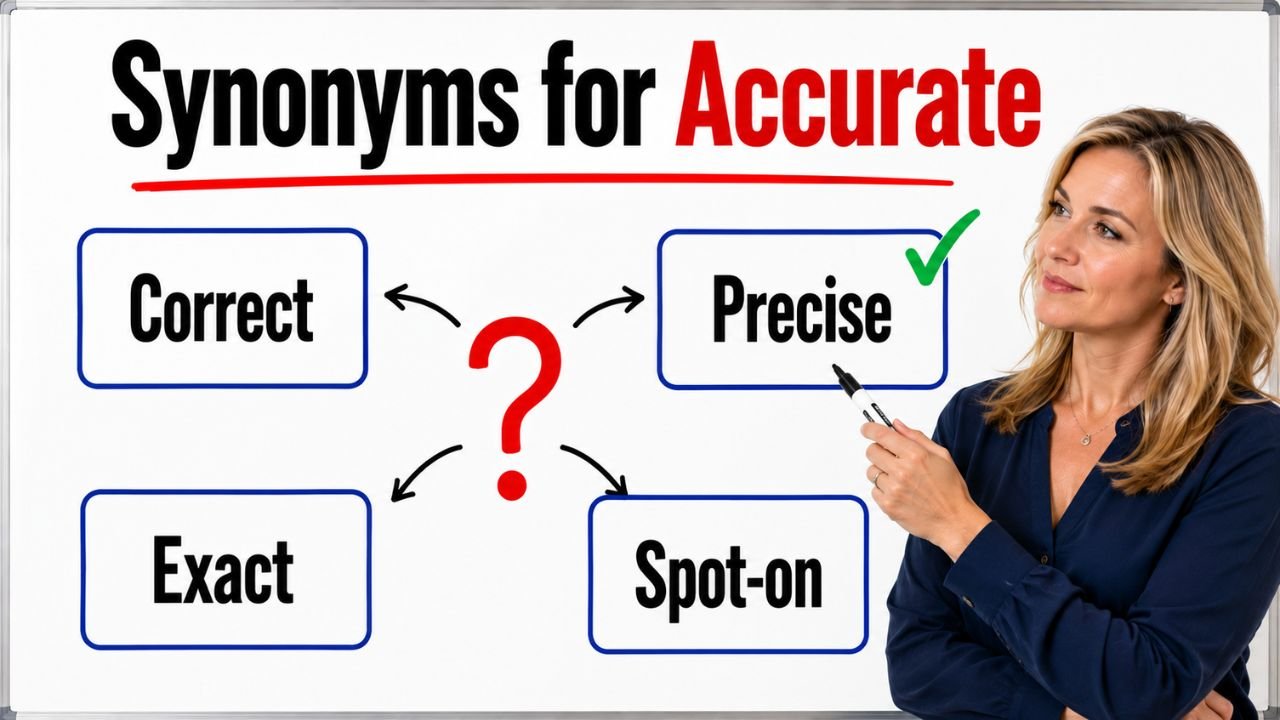
Quick Answer: The best synonyms for accurate include correct, precise, exact, factual, reliable, truthful, valid, faithful, meticulous, and dependable. Use correct when something contains no mistake, precise for measurements or detailed information, and exact when a value or description matches perfectly. Factual is best for statements supported by facts, while reliable suits information that can be trusted repeatedly. Truthful describes honest communication, valid applies to acceptable conclusions or methods, and faithful works for descriptions, copies, or representations that closely match the original.
Pronunciation and Word Details
Word: Accurate
Pronunciation: /ˈæk.jə.rət/
Part of Speech: Adjective
Meaning: Accurate describes information, measurements, descriptions, or results that are correct and free from important mistakes.
US Pronunciation:
UK Pronunciation:
What Does “Accurate” Mean?
Accurate means correct, truthful, or closely matching the real facts, value, condition, or original source. It is an adjective used to describe information, measurements, calculations, descriptions, records, predictions, and actions.
An accurate report presents facts correctly. An accurate measurement closely matches the true value. An accurate description represents a person, place, object, or situation without misleading details.
The word can also describe physical performance. An accurate throw, shot, or movement reaches the intended target.
Accurate does not always mean perfectly exact. In scientific, technical, and statistical contexts, accuracy often refers to how closely a result matches the true or accepted value.
Meaning, Tone, and Context of “Accurate”
Accurate has a neutral, positive, and often formal tone. It suggests correctness, care, trustworthiness, and attention to facts.
The word is common in academic writing, journalism, research, science, mathematics, medicine, technology, business reports, legal discussions, and everyday conversation. It can describe both simple facts and highly technical measurements.
In casual speech, accurate may mean that a statement or description feels true. In formal writing, it usually requires evidence, dependable data, careful observation, or a verified source.
Accurate is stronger than close or approximate because it suggests a high level of correctness. However, it is not always interchangeable with precise, exact, truthful, or reliable. Each of these words emphasizes a different kind of correctness.
When and How to Use “Accurate”
For Correct Information: Use accurate when facts, dates, names, statistics, or statements match reality.
Example: The article provides accurate information about the historical event.
For Measurements: Use accurate when a measurement closely matches the true value.
Example: The instrument produced an accurate temperature reading.
For Descriptions: Use accurate when words or images represent something faithfully.
Example: Her account gives an accurate description of the neighborhood.
For Calculations: Use accurate when mathematical work produces the correct result.
Example: Accurate calculations are essential when preparing the budget.
For Predictions: Use accurate when a forecast closely matches what later happens.
Example: The analyst made an accurate prediction about consumer demand.
For Records: Use accurate when documents contain correct and complete details.
Example: Employees must keep accurate records of every transaction.
For Physical Performance: Use accurate when an action reaches its intended target.
Example: The player delivered an accurate pass across the field.
For Representation: Use accurate when a copy, image, model, or summary closely reflects the original.
Example: The diagram provides an accurate representation of the system.
Best Synonyms for Accurate
Correct: Free from mistakes and consistent with the right answer or accepted facts.
Example: Please confirm that the address is correct before submitting the form.
Precise: Clearly defined, carefully measured, and expressed with fine detail.
Example: The technician recorded the precise dimensions of the component.
Exact: Completely matching a particular value, detail, or original form.
Example: We need the exact time when the problem began.
Factual: Based on real events, evidence, or verifiable information.
Example: The report should remain factual and objective.
Reliable: Consistently producing information or results that can be trusted.
Example: Researchers need reliable data before reaching a conclusion.
Truthful: Honest and not intended to deceive.
Example: She gave a truthful account of what happened.
Valid: Logically sound, acceptable, or supported by appropriate evidence.
Example: The study reached a valid conclusion from the available evidence.
Faithful: Closely representing the original object, message, style, or meaning.
Example: The translation is faithful to the original passage.
Meticulous: Extremely careful about small details and correctness.
Example: His meticulous research prevented factual mistakes.
Dependable: Consistently trustworthy and unlikely to produce errors.
Example: The system provides dependable results under normal conditions.
50 Synonyms for Accurate with Short Meanings
- Correct: Free from mistakes or errors.
- Precise: Clearly defined and carefully measured.
- Exact: Completely matching a value or detail.
- True: Consistent with reality or fact.
- Factual: Based on real and verifiable information.
- Truthful: Honest and free from deception.
- Reliable: Consistently producing trustworthy results.
- Dependable: Able to be trusted repeatedly.
- Trustworthy: Deserving confidence or belief.
- Credible: Believable and supported by convincing evidence.
- Valid: Logically acceptable or properly supported.
- Sound: Based on good judgment or reliable evidence.
- Authentic: Genuine and true to the original.
- Faithful: Closely matching the original meaning or appearance.
- Verifiable: Capable of being checked and confirmed.
- Confirmed: Established as correct through checking.
- Proven: Demonstrated to be true or effective.
- Definite: Clear, certain, and not vague.
- Specific: Clearly identified and limited to exact details.
- Detailed: Containing careful and complete information.
- Meticulous: Extremely careful about every detail.
- Careful: Giving close attention to correctness.
- Rigorous: Thorough, strict, and methodically careful.
- Unerring: Consistently correct and free from mistakes.
- Flawless: Containing no noticeable faults or errors.
- Consistent: Producing similar and dependable results.
- Objective: Based on facts rather than personal feelings.
- Realistic: Closely representing real conditions or possibilities.
- Representative: Fairly reflecting the qualities of a larger whole.
- Literal: Following the exact and direct meaning.
- Verbatim: Repeating the exact original words.
- Proper: Correct according to rules or accepted practice.
- Right: Correct in fact, judgment, or action.
- Certain: Known or established without serious doubt.
- Sure: Confidently known to be correct.
- Just: Fair, correct, or appropriate in a particular context.
- Authoritative: Trusted because of knowledge or expertise.
- Evidence based: Supported by reliable facts or research.
- Well founded: Based on strong reasons or evidence.
- Calibrated: Adjusted to produce correct measurements.
- Measured: Determined through careful observation or calculation.
- Computed: Worked out through mathematical calculation.
- Calculated: Determined carefully by using numbers or reasoning.
- Scientific: Based on systematic observation and testing.
- Mathematical: Expressed or determined through exact calculation.
- Reproducible: Able to produce the same result again.
- Thorough: Complete, careful, and attentive to every part.
- Conscientious: Careful, responsible, and committed to correctness.
- Scrupulous: Extremely careful to remain correct and honest.
- Punctilious: Very attentive to precise details and proper procedure.
Read Also:
Synonyms for Characteristics
Synonyms for Accurate by Context
When Accurate Means Correct
Use correct, right, true, proper, valid, or sound when a statement, answer, decision, or conclusion contains no meaningful mistake.
Example: Her answer was correct because it followed the information provided in the question.
Correct is the most direct replacement. Right is more conversational, while valid and sound are often better for arguments, conclusions, methods, and reasoning.
When Accurate Means Precise
Use precise, exact, specific, definite, measured, calibrated, or mathematical when discussing quantities, times, dimensions, locations, or technical details.
Example: The engineer provided precise measurements for each section of the structure.
Precise emphasizes careful detail. Exact suggests a complete match, while calibrated describes an instrument adjusted to produce dependable readings.
When Accurate Means Factual
Use factual, true, verifiable, confirmed, proven, objective, or evidence based when discussing statements, reports, research, and historical information.
Example: The editor removed unsupported opinions and kept the description factual.
Factual means based on real information. Verifiable means the information can be checked. Confirmed indicates that the checking process has already taken place.
When Accurate Means Reliable
Use reliable, dependable, trustworthy, credible, consistent, authoritative, or reproducible when information or results can be trusted repeatedly.
Example: The researchers collected reliable data from several carefully controlled tests.
Reliable emphasizes consistent trust. Credible describes something believable, while reproducible is especially useful for scientific results that can be repeated.
When Accurate Means Faithful to the Original
Use faithful, authentic, representative, literal, realistic, or verbatim when discussing translations, copies, portraits, models, summaries, and descriptions.
Example: The adaptation remained faithful to the central meaning of the original story.
Faithful preserves meaning or character. Verbatim repeats the original words exactly, while representative reflects the main qualities without copying every detail.
When Accurate Means Careful
Use meticulous, rigorous, careful, conscientious, thorough, scrupulous, or punctilious when describing a person or process focused on avoiding mistakes.
Example: Her meticulous review identified several errors before publication.
Meticulous emphasizes attention to small details. Rigorous suggests a strict method, while conscientious describes responsible and careful behavior.
Another Word for Accurate
Another word for accurate is correct. It is the clearest general replacement when information, an answer, or a result contains no mistake.
The best alternative still depends on context. Use precise for measurements, factual for information, faithful for representations, reliable for repeated results, and truthful for honest statements.
Original: The information in the document is accurate.
Better Option: The information in the document is correct.
Original: The machine produced an accurate measurement.
Better Option: The machine produced a precise measurement.
Original: She gave an accurate account of the meeting.
Better Option: She gave a factual account of the meeting.
Original: The model offers an accurate view of the original structure.
Better Option: The model offers a faithful representation of the original structure.
When Not to Use “Accurate”
Avoid accurate when a more specific word would explain the type of correctness more clearly.
For measurements, precise or exact may be stronger. For honesty, truthful is more suitable. For dependable performance, reliable is clearer. For an argument, valid or sound may express the intended meaning better.
Weak: He gave an accurate promise to the customer.
Better: He gave an honest promise to the customer.
Accurate does not normally describe moral behavior. Honest, truthful, fair, or ethical will usually be more appropriate.
Do not use accurate when the information is only close to the truth.
Weak: The estimated total was accurate, although it differed by several thousand units.
Better: The estimated total was reasonably close, although it differed by several thousand units.
Avoid using accurate as a vague compliment without explaining what was correct.
Weak: The presentation was very accurate.
Better: The presentation used correct statistics and clearly explained the research findings.
Accurate may also sound unnatural when describing emotion.
Weak: Her accurate sadness was visible throughout the conversation.
Better: Her genuine sadness was visible throughout the conversation.
Words Commonly Confused With Accurate
Accurate vs Precise: Accurate means close to the true value. Precise means exact, detailed, or consistent. A group of measurements can be precise because they are close to one another but inaccurate because they are far from the true value.
Accurate vs Exact: Accurate allows a small acceptable difference in some contexts. Exact means completely matching a value, detail, or requirement.
Accurate vs Correct: Correct is the broadest word for something free from error. Accurate is especially useful for information, measurements, descriptions, and representations.
Accurate vs Truthful: Accurate refers to factual correctness. Truthful refers to honesty and the absence of deliberate deception.
Accurate vs Reliable: Accurate describes the correctness of a particular result. Reliable means consistently producing dependable results over time.
Accurate vs Valid: Accurate concerns closeness to truth or reality. Valid describes something logically sound, acceptable, or properly supported.
Accurate vs Factual: Accurate means correct in detail. Factual means based on facts rather than imagination or opinion.
Accurate vs Authentic: Accurate means correct. Authentic means genuine, original, or true to a particular identity or source.
Which Synonym Should You Choose?
Choose correct for answers, spelling, grammar, facts, instructions, and general statements that contain no mistake.
Choose precise when discussing measurements, coordinates, times, technical language, or carefully defined details.
Choose exact when a number, copy, time, amount, or description must match perfectly.
Choose factual for reports, historical accounts, articles, records, and statements based on real information.
Choose truthful when emphasizing honesty in speech, testimony, or personal communication.
Choose reliable for data, systems, sources, instruments, and methods that produce dependable results repeatedly.
Choose valid for arguments, conclusions, reasons, methods, documents, and research findings that meet accepted standards.
Choose faithful for translations, adaptations, portraits, summaries, and representations that preserve the original meaning or appearance.
Choose objective for descriptions and evaluations based on facts rather than personal feelings.
Choose meticulous when describing extremely careful research, editing, measurement, or record keeping.
Choose rigorous in academic and professional writing when a process follows strict methods and careful standards.
Choose reproducible when a scientific test or experiment can produce the same result under the same conditions.
Real Life Examples of “Accurate” in Sentences
Original: The map provides an accurate view of the region.
Better Option: The map provides a faithful representation of the region.
Original: Her answer was accurate.
Better Option: Her answer was correct.
Original: The device gives accurate readings.
Better Option: The device gives reliable readings.
Original: We need an accurate measurement of the room.
Better Option: We need a precise measurement of the room.
Original: The article contains accurate historical information.
Better Option: The article contains factual historical information.
Original: His description of the event was accurate.
Better Option: His description of the event was truthful and detailed.
Original: The prediction proved accurate.
Better Option: The prediction proved correct.
Original: The report presents an accurate summary of the findings.
Better Option: The report presents a faithful summary of the findings.
Original: Accurate records are necessary for financial planning.
Better Option: Reliable and detailed records are necessary for financial planning.
Original: The player made an accurate pass.
Better Option: The player delivered a precise pass.
Synonym Groups and Usage Differences
Correctness Group
Correct, right, true, proper, valid, and sound describe something that follows facts, rules, logic, or accepted standards.
Correct is the most general term. Proper often relates to rules or procedures. Sound and valid are useful for reasoning and conclusions.
Example: The conclusion was valid because it followed a sound method and used correct data.
Measurement Group
Precise, exact, calibrated, measured, computed, calculated, mathematical, and scientific relate to numbers, quantities, and technical results.
Precise suggests fine detail. Exact suggests complete agreement. Calibrated refers to an instrument adjusted for dependable measurement.
Example: A calibrated instrument produced precise measurements for the scientific study.
Truth Group
Factual, truthful, true, confirmed, proven, verifiable, and evidence based relate to statements supported by reality or evidence.
Truthful emphasizes honesty. Factual focuses on information. Verifiable means the claim can be checked independently.
Example: The witness gave a truthful statement that was later confirmed by verifiable evidence.
Reliability Group
Reliable, dependable, trustworthy, credible, authoritative, consistent, and reproducible describe information or performance that deserves confidence.
Credible means believable. Authoritative suggests recognized expertise. Reproducible is particularly important in research.
Example: The team used a reliable method that produced consistent and reproducible results.
Representation Group
Faithful, authentic, representative, realistic, literal, and verbatim describe how closely something reflects an original source or reality.
Verbatim means exactly the same words. Literal follows the direct meaning. Representative captures the main qualities of a larger subject.
Example: The summary was faithful to the original report without repeating it verbatim.
Carefulness Group
Meticulous, rigorous, thorough, conscientious, scrupulous, careful, and punctilious describe close attention to correctness.
Meticulous focuses on fine detail. Rigorous emphasizes strict methods. Scrupulous can also suggest honesty and strong ethical care.
Example: A rigorous and meticulous review ensured that every figure was correct.
Antonyms of Accurate
The opposite of accurate depends on whether the word refers to facts, measurements, descriptions, methods, or predictions.
Inaccurate: Containing mistakes or incorrect details.
Incorrect: Not matching the right answer or accepted facts.
Wrong: Not true, proper, or correct.
False: Contrary to fact or reality.
Untrue: Not based on the truth.
Misleading: Creating a wrong or incomplete impression.
Imprecise: Lacking exact detail or clear measurement.
Approximate: Close to the true value but not exact.
Vague: Lacking clear or specific information.
Unreliable: Not producing dependable results.
Invalid: Not logically acceptable or properly supported.
Faulty: Containing a defect, weakness, or error.
Distorted: Changed in a way that misrepresents the truth.
Exaggerated: Presented as greater or more extreme than reality.
Careless: Showing insufficient attention to correctness.
Comparison of Accurate and Related Words
Accurate vs Precise
Accurate means close to the true value or reality. Precise means exact, consistent, or expressed with careful detail.
A measurement can be accurate without being highly precise. It can also be precise without being accurate when repeated readings are similar but all are far from the true value.
Example With Accurate: The scale gave an accurate reading of the package weight.
Example With Precise: The scale displayed the weight to three decimal places.
Accurate vs Exact
Accurate suggests correctness within an acceptable range. Exact means completely identical to the required value or detail.
Example With Accurate: The estimate was accurate enough for the initial plan.
Example With Exact: The final document included the exact cost of every item.
Accurate vs Correct
Correct is a broad word for anything free from error. Accurate is more commonly connected with facts, measurements, records, descriptions, and representations.
Example With Accurate: The report contains accurate population data.
Example With Correct: She selected the correct answer.
Accurate vs Factual
Accurate means correct in detail. Factual means based on facts and real events rather than imagination or opinion.
Example With Accurate: The timeline provides accurate dates.
Example With Factual: The article presents a factual account of the event.
Accurate vs Truthful
Accurate focuses on correctness. Truthful emphasizes honesty and intention.
A person may make an inaccurate statement without lying if the mistake was unintentional.
Example With Accurate: His memory of the date was not accurate.
Example With Truthful: His explanation was truthful, although he could not remember every detail.
Accurate vs Reliable
Accurate describes how correct one result is. Reliable describes how consistently a method, source, or instrument performs.
Example With Accurate: Today’s reading was accurate.
Example With Reliable: The instrument has remained reliable for many years.
Accurate vs Valid
Accurate relates to truth or correct measurement. Valid relates to sound reasoning, acceptable procedures, or recognized authority.
Example With Accurate: The table includes accurate figures.
Example With Valid: The researchers used a valid method to analyze the figures.
Common Phrases and Expressions With “Accurate”
Accurate Information: Facts and details that correctly represent reality.
Accurate Description: A clear account that faithfully represents a subject.
Accurate Measurement: A measurement close to the true value.
Accurate Results: Findings or outcomes that are correct.
Accurate Data: Information recorded without important mistakes.
Accurate Prediction: A forecast that closely matches what happens later.
Accurate Record: A document containing correct and complete details.
Accurate Representation: An image, model, or description that closely reflects the original.
Accurate Calculation: A mathematical result produced without error.
Accurate Assessment: A judgment that correctly identifies the condition or situation.
Common Mistakes to Avoid
A common mistake is treating accurate and precise as perfect synonyms. Accuracy concerns closeness to the true value, while precision concerns detail or consistency.
Avoid using accurate when truthful is the intended meaning. A statement can be honest but inaccurate because the speaker remembers something incorrectly.
Do not use exact when only a close estimate is available. Exact suggests complete agreement and may make a claim sound stronger than the evidence supports.
Avoid calling a source accurate merely because it sounds professional. Accuracy should be supported by checking, evidence, comparison, or dependable methods.
Do not repeat accurate throughout one paragraph. Use correct for answers, factual for information, reliable for sources, precise for measurements, and faithful for representations.
Avoid vague expressions such as very accurate when a measurable degree of correctness can be stated. Explain the margin, range, or specific detail whenever it matters.
Choose synonyms according to the noun. A correct answer, precise measurement, factual report, truthful statement, valid argument, faithful translation, and reliable method express different kinds of accuracy.
Conclusion
The best synonyms for accurate depend on the type of correctness being described. Use correct for general answers and facts, precise for measurements and technical details, and exact for a complete match. Factual and truthful suit information and honest statements, while reliable and dependable describe consistent results. Valid works well for arguments and methods, and faithful is useful for translations or representations. Understanding these synonyms for accurate helps you select clearer words for reports, essays, research, records, descriptions, and everyday communication.
FAQs About Synonyms for Accurate
What is the best synonym for accurate?
Correct is the best general synonym for accurate. Precise, exact, factual, reliable, and truthful are better choices in more specific contexts.
What is another word for accurate information?
Factual, correct, reliable, verified, credible, and trustworthy can describe accurate information.
Are accurate and precise the same?
No. Accurate means close to the true value, while precise means exact, detailed, or consistent.
What is a formal synonym for accurate?
Precise, factual, valid, reliable, objective, rigorous, and verifiable are useful formal alternatives.
What word describes an accurate description?
Faithful, realistic, factual, detailed, or representative can describe an accurate account or representation.
Can truthful replace accurate?
Truthful can replace accurate when honesty is the main idea. It is not always suitable for measurements, calculations, or technical results.
What is the opposite of accurate?
Common opposites include inaccurate, incorrect, false, imprecise, misleading, unreliable, vague, and faulty.
