
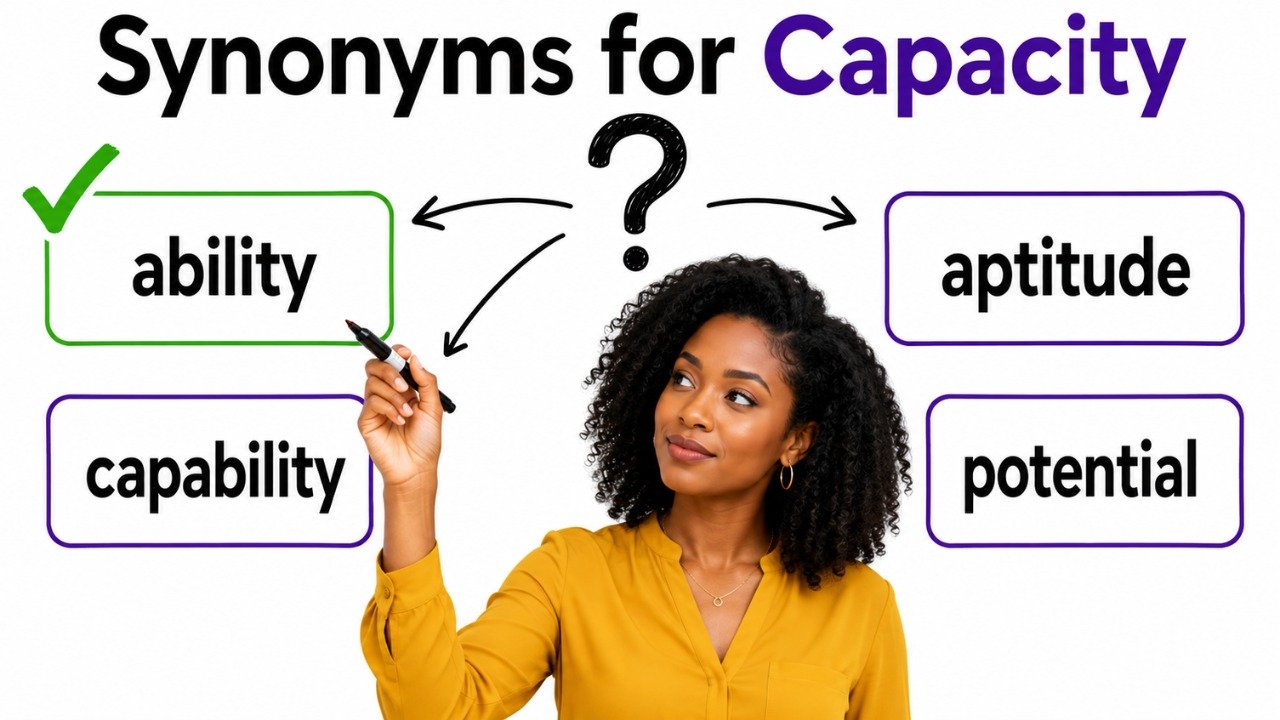
Quick Answer: The best synonyms for capacity include ability, capability, potential, aptitude, volume, room, space, function, role, and competence. Use ability when referring to what someone can do, capability for the power or potential to achieve something, volume for how much a container can hold, room or space for available physical capacity, potential for future ability, aptitude for natural talent, competence for sufficient skill, and role or function when capacity means an official position or purpose. The right synonym depends on whether you are discussing skill, limits, storage, mental ability, production, or responsibility.
Pronunciation and Word Details
Word: Capacity
Pronunciation: /kəˈpæsəti/
Part of Speech: Noun
Meaning: The ability, maximum amount, available space, or official role that a person or thing can have or perform.
US Pronunciation:
UK Pronunciation:
What Does “Capacity” Mean?
Capacity means the ability to do something, the maximum amount something can contain or handle, or the role in which someone acts.
As a noun, capacity has several common meanings. It can describe a person’s ability to understand, perform, learn, or manage something. For example, someone may have the capacity to solve difficult problems.
Capacity can also describe physical limits. A hall with a capacity of 500 people can safely or practically accommodate up to that number.
In business and technical contexts, capacity often refers to the maximum amount that a system, factory, machine, or organization can produce or process.
The word can also describe an official role. A person may attend a meeting in their capacity as a manager, adviser, representative, or committee member.
Because capacity has several meanings, choosing the right synonym requires understanding the sentence context.
Meaning, Tone, and Context of “Capacity”
Capacity is generally a neutral and flexible word. It appears naturally in everyday conversation, formal writing, academic work, business communication, technical reports, legal discussions, and professional settings.
When capacity refers to someone’s ability, it can sound slightly more formal than the simple word ability.
When discussing containers, buildings, machines, or storage, capacity often has a technical or measurable meaning.
When describing someone’s official position, capacity has a formal tone. Expressions such as “in her capacity as director” identify the specific role in which a person is acting.
Capacity can also refer to intellectual or emotional ability. Phrases such as mental capacity, capacity for learning, or capacity for understanding focus on what a person is able to process or achieve.
When and How to Use “Capacity”
For Ability
Use capacity when talking about someone’s ability to perform, understand, learn, or accomplish something.
Example: She has the capacity to manage several complex projects successfully.
For Potential
Capacity can describe an ability that exists even if it has not yet been fully developed or used.
Example: The student has a remarkable capacity for learning new languages.
For Physical Space
Use capacity when describing how much a place or container can hold.
Example: The auditorium has a seating capacity of 800 people.
For Storage
Capacity is commonly used for the amount that a container, device, facility, or system can store.
Example: The tank has enough capacity to hold the entire water supply.
For Production
Capacity can describe the maximum amount that a business, factory, machine, or system can produce.
Example: The company increased its production capacity to meet demand.
For Mental Ability
Capacity may describe a person’s ability to understand information, make judgments, or think clearly.
Example: His capacity for careful reasoning impressed the entire team.
For an Official Role
Use capacity when explaining the particular position in which someone is acting.
Example: She attended the conference in her capacity as department director.
For Workload
Capacity can describe how much work a person, team, or system can reasonably handle.
Example: Our team does not currently have the capacity to accept another major project.
Best Synonyms for Capacity
Ability
Synonym: The power or skill needed to do something.
Example: Her ability to explain complicated ideas makes her an effective teacher.
Capability
Synonym: The power or potential to perform a particular action successfully.
Example: The system has the capability to process large amounts of information.
Potential
Synonym: The possibility of developing greater ability or achieving something in the future.
Example: The young athlete showed enormous potential.
Aptitude
Synonym: A natural ability to learn or perform a particular skill.
Example: He demonstrated a strong aptitude for mathematics.
Volume
Synonym: The amount of space occupied or contained by something.
Example: The container has enough volume to store the liquid.
Room
Synonym: Available space for additional people, objects, or activity.
Example: There is room for five more passengers.
Space
Synonym: An available physical area in which something can fit.
Example: The warehouse has additional space for new inventory.
Competence
Synonym: The ability and knowledge required to perform something adequately.
Example: Her professional competence earned the confidence of her colleagues.
Role
Synonym: The position or part someone performs in a situation or organization.
Example: He spoke in his role as project coordinator.
Function
Synonym: The purpose, responsibility, or activity performed by someone or something.
Example: The main function of the department is to support customers.
50 Synonyms for Capacity with Short Meanings
- Ability: Power or skill to do something.
- Capability: Power or potential to perform successfully.
- Competence: Sufficient skill or knowledge for a task.
- Potential: Possibility for future development or achievement.
- Aptitude: Natural ability to learn or perform something.
- Faculty: An inherent mental or physical ability.
- Power: Ability or strength to act or achieve.
- Skill: Learned ability to perform something effectively.
- Proficiency: A high level of skill or ability.
- Talent: Natural ability in a particular area.
- Volume: Amount of space something can contain.
- Room: Available area for additional people or things.
- Space: Available physical area.
- Size: Physical extent or overall dimensions.
- Extent: Amount, degree, or range of something.
- Limit: Greatest amount that can be allowed or handled.
- Maximum: Highest possible amount or level.
- Ceiling: Upper limit that cannot normally be exceeded.
- Quota: Fixed or permitted amount.
- Accommodation: Space or ability to hold or provide for something.
- Occupancy: Number or amount that a place can accommodate.
- Storage: Space available for keeping something.
- Load: Amount that something can carry or handle.
- Carrying Power: Ability to transport or support a particular amount.
- Holding Power: Ability to contain or retain something.
- Throughput: Amount a system can process within a period.
- Output: Amount that a person, machine, or system can produce.
- Bandwidth: Available ability or resources for handling work or information.
- Scope: Extent of possible activity or responsibility.
- Range: Extent of ability, operation, or coverage.
- Role: Position or part performed in a situation.
- Function: Purpose or activity performed.
- Position: Particular place or responsibility in an organization.
- Office: Official position carrying particular responsibilities.
- Status: Recognized position or condition.
- Character: Role or nature in which someone acts.
- Post: Official job or position.
- Appointment: Position to which someone has been formally assigned.
- Duty: Responsibility that someone is expected to perform.
- Responsibility: Task, obligation, or area of authority.
- Authority: Power connected with a particular position.
- Comprehension: Ability to understand information.
- Understanding: Ability to grasp meaning or ideas.
- Intelligence: Mental ability to learn, reason, and understand.
- Cognition: Mental ability involving thought and understanding.
- Judgment: Ability to make sensible decisions.
- Reason: Ability to think logically.
- Discernment: Ability to understand and judge differences clearly.
- Mental Ability: Capacity for thinking, learning, or understanding.
- Learning Ability: Capacity to acquire and use new knowledge.
Read Also:
Synonyms for Reflective

Synonyms for Capacity by Context
When Capacity Means Ability
The strongest alternatives are ability, capability, competence, skill, faculty, and power.
Use these words when describing what a person, organization, machine, or system can do.
Example: She has the ability to remain calm during difficult negotiations.
Example: The software has the capability to process complex calculations.
When Capacity Means Natural Potential
Potential, aptitude, talent, and faculty work well when capacity describes an undeveloped or natural ability.
Example: His aptitude for engineering became obvious at an early age.
Example: The student has considerable potential as a writer.
When Capacity Means Physical Space
Volume, room, space, size, accommodation, occupancy, and storage are useful alternatives when discussing buildings, containers, vehicles, or facilities.
Example: There is enough room in the hall for another fifty guests.
Example: The container provides sufficient storage for the equipment.
When Capacity Means a Maximum Limit
Limit, maximum, ceiling, quota, load, and extent emphasize the greatest amount something can handle.
Example: The machine has reached its maximum operating level.
Example: The bridge cannot safely carry a load beyond the stated limit.
When Capacity Means Production Ability
Throughput, output, capability, bandwidth, and potential can describe how much work or production a system can handle.
Example: The factory increased its output after installing additional equipment.
Example: The support team lacks the bandwidth to take on another major assignment.
When Capacity Means an Official Role
Role, function, position, office, post, status, and character can replace capacity when describing the position in which someone is acting.
Example: She attended the meeting in her role as financial adviser.
Example: He made the statement in his official position as committee chair.
When Capacity Means Mental Ability
Understanding, comprehension, cognition, intelligence, judgment, reason, and discernment fit contexts involving thinking and decision making.
Example: The exercise tests a student’s comprehension of written information.
Example: Good judgment is essential when making important decisions.
Another Word for Capacity
Ability is often the best general replacement for capacity when the word describes what someone can do.
However, there is no single synonym that works in every situation. Use volume, room, or space for physical amounts, capability or potential for performance, and role or function for an official position.
Original: She has the capacity to solve difficult problems.
Better Option: She has the ability to solve difficult problems.
Original: The building has a capacity of 600 visitors.
Better Option: The building has room for 600 visitors.
Original: The organization has the capacity to expand rapidly.
Better Option: The organization has the capability to expand rapidly.
Original: He spoke in his capacity as team leader.
Better Option: He spoke in his role as team leader.
When Not to Use “Capacity”
Capacity is useful, but another word may sometimes make the meaning clearer.
Avoid capacity when a simpler word communicates the idea more naturally.
Weak: She has the capacity to swim very well.
Better: She has the ability to swim very well.
When discussing exact physical measurements, volume may be clearer if the focus is specifically on three dimensional space rather than the maximum amount something can hold.
Weak: We calculated the capacity occupied by the liquid.
Better: We calculated the volume occupied by the liquid.
Capacity may also sound unnecessarily formal in casual conversation.
Weak: I do not have the capacity to answer more messages tonight.
Better: I do not have the time or energy to answer more messages tonight.
When describing someone’s job, role or position may sound more direct.
Weak: She attended in the capacity of an adviser.
Better: She attended in her role as an adviser.
The best choice depends on the exact idea being expressed rather than simply replacing capacity with the same synonym every time.
Words Commonly Confused With Capacity
Capacity vs Capability: Capacity often describes how much someone or something can hold, handle, produce, or understand. Capability emphasizes whether someone or something possesses the power or ability to perform a particular action.
Capacity vs Ability: Ability usually describes what someone can do. Capacity can mean ability but can also describe maximum volume, workload, production, or an official role.
Capacity vs Volume: Capacity describes the maximum amount a container can hold. Volume describes the amount of three dimensional space occupied by something.
Capacity vs Competence: Capacity is the ability or potential to act. Competence refers more specifically to having enough knowledge or skill to perform successfully.
Capacity vs Potential: Capacity may describe existing ability or limits. Potential usually focuses on what could develop or become possible in the future.
Capacity vs Role: Capacity can mean an official role in expressions involving the position in which someone acts. Role refers directly to that position or function.
Which Synonym Should You Choose?
Choose ability when discussing what a person can do in clear, everyday language.
Choose capability when discussing the power of a person, organization, system, or technology to perform a specific task.
Choose potential when the ability exists but has not been fully developed.
Choose aptitude when discussing a natural ability to learn or perform something.
Choose competence when emphasizing sufficient professional knowledge or skill.
Choose volume when describing measurable physical space.
Choose room or space in casual conversation about available physical capacity.
Choose maximum or limit when emphasizing the highest amount something can handle.
Choose throughput when discussing how much a system can process.
Choose output when discussing production levels.
Choose bandwidth when describing available resources or workload in professional conversation.
Choose role when describing the position in which someone acts.
Choose function when emphasizing purpose or responsibility.
Choose comprehension or understanding when discussing mental capacity to grasp information.
For essays and reports, capability, potential, volume, extent, function, and competence can provide greater precision than repeatedly using capacity.
For professional emails, ability, availability, resources, role, or bandwidth may sound more natural depending on the intended meaning.
Real Life Examples of “Capacity” in Sentences
Original: She has the capacity to lead a large organization.
Better Option: She has the ability to lead a large organization.
Original: The student has an impressive capacity for learning.
Better Option: The student has an impressive aptitude for learning.
Original: The theater has a capacity of 900 people.
Better Option: The theater has room for 900 people.
Original: The container has a capacity of ten liters.
Better Option: The container can hold a maximum of ten liters.
Original: The factory is operating at full capacity.
Better Option: The factory is operating at maximum output.
Original: The system has the capacity to process thousands of requests.
Better Option: The system has the capability to process thousands of requests.
Original: Our department has limited capacity for additional work.
Better Option: Our department has limited bandwidth for additional work.
Original: She attended in her capacity as legal adviser.
Better Option: She attended in her role as legal adviser.
Original: Reading regularly can increase a person’s capacity for understanding complex ideas.
Better Option: Reading regularly can improve a person’s ability to understand complex ideas.
Original: The organization is increasing its capacity to serve more customers.
Better Option: The organization is expanding its capability to serve more customers.
Synonym Groups and Usage Differences
Ability Group
Ability, capability, competence, skill, proficiency, and power describe what someone or something can accomplish.
Ability is the broadest everyday option. Capability often emphasizes practical or potential performance, while competence suggests sufficient knowledge or skill.
Example: Her ability to organize complex projects makes her valuable to the team.
Potential Group
Potential, aptitude, talent, and faculty focus on natural or developing capacity.
Potential concerns future possibilities, while aptitude and talent suggest natural strengths.
Example: His aptitude for languages helped him learn quickly.
Space and Volume Group
Volume, room, space, storage, accommodation, and occupancy describe how much can fit inside a physical area.
Volume is more technical, while room and space are more conversational.
Example: The warehouse has enough space for the additional equipment.
Limit and Workload Group
Limit, maximum, ceiling, load, throughput, output, and bandwidth describe boundaries or how much activity can be handled.
Throughput works especially well for processing systems, while bandwidth is often used figuratively for workload and available resources.
Example: The team does not currently have enough bandwidth for another major project.
Role and Function Group
Role, function, position, office, post, duty, and responsibility describe the position or purpose in which someone acts.
Role is usually the most natural general replacement when capacity refers to an official position.
Example: She represented the organization in her role as director.
Antonyms of Capacity
Capacity has several meanings, so its opposite changes with context.
Inability: Lack of ability to do something.
Incapacity: Lack of physical, mental, or practical ability.
Incompetence: Lack of sufficient skill or ability.
Limitation: Condition that restricts ability or performance.
Restriction: Rule or condition that reduces what is possible.
Shortage: Insufficient amount of something needed.
Insufficiency: Lack of enough ability, space, or resources.
Weakness: Lack of strength or effectiveness.
Deficiency: Lack of something necessary for adequate performance.
Constraint: Factor that limits action, growth, or output.
Comparison: Capacity vs Related Words
Capacity vs Ability
Capacity is broader than ability because it can describe skill, physical volume, workload, production, mental ability, or an official role. Ability usually focuses specifically on being able to do something.
Example With Capacity: She has the capacity to handle greater responsibility.
Example With Ability: She has the ability to communicate clearly.
Capacity vs Capability
Capability emphasizes the power or potential to perform a particular task. Capacity often focuses on how much can be performed, contained, processed, or handled.
Example With Capacity: The facility has reached its production capacity.
Example With Capability: The new equipment has the capability to complete the task automatically.
Capacity vs Volume
Capacity is the maximum amount a container can hold. Volume is the actual amount of space occupied by an object or substance.
Example With Capacity: The bottle has a capacity of two liters.
Example With Volume: The volume of liquid in the bottle is one liter.
Capacity vs Potential
Capacity may describe ability that already exists. Potential emphasizes what someone or something may become capable of doing.
Example With Capacity: She has the capacity to manage the department.
Example With Potential: She has the potential to become an excellent leader.
Capacity vs Role
Capacity can refer to the position in which someone officially acts, but role usually expresses this meaning more directly.
Example With Capacity: He attended in his capacity as adviser.
Example With Role: He attended in his role as adviser.
Common Phrases and Expressions With “Capacity”
Full Capacity: The maximum level that can be handled, produced, or contained.
Maximum Capacity: The greatest possible amount something can hold or manage.
Storage Capacity: The amount of material, information, or goods that can be stored.
Seating Capacity: The maximum number of people who can be seated in a place.
Production Capacity: The maximum amount that a business or system can produce.
Mental Capacity: The ability to understand, think, reason, and make decisions.
Capacity to Learn: Ability to understand and acquire new knowledge.
In the Capacity of: Acting in a particular official role or position.
Reduced Capacity: A lower than normal ability to operate, perform, or produce.
Excess Capacity: Available ability or resources beyond what is currently being used.
Common Mistakes to Avoid
One common mistake is treating capacity and capability as perfect synonyms in every sentence. Capability usually concerns whether an action can be performed, while capacity often concerns the amount that can be handled.
Another mistake is confusing capacity with volume. A container’s capacity is the maximum amount it can hold, while volume can refer to the space actually occupied.
Avoid using ability for every meaning of capacity. Ability works well for people and performance but sounds unnatural when describing container size or an official position.
Do not automatically replace capacity with space. Space works for physical room but not naturally for mental ability, professional roles, or technical performance.
Avoid unnecessary repetition in essays and reports. If capacity appears several times close together, consider capability, ability, potential, volume, output, role, or function when those alternatives preserve the intended meaning.
Be careful with figurative expressions such as bandwidth. Bandwidth can describe available time or resources in professional conversation, but capacity may be clearer in formal or technical writing.
Finally, always identify the intended meaning before choosing a synonym. The best alternative for storage capacity will be different from the best alternative for mental capacity or professional capacity.
Conclusion
Synonyms for capacity vary because capacity can describe ability, potential, physical space, maximum limits, production, mental understanding, or an official role. Ability and capability work best for general performance, potential and aptitude suit developing talent, volume and room fit physical space, and role or function work for professional positions. For technical contexts, limit, throughput, output, and storage may provide greater precision. Choosing the synonym that matches the intended meaning makes writing clearer, more natural, and more accurate.
FAQs About Synonyms for Capacity
What Is the Best Synonym for Capacity?
Ability is the best general synonym when capacity refers to what someone can do. Capability, volume, room, potential, and role may be better in other contexts.
What Is Another Word for Capacity in a Person?
Ability, capability, competence, aptitude, potential, faculty, and skill can describe a person’s capacity.
What Is a Synonym for Capacity When Talking About Space?
Room, space, volume, storage, accommodation, and size are useful alternatives when discussing physical capacity.
Are Capacity and Capability the Same?
Not completely. Capacity often emphasizes how much can be handled or contained, while capability emphasizes whether someone or something can perform a particular action.
What Is Another Word for Maximum Capacity?
Maximum, limit, ceiling, load, or upper limit can express the idea of maximum capacity depending on the sentence.
What Is a Synonym for Capacity in a Professional Role?
Role, function, position, office, post, and responsibility can replace capacity when describing someone’s official position.
What Are Formal Synonyms for Capacity?
Capability, competence, potential, faculty, extent, function, authority, throughput, and proficiency can work well in formal, academic, professional, or technical writing.
