
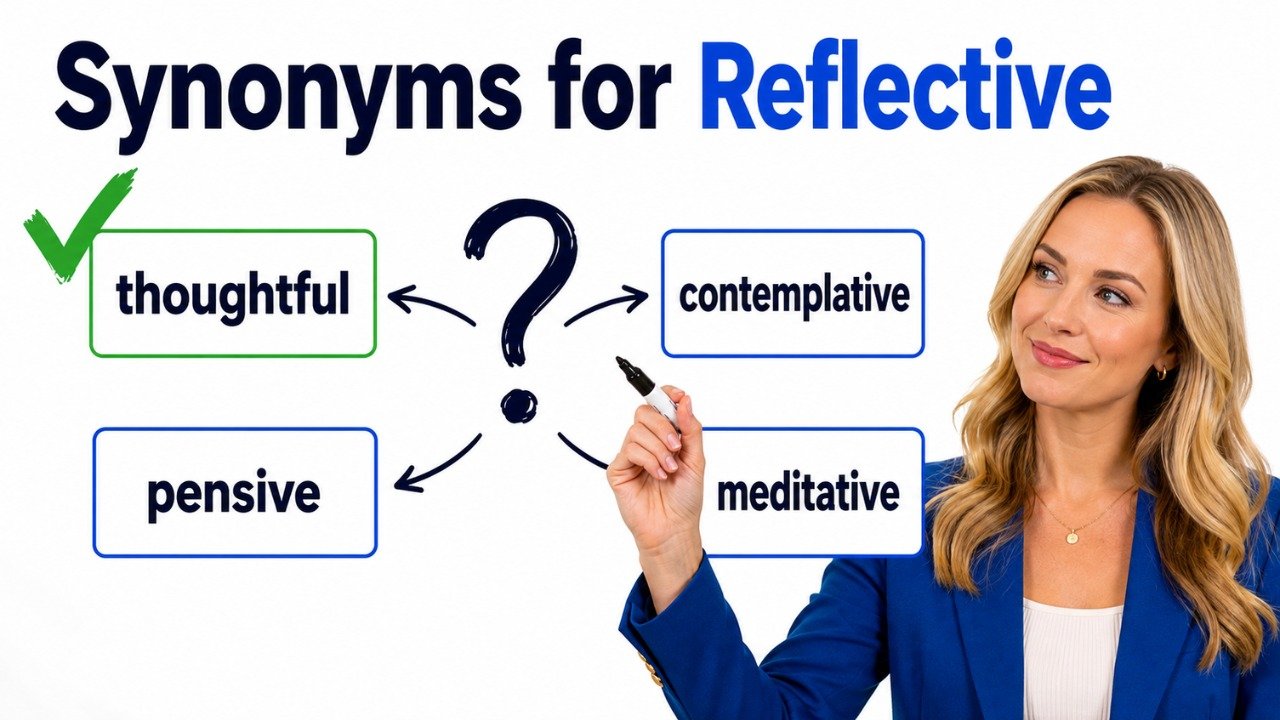
Quick Answer: The best synonyms for reflective include thoughtful, contemplative, meditative, pensive, introspective, philosophical, mirrored, polished, indicative, and representative. Use thoughtful for a person who carefully considers ideas, contemplative for quiet and serious thinking, introspective for examining personal thoughts and feelings, and pensive for a deeply thoughtful mood. For surfaces that reflect light, mirrored, glossy, or polished may work better. When reflective means showing or representing something, indicative or representative is usually more precise.
Pronunciation and Word Details
Word: Reflective.
Pronunciation: /rɪˈflek.tɪv/
Part of Speech: Adjective.
Meaning: Showing careful thought, capable of reflecting light or images, or revealing the qualities of something.
US Pronunciation:
UK Pronunciation:
What Does “Reflective” Mean?
Reflective means thoughtful, able to send back light or images, or showing the nature or qualities of something.
As an adjective, reflective has several important uses. When describing a person, expression, mood, or piece of writing, it often suggests careful and serious thought.
A reflective person may think deeply about experiences, decisions, emotions, or ideas before reaching a conclusion.
Example: She became reflective after discussing her future plans.
Reflective can also describe a physical surface that sends light or an image back toward the viewer.
Example: The reflective glass caught the afternoon sunlight.
Another common use appears in the phrase “reflective of.” In this sense, the word means showing, representing, or being characteristic of something.
Example: His careful response was reflective of his thoughtful personality.
The correct synonym therefore depends heavily on whether reflective refers to thought, physical reflection, or representation.
Meaning, Tone, and Context of “Reflective”
Reflective is generally a neutral and versatile adjective. Its tone changes according to context.
When describing a person or mood, reflective usually sounds thoughtful, calm, serious, and somewhat intellectual. It works naturally in everyday conversation, essays, personal writing, professional communication, and literary descriptions.
Thoughtful Context: Reflective describes someone who carefully considers ideas, feelings, or experiences.
Example: He was unusually reflective after the meeting.
In academic or personal writing, reflective often describes writing that examines experiences and explains what someone learned from them.
Example: Her reflective essay explored how the experience changed her perspective.
When describing materials or objects, reflective becomes more physical or technical.
Example: The reflective surface made the room appear brighter.
The phrase “reflective of” is often more formal. It means that something demonstrates or represents a broader quality, situation, attitude, or trend.
Example: The results were reflective of changes in customer preferences.
Because reflective has several meanings, choosing a synonym without considering context can easily change the intended message.
When and How to Use “Reflective”
For Careful Thought
Use reflective when describing someone who is quietly considering an experience, idea, or decision.
Example: She became reflective while thinking about everything she had achieved.
For Personal Examination
Reflective works well when someone is examining personal feelings, choices, or experiences.
Example: His journal became more reflective as he considered what he had learned.
For a Thoughtful Mood
Use reflective when describing a calm, serious, and thoughtful emotional state.
Example: The conversation left him in a reflective mood.
For Writing and Learning
Reflective can describe writing that discusses experiences and analyzes lessons or personal development.
Example: The assignment required a reflective paragraph about the project.
For Light or Images
Use reflective when a material or surface sends light, heat, or an image back rather than absorbing it.
Example: The building used reflective glass on its exterior.
For Representation
Use reflective of when something demonstrates, represents, or reveals a larger quality or condition.
Example: Her response was reflective of the concerns shared by the entire group.
Best Synonyms for Reflective
Thoughtful: Showing careful consideration or serious thought.
Example: He gave a thoughtful answer after considering the question.
Contemplative: Involving quiet and prolonged thinking.
Example: She remained contemplative as she watched the evening sky.
Meditative: Characterized by deep, calm, and focused thought.
Example: The peaceful setting created a meditative mood.
Pensive: Deeply thoughtful, often with a slightly serious or emotional feeling.
Example: He looked pensive as he remembered his childhood.
Introspective: Focused on examining your own thoughts, feelings, and motives.
Example: Her introspective writing revealed how much she had changed.
Philosophical: Thoughtful about deeper questions concerning life, meaning, or experience.
Example: Their discussion became philosophical as the evening continued.
Mirrored: Having a surface that reflects images like a mirror.
Example: The mirrored wall made the room seem larger.
Polished: Smooth and shiny enough to reflect light.
Example: The polished floor reflected the ceiling lights.
Indicative: Showing that a particular condition or quality exists.
Example: His response was indicative of growing confidence.
Representative: Typical of or showing the qualities of a wider group or situation.
Example: The examples were representative of the overall pattern.
50 Synonyms for Reflective with Short Meanings
- Thoughtful: Showing careful consideration.
- Contemplative: Engaged in quiet, serious thought.
- Meditative: Involving deep and calm thinking.
- Pensive: Deeply absorbed in thought.
- Introspective: Examining personal thoughts and feelings.
- Philosophical: Thoughtful about deeper ideas or life.
- Ruminative: Thinking repeatedly and deeply about something.
- Musing: Quietly considering an idea.
- Pondering: Thinking carefully about something.
- Deliberative: Involving careful consideration before deciding.
- Analytical: Examining ideas logically and carefully.
- Mindful: Carefully aware of thoughts or circumstances.
- Self aware: Conscious of personal feelings and behavior.
- Self examining: Carefully considering your own thoughts or actions.
- Inward looking: Focused on personal thoughts or experiences.
- Discerning: Showing careful judgment and understanding.
- Considering: Giving careful thought to something.
- Brooding: Deeply occupied with serious thoughts.
- Speculative: Considering possibilities or ideas thoughtfully.
- Cerebral: Focused strongly on intellectual thought.
- Studious: Showing serious mental attention.
- Measured: Careful, controlled, and considered.
- Reasoned: Based on careful thought and logic.
- Careful: Showing deliberate consideration.
- Soul searching: Involving deep examination of personal beliefs or feelings.
- Mirrored: Made to reflect images.
- Mirrorlike: Resembling a mirror in appearance.
- Shiny: Having a surface that reflects light.
- Glossy: Smooth and highly shining.
- Polished: Smooth and bright from finishing or rubbing.
- Lustrous: Having a soft and attractive shine.
- Gleaming: Shining brightly with reflected light.
- Glistening: Shining with small flashes of light.
- Shimmering: Reflecting light with a soft changing shine.
- Luminous: Appearing bright or full of light.
- Radiant: Bright or shining strongly.
- Sparkling: Reflecting many small points of light.
- Glassy: Smooth and shining like glass.
- Silvery: Having a bright appearance similar to silver.
- Specular: Producing mirrorlike reflection from a surface.
- Indicative: Showing evidence of something.
- Representative: Showing the qualities of a larger whole.
- Revealing: Making a quality or condition noticeable.
- Suggestive: Indicating or implying something.
- Expressive: Clearly showing a feeling or quality.
- Emblematic: Representing a particular quality or idea.
- Characteristic: Typical of a particular person or thing.
- Showing: Making a quality or condition apparent.
- Demonstrating: Providing clear evidence of something.
- Mirroring: Closely representing or reproducing something.
Read Also:
Synonyms for criteria

Synonyms for Reflective by Context
When Reflective Means Thoughtful
When reflective describes careful thinking, the most natural alternatives are thoughtful, contemplative, pensive, meditative, and pondering.
Example: She was reflective about the decision.
Alternative: She was thoughtful about the decision.
Thoughtful is the broadest choice and works naturally in both speech and writing.
When Reflective Means Introspective
For personal thoughts, feelings, memories, and self examination, introspective is often more precise.
Other useful choices include self aware, self examining, inward looking, and soul searching.
Example: His reflective journal explored his fears and ambitions.
Alternative: His introspective journal explored his fears and ambitions.
Introspective places stronger emphasis on looking inward.
When Reflective Means Contemplative
When the word suggests calm, prolonged, or serious thought, contemplative, meditative, philosophical, and ruminative are useful alternatives.
Example: She spent a reflective evening near the window.
Alternative: She spent a contemplative evening near the window.
Contemplative sounds especially natural when the thinking is quiet and peaceful.
When Reflective Describes a Surface
For surfaces, materials, glass, metal, or objects that return light or images, use mirrored, shiny, glossy, polished, lustrous, gleaming, or specular.
Example: The reflective surface caught the sunlight.
Alternative: The polished surface caught the sunlight.
The best choice depends on the physical appearance of the material.
When Reflective Means Representative
In the phrase “reflective of,” synonyms such as indicative, representative, revealing, characteristic, and suggestive are often clearer.
Example: The changes were reflective of wider economic conditions.
Alternative: The changes were indicative of wider economic conditions.
Indicative works especially well when something provides evidence of a larger condition.
Another Word for Reflective
The best general replacement for reflective is thoughtful when the word describes a person, expression, mood, or response.
However, reflective has several meanings, so no single synonym works in every sentence. Introspective is stronger for personal self examination, contemplative works for quiet thought, mirrored is appropriate for surfaces, and indicative works when reflective means representative of something.
Original: She seemed reflective after the conversation.
Better Option: She seemed thoughtful after the conversation.
Original: He wrote a reflective account of his experience.
Better Option: He wrote an introspective account of his experience.
Original: The reflective surface caught the light.
Better Option: The polished surface caught the light.
Original: Their attitudes were reflective of changing expectations.
Better Option: Their attitudes were indicative of changing expectations.
When Not to Use “Reflective”
Reflective is useful, but a more precise word is sometimes clearer.
Avoid reflective when the sentence specifically concerns personal self examination and introspective would communicate that meaning more accurately.
Weak: She wrote a reflective analysis of her own fears and motivations.
Better: She wrote an introspective analysis of her own fears and motivations.
Do not use reflective for every shiny object. If you are simply describing appearance, polished, glossy, gleaming, or mirrored may create a clearer image.
Weak: He placed the cup on the reflective table.
Better: He placed the cup on the polished table.
The phrase reflective of can also sound unnecessarily formal in simple conversation.
Weak: His smile was reflective of his happiness.
Better: His smile showed his happiness.
Avoid repeating reflective several times within the same paragraph. Choose alternatives based on the specific meaning.
Weak: The reflective writer created a reflective essay while feeling reflective about her experience.
Better: The thoughtful writer created an introspective essay while feeling contemplative about her experience.
Words Commonly Confused With Reflective
Reflective vs Reflexive: Reflective usually involves careful thought or the ability to reflect light. Reflexive describes an automatic response or an action directed back toward the subject.
Reflective vs Thoughtful: Reflective often emphasizes careful inward consideration. Thoughtful can mean carefully considering an idea or showing consideration for other people.
Reflective vs Introspective: Reflective is broader. Introspective specifically involves examining your own thoughts, feelings, motives, or experiences.
Reflective vs Contemplative: Reflective means thoughtful in a general sense. Contemplative often suggests prolonged, calm, or quiet thinking.
Reflective vs Pensive: Both describe thoughtfulness, but pensive often carries a serious, emotional, or slightly sad feeling.
Reflective vs Mirrored: Reflective can describe any surface that sends light back. Mirrored more specifically suggests a surface that produces a clear reflection.
Reflective vs Indicative: Reflective of can mean showing or representing something. Indicative is more direct when something serves as evidence of a condition or trend.
Which Synonym Should You Choose?
Choose thoughtful when describing a person, response, expression, or decision that involves careful consideration.
Choose contemplative for quiet and sustained thinking.
Choose meditative when the thought feels calm, focused, and peaceful.
Choose pensive when someone appears deeply thoughtful and slightly serious or emotional.
Choose introspective when someone examines personal thoughts, feelings, experiences, or motives.
Choose philosophical when discussing deeper questions about life, meaning, values, or experience.
Choose analytical when the thinking is logical, structured, and focused on examining information.
Choose mirrored when describing a surface designed to produce reflections.
Choose polished or glossy when appearance and shine matter more than the technical ability to reflect.
Choose indicative in reports, essays, or formal writing when something reveals evidence of a larger condition.
Choose representative when something serves as an example of a wider group, pattern, or situation.
Real Life Examples of “Reflective” in Sentences
Original: She became reflective after reading her old journal.
Better Option: She became introspective after reading her old journal.
Original: He gave a reflective response to the difficult question.
Better Option: He gave a thoughtful response to the difficult question.
Original: The quiet evening put her in a reflective mood.
Better Option: The quiet evening put her in a contemplative mood.
Original: His reflective expression suggested that something was troubling him.
Better Option: His pensive expression suggested that something was troubling him.
Original: She wrote a reflective essay about her first year at college.
Better Option: She wrote an introspective essay about her first year at college.
Original: The reflective floor made the lights appear brighter.
Better Option: The polished floor made the lights appear brighter.
Original: The reflective glass showed the surrounding buildings.
Better Option: The mirrored glass showed the surrounding buildings.
Original: His attitude was reflective of his growing confidence.
Better Option: His attitude was indicative of his growing confidence.
Original: The survey results were reflective of broader changes in opinion.
Better Option: The survey results were representative of broader changes in opinion.
Original: She remained reflective before making her final choice.
Better Option: She remained thoughtful before making her final choice.
Synonym Groups and Usage Differences
Thoughtfulness Group
Thoughtful, contemplative, pondering, deliberative, and considering describe careful thinking.
Thoughtful is the most flexible. Contemplative suggests quieter and deeper consideration, while deliberative emphasizes thinking before making a decision.
Example: He gave the proposal a thoughtful review before responding.
Introspection Group
Introspective, self aware, self examining, inward looking, and soul searching focus on examining yourself.
These words work well for personal writing, emotional reflection, memories, and personal development.
Example: Her introspective journal helped her understand her priorities.
Deep Thought Group
Pensive, ruminative, musing, philosophical, and meditative describe different forms of deep thought.
Pensive may carry emotional weight, while meditative sounds calmer. Philosophical often concerns broad or meaningful questions.
Example: He became philosophical while discussing how his priorities had changed.
Careful Reasoning Group
Analytical, reasoned, measured, discerning, and careful emphasize controlled or logical thought.
These alternatives are useful in professional, academic, and decision making contexts.
Example: She offered a measured response instead of reacting immediately.
Shining Surface Group
Shiny, glossy, polished, lustrous, gleaming, and glistening describe surfaces that visibly return light.
They focus more strongly on appearance than on the physical process of reflection.
Example: The polished stone gleamed beneath the lights.
Mirror Group
Mirrored, mirrorlike, glassy, and specular describe stronger or clearer forms of reflection.
Specular is more technical, while mirrored is common in ordinary descriptions.
Example: The mirrored panel reflected the entire hallway.
Representation Group
Indicative, representative, revealing, characteristic, suggestive, and emblematic work when reflective means showing something about a larger condition.
Example: The result was indicative of a broader shift in attitudes.
Antonyms of Reflective
The opposite of reflective changes according to its meaning.
When reflective means thoughtful, the opposite may describe someone who acts without enough consideration.
Thoughtless: Showing little careful consideration.
Impulsive: Acting quickly without sufficient thought.
Unthinking: Acting without reflection or careful reasoning.
Careless: Not giving enough attention or consideration.
Hasty: Done too quickly without proper thought.
Superficial: Lacking depth of thought or understanding.
When reflective describes a surface, the opposite may relate to absorbing rather than returning light.
Dull: Lacking shine or brightness.
Matte: Having a surface without noticeable shine.
Nonshiny: Not reflecting much visible light.
When reflective means revealing or representative, possible opposites include:
Unrepresentative: Not accurately showing a wider group or condition.
Uncharacteristic: Not typical of a person, thing, or situation.
Misleading: Giving an inaccurate impression of something.
Comparison: Reflective vs Related Words
Reflective vs Thoughtful
Reflective suggests careful consideration and can involve looking back on experiences. Thoughtful is broader and can also describe consideration for other people.
Example With Reflective: She felt reflective after visiting her childhood home.
Example With Thoughtful: She gave a thoughtful answer to the question.
Reflective vs Introspective
Reflective can involve thinking about any experience, idea, or situation. Introspective specifically means looking inward at your own feelings, thoughts, or motivations.
Example With Reflective: He became reflective about the changes in his career.
Example With Introspective: He became introspective about why success mattered so much to him.
Reflective vs Contemplative
Reflective describes thoughtful consideration, while contemplative often suggests quiet, sustained, and peaceful thinking.
Example With Reflective: She was reflective after receiving the news.
Example With Contemplative: She sat in contemplative silence beside the window.
Reflective vs Pensive
Reflective is generally neutral. Pensive often suggests serious thought combined with emotion, concern, or sadness.
Example With Reflective: His reflective expression showed that he was considering the proposal.
Example With Pensive: His pensive expression suggested that old memories were troubling him.
Reflective vs Meditative
Reflective means thoughtful, while meditative suggests calm, focused, and often prolonged thought.
Example With Reflective: The story has a reflective tone.
Example With Meditative: The story has a calm, meditative tone.
Reflective vs Mirrored
Reflective describes the general ability to return light or images. Mirrored suggests a surface that creates a stronger and clearer visual reflection.
Example With Reflective: The reflective material became bright under the headlights.
Example With Mirrored: The mirrored wall reflected the entire room.
Reflective vs Indicative
Reflective of and indicative of can both mean showing a quality or condition. Indicative usually sounds more precise when discussing evidence, data, patterns, or trends.
Example With Reflective: The results were reflective of changing preferences.
Example With Indicative: The results were indicative of changing preferences.
Common Phrases and Expressions With Reflective
Reflective Mood: A mental state involving quiet and serious thought.
Reflective Thinking: Careful consideration of ideas, experiences, or decisions.
Reflective Practice: Careful examination of previous experiences to improve future actions.
Reflective Writing: Writing that explores experiences, thoughts, feelings, and lessons.
Reflective Essay: An essay that examines a personal experience and its meaning.
Reflective Surface: A surface that sends light or images back.
Reflective Material: Material designed or able to return light.
Reflective Glass: Glass that reflects a noticeable amount of light.
Reflective of Something: Showing or representing a particular quality or condition.
Reflective Person: Someone who regularly thinks carefully about ideas, actions, or experiences.
Common Mistakes to Avoid
One common mistake is treating every synonym for reflective as interchangeable.
Thoughtful, pensive, contemplative, and introspective all relate to thinking, but each carries a different nuance.
Use thoughtful for general careful consideration. Use introspective when someone examines personal emotions or motives. Choose pensive when the thoughtfulness has a serious or emotional quality.
Another mistake is using reflective when describing a surface without considering what visual quality actually matters. A glossy surface is smooth and shiny, while a mirrored surface produces a much clearer reflection.
Writers also sometimes confuse reflective with reflexive. These words may look similar, but their meanings are different. Reflective relates mainly to thought or reflection. Reflexive commonly describes an automatic reaction or a grammatical structure involving the subject itself.
Avoid overusing reflective of in simple sentences. Words such as indicative, representative, showing, or revealing can sometimes make the sentence clearer.
Finally, consider the specific meaning before replacing reflective. A synonym that works perfectly for reflective thinking will usually make no sense when describing reflective glass.
Conclusion
The best synonyms for reflective depend on what the word describes. Thoughtful is the strongest general choice for careful thinking, while contemplative, meditative, pensive, and introspective express different kinds of deeper thought. Mirrored, polished, glossy, and gleaming work better for surfaces that return light. When reflective means showing or representing something, indicative and representative are often clearer. Matching the synonym to the intended meaning helps make writing more natural, accurate, and expressive.
FAQs About Synonyms for Reflective
What Is the Best Synonym for Reflective?
Thoughtful is the best general synonym when reflective describes a person, response, mood, or idea. Other choices depend on the exact context.
What Is Another Word for a Reflective Person?
A reflective person can be described as thoughtful, contemplative, introspective, philosophical, pensive, or meditative.
What Is a Synonym for Reflective Thinking?
Useful alternatives include thoughtful thinking, contemplative thought, careful reasoning, introspection, deliberation, and analytical thinking.
Is Introspective a Synonym for Reflective?
Yes. Introspective is a strong synonym when reflective refers to examining your own thoughts, feelings, motives, or experiences.
What Is a Synonym for a Reflective Surface?
Mirrored, polished, glossy, shiny, lustrous, gleaming, and mirrorlike can describe reflective surfaces depending on their appearance.
What Does Reflective of Mean?
Reflective of means showing, representing, or revealing the qualities of something. Indicative of and representative of are common alternatives.
What Is the Difference Between Reflective and Pensive?
Reflective generally means thoughtful or considering something carefully. Pensive describes deep thought that often carries a serious, emotional, or slightly sad feeling.
I can also prepare the SEO friendly external link placement and exact anchor sentence for this reflective article using your usual one link rule.
Here is the complete article for synonyms for reflective, following the same sequence with an SEO title, balanced meta description, context based explanations, and exactly 50 synonyms.
SEO Title: Synonyms for Reflective with Meanings and Best Uses
Meta Description: Explore synonyms for reflective for thoughtful ideas, moods, and shining surfaces. Learn which words fit contemplation, light, writing, and description.
