
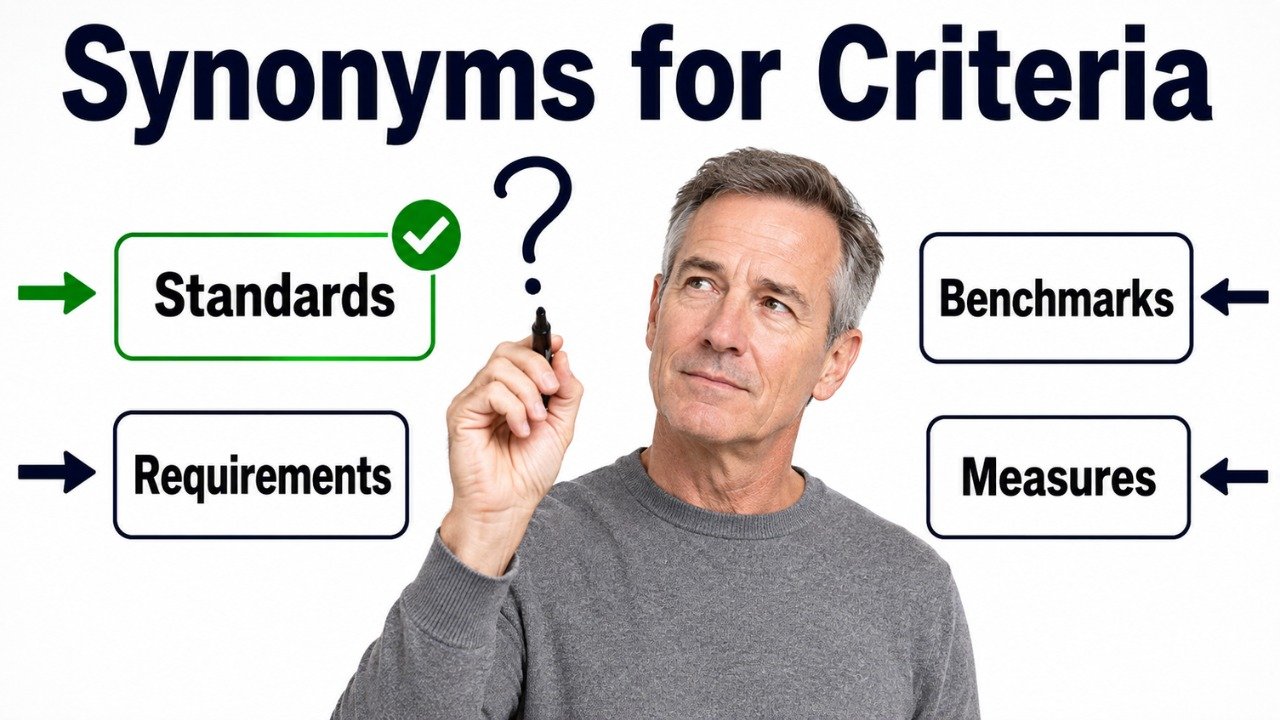
Quick Answer: The best synonyms for criteria include standards, requirements, conditions, benchmarks, measures, guidelines, qualifications, specifications, rules, and principles. Use standards when judging quality, requirements for things that must be satisfied, conditions for circumstances that must exist, benchmarks for comparison, measures for evaluation, guidelines for recommended practices, qualifications for eligibility, and specifications for precise technical expectations.
Pronunciation and Word Details
Word: Criteria.
Pronunciation: /kraɪˈtɪəriə/
Part of Speech: Plural noun.
Meaning: Standards, requirements, or conditions used to judge, evaluate, select, or decide something.
US Pronunciation:
UK Pronunciation:
What Does “Criteria” Mean?
Criteria means the standards, requirements, conditions, or measures used to judge, compare, evaluate, or select something.
Criteria is the plural form of criterion. One standard is a criterion, while two or more standards are criteria.
The word is commonly used in education, hiring, research, business, science, evaluation, decision making, applications, competitions, and professional reports.
For example, admission criteria are the requirements used to decide who may enter a program. Evaluation criteria are the standards used to judge performance or quality.
The meaning can change slightly with context. In selection, criteria often means requirements or qualifications. In evaluation, it may mean standards, measures, or benchmarks.
Meaning, Tone, and Context of “Criteria”
Criteria has a neutral and somewhat formal tone. It is especially common in academic, professional, technical, administrative, and business writing.
In everyday conversation, requirements, rules, or standards may sound simpler.
In formal reports, criteria is useful because it clearly indicates that a decision is based on defined standards rather than personal preference.
In hiring, criteria may refer to experience, education, skills, or qualifications.
In research, criteria can describe the rules used to include, exclude, classify, or evaluate information.
In quality assessment, standards, benchmarks, and measures may be more precise alternatives.
Because criteria is broad, the best synonym depends on whether the sentence focuses on judgment, eligibility, comparison, rules, or technical expectations.
When and How to Use “Criteria”
For Evaluation: Use criteria when referring to standards used to judge quality, performance, or effectiveness.
Example: The judges evaluated each entry using five criteria.
For Selection: Use criteria when explaining how people, products, ideas, or options are chosen.
Example: Experience and communication skills are important selection criteria.
For Eligibility: Criteria can describe conditions that someone must meet to qualify.
Example: Applicants must satisfy all eligibility criteria.
For Research: Use criteria for rules that determine which data, participants, or studies are included.
Example: The researchers established clear inclusion criteria.
For Decision Making: Criteria can identify the factors used to compare alternatives.
Example: Cost, reliability, and safety were the main decision criteria.
For Quality Control: Use criteria when judging whether something meets an expected level.
Example: The product failed to meet the quality criteria.
For Technical Requirements: Criteria can refer to measurable expectations or specifications.
Example: The system must satisfy several performance criteria.
Best Synonyms for Criteria
Standards: Established levels used to judge quality or performance.
Example: The work must meet professional standards.
Requirements: Conditions that must be satisfied.
Example: Applicants must meet the listed requirements.
Conditions: Circumstances or terms that must exist or be fulfilled.
Example: The applicant satisfied all necessary conditions.
Benchmarks: Reference points used for comparison or evaluation.
Example: The results exceeded industry benchmarks.
Measures: Methods or factors used to assess something.
Example: Several measures were used to evaluate performance.
Guidelines: Recommended rules or principles that direct decisions or actions.
Example: Reviewers followed the evaluation guidelines.
Qualifications: Skills, experience, or characteristics required for eligibility.
Example: The position requires several professional qualifications.
Specifications: Detailed requirements describing expected features or performance.
Example: The equipment meets all technical specifications.
Rules: Defined instructions or standards that govern decisions or behavior.
Example: The competition rules explain how entries are judged.
Principles: Fundamental ideas or standards guiding judgment or action.
Example: Fairness and accuracy are key principles of the process.
50 Synonyms for Criteria with Short Meanings
- Standards: Levels used to judge quality or performance.
- Requirements: Conditions that must be satisfied.
- Conditions: Terms or circumstances that must be met.
- Benchmarks: Reference points used for comparison.
- Measures: Factors or methods used for assessment.
- Guidelines: Recommended standards for decisions or actions.
- Qualifications: Abilities or characteristics needed for eligibility.
- Specifications: Detailed statements of expected features or performance.
- Rules: Defined instructions governing evaluation or selection.
- Principles: Basic ideas guiding judgment or decisions.
- Factors: Elements considered when making a decision.
- Considerations: Matters taken into account.
- Indicators: Signs used to evaluate or identify something.
- Parameters: Defined limits or conditions for evaluation.
- Prerequisites: Things required before another condition can be satisfied.
- Expectations: Levels or results considered necessary or desirable.
- Norms: Accepted standards within a group or field.
- Tests: Methods used to determine whether standards are met.
- Measures of Quality: Factors used to assess excellence or suitability.
- Evaluation Standards: Rules used to judge performance or quality.
- Selection Standards: Standards used to choose among options.
- Selection Requirements: Conditions used to determine eligibility.
- Eligibility Requirements: Conditions that determine who qualifies.
- Judging Standards: Standards used to assess entries or performance.
- Assessment Measures: Methods used to evaluate results.
- Evaluation Measures: Factors used to judge effectiveness.
- Performance Standards: Expected levels of achievement or quality.
- Quality Standards: Requirements used to judge quality.
- Acceptance Standards: Conditions that determine whether something is approved.
- Admission Requirements: Conditions necessary for entry.
- Entry Requirements: Conditions that must be met to participate or enter.
- Minimum Requirements: Lowest acceptable conditions or standards.
- Essential Requirements: Conditions considered necessary.
- Core Requirements: Fundamental conditions that must be met.
- Evaluation Factors: Elements considered during assessment.
- Decision Factors: Elements influencing a choice.
- Selection Factors: Elements used when choosing among alternatives.
- Judging Factors: Elements considered when making an evaluation.
- Reference Points: Standards used for comparison.
- Yardsticks: Informal standards used for measuring or comparing.
- Thresholds: Minimum levels required for acceptance or action.
- Conditions of Acceptance: Requirements necessary for approval.
- Conditions of Eligibility: Requirements necessary to qualify.
- Assessment Standards: Established levels used for evaluation.
- Evaluation Principles: Ideas that guide assessment.
- Decision Rules: Defined rules used to make choices.
- Screening Standards: Standards used to filter candidates or options.
- Indicators of Quality: Signs used to judge excellence or suitability.
- Performance Measures: Ways of evaluating achievement or effectiveness.
- Selection Guidelines: Recommended standards for choosing among options.
Read Also:
Synonyms for Notable

Synonyms for Criteria by Context
When Criteria Means Standards
When criteria refers to levels used to judge quality or performance, standards is usually the strongest alternative.
Useful synonyms include standards, norms, benchmarks, quality standards, performance standards, and assessment standards.
Example: The work must meet strict quality standards.
Example: The organization established clear performance benchmarks.
When Criteria Means Requirements
When criteria describes things that must be satisfied, requirements, conditions, prerequisites, or qualifications may be better choices.
Example: Applicants must meet all admission requirements.
Example: Previous experience is one of the main qualifications for the role.
When Criteria Means Measures
When criteria refers to ways of evaluating something, measures, indicators, assessment measures, and performance measures are useful alternatives.
Example: The team developed several measures of success.
Example: Customer satisfaction was one of the key performance measures.
When Criteria Means Guidelines
When criteria provides direction rather than strict requirements, guidelines, principles, or selection guidelines may be more accurate.
Example: Reviewers followed clear selection guidelines.
Example: The committee based its decisions on several guiding principles.
When Criteria Means Benchmarks
Benchmarks and reference points work best when one result is compared with another established level.
Example: The company compared its results with established benchmarks.
Example: Previous performance served as a useful reference point.
When Criteria Means Eligibility Conditions
Requirements, qualifications, prerequisites, eligibility requirements, and entry requirements work well when deciding whether someone qualifies.
Example: Applicants must satisfy all eligibility requirements.
Example: A valid certificate is one of the entry requirements.
Another Word for Criteria
Standards is often the best single replacement for criteria when the sentence describes how quality, performance, or suitability is judged. However, requirements may be more accurate when something must be satisfied, while benchmarks work better for comparison.
Original: The committee established clear criteria for judging the applications.
Better Option: The committee established clear standards for judging the applications.
Original: Applicants must meet several criteria.
Better Option: Applicants must meet several requirements.
Original: Cost and reliability are important criteria for our decision.
Better Option: Cost and reliability are important decision factors.
Original: The system was tested against strict criteria.
Better Option: The system was tested against strict performance standards.
When Not to Use “Criteria”
Criteria can sound unnecessarily formal in simple everyday conversation.
Weak: My criteria for choosing lunch are price and taste.
Better: My main considerations for choosing lunch are price and taste.
Do not use criteria as a singular noun in formal writing.
Weak: The main criteria is experience.
Better: The main criterion is experience.
Use criteria when referring to more than one standard.
Weak: This criteria is important.
Better: This criterion is important.
Criteria can also be vague when the exact meaning is requirements.
Weak: Applicants must satisfy the criteria.
Better: Applicants must satisfy the listed eligibility requirements.
Avoid criteria when technical specifications are more precise.
Weak: The machine meets the design criteria.
Better: The machine meets the technical specifications.
Do not repeat criteria in every sentence when alternatives can clarify the meaning.
Weak: The criteria include cost criteria, safety criteria, and quality criteria.
Better: The evaluation standards include cost, safety, and quality measures.
Words Commonly Confused With Criteria
Criteria vs Criterion: Criterion is singular, while criteria is plural. One standard is a criterion, while several standards are criteria.
Criteria vs Requirements: Criteria are standards used for evaluation or decision making. Requirements are conditions that must be satisfied.
Criteria vs Standards: Standards usually describe expected levels of quality or performance. Criteria can include standards, requirements, factors, or measures.
Criteria vs Guidelines: Criteria are often used to make judgments. Guidelines usually provide recommendations or direction and may not be mandatory.
Criteria vs Benchmarks: Criteria determine how something will be evaluated, while benchmarks provide reference points for comparison.
Criteria vs Qualifications: Qualifications usually refer to skills, experience, education, or characteristics that make someone suitable or eligible.
Criteria vs Specifications: Specifications describe precise technical or functional requirements, while criteria can be broader.
Criteria vs Factors: Factors are elements considered in a decision. Criteria are often the defined standards used to judge those factors.
Which Synonym Should You Choose?
Choose standards when discussing quality, performance, professional expectations, or evaluation.
Choose requirements when describing conditions that must be satisfied.
Choose conditions when approval or eligibility depends on particular circumstances.
Choose benchmarks when comparing results with an established reference point.
Choose measures when evaluating performance, effectiveness, quality, or progress.
Choose guidelines when the standards provide direction rather than strict obligations.
Choose qualifications when discussing skills, education, experience, or eligibility for a position.
Choose specifications when describing detailed technical expectations.
Choose factors when identifying things that influence a decision.
Choose prerequisites when something must exist or happen before another step can occur.
Choose indicators when particular signs are used to measure quality, progress, or success.
Choose thresholds when there is a minimum level that must be reached.
Real Life Examples of “Criteria” in Sentences
Original: The judges used several criteria to evaluate the entries.
Better Option: The judges used several standards to evaluate the entries.
Original: Applicants must meet all the criteria.
Better Option: Applicants must meet all the requirements.
Original: Cost is one of our main criteria.
Better Option: Cost is one of our main decision factors.
Original: The project met the required criteria.
Better Option: The project met the required standards.
Original: Experience is part of the selection criteria.
Better Option: Experience is part of the selection requirements.
Original: The researchers established clear criteria for participation.
Better Option: The researchers established clear eligibility conditions for participation.
Original: Safety was one of the most important criteria.
Better Option: Safety was one of the most important considerations.
Original: The equipment failed to meet the performance criteria.
Better Option: The equipment failed to meet the performance standards.
Original: The committee reviewed the criteria before making a decision.
Better Option: The committee reviewed the evaluation guidelines before making a decision.
Original: Reliability and cost are useful criteria for comparison.
Better Option: Reliability and cost are useful measures for comparison.
Synonym Groups and Usage Differences
Standards Group
Standards, norms, benchmarks, quality standards, and performance standards focus on expected levels of quality or achievement.
These words work well in professional, educational, technical, and quality control contexts.
Example: Every submission must meet the required quality standards.
Requirements Group
Requirements, conditions, prerequisites, minimum requirements, and essential requirements describe things that must be satisfied.
These alternatives are especially useful for applications, admissions, contracts, and eligibility.
Example: Applicants must meet all essential requirements.
Evaluation Group
Measures, indicators, assessment measures, evaluation measures, and performance measures focus on judging results or effectiveness.
Example: The report identifies several measures of success.
Selection Group
Selection standards, selection requirements, qualifications, screening standards, and selection factors are useful when choosing people, products, or options.
Example: Experience is one of the main selection factors.
Comparison Group
Benchmarks, reference points, standards, and yardsticks provide a basis for comparison.
Example: Previous results provide a useful benchmark for future performance.
Guidance Group
Guidelines, principles, evaluation principles, and selection guidelines provide direction for decisions.
Example: The panel followed consistent selection guidelines.
Antonyms of Criteria
Criteria does not have one exact opposite because it refers to standards or requirements. However, several contrasting ideas can apply depending on context.
Arbitrariness: Decision making without clear standards.
Guesswork: Judgment based on uncertainty rather than defined measures.
Randomness: Selection without established standards.
Subjectivity: Judgment based mainly on personal opinion.
Irrelevance: Information that has no useful connection to the decision.
Exception: A case that does not follow the normal standard.
Discretion: Freedom to decide without rigid rules.
Flexibility: Ability to adjust standards or requirements.
Uncertainty: Lack of clear standards or conditions.
Indefiniteness: Absence of precise requirements or limits.
Comparison: Criteria vs Related Words
Criteria vs Standards
Criteria are the factors or rules used for judgment, while standards often describe the expected level of quality or performance.
Example With Criteria: Accuracy and clarity are two criteria for evaluating the report.
Example With Standards: The report must meet professional writing standards.
Criteria vs Requirements
Criteria help evaluate or select something. Requirements identify conditions that must be satisfied.
Example With Criteria: Experience is one criterion used to compare applicants.
Example With Requirements: Applicants must have at least two years of experience.
Criteria vs Guidelines
Criteria are used directly in evaluation or selection. Guidelines provide recommended direction and may be more flexible.
Example With Criteria: The judges used five criteria to score the entries.
Example With Guidelines: The judges followed the published evaluation guidelines.
Criteria vs Benchmarks
Criteria define what will be judged. Benchmarks provide a reference level for comparison.
Example With Criteria: Speed and reliability are important criteria.
Example With Benchmarks: The new system exceeded previous performance benchmarks.
Criteria vs Qualifications
Criteria can include many types of standards, while qualifications usually describe the skills, education, experience, or characteristics needed for a role.
Example With Criteria: Communication ability is one of the selection criteria.
Example With Qualifications: The position requires strong communication qualifications and relevant experience.
Criteria vs Specifications
Criteria are broader standards for judgment, while specifications state precise technical or functional requirements.
Example With Criteria: Durability is an important design criterion.
Example With Specifications: The materials must meet the listed technical specifications.
Common Phrases and Expressions With Criteria
Selection Criteria: Standards used to choose among people or options.
Evaluation Criteria: Standards used to assess quality or performance.
Eligibility Criteria: Conditions used to determine who qualifies.
Admission Criteria: Standards used to decide who may enter a program or institution.
Assessment Criteria: Standards used to evaluate work or performance.
Performance Criteria: Standards used to measure effectiveness or achievement.
Quality Criteria: Standards used to judge quality.
Decision Criteria: Factors or standards used when making a choice.
Inclusion Criteria: Conditions that determine what or who may be included.
Exclusion Criteria: Conditions that determine what or who must be left out.
Common Mistakes to Avoid
A common grammar mistake is using criteria as a singular noun. Criteria is plural, while criterion is singular.
Write “this criterion” when referring to one standard and “these criteria” when referring to several standards.
Another mistake is pairing criteria with a singular verb.
Incorrect: The criteria is clear.
Correct: The criteria are clear.
Do not use requirements, standards, and criteria as though they always mean exactly the same thing. Requirements must generally be satisfied, while criteria may simply be used to compare or judge alternatives.
Avoid vague phrases such as “the criteria are good” when you can explain what the standards actually measure.
Do not overuse criteria in the same paragraph. Alternatives such as standards, requirements, measures, factors, and guidelines can make the meaning clearer.
Be careful with benchmark. A benchmark is a reference point for comparison, not simply any rule used in evaluation.
Conclusion
The best synonyms for criteria depend on how the standards are being used. Standards works well for quality and performance, requirements for mandatory conditions, benchmarks for comparison, measures for evaluation, and guidelines for recommended practices. Qualifications are useful for eligibility, while specifications fit technical contexts. Understanding these synonyms for criteria helps you describe selection, assessment, decision making, and evaluation more precisely while avoiding common confusion between criteria, criterion, standards, and requirements.
FAQs About Synonyms for Criteria
What is the best synonym for criteria?
Standards is one of the strongest general synonyms for criteria, especially when something is being judged for quality, performance, or suitability.
What is a simple synonym for criteria?
Requirements, standards, and rules are simple alternatives, depending on the context.
What is the singular form of criteria?
Criterion is the singular form. One standard is a criterion, while several standards are criteria.
Can requirements replace criteria?
Yes, when the sentence describes conditions that must be satisfied. However, criteria may also include factors used for comparison that are not strict requirements.
What is a formal synonym for criteria?
Standards, parameters, benchmarks, specifications, evaluation measures, and prerequisites are useful formal alternatives.
What are synonyms for selection criteria?
Useful alternatives include selection standards, selection requirements, qualifications, screening standards, decision factors, and selection guidelines.
What synonyms for criteria work well in essays?
Standards, requirements, benchmarks, measures, factors, principles, guidelines, parameters, and considerations are strong choices for essays and academic writing.
