
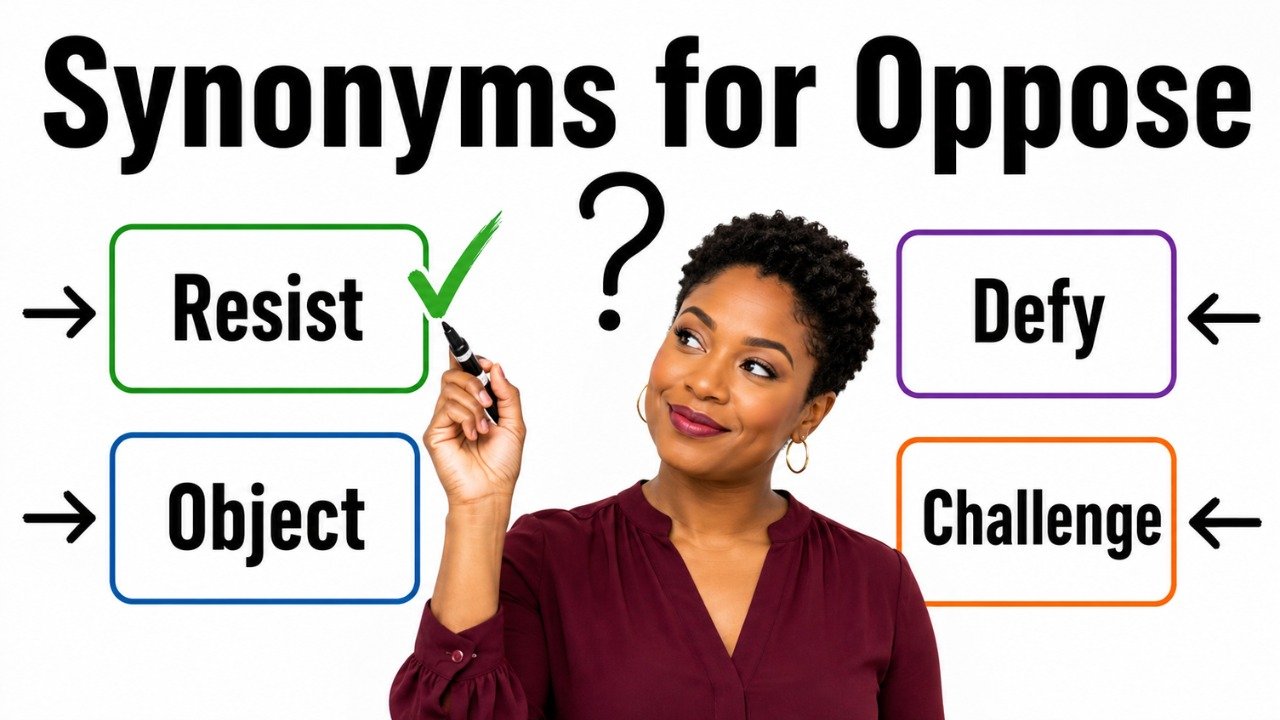
Quick Answer: The best synonyms for oppose include resist, object to, challenge, contest, reject, dispute, contradict, protest, defy, and withstand. Use resist when fighting against pressure or change, object to for expressing disagreement, challenge when questioning an idea or decision, contest for formally disputing something, reject for refusing a proposal, dispute for arguing against a claim, contradict for opposing a statement, protest for public or strong objection, defy for refusing to obey, and withstand for resisting force or pressure.
Pronunciation and Word Details
Word: Oppose.
Pronunciation: /əˈpoʊz/
Part of Speech: Verb.
Meaning: To disagree with, resist, challenge, or act against someone or something.
US Pronunciation:
UK Pronunciation:
What Does “Oppose” Mean?
Oppose means to disagree with, resist, or act against a person, idea, proposal, rule, action, or force.
It is a verb and can describe verbal disagreement, political resistance, physical resistance, competition, or an attempt to prevent something from happening.
A person may oppose a new policy, oppose a decision, oppose an argument, or oppose another candidate. An object can also oppose force or movement in a more physical sense.
The exact meaning depends on context. In discussion, oppose often means disagree or object. In conflict, it can mean resist or fight against. In formal situations, contest or challenge may be more precise.
Meaning, Tone, and Context of “Oppose”
Oppose is a neutral to strong word. It can sound formal, serious, or direct depending on the sentence.
It is common in essays, debates, reports, politics, law, workplace discussions, academic writing, and everyday conversation.
When someone opposes an idea, the word usually suggests more than simple uncertainty. It often means that the person takes a position against it.
In casual conversation, disagree with or be against may sound more natural.
In formal writing, object to, challenge, contest, dispute, or reject may provide a more specific meaning.
Oppose can also describe active resistance. Someone may oppose pressure, authority, restrictions, or harmful actions.
When and How to Use “Oppose”
For Disagreement: Use oppose when someone has a different position from another person or idea.
Example: Several members oppose the proposed changes.
For Resistance: Use oppose when someone actively tries to prevent something from happening.
Example: Residents opposed the construction plan.
For Policies and Decisions: Oppose works well when discussing laws, rules, plans, or proposals.
Example: The committee decided to oppose the new policy.
For Arguments: Use oppose when presenting a position against a claim or viewpoint.
Example: The essay opposes the idea that the change is necessary.
For Competition: Oppose can describe competing against another person or group.
Example: She will oppose a strong competitor in the final round.
For Authority: Use oppose when someone refuses to support or accept authority or control.
Example: The group continued to oppose the restrictions.
Best Synonyms for Oppose
Resist: To fight against pressure, control, change, or force.
Example: Many residents resisted the proposed development.
Object To: To express disagreement or disapproval.
Example: Several employees objected to the new rule.
Challenge: To question or oppose the truth, fairness, or authority of something.
Example: The lawyer challenged the decision.
Contest: To dispute or formally oppose a claim, result, or decision.
Example: The candidate decided to contest the result.
Reject: To refuse to accept, approve, or support something.
Example: The board rejected the proposal.
Dispute: To argue against the truth or validity of something.
Example: The researcher disputed the earlier conclusion.
Contradict: To state the opposite of what another statement says.
Example: The evidence contradicts his claim.
Protest: To express strong objection or opposition.
Example: Residents protested the planned closure.
Defy: To openly resist or refuse to obey.
Example: The group defied the order.
Withstand: To resist force, pressure, damage, or influence.
Example: The structure can withstand strong winds.
50 Synonyms for Oppose with Short Meanings
- Resist: Fight against pressure, force, or change.
- Object To: Express disagreement with something.
- Challenge: Question or confront an idea, decision, or authority.
- Contest: Formally dispute or oppose something.
- Reject: Refuse to accept or support.
- Dispute: Argue against a claim or conclusion.
- Contradict: State something contrary to another statement.
- Protest: Express strong disagreement or objection.
- Defy: Openly resist or refuse to obey.
- Withstand: Resist pressure, force, or damage.
- Disagree With: Hold a different opinion from someone.
- Be Against: Take a position opposed to something.
- Counter: Act or argue against something.
- Combat: Fight actively against a problem or force.
- Fight: Struggle against someone or something.
- Fight Against: Actively resist or combat.
- Rebel Against: Resist authority or control.
- Stand Against: Take a clear position in opposition.
- Argue Against: Give reasons for rejecting an idea.
- Speak Against: Publicly express disagreement.
- Campaign Against: Work actively to prevent or defeat something.
- Resist Against: Struggle against control or pressure.
- Refuse: Decline to accept, follow, or support.
- Deny: Refuse to acknowledge or accept.
- Repudiate: Reject strongly and formally.
- Renounce: Formally reject or give up support for something.
- Disapprove Of: Have an unfavorable opinion of something.
- Dissent From: Disagree with an accepted view or decision.
- Differ With: Hold a different opinion from someone.
- Take Issue With: Express disagreement with a statement or position.
- Question: Express doubt about the truth or value of something.
- Criticize: Point out faults or weaknesses.
- Condemn: Express strong disapproval.
- Denounce: Publicly criticize or reject strongly.
- Confront: Face or challenge directly.
- Counteract: Act against an effect or influence.
- Block: Prevent something from proceeding.
- Obstruct: Make progress difficult or impossible.
- Hinder: Create difficulty or delay.
- Prevent: Stop something from happening.
- Thwart: Successfully prevent a plan or effort.
- Frustrate: Prevent a plan from succeeding.
- Restrain: Hold back or limit action.
- Resist Pressure: Refuse to give in to influence.
- Dispute Against: Challenge the validity of a position.
- Compete Against: Act as a rival to another person or group.
- Face: Meet an opponent or challenge directly.
- Counterbalance: Act against an opposing force or influence.
- Countermand: Reverse or oppose a previous command or instruction.
- Stand Up Against: Resist something considered wrong or harmful.
Read Also:
Synonyms for Primarily

Synonyms for Oppose by Context
When Oppose Means Disagree
When oppose refers mainly to disagreement, useful alternatives include disagree with, object to, differ with, dissent from, take issue with, and be against.
Example: Several members disagreed with the proposed change.
Example: She objected to the new procedure.
When Oppose Means Resist
When oppose involves active resistance, use resist, withstand, defy, rebel against, fight against, or stand against.
Example: The community resisted the development plan.
Example: The workers stood against the unfair rule.
When Oppose Means Challenge
Challenge, contest, dispute, question, and contradict are useful when opposing a claim, argument, decision, or result.
Example: The lawyer challenged the ruling.
Example: The evidence contradicted the original explanation.
When Oppose Means Prevent
When oppose involves trying to stop an action or outcome, useful alternatives include block, obstruct, hinder, prevent, thwart, and frustrate.
Example: The committee blocked the proposal.
Example: New safeguards helped prevent misuse.
When Oppose Means Publicly Object
Protest, denounce, condemn, campaign against, speak against, and stand against work well when opposition is public or strongly expressed.
Example: Residents protested the closure.
Example: Community leaders spoke against the proposal.
Another Word for Oppose
Resist is often the best single replacement for oppose when the meaning involves fighting against pressure, change, control, or an unwanted action. However, the best alternative depends on whether the context involves disagreement, criticism, formal dispute, or active resistance.
Original: Many residents oppose the new project.
Better Option: Many residents resist the new project.
Original: She opposes the proposed rule.
Better Option: She objects to the proposed rule.
Original: The lawyer opposed the decision.
Better Option: The lawyer challenged the decision.
Original: Several members oppose the claim.
Better Option: Several members dispute the claim.
When Not to Use “Oppose”
Oppose can sound too strong when someone simply has a different opinion.
Weak: I oppose your choice of restaurant.
Better: I disagree with your choice of restaurant.
Avoid oppose when reject is more precise.
Weak: The committee opposed the application after reviewing it.
Better: The committee rejected the application after reviewing it.
Do not use oppose when the sentence is specifically about questioning evidence or a claim.
Weak: The study opposes the earlier findings.
Better: The study challenges the earlier findings.
Oppose may also sound vague when the exact kind of resistance matters.
Weak: The material opposes heat.
Better: The material withstands heat.
Avoid repeating oppose several times in the same paragraph.
Weak: Residents oppose the proposal because they oppose the cost and oppose the location.
Better: Residents object to the proposal because they reject the cost and disagree with the location.
Words Commonly Confused With Oppose
Oppose vs Resist: Oppose means to take a position against something, while resist usually suggests active effort to prevent, withstand, or fight it.
Oppose vs Disagree: Disagree means to hold a different opinion. Oppose often suggests a stronger or more active position against something.
Oppose vs Object: Object means to express disagreement or disapproval. Oppose can include both disagreement and active resistance.
Oppose vs Reject: Reject means to refuse to accept or approve something. Oppose means to stand against it, whether or not you have the power to reject it.
Oppose vs Challenge: Challenge means to question the truth, fairness, validity, or authority of something. Oppose is broader.
Oppose vs Protest: Protest usually involves openly expressing strong objection. Oppose does not necessarily involve public action.
Oppose vs Contradict: Contradict means to say or show that another statement is wrong or inconsistent. Oppose can refer to ideas, actions, people, policies, or forces.
Which Synonym Should You Choose?
Choose resist when describing active opposition to pressure, authority, control, or change.
Choose object to when expressing polite or formal disagreement.
Choose disagree with in casual conversation when the opposition is mainly about opinion.
Choose challenge when questioning an argument, claim, decision, authority, or established belief.
Choose contest when formally disputing an election result, legal decision, claim, or judgment.
Choose reject when someone refuses to approve or accept an offer, proposal, application, or idea.
Choose dispute when arguing that a statement, fact, conclusion, or claim is incorrect.
Choose contradict when one statement or piece of evidence directly conflicts with another.
Choose protest when describing open or public objection.
Choose defy when someone deliberately refuses to obey an order, rule, or authority.
Choose block, prevent, or thwart when the goal is to stop something from happening.
Choose withstand when talking about resisting physical force, pressure, heat, damage, or influence.
Real Life Examples of “Oppose” in Sentences
Original: Many residents oppose the new construction project.
Better Option: Many residents object to the new construction project.
Original: She opposed the decision during the meeting.
Better Option: She challenged the decision during the meeting.
Original: The organization opposes unnecessary waste.
Better Option: The organization campaigns against unnecessary waste.
Original: Several experts oppose the conclusion.
Better Option: Several experts dispute the conclusion.
Original: He opposed pressure from his colleagues.
Better Option: He resisted pressure from his colleagues.
Original: The board opposed the proposal.
Better Option: The board rejected the proposal.
Original: The evidence opposes the earlier explanation.
Better Option: The evidence contradicts the earlier explanation.
Original: Residents opposed the planned closure.
Better Option: Residents protested the planned closure.
Original: The structure can oppose strong winds.
Better Option: The structure can withstand strong winds.
Original: She openly opposed the order.
Better Option: She openly defied the order.
Synonym Groups and Usage Differences
Disagreement Group
Disagree with, object to, differ with, dissent from, and take issue with describe differences of opinion.
These words are useful when opposition is mainly verbal or intellectual.
Example: Several experts disagreed with the conclusion.
Resistance Group
Resist, defy, rebel against, withstand, and stand against describe active resistance.
These words are stronger than simple disagreement.
Example: The community resisted the proposed restrictions.
Argument Group
Challenge, dispute, contradict, question, and contest are useful when opposing claims, ideas, evidence, or decisions.
Example: The attorney challenged the accuracy of the statement.
Prevention Group
Block, obstruct, hinder, prevent, thwart, and frustrate focus on stopping an action or outcome.
Example: The new rules prevented further misuse.
Public Opposition Group
Protest, denounce, condemn, campaign against, and speak against describe visible or strongly expressed opposition.
Example: Residents protested the proposed closure.
Formal Rejection Group
Reject, repudiate, renounce, and refuse describe a decision not to accept or support something.
Example: The committee rejected the proposal.
Antonyms of Oppose
The opposite of oppose changes depending on whether the sentence refers to agreement, support, acceptance, or cooperation.
Support: Give approval or assistance to something.
Agree With: Share the same opinion.
Approve: Formally or personally accept something as satisfactory.
Accept: Agree to receive or recognize something.
Endorse: Publicly express support or approval.
Favor: Prefer or support one option.
Back: Give support to a person, proposal, or cause.
Advocate: Publicly recommend or support something.
Encourage: Give support or confidence to an action.
Cooperate: Work together rather than resist.
Comply: Act according to a rule or request.
Assist: Help something succeed.
Comparison: Oppose vs Related Words
Oppose vs Resist
Oppose is broader and can describe disagreement or action against something. Resist emphasizes active effort not to give in.
Example With Oppose: Residents oppose the proposed rule.
Example With Resist: Residents resisted pressure to accept the rule.
Oppose vs Object
Oppose may involve a general or active position against something. Object usually means expressing disagreement or disapproval.
Example With Oppose: Several employees oppose the policy.
Example With Object: Several employees objected to the policy during the meeting.
Oppose vs Challenge
Oppose means to stand against something. Challenge often means questioning its truth, fairness, authority, or validity.
Example With Oppose: The group opposes the decision.
Example With Challenge: The group challenged the legality of the decision.
Oppose vs Reject
Oppose means to be against something, while reject means to refuse to accept or approve it.
Example With Oppose: Several members oppose the proposal.
Example With Reject: The committee rejected the proposal.
Oppose vs Protest
Oppose does not necessarily involve public expression. Protest usually suggests visible or organized objection.
Example With Oppose: Residents oppose the development.
Example With Protest: Residents protested the development outside the meeting hall.
Oppose vs Contradict
Oppose can refer to people, policies, actions, or ideas. Contradict specifically refers to statements, claims, evidence, or information that conflict.
Example With Oppose: She opposes the proposed explanation.
Example With Contradict: The new evidence contradicts the proposed explanation.
Common Phrases and Expressions With Oppose
Strongly Oppose: Be firmly against something.
Actively Oppose: Take deliberate action against something.
Openly Oppose: Express opposition publicly or clearly.
Oppose a Proposal: Take a position against a suggested plan.
Oppose a Decision: Disagree with or challenge a decision.
Oppose a Policy: Stand against a rule or official approach.
Oppose a Change: Resist a planned or proposed change.
Oppose an Idea: Disagree with a concept or viewpoint.
Oppose a Candidate: Compete against or refuse to support a candidate.
Oppose a Motion: Vote or argue against a formal proposal.
Common Mistakes to Avoid
One common mistake is using oppose when simple disagreement is meant. Oppose usually sounds stronger than disagree.
Choose disagree with for ordinary differences of opinion and oppose for firmer resistance.
Another mistake is using oppose for every form of rejection. If a committee formally refuses a proposal, reject may be more precise.
Writers also sometimes confuse oppose with contradict. A person may oppose a policy, but evidence usually contradicts a claim.
Avoid unnatural phrases when a more specific verb is available. For physical pressure or difficult conditions, withstand or resist may sound more natural.
Do not repeat oppose throughout the same paragraph. Use context specific alternatives such as challenge, object to, resist, reject, or dispute.
Be careful with words such as condemn and denounce. They express much stronger disapproval than oppose and should only be used when that intensity is intended.
Conclusion
The best synonyms for oppose depend on the type and strength of opposition. Resist works well for active resistance, object to for clear disagreement, challenge for questioning decisions or ideas, contest for formal disputes, and reject for refusing proposals. Dispute and contradict are useful for claims and evidence, while protest and defy express stronger resistance. Understanding these synonyms for oppose helps you choose language that accurately reflects disagreement, criticism, resistance, prevention, or conflict in essays, reports, professional writing, and everyday conversation.
FAQs About Synonyms for Oppose
What is the best synonym for oppose?
Resist is one of the strongest general synonyms for oppose, especially when someone actively fights against pressure, change, authority, or an action.
What is a simple synonym for oppose?
Disagree with and be against are simple alternatives that work well in everyday conversation.
What is a formal synonym for oppose?
Object to, challenge, contest, dispute, and repudiate are useful formal alternatives depending on the context.
What is another word for strongly oppose?
Strong alternatives include resist, protest, condemn, denounce, defy, and stand against.
Is resist the same as oppose?
Not exactly. Oppose can mean simply being against something, while resist usually suggests active effort to prevent or withstand it.
Can challenge replace oppose?
Yes, when the sentence involves questioning a decision, claim, authority, belief, or conclusion. Challenge is less suitable when the meaning is simple disagreement.
What synonyms for oppose work well in essays?
Useful essay choices include challenge, dispute, object to, resist, reject, contradict, contest, dissent from, and argue against.
