
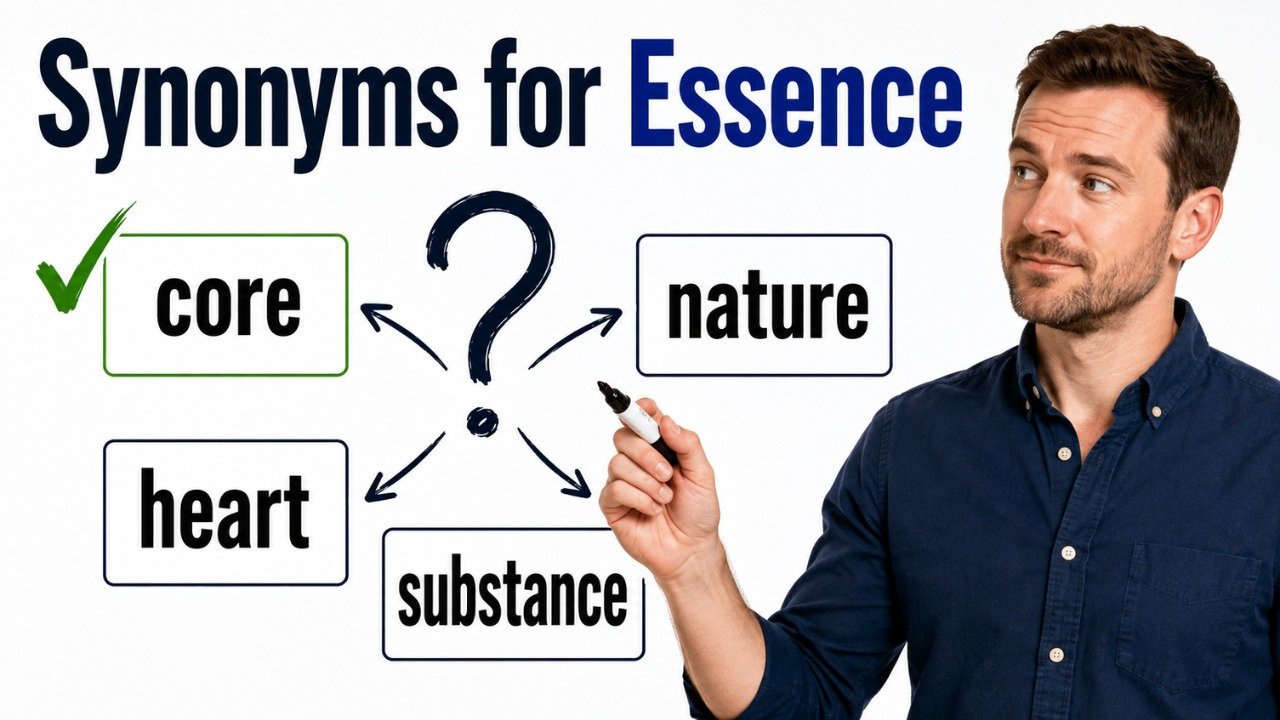
Quick Answer: The best synonyms for essence include core, nature, substance, spirit, heart, soul, character, gist, crux, and quintessence. Use core when referring to the central part of an idea, nature for the basic qualities of a person or thing, substance for meaningful content, spirit for the character or intention behind something, heart for its most important part, gist for the main idea of a message, crux for the decisive point of an issue, and quintessence for the purest or most perfect example. The best synonym depends on whether essence means fundamental nature, central meaning, important quality, or concentrated extract.
Pronunciation and Word Details
Word: Essence
Pronunciation: /ˈesəns/
Part of Speech: Noun
Meaning: The most important, basic, or characteristic quality of a person, thing, idea, or substance.
US Pronunciation:
UK Pronunciation:
What Does “Essence” Mean?
Essence means the most basic, important, or characteristic quality that makes something what it truly is.
As a noun, essence is commonly used to describe the fundamental nature of a person, object, idea, experience, or situation.
Example: Trust is the essence of a strong friendship.
In this sentence, essence refers to the most important quality at the heart of friendship.
Essence can also mean the central meaning or main idea of something.
Example: She captured the essence of the argument in one sentence.
The word also has a physical meaning. An essence can be a concentrated substance extracted from a plant, fruit, flower, or other material and used for flavor or fragrance.
Example: A small amount of vanilla essence was added to the mixture.
Because essence has both abstract and physical meanings, the most accurate synonym depends on the context.
Meaning, Tone, and Context of “Essence”
Essence is generally a neutral to slightly formal word. It is common in academic writing, essays, literature, philosophy, professional communication, descriptions, and everyday conversation.
When essence refers to the basic nature of something, it often has a thoughtful or analytical tone.
Example: The essay explores the essence of leadership.
When discussing an idea or argument, essence can mean the main point or central meaning.
Example: The summary captures the essence of the report.
In emotional or descriptive writing, essence may refer to the spirit, character, or identity of a person or place.
Example: The painting captures the essence of the coastal village.
In cooking, fragrance, and manufacturing contexts, essence may refer to a concentrated extract used to provide flavor or scent.
The word is flexible, but it should be replaced carefully because core, nature, gist, spirit, and extract do not carry exactly the same meaning.
When and How to Use “Essence”
For Fundamental Nature
Use essence when describing the most basic qualities that define a person, thing, idea, or experience.
Example: Honesty is at the essence of her character.
For a Central Idea
Essence can describe the main meaning of a speech, article, argument, or discussion.
Example: His summary captured the essence of the proposal.
For an Important Quality
Use essence when referring to the quality that is most necessary or characteristic.
Example: Patience is the essence of effective teaching.
For Character or Identity
Essence can express the distinctive nature or personality of someone or something.
Example: The design preserves the essence of the original building.
For the Heart of an Issue
Use essence when discussing the central or most important part of a problem.
Example: The essence of the disagreement was a lack of trust.
For a Pure or Perfect Example
Essence may describe the qualities that make someone or something a perfect representation of an idea.
Example: Her calm response was the essence of professionalism.
For a Concentrated Substance
Essence can refer to a concentrated liquid or extract used for flavor, aroma, or another characteristic.
Example: The recipe requires a few drops of almond essence.
Best Synonyms for Essence
Core
Synonym: The central or most important part of something.
Example: Cooperation is at the core of the project.
Nature
Synonym: The basic qualities or characteristics of a person or thing.
Example: The discussion focused on the nature of human motivation.
Substance
Synonym: The real meaning, importance, or content of something.
Example: The proposal had style but lacked substance.
Spirit
Synonym: The character, intention, or feeling that defines something.
Example: The new policy preserves the spirit of the original agreement.
Heart
Synonym: The central or most important part of something.
Example: Trust lies at the heart of the relationship.
Soul
Synonym: The deepest character or emotional quality of a person, place, or thing.
Example: Music is often described as the soul of the celebration.
Gist
Synonym: The main point or general meaning of something.
Example: I understood the gist of the conversation.
Crux
Synonym: The most important or difficult point of an issue.
Example: The crux of the problem is a lack of resources.
Character
Synonym: The distinctive qualities that define a person, place, or thing.
Example: The renovation preserved the character of the old house.
Quintessence
Synonym: The purest or most perfect example of a quality or type.
Example: The peaceful garden was the quintessence of simplicity.
50 Synonyms for Essence with Short Meanings
- Core: The central or most important part.
- Nature: The basic qualities that define something.
- Substance: The real or meaningful content of something.
- Spirit: The defining character or intention.
- Heart: The central or most important element.
- Soul: The deepest character or emotional quality.
- Gist: The main point or meaning.
- Crux: The most important point of an issue.
- Character: The distinctive qualities of something.
- Quintessence: The purest or most perfect example.
- Fundamentals: The basic and essential parts.
- Foundation: The basis on which something depends.
- Basis: The underlying support or principle.
- Root: The basic source or origin.
- Kernel: The central or essential part of an idea.
- Nucleus: The central part around which something develops.
- Pith: The essential or most meaningful part.
- Marrow: The deepest or most vital part.
- Nub: The central point of a matter.
- Center: The main or most important point.
- Central Idea: The main thought or concept.
- Main Point: The most important idea being expressed.
- Meaning: The idea or significance expressed.
- Sense: The intended meaning of something.
- Import: The significance or meaning of a statement.
- Significance: The importance or meaning of something.
- Idea: A central thought or concept.
- Concept: A general idea or principle.
- Principle: A basic belief or rule.
- Element: An important part of something larger.
- Quality: A distinctive feature or characteristic.
- Attribute: A characteristic belonging to something.
- Trait: A distinguishing quality or feature.
- Identity: The defining nature of a person or thing.
- Being: The essential nature or existence of something.
- Intrinsic Nature: The qualities naturally belonging to something.
- Essential Quality: A defining and necessary characteristic.
- Underlying Nature: The deeper qualities beneath the surface.
- Inner Nature: The basic character within a person or thing.
- Essential Character: The defining nature of something.
- Extract: A concentrated substance obtained from something.
- Concentrate: A substance made stronger by removing other material.
- Distillate: A concentrated substance produced through distillation.
- Flavoring: A substance added to create or strengthen taste.
- Aroma: A distinctive and often pleasant smell.
- Fragrance: A pleasant or distinctive scent.
- Scent: A particular smell associated with something.
- Perfume: A fragrant substance or distinctive smell.
- Oil: A concentrated liquid substance obtained from plants or other materials.
- Tincture: A concentrated liquid preparation or extract.
Read Also:
Synonyms for Capacity

Synonyms for Essence by Context
When Essence Means Fundamental Nature
Core, nature, character, identity, spirit, intrinsic nature, essential quality, and underlying nature are strong choices when essence refers to what fundamentally defines something.
Example: Compassion is part of the core of her personality.
Example: The book explores the nature of personal responsibility.
When Essence Means the Central Idea
Gist, main point, central idea, crux, meaning, sense, import, and substance work well when essence refers to the main message or idea.
Example: The gist of the report can be explained in two sentences.
Example: The crux of the argument is that greater planning is necessary.
When Essence Means the Most Important Part
Heart, core, center, nucleus, kernel, pith, marrow, and nub emphasize the central or most important element.
Example: Communication is at the heart of effective teamwork.
Example: The central point of the discussion was financial stability.
When Essence Means Character or Spirit
Spirit, soul, character, identity, quality, and nature can describe the distinctive feel or personality of someone or something.
Example: The restoration preserved the character of the historic neighborhood.
Example: Her photographs capture the spirit of everyday life.
When Essence Means a Perfect Example
Quintessence is especially strong when essence refers to the purest or most perfect example of a quality.
Example: The quiet retreat was the quintessence of peaceful living.
In less formal writing, perfect example or embodiment may sometimes communicate the same idea more simply.
When Essence Means a Concentrated Extract
Extract, concentrate, distillate, flavoring, oil, and tincture are useful when essence refers to a concentrated physical substance.
Example: The recipe uses a concentrated vanilla extract.
Example: The fragrance contains a floral oil.
Another Word for Essence
Core is often the best general replacement for essence when referring to the most important or defining part of something.
However, nature is usually better for basic qualities, gist for the main meaning of a statement, spirit for the character or intention behind something, and extract when essence refers to a concentrated substance.
Original: Trust is the essence of a successful partnership.
Better Option: Trust is at the core of a successful partnership.
Original: She understood the essence of his argument.
Better Option: She understood the gist of his argument.
Original: The artist captured the essence of the city.
Better Option: The artist captured the spirit of the city.
Original: The recipe contains lemon essence.
Better Option: The recipe contains lemon extract.
When Not to Use “Essence”
Essence can sound abstract when a more specific synonym would communicate the meaning more clearly.
Avoid essence when you simply mean the main point of a conversation or argument.
Weak: I understood the essence of what she said.
Better: I understood the gist of what she said.
When referring to the source of a problem, root or cause may be more precise.
Weak: The essence of the problem is poor communication.
Better: The root of the problem is poor communication.
Essence may also sound overly formal in simple everyday sentences.
Weak: The essence of my request is that I need more time.
Better: The main point of my request is that I need more time.
When describing a person’s qualities, nature or character may sound more natural.
Weak: Kindness is part of his essence.
Better: Kindness is part of his nature.
If referring to a concentrated ingredient, use the technically appropriate term such as extract, flavoring, or oil when greater precision is needed.
Words Commonly Confused With Essence
Essence vs Core: Core refers to the central or most important part of something. Essence refers more broadly to the qualities or nature that make something what it is.
Essence vs Nature: Nature describes the basic qualities and characteristics of something. Essence often emphasizes the most defining or essential qualities within that nature.
Essence vs Gist: Gist refers specifically to the main point or general meaning of a message. Essence can also refer to character, identity, fundamental nature, or concentrated substances.
Essence vs Substance: Substance can mean meaningful content or importance. Essence focuses more strongly on the defining nature or central quality.
Essence vs Spirit: Spirit often describes the character, intention, emotional quality, or general feeling behind something. Essence can be broader and more analytical.
Essence vs Quintessence: Essence means the fundamental nature of something. Quintessence often means the purest or most perfect example of a particular quality.
Essence vs Extract: Extract is a concentrated substance obtained from another material. Essence may describe a similar substance, but it also has many abstract meanings.
Which Synonym Should You Choose?
Choose core when referring to the central or most important part of an idea, system, relationship, or problem.
Choose nature when discussing the basic characteristics of a person, object, concept, or situation.
Choose substance when emphasizing meaningful content or real importance.
Choose spirit when describing the feeling, intention, or character behind an event, agreement, place, or idea.
Choose heart when emphasizing the most important emotional or practical element.
Choose soul when writing creatively about the deepest character of a person, place, culture, or experience.
Choose gist when summarizing a speech, discussion, message, report, or explanation.
Choose crux when identifying the most important point of a difficult issue or argument.
Choose character when discussing the distinctive qualities of a person, place, building, or object.
Choose quintessence when describing the purest or most perfect example of something.
Choose basis or foundation in formal writing when discussing supporting principles.
Choose kernel, pith, or nub when emphasizing the central idea in concise or expressive writing.
Choose extract when discussing concentrated flavoring or a substance obtained from another material.
For academic essays, nature, substance, principle, core, foundation, and significance are often precise choices.
For professional reports, core, main point, basis, substance, and central idea usually sound clear and direct.
For creative writing, spirit, soul, heart, character, marrow, and quintessence can add emotional depth.
Real Life Examples of “Essence” in Sentences
Original: Trust is the essence of a strong relationship.
Better Option: Trust is at the core of a strong relationship.
Original: The essay examines the essence of human courage.
Better Option: The essay examines the nature of human courage.
Original: She captured the essence of the discussion perfectly.
Better Option: She captured the gist of the discussion perfectly.
Original: Cooperation is the essence of the agreement.
Better Option: Cooperation is the central principle of the agreement.
Original: The photographer captured the essence of the village.
Better Option: The photographer captured the spirit of the village.
Original: The essence of the problem is poor communication.
Better Option: The crux of the problem is poor communication.
Original: The new design maintains the essence of the original.
Better Option: The new design maintains the character of the original.
Original: The story captures the essence of childhood.
Better Option: The story captures the spirit of childhood.
Original: His explanation communicated the essence of the theory.
Better Option: His explanation communicated the core idea of the theory.
Original: The recipe uses a small amount of orange essence.
Better Option: The recipe uses a small amount of orange extract.
Synonym Groups and Usage Differences
Core Meaning Group
Core, heart, center, nucleus, kernel, pith, marrow, and nub refer to the central or most important part of something.
Core is the most versatile option, while heart often carries greater emotional emphasis.
Example: Mutual respect is at the core of successful cooperation.
Nature and Identity Group
Nature, character, identity, being, intrinsic nature, inner nature, and essential quality describe what fundamentally defines something.
Nature is broad and neutral, while identity emphasizes distinctive characteristics.
Example: The experience changed the nature of their relationship.
Main Idea Group
Gist, crux, central idea, main point, meaning, sense, import, and substance describe the primary meaning of communication or an argument.
Gist is conversational, while crux is especially useful for identifying the decisive point of an issue.
Example: The crux of the debate concerns how resources should be distributed.
Principle and Foundation Group
Principle, foundation, basis, fundamentals, and root describe the basic ideas or support on which something depends.
Foundation often suggests support, while principle refers to a basic rule, belief, or idea.
Example: Fairness is a basic principle of the process.
Character and Spirit Group
Spirit, soul, character, quality, and identity describe the emotional or distinctive qualities of something.
Spirit works especially well for places, events, traditions, agreements, and creative works.
Example: The festival preserved the spirit of the local tradition.
Concentrated Substance Group
Extract, concentrate, distillate, flavoring, oil, and tincture refer to physical substances produced or strengthened through concentration or extraction.
Example: The dessert contains a small amount of natural fruit extract.
Antonyms of Essence
The opposite of essence changes according to the intended meaning.
Surface: The outer or most obvious part rather than the deeper nature.
Appearance: The way something looks rather than what it fundamentally is.
Exterior: The outside portion or outward form.
Form: External shape or structure rather than essential nature.
Detail: A smaller part rather than the central idea.
Triviality: Something of little importance.
Insignificance: Lack of importance or meaningful value.
Accident: A nonessential characteristic rather than a defining quality.
Superficiality: Concern with surface qualities rather than deeper meaning.
Outer Layer: The external part rather than the core.
Minor Point: A less important detail.
Decoration: An added feature rather than an essential element.
Comparison: Essence vs Related Words
Essence vs Core
Essence describes the fundamental nature or defining qualities of something. Core emphasizes its central or most important part.
Example With Essence: Trust is the essence of their relationship.
Example With Core: Trust is at the core of their relationship.
Essence vs Nature
Essence emphasizes the defining qualities that make something what it is. Nature refers more generally to its basic characteristics.
Example With Essence: The story explores the essence of friendship.
Example With Nature: The story explores the nature of friendship.
Essence vs Gist
Essence can refer to fundamental nature, character, or central meaning. Gist specifically means the main point of a statement, conversation, or text.
Example With Essence: The summary captured the essence of the theory.
Example With Gist: I understood the gist of her explanation.
Essence vs Crux
Essence refers broadly to the defining nature or central meaning. Crux usually refers to the most important or difficult point of a problem or argument.
Example With Essence: The essence of the proposal is cooperation.
Example With Crux: The crux of the dispute is how the cost will be divided.
Essence vs Spirit
Essence focuses on fundamental nature. Spirit often emphasizes emotional character, intention, atmosphere, or values.
Example With Essence: The essay explores the essence of the tradition.
Example With Spirit: The celebration preserved the spirit of the tradition.
Essence vs Substance
Essence focuses on defining qualities. Substance often describes meaningful content, importance, or real value.
Example With Essence: The essence of the idea is simplicity.
Example With Substance: The report contains considerable substance.
Essence vs Quintessence
Essence refers to the fundamental nature of something. Quintessence refers more strongly to the purest or most perfect example of a quality.
Example With Essence: Calmness was part of her essence.
Example With Quintessence: Her graceful response was the quintessence of professionalism.
Common Phrases and Expressions With “Essence”
In Essence: Basically or in the most important sense.
The Essence of Something: The fundamental nature or most important quality of something.
Capture the Essence: Represent the most important qualities accurately.
Essence of Life: The qualities believed to be most important to living.
Essence of the Argument: The central meaning or main idea of an argument.
Essence of the Problem: The most important part of a problem.
Essence of Beauty: The defining or fundamental quality of beauty.
Essence of Character: The qualities that most strongly define someone’s character.
Very Essence: The complete or perfect representation of a quality.
Pure Essence: The most concentrated or fundamental form of something.
Common Mistakes to Avoid
One common mistake is using essence as though it always means gist. Gist works only when referring to the main meaning of communication, while essence can also describe nature, identity, character, and physical extracts.
Avoid treating essence and core as perfect synonyms in every sentence. Core emphasizes the central part, while essence focuses more strongly on defining qualities.
Another mistake is using quintessence where a simple word would be clearer. Quintessence is more formal and usually refers to the purest or most perfect example of a quality.
Do not use extract as a synonym for abstract meanings of essence.
Incorrect: Trust is the extract of friendship.
Correct: Trust is the essence or core of friendship.
Be careful when using essence in repetitive academic writing. If the word appears several times, alternatives such as nature, core, substance, principle, meaning, and central idea can improve precision.
Avoid vague phrases such as “the essence of everything” when the intended meaning is not clear. State the specific idea, quality, or principle whenever possible.
Finally, choose synonyms according to meaning rather than appearance. A word that sounds more sophisticated is not necessarily more accurate.
Conclusion
Synonyms for essence vary according to whether the word refers to fundamental nature, central meaning, defining character, or a concentrated substance. Core and heart emphasize the central part, nature and character describe defining qualities, gist and crux suit ideas and arguments, while spirit and soul work well in expressive writing. Quintessence describes a perfect example, and extract fits physical substances. Choosing the synonym that matches the intended context makes writing clearer, more precise, and more natural.
FAQs About Synonyms for Essence
What Is the Best Synonym for Essence?
Core is one of the best general synonyms for essence. Nature, spirit, substance, heart, gist, and character may be more precise depending on the sentence.
What Is Another Word for the Essence of Something?
The core, heart, nature, substance, spirit, or central idea of something can express a similar meaning.
What Is a Synonym for Essence in an Essay?
Core, nature, substance, principle, central idea, meaning, significance, and foundation are useful choices in essay writing.
Are Essence and Core the Same?
They are similar but not identical. Essence focuses on the defining nature or qualities of something, while core emphasizes its central or most important part.
What Is Another Word for Essence When Referring to Meaning?
Gist, meaning, sense, import, crux, main point, and central idea are useful alternatives.
What Is a Formal Synonym for Essence?
Quintessence, substance, intrinsic nature, fundamental nature, character, and significance can work well in formal contexts.
What Is a Synonym for Essence in Cooking or Flavoring?
Extract, concentrate, flavoring, oil, or distillate may be suitable when essence refers to a concentrated substance used for flavor or aroma.
