
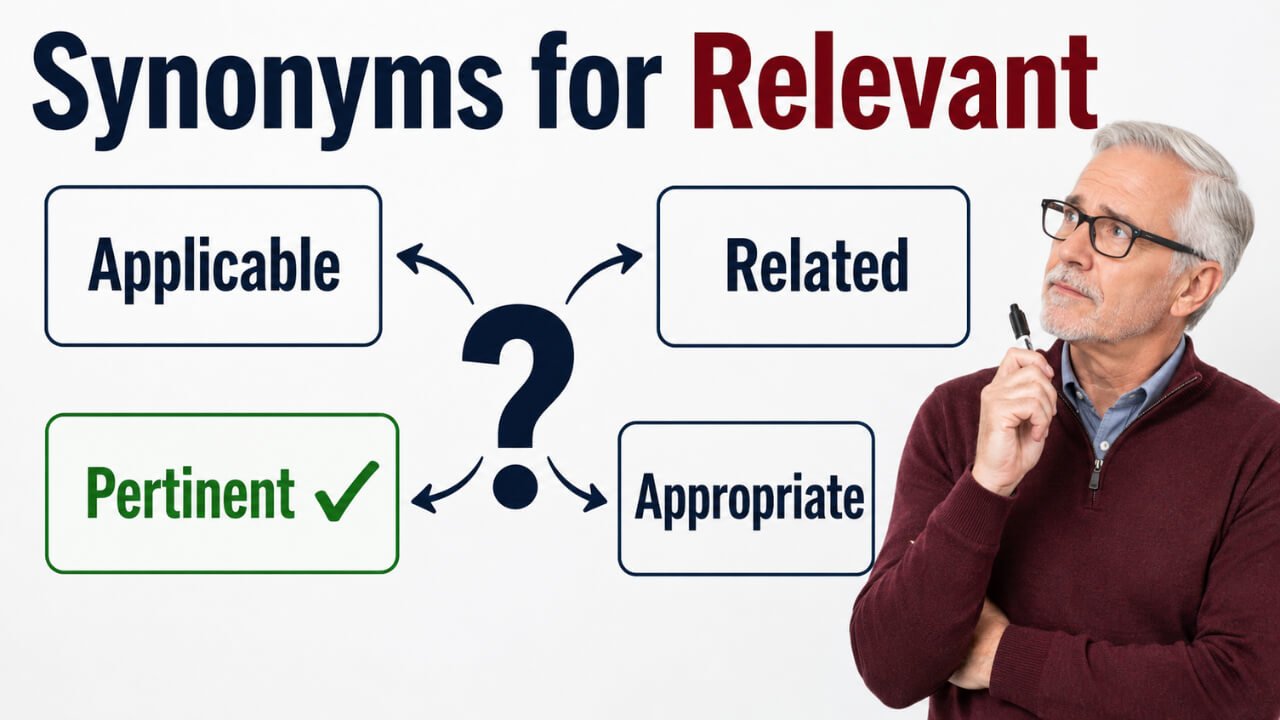
Quick Answer: The best synonyms for relevant include applicable, appropriate, related, pertinent, suitable, significant, connected, useful, important, and material. Use pertinent for information that directly concerns a subject, applicable for rules or ideas that can be used in a situation, and appropriate for something suitable to the circumstances. Related emphasizes a connection, significant highlights importance, and material is common in formal, legal, and professional writing.
Pronunciation and Word Details
Word: Relevant
Pronunciation: /ˈreləvənt/
Part of Speech: Adjective
Meaning: Closely connected to the subject, situation, question, or purpose being considered.
US Pronunciation:
UK Pronunciation:
What Does “Relevant” Mean?
Relevant means directly connected to the subject, issue, question, or situation being discussed. It is an adjective used to describe information, ideas, experiences, facts, or details that matter in a particular context.
In “Please include only relevant information,” the word describes information that relates directly to the topic. In “Her experience is relevant to the position,” it means her experience is useful and connected to the requirements.
Relevant can also describe something that remains important or useful in current circumstances. A book, skill, rule, or opinion may still be relevant when it continues to influence modern decisions or discussions.
Meaning, Tone, and Context of “Relevant”
Relevant has a neutral and professional tone. It is common in academic writing, business communication, reports, essays, interviews, legal discussions, research, and everyday conversation.
In formal writing, relevant often describes facts, evidence, qualifications, data, or experience that directly support a subject. In casual speech, it may describe something that matters to a conversation or current situation.
The word is not usually emotional. It communicates connection, usefulness, and importance in a clear and objective way. However, the exact meaning changes slightly depending on whether the speaker is discussing suitability, importance, usefulness, or direct connection.
When and How to Use “Relevant”
For Related Information: Use relevant when information directly concerns the topic being discussed.
Example: The report contains several relevant facts about customer behavior.
For Useful Experience: Use relevant to describe skills or experience that match a role, task, or opportunity.
Example: Applicants should describe their relevant work experience.
For Supporting Evidence: Use relevant when evidence helps prove, explain, or support a claim.
Example: The researcher included only relevant evidence in the final analysis.
For Current Importance: Use relevant when something remains useful or meaningful in present circumstances.
Example: The advice remains relevant to modern workplaces.
For Appropriate Details: Use relevant when details belong in a discussion and help the audience understand the subject.
Example: Please provide all relevant details about the incident.
Best Synonyms for Relevant
Applicable: Able to be used in a particular situation.
Example: These instructions are applicable to all new employees.
Pertinent: Directly connected to the matter being considered.
Example: The witness provided pertinent information about the event.
Appropriate: Suitable or correct for a particular purpose or situation.
Example: Choose an appropriate example for your argument.
Related: Connected to the same subject, idea, person, or event.
Example: The article discusses several related health concerns.
Significant: Important enough to deserve attention.
Example: The study revealed significant changes in public behavior.
Suitable: Right or acceptable for a particular use or purpose.
Example: Her qualifications are suitable for the position.
Connected: Joined by a shared subject, cause, purpose, or relationship.
Example: The two problems are closely connected.
Material: Important and directly affecting a decision or issue.
Example: The lawyer presented material evidence to the court.
Useful: Able to help achieve a purpose or improve understanding.
Example: The guide contains useful information for beginners.
Important: Having value, influence, or a strong effect on an issue.
Example: Cost is an important factor in the final decision.
50 Synonyms for Relevant with Short Meanings
- Applicable: Able to be used in a specific situation.
- Appropriate: Suitable for a particular purpose.
- Pertinent: Directly related to the subject.
- Related: Connected to the topic or issue.
- Significant: Important enough to receive attention.
- Suitable: Right for a particular purpose.
- Connected: Linked by subject, cause, or meaning.
- Material: Important to a decision or matter.
- Useful: Helpful for a specific purpose.
- Important: Having considerable value or influence.
- Meaningful: Having importance or a clear purpose.
- Related to: Having a connection with something.
- Linked: Joined through a common idea or relationship.
- Associated: Connected in thought, meaning, or experience.
- Germane: Closely related to the matter being discussed.
- Apt: Suitable and especially appropriate.
- Fitting: Proper for the situation or purpose.
- Proper: Correct or suitable in the circumstances.
- Suitable to: Appropriate for a particular need.
- Compatible: Able to work or exist well together.
- Corresponding: Matching or relating to something else.
- Concerning: About or connected with a subject.
- Regarding: Relating to a particular matter.
- Regarding the matter: Directly concerning the issue.
- On topic: Closely connected to the discussion.
- Topical: Related to a current subject or issue.
- Current: Important or useful at the present time.
- Timely: Appropriate or useful at a particular moment.
- Useful to the issue: Helpful for understanding the matter.
- Directly related: Closely connected without unnecessary detail.
- Closely connected: Strongly linked to the topic.
- Involved: Included or connected with a situation.
- Essential: Completely necessary to the subject or purpose.
- Valuable: Useful or important in a situation.
- Informative: Providing useful knowledge or details.
- Influential: Able to affect a result or decision.
- Consequential: Important because of possible results.
- Notable: Worth noticing because of importance.
- Substantial: Important, meaningful, or considerable.
- Central: Extremely important to the main subject.
- Key: Essential to understanding or success.
- Critical: Extremely important to an outcome.
- Necessary: Required for a particular purpose.
- Purposeful: Having a clear and useful purpose.
- Responsive: Directly addressing a question or need.
- Aligned: Matching a goal, subject, or requirement.
- Contextual: Connected to the surrounding circumstances.
- Bearing on: Having an effect or connection to a matter.
- To the point: Directly addressing the main issue.
- In relation to: Connected with the subject being considered.
Read Also:
Synonyms for Contrast
Synonyms for Relevant by Context
When Relevant Means Directly Connected
Pertinent, germane, related, connected, and associated describe something that has a clear relationship with the subject.
Example: The manager asked the applicant to provide pertinent details about her previous experience.
When Relevant Means Suitable
Appropriate, suitable, fitting, proper, and apt describe something that is right for a particular purpose or situation.
Example: This example is more appropriate for an academic essay.
When Relevant Means Useful
Applicable, useful, valuable, informative, and meaningful describe information or ideas that help someone complete a task or understand a subject.
Example: The training provided applicable advice for handling customer concerns.
When Relevant Means Important
Significant, material, important, key, central, and critical emphasize value or influence rather than connection alone.
Example: The report identified several significant factors affecting the result.
When Relevant Means Current
Current, timely, and topical describe information that matters because it concerns present conditions or recent discussions.
Example: The speaker used timely examples to make the presentation more engaging.
Another Word for Relevant
Pertinent is one of the best single replacements for relevant when something directly concerns a question, discussion, or issue. However, the best alternative depends on whether you want to emphasize connection, usefulness, suitability, importance, or current value.
Original: Please include relevant information in your response.
Better Option: Please include pertinent information in your response.
Original: She has relevant experience for the position.
Better Option: She has applicable experience for the position.
Original: The teacher selected a relevant example.
Better Option: The teacher selected an appropriate example.
Original: The study discusses relevant concerns.
Better Option: The study discusses significant concerns.
When Not to Use “Relevant”
Relevant may sound repetitive when it appears several times in the same paragraph. A more precise synonym can explain whether something is connected, useful, suitable, current, or important.
Avoid relevant when the relationship between two ideas is weak or unclear. The word should describe a genuine connection to the subject.
It may also be too general when a stronger word such as essential, critical, applicable, or pertinent communicates the intended meaning more accurately.
Weak: The relevant rule is relevant to this situation.
Better: The applicable rule directly addresses this situation.
Weak: She shared some relevant and important information.
Better: She shared significant information about the problem.
Weak: This is a relevant example because it is related.
Better: This is an appropriate example because it directly supports the argument.
Words Commonly Confused With Relevant
Relevant vs Related: Relevant means connected and useful to the matter being considered. Related only means that a connection exists. Something can be related without being important to the current discussion.
Relevant vs Applicable: Relevant describes a connection to a subject. Applicable describes something that can be used in a specific situation.
Relevant vs Appropriate: Relevant means connected to the topic. Appropriate means suitable for the circumstances.
Relevant vs Important: Relevant emphasizes connection. Important emphasizes value, influence, or consequence.
Relevant vs Significant: Relevant describes information that belongs to the subject. Significant describes information that has considerable meaning or effect.
Relevant vs Pertinent: Both describe a direct connection, but pertinent often sounds more formal and precise.
Which Synonym Should You Choose?
Choose pertinent when referring to facts, questions, details, evidence, or information that directly concerns an issue.
Choose applicable when discussing rules, methods, advice, knowledge, or experience that can be used in a situation.
Choose appropriate when describing language, behavior, examples, clothing, or choices that suit particular circumstances.
Choose related when you only need to show a general connection between ideas or subjects.
Choose significant when emphasizing importance, influence, size, or effect.
Choose material for formal, legal, financial, or professional matters that affect a decision.
Choose timely or current when discussing information that matters in present circumstances.
Choose useful for friendly, simple, and conversational writing.
Choose essential, key, or critical when the information is necessary rather than merely connected.
Real Life Examples of “Relevant” in Sentences
Original: Please attach all relevant documents to the application.
Better Option: Please attach all applicable documents to the application.
Original: The student included relevant evidence in the essay.
Better Option: The student included pertinent evidence in the essay.
Original: Her previous role gave her relevant experience.
Better Option: Her previous role gave her suitable experience.
Original: The article raises several relevant questions.
Better Option: The article raises several significant questions.
Original: We discussed relevant issues during the meeting.
Better Option: We discussed related issues during the meeting.
Original: The guide offers relevant advice for new writers.
Better Option: The guide offers useful advice for new writers.
Original: That example is relevant to the current topic.
Better Option: That example is appropriate for the current topic.
Original: The law is still relevant today.
Better Option: The law is still applicable today.
Original: The interviewer asked about her relevant skills.
Better Option: The interviewer asked about her job related skills.
Original: Only relevant facts should appear in the summary.
Better Option: Only material facts should appear in the summary.
Synonym Groups and Usage Differences
Connection Group
Related, connected, associated, linked, and corresponding show that two or more things share a subject, cause, purpose, or relationship.
Example: The researchers examined several connected problems.
Suitability Group
Appropriate, suitable, fitting, proper, and apt describe something that matches the needs or conditions of a situation.
Example: The instructor selected an appropriate reading for the class.
Usefulness Group
Applicable, useful, valuable, informative, and purposeful describe something that provides practical help or knowledge.
Example: Her advice was applicable to several workplace situations.
Importance Group
Important, significant, essential, key, material, and critical emphasize value, influence, or necessity.
Example: Communication is a key part of effective teamwork.
Current Interest Group
Current, timely, and topical describe subjects or information that matter at the present time.
Example: The discussion focused on timely concerns affecting local communities.
Antonyms of Relevant
The opposite of relevant depends on whether the word refers to connection, usefulness, importance, or suitability.
Irrelevant: Not connected to the subject.
Unrelated: Having no meaningful relationship.
Inapplicable: Unable to be used in a particular situation.
Inappropriate: Unsuitable for the circumstances.
Immaterial: Not important to the issue or decision.
Insignificant: Too unimportant to deserve attention.
Useless: Providing no practical help or value.
Outdated: No longer current or useful.
Pointless: Having no useful purpose.
Extraneous: Unnecessary and unrelated to the main matter.
Comparison Relevant vs Related Words
Relevant vs Pertinent
Relevant and pertinent both describe a direct connection to a subject. Pertinent is usually more formal and often emphasizes that a detail is especially important to the matter being considered.
Example With Relevant: The report contains relevant information about the project.
Example With Pertinent: The report contains pertinent evidence about the project failure.
Relevant vs Applicable
Relevant shows that something is connected to a subject. Applicable shows that it can be practically used in a particular situation.
Example With Relevant: Her research is relevant to the discussion.
Example With Applicable: Her research method is applicable to this study.
Relevant vs Appropriate
Relevant concerns connection to a topic. Appropriate concerns suitability for a purpose, audience, or situation.
Example With Relevant: He provided relevant background information.
Example With Appropriate: He used appropriate language for the audience.
Relevant vs Significant
Relevant means connected to the issue. Significant means important or influential. A detail may be relevant without having a major effect.
Example With Relevant: The date is relevant to the investigation.
Example With Significant: The date represents a significant change in the investigation.
Relevant vs Material
Relevant is broad and common in many contexts. Material is more formal and describes information that may affect a decision, judgment, or outcome.
Example With Relevant: The manager reviewed the relevant facts.
Example With Material: The manager reviewed the material facts before making a decision.
Common Phrases and Expressions With Relevant
Relevant Information: Facts or details connected to a subject.
Relevant Experience: Previous work or knowledge connected to a role.
Relevant Skills: Abilities that match a task or position.
Relevant Evidence: Proof that directly supports an issue or claim.
Relevant Details: Specific information that matters to the subject.
Relevant Question: A question connected to the current discussion.
Relevant Example: An example that clearly supports the subject.
Relevant Factors: Conditions that affect a decision or result.
Relevant Qualifications: Education, training, or experience suited to a role.
Relevant to the Topic: Directly connected to the matter being discussed.
Common Mistakes to Avoid
A common mistake is using relevant for any information that is loosely related to a subject. Relevant information should contribute directly to understanding, explaining, or deciding the matter.
Avoid repeating relevant several times in one paragraph. Replace it with precise alternatives such as pertinent, applicable, appropriate, significant, or related.
Do not use applicable when you only mean connected. Applicable suggests that something can be practically used.
Do not use significant as a direct replacement when importance is not intended. A detail can be relevant but minor.
Avoid vague statements such as “This is relevant” without explaining the connection. Tell the reader why the information matters or how it relates to the topic.
Conclusion
Understanding synonyms for relevant helps you express connection, suitability, usefulness, and importance more precisely. Pertinent works well for facts and evidence, applicable suits rules and practical knowledge, and appropriate describes choices that fit a situation. Related shows a general connection, while significant and material emphasize importance. Choosing the right alternative depends on what makes the information relevant, whether it supports the topic, applies to the circumstances, affects a decision, or remains useful today.
FAQs About Synonyms for Relevant
What Is the Best Synonym for Relevant?
Pertinent is often the best synonym when information directly concerns a subject. Applicable, appropriate, and related may work better in other contexts.
What Is a Formal Synonym for Relevant?
Pertinent, germane, and material are formal alternatives. Pertinent suits academic and professional writing, while material is common in legal contexts.
Can Applicable Replace Relevant?
Applicable can replace relevant when something can be practically used in a situation. It is not always suitable when you only mean connected.
What Is Another Word for Relevant Information?
Pertinent information, applicable information, useful information, and material information are strong alternatives depending on the context.
Is Related the Same as Relevant?
Not exactly. Related means connected, while relevant means connected and useful or important to the matter being considered.
What Is the Opposite of Relevant?
Irrelevant is the most direct opposite. Other antonyms include unrelated, inapplicable, inappropriate, immaterial, and extraneous.
How Do You Use Relevant in a Sentence?
You can write, “Please provide relevant evidence to support your claim.” Here, relevant means directly connected to the claim.
