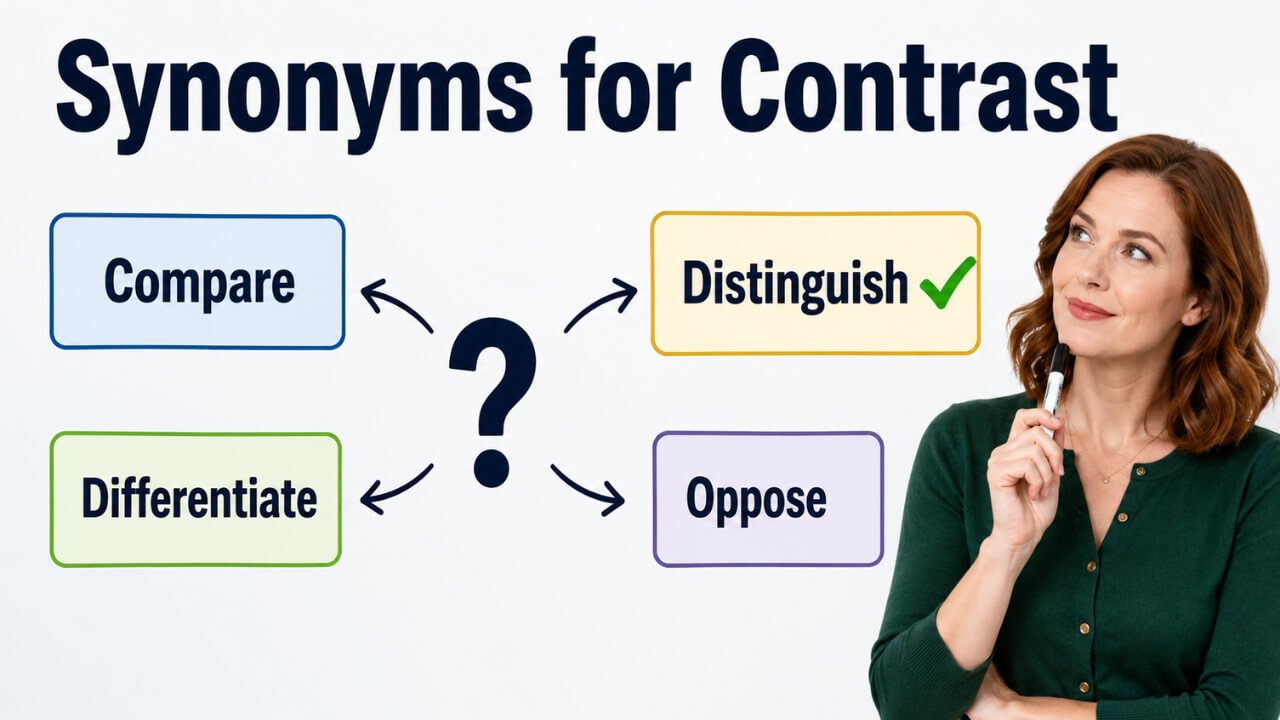
Quick Answer: Common synonyms for contrast include difference, distinction, comparison, disparity, divergence, opposition, juxtaposition, variation, differentiation, and contradistinction. Use difference for a general lack of similarity, distinction for a clear or important difference, disparity for an unfair or noticeable gap, and opposition for conflicting ideas. Juxtaposition works best when two things are placed together to highlight their differences, while comparison is suitable when examining both similarities and differences.
Pronunciation and Word Details
Word: Contrast
Pronunciation: Noun: /ˈkɑːntræst/ Verb: /kənˈtræst/
Part of Speech: Noun and verb
Meaning: A noticeable difference between things, or the act of comparing things to show how they differ.
US Pronunciation:
UK Pronunciation:
What Does “Contrast” Mean?
Contrast means a noticeable difference between two or more people, objects, ideas, colors, situations, or qualities. As a noun, it refers to the difference itself. As a verb, it means to compare things in order to emphasize their differences.
In visual descriptions, contrast may refer to differences in color, brightness, shape, texture, or size. In writing and academic discussion, it often describes differences between arguments, characters, periods, or results.
Noun Example: The contrast between the two designs was immediately visible.
Verb Example: The report contrasts urban life with rural life.
Meaning, Tone, and Context of “Contrast”
Contrast is a neutral and flexible word used in formal, academic, creative, technical, and conversational language. It can describe simple differences or strong opposition.
In academic writing, contrast is commonly used to examine ideas, theories, results, historical periods, or literary characters. In art and design, it describes differences in color, light, shape, or texture. In daily conversation, it helps explain how one person, place, or experience differs from another.
The tone depends on context. A contrast may be pleasant and visually interesting, or it may reveal inequality, conflict, or contradiction.
When and How to Use “Contrast”
For General Differences: Use contrast when two things have noticeably different features.
Example: There is a sharp contrast between the old building and the modern tower.
For Academic Comparison: Use contrast when examining differences between theories, texts, events, or findings.
Example: The essay contrasts the leadership styles of the two rulers.
For Visual Appearance: Use contrast when describing differences in color, brightness, texture, or shape.
Example: The dark furniture creates contrast with the pale walls.
For Opposing Ideas: Use contrast when two opinions, values, or arguments are clearly different.
Example: Her practical approach contrasts with his idealistic thinking.
For Social Differences: Use contrast to describe gaps in wealth, opportunity, living conditions, or treatment.
Example: The study revealed a troubling contrast between the two communities.
For Character Description: Use contrast when two characters have different personalities or motivations.
Example: The calm protagonist contrasts with the impatient antagonist.
Best Synonyms for Contrast
Difference: A quality that makes one thing unlike another.
Example: The main difference between the plans is their cost.
Distinction: A clear or meaningful difference between similar things.
Example: The author makes an important distinction between confidence and arrogance.
Comparison: An examination of two or more things to identify similarities or differences.
Example: The comparison showed that the second method was more efficient.
Disparity: A large, noticeable, or unfair difference.
Example: The report highlighted the disparity in educational opportunities.
Divergence: A movement or development in different directions.
Example: A divergence appeared between the predicted and actual results.
Opposition: A state in which ideas, forces, or positions conflict.
Example: The proposal faced strong opposition from local residents.
Juxtaposition: The placement of different things close together to emphasize their qualities.
Example: The juxtaposition of ancient and modern architecture created visual interest.
Variation: A difference in form, amount, condition, or quality.
Example: Researchers observed considerable variation in the responses.
Differentiation: The process of recognizing or creating differences.
Example: Product differentiation helped customers understand each option.
Contradistinction: A distinction created by comparing opposing characteristics.
Example: The policy was defined in contradistinction to the previous approach.
50 Synonyms for Contrast with Short Meanings
- Difference: A quality that makes things unlike each other.
- Distinction: A clear or meaningful difference.
- Comparison: An examination of similarities and differences.
- Disparity: A large or unfair difference.
- Divergence: A movement toward different directions or results.
- Opposition: A state of conflict between ideas or forces.
- Juxtaposition: Placement together to highlight differences.
- Variation: A change or difference in form or amount.
- Differentiation: The process of identifying differences.
- Contradistinction: A distinction based on opposing qualities.
- Dissimilarity: A lack of similarity.
- Discrepancy: An unexpected or unexplained difference.
- Inconsistency: A lack of agreement or uniformity.
- Contradiction: A direct conflict between statements or ideas.
- Antithesis: The complete opposite of something.
- Polarity: A relationship between two opposite positions.
- Dichotomy: A division into two strongly different parts.
- Opposite: A person or thing completely different from another.
- Counterpoint: A contrasting element that strengthens another element.
- Departure: A change from an established pattern.
- Deviation: A movement away from what is normal or expected.
- Gap: A noticeable difference between levels or conditions.
- Divide: A strong difference separating groups or opinions.
- Imbalance: A lack of equality or proper proportion.
- Inequality: A difference in status, treatment, or opportunity.
- Mismatch: A combination of things that do not fit together.
- Incongruity: A lack of harmony or suitability.
- Discordance: A lack of agreement or harmony.
- Conflict: A serious disagreement between ideas or interests.
- Contrariety: A condition of being opposite in nature.
- Separation: A state of being distinct or apart.
- Differential: A difference between amounts, levels, or conditions.
- Unlikeness: The quality of not being similar.
- Diversity: The presence of many different qualities or forms.
- Variety: A collection of different types or forms.
- Relief: Visual emphasis created when one element stands out.
- Foil: Something that emphasizes another thing through difference.
- Inverse: Something opposite in order, effect, or relationship.
- Reverse: A condition or direction opposite to another.
- Disagreement: A lack of shared opinion or belief.
- Distinguish: To recognize or show a difference.
- Differentiate: To identify or create differences.
- Compare: To examine things for similarities and differences.
- Juxtapose: To place things together for comparison.
- Oppose: To place something against another idea or force.
- Set Against: To compare one thing directly with another.
- Separate: To recognize or keep things as distinct.
- Discriminate: To notice a difference between similar things.
- Vary: To differ in form, amount, or quality.
- Conflict With: To be incompatible or inconsistent with something.
Read Also:
Synonyms for Overcome
Synonyms for Contrast by Context
When Contrast Means a General Difference
Difference, distinction, dissimilarity, variation, and unlikeness describe ways in which people or things are not the same.
Example: The difference between the two materials becomes clear after exposure to heat.
Difference is the broadest option. Distinction suggests a clearer or more meaningful separation, while dissimilarity emphasizes a lack of resemblance.
When Contrast Means a Large or Unequal Gap
Disparity, discrepancy, inequality, imbalance, gap, and divide are useful when the difference is significant, measurable, or unfair.
Example: The survey revealed a major disparity in access to essential services.
Disparity is especially suitable for social, financial, educational, or economic differences. Discrepancy is better for conflicting figures, statements, or records.
When Contrast Means Opposing Ideas
Opposition, contradiction, antithesis, polarity, conflict, and contrariety describe ideas or qualities that work against each other.
Example: The debate revealed a clear opposition between personal freedom and public responsibility.
Antithesis expresses a complete opposite. Contradiction refers to statements or ideas that cannot both be correct.
When Contrast Means Visual Difference
Juxtaposition, counterpoint, relief, distinction, variation, and differentiation describe visible differences in art, photography, design, or decoration.
Example: The designer used color variation to create contrast and depth.
Juxtaposition highlights differences by placing elements close together. Relief describes the effect of one element standing out clearly from its surroundings.
When Contrast Means Comparing Two Things
Comparison, differentiation, contradistinction, juxtaposition, and examination are useful when differences are discovered through analysis.
Example: A comparison of the two reports revealed several conflicting conclusions.
Comparison is the most general term. Contradistinction is more formal and focuses specifically on opposing characteristics.
When Contrast Is Used as a Verb
Compare, differentiate, distinguish, juxtapose, oppose, separate, and set against can replace contrast as a verb.
Example: The article juxtaposes traditional methods with modern technology.
Differentiate means to identify differences, while juxtapose means to place things together so their differences become more noticeable.
Another Word for Contrast
The best general replacement for contrast is difference. However, the most accurate choice depends on whether you mean a simple difference, a comparison, a visual effect, an inequality, or direct opposition.
Original: The contrast between their opinions was obvious.
Better Option: The difference between their opinions was obvious.
Original: The data shows a contrast between the two regions.
Better Option: The data shows a disparity between the two regions.
Original: The artist created contrast by combining light and dark colors.
Better Option: The artist created visual distinction by combining light and dark colors.
Original: The essay contrasts freedom with responsibility.
Better Option: The essay compares freedom with responsibility to emphasize their differences.
When Not to Use “Contrast”
Avoid contrast when a more precise word can explain the type of difference. It may sound too general when discussing unfair gaps, numerical errors, direct contradictions, or minor variations.
Weak: There was a contrast between the two financial totals.
Better: There was a discrepancy between the two financial totals.
Weak: The report discusses the contrast in access to medical care.
Better: The report discusses the disparity in access to medical care.
Weak: His final statement created a contrast with his earlier claim.
Better: His final statement contradicted his earlier claim.
Contrast may also become repetitive in essays that compare several ideas.
Weak: The first contrast is cost, while another contrast is quality.
Better: The first difference is cost, while another distinction involves quality.
Do not use contrast as though it always means complete opposition. Two things can contrast without being exact opposites.
Words Commonly Confused With Contrast
Contrast vs Compare: Contrast focuses mainly on differences, while compare may examine both similarities and differences.
Contrast vs Difference: Contrast often involves two things being viewed together, while difference simply describes how they are not the same.
Contrast vs Distinction: Contrast may be broad or visual, while distinction usually refers to a clear and meaningful difference.
Contrast vs Disparity: Contrast is neutral, while disparity often suggests a large, measurable, or unfair difference.
Contrast vs Contradiction: Contrast describes difference, while contradiction describes statements or ideas that directly conflict.
Contrast vs Comparison: Contrast is the difference being emphasized, while comparison is the process of examining two or more things.
Contrast vs Juxtaposition: Contrast is the effect or difference, while juxtaposition is the act of placing things close together to produce that effect.
Contrast vs Variation: Contrast usually involves noticeable differences between separate things, while variation may refer to changes within the same group or pattern.
Which Synonym Should You Choose?
Choose difference when you need a broad and familiar word for things that are not the same.
Choose distinction when the difference is clear, important, or conceptually meaningful.
Choose comparison when examining both similarities and differences.
Choose disparity when describing a major or unfair gap in income, opportunity, treatment, or resources.
Choose discrepancy when numbers, records, statements, or results do not agree.
Choose opposition when ideas, positions, or forces are in conflict.
Choose contradiction when two claims cannot both be true.
Choose juxtaposition when different visual, literary, or creative elements are placed together.
Choose variation when describing changes within a group, pattern, design, or set of results.
Choose differentiation when discussing the process of separating products, concepts, categories, or features.
Choose antithesis when one thing represents the complete opposite of another.
Choose compare, differentiate, or distinguish when replacing contrast as a verb.
Real Life Examples of “Contrast” in Sentences
Original: The contrast between the busy city and the quiet village was striking.
Better Option: The difference between the busy city and the quiet village was striking.
Original: The report contrasts the performance of the two teams.
Better Option: The report compares the performance of the two teams.
Original: There is a sharp contrast between their teaching methods.
Better Option: There is a clear distinction between their teaching methods.
Original: The contrast in household income remains a serious concern.
Better Option: The disparity in household income remains a serious concern.
Original: The white flowers contrast beautifully with the dark leaves.
Better Option: The white flowers stand out beautifully against the dark leaves.
Original: Her actions contrast with her earlier promises.
Better Option: Her actions contradict her earlier promises.
Original: The author contrasts hope and despair throughout the story.
Better Option: The author juxtaposes hope and despair throughout the story.
Original: The results contrast with the original prediction.
Better Option: The results diverge from the original prediction.
Original: The room needs more contrast.
Better Option: The room needs greater variation in color and texture.
Original: His calm personality contrasts with his brother’s energetic nature.
Better Option: His calm personality differs greatly from his brother’s energetic nature.
Synonym Groups and Usage Differences
General Difference Group
Difference, distinction, dissimilarity, variation, and unlikeness describe a lack of sameness.
Difference is the most flexible word. Distinction suggests importance or clarity, while variation often refers to changes within a shared category.
Example: There is a noticeable variation in the size of the handmade pieces.
Inequality Group
Disparity, inequality, imbalance, gap, and divide describe differences in level, treatment, resources, or opportunity.
These words often appear in social, educational, financial, and economic discussions.
Example: The research identified a growing gap between high income and low income households.
Opposition Group
Opposition, contradiction, antithesis, polarity, conflict, and contrariety express strong differences or incompatibility.
Antithesis is the strongest option when two things are complete opposites.
Example: Her generous behavior was the antithesis of his selfish attitude.
Visual Difference Group
Juxtaposition, counterpoint, relief, differentiation, and variation describe contrasts in color, shape, texture, size, or composition.
These terms are useful in discussions of art, design, photography, fashion, and architecture.
Example: The bright doorway creates a visual counterpoint to the neutral walls.
Comparison Group
Comparison, contradistinction, differentiation, juxtaposition, and analysis involve examining things together.
Comparison is broad, while contradistinction is formal and emphasizes opposing characteristics.
Example: The comparison revealed important differences in reliability.
Verb Group
Compare, distinguish, differentiate, juxtapose, oppose, vary, and set against describe actions related to contrast.
Use distinguish when recognizing a difference and differentiate when explaining or creating one.
Example: The guide differentiates essential features from optional ones.
Antonyms of Contrast
The opposite of contrast depends on whether contrast means difference, opposition, or visual separation.
Similarity: The quality of being alike.
Likeness: A close resemblance between things.
Sameness: The condition of being identical or nearly identical.
Agreement: A state in which opinions or statements are consistent.
Harmony: A pleasing combination of related elements.
Uniformity: A lack of noticeable variation.
Consistency: Agreement in appearance, behavior, or results.
Conformity: Similarity created by following the same pattern.
Resemblance: A visible or noticeable similarity.
Compatibility: The ability of things to work well together.
Correspondence: A close connection or similarity between elements.
Match: A person or thing that is equal, similar, or suitable.
Comparison: Contrast vs Related Words
Contrast vs Difference
Contrast emphasizes how differences become noticeable when things are considered together. Difference is a broader term that simply means two things are not the same.
Example With Contrast: The contrast between the dark floor and white walls creates drama.
Example With Difference: The main difference between the rooms is their size.
Contrast vs Compare
Contrast mainly emphasizes differences. Compare may explore both similarities and differences.
Example With Contrast: The essay contrasts traditional education with online learning.
Example With Compare: The essay compares the cost, flexibility, and results of both approaches.
Contrast vs Distinction
Contrast often describes a visible, emotional, or conceptual difference. Distinction usually describes a precise or important difference between related concepts.
Example With Contrast: The contrast between the characters creates tension.
Example With Distinction: The teacher explained the distinction between evidence and opinion.
Contrast vs Disparity
Contrast is neutral and can describe any noticeable difference. Disparity usually describes a large or unfair difference.
Example With Contrast: The contrast between the neighborhoods is easy to see.
Example With Disparity: The income disparity between the neighborhoods has increased.
Contrast vs Contradiction
Contrast means that things are different. Contradiction means that statements, beliefs, or actions directly conflict.
Example With Contrast: Her quiet manner contrasts with his outgoing personality.
Example With Contradiction: His actions are in contradiction with his stated values.
Contrast vs Juxtaposition
Contrast is the noticeable difference between elements. Juxtaposition is the placement of elements together to reveal that difference.
Example With Contrast: The photograph has strong contrast between light and shadow.
Example With Juxtaposition: The juxtaposition of wealth and poverty gives the photograph emotional power.
Contrast vs Variation
Contrast often involves differences between separate elements. Variation describes changes or differences within a shared pattern, group, or type.
Example With Contrast: The red chair contrasts with the neutral furniture.
Example With Variation: The collection includes several variations of the same chair design.
Common Phrases and Expressions With “Contrast”
In Contrast: Used to introduce something noticeably different.
By Contrast: Used to compare a second situation with the first.
In Sharp Contrast: Showing a very strong and obvious difference.
In Direct Contrast: Completely different from something else.
A Striking Contrast: A difference that is immediately noticeable.
A Stark Contrast: An extreme and often serious difference.
Create Contrast: To produce a noticeable visual or conceptual difference.
Provide Contrast: To add an element that emphasizes another quality.
Contrast With: To be noticeably different from something.
Contrast Between: A noticeable difference involving two things.
Compare and Contrast: To examine both similarities and differences.
Stand in Contrast: To appear clearly different when compared.
Common Mistakes to Avoid
A common mistake is treating contrast and compare as identical. Compare may include similarities, while contrast focuses primarily on differences.
Writers also use contrast when a more specific word is needed. Use disparity for an unfair gap, discrepancy for conflicting information, and contradiction for incompatible claims.
Avoid repeating contrast several times in one paragraph. Replace it with difference, distinction, variation, comparison, or another context appropriate term.
Do not assume that contrasting things must be complete opposites. A small but noticeable difference can still create contrast.
Be careful with verb structure. Contrast one thing with another, or contrast two things.
Correct: The article contrasts city life with country life.
Correct: The article contrasts city life and country life.
Unnatural: The article contrasts city life from country life.
Avoid vague statements that do not explain the difference.
Vague: There is a contrast between the plans.
Clear: There is a major contrast between the cost and flexibility of the plans.
Conclusion
Synonyms for contrast help express different types of separation, comparison, inequality, opposition, and visual difference. Difference is the best general alternative, while distinction suits clear conceptual differences. Use disparity for unfair gaps, discrepancy for conflicting details, opposition for competing positions, and juxtaposition for creative or visual comparisons. Comparison works when examining several features, while contradiction describes directly conflicting claims. Choosing a precise synonym makes writing clearer, more natural, and better suited to the intended context.
FAQs About Synonyms for Contrast
What is the best synonym for contrast?
Difference is the best general synonym for contrast. However, distinction, disparity, comparison, or opposition may be more accurate in specific contexts.
What is a formal synonym for contrast?
Distinction, differentiation, contradistinction, divergence, and disparity are suitable formal alternatives, depending on the intended meaning.
What is another word for strong contrast?
Stark difference, sharp distinction, direct opposition, antithesis, and polarity can describe a strong contrast.
What is a synonym for contrast in art?
Juxtaposition, visual distinction, counterpoint, relief, variation, and differentiation are useful terms for contrast in art and design.
Is comparison a synonym for contrast?
Comparison is a close alternative, but it may include both similarities and differences. Contrast focuses mainly on differences.
What is the difference between contrast and contradiction?
Contrast describes things that differ, while contradiction describes statements or ideas that directly conflict and cannot both be correct.
Can contrast be used as a verb?
Yes. As a verb, contrast means to compare things in order to emphasize their differences. Compare, differentiate, distinguish, and juxtapose are useful verb alternatives.
