
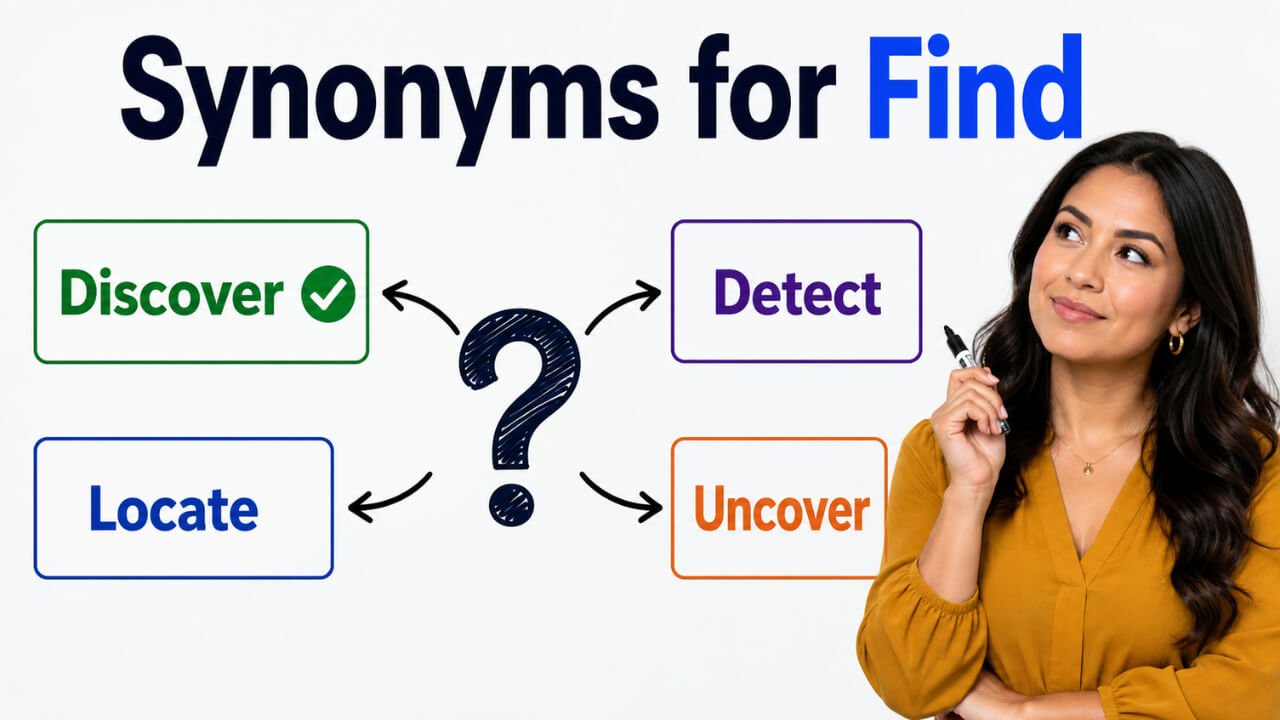
Quick Answer: Common synonyms for find include discover, locate, identify, detect, spot, notice, uncover, determine, obtain, and realize. Use locate when discovering the position of something, discover for learning something new, identify for recognizing a person or object, and detect for noticing something difficult to see. Obtain works when find means to acquire something, while realize and determine are better when find refers to reaching an understanding or conclusion.
Pronunciation and Word Details
Word: Find
Pronunciation: /faɪnd/
Part of Speech: Verb
Meaning: To discover, locate, notice, obtain, or become aware of someone or something.
US Pronunciation:
UK Pronunciation:
What Does “Find” Mean?
Find means to discover, locate, notice, obtain, or recognize someone or something. It is mainly used as a verb, although the noun form can describe a valuable or interesting discovery.
The word has several meanings depending on the sentence. You can find a missing object, find new information, find a solution, find a person interesting, or find yourself in an unexpected situation.
Location Example: She found her keys under the chair.
Discovery Example: Researchers found evidence of earlier activity.
Understanding Example: I find the instructions difficult to follow.
Obtaining Example: He found a suitable job near his home.
Judgment Example: The committee found the proposal reasonable.
Meaning, Tone, and Context of “Find”
Find is a common, neutral, and flexible word. It appears naturally in casual conversation, formal writing, academic discussion, reports, stories, instructions, and professional communication.
In everyday speech, find often refers to locating people or objects. In research and academic writing, it may describe discovering evidence, reaching conclusions, or identifying patterns. In legal or official contexts, find can mean making a judgment or decision.
The word is rarely emotional by itself. Its tone depends on what is found. Finding a solution may sound positive, while finding a serious problem may create concern.
Because find has several meanings, choosing a more specific synonym can make a sentence clearer and more informative.
When and How to Use “Find”
For Locating Something: Use find when discovering where a person, object, or place is.
Example: We finally found the missing document.
For Discovering Information: Use find when learning a fact or uncovering new evidence.
Example: The investigation found several errors in the records.
For Noticing Something: Use find when becoming aware of a detail, change, or problem.
Example: She found a small crack in the window.
For Reaching a Conclusion: Use find when deciding what evidence or experience suggests.
Example: The researchers found that the new method produced better results.
For Expressing an Opinion: Use find when describing how someone experiences or judges something.
Example: I find this explanation much easier to understand.
For Obtaining Something: Use find when successfully getting a job, opportunity, solution, or resource.
Example: He found temporary accommodation near the office.
For Entering a Situation: Use find when someone unexpectedly becomes involved in a condition or circumstance.
Example: She found herself responsible for the entire project.
Best Synonyms for Find
Discover: To learn about something for the first time.
Example: Scientists discovered a previously unknown pattern in the data.
Locate: To determine the exact position of someone or something.
Example: The technician located the source of the problem.
Identify: To recognize or name someone or something correctly.
Example: Witnesses identified the person in the photograph.
Detect: To notice something that is difficult to see or recognize.
Example: The test detected a minor fault in the system.
Spot: To notice or see something quickly.
Example: She spotted an empty seat near the entrance.
Uncover: To discover information that was hidden or unknown.
Example: The review uncovered several important mistakes.
Determine: To discover or decide something through examination.
Example: The team determined the cause of the delay.
Realize: To become aware of or understand something.
Example: He realized that he had entered the wrong room.
Obtain: To get something through effort or a process.
Example: The applicant obtained permission to view the records.
Encounter: To meet or experience someone or something unexpectedly.
Example: We encountered several difficulties during the journey.
50 Synonyms for Find with Short Meanings
- Discover: To learn or become aware of something new.
- Locate: To determine the position of something.
- Identify: To recognize or name something correctly.
- Detect: To notice something difficult to observe.
- Spot: To see or notice something quickly.
- Notice: To become aware of something.
- Observe: To see or examine something carefully.
- Encounter: To meet or experience something unexpectedly.
- Meet: To come into contact with someone.
- Come Across: To find someone or something unexpectedly.
- Stumble Upon: To discover something by accident.
- Uncover: To discover something hidden.
- Unearth: To bring hidden information or objects to light.
- Ferret Out: To discover something through careful searching.
- Ascertain: To discover facts with certainty.
- Determine: To establish something through examination.
- Establish: To prove or confirm a fact.
- Learn: To gain knowledge of something.
- Realize: To become aware of a fact or situation.
- Recognize: To identify something previously known.
- Perceive: To become aware through the senses or mind.
- Discern: To notice or understand something unclear.
- Conclude: To form a judgment after considering evidence.
- Decide: To reach a conclusion or judgment.
- Judge: To form an opinion after examination.
- Consider: To regard something in a particular way.
- Deem: To judge or consider something to be true.
- Regard: To think of something in a particular way.
- Obtain: To get something through effort.
- Acquire: To gain possession of something.
- Secure: To successfully obtain something.
- Gain: To get or achieve something valuable.
- Recover: To find and regain something lost.
- Retrieve: To locate and bring something back.
- Track Down: To find someone or something after searching.
- Seek Out: To search for and locate something.
- Pinpoint: To locate or identify something precisely.
- Trace: To find the origin, path, or location of something.
- Search Out: To locate through careful searching.
- Turn Up: To be found or appear unexpectedly.
- Find Out: To discover information or learn the truth.
- Come Upon: To meet or discover something unexpectedly.
- Chance Upon: To find something accidentally.
- Happen Upon: To discover something without planning.
- Reach: To arrive at a place, result, or conclusion.
- Attain: To succeed in reaching or obtaining something.
- Achieve: To successfully gain a desired result.
- Access: To reach or obtain information or resources.
- Get: To obtain, receive, or locate something.
- Procure: To obtain something through effort or arrangement.
Read Also:
Synonyms for Relevant
Synonyms for Find by Context
When Find Means Locate
Locate, pinpoint, track down, trace, retrieve, seek out, and search out are useful when finding involves determining where someone or something is.
Example: Investigators tracked down the owner of the abandoned vehicle.
Locate is the most direct formal alternative. Pinpoint suggests exactness, while track down implies that the search required time and effort.
When Find Means Discover
Discover, uncover, unearth, come across, stumble upon, chance upon, and happen upon describe learning about or encountering something previously unknown.
Example: The researchers uncovered new evidence during the review.
Discover is the broadest choice. Uncover and unearth often suggest hidden information, while stumble upon and chance upon describe accidental discoveries.
When Find Means Notice
Notice, spot, observe, detect, perceive, discern, and recognize describe becoming aware of something.
Example: The editor detected several inconsistencies in the final draft.
Spot is suitable for quick visual recognition. Detect suggests difficulty, while discern describes noticing a subtle difference or meaning.
When Find Means Determine
Ascertain, determine, establish, conclude, decide, and learn are useful when find refers to discovering facts or reaching a conclusion.
Example: The investigation determined that the equipment had been installed incorrectly.
Ascertain is formal and emphasizes certainty. Establish means confirming a fact, while conclude describes forming a judgment from evidence.
When Find Means Realize
Realize, recognize, perceive, understand, learn, and become aware are useful when find means reaching a new understanding.
Example: She realized that the solution was simpler than expected.
Realize emphasizes a moment of understanding, while recognize often involves identifying something familiar.
When Find Means Obtain
Obtain, acquire, secure, gain, procure, get, attain, and achieve describe successfully receiving or gaining something.
Example: The organization secured enough funding to continue the project.
Obtain is neutral and formal. Secure suggests success after effort, while procure often involves arranging to get something specific.
When Find Means Judge
Consider, deem, regard, judge, conclude, and decide can replace find when it expresses an opinion or official decision.
Example: The panel deemed the application incomplete.
Deem is formal and common in official writing. Consider and regard are more neutral, while judge emphasizes evaluation.
Another Word for Find
The best general replacement for find is discover. However, the most accurate alternative depends on whether you are locating an object, noticing a detail, obtaining something, learning information, or reaching a conclusion.
Original: She found an error in the report.
Better Option: She detected an error in the report.
Original: The police found the missing vehicle.
Better Option: The police located the missing vehicle.
Original: Researchers found a connection between the two factors.
Better Option: Researchers identified a connection between the two factors.
Original: He found a better solution to the problem.
Better Option: He developed a better solution to the problem.
When Not to Use “Find”
Avoid find when it is too general to explain exactly what happened. A precise synonym can show whether someone located, detected, identified, obtained, or concluded something.
Weak: The test found a problem.
Better: The test detected a problem.
Weak: The team found the building.
Better: The team located the building.
Weak: The review found several patterns.
Better: The review identified several patterns.
Find can also sound repetitive when used several times in one paragraph.
Weak: We found the address, found the building, and found the correct office.
Better: We obtained the address, located the building, and identified the correct office.
Avoid using find when you actually mean search. Search describes the effort to look, while find describes the successful result.
Weak: I found for my missing glasses all morning.
Better: I searched for my missing glasses all morning.
Use a more formal alternative in academic, technical, or official writing when greater precision is needed.
Weak: The study found the exact source of the error.
Better: The study determined the exact source of the error.
Words Commonly Confused With Find
Find vs Search: Find means successfully locating or discovering something. Search means making an effort to look for it.
Find vs Discover: Find can refer to ordinary objects or information, while discover often suggests something new, unknown, or important.
Find vs Locate: Find is broad and conversational, while locate focuses specifically on determining position.
Find vs Identify: Find means discovering or locating something, while identify means recognizing or naming it correctly.
Find vs Detect: Find is general, while detect usually refers to noticing something hidden, faint, or difficult to observe.
Find vs Realize: Find may describe discovery through action or examination, while realize describes becoming mentally aware of something.
Find vs Obtain: Find may include locating or discovering, while obtain specifically means successfully getting something.
Find vs Encounter: Find often suggests a result, while encounter describes meeting or experiencing something unexpectedly.
Which Synonym Should You Choose?
Choose discover when learning something new or previously unknown.
Choose locate when determining the position of a person, object, place, or source.
Choose identify when naming or recognizing someone or something correctly.
Choose detect when noticing a hidden, small, or difficult detail.
Choose spot for quick visual recognition in casual conversation.
Choose uncover when hidden facts, problems, or evidence become known.
Choose ascertain for formal writing about confirming facts with certainty.
Choose determine when research, testing, or analysis produces a conclusion.
Choose realize when describing a moment of understanding.
Choose obtain when successfully getting permission, information, work, or resources.
Choose secure when something is obtained after effort or competition.
Choose encounter when meeting a person or experiencing a problem unexpectedly.
Choose deem when expressing an official or formal judgment.
Choose retrieve when locating something and bringing it back.
Choose track down when the search is difficult or takes considerable effort.
Real Life Examples of “Find” in Sentences
Original: I could not find my phone this morning.
Better Option: I could not locate my phone this morning.
Original: The doctor found signs of an infection.
Better Option: The doctor detected signs of an infection.
Original: Researchers found a clear pattern in the results.
Better Option: Researchers identified a clear pattern in the results.
Original: She found an old photograph in the drawer.
Better Option: She came across an old photograph in the drawer.
Original: We found the information through careful research.
Better Option: We uncovered the information through careful research.
Original: He found that the instructions were incorrect.
Better Option: He determined that the instructions were incorrect.
Original: The company found a suitable candidate.
Better Option: The company identified a suitable candidate.
Original: She found the course surprisingly useful.
Better Option: She considered the course surprisingly useful.
Original: They finally found enough money for the repairs.
Better Option: They finally secured enough money for the repairs.
Original: I found myself in an unfamiliar part of the city.
Better Option: I realized that I was in an unfamiliar part of the city.
Synonym Groups and Usage Differences
Location Group
Locate, pinpoint, track down, trace, retrieve, seek out, and search out relate to discovering where something is.
Locate is the broadest formal word. Pinpoint emphasizes exactness, while retrieve includes bringing the object back.
Example: The technician pinpointed the damaged section of the cable.
Discovery Group
Discover, uncover, unearth, ferret out, stumble upon, and come across describe learning about something unknown or hidden.
Discover is neutral. Unearth and ferret out suggest effort, while stumble upon describes accidental discovery.
Example: The journalist unearthed documents that changed the investigation.
Observation Group
Notice, spot, observe, detect, perceive, discern, and recognize refer to becoming aware of something.
Notice and spot are common in conversation. Detect and discern are more precise and formal.
Example: She discerned a slight change in his tone.
Knowledge Group
Learn, realize, ascertain, determine, establish, and conclude describe gaining information or understanding.
Ascertain and determine suit formal analysis. Realize describes personal awareness, while establish suggests proving a fact.
Example: The researchers established that the two events were connected.
Judgment Group
Judge, consider, deem, regard, conclude, and decide describe forming an opinion or reaching a decision.
Deem is formal and often appears in rules or official statements. Consider is softer and more neutral.
Example: The inspector deemed the building safe for use.
Acquisition Group
Obtain, acquire, secure, procure, gain, get, attain, and achieve refer to receiving or gaining something.
Obtain is widely useful. Secure suggests effort, procure suggests arrangement, and achieve usually refers to reaching a goal.
Example: She obtained the necessary approval before beginning work.
Accidental Discovery Group
Come across, chance upon, happen upon, stumble upon, and come upon describe finding something without intentionally searching for it.
These phrases are common in storytelling and casual speech.
Example: We happened upon a quiet garden behind the old building.
Antonyms of Find
The opposite of find depends on whether the word means locate, notice, understand, or obtain.
Lose: To become unable to locate or keep something.
Misplace: To put something somewhere and forget its location.
Miss: To fail to notice, reach, or discover something.
Overlook: To fail to notice an important detail.
Ignore: To deliberately avoid noticing or considering something.
Conceal: To hide something so it cannot be discovered.
Hide: To place something where it is difficult to locate.
Misunderstand: To fail to understand something correctly.
Forget: To lose awareness or memory of something.
Abandon: To stop looking for or pursuing something.
Fail: To be unsuccessful in reaching or obtaining a result.
Lose Sight Of: To become unable to see or follow something.
Comparison: Find vs Related Words
Find vs Discover
Find is a broad word for locating, noticing, obtaining, or understanding something. Discover usually refers to learning about something new or previously unknown.
Example With Find: She found her notebook under the sofa.
Example With Discover: She discovered an unknown letter inside the notebook.
Find vs Locate
Find may describe any successful discovery. Locate focuses on determining the exact position of someone or something.
Example With Find: We found the missing package.
Example With Locate: We located the package in the storage room.
Find vs Search
Find refers to a successful result. Search refers to the activity of looking for something, whether successful or not.
Example With Find: I found the document before the meeting.
Example With Search: I searched for the document for nearly an hour.
Find vs Identify
Find means locating or discovering something. Identify means recognizing, naming, or classifying it correctly.
Example With Find: The team found an unusual object.
Example With Identify: The team identified the object as an ancient tool.
Find vs Detect
Find is general, while detect suggests noticing something faint, hidden, small, or difficult to recognize.
Example With Find: The mechanic found a fault in the engine.
Example With Detect: The sensor detected a slight change in temperature.
Find vs Realize
Find can involve physical discovery or judgment. Realize refers specifically to becoming mentally aware of a fact.
Example With Find: I found the instructions confusing.
Example With Realize: I realized that I had misunderstood the instructions.
Find vs Obtain
Find can mean locating, discovering, or getting something. Obtain specifically means acquiring something through effort or a process.
Example With Find: She found a useful guide online.
Example With Obtain: She obtained official permission to use the material.
Common Phrases and Expressions With “Find”
Find Out: To discover information or learn the truth.
Find a Way: To develop a method for solving a problem.
Find Time: To make enough time available for an activity.
Find Yourself: To unexpectedly become involved in a situation.
Find Fault: To criticize or identify problems.
Find Common Ground: To discover shared opinions or interests.
Find Your Way: To successfully reach a place or understand a process.
Find It Difficult: To experience difficulty doing something.
Find the Right Words: To decide how to express an idea or feeling.
Find a Solution: To discover a way to solve a problem.
Find Favor: To gain approval or support.
Find Meaning: To discover purpose or significance.
Common Mistakes to Avoid
One common mistake is confusing find with search. You search for something while looking, but you find it when the search succeeds.
Incorrect: I found for my wallet throughout the house.
Correct: I searched for my wallet throughout the house.
Another mistake is using find when a more exact word would improve clarity. In research writing, use detect, identify, determine, or establish when those meanings are intended.
Avoid using find repeatedly in nearby sentences. Vary the wording according to the meaning.
Repetitive: The researchers found a pattern and found several causes.
Improved: The researchers identified a pattern and uncovered several causes.
Do not use discover for ordinary objects unless the discovery is surprising or important.
Unnatural: I discovered my shoes beside the door.
Natural: I found my shoes beside the door.
Be careful with the past tense. The past tense and past participle of find are both found.
Incorrect: She finded the missing file.
Correct: She found the missing file.
Avoid vague statements that do not explain what was discovered.
Vague: The report found many things.
Clear: The report identified several weaknesses in the current process.
Conclusion
Synonyms for find can express location, discovery, observation, understanding, judgment, or acquisition. Use locate for physical position, discover for something new, detect for hidden details, and identify for correct recognition. Determine and ascertain suit formal conclusions, while realize describes personal understanding. Obtain and secure work best when find means gaining something. Choosing the most precise alternative makes each sentence clearer, reduces repetition, and helps readers understand exactly how something was located, learned, noticed, or acquired.
FAQs About Synonyms for Find
What is the best synonym for find?
Discover is a strong general synonym, but locate is better for position, identify for recognition, and obtain for gaining something.
What is a formal synonym for find?
Locate, ascertain, determine, identify, establish, obtain, and detect are useful formal alternatives.
What is another word for finding information?
Discovering, learning, uncovering, ascertaining, and finding out can describe gaining information.
What is a synonym for finding a lost object?
Locate, recover, retrieve, track down, and turn up are suitable alternatives.
What is the difference between find and search?
Search describes looking for something. Find describes successfully locating or discovering it.
Can find mean forming an opinion?
Yes. In a sentence such as “I find the book useful,” find means consider, regard, or judge.
What is the past tense of find?
The past tense and past participle of find are both found.
