
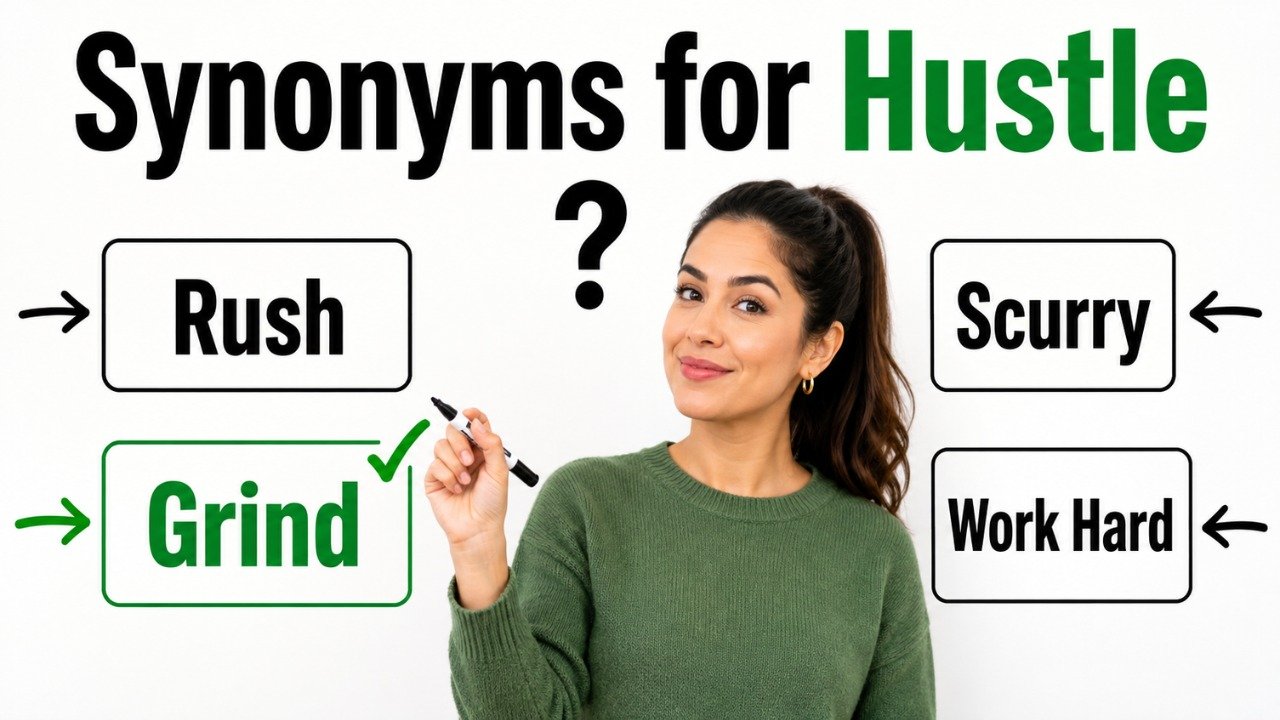
Quick Answer: The best synonyms for hustle include work hard, strive, grind, hurry, rush, bustle, push, labor, endeavor, and scramble. The right choice depends on context. Use work hard or strive for persistent effort, grind for intense ongoing work, hurry or rush for fast movement, bustle for energetic activity, push for determined effort, and scramble when someone acts quickly under pressure.
Pronunciation and Word Details
Word: Hustle.
Pronunciation: /ˈhʌsəl/
Part of Speech: Verb and noun.
Meaning: To work energetically, move quickly, push toward a goal, or engage in busy and determined activity.
US Pronunciation:
UK Pronunciation:
What Does “Hustle” Mean?
Hustle means to move quickly, work energetically, or make a determined effort to achieve something.
As a verb, hustle can describe physical movement, intense work, persuasion, ambition, or hurried activity.
Example: She hustled to finish the project before the deadline.
In this sentence, hustle means that she worked quickly and energetically.
Hustle can also describe moving someone along quickly.
Example: The staff hustled everyone into the building before the rain started.
As a noun, hustle can refer to energetic effort, busy activity, or determination.
Example: His hustle helped the team complete the difficult assignment.
In informal contexts, hustle may also describe aggressive selling, deceptive activity, or trying to earn money through persistent effort. Because of these different meanings, the best synonym depends heavily on the sentence.
Meaning, Tone, and Context of “Hustle”
Hustle can be casual, energetic, motivational, critical, or negative depending on how it is used.
In positive contexts, hustle often refers to ambition, persistence, energy, and hard work.
Example: Her hustle and determination helped her build a successful career.
In movement contexts, hustle usually means to hurry or move quickly.
Example: We need to hustle if we want to arrive on time.
In workplace language, hustle can describe sustained effort, productivity, initiative, or drive. However, it is more conversational than formal words such as strive, endeavor, or labor.
Hustle can also carry a negative meaning when it refers to pressuring, deceiving, or aggressively persuading someone.
For this reason, context matters. In an essay, report, or professional document, a more precise synonym may communicate the intended meaning more clearly.
When and How to Use “Hustle”
For Hard Work: Use hustle when someone works with energy, persistence, and determination.
Example: She continued to hustle even when progress was slow.
For Fast Movement: Use hustle when someone needs to move quickly.
Example: We had to hustle to catch the train.
For Ambition: Hustle can describe energetic effort toward a personal or professional goal.
Example: His hustle helped him make steady progress in his career.
For Busy Activity: Use hustle to describe a place or situation filled with energetic movement.
Example: The morning hustle began before sunrise.
For Urgent Action: Hustle can describe acting quickly because time is limited.
Example: The team hustled to complete the preparations.
For Persistent Effort: Use hustle when someone keeps pushing toward a goal despite difficulty.
Example: She hustled for months to turn the idea into reality.
Best Synonyms for Hustle
Strive: Make a strong and determined effort toward a goal.
Example: She strives to improve her skills every day.
Work Hard: Put significant energy and effort into a task.
Example: They worked hard to complete the project on time.
Grind: Work continuously and intensely for a long period.
Example: He continued to grind through a difficult week.
Hurry: Move or act more quickly than usual.
Example: We need to hurry before the store closes.
Rush: Move or act with great speed, often because time is limited.
Example: She rushed to finish the report before the meeting.
Bustle: Move around energetically in a busy manner.
Example: Workers bustled through the office preparing for the event.
Push: Make a determined effort to make progress.
Example: The team pushed hard to reach its final goal.
Labor: Work with considerable physical or mental effort.
Example: They labored for hours over the complicated design.
Endeavor: Make a serious and purposeful attempt.
Example: She endeavored to complete every part of the assignment carefully.
Scramble: Act or move quickly because of urgency or pressure.
Example: Employees scrambled to meet the unexpected deadline.
50 Synonyms for Hustle with Short Meanings
- Strive: Make a determined effort toward a goal.
- Work Hard: Apply strong effort to a task.
- Grind: Work intensely and continuously.
- Hurry: Move or act quickly.
- Rush: Move rapidly because time is limited.
- Bustle: Move about with energetic activity.
- Push: Make a strong effort to progress.
- Labor: Work with sustained physical or mental effort.
- Endeavor: Make a serious attempt.
- Scramble: Act quickly under pressure.
- Toil: Work long and hard.
- Struggle: Make great effort despite difficulty.
- Persist: Continue despite obstacles or delay.
- Persevere: Keep working toward a goal despite challenges.
- Apply Oneself: Give focused effort to a task.
- Exert Oneself: Use significant energy or effort.
- Drive: Push forward with determination.
- Press On: Continue making progress despite difficulty.
- Keep Going: Continue working or moving forward.
- Forge Ahead: Move forward with determination.
- Pursue: Work toward achieving a goal.
- Chase: Actively seek or work toward something.
- Seek: Make an effort to obtain or achieve something.
- Advance: Move forward toward a goal.
- Move Quickly: Travel or act at a fast pace.
- Speed: Move rapidly.
- Dash: Move somewhere very quickly.
- Sprint: Move rapidly for a short distance or period.
- Race: Move quickly toward a destination or goal.
- Scurry: Move quickly with short rapid movements.
- Scuttle: Move quickly with hurried steps.
- Hasten: Cause or choose to move more quickly.
- Accelerate: Increase speed or rate of progress.
- Mobilize: Prepare and act quickly toward a goal.
- Get Moving: Begin moving or working quickly.
- Get Busy: Start working actively.
- Get To Work: Begin focused effort on a task.
- Stay Active: Continue working or moving energetically.
- Keep At It: Continue working persistently.
- Put In Effort: Devote energy to achieving something.
- Make An Effort: Try seriously to accomplish something.
- Give It Your All: Apply maximum effort.
- Go All Out: Make the strongest possible effort.
- Work Relentlessly: Continue working with little interruption.
- Work Diligently: Work carefully and persistently.
- Strain: Make a strong physical or mental effort.
- Busy Oneself: Keep actively occupied with work.
- Move Briskly: Move at a quick and energetic pace.
- Press Forward: Continue advancing with determination.
- Make Headway: Achieve progress through continued effort.
Read Also:
Synonyms for Performed

Synonyms for Hustle by Context
When Hustle Means Work Hard
The strongest choices are work hard, strive, labor, toil, grind, and apply oneself.
These words focus on sustained effort rather than fast physical movement.
Example: She worked hard to improve her qualifications.
Example: He continued to strive for better results despite setbacks.
When Hustle Means Move Quickly
Use hurry, rush, dash, race, hasten, or move briskly when speed is the main idea.
Example: We hurried across the station before the doors closed.
Example: She dashed outside when she heard her name.
When Hustle Means Show Ambition
Use strive, push, pursue, drive, or forge ahead when the sentence describes ambition and determination.
Example: He pushed himself to achieve a demanding professional goal.
Example: She pursued every opportunity that could help her improve.
When Hustle Means Stay Busy
Use bustle, busy oneself, stay active, or get busy when referring to energetic activity.
Example: Staff bustled around the room preparing everything for the guests.
When Hustle Means Act Under Pressure
Use scramble, rush, hurry, or race when someone needs to act quickly because of limited time.
Example: The team scrambled to finish the presentation before noon.
When Hustle Means Persistent Effort
Use persist, persevere, press on, keep at it, or press forward when the focus is continuing despite difficulty.
Example: She persevered even after several unsuccessful attempts.
Another Word for Hustle
The best single replacement for hustle is often strive when the word refers to determined effort.
However, the best alternative changes according to meaning. Use hurry when hustle means moving quickly, grind for intense ongoing work, bustle for energetic activity, and scramble for urgent action.
Original: She hustled to reach her professional goals.
Better Option: She strived to reach her professional goals.
Original: We need to hustle before the doors close.
Better Option: We need to hurry before the doors close.
Original: The team hustled to complete the project.
Better Option: The team worked hard to complete the project.
Original: Employees hustled around preparing for the event.
Better Option: Employees bustled around preparing for the event.
When Not to Use “Hustle”
Hustle may sound too informal in academic, legal, technical, or highly professional writing.
A more exact word such as strive, endeavor, labor, hurry, or pursue may fit better.
Weak: Researchers hustled to complete the analysis.
Better: Researchers worked diligently to complete the analysis.
Avoid hustle when the reader might misunderstand whether you mean hard work, speed, or aggressive persuasion.
Weak: She hustled the customers.
Better: She pressured the customers to make a purchase.
Hustle can also sound vague in formal writing about professional performance.
Weak: The employee showed a lot of hustle.
Better: The employee demonstrated strong initiative and persistence.
Do not automatically use rush as a synonym when hustle means sustained hard work.
Weak: She rushed for years to establish her career.
Better: She worked relentlessly for years to establish her career.
A precise synonym should communicate whether the sentence focuses on effort, urgency, movement, ambition, or persistence.
Words Commonly Confused With Hustle
Hustle vs Hurry: Hustle can mean both energetic work and fast movement. Hurry mainly means acting or moving quickly.
Hustle vs Grind: Hustle is broader and can describe movement or ambition. Grind usually suggests long, repetitive, or demanding work.
Hustle vs Strive: Hustle sounds more casual and energetic. Strive is more formal and emphasizes determined effort toward a goal.
Hustle vs Rush: Hustle can involve energetic action without poor planning. Rush often suggests limited time and may imply excessive speed.
Hustle vs Bustle: Hustle can describe personal effort or quick movement. Bustle usually describes energetic movement in a busy environment.
Hustle vs Toil: Hustle often sounds energetic or ambitious. Toil emphasizes difficult, tiring, or prolonged labor.
Hustle vs Scramble: Hustle may describe normal energetic effort. Scramble usually suggests urgency, pressure, or sudden difficulty.
Hustle vs Persevere: Hustle focuses on active effort. Persevere emphasizes continuing despite setbacks or obstacles.
Which Synonym Should You Choose?
Choose strive for formal writing about determination, progress, goals, and achievement.
Choose work hard for clear everyday language about effort.
Choose grind for casual descriptions of sustained and demanding work.
Choose labor for serious or formal descriptions of difficult work.
Choose endeavor for formal writing about purposeful attempts.
Choose hurry when someone needs to move or act quickly.
Choose rush when time pressure causes rapid action.
Choose bustle when describing energetic activity in a busy place.
Choose scramble when someone must act quickly because of unexpected pressure.
Choose persevere when the main idea is continuing despite difficulty.
Choose pursue when someone actively works toward an opportunity, objective, or ambition.
Real Life Examples of “Hustle” in Sentences
Original: She hustled every day to improve her business skills.
Better Option: She worked hard every day to improve her business skills.
Original: We had to hustle to reach the station on time.
Better Option: We had to hurry to reach the station on time.
Original: He continued to hustle despite several setbacks.
Better Option: He continued to persevere despite several setbacks.
Original: The employees hustled to finish the orders.
Better Option: The employees scrambled to finish the orders.
Original: She hustled toward her long term goal.
Better Option: She strived toward her long term goal.
Original: Everyone hustled around before the guests arrived.
Better Option: Everyone bustled around before the guests arrived.
Original: The team hustled through the final stage of the project.
Better Option: The team pushed through the final stage of the project.
Original: He hustled for years to develop his skills.
Better Option: He labored for years to develop his skills.
Original: We need to hustle if we want to finish before evening.
Better Option: We need to move quickly if we want to finish before evening.
Original: She hustled to create new opportunities for herself.
Better Option: She pursued new opportunities with determination.
Synonym Groups and Usage Differences
Hard Work Group
Words such as work hard, labor, toil, grind, and work diligently focus on effort and sustained activity.
Example: She worked diligently to finish every assignment accurately.
Ambition Group
Words such as strive, push, pursue, drive, and forge ahead focus on determination and progress toward goals.
Example: He continued to strive for improvement throughout his career.
Speed Group
Words such as hurry, rush, dash, race, and hasten describe fast movement or action.
Example: We hurried across the building before the meeting started.
Busy Activity Group
Words such as bustle, busy oneself, stay active, and get busy describe energetic activity.
Example: Volunteers bustled around preparing tables and supplies.
Persistence Group
Words such as persist, persevere, press on, keep at it, and press forward emphasize continued effort despite challenges.
Example: She persevered until she found a solution.
Urgency Group
Words such as scramble, rush, and race are best when a person is acting under strong time pressure.
Example: The staff scrambled to make the final changes before the deadline.
Antonyms of Hustle
The opposite of hustle depends on whether the word refers to hard work, speed, ambition, or energetic activity.
Rest: Stop working or moving in order to recover.
Relax: Become less active or tense.
Idle: Spend time without productive activity.
Linger: Remain somewhere without hurrying.
Delay: Postpone an action or make it happen later.
Dawdle: Move or act unnecessarily slowly.
Loiter: Remain somewhere without a clear purpose.
Pause: Stop temporarily before continuing.
Slow: Reduce speed or pace.
Procrastinate: Delay something that should be done.
Neglect: Fail to give proper attention or effort.
Abandon: Stop pursuing an activity or goal.
Comparison: Hustle vs Related Words
Hustle vs Strive
Hustle is informal and can suggest energetic action. Strive is more formal and emphasizes sustained effort toward a goal.
Example With Hustle: She hustled to build a better future.
Example With Strive: She strived to build a better future.
Hustle vs Hurry
Hustle can mean working energetically or moving fast. Hurry focuses mainly on speed.
Example With Hustle: We need to hustle to finish these preparations.
Example With Hurry: We need to hurry or we will miss the train.
Hustle vs Grind
Hustle often suggests energy, ambition, and movement. Grind emphasizes demanding or repetitive work over time.
Example With Hustle: He hustled to grow his skills.
Example With Grind: He continued to grind through months of difficult training.
Hustle vs Rush
Hustle can involve purposeful energy. Rush usually emphasizes speed caused by urgency or limited time.
Example With Hustle: The team hustled to complete the setup.
Example With Rush: The team rushed through the final preparations.
Hustle vs Bustle
Hustle can refer to individual effort or speed. Bustle commonly describes energetic activity involving movement in a busy setting.
Example With Hustle: She hustled to finish her work.
Example With Bustle: Workers bustled around the hall before the event.
Hustle vs Toil
Hustle often sounds energetic and ambitious. Toil suggests prolonged, tiring, or difficult work.
Example With Hustle: He hustled to reach his goals.
Example With Toil: He toiled for hours over the complicated task.
Hustle vs Scramble
Hustle can describe normal energetic effort, while scramble usually implies sudden urgency or pressure.
Example With Hustle: They hustled to complete the assignment.
Example With Scramble: They scrambled to complete the assignment after the deadline changed.
Common Phrases and Expressions With Hustle
Hustle Hard: Work with strong energy and determination.
Hustle Up: Move or act more quickly.
Daily Hustle: The regular effort and activity involved in work or responsibilities.
Side Hustle: Additional work done alongside a main occupation to earn income or develop an opportunity.
Hustle And Bustle: Busy and energetic activity involving many people or movements.
Hustle For Success: Work energetically toward achievement.
Hustle To Finish: Work quickly to complete something.
Hustle To Catch Up: Work rapidly to reach the required level or schedule.
Hustle For Opportunities: Actively seek chances for progress or advancement.
Hustle Through The Day: Move through daily responsibilities with considerable energy and activity.
Common Mistakes to Avoid
One common mistake is using hustle without considering its different meanings.
If hustle means hard work, choose words such as strive, labor, or work hard. If it means fast movement, hurry or rush may be clearer.
Another mistake is using hustle in highly formal writing when a more precise verb would sound more professional.
Weak: The department hustled to achieve its objectives.
Better: The department worked diligently to achieve its objectives.
Do not confuse hustle with hurry in every sentence. Hustle can involve effort and ambition even when speed is not the main idea.
Avoid overusing motivational language such as hustle when discussing exhaustion, unhealthy workloads, or serious workplace expectations. A neutral phrase such as sustained effort may communicate the situation more accurately.
Be careful with grind, which can suggest difficult and exhausting repetitive work.
Also remember that hustle can have negative meanings involving pressure or deception. Make sure the context clearly communicates the intended sense.
Choose synonyms according to whether your sentence describes work, movement, urgency, ambition, persistence, or busy activity.
Conclusion
The most useful synonyms for hustle include strive, work hard, grind, hurry, rush, bustle, push, labor, endeavor, and scramble. Use strive for determined goals, work hard for general effort, hurry for fast movement, and scramble for urgent action. Grind suits demanding ongoing work, while persevere emphasizes persistence through difficulty. Since hustle can express effort, speed, ambition, or busy activity, choosing a synonym that matches the exact context makes your writing clearer and more precise.
FAQs About Synonyms for Hustle
What Is the Best Synonym for Hustle?
Strive is a strong general synonym when hustle means making determined effort. Hurry is better when hustle refers to moving quickly.
What Is Another Word for Hustle in Work?
Useful alternatives include work hard, strive, labor, grind, toil, and apply oneself.
What Is a Formal Synonym for Hustle?
Strive, endeavor, labor, persevere, and pursue are more formal alternatives, depending on the context.
What Is Another Word for Hustle and Grind?
Useful alternatives include work hard, labor, toil, persevere, work relentlessly, and work diligently.
What Is Another Word for Hustle When Moving Quickly?
Use hurry, rush, dash, race, hasten, or move briskly when speed is the intended meaning.
Is Strive a Synonym for Hustle?
Yes. Strive is a strong synonym when hustle means working energetically and persistently toward a goal. It usually sounds more formal.
What Is the Opposite of Hustle?
Common opposites include rest, relax, idle, linger, dawdle, delay, and procrastinate, depending on the meaning.
