
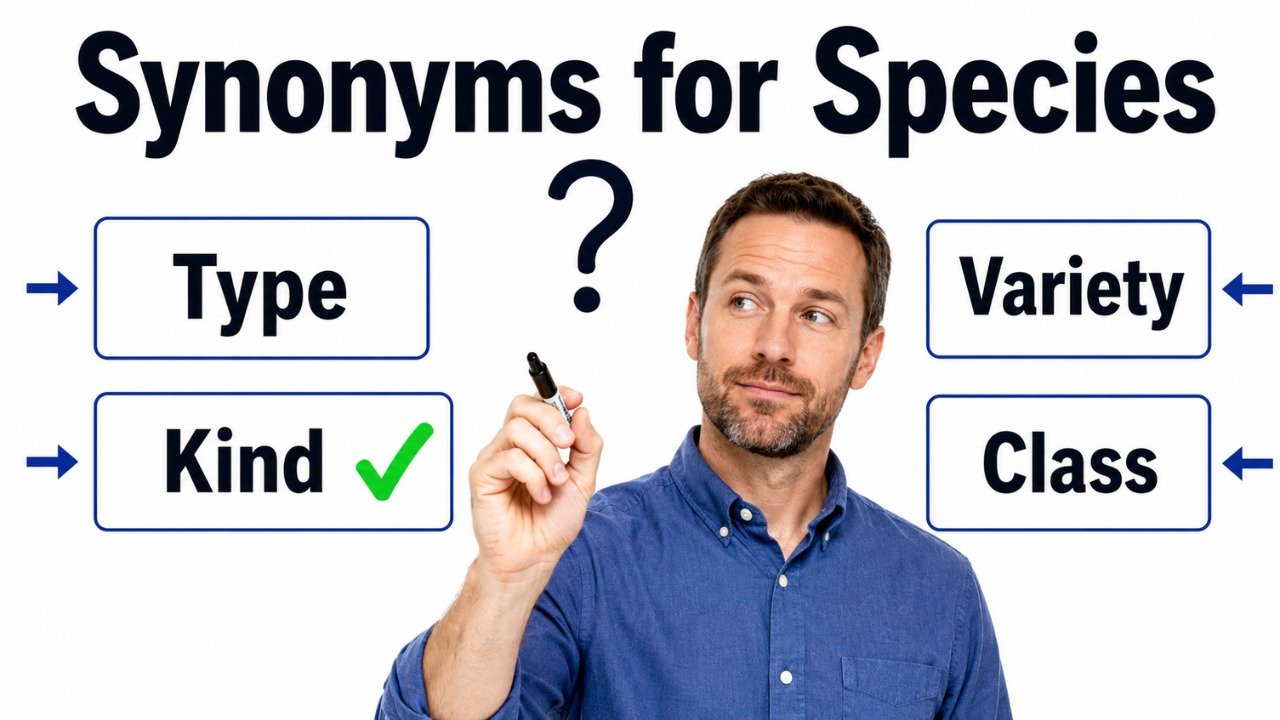
Quick Answer: The best synonyms for species include kind, type, sort, variety, class, category, group, form, strain, and classification. The best choice depends on context. Use kind or type in everyday speech, category or class when organizing things, variety for a distinct form within a broader group, and strain for certain biological or microbial variations. In scientific writing, species has a precise taxonomic meaning, so general alternatives should not always replace it.
Pronunciation and Word Details
Word: Species.
Pronunciation: /ˈspiːʃiːz/
Part of Speech: Noun.
Meaning: A group of living organisms that share important characteristics, or more generally, a particular kind or type of something.
US Pronunciation:
UK Pronunciation:
What Does “Species” Mean?
Species means a distinct group of living organisms that share important biological characteristics.
In biology, species is a formal classification used to identify organisms that belong to the same closely related group. The word can refer to animals, plants, fungi, microorganisms, and other living things.
Species is unusual because the same form is used for both singular and plural meanings. You can say “one species” and “many species.”
Outside scientific contexts, species can also mean a kind, type, or category of something. This broader use is less common in casual conversation but appears in formal, descriptive, and literary writing.
The best synonym therefore depends on whether the sentence concerns biological classification or simply a general kind of person, object, idea, or phenomenon.
Meaning, Tone, and Context of “Species”
Species is a neutral word, but its tone varies according to context.
In biology, ecology, zoology, botany, conservation, and environmental science, species is a technical and precise term. Replacing it with a general word such as kind or type can reduce scientific accuracy.
In everyday language, species can occasionally mean a particular sort or kind of something. This use often sounds more formal than simply saying type or kind.
In academic writing, species commonly appears when discussing biodiversity, evolution, ecosystems, classification, extinction, habitats, populations, and organisms.
The word itself is neither strongly emotional nor casual. Its scientific use is precise and technical, while its broader figurative use can sound formal or descriptive.
When and How to Use “Species”
For Biological Classification: Use species when referring to a formally recognized biological group.
Example: Scientists identified a previously unknown species of frog.
For Animals: Species is useful when distinguishing one biological group of animals from another.
Example: Several bird species live in the wetland.
For Plants: Use species when discussing scientifically recognized groups of plants.
Example: This forest contains many native tree species.
For Biodiversity: Species is appropriate when discussing the number and variety of organisms within an ecosystem.
Example: Protecting the habitat could benefit several threatened species.
For General Types: In broader writing, species can sometimes mean a particular kind or type.
Example: The author described arrogance as a peculiar species of ignorance.
Best Synonyms for Species
Kind: A group of things sharing similar characteristics.
Example: This kind of plant prefers moist soil.
Type: A category distinguished by shared qualities or features.
Example: Researchers examined several types of microorganisms.
Sort: A particular kind or variety of something.
Example: What sort of animal leaves tracks like these?
Variety: A distinct form or variation within a broader group.
Example: The garden contains a rare variety of rose.
Class: A group organized according to shared characteristics.
Example: The organisms belong to a broader class of animals.
Category: A division created by grouping similar things together.
Example: Each specimen was placed in the appropriate category.
Group: A collection of organisms or things considered together.
Example: This group of insects shares several noticeable features.
Form: A particular version, shape, or variation of something.
Example: Researchers discovered an unusual form of the plant.
Strain: A genetic variation or subtype within some organisms, especially microorganisms.
Example: Scientists studied a resistant strain of bacteria.
Classification: A division or arrangement based on shared characteristics.
Example: Biological classification helps organize living organisms systematically.
50 Synonyms for Species with Short Meanings
- Kind: A group sharing similar characteristics.
- Type: A particular category or form.
- Sort: A specific kind of something.
- Variety: A distinct form within a larger group.
- Class: A group sharing common features.
- Category: A division based on shared qualities.
- Group: A collection considered together.
- Form: A particular version or variation.
- Strain: A genetic subtype of certain organisms.
- Classification: A grouping based on common characteristics.
- Division: A section within a larger system.
- Order: A ranked biological classification above family.
- Taxon: A formally recognized group in biological classification.
- Taxonomic Group: A category recognized within biological classification.
- Biological Group: Organisms considered together because of biological similarities.
- Organism Group: A collection of related living organisms.
- Population: Members of one species living in a particular area.
- Subspecies: A distinct group within a species.
- Varietal Form: A recognizable variation within a broader biological group.
- Variant: A form that differs from others of the same general type.
- Subtype: A smaller category within a larger type.
- Subgroup: A smaller division within a larger group.
- Breed: A distinct domesticated animal group produced through selective breeding.
- Cultivar: A cultivated plant variety selected for particular characteristics.
- Lineage: A line of descent connecting related organisms.
- Stock: A population or line from which organisms descend.
- Race: A biological grouping term used in limited specialized contexts.
- Morph: A distinct physical form within a species.
- Ecotype: A locally adapted form within a species.
- Biotype: A group distinguished by particular biological characteristics.
- Phenotype: An observable form defined by expressed characteristics.
- Genotype: A genetic constitution distinguishing an organism or group.
- Form Type: A recognizable version distinguished by particular features.
- Distinct Type: A clearly differentiated kind.
- Natural Group: A group based on naturally shared features.
- Organism Type: A general kind of living organism.
- Life Form: A type of living organism or biological form.
- Living Group: A set of organisms considered together.
- Biological Type: A type defined through biological characteristics.
- Taxonomic Category: A formal grouping in biological classification.
- Taxonomic Unit: A recognized unit used in classification.
- Taxonomic Division: A biological grouping within a classification system.
- Natural Kind: A naturally occurring category defined by shared traits.
- Family Type: A type associated with a broader biological family.
- Organism Class: A category used to group living organisms.
- Biological Category: A category defined by biological similarities.
- Distinct Form: A clearly recognizable form within a larger group.
- Related Group: A collection of organisms connected by shared traits.
- Biological Variety: A distinguishable biological variation.
- Taxonomic Classification: The scientific grouping of organisms according to shared characteristics.
Read Also:
Synonyms for Glorious

Synonyms for Species by Context
When Species Means Kind or Type
In general writing, the most natural alternatives are kind, type, sort, and form.
These words work when species is being used broadly rather than as a strict biological classification.
Example: This type of behavior is uncommon in the region.
Example: Researchers observed an unusual kind of interaction among the animals.
When Species Means a Biological Group
In scientific contexts, useful related terms include taxon, taxonomic group, biological group, and organism group.
These terms are not always exact substitutes because species has a specific rank in biological classification.
Example: Each taxon was examined separately during the study.
Example: The biological group shares several inherited traits.
When Species Means a Variation
Use variety, variant, subtype, morph, or form when referring to a distinguishable variation.
Example: This variety produces smaller flowers than the common form.
Example: Researchers identified a darker morph in the population.
When Species Refers to Microorganisms
Strain, biotype, variant, and subtype may be useful when discussing differences among microorganisms.
These words should be chosen carefully because they describe different biological relationships.
Example: The laboratory examined a newly identified strain of bacteria.
When Species Refers to Plants
Words such as cultivar, variety, form, and ecotype may be appropriate depending on the biological distinction being described.
Example: The cultivated variety produces larger fruit.
Example: This ecotype is adapted to dry conditions.
Another Word for Species
The best general replacement for species is type when the sentence is not using the word as a formal biological classification.
In everyday language, kind is also natural. In scientific writing, however, species usually should remain unchanged because it represents a specific taxonomic concept.
Original: Scientists recorded several species of insects in the area.
Better Option: Scientists recorded several types of insects in the area.
Original: This species of behavior is difficult to explain.
Better Option: This kind of behavior is difficult to explain.
Original: They studied a distinct species of microorganism.
Better Option: They studied a distinct biological group of microorganisms.
Original: The collection contains several species of decorative plants.
Better Option: The collection contains several varieties of decorative plants.
When Not to Use “Species”
Do not replace species with a general synonym when scientific precision matters.
Words such as kind, type, and group are broader than species and may not communicate a formal taxonomic relationship.
Weak: Scientists discovered a new kind of bird and formally named it.
Better: Scientists discovered a new species of bird and formally named it.
Avoid using breed as a direct synonym for species. A breed normally refers to a distinct group within a domesticated species.
Weak: A Labrador is a different species of dog.
Better: A Labrador is a different breed of dog.
Do not use genus as an interchangeable synonym for species. Genus is a separate and broader taxonomic rank.
Weak: The two organisms belong to the same species because they share a genus.
Better: The two organisms belong to the same genus but may represent different species.
Avoid unnecessary technical language in casual writing.
Weak: Which taxonomic group of sandwich would you like?
Better: Which type of sandwich would you like?
Words Commonly Confused With Species
Species vs Genus: A species is a more specific biological group, while a genus contains one or more closely related species.
Species vs Breed: A species is a biological classification, while a breed is a human developed group within a domesticated animal species.
Species vs Variety: Species is a formal biological category, while variety often describes a distinguishable form within a larger group and has specialized meanings in plant classification.
Species vs Strain: Species identifies a broader biological group, while strain describes a particular genetic line or subtype, especially among microorganisms.
Species vs Population: A species includes related organisms across its range, while a population consists of members of a species living in a particular area.
Species vs Subspecies: A species is the broader group, while a subspecies is a recognizable subdivision within it.
Species vs Taxon: Species is one particular taxonomic rank. Taxon is a broader term that can refer to a recognized group at any taxonomic level.
Which Synonym Should You Choose?
Choose kind for simple everyday conversation about a general category.
Choose type when distinguishing something according to characteristics or function.
Choose sort for conversational descriptions of a particular kind.
Choose category when sorting things into organized groups.
Choose class when discussing structured groupings or classifications.
Choose variety when describing a distinguishable form within a broader group.
Choose strain for particular genetic lines, especially when discussing microorganisms.
Choose cultivar for cultivated plant varieties developed or selected for particular traits.
Choose taxon in scientific writing when referring broadly to a formally classified biological group.
Choose species itself when precise biological classification is essential.
Real Life Examples of “Species” in Sentences
Original: The forest supports hundreds of species of plants.
Better Option: The forest supports hundreds of types of plants.
Original: Scientists discovered a species that had not been recorded before.
Better Option: Scientists discovered a biological group that had not been recorded before.
Original: Several species of fish live in the lake.
Better Option: Several kinds of fish live in the lake.
Original: This species has adapted well to colder conditions.
Better Option: This biological type has adapted well to colder conditions.
Original: The researchers compared three species of flowering plants.
Better Option: The researchers compared three varieties of flowering plants.
Original: Some species are found only on isolated islands.
Better Option: Some organism groups are found only on isolated islands.
Original: The garden attracts many species of butterfly.
Better Option: The garden attracts many types of butterfly.
Original: Each species responds differently to environmental change.
Better Option: Each biological group responds differently to environmental change.
Original: The disease can affect several species.
Better Option: The disease can affect several kinds of organisms.
Original: Conservation programs protect endangered species.
Better Option: Conservation programs protect endangered biological groups.
Synonym Groups and Usage Differences
General Type Group
Words such as kind, type, sort, and form are useful when species means a general category rather than a formal biological rank.
Example: This type of plant grows quickly in moist environments.
Classification Group
Words such as class, category, classification, division, and taxonomic group relate to organizing organisms according to shared characteristics.
Example: Each organism was assigned to the correct taxonomic group.
Biological Variation Group
Words such as variety, variant, subtype, morph, and ecotype describe distinguishable forms within broader biological groups.
Example: A darker morph occurs naturally within the population.
Scientific Grouping Group
Words such as taxon, taxonomic unit, biological group, and organism group are useful in scientific discussions about classification.
Example: Researchers compared traits across several taxonomic units.
Specialized Variation Group
Terms such as strain, cultivar, breed, and biotype have specific uses and should not be treated as universal synonyms for species.
Example: The laboratory identified a resistant strain of the microorganism.
Antonyms of Species
Species does not have one exact antonym because it names a category rather than a quality. However, several contrasting concepts can work depending on context.
Individual: A single organism rather than an entire biological group.
Whole: The complete collection rather than one particular category.
Generality: Something broad rather than one specific type.
Uniformity: Lack of distinct types or variations.
Sameness: Absence of meaningful differences between forms.
Mixture: A combination of different kinds rather than one defined group.
Diversity: The presence of many different forms or groups.
Collective: A broad collection rather than one distinct classification.
Universality: Something applying across all kinds rather than one species.
Undifferentiated Group: A collection not divided into distinct categories.
Comparison: Species vs Related Words
Species vs Type
Species is a precise biological term when used scientifically. Type is broader and can describe almost any category.
Example With Species: The island contains a rare species of lizard.
Example With Type: This type of lizard prefers rocky areas.
Species vs Kind
Kind is an everyday word for a general category. Species is more precise and often scientific.
Example With Species: Scientists identified a new species of orchid.
Example With Kind: What kind of orchid grows here?
Species vs Variety
Species identifies a distinct biological group. Variety usually describes a distinguishable form within a broader group and may have a specific botanical meaning.
Example With Species: This species grows naturally in mountain forests.
Example With Variety: This variety produces pale purple flowers.
Species vs Breed
Species is a biological classification that exists independently of selective breeding. Breed normally describes a domesticated group developed through selective reproduction.
Example With Species: Domestic dogs belong to the same species.
Example With Breed: The two dogs belong to different breeds.
Species vs Strain
Species is broader, while strain refers to a particular genetic line or variation, especially among microorganisms.
Example With Species: Researchers studied the bacterial species.
Example With Strain: Researchers identified a resistant strain within the bacterial group.
Species vs Genus
A genus is a taxonomic rank that contains one or more related species. They are not interchangeable terms.
Example With Species: The researchers identified the species based on several characteristics.
Example With Genus: Several closely related species belong to the same genus.
Common Phrases and Expressions With Species
Animal Species: A distinct biological group of animals.
Plant Species: A distinct biological group of plants.
Endangered Species: A species facing a high risk of extinction.
Threatened Species: A species at risk of becoming endangered.
Native Species: A species occurring naturally in a particular region.
Invasive Species: A nonnative species that spreads and may disrupt an ecosystem.
Rare Species: A species with a small population or limited distribution.
New Species: A species newly identified or formally described.
Different Species: Biological groups recognized as distinct from one another.
Species Diversity: The variety of species present within a particular environment or ecosystem.
Common Mistakes to Avoid
One major mistake is treating species as interchangeable with every biological grouping term.
Do not use genus, family, breed, or strain as direct replacements unless the sentence actually refers to those specific concepts.
Another common mistake concerns singular and plural forms. The word species stays the same.
Correct: One species was discovered.
Correct: Five species were discovered.
Avoid writing “specie” when you mean one biological species. In this context, the singular form is still species.
Be careful when replacing species with type or kind in scientific writing. Those words may communicate the general idea but lose the technical precision.
Writers should also distinguish between species and subspecies. A subspecies is a division within a species rather than an equivalent classification.
Choose broader synonyms in everyday writing and retain species when biological accuracy matters.
Conclusion
The most useful synonyms for species include kind, type, sort, variety, class, category, group, form, taxon, and strain. Kind and type work best in general conversation, while category and class suit organized groupings. More specialized words such as strain, cultivar, subspecies, and taxon belong to particular scientific contexts. Because species has a precise biological meaning, it is often better to keep the original word in scientific writing rather than replace it with a broader alternative.
FAQs About Synonyms for Species
What Is the Best Synonym for Species?
Type is one of the best general synonyms for species outside strict scientific contexts. Kind is another natural alternative in everyday language.
What Is Another Word for Species in Biology?
Taxon or taxonomic group can be useful related terms, but neither is always an exact replacement because species represents a specific taxonomic rank.
Is Kind a Synonym for Species?
Yes, kind can replace species when the word simply means a type or category. It is less precise in scientific writing.
Is Type the Same as Species?
Not exactly. Type is a broad term for a category, while species has a specific meaning in biological classification.
What Is the Difference Between Species and Breed?
A species is a biological classification. A breed is a distinct domesticated group within a species that has particular inherited characteristics.
What Is the Plural of Species?
The plural of species is also species. The spelling does not change whether you are referring to one species or several species.
What Is a Scientific Alternative to Species?
Taxon, taxonomic group, and biological group are useful related expressions, but the correct term depends on the exact level of classification being discussed.
