
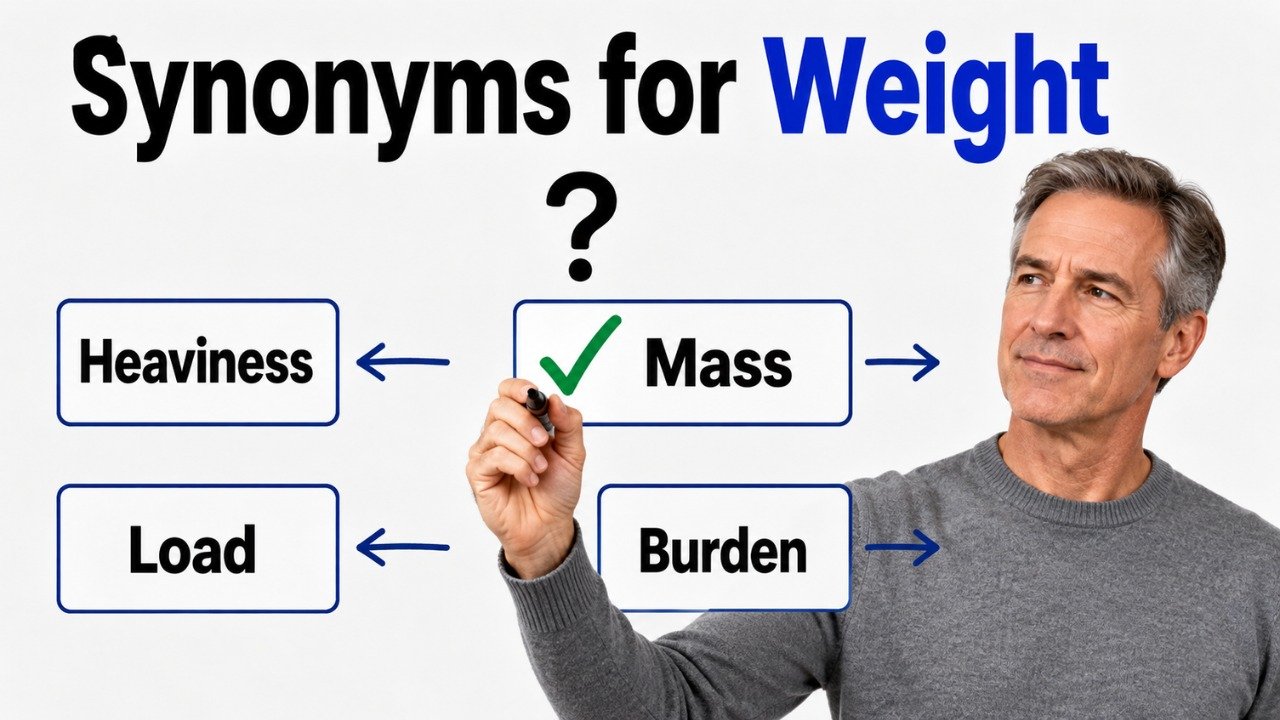
Quick Answer: The best synonyms for weight include heaviness, heft, mass, load, burden, pressure, importance, significance, influence, and gravity. Use heaviness or heft when describing how heavy something feels, load for something being carried, burden for physical or emotional difficulty, importance or significance for value, influence for persuasive power, and gravity for seriousness. The best synonym depends on whether weight refers to physical heaviness, responsibility, pressure, importance, influence, or measurement.
Pronunciation and Word Details
Word: Weight.
Pronunciation: /weɪt/
Part of Speech: Noun and verb.
Meaning: Weight refers to how heavy something is, or figuratively to a burden, degree of importance, influence, pressure, or emphasis.
US Pronunciation:
UK Pronunciation:
What Does “Weight” Mean?
Weight most commonly means the heaviness of a person or object.
Example: The weight of the package made it difficult to carry.
As a noun, weight may describe physical heaviness, a heavy load, responsibility, emotional pressure, importance, influence, or the strength given to an idea or argument.
Example: She felt the weight of responsibility after becoming team leader.
Weight can also refer to importance.
Example: His experience gave considerable weight to his opinion.
In another figurative sense, weight describes influence or persuasive power.
Example: Her recommendation carries weight with the committee.
As a verb, weight can mean to make something heavier or to give greater importance to a particular factor.
Example: The final score was weighted toward practical performance.
Because weight has several meanings, its most accurate synonym depends strongly on context.
Meaning, Tone, and Context of “Weight”
Weight is generally a neutral word, but its tone changes according to how it is used.
When talking about the physical heaviness of an object or person, weight is factual and neutral.
Example: The table can support the weight of several large boxes.
When weight refers to responsibility or emotional difficulty, it can have a serious or negative tone.
Example: The weight of the decision remained on his mind.
In formal, academic, and professional writing, weight can mean importance, credibility, or influence.
Example: Recent evidence adds weight to the argument.
In everyday conversation, people may use weight when discussing heaviness, body measurements, packages, exercise, luggage, or objects.
In analytical writing, weight may describe the relative importance given to different factors.
Example: Greater weight was given to accuracy than speed.
Words such as mass, burden, significance, influence, pressure, and emphasis can often provide greater precision when the intended meaning is clear.
When and How to Use “Weight”
For Physical Heaviness: Use weight when discussing how heavy an object, person, or material is.
Example: The weight of the suitcase exceeded what she expected.
For a Heavy Load: Weight can describe something that must be physically carried or supported.
Example: The shelf bent under the weight of the books.
For Responsibility: Use weight figuratively when duties or expectations feel difficult to carry.
Example: He understood the weight of his new responsibilities.
For Emotional Pressure: Weight can describe worry, stress, guilt, or emotional difficulty.
Example: Talking about the problem removed some of the weight from her mind.
For Importance: Use weight when an idea, fact, statement, or consideration deserves serious attention.
Example: Her practical experience gave weight to her argument.
For Influence: Weight can describe the power a person or opinion has over decisions.
Example: His views carry considerable weight in the organization.
For Emphasis: Weight can refer to the importance assigned to one part of a decision, assessment, or discussion.
Example: The evaluation gives greater weight to practical skills.
Best Synonyms for Weight
Heaviness: The quality of being heavy.
Example: The heaviness of the box made lifting it difficult.
Heft: The noticeable weight or substantial feel of something.
Example: He was surprised by the heft of the old metal tool.
Mass: The amount of matter in an object, often used as a close alternative in physical contexts.
Example: The object has a greater mass than the smaller sample.
Load: Something heavy that is carried, supported, or transported.
Example: The vehicle was designed to carry a large load.
Burden: A difficult physical, emotional, or practical responsibility.
Example: The financial burden affected the entire household.
Pressure: Stress, force, or demands placed on someone or something.
Example: She remained calm despite the pressure of the situation.
Importance: The quality of being valuable, serious, or worthy of attention.
Example: The decision has great importance for the project.
Significance: The degree to which something is meaningful or important.
Example: Researchers discussed the significance of the findings.
Influence: The power to affect decisions, opinions, or actions.
Example: His experience gave him considerable influence.
Gravity: Seriousness, importance, or solemnity.
Example: Everyone understood the gravity of the situation.
50 Synonyms for Weight with Short Meanings
- Heaviness: The quality of being physically heavy.
- Heft: Noticeable or substantial physical weight.
- Mass: The quantity of matter in an object.
- Load: Something carried or supported.
- Burden: A difficult load, duty, or responsibility.
- Pressure: Force, stress, or demanding circumstances.
- Strain: Physical or emotional pressure caused by difficulty.
- Stress: Mental, emotional, or physical pressure.
- Onus: A responsibility or duty that must be carried.
- Responsibility: A duty or obligation placed on someone.
- Obligation: Something a person is required or expected to do.
- Encumbrance: Something that creates difficulty or restricts progress.
- Liability: A responsibility, disadvantage, or financial obligation.
- Drag: Something that slows progress or becomes a burden.
- Ballast: Heavy material used to provide stability.
- Bulk: Large physical size or substantial quantity.
- Poundage: An amount measured in pounds.
- Tonnage: A quantity or capacity measured by weight.
- Gravity: Seriousness, importance, or physical gravitational force.
- Importance: The quality of deserving attention or consideration.
- Significance: Meaning, importance, or consequence.
- Consequence: Importance or meaningful effect.
- Seriousness: The quality of being important or requiring careful attention.
- Prominence: The state of being important or noticeable.
- Value: Importance, usefulness, or worth.
- Substance: Meaningful quality, seriousness, or importance.
- Import: Importance or significance.
- Priority: Something given greater importance than other matters.
- Emphasis: Special importance or attention given to something.
- Influence: Power to affect people, choices, or outcomes.
- Power: Ability to control, affect, or influence.
- Authority: Recognized power or influence.
- Clout: Informal influence or power.
- Leverage: Influence used to produce a desired result.
- Sway: Power to influence opinions or decisions.
- Pull: Informal ability to influence people or outcomes.
- Force: Strength, power, or physical pressure.
- Impact: Strong effect or influence.
- Bearing: Relevance or influence on a particular matter.
- Strength: Degree of power, force, or effectiveness.
- Gravitas: Seriousness, dignity, and importance.
- Preponderance: Greater influence, importance, or amount.
- Consideration: A factor that deserves attention in a decision.
- Relevance: Importance or connection to the matter being discussed.
- Standing: Degree of respect, influence, or importance.
- Dominance: Superior influence, strength, or control.
- Control: Power to direct or influence outcomes.
- Magnitude: Great size, extent, or importance.
- Deadweight: A heavy or burdensome load that provides little benefit.
- Weightiness: The quality of being heavy, serious, or important.
Read Also:
Synonyms for Hustle

Synonyms for Weight by Context
When Weight Means Physical Heaviness
Heaviness, heft, mass, bulk, poundage, tonnage, load, and ballast can relate to physical weight.
Example: The heft of the package surprised her when she picked it up.
Heaviness is the most direct alternative when describing the quality of being heavy. Heft emphasizes how substantial something feels when lifted.
Mass is related to weight but has a more specific scientific meaning. In everyday language, the two concepts are sometimes treated similarly, but they are not technically identical.
When Weight Means a Burden
Burden, load, onus, responsibility, obligation, encumbrance, liability, drag, and deadweight work when weight refers to something difficult to carry or manage.
Example: Caring for the entire project alone became a heavy burden.
Burden is especially useful for emotional, financial, or practical difficulty. Onus is more formal and emphasizes responsibility.
When Weight Means Pressure
Pressure, stress, strain, burden, and responsibility describe demands that affect a person’s mental or emotional state.
Example: The pressure of meeting the deadline affected everyone.
Stress is common in everyday and professional language. Strain can describe both mental difficulty and physical tension.
When Weight Means Importance
Importance, significance, gravity, consequence, seriousness, substance, import, prominence, and value can replace weight when something deserves serious consideration.
Example: The significance of the decision became clear later.
Gravity is particularly strong when the subject is serious, while significance works well in academic, professional, and neutral writing.
When Weight Means Influence
Influence, power, authority, clout, leverage, sway, pull, standing, and impact describe the ability to affect opinions or decisions.
Example: Her professional experience gave her considerable influence.
Clout and pull are more conversational, while authority and influence are suitable for formal writing.
When Weight Means Emphasis
Emphasis, priority, importance, consideration, relevance, and significance can describe the amount of attention given to a particular factor.
Example: The review places greater emphasis on accuracy.
Emphasis is often the clearest alternative when discussing how much importance is assigned to one part of an evaluation or argument.
Another Word for Weight
Another word for weight is heaviness when you are discussing physical weight. However, no single synonym works for every meaning of weight.
Use burden for difficult responsibility, significance for importance, influence for persuasive power, and pressure for emotional or practical demands.
Original: The weight of the package surprised me.
Better Option: The heaviness of the package surprised me.
Original: She carried the weight of the responsibility alone.
Better Option: She carried the burden of the responsibility alone.
Original: His opinion has considerable weight.
Better Option: His opinion has considerable influence.
Original: This evidence gives weight to the argument.
Better Option: This evidence gives significance to the argument.
When Not to Use “Weight”
Weight can become vague when readers cannot tell whether it refers to physical heaviness, importance, pressure, or influence.
Weak: The issue has a lot of weight.
Better: The issue has considerable significance.
A more specific word is also useful when describing emotional difficulty.
Weak: She felt the weight of everything happening around her.
Better: She felt the pressure of everything happening around her.
Avoid using weight when a technical distinction between weight and mass matters.
Weak: The object’s weight remains exactly the same regardless of gravitational conditions.
Better: The object’s mass remains the same even when gravitational conditions change.
Weight may also sound unclear in professional evaluations.
Weak: We put more weight on communication.
Better: We placed greater emphasis on communication.
Choose the synonym that identifies the intended meaning rather than replacing weight mechanically.
Words Commonly Confused With Weight
Weight vs Mass: Weight is the force associated with gravity acting on an object, while mass refers to the amount of matter in the object. They are often connected in everyday conversation but are not technically identical.
Weight vs Heaviness: Weight can be measured and can also have figurative meanings. Heaviness usually describes the quality or feeling of being heavy.
Weight vs Load: Weight refers to heaviness, while load usually means something being carried, supported, transported, or placed on a structure.
Weight vs Burden: Weight can be literal or figurative. Burden usually describes something difficult, demanding, or troublesome to carry or manage.
Weight vs Pressure: Weight may create pressure, but pressure specifically emphasizes force, stress, expectations, or demands.
Weight vs Importance: Weight can figuratively mean importance, but importance directly describes how valuable or significant something is.
Weight vs Influence: Weight may describe persuasive power, while influence directly refers to the ability to affect decisions, behavior, or opinions.
Weight vs Gravity: Weight and gravity are related physically, but gravity can also mean seriousness. In figurative language, gravity is especially suitable for serious situations.
Which Synonym Should You Choose?
Choose heaviness when describing how heavy something is.
Choose heft when emphasizing the substantial feel of an object.
Choose mass in scientific or technical contexts when referring to the amount of matter rather than gravitational force.
Choose load for something being carried, transported, or supported.
Choose burden for difficult responsibilities, financial problems, emotional concerns, or demanding duties.
Choose pressure when describing demands, expectations, or stressful circumstances.
Choose strain for sustained physical, emotional, or financial pressure.
Choose significance for formal writing, essays, research, reports, and discussions of importance.
Choose gravity when emphasizing seriousness.
Choose influence when discussing the ability to affect people or decisions.
Choose clout for informal discussions of strong influence or connections.
Choose emphasis when describing how much importance is given to one factor.
Choose priority when one matter is treated as more important than others.
Choose authority when influence comes from expertise, position, or recognized power.
Real Life Examples of “Weight” in Sentences
Original: The weight of the box made it difficult to move.
Better Option: The heaviness of the box made it difficult to move.
Original: He struggled under the weight of the equipment.
Better Option: He struggled under the load of the equipment.
Original: She felt the weight of her responsibilities.
Better Option: She felt the burden of her responsibilities.
Original: The weight of the deadline affected the whole team.
Better Option: The pressure of the deadline affected the whole team.
Original: Her experience gave weight to her recommendation.
Better Option: Her experience gave authority to her recommendation.
Original: His opinion carries considerable weight.
Better Option: His opinion carries considerable influence.
Original: The new evidence adds weight to the argument.
Better Option: The new evidence adds strength to the argument.
Original: Greater weight was placed on customer feedback.
Better Option: Greater emphasis was placed on customer feedback.
Original: They understood the weight of the situation.
Better Option: They understood the gravity of the situation.
Original: Financial concerns added weight to the decision.
Better Option: Financial concerns became an important consideration in the decision.
Synonym Groups and Usage Differences
Physical Heaviness Group
Heaviness, heft, mass, load, bulk, poundage, and tonnage relate to physical size, heaviness, or measurable quantity.
Heaviness is broad and direct. Heft suggests a noticeable sense of weight, while mass has a specific technical meaning.
Example: The unexpected heft of the package made her use both hands.
Burden and Responsibility Group
Burden, onus, responsibility, obligation, encumbrance, liability, and deadweight describe duties or difficulties that must be carried.
Burden is the most flexible choice. Onus is more formal, and obligation focuses on something a person is expected or required to do.
Example: The responsibility of managing the project fell entirely on him.
Pressure Group
Pressure, stress, strain, load, and burden can describe demanding situations.
Pressure emphasizes expectations or force. Stress describes the mental or physical response, while strain often suggests pressure continuing over time.
Example: The constant pressure began affecting her concentration.
Importance Group
Importance, significance, gravity, consequence, seriousness, prominence, substance, import, and value express the idea that something matters.
Significance is useful in academic and professional writing. Gravity works especially well for serious situations.
Example: The significance of the discovery became apparent immediately.
Influence Group
Influence, power, authority, clout, leverage, sway, pull, standing, dominance, and control describe the ability to affect decisions or behavior.
Influence is neutral and widely applicable. Clout is informal, while authority may come from knowledge or position.
Example: Her expertise gave her considerable influence in the discussion.
Emphasis Group
Emphasis, priority, consideration, relevance, significance, and importance relate to the amount of attention something receives.
Emphasis suits evaluations and explanations, while priority indicates that something comes before other concerns.
Example: The program places strong emphasis on practical learning.
Antonyms of Weight
The opposite of weight depends on whether weight means physical heaviness, burden, importance, or influence.
Lightness: The quality of having little physical weight.
Weightlessness: The condition of appearing to have no weight.
Ease: Freedom from difficulty, burden, or strain.
Relief: The removal or reduction of pressure or burden.
Freedom: Absence of restriction, responsibility, or constraint.
Insignificance: Lack of importance or meaningful effect.
Triviality: The quality of having little importance.
Unimportance: Lack of significance or value.
Irrelevance: Lack of connection or importance to a matter.
Powerlessness: Lack of ability to influence or control.
Weakness: Lack of strength, force, or influence.
Impotence: Lack of effective power or influence.
Negligibility: The quality of being too minor to deserve much attention.
Levity: Lack of seriousness or a lighthearted quality.
Release: Freedom from a burden, duty, or pressure.
Comparison: Weight vs Related Words
Weight vs Heaviness
Weight can refer to measurable heaviness as well as burden, importance, or influence. Heaviness mainly describes the state or sensation of being heavy.
Example With Weight: The weight of the equipment required a stronger shelf.
Example With Heaviness: The heaviness of the equipment made it difficult to lift.
Weight vs Mass
Weight depends on gravitational force, while mass describes the quantity of matter in an object.
Example With Weight: The object’s weight changes when gravitational conditions change.
Example With Mass: The object’s mass remains constant.
Weight vs Load
Weight describes heaviness. Load describes something that is carried, transported, placed on, or supported by something else.
Example With Weight: The bridge must support considerable weight.
Example With Load: The truck carried a heavy load of materials.
Weight vs Burden
Weight can have neutral or negative meanings. Burden specifically suggests difficulty, responsibility, worry, or something troublesome to carry.
Example With Weight: She understood the weight of her responsibilities.
Example With Burden: Managing everything alone became a burden.
Weight vs Importance
Weight can figuratively indicate importance. Importance directly states that something matters.
Example With Weight: His experience gave weight to his argument.
Example With Importance: The report explains the importance of careful planning.
Weight vs Influence
Weight can suggest the strength of an opinion or person’s authority. Influence directly describes the ability to affect decisions or behavior.
Example With Weight: Her recommendation carries great weight.
Example With Influence: Her recommendation has considerable influence on the final decision.
Weight vs Gravity
Weight has both literal and figurative meanings. Gravity often emphasizes either gravitational force or the seriousness of a situation.
Example With Weight: He felt the weight of making the final choice.
Example With Gravity: He understood the gravity of making the wrong choice.
Common Phrases and Expressions With Weight
Carry Weight: To have influence, credibility, or importance.
Example: Her opinion carries weight because of her experience.
Lose Weight: To become lighter in body weight.
Example: The phrase commonly describes a reduction in body weight.
Gain Weight: To become heavier.
Example: The animal began to gain weight after its diet improved.
Put On Weight: To increase in body weight.
Example: The puppy quickly put on weight as it grew.
Pull Your Weight: To do a fair share of the work.
Example: Every member of the group was expected to pull their weight.
Weight of Responsibility: The pressure created by important duties.
Example: She felt the weight of responsibility after accepting the role.
Weight of Evidence: The overall strength or persuasive value of available evidence.
Example: The weight of evidence supported the conclusion.
Give Weight To: To make an idea or argument seem more important or convincing.
Example: The new findings give weight to his explanation.
Under the Weight Of: Experiencing difficulty because of a heavy burden or pressure.
Example: The small branch bent under the weight of the snow.
Throw Your Weight Around: To use power or influence in an overly forceful way.
Example: A good leader does not need to throw their weight around.
Common Mistakes to Avoid
A common mistake is assuming that every synonym for weight can replace the word in every sentence.
Mass, burden, influence, significance, and pressure represent different meanings and are not interchangeable.
Incorrect Choice: Her opinion has a great mass in the discussion.
Better: Her opinion has great influence in the discussion.
Another mistake is confusing mass and weight in scientific writing. Mass refers to the amount of matter, while weight involves gravitational force.
Avoid using burden when the meaning is simply physical measurement.
Unnatural: The burden of the package is five kilograms.
Better: The mass of the package is five kilograms.
Do not use highly informal terms such as clout or pull when formal writing calls for influence, authority, or significance.
Avoid vague figurative uses when a precise alternative would communicate more information.
Vague: This factor has more weight.
Better: This factor receives greater emphasis.
Repetition can also weaken writing.
Repetitive: The weight of his duties added weight to the decision because his opinion carried weight.
Better: The burden of his duties affected the decision because his opinion carried considerable influence.
Always identify the intended meaning before selecting a synonym.
Conclusion
Synonyms for weight vary widely because weight can describe physical heaviness, a load, emotional pressure, responsibility, importance, or influence. Heaviness and heft work well for physical contexts, while load describes something carried or supported. Burden, pressure, and strain suit difficult responsibilities or demands. Significance, importance, and gravity express seriousness, while influence, authority, and clout describe persuasive power. Choosing the right alternative makes each sentence clearer, more precise, and more natural.
FAQs About Synonyms for Weight
What Is the Best Synonym for Weight?
Heaviness is the closest general synonym when weight refers to how heavy something is. For figurative meanings, burden, importance, significance, influence, or pressure may be better choices.
What Is Another Word for Weight?
Another word for weight can be heaviness, heft, load, burden, mass, significance, pressure, or influence depending on the context.
What Is a Synonym for Heavy Weight?
Heft, heaviness, load, bulk, and mass can describe substantial physical weight. The most natural choice depends on what is being measured or carried.
What Is a Synonym for Emotional Weight?
Burden, pressure, stress, strain, and onus are useful alternatives when weight describes emotional or mental difficulty.
What Is a Synonym for Weight Meaning Importance?
Importance, significance, gravity, consequence, substance, and prominence can replace weight when something deserves serious attention.
What Is a Synonym for Weight Meaning Influence?
Influence, authority, clout, leverage, sway, and pull can describe the power to affect decisions or opinions.
Are Weight and Mass the Same?
No. In everyday conversation they may appear similar, but technically mass is the amount of matter in an object, while weight is the gravitational force acting on that mass.
