
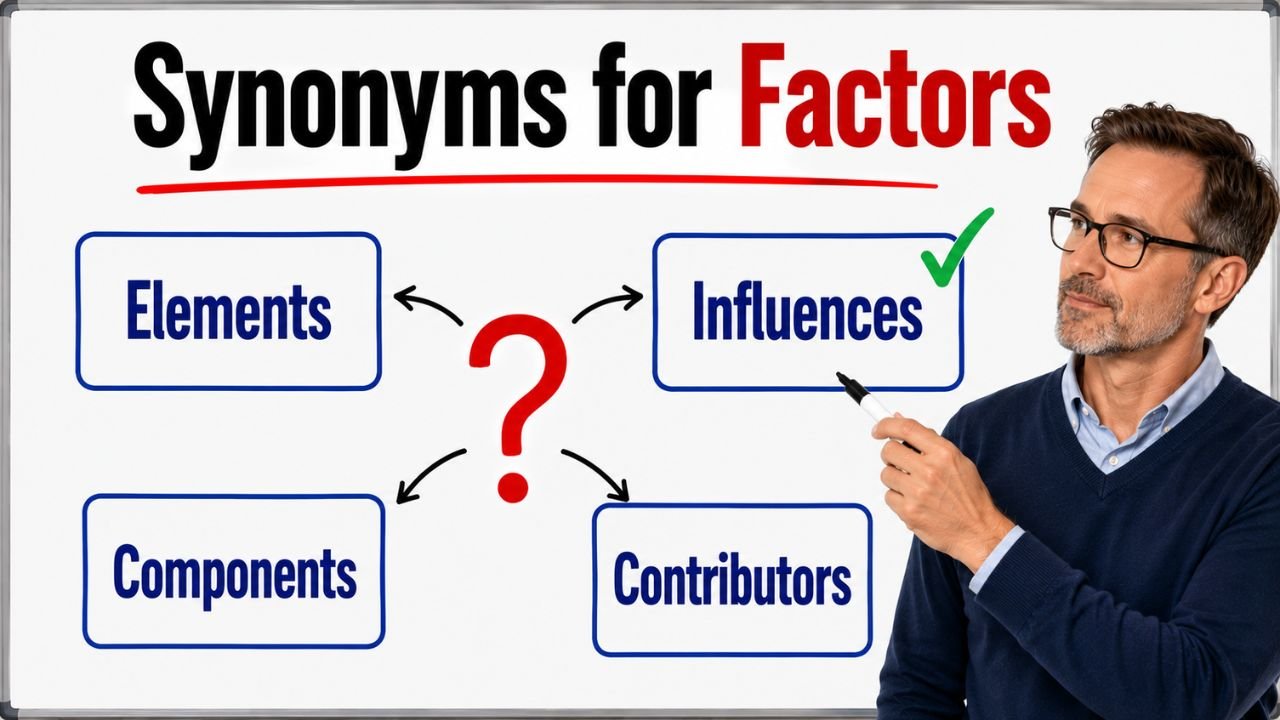
Quick Answer: The best synonyms for factor include cause, element, component, influence, consideration, determinant, variable, contributor, circumstance, and divisor. Use cause when something produces a result, element or component for one part of a larger whole, influence for something that affects a decision, consideration for a point that must be examined, determinant for a decisive condition, variable in research, and divisor when discussing mathematics.
Pronunciation and Word Details
Word: Factor.
Pronunciation: /ˈfæk.tər/.
Part of Speech: Noun and verb.
Meaning: A factor is something that contributes to a result, forms part of a situation, or divides a number evenly.
US Pronunciation:
UK Pronunciation:
What Does “Factor” Mean?
Factor means a cause, condition, element, or influence that helps produce a particular result.
As a noun, factor commonly refers to one part of a situation that affects what happens. Cost may be a factor in a purchasing decision, while experience may be a factor in choosing a candidate.
The word also has a mathematical meaning. A factor is a number that divides another number without leaving a remainder. For example, 3 and 4 are factors of 12.
As a verb, factor means to include something in a calculation, judgment, or plan.
General Use: Weather was an important factor in their decision.
Decision Context: Price remains the main factor affecting demand.
Research Context: Age was included as a variable in the study.
Mathematical Context: Six is a factor of eighteen.
Verb Use: We must factor additional expenses into the budget.
Factor is a flexible word, but its meaning changes according to whether the subject involves causes, decisions, components, research, mathematics, or calculations.
Meaning, Tone, and Context of “Factor”
Factor has a neutral, analytical, and practical tone. It is common in formal writing, academic discussion, reports, research, business communication, mathematics, science, and everyday conversation.
The word is especially useful when several conditions contribute to one result. It allows a writer to discuss causes without suggesting that one condition is solely responsible.
In casual conversation, reason, part, issue, and consideration may sound more natural.
In formal analysis, determinant, variable, parameter, component, and contributing influence may provide greater precision.
In mathematical writing, factor, divisor, multiplier, coefficient, and term have specialized meanings and should not be treated as completely interchangeable.
Neutral Tone: Cost was one factor in the final choice.
Formal Tone: Income is an important determinant of purchasing behavior.
Academic Tone: Several variables influenced the research findings.
Conversational Tone: Time was a major consideration for us.
Technical Tone: Each factor was included in the statistical model.
The most suitable synonym depends on whether factor describes a cause, part, influence, condition, mathematical number, or point for consideration.
When and How to Use “Factor”
For a Cause
Use factor when something contributes to a result without necessarily being the only cause.
Example: Poor visibility was a factor in the accident.
For a Decision
Use factor for a detail or condition that affects a choice.
Example: Location was the deciding factor when they selected the house.
For Part of a Situation
Use factor when one element forms part of a larger issue.
Example: Communication is an essential factor in successful teamwork.
For Research and Analysis
Use factor for a variable, condition, or influence being examined.
Example: The study considered age, income, and education as important factors.
For Business Planning
Use factor when discussing costs, risks, demand, competition, or performance.
Example: Production cost is a major factor in setting the final price.
For Mathematics
Use factor for a whole number or expression that divides another number or expression evenly.
Example: Five is a factor of twenty.
For Calculations
Use factor as a verb when including a condition or amount in a plan.
Example: Remember to factor delivery costs into the total budget.
For Personal Choices
Use factor when several practical or emotional conditions affect a decision.
Example: Family responsibilities were a significant factor in her career choice.
Best Synonyms for Factor
Cause: Something that directly produces a result.
Example: Heavy rain was the main cause of the flooding.
Element: One important part of a larger situation or system.
Example: Trust is an essential element of a healthy relationship.
Component: A part that combines with others to form a complete system.
Example: Training is a key component of the safety program.
Influence: Something that affects a person, event, or decision.
Example: Her teacher was a strong influence on her career choice.
Consideration: A fact or issue that must be examined before making a decision.
Example: Cost is an important consideration when planning the project.
Determinant: A condition that strongly controls or decides an outcome.
Example: Access to education is a major determinant of opportunity.
Variable: A condition or quantity that can change and affect results.
Example: Temperature was the main variable in the experiment.
Contributor: A person, condition, or cause that helps produce a result.
Example: Lack of sleep was a contributor to his poor concentration.
Circumstance: A condition connected with an event or situation.
Example: Financial circumstances affected their final decision.
Divisor: A number that divides another number without leaving a remainder.
Example: Four is a divisor of sixteen.
50 Synonyms for Factor with Short Meanings
- Cause: Something that produces a result.
- Reason: An explanation for why something happens.
- Source: The place or condition from which something begins.
- Origin: The starting point of an event or situation.
- Root: The basic cause of a problem or result.
- Trigger: Something that starts a reaction or event.
- Stimulus: Something that encourages a response or change.
- Catalyst: Something that speeds up or creates change.
- Driver: A force that causes progress or activity.
- Determinant: A condition that strongly decides an outcome.
- Influence: Something that affects a result or decision.
- Contributor: Something that helps produce an outcome.
- Consideration: A point that must be examined carefully.
- Criterion: A standard used to make a judgment.
- Issue: A subject or problem that affects a situation.
- Point: A particular detail requiring attention.
- Matter: A subject or condition of importance.
- Element: One part of a larger situation.
- Component: A part of a complete system.
- Part: One piece of a larger whole.
- Ingredient: One element needed to create a result.
- Aspect: One feature or side of a subject.
- Feature: A noticeable quality or characteristic.
- Detail: A small but relevant part of something.
- Dimension: One particular part or measurement of an issue.
- Attribute: A quality belonging to someone or something.
- Characteristic: A feature that helps identify something.
- Variable: A changing condition that affects a result.
- Parameter: A limit or condition within a system.
- Condition: A circumstance affecting what happens.
- Circumstance: A fact connected with an event or decision.
- Force: A strong influence producing change.
- Agent: Something that causes an action or effect.
- Mechanism: A process through which a result occurs.
- Input: Information or resources added to a process.
- Basis: The main reason or foundation for something.
- Ground: A reason supporting a belief or decision.
- Explanation: A statement showing why something happened.
- Term: A part of a mathematical expression.
- Coefficient: A number multiplying a mathematical variable.
- Divisor: A number that divides another number evenly.
- Multiplier: A number or condition that increases an amount.
- Quantity: An amount included in a calculation.
- Value: A numerical amount or level.
- Measure: A quantity used to assess something.
- Number: A mathematical value used in a calculation.
- Constituent: One part that forms a complete whole.
- Building Block: A basic part used to create something larger.
- Impetus: A force that encourages action or progress.
- Pressure: An influence that encourages a particular response.
Read Also:
Synonyms for Toxic
Synonyms for Factor by Context
When Factor Means Cause
Cause, reason, root, source, origin, trigger, stimulus, and catalyst describe something that produces or begins a result.
Cause is the most direct replacement when there is a clear connection between an action and an outcome. Root often describes the deepest cause of a problem. Trigger refers to something that starts an immediate response.
Example With Factor: Stress was a factor in his poor sleep.
Example With Cause: Stress was a cause of his poor sleep.
Example With Contributor: Stress was a major contributor to his poor sleep.
When Factor Means Part or Element
Element, component, part, constituent, ingredient, aspect, and building block describe one portion of a larger whole.
Element is useful for ideas, situations, and systems. Component commonly refers to a structured system or process. Ingredient works well in figurative descriptions of success.
Example With Factor: Patience is an important factor in learning.
Example With Element: Patience is an important element of learning.
Example With Ingredient: Patience is an essential ingredient for successful learning.
When Factor Means Influence
Influence, force, pressure, driver, contributor, stimulus, and impetus describe something that affects behavior, change, or decisions.
Influence is broad and neutral. Driver is common when discussing growth, business, or change. Pressure usually suggests a stronger external effect.
Example With Factor: Advertising was a major factor in increased demand.
Example With Influence: Advertising was a major influence on demand.
Example With Driver: Advertising was a major driver of increased demand.
When Factor Means Consideration
Consideration, issue, point, matter, criterion, condition, and circumstance describe something that must be evaluated before making a choice.
Consideration is the strongest replacement in decision making. Criterion refers to a standard used for judgment, while circumstance refers to surrounding conditions.
Example With Factor: Travel time was an important factor in their choice.
Example With Consideration: Travel time was an important consideration in their choice.
Example With Criterion: Travel time was one criterion used to compare the options.
When Factor Means Variable
Variable, parameter, quantity, measure, value, input, and condition are useful in research, data, science, and technical analysis.
Variable refers to something that can change. Parameter sets a boundary or condition. Input refers to information or resources added to a process.
Example With Factor: Temperature was carefully controlled as a factor.
Example With Variable: Temperature was carefully controlled as a variable.
Example With Parameter: Temperature was established as a controlled parameter.
When Factor Has a Mathematical Meaning
Divisor, multiplier, term, coefficient, number, quantity, and value may relate to factor in mathematical contexts.
These terms are not always interchangeable. Divisor is closest when a number divides another exactly. Coefficient refers to a number placed before a variable.
Example With Factor: Three is a factor of fifteen.
Example With Divisor: Three is a divisor of fifteen.
Example With Multiplier: Three acts as a multiplier in the expression.
Another Word for Factor
The best general replacement for factor is element. It works well when factor means one important part of a situation, process, or result.
The strongest alternative still depends on context. Use cause for something producing a result, consideration for a decision, variable for research, and divisor for mathematics.
Original: Cost was a major factor in the decision.
Better Option: Cost was a major consideration in the decision.
Original: Lack of practice was a factor in his performance.
Better Option: Lack of practice was a contributor to his performance.
Original: Temperature was an important factor in the experiment.
Better Option: Temperature was an important variable in the experiment.
Original: Eight is a factor of thirty two.
Better Option: Eight is a divisor of thirty two.
When Not to Use “Factor”
Factor may sound vague when the exact cause, condition, component, or influence is already known.
When One Direct Cause Is Responsible
Use cause rather than factor when one event clearly produces the result.
Weak: The broken pipe was a factor in the flooding.
Better: The broken pipe was the cause of the flooding.
When Referring to a Physical Part
Use component, part, or element when describing an actual piece of a system.
Weak: The battery is a factor of the device.
Better: The battery is a component of the device.
When Explaining a Decision
Use consideration or criterion when discussing how a choice was made.
Weak: Quality was a factor we examined before buying.
Better: Quality was an important consideration before buying.
When Discussing Research
Use variable or parameter if the condition was measured, changed, or controlled.
Weak: Age was a factor measured in the study.
Better: Age was a variable measured in the study.
When Discussing Mathematics
Do not replace factor with divisor, coefficient, or multiplier unless the mathematical relationship supports that term.
Weak: The coefficient of twelve is three.
Better: Three is a factor of twelve.
When Factor Becomes Repetitive
Repeated use can make analytical writing sound vague.
Weak: Cost was one factor, location was another factor, and timing was a third factor.
Better: Cost was one consideration, location was another concern, and timing was the final deciding influence.
Words Commonly Confused With Factor
Factor vs Cause: A factor contributes to a result, while a cause may produce the result more directly. Several factors can combine to create one outcome.
Factor vs Reason: A factor affects what happens. A reason explains why an action, belief, or decision occurred.
Factor vs Element: Factor emphasizes influence on a result. Element emphasizes being part of a larger whole.
Factor vs Component: Factor can be an abstract condition. Component is usually a defined part of a system, structure, or process.
Factor vs Variable: Factor is broad. Variable is a measurable or changing condition in research, mathematics, or analysis.
Factor vs Consideration: A factor affects an outcome. A consideration is something deliberately examined before making a decision.
Factor vs Criterion: A factor influences a choice, while a criterion is a standard used to judge or compare options.
Factor vs Divisor: Factor and divisor are closely related in basic mathematics, but divisor specifically describes the number performing the division.
Which Synonym Should You Choose?
Choose cause when one event or condition directly produces a result.
Choose reason when explaining why something happened or why someone acted.
Choose element when describing one important part of a broader situation.
Choose component when referring to a defined part of a system, machine, plan, or process.
Choose influence when something affects behavior, opinions, or decisions.
Choose contributor when something helps create an outcome but is not the only cause.
Choose consideration when discussing information examined before a choice.
Choose determinant when one condition has a strong or decisive effect.
Choose criterion when describing a standard used for comparison or judgment.
Choose variable in research, science, data analysis, and experiments.
Choose parameter when referring to a limit, rule, or controlled condition.
Choose driver when discussing business growth, demand, innovation, or change.
Choose circumstance when describing surrounding conditions.
Choose catalyst when something begins or accelerates change.
Choose divisor in mathematics when one number divides another evenly.
Real Life Examples of “Factor” in Sentences
Original: Cost was the biggest factor in choosing the hotel.
Better Option: Cost was the biggest consideration in choosing the hotel.
Original: Lack of preparation was a factor in the failure.
Better Option: Lack of preparation was a major contributor to the failure.
Original: Weather was an important factor during the journey.
Better Option: Weather was an important influence on the journey.
Original: Trust is a key factor in a strong relationship.
Better Option: Trust is a key element of a strong relationship.
Original: Experience was a factor in selecting the candidate.
Better Option: Experience was a deciding criterion in selecting the candidate.
Original: Age was recorded as a factor in the study.
Better Option: Age was recorded as a variable in the study.
Original: Demand is a factor that affects prices.
Better Option: Demand is a driver that affects prices.
Original: Poor communication was one factor behind the delay.
Better Option: Poor communication was one cause of the delay.
Original: Family needs were a factor in her decision.
Better Option: Family needs were an important consideration in her decision.
Original: Four is a factor of twenty.
Better Option: Four is a divisor of twenty.
Synonym Groups and Usage Differences
Cause Group
Cause, reason, source, origin, root, trigger, stimulus, and catalyst describe how something begins or why it happens.
Cause is direct. Root identifies a deeper underlying problem. Trigger describes an immediate beginning, while catalyst suggests faster change.
Example: The announcement acted as a catalyst for reform.
Component Group
Element, component, part, constituent, ingredient, and building block describe pieces of a larger whole.
Component often refers to organized systems. Ingredient may be literal or figurative. Building block describes a basic foundation.
Example: Clear communication is a building block of effective teamwork.
Influence Group
Influence, force, pressure, driver, impetus, and contributor describe conditions that shape actions or outcomes.
Driver is common in analytical and business writing. Pressure often suggests an unwanted or powerful influence.
Example: Customer demand was the main driver of growth.
Decision Group
Consideration, criterion, issue, point, matter, condition, and circumstance help describe decision making.
Consideration refers to something examined. Criterion is a standard. Circumstance describes the conditions surrounding the decision.
Example: Safety was the most important criterion in the selection process.
Research Group
Variable, parameter, input, measure, quantity, value, and condition are useful in scientific and analytical writing.
Variable changes or is measured. Parameter sets a limit. Input enters a system or calculation.
Example: Researchers controlled every variable except temperature.
Mathematical Group
Factor, divisor, multiplier, coefficient, term, quantity, value, and number have distinct mathematical uses.
A factor divides a number evenly. A coefficient multiplies a variable. A term is one part of an expression.
Example: In the expression 4x, four is the coefficient.
Antonyms of Factor
The opposite of factor depends on whether the word means a cause, influence, component, or consideration.
Result: An outcome produced by one or more factors.
Effect: A change created by a cause or influence.
Outcome: The final consequence of a situation.
Consequence: Something that happens because of an earlier action.
Whole: The complete object rather than one component.
Totality: Everything considered as a complete unit.
Irrelevance: A lack of connection or importance.
Nonissue: A matter that does not affect the situation.
Obstacle: Something that prevents progress rather than contributing positively.
Deterrent: Something that discourages action.
Exclusion: The act of leaving something out of consideration.
Constant: A value or condition that does not change.
Certainty: A fixed condition rather than a changing influence.
Independence: Freedom from outside influence.
Insignificance: A lack of meaningful effect.
Comparison: Factor vs Related Words
Factor vs Cause
Factor is one condition that contributes to a result. Cause suggests a more direct connection with the result.
Example With Factor: Fatigue was a factor in the mistake.
Example With Cause: A damaged cable was the cause of the failure.
Factor vs Element
Factor emphasizes effect or influence. Element emphasizes being one part of something larger.
Example With Factor: Timing was an important factor in the decision.
Example With Element: Timing was an important element of the plan.
Factor vs Component
Factor may be abstract, while component usually refers to a clear part of a system or structure.
Example With Factor: Motivation is a factor in performance.
Example With Component: Training is a component of the development program.
Factor vs Consideration
Factor affects an outcome. Consideration is consciously examined when a person makes a decision.
Example With Factor: Distance affected their final choice.
Example With Consideration: Distance was an important consideration.
Factor vs Variable
Factor is a general word for something affecting a result. Variable is a specific condition that can change or be measured.
Example With Factor: Sleep was a factor in performance.
Example With Variable: Sleep duration was measured as a variable.
Factor vs Determinant
A factor contributes to an outcome, while a determinant has a stronger or more decisive effect.
Example With Factor: Price was one factor affecting demand.
Example With Determinant: Availability was the main determinant of the final decision.
Factor vs Divisor
Factor and divisor are closely related in mathematics. Factor describes a number that divides another evenly, while divisor emphasizes its role in a division operation.
Example With Factor: Five is a factor of twenty five.
Example With Divisor: Five is the divisor in the calculation twenty five divided by five.
Common Phrases and Expressions With “Factor”
Key Factor: A highly important influence or condition.
Major Factor: Something that strongly affects an outcome.
Important Factor: A condition that deserves serious attention.
Deciding Factor: The condition that determines the final choice.
Contributing Factor: One of several conditions producing a result.
Risk Factor: A condition that increases the chance of harm or illness.
Human Factor: The influence of human behavior or ability.
External Factor: An influence coming from outside a system.
Environmental Factor: A surrounding condition that affects development or results.
Factor In: To include something in a calculation, plan, or decision.
Common Mistakes to Avoid
A common mistake is using factor as a direct replacement for cause in every sentence. A factor may contribute to a result without being the sole cause.
Unclear: The weather was the factor of the cancellation.
Better: The weather was a major factor in the cancellation.
Use the correct preposition after factor. Writers normally say factor in, factor affecting, or factor contributing to something.
Incorrect: Cost was a factor of our decision.
Correct: Cost was a factor in our decision.
Do not confuse a factor with an effect. A factor helps produce an outcome, while an effect is the outcome itself.
Incorrect: Lower prices were a factor of increased competition.
Clearer: Lower prices were an effect of increased competition.
Avoid replacing factor with component when discussing an influence rather than a physical or structured part.
Unnatural: Stress was a component in his poor sleep.
Better: Stress was a factor in his poor sleep.
Use variable instead of factor when discussing a condition that is deliberately measured or changed in an experiment.
Vague: The researchers changed one factor.
Precise: The researchers changed one variable.
In mathematics, do not confuse factors with multiples. A factor divides a number evenly, while a multiple is produced by multiplying that number.
Factor Example: Four is a factor of twelve.
Multiple Example: Twelve is a multiple of four.
Avoid repeating factor several times when more precise alternatives would improve clarity.
Repetitive: Cost was one factor, quality was another factor, and location was the final factor.
Better: Cost was one consideration, quality was another criterion, and location was the deciding influence.
Conclusion
Synonyms for factor help describe causes, components, influences, conditions, and mathematical relationships more accurately. Cause works for direct results, while element and component describe parts of a larger whole. Influence, driver, and contributor suit conditions that shape outcomes. Consideration and criterion are useful in decision making, while variable and parameter fit research. In mathematics, divisor is often the closest alternative. Choosing the right word makes analytical, academic, professional, and everyday writing clearer and more precise.
FAQs About Synonyms for Factor
What Is the Best Synonym for Factor?
Element is a strong general synonym, but cause, influence, component, or consideration may be better depending on the context.
What Is a Formal Synonym for Factor?
Determinant, variable, parameter, criterion, component, and contributing influence are useful formal alternatives.
What Is Another Word for a Contributing Factor?
Contributor, influence, cause, condition, driver, and determinant can replace contributing factor.
What Is a Synonym for Factor in a Decision?
Consideration, criterion, issue, circumstance, and deciding influence are suitable choices.
What Is a Synonym for Factor in Research?
Variable is usually the best alternative. Parameter, condition, input, and measure may also fit technical contexts.
What Is a Mathematical Synonym for Factor?
Divisor is the closest alternative when one number divides another without leaving a remainder.
What Is the Difference Between a Factor and a Cause?
A factor contributes to a result, while a cause often has a more direct role in producing it.
