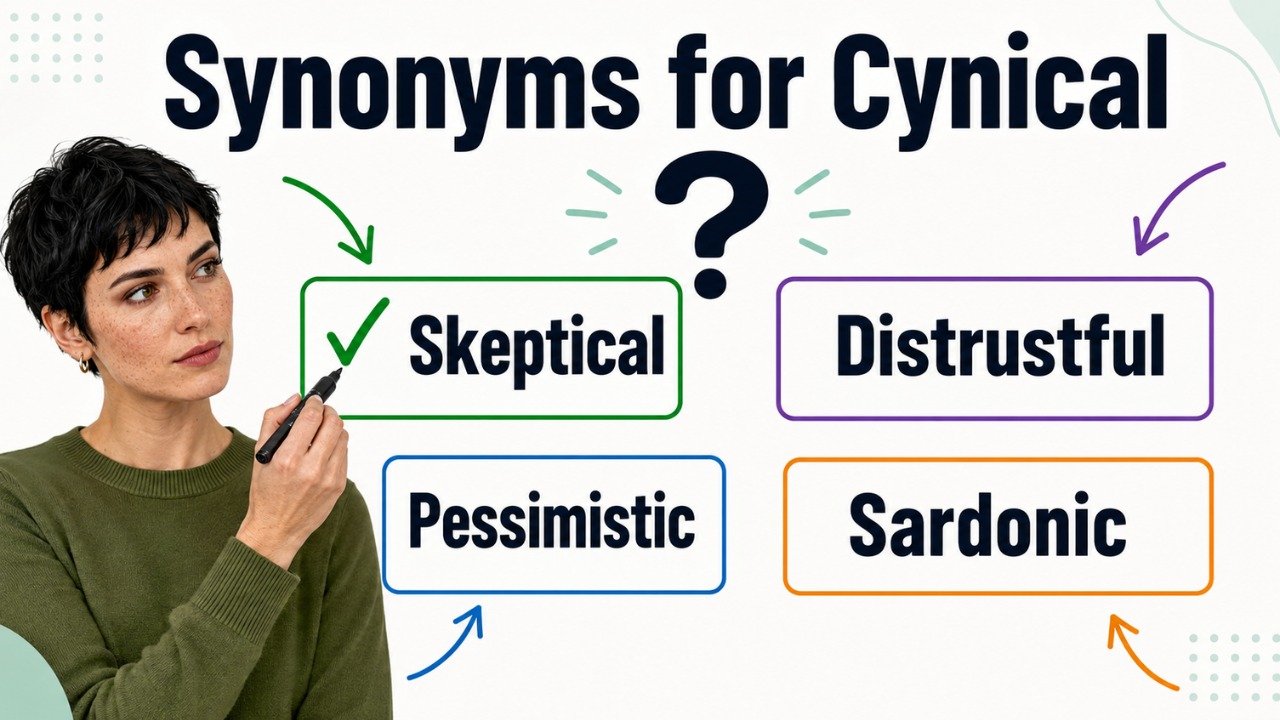
Quick Answer: Common synonyms for cynical include skeptical, distrustful, suspicious, pessimistic, jaded, disillusioned, sardonic, sarcastic, scornful, and misanthropic. Use skeptical when someone needs evidence before believing something. Choose distrustful or suspicious when a person questions the motives of others. Pessimistic fits a negative expectation about the future, while jaded and disillusioned describe negativity caused by disappointing experiences. Sardonic and sarcastic are better for mocking remarks, while scornful expresses open contempt.
Pronunciation and Word Details
Word: Cynical
Pronunciation: /ˈsɪnɪkəl/
Part of Speech: Adjective
Meaning: Believing that people are mainly motivated by selfish interests or expecting situations to have negative outcomes.
US Pronunciation:
UK Pronunciation:
What Does “Cynical” Mean?
Cynical means believing that people usually act for selfish, dishonest, or personal reasons rather than from sincerity or kindness.
Cynical is an adjective. It can describe a person, opinion, attitude, expression, remark, or interpretation. Someone may become cynical after experiencing repeated dishonesty, disappointment, or broken promises.
In a sentence about human motives, cynical suggests distrust.
Example: She was cynical about his sudden offer to help.
In a sentence about the future, it can express a negative expectation.
Example: His cynical outlook made him expect the project to fail.
When describing speech, cynical often suggests mocking, bitter, or sarcastic criticism.
Example: He made a cynical remark about the company’s promises.
The word does not always mean that a person is completely negative. It often indicates that the person doubts sincerity and looks for hidden personal interests behind an action.
Meaning, Tone, and Context of “Cynical”
Cynical usually carries a negative or critical tone. It suggests more than simple doubt because a cynical person often assumes that selfishness, dishonesty, or personal gain is behind an action.
Neutral Context: The word can neutrally describe a person who has lost trust after repeated disappointment.
Critical Context: It may criticize someone for unfairly assuming the worst about people.
Emotional Context: Cynical can express bitterness, frustration, disappointment, or emotional exhaustion.
Conversational Context: It commonly appears in everyday discussions about relationships, promises, public statements, and human behavior.
Formal Context: It can be used in essays, reports, reviews, and analysis when describing attitudes, motives, or public reactions.
Literary Context: Writers may use cynical to create a character who is distrustful, emotionally hardened, or sharply observant.
Academic Context: The word may describe an interpretation that assumes people are guided mainly by self interest.
Cynical is stronger than skeptical. A skeptical person asks for evidence, while a cynical person may already believe that the motives behind an action are selfish or dishonest.
When and How to Use “Cynical”
For Distrust of Motives
Use cynical when someone believes that another person is acting for personal advantage rather than sincere concern.
Example: She was cynical about his generous donation and suspected he wanted attention.
For a Negative Outlook
Use cynical when a person expects disappointment, failure, or dishonesty because of previous experiences.
Example: Years of broken promises had made him cynical about workplace changes.
For Bitter Humor
Use cynical to describe humor that mocks idealism, sincerity, or positive expectations.
Example: The writer used cynical humor to expose the characters’ selfish behavior.
For Critical Remarks
Use cynical when a comment questions the honesty or sincerity of a person, organization, or situation.
Example: Her cynical remark suggested that the apology was only an attempt to avoid criticism.
For Emotional Disillusionment
Use cynical when disappointment has caused someone to lose trust in people or institutions.
Example: The repeated betrayals left him cynical and emotionally guarded.
For Literary Characters
Use cynical to describe a fictional character who assumes the worst about human nature.
Example: The cynical detective trusted evidence but rarely trusted people.
Best Synonyms for Cynical
Skeptical: Unwilling to believe something without sufficient evidence.
Example: She remained skeptical until the results were independently confirmed.
Distrustful: Unwilling to trust someone’s intentions, words, or actions.
Example: He became distrustful after discovering that several promises were false.
Suspicious: Believing that something may be dishonest, harmful, or secretly motivated.
Example: The customer was suspicious of the unusually generous offer.
Pessimistic: Expecting unfavorable results or focusing on negative possibilities.
Example: She felt pessimistic about the plan because several important details were missing.
Jaded: Tired, bored, or emotionally dulled after too much disappointment or experience.
Example: The jaded journalist was no longer impressed by dramatic promises.
Disillusioned: Disappointed after discovering that something is less honest or admirable than expected.
Example: He became disillusioned when the organization failed to follow its own principles.
Sardonic: Grimly mocking or expressing bitter amusement.
Example: She gave a sardonic smile when he claimed that everything was under control.
Sarcastic: Using mocking language that often means the opposite of the spoken words.
Example: His sarcastic response made it clear that he did not believe the excuse.
Scornful: Showing strong disrespect or contempt.
Example: She gave a scornful reply to the dishonest explanation.
Misanthropic: Showing a deep dislike or distrust of humanity.
Example: The novel presents a misanthropic character who assumes that kindness is always selfish.
50 Synonyms for Cynical with Short Meanings
- Skeptical: Unwilling to believe without convincing evidence.
- Distrustful: Unwilling to trust people or their intentions.
- Mistrustful: Doubting the honesty or reliability of others.
- Suspicious: Believing that something may be dishonest or harmful.
- Doubtful: Uncertain about whether something is true or sincere.
- Dubious: Hesitant to accept a claim as reliable or honest.
- Incredulous: Unwilling or unable to believe something.
- Unconvinced: Not persuaded that a claim is true.
- Questioning: Inclined to examine claims instead of accepting them immediately.
- Wary: Cautious because of possible dishonesty or danger.
- Guarded: Careful about trusting others or showing feelings.
- Disbelieving: Refusing or struggling to accept something as true.
- Unbelieving: Not accepting a statement, promise, or belief.
- Pessimistic: Expecting negative results or disappointing outcomes.
- Negative: Focused mainly on problems, weaknesses, or failure.
- Fatalistic: Believing that negative outcomes cannot be avoided.
- Defeatist: Expecting failure and showing little hope of success.
- Gloomy: Having a dark or discouraging outlook.
- Bleak: Offering little hope or encouragement.
- Hopeless: Feeling that improvement or success is unlikely.
- Jaded: Emotionally tired after repeated disappointment.
- Disillusioned: Disappointed after losing a positive belief.
- Disenchanted: No longer impressed by something once admired.
- Embittered: Made angry and resentful by unfair experiences.
- Bitter: Showing anger caused by hurt or disappointment.
- Hardened: Made emotionally tough and less trusting by experience.
- World Weary: Tired and disillusioned by life and human behavior.
- Hard Bitten: Tough, practical, and distrustful because of experience.
- Unsentimental: Not influenced by tender emotions or idealistic beliefs.
- Detached: Emotionally distant and not easily persuaded by feelings.
- Sardonic: Mocking in a bitter or grimly amused way.
- Sarcastic: Using sharp mockery to criticize or express disbelief.
- Ironic: Expressing meaning through a contrast between words and reality.
- Satirical: Using humor or exaggeration to expose faults.
- Mocking: Making fun of someone or something.
- Derisive: Expressing ridicule or contempt.
- Sneering: Showing disrespect through mocking words or expressions.
- Scornful: Showing strong contempt or lack of respect.
- Contemptuous: Treating someone or something as worthless.
- Dismissive: Showing that an idea or person is not worth considering.
- Caustic: Sharply critical in a hurtful or cutting way.
- Acerbic: Sharp, bitter, and direct in speech or tone.
- Mordant: Grimly humorous and sharply critical.
- Scathing: Extremely severe and damaging in criticism.
- Biting: Sharply critical or painfully effective.
- Cutting: Intended to hurt through sharp criticism.
- Misanthropic: Distrustful of or hostile toward humanity.
- Censorious: Strongly inclined to criticize faults.
- Sour: Bitter, unfriendly, or unpleasant in attitude.
- Uncharitable: Unfairly assuming negative motives or intentions.
Read Also:
Synonyms for Hardships
Synonyms for Cynical by Context
When Cynical Means Distrustful
Use these alternatives when someone doubts the sincerity, honesty, or motives of another person.
Skeptical: Best when someone needs evidence before accepting a claim.
Example: She was skeptical of the impressive promises.
Distrustful: Best when a person has difficulty trusting others.
Example: Previous betrayals had made him distrustful.
Suspicious: Best when someone believes a hidden motive may exist.
Example: The sudden change made the team suspicious.
Mistrustful: Best when doubt is directed toward another person’s reliability.
Example: She remained mistrustful of anyone who offered an easy solution.
Wary: Best when distrust leads to caution.
Example: Buyers were wary of an agreement containing unclear conditions.
When Cynical Means Pessimistic
These words describe a negative expectation about the future or a lack of hope.
Pessimistic: Expecting an unfavorable result.
Example: He was pessimistic about meeting the deadline.
Fatalistic: Believing the result cannot be changed.
Example: Her fatalistic attitude prevented her from exploring other options.
Defeatist: Expecting failure before making a serious effort.
Example: The defeatist response discouraged the rest of the group.
Bleak: Showing very little hope.
Example: The report presented a bleak picture of the situation.
Gloomy: Dark, discouraging, or lacking optimism.
Example: His gloomy prediction affected everyone’s confidence.
When Cynical Means Disillusioned
These alternatives describe negativity caused by painful or disappointing experiences.
Jaded: Emotionally tired because nothing seems new, sincere, or impressive.
Example: The jaded reviewer was difficult to impress.
Disillusioned: Disappointed after discovering an unpleasant truth.
Example: She became disillusioned after seeing how decisions were actually made.
Disenchanted: No longer attracted to an idea that once seemed exciting.
Example: Many participants became disenchanted with the program.
Embittered: Angry and resentful because of unfair treatment.
Example: Years of rejection left him embittered.
World Weary: Tired of life because of repeated disappointment.
Example: The character speaks in a world weary voice.
When Cynical Means Mocking
These alternatives work when cynical describes sharp, bitter, or disrespectful speech.
Sardonic: Bitterly humorous or grimly mocking.
Example: She gave a sardonic laugh when the promise was repeated.
Sarcastic: Using mock praise or opposite wording to criticize.
Example: His sarcastic comment made his disbelief obvious.
Derisive: Expressing ridicule or contempt.
Example: The suggestion received a derisive response.
Caustic: Harshly and painfully critical.
Example: The critic published a caustic review.
Mordant: Darkly humorous and sharply observant.
Example: The author’s mordant humor exposed the hypocrisy of the characters.
Another Word for Cynical
Skeptical is often the best single replacement for cynical, especially when the sentence expresses doubt rather than bitterness. However, the best alternative depends on the intended meaning.
Use distrustful when someone questions another person’s motives. Use pessimistic when the focus is on negative expectations. Choose jaded when repeated disappointment has caused emotional weariness. Use sardonic when the sentence describes bitter or mocking humor.
Original: She was cynical about his explanation.
Better Option: She was skeptical about his explanation.
Original: He had become cynical after years of broken promises.
Better Option: He had become disillusioned after years of broken promises.
Original: Her cynical outlook made success seem impossible.
Better Option: Her pessimistic outlook made success seem impossible.
Original: He responded with a cynical smile.
Better Option: He responded with a sardonic smile.
When Not to Use “Cynical”
Do not use cynical when you only mean that someone is careful, analytical, or uncertain. The word can unfairly suggest that a person assumes others are selfish or dishonest.
When Someone Only Wants Evidence
Use skeptical rather than cynical when the person is open to being persuaded.
Weak: The researcher was cynical about the untested claim.
Better: The researcher was skeptical about the untested claim.
When Describing General Negativity
Use pessimistic when the issue involves an unfavorable prediction rather than distrust of motives.
Weak: She was cynical about tomorrow’s weather.
Better: She was pessimistic about tomorrow’s weather.
When Describing Careful Judgment
Use cautious, critical, or analytical when someone is examining information responsibly.
Weak: The editor took a cynical approach to the report.
Better: The editor took a critical approach to the report.
When Giving Professional Feedback
Cynical may sound accusatory in formal communication. Use concerned, doubtful, or unconvinced when a neutral tone is needed.
Weak: I am cynical about the proposed schedule.
Better: I am concerned about whether the proposed schedule is realistic.
When Describing Humor
Use sarcastic, sardonic, satirical, or mocking when the style of humor is more important than distrust.
Weak: The speaker made a cynical joke about the failed plan.
Better: The speaker made a sardonic joke about the failed plan.
Words Commonly Confused With Cynical
Cynical vs Skeptical: Cynical suggests distrust of motives, while skeptical means requiring evidence before believing a claim. A skeptical person may change an opinion when convincing proof appears.
Cynical vs Pessimistic: Cynical focuses on selfishness, dishonesty, or insincerity. Pessimistic focuses on expecting an unfavorable result.
Cynical vs Sarcastic: Cynical describes an attitude or belief, while sarcastic describes a style of speech that uses mockery.
Cynical vs Jaded: Cynical means distrustful of motives. Jaded means emotionally tired or unimpressed after too much experience.
Cynical vs Critical: Critical means carefully judging strengths and weaknesses. Cynical assumes negative motives and may not involve balanced judgment.
Cynical vs Suspicious: Suspicious describes concern about a specific person or situation. Cynical often reflects a broader belief about people and their motives.
Cynical vs Sardonic: Cynical describes an outlook, while sardonic describes a grimly mocking tone or expression.
Which Synonym Should You Choose?
Choose skeptical when someone wants proof before accepting a statement.
Choose distrustful when a person finds it difficult to trust others.
Choose suspicious when a specific action or offer appears dishonest.
Choose pessimistic when describing negative expectations about the future.
Choose jaded when someone has become emotionally tired after repeated experiences.
Choose disillusioned when someone has lost faith in a person, idea, or institution.
Choose sardonic when describing bitter amusement or a grim smile.
Choose sarcastic when someone uses mocking or opposite wording.
Choose caustic when criticism is sharp and hurtful.
Choose misanthropic when describing deep distrust or dislike of humanity.
For formal essays and reports, skeptical, distrustful, pessimistic, and disillusioned are usually clear choices.
For literary writing, sardonic, mordant, jaded, embittered, and world weary can create a stronger emotional tone.
For professional emails, use concerned, doubtful, cautious, or unconvinced instead of cynical when you want to avoid sounding accusatory.
For casual conversation, skeptical, suspicious, bitter, negative, and sarcastic are often easier to understand.
Real Life Examples of “Cynical” in Sentences
Original: She was cynical about his sudden kindness.
Better Option: She was suspicious of his sudden kindness.
Original: He became cynical after hearing the same promise repeatedly.
Better Option: He became disillusioned after hearing the same promise repeatedly.
Original: Her cynical attitude made cooperation difficult.
Better Option: Her distrustful attitude made cooperation difficult.
Original: The audience gave a cynical response to the announcement.
Better Option: The audience gave a skeptical response to the announcement.
Original: He made a cynical joke about the new policy.
Better Option: He made a sardonic joke about the new policy.
Original: She had a cynical view of human nature.
Better Option: She had a misanthropic view of human nature.
Original: His cynical prediction lowered the team’s confidence.
Better Option: His pessimistic prediction lowered the team’s confidence.
Original: The character offers cynical observations throughout the story.
Better Option: The character offers mordant observations throughout the story.
Original: Her cynical smile showed that she did not believe him.
Better Option: Her sardonic smile showed that she did not believe him.
Original: Years of disappointment made him cynical.
Better Option: Years of disappointment made him jaded.
Synonym Groups and Usage Differences
Distrust Group
Skeptical, distrustful, mistrustful, suspicious, wary, and dubious relate to doubt and limited trust. Skeptical is the most neutral because it allows for belief when evidence is provided. Distrustful and mistrustful describe a deeper lack of confidence in people.
Example: She remained skeptical until she reviewed the complete evidence.
Pessimism Group
Pessimistic, negative, fatalistic, defeatist, gloomy, and bleak describe unfavorable expectations. These words focus on outcomes rather than selfish motives.
Example: His pessimistic outlook made every challenge seem impossible.
Disillusionment Group
Jaded, disillusioned, disenchanted, embittered, hardened, and world weary describe attitudes shaped by disappointing experiences. Jaded suggests emotional tiredness, while embittered carries stronger anger.
Example: The former idealist had become disillusioned by repeated dishonesty.
Mocking Tone Group
Sardonic, sarcastic, ironic, satirical, mocking, and mordant describe different forms of ridicule or critical humor. Sardonic and mordant often sound dark, while sarcastic is more direct and conversational.
Example: Her sardonic reply revealed that she expected the promise to be broken.
Harsh Criticism Group
Caustic, acerbic, scathing, biting, cutting, derisive, and scornful express strong criticism. These alternatives describe tone more than personal belief.
Example: The article offered a scathing criticism of the poorly designed proposal.
Emotional Distance Group
Guarded, detached, unsentimental, hardened, and wary suggest emotional caution. These words may replace cynical when the person is reserved rather than openly negative.
Example: He remained guarded until he understood everyone’s intentions.
Antonyms of Cynical
The opposite of cynical depends on whether the word refers to trust, hope, sincerity, or expectations.
Trusting: Willing to believe that people are honest and reliable.
Optimistic: Expecting positive outcomes.
Hopeful: Believing that improvement or success is possible.
Idealistic: Guided by high principles and positive expectations.
Sincere: Honest and genuine in feelings or intentions.
Believing: Willing to accept something as true.
Confident: Feeling certain about a person, plan, or outcome.
Openhearted: Willing to trust and show sincere feelings.
Charitable: Willing to interpret another person’s motives kindly.
Encouraging: Giving support, confidence, or hope.
Positive: Focused on favorable possibilities and solutions.
Faithful: Showing confidence, loyalty, or trust.
Comparison of Cynical and Related Words
Cynical vs Skeptical
Cynical assumes that selfish or dishonest motives may be behind an action. Skeptical means uncertain and willing to examine evidence.
Example With Cynical: She was cynical about his offer because she believed he wanted something in return.
Example With Skeptical: She was skeptical about his claim because he had provided no evidence.
Cynical vs Pessimistic
Cynical describes distrust of people or motives. Pessimistic describes the expectation of a negative outcome.
Example With Cynical: He believed the promise was made only to gain approval.
Example With Pessimistic: He believed the plan would probably fail.
Cynical vs Sarcastic
Cynical is an attitude or belief. Sarcastic is a way of speaking that uses mockery.
Example With Cynical: She assumed that the apology was insincere.
Example With Sarcastic: She said, “What a wonderfully sincere apology,” in a mocking voice.
Cynical vs Jaded
Cynical involves distrust. Jaded describes emotional tiredness or a lack of enthusiasm caused by too much experience.
Example With Cynical: The reporter questioned whether the donation was sincere.
Example With Jaded: The reporter had covered so many similar events that nothing surprised her.
Cynical vs Suspicious
Cynical is often a general outlook, while suspicious usually concerns a particular action, person, or event.
Example With Cynical: He believed that most public promises were motivated by self interest.
Example With Suspicious: He became suspicious when the figures in the report did not match.
Cynical vs Sardonic
Cynical describes a distrustful belief. Sardonic describes bitter humor, a grim smile, or a mocking tone.
Example With Cynical: She doubted that the generous offer was sincere.
Example With Sardonic: She gave a sardonic smile when the offer was announced.
Common Phrases and Expressions With Cynical
Cynical Attitude: A habit of assuming that people have selfish motives.
Cynical View: An opinion based on distrust or negative expectations.
Cynical Outlook: A generally distrustful or pessimistic way of seeing life.
Cynical Remark: A comment that questions sincerity or expresses bitter doubt.
Cynical Response: A reaction showing disbelief or distrust.
Cynical Smile: An expression of bitter amusement or disbelief.
Cynical Tone: A manner of speaking that sounds distrustful or mocking.
Cynical Observer: A person who interprets events through distrust.
Cynical Interpretation: An explanation that assumes selfish intentions.
Deeply Cynical: Strongly distrustful of people, promises, or motives.
Common Mistakes to Avoid
Confusing Cynicism With Skepticism: Skepticism involves requesting proof. Cynicism involves expecting selfishness or dishonesty. Use skeptical when the person is willing to consider evidence.
Using Cynical for Every Negative Opinion: Not every negative person is cynical. Use pessimistic for negative expectations, critical for careful evaluation, and concerned for reasonable worry.
Overusing the Word: Repeating cynical can make writing sound vague. Replace it with distrustful, jaded, sardonic, pessimistic, or disillusioned when those words express the exact meaning.
Choosing an Incorrect Tone: Cynical may sound judgmental in professional communication. A neutral alternative such as doubtful, cautious, or unconvinced may be more appropriate.
Confusing Attitude With Speech: Cynical describes an outlook, while sarcastic and sardonic often describe speech, humor, or expressions.
Ignoring Context: A cynical person doubts motives, a pessimistic person expects failure, and a jaded person has lost enthusiasm through experience.
Using Weak Phrasing: Avoid expressions such as very cynical when a stronger and more specific word is available. Deeply distrustful, bitterly disillusioned, or openly scornful may communicate the idea more clearly.
Conclusion
Synonyms for cynical express different kinds of distrust, negativity, disappointment, and criticism. Skeptical works best for evidence based doubt, while distrustful and suspicious focus on questionable motives. Pessimistic describes negative expectations, and jaded or disillusioned reflects disappointment caused by experience. Sardonic, sarcastic, and caustic are useful for mocking or harsh speech. Choosing the right alternative helps readers understand whether a person is cautious, bitter, doubtful, emotionally tired, or openly contemptuous.
FAQs About Synonyms for Cynical
What Is the Best Synonym for Cynical?
Skeptical is often the best general alternative. Distrustful is more accurate when someone questions another person’s motives.
Does Cynical Mean Pessimistic?
Not exactly. Cynical involves distrust of sincerity or motives, while pessimistic means expecting an unfavorable outcome.
Is Skeptical the Same as Cynical?
No. A skeptical person asks for evidence, while a cynical person may assume that people are acting for selfish reasons.
What Is a Formal Synonym for Cynical?
Distrustful, skeptical, pessimistic, disillusioned, and misanthropic can work in formal writing, depending on the intended meaning.
What Is a Synonym for a Cynical Person?
A cynical person may be described as a skeptic, pessimist, doubter, or misanthrope. The best noun depends on the reason for the person’s negative outlook.
What Word Describes Cynical Humor?
Sardonic, mordant, sarcastic, caustic, and satirical can describe cynical humor. Sardonic is especially useful for bitter or grim amusement.
What Is the Opposite of Cynical?
Trusting, optimistic, hopeful, sincere, idealistic, and openhearted are common opposites of cynical.
