
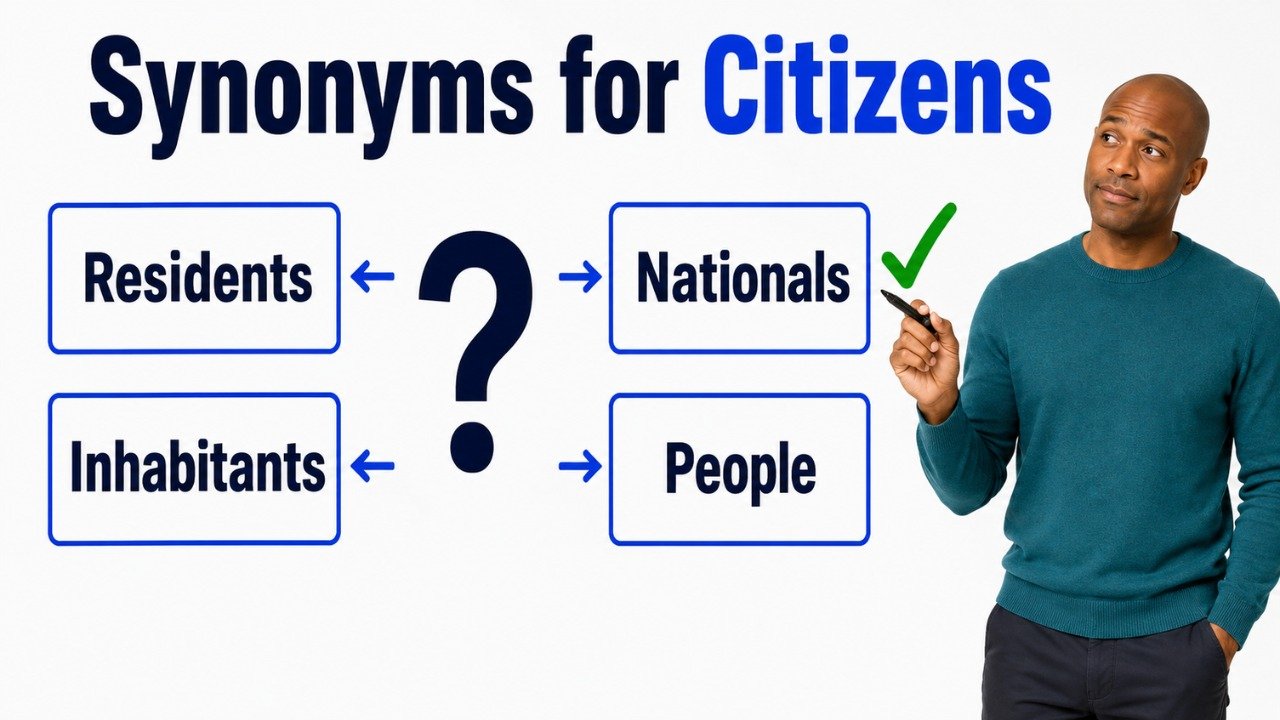
Quick Answer: The best synonyms for citizens include residents, nationals, inhabitants, people, citizenry, populace, civilians, locals, community members, and members of the public. Use nationals when referring to legal membership in a country, residents when focusing on where people live, and inhabitants when describing people living in a particular place. Citizenry and populace work well when discussing society collectively. Civilians are people who are not serving in the armed forces, while voters, constituents, and the electorate are useful in political and democratic contexts.
Pronunciation and Word Details
Word: Citizens.
Pronunciation: /ˈsɪtɪzənz/.
Part of Speech: Plural noun.
Meaning: People who legally belong to a country or who live as members of a town, city, state, or community.
US Pronunciation:
UK Pronunciation:
What Does “Citizens” Mean?
Citizens are people who legally belong to a particular country or are recognized as members of a political community.
The word citizens is the plural form of citizen. It is mainly used as a noun. A citizen may receive legal rights, protections, and responsibilities within a country. These may include voting, following national laws, paying taxes, and participating in civic life.
The word can also describe people who live in a particular town, city, or community, although resident is often more accurate when legal nationality is not involved.
In legal writing, citizens usually refers to people who officially hold citizenship. In everyday conversation, it may refer more generally to the people of a country or community.
Legal Context: The country provides passports to its citizens.
Community Context: Local citizens helped clean the public park.
Political Context: Citizens will vote in the upcoming election.
Social Context: Responsible citizens contribute to the well being of their communities.
Meaning, Tone, and Context of “Citizens”
Citizens is generally a neutral and respectful word. Its exact meaning depends on the context in which it appears.
In legal and government contexts, the word has a formal meaning. It refers to people who have officially recognized membership in a country. In this sense, citizens may have rights and duties that visitors or temporary residents do not have.
In political writing, citizens often refers to voters, members of the electorate, or people affected by public decisions.
In community discussions, the word may describe ordinary people who live in an area and participate in local life.
In historical or patriotic writing, citizens can have an emotional or inspirational tone. Phrases such as fellow citizens may create a sense of national unity and shared responsibility.
In casual conversation, people, locals, or residents may sound more natural.
Formal Tone: Citizens have the right to express their opinions peacefully.
Neutral Tone: The city provides several services for its citizens.
Community Tone: Concerned citizens attended the public meeting.
Political Tone: Citizens expect elected leaders to act responsibly.
Inspirational Tone: Active citizens can improve their communities.
When and How to Use “Citizens”
For Legal Nationality
Use citizens when discussing people who legally belong to a country.
Example: All citizens must follow the laws of the country.
For Civic Rights
Use citizens when discussing voting, legal protections, public participation, or political freedoms.
Example: Citizens have the right to participate in democratic elections.
For Civic Responsibilities
The word is useful when discussing duties such as obeying laws, paying taxes, and supporting the community.
Example: Responsible citizens respect the rights of others.
For Community Participation
Citizens can refer to people who take part in the life and development of a town or city.
Example: Local citizens volunteered to improve the neighborhood.
For Public Opinion
Use citizens when discussing the views, concerns, or reactions of a country’s people.
Example: Many citizens expressed concern about the proposed policy.
For National Unity
Citizens may emphasize a shared identity among the people of one country.
Example: The speech encouraged citizens to work together.
For Political Representation
Citizens can describe people who are represented by elected officials.
Example: Public officials should listen carefully to the citizens they represent.
For Historical Writing
The term is often used when explaining laws, governments, revolutions, rights, or civic movements.
Example: Ancient citizens participated directly in important public decisions.
Best Synonyms for Citizens
Residents: People who live in a particular place.
Example: Residents attended a meeting about the new road.
Nationals: People who legally belong to a particular nation.
Example: All nationals were asked to update their travel documents.
Inhabitants: People or living beings that occupy a particular place.
Example: The island’s inhabitants depend heavily on fishing.
People: A general word for the members of a country, area, or community.
Example: The people demanded fair treatment.
Citizenry: The citizens of a country or community considered as one group.
Example: An informed citizenry is important for a healthy democracy.
Populace: The general population of a country, city, or area.
Example: The announcement caused concern among the populace.
Public: Ordinary people considered as a group.
Example: The public was invited to attend the discussion.
Civilians: People who are not members of the armed forces.
Example: Emergency workers helped civilians leave the dangerous area.
Locals: People who live in a particular area.
Example: Locals recommended several quiet places to visit.
Community Members: People who belong to a particular local or social community.
Example: Community members organized a neighborhood event.
50 Synonyms for Citizens with Short Meanings
- Residents: People who live in a particular place.
- Nationals: People who legally belong to a nation.
- Inhabitants: People who occupy or live in an area.
- People: Human members of a place, group, or nation.
- Populace: The population of a country or area.
- Population: All the people living in a particular place.
- Public: Ordinary people considered collectively.
- Citizenry: Citizens viewed as one social or political group.
- Civilians: People who are not members of the armed forces.
- Locals: People who live in the area being discussed.
- Community Members: People who belong to a particular community.
- Members of Society: People who form part of an organized society.
- Compatriots: People from the same country as one another.
- Countrymen: People from the same country, although the term can sound traditional or less inclusive.
- Fellow Nationals: People who share the same nationality.
- Fellow Citizens: People who share citizenship in the same country.
- Townspeople: People who live in a particular town.
- Townsfolk: The people of a town considered collectively.
- City Dwellers: People who live in cities.
- Urban Residents: People who live in urban areas.
- Villagers: People who live in a village.
- Rural Residents: People who live in the countryside.
- Electorate: Citizens who are legally allowed to vote.
- Voters: People who participate in an election.
- Constituents: People represented by an elected official.
- Taxpayers: People who pay taxes to a government.
- Householders: People responsible for maintaining households.
- Native Citizens: Citizens who gained citizenship by birth.
- Naturalized Citizens: People who gained citizenship through a legal process.
- National Community: The people who collectively belong to a nation.
- General Public: Ordinary members of society.
- Members of the Public: Individual people within the wider public.
- Civil Population: People who are not actively involved in military service.
- Local Population: All the people living in a particular area.
- Permanent Population: People who live in an area on a lasting basis.
- Residents of a Country: People who live within a particular nation.
- Residents of a State: People who live within a particular state or region.
- Residents of a City: People whose homes are within a city.
- People of a Nation: The individuals who make up a country.
- People of the Country: The population living within a nation.
- Civic Community: People connected through shared public life and responsibilities.
- Body Politic: The people of a nation considered as a political group.
- Society: People living together within an organized community.
- Nation: The people of a country considered collectively.
- Community: A group of people living together or sharing common interests.
- Denizens: People who regularly live in or frequent a place.
- Settlers: People who establish homes in a new area.
- Subjects: People living under the authority of a monarch.
- Indigenous Inhabitants: Original peoples of a particular land or region.
- Permanent Residents: People legally allowed to live permanently in a country, although they may not hold citizenship.
Read Also:
Synonyms for Strict

Synonyms for Citizens by Context
When Citizens Means Legal Members of a Country
The strongest alternatives are nationals, native citizens, naturalized citizens, fellow nationals, and compatriots.
Nationals is common in legal, diplomatic, and international contexts. It emphasizes a person’s formal connection to a country.
Example: The government arranged assistance for its nationals abroad.
Compatriots refers to people who come from the same country. It often carries a sense of unity or shared national identity.
Example: She celebrated the achievement with her compatriots.
Fellow citizens emphasizes a shared legal and civic identity.
Example: He asked his fellow citizens to support the community project.
When Citizens Means People Living in a Place
Use residents, inhabitants, locals, townspeople, villagers, or city dwellers.
Residents is best when the important fact is where people live rather than which nationality they hold.
Example: Residents complained about the noise from the construction site.
Inhabitants is suitable for geographical, historical, or descriptive writing.
Example: The region’s inhabitants adapted to the dry climate.
Locals is more conversational and often refers to people familiar with an area.
Example: Locals know the safest route through the mountains.
When Citizens Means the General Population
Use people, population, populace, public, citizenry, or society.
Populace is formal and refers to the people of a country or area collectively.
Example: The new rule was unpopular with the general populace.
Citizenry is often used in political and academic discussions.
Example: A well educated citizenry can make informed public decisions.
The public is useful when discussing opinions, services, information, or access.
Example: The museum is open to the public.
When Citizens Means Voters
Use voters, electorate, constituents, or taxpayers.
The electorate includes all people who are legally qualified to vote.
Example: The policy attracted support from younger members of the electorate.
Constituents are people represented by a particular elected official.
Example: The representative held a meeting with local constituents.
Voters is the clearest option when discussing people who cast ballots.
Example: Voters considered several important issues before the election.
When Citizens Means Nonmilitary People
Use civilians or civil population.
Civilians distinguishes ordinary people from members of the armed forces.
Example: The evacuation plan was designed to protect civilians.
Civil population is more formal and often appears in reports or historical writing.
Example: Food supplies were distributed among the civil population.
When Citizens Means Members of a Community
Use community members, members of society, local people, townspeople, or residents.
Community members emphasizes participation and a sense of belonging.
Example: Community members worked together to restore the playground.
Members of society is broader and may include people across an entire country.
Example: All members of society should be treated with dignity.
Another Word for Citizens
Residents is often the best general replacement for citizens when the sentence describes people living in a town, city, or region. However, residents and citizens are not legally identical.
A person may be a resident of a country without being one of its citizens. When legal nationality matters, nationals or citizens is usually more accurate.
Original: The citizens living near the river received a warning.
Better Option: The residents living near the river received a warning.
Original: The country helped its citizens who were travelling abroad.
Better Option: The country helped its nationals who were travelling abroad.
Original: The citizens attended the local festival.
Better Option: The townspeople attended the local festival.
Original: Citizens were invited to comment on the proposal.
Better Option: Members of the public were invited to comment on the proposal.
When Not to Use “Citizens”
Do not use citizens when you are unsure whether the people legally hold citizenship. Residents, inhabitants, or members of the public may be more accurate.
Weak: All citizens staying at the hotel must register at reception.
Better: All guests staying at the hotel must register at reception.
Do not use citizens as a direct substitute for civilians in military contexts.
Weak: The soldiers helped the citizens leave the conflict area.
Better: The soldiers helped the civilians leave the conflict area.
Avoid using citizens when referring only to people who are legally allowed to vote. Not every citizen is necessarily eligible to vote because voting rules may involve age and other legal requirements.
Weak: The citizens will decide the election result.
Better: The voters will decide the election result.
Do not use citizens when residents is more precise.
Weak: The city’s citizens complained about local traffic, including people who were not nationals of the country.
Better: The city’s residents complained about local traffic.
Avoid repeating citizens several times in one paragraph.
Weak: Citizens attended the meeting because citizens wanted officials to hear citizens’ concerns.
Better: Residents attended the meeting because they wanted officials to hear the community’s concerns.
Do not use citizens for animals or other living organisms. Use inhabitants when describing all forms of life in an environment.
Weak: Many animal citizens live in the forest.
Better: Many animal species inhabit the forest.
Words Commonly Confused With Citizens
Citizens vs Residents: Citizens legally belong to a country. Residents live in a place, but they may hold citizenship somewhere else.
Citizens vs Nationals: Both can refer to people connected legally to a country. National may be broader in some legal systems, while citizen often emphasizes political rights and civic membership.
Citizens vs Civilians: Citizens are legal members of a country. Civilians are people who are not serving in the armed forces. A civilian may or may not be a citizen of the country being discussed.
Citizens vs Inhabitants: Citizens focuses on legal or civic membership. Inhabitants focuses only on living in a place.
Citizens vs Constituents: Citizens belong to a country. Constituents are people represented by a particular elected official or political district.
Citizens vs Voters: Citizens may include children and other people who cannot vote. Voters are people who are legally eligible and choose to participate in an election.
Citizens vs Subjects: Citizens usually belong to a state in which they have recognized civic status. Subjects traditionally owe allegiance to a monarch.
Citizens vs Immigrants: Citizens have formal citizenship. Immigrants are people who moved from one country to another. An immigrant may later become a naturalized citizen.
Citizens vs Refugees: Citizens legally belong to a country. Refugees have left their country because of serious danger or persecution and may not have citizenship in the country where they currently live.
Citizens vs Tourists: Citizens legally belong to a country. Tourists visit a place temporarily for travel or recreation.
Which Synonym Should You Choose?
Choose residents when discussing people who live in a town, city, neighborhood, or region.
Choose nationals when legal nationality or international travel is the main subject.
Choose inhabitants for geographical, historical, environmental, or descriptive writing.
Choose people for simple, clear, and conversational language.
Choose citizenry for formal discussions about civic knowledge, democracy, participation, or public responsibility.
Choose populace when referring formally to the population of a country or area.
Choose public when discussing public opinion, public access, public safety, or public information.
Choose locals when writing casually about people who live in and understand a particular area.
Choose community members when emphasizing belonging, cooperation, or local participation.
Choose civilians when distinguishing ordinary people from military personnel.
Choose voters when discussing people who cast ballots.
Choose electorate when referring to all people who are legally qualified to vote.
Choose constituents when discussing people represented by a politician or public official.
Choose taxpayers when discussing public money, taxation, or government spending.
Choose compatriots when emphasizing a shared homeland or national connection.
For formal reports, residents, nationals, inhabitants, population, and electorate are usually strong choices.
For essays, citizenry, populace, society, community, and body politic may provide useful variety.
For emails and public notices, residents, community members, or members of the public usually sound clear and respectful.
For casual conversation, people and locals often sound the most natural.
Real Life Examples of “Citizens” in Sentences
Original: Citizens attended the meeting to discuss the new transport plan.
Better Option: Residents attended the meeting to discuss the new transport plan.
Original: The government warned its citizens about the severe weather.
Better Option: The government warned its nationals about the severe weather.
Original: Citizens of the village depend on farming.
Better Option: Inhabitants of the village depend on farming.
Original: The decision affected citizens across the country.
Better Option: The decision affected people across the country.
Original: Citizens were asked to share their views on the proposal.
Better Option: Members of the public were asked to share their views on the proposal.
Original: Citizens elected a new local representative.
Better Option: Voters elected a new local representative.
Original: The official met citizens from the surrounding district.
Better Option: The official met constituents from the surrounding district.
Original: Citizens were moved away from the military area.
Better Option: Civilians were moved away from the military area.
Original: Citizens organized a cleanup campaign in the park.
Better Option: Community members organized a cleanup campaign in the park.
Original: Citizens know where to find the best local food.
Better Option: Locals know where to find the best local food.
Synonym Groups and Usage Differences
Legal Membership Group
This group includes nationals, native citizens, naturalized citizens, fellow citizens, and fellow nationals.
These words focus on legal membership, nationality, or a shared connection to a country.
Nationals is especially useful in international, legal, and travel contexts.
Example: The embassy issued advice to its nationals abroad.
Residence Group
This group includes residents, inhabitants, locals, townspeople, villagers, city dwellers, and denizens.
These words focus on where people live rather than their legal nationality.
Residents is the safest general choice. Inhabitants sounds more formal or descriptive, while locals is conversational.
Example: Local residents supported the new community center.
General Population Group
This group includes people, population, populace, public, citizenry, and society.
These words refer to large groups collectively.
People is simple and natural. Populace is more formal. Citizenry is especially suitable for civic or political discussions.
Example: The policy received support from much of the population.
Democratic Participation Group
This group includes electorate, voters, constituents, and taxpayers.
These terms describe people according to a specific political or civic role.
Voters participate in elections. The electorate includes eligible voters. Constituents are represented by elected officials.
Example: Candidates explained their plans to the electorate.
Community Group
This group includes community members, townspeople, townsfolk, locals, householders, and residents.
These words emphasize local identity, cooperation, and shared concerns.
Community members sounds welcoming and inclusive in notices, announcements, and public discussions.
Example: Community members volunteered at the local shelter.
Civilian Status Group
This group includes civilians and civil population.
These alternatives are used when separating ordinary people from military personnel or armed groups.
Example: Emergency aid was delivered to the civilian population.
Shared National Identity Group
This group includes compatriots, fellow nationals, fellow citizens, and countrymen.
These terms emphasize unity among people from the same country.
Compatriots is formal and often emotional. Countrymen is traditional and may not feel inclusive in every context.
Example: The athlete received a warm welcome from her compatriots.
Antonyms of Citizens
The opposite of citizens depends on whether the sentence concerns nationality, residence, membership, or public status.
Noncitizens: People who do not hold citizenship in the country being discussed.
Foreign Nationals: Citizens or nationals of another country.
Foreigners: People who come from or belong to another country.
Visitors: People who are present temporarily.
Tourists: People visiting a place for travel or recreation.
Temporary Residents: People allowed to live in a place for a limited period.
Outsiders: People who do not belong to a particular group or community.
Guests: People visiting rather than permanently belonging to a place.
Newcomers: People who have recently arrived in a place or group.
Military Personnel: Members of the armed forces, used as an opposite of civilians rather than citizens.
Nonresidents: People who do not live in the area being discussed.
Stateless People: People who are not legally recognized as citizens by any country.
Comparison: Citizens vs Related Words
Citizens vs Residents
Citizens have formal legal membership in a country. Residents live in a place, but they may not be citizens of that country.
Example With Citizens: Citizens may apply for the national passport.
Example With Residents: All residents must follow the building’s safety rules.
Citizens vs Nationals
Citizens usually have recognized civic rights and responsibilities within a country. Nationals have a legal connection to a country, although the precise legal meaning can vary.
Example With Citizens: Citizens participated in the national election.
Example With Nationals: The embassy contacted its nationals after the emergency.
Citizens vs Inhabitants
Citizens emphasizes legal or civic membership. Inhabitants simply means people or living beings occupying a place.
Example With Citizens: Citizens requested greater protection for their rights.
Example With Inhabitants: The island’s inhabitants rely on boats for transportation.
Citizens vs Civilians
Citizens belong legally to a country. Civilians are people who are not serving in the military.
Example With Citizens: The new law applies to all citizens.
Example With Civilians: The rescue team moved civilians to a safer area.
Citizens vs People
Citizens is more specific and may involve nationality or civic membership. People is broader and more conversational.
Example With Citizens: Citizens must renew their identity documents.
Example With People: People gathered outside the community hall.
Citizens vs Public
Citizens refers to legal or civic members of a country. The public includes ordinary people generally and may include citizens, residents, visitors, and other groups.
Example With Citizens: Citizens can contact their elected representatives.
Example With Public: The library is open to the public.
Citizens vs Voters
Citizens includes all people who hold citizenship. Voters are those who are legally eligible and participate in elections.
Example With Citizens: Citizens have different civic rights and responsibilities.
Example With Voters: Voters selected a new representative.
Citizens vs Constituents
Citizens belong to a country. Constituents belong to an electoral area represented by a particular official.
Example With Citizens: Citizens asked the national government for greater transparency.
Example With Constituents: The representative answered questions from constituents.
Common Phrases and Expressions With Citizens
Fellow Citizens: People who share citizenship in the same country.
Senior Citizens: Older members of society.
Private Citizens: Individuals who do not act in an official government role.
Ordinary Citizens: Members of the general population without special authority.
Responsible Citizens: People who perform their civic duties and respect others.
Concerned Citizens: People who publicly express worry about an issue.
Law Abiding Citizens: People who follow the law.
Naturalized Citizens: People who acquired citizenship through a legal process.
Dual Citizens: People who legally hold citizenship in two countries.
Citizens of the World: People who see themselves as members of the global human community.
Active Citizens: People who participate in civic and community life.
Local Citizens: Citizens associated with a particular town, city, or region.
Citizens’ Rights: Legal freedoms and protections belonging to citizens collectively.
Citizens’ Responsibilities: Duties expected from members of a country or civic community.
Common Mistakes to Avoid
One common mistake is treating citizens and residents as exact synonyms. A resident lives in a country or area, but that person may not legally hold citizenship there.
Another mistake is using citizens when civilians is required. In a military or conflict related context, civilians means people who are not members of the armed forces.
Avoid using voters as a replacement for all citizens. Some citizens may not be legally eligible to vote because of age or other voting requirements.
Writers also confuse citizens with constituents. A constituent is represented by a particular elected official, while a citizen belongs legally to a country.
Do not overuse the word citizens in the same paragraph. Replace some repetitions with residents, people, members of the public, community members, or a suitable pronoun.
Use the correct possessive form. Citizen’s refers to something belonging to one citizen. Citizens’ refers to something belonging to multiple citizens.
Singular Possessive: A citizen’s right should be protected.
Plural Possessive: Citizens’ rights should be protected.
Avoid using a formal synonym where simple language would be clearer.
Unnatural: The populace entered the local coffee shop.
Natural: The locals entered the coffee shop.
Do not use a broad term when a precise term is available.
Vague: Citizens participated in the election.
Precise: Eligible voters participated in the election.
Be careful with words that may sound outdated, impersonal, or exclusionary. Countrymen is traditional and gendered, while compatriots or fellow citizens is usually more inclusive.
Conclusion
The most suitable synonyms for citizens depend on whether you are discussing legal nationality, residence, community life, politics, or civilian status. Nationals is useful for legal membership, while residents and inhabitants describe people living in a place. Citizenry, populace, public, and people refer to society collectively. Voters, constituents, and the electorate fit political contexts, while civilians is best when distinguishing ordinary people from military personnel. Choosing the right alternative makes sentences clearer, more accurate, and more natural.
FAQs About Synonyms for Citizens
What Is the Best Synonym for Citizens?
Residents is the best general alternative when discussing people living in a place. Nationals is better when legal nationality is important.
Are Citizens and Residents the Same?
No. Citizens legally belong to a country, while residents simply live there. A resident may be a citizen of another country.
Can People Be Used Instead of Citizens?
Yes. People is a simple and natural alternative when legal citizenship is not important to the meaning.
Is Citizenry a Synonym for Citizens?
Yes. Citizenry means the citizens of a country or community considered as one collective group. It is common in formal and political writing.
Is Populace Another Word for Citizens?
Populace can replace citizens when referring generally to the population of a country or area. However, it does not specifically indicate legal citizenship.
What Is a Formal Synonym for Citizens?
Nationals, citizenry, populace, inhabitants, electorate, and body politic are formal alternatives. The best choice depends on the sentence.
What Is the Difference Between Citizens and Civilians?
Citizens legally belong to a country. Civilians are people who are not members of the armed forces. A civilian may be a citizen, resident, visitor, or foreign national.
