
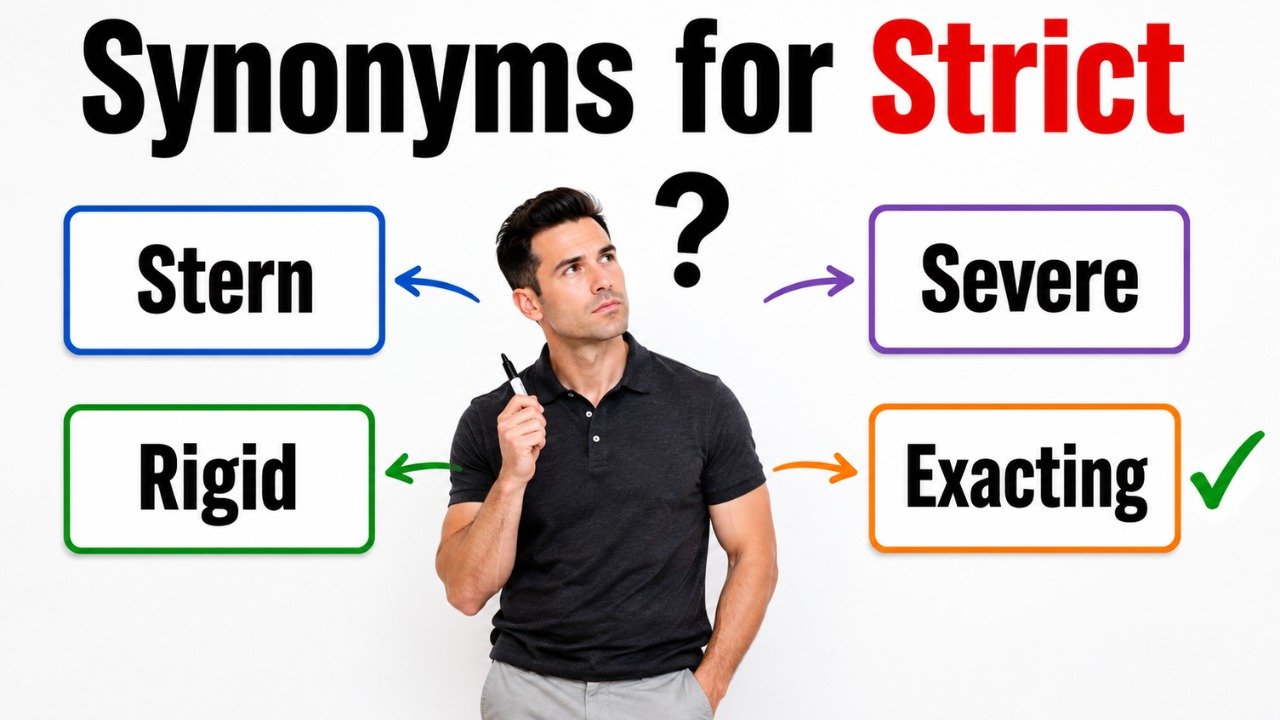
Quick Answer: The best synonyms for strict include stringent, stern, rigid, rigorous, exacting, firm, severe, disciplined, uncompromising, and precise. Use stringent for rules and regulations, stern for a serious person, and rigid for requirements that allow little flexibility. Rigorous suits testing, training, or academic standards, while exacting describes very high expectations. Firm is useful for fair but controlled authority, severe emphasizes harshness, disciplined describes controlled behavior, and precise works best for exact definitions or interpretations.
Pronunciation and Word Details
Word: Strict.
Pronunciation: /strɪkt/
Part of Speech: Adjective.
Meaning: Requiring rules, standards, or instructions to be followed carefully without much freedom or flexibility.
US Pronunciation:
UK Pronunciation:
What Does “Strict” Mean?
Strict means requiring complete obedience to rules, instructions, standards, or expectations. It is an adjective used to describe people, systems, requirements, interpretations, routines, and limits.
A strict person expects others to behave properly and follow established rules. For example, a strict teacher may require students to arrive on time, complete every assignment, and behave respectfully.
The word can also describe rules or conditions that leave little room for exceptions. A strict deadline must be followed closely, while a strict policy may have clearly defined requirements.
Strict sometimes means exact or limited to a precise meaning. In the phrase “in the strict sense,” it means according to the most exact definition.
The word can therefore describe authority, discipline, precision, restriction, high standards, or careful obedience. Its exact meaning depends on the sentence and situation.
Meaning, Tone, and Context of “Strict”
Strict usually has a serious, controlled, and authoritative tone. It can be neutral, positive, or negative depending on how the rules are applied.
In a positive context, strict may suggest discipline, safety, fairness, accuracy, or high standards. A strict quality control process may protect customers by preventing defective products from being approved.
In a negative context, strict can suggest harshness, excessive control, or a lack of freedom. A person may describe rules as strict when they feel unnecessarily restrictive.
The word is common in formal writing, academic discussions, workplace communication, education, parenting, law, health routines, security, and everyday conversation.
Strict is stronger than firm in many contexts. A firm person maintains boundaries while remaining reasonable, while a strict person may expect exact obedience.
It is also different from severe. Severe often suggests punishment, unpleasantness, or extreme harshness. Strict mainly focuses on careful control and rule enforcement.
When and How to Use “Strict”
For Rules and Regulations
Use: Use strict when rules must be followed carefully and exceptions are limited.
Example: The laboratory has strict safety rules.
For Authority
Use: Use strict to describe someone who expects obedience, discipline, or responsible behavior.
Example: Her coach is strict but fair.
For High Standards
Use: Use strict when requirements are demanding and carefully measured.
Example: Every product must meet strict quality standards.
For Deadlines
Use: Use strict when a date or time limit cannot easily be changed.
Example: The application process has a strict deadline.
For Discipline
Use: Use strict when behavior is controlled through clear expectations and consequences.
Example: The school maintains strict discipline in the classroom.
For Exact Meaning
Use: Use strict when a word, statement, or rule is interpreted according to its precise definition.
Example: In the strict sense, the two terms are not identical.
For Diets and Routines
Use: Use strict when someone follows a controlled plan without making many exceptions.
Example: The athlete follows a strict training routine.
For Security
Use: Use strict when access, behavior, or information is carefully controlled.
Example: The building has strict security procedures.
Best Synonyms for Strict
Stringent: Requiring careful obedience to demanding rules or conditions.
Example: The factory follows stringent safety regulations.
Stern: Serious and firm, especially when controlling behavior.
Example: The principal gave the students a stern warning.
Rigid: Fixed and unwilling or unable to change.
Example: The organization follows a rigid approval process.
Rigorous: Extremely thorough, careful, and demanding.
Example: Applicants must complete a rigorous selection process.
Exacting: Requiring great effort, care, or attention.
Example: The editor has exacting standards for every article.
Firm: Strong and controlled without necessarily being harsh.
Example: The manager remained firm about the attendance policy.
Severe: Extremely strict, harsh, or serious.
Example: Severe penalties were introduced for repeated violations.
Disciplined: Controlled and able to follow rules or routines consistently.
Example: She maintains a disciplined approach to her studies.
Uncompromising: Unwilling to weaken standards or accept exceptions.
Example: The inspector was uncompromising about safety.
Precise: Exact and clearly defined.
Example: The agreement contains precise instructions.
50 Synonyms for Strict with Short Meanings
- Stringent: Requiring close obedience to demanding rules.
- Severe: Extremely firm, harsh, or serious.
- Stern: Serious and firm in manner or authority.
- Rigid: Fixed and allowing little change or flexibility.
- Rigorous: Thorough, demanding, and carefully controlled.
- Exacting: Requiring great effort and very high standards.
- Firm: Strong and unwilling to abandon a reasonable decision.
- Uncompromising: Refusing to weaken rules or expectations.
- Inflexible: Unwilling or unable to change.
- Harsh: Unpleasantly severe or unkind.
- Tough: Strong, demanding, and difficult to satisfy.
- Demanding: Requiring considerable effort or obedience.
- Disciplined: Controlled and consistent in following rules.
- Precise: Exact and clearly stated.
- Exact: Completely accurate or carefully defined.
- Literal: Following the exact words without broader interpretation.
- Narrow: Limited to a small or precise interpretation.
- Absolute: Complete and allowing no exceptions.
- Meticulous: Extremely careful about every detail.
- Scrupulous: Very careful to follow rules and principles.
- Careful: Giving close attention to requirements or details.
- Austere: Serious, plain, and lacking comfort or softness.
- Forbidding: Unfriendly, severe, or intimidating in appearance.
- Controlling: Directing behavior with limited freedom.
- Restrictive: Limiting choices, movement, or action.
- Regulated: Controlled by official rules or procedures.
- Formal: Following established rules and accepted procedures.
- Unyielding: Refusing to change or give way.
- Relentless: Continuing with firm pressure or determination.
- Authoritarian: Demanding obedience and allowing little freedom.
- Commanding: Showing authority and expecting obedience.
- Unsparing: Showing little mercy or tolerance.
- Hard: Difficult, firm, or lacking softness.
- Draconian: Extremely harsh and restrictive.
- Punitive: Intended to punish rule breaking.
- Repressive: Controlling behavior or freedom severely.
- Prohibitive: Preventing or strongly restricting an action.
- Observant: Careful to follow rules, customs, or principles.
- Dutiful: Obediently performing required responsibilities.
- Orderly: Carefully organized and controlled.
- Systematic: Following a fixed and organized method.
- Thorough: Complete and careful in every detail.
- Conscientious: Careful, responsible, and guided by duty.
- Vigilant: Watchful about rules, risks, or possible problems.
- Watchful: Carefully observing behavior or conditions.
- Particular: Very careful about requirements or preferences.
- Selective: Applying careful and demanding standards.
- Rule bound: Controlled closely by established rules.
- No nonsense: Practical, firm, and unwilling to accept foolish behavior.
- Hard line: Supporting firm rules without compromise.
Read Also:
Synonyms for Treasure

Synonyms for Strict by Context
When Strict Describes Rules
Stringent, rigid, restrictive, regulated, absolute, and prohibitive are useful when discussing rules, policies, laws, or requirements.
Stringent suggests that the conditions are demanding and carefully enforced. Rigid means the rules allow little flexibility, while restrictive emphasizes limited freedom.
Example: The company introduced stringent privacy procedures.
Example: The application has rigid eligibility requirements.
Example: The building follows restrictive access rules.
When Strict Describes a Person
Stern, firm, severe, commanding, authoritarian, and no nonsense can describe someone who expects discipline or obedience.
Stern usually describes a serious manner. Firm is more positive because it suggests controlled authority without unnecessary harshness. Authoritarian has a more negative meaning because it suggests excessive control.
Example: The stern instructor expected complete silence.
Example: Her parents were firm about bedtime.
Example: The authoritarian leader tolerated no disagreement.
When Strict Describes Standards
Rigorous, exacting, demanding, meticulous, selective, and thorough are suitable for standards, testing, education, inspection, or professional work.
Rigorous emphasizes careful and complete examination. Exacting describes standards that are difficult to satisfy, while meticulous focuses on close attention to details.
Example: Every candidate completes a rigorous assessment.
Example: The publisher maintains exacting editorial standards.
Example: The inspector conducted a meticulous review.
When Strict Means Exact
Precise, exact, literal, narrow, absolute, and careful work well when strict refers to meaning, interpretation, wording, or definition.
Literal means following the exact words. Narrow describes an interpretation with limited scope, while precise emphasizes accuracy and clarity.
Example: Under a literal interpretation, the action is not permitted.
Example: The term has a narrow technical meaning.
Example: The document provides a precise definition.
When Strict Describes Discipline
Disciplined, orderly, dutiful, systematic, observant, and conscientious suit routines, conduct, study habits, or personal principles.
Disciplined describes self control. Dutiful emphasizes responsibility, while systematic refers to following an organized method.
Example: She follows a disciplined study schedule.
Example: He is dutiful in completing every assignment.
Example: The researcher uses a systematic process.
When Strict Suggests Harshness
Harsh, severe, punitive, draconian, repressive, unsparing, and relentless communicate a stronger negative tone.
Punitive describes measures intended to punish. Draconian suggests rules that are unreasonably severe, while repressive suggests excessive control over freedom.
Example: Workers criticized the harsh attendance policy.
Example: The law introduced punitive fines.
Example: Residents opposed the draconian restrictions.
Another Word for Strict
Stringent is often the best replacement for strict when discussing rules, regulations, standards, or conditions. It clearly communicates that requirements are demanding and carefully enforced.
However, the best alternative depends on context. Stern is better for a serious person, rigorous suits testing or training, firm describes reasonable authority, and precise is best for exact wording or meaning.
Original: The laboratory follows strict safety regulations.
Better Option: The laboratory follows stringent safety regulations.
Original: Our teacher is strict about classroom behavior.
Better Option: Our teacher is stern about classroom behavior.
Original: Candidates must complete a strict training program.
Better Option: Candidates must complete a rigorous training program.
Original: The rule has a strict definition.
Better Option: The rule has a precise definition.
When Not to Use “Strict”
Do not use strict when another word can communicate the exact type of control, difficulty, accuracy, or authority more clearly.
Use stringent for demanding regulations, rigorous for thorough testing, stern for a serious person, and precise for exact wording. These alternatives prevent vague or repetitive writing.
Strict can sound negative when describing a person. When the person is reasonable rather than harsh, firm may be a fairer and more accurate choice.
Avoid using strict when you simply mean careful. A careful review is not necessarily controlled by inflexible rules.
Do not use strict for something that is merely difficult. A difficult examination may be challenging, while a strict examination may involve tightly controlled rules.
Weak: The researcher completed a strict examination of the evidence.
Better: The researcher completed a thorough examination of the evidence.
Weak: She gave a strict description of the event.
Better: She gave a precise description of the event.
Weak: The manager is strict but listens to reasonable requests.
Better: The manager is firm but listens to reasonable requests.
Weak: The course includes strict physical exercises.
Better: The course includes demanding physical exercises.
Weak: The policy is strict because it cannot be changed.
Better: The policy is rigid because it cannot be changed.
Words Commonly Confused With Strict
Strict vs Stern: Strict describes someone who expects rules to be obeyed. Stern describes a serious and sometimes unfriendly manner.
Strict vs Stringent: Strict is a general word for firm rules or authority. Stringent usually describes demanding regulations, standards, or conditions.
Strict vs Rigid: Strict means rules are carefully enforced. Rigid emphasizes an unwillingness or inability to change.
Strict vs Rigorous: Strict focuses on rules and discipline. Rigorous focuses on thoroughness, difficulty, and careful testing.
Strict vs Severe: Strict means firm control. Severe suggests greater harshness, seriousness, or punishment.
Strict vs Firm: Strict may imply limited flexibility. Firm suggests maintaining clear boundaries without being unfair.
Strict vs Exact: Strict can mean carefully controlled or precisely limited. Exact specifically means fully accurate or correct.
Strict vs Disciplined: Strict usually describes external rules or authority. Disciplined often describes a person’s ability to control personal behavior.
Strict vs Restrictive: Strict emphasizes enforcement. Restrictive emphasizes reduced freedom or limited choices.
Strict vs Meticulous: Strict relates to rules or standards. Meticulous describes extreme care with details.
Which Synonym Should You Choose?
Choose stringent when writing about demanding laws, regulations, safety requirements, or official policies.
Choose stern when describing a serious teacher, parent, supervisor, coach, or authority figure.
Choose rigid when rules or systems cannot easily be changed.
Choose rigorous when describing testing, research, training, academic work, or careful examination.
Choose exacting when standards require exceptional effort or attention.
Choose firm when authority is controlled, reasonable, and fair.
Choose severe when punishment, criticism, or restrictions are extremely harsh.
Choose disciplined when describing self control, routines, study habits, or organized behavior.
Choose precise when discussing wording, measurements, definitions, or technical details.
Choose restrictive when the main idea is that choices or freedoms are limited.
Choose uncompromising when a person refuses to lower standards or accept exceptions.
Choose meticulous when close attention to every detail matters.
Real Life Examples of “Strict” in Sentences
Original: The school has strict attendance rules.
Better Option: The school has stringent attendance rules.
Original: My instructor is strict about arriving on time.
Better Option: My instructor is stern about arriving on time.
Original: The company uses a strict hiring process.
Better Option: The company uses a rigorous hiring process.
Original: The schedule is too strict to allow changes.
Better Option: The schedule is too rigid to allow changes.
Original: She has strict standards for written work.
Better Option: She has exacting standards for written work.
Original: The manager remained strict about workplace conduct.
Better Option: The manager remained firm about workplace conduct.
Original: The government introduced strict penalties.
Better Option: The government introduced severe penalties.
Original: He follows a strict daily routine.
Better Option: He follows a disciplined daily routine.
Original: The word has a strict technical meaning.
Better Option: The word has a precise technical meaning.
Original: The policy places strict limits on access.
Better Option: The policy places restrictive limits on access.
Synonym Groups and Usage Differences
Rules and Regulation Group
Stringent, restrictive, regulated, prohibitive, and rigid describe controlled rules or conditions.
Stringent is suitable for demanding official requirements. Restrictive emphasizes limited freedom, while prohibitive suggests that something is prevented entirely or made extremely difficult.
Example: The facility follows stringent security regulations.
Authority and Behavior Group
Stern, firm, commanding, authoritarian, and no nonsense describe people who expect obedience.
Firm usually has the most balanced tone. Stern sounds serious, while authoritarian suggests excessive control.
Example: The firm supervisor expected everyone to follow the procedure.
Standards and Quality Group
Rigorous, exacting, demanding, selective, meticulous, and thorough describe difficult or carefully measured standards.
Rigorous is common for tests and processes. Exacting describes expectations that are hard to satisfy.
Example: The organization uses a rigorous quality assessment.
Precision Group
Precise, exact, literal, narrow, and absolute relate to careful meaning or interpretation.
Precise emphasizes clarity. Literal follows the exact wording, while narrow limits the meaning or scope.
Example: The regulation requires a precise interpretation of the term.
Discipline Group
Disciplined, systematic, orderly, dutiful, observant, and conscientious describe controlled conduct and responsible routines.
Disciplined emphasizes self control. Systematic refers to an organized method, while conscientious suggests responsibility and care.
Example: Her disciplined approach helped her finish the project early.
Harshness Group
Severe, harsh, draconian, punitive, repressive, and unsparing express excessive or unpleasant strictness.
Draconian is especially strong and should be reserved for unusually harsh measures.
Example: Critics described the restrictions as draconian.
Unwillingness to Change Group
Rigid, inflexible, unyielding, uncompromising, hard line, and absolute describe rules or positions that do not easily change.
Uncompromising can be positive when it protects high standards. Inflexible is often negative because it suggests an unreasonable refusal to adapt.
Example: The committee took an uncompromising position on safety.
Antonyms of Strict
The opposite of strict depends on whether the word describes a person, rule, standard, interpretation, or routine.
Lenient: Not severe when applying rules or punishment.
Flexible: Willing or able to change according to circumstances.
Permissive: Allowing considerable freedom of behavior.
Relaxed: Not highly controlled or formal.
Tolerant: Willing to accept differences or minor mistakes.
Mild: Gentle and not severe.
Easygoing: Calm and not overly concerned with rules.
Loose: Not carefully controlled or precisely defined.
Forgiving: Willing to excuse errors or wrongdoing.
Informal: Not controlled by strict official rules.
Liberal: Allowing greater freedom or broader interpretation.
Indulgent: Allowing behavior that might normally be restricted.
Comparison: Strict vs Related Words
Strict vs Stringent
Strict is a broad word for firm rules, authority, or standards. Stringent usually describes official requirements that are especially demanding.
Example With Strict: The teacher has strict classroom rules.
Example With Stringent: The factory follows stringent safety regulations.
Strict vs Stern
Strict focuses on enforcing rules. Stern focuses on a person’s serious expression, tone, or behavior.
Example With Strict: Her father is strict about study time.
Example With Stern: Her father gave her a stern look.
Strict vs Rigid
Strict requirements are carefully enforced. Rigid requirements cannot easily be adjusted.
Example With Strict: The office has strict attendance requirements.
Example With Rigid: The office has a rigid schedule that cannot be changed.
Strict vs Rigorous
Strict emphasizes rules and control. Rigorous emphasizes thoroughness, difficulty, and careful testing.
Example With Strict: Students must follow strict examination rules.
Example With Rigorous: Students must complete a rigorous examination.
Strict vs Firm
Strict can imply little flexibility. Firm means maintaining a decision or boundary confidently but reasonably.
Example With Strict: The supervisor is strict about breaks.
Example With Firm: The supervisor was firm when explaining the break policy.
Strict vs Severe
Strict means demanding obedience. Severe adds the idea of harshness, seriousness, or extreme consequences.
Example With Strict: The school introduced strict rules.
Example With Severe: The school introduced severe punishments.
Strict vs Precise
Strict can refer to control or an exact interpretation. Precise relates specifically to accuracy and clear detail.
Example With Strict: In the strict meaning of the term, the statement is incorrect.
Example With Precise: The writer provided a precise meaning of the term.
Strict vs Disciplined
Strict often describes external control. Disciplined usually describes internal self control.
Example With Strict: The academy has strict rules.
Example With Disciplined: Its students maintain disciplined study habits.
Common Phrases and Expressions With Strict
Strict Rules: Requirements that must be carefully obeyed.
Strict Standards: Demanding levels of quality or performance.
Strict Teacher: A teacher who expects discipline and obedience.
Strict Deadline: A final date or time that allows no delay.
Strict Control: Close authority over actions, resources, or behavior.
Strict Interpretation: Understanding words according to their exact meaning.
Strict Diet: A controlled eating plan with limited exceptions.
Strict Discipline: Firm control of conduct and behavior.
Strict Instructions: Directions that must be followed carefully.
Strict Limits: Clearly defined restrictions that should not be exceeded.
Common Mistakes to Avoid
A common mistake is using strict for every demanding situation. Choose a more specific synonym when the context involves accuracy, thoroughness, severity, or inflexibility.
Do not confuse strict with rigorous. A strict teacher enforces rules, while a rigorous course requires careful and demanding work.
Avoid calling someone severe when firm is more accurate. Severe can suggest unnecessary harshness, while firm often communicates fair and confident authority.
Do not use rigid as a positive replacement in every sentence. Rigid frequently suggests an unreasonable refusal to adapt.
Writers sometimes use strict where precise is needed. A precise definition is clear and exact, while a strict definition is interpreted within narrow limits.
Avoid repeating strict several times in the same paragraph. Use stringent for regulations, stern for behavior, exacting for standards, and disciplined for routines.
Also consider tone before using draconian, authoritarian, repressive, or punitive. These words communicate strong criticism and should not be used for ordinary rules.
Incorrect: The researcher used a strict method to examine every detail.
Correct: The researcher used a rigorous method to examine every detail.
Incorrect: The measurement must be strict.
Correct: The measurement must be precise.
Incorrect: She follows a strict and organized approach.
Correct: She follows a disciplined and organized approach.
Conclusion
The best synonyms for strict depend on the type of authority, rule, standard, or limitation being described. Stringent works well for regulations, stern for serious people, rigid for inflexible systems, and rigorous for demanding tests or processes. Choose exacting for high standards, firm for reasonable authority, and precise for exact meanings. Understanding these synonyms for strict helps you communicate control, discipline, accuracy, and severity with greater clarity while avoiding vague or overly harsh wording.
FAQs About Synonyms for Strict
What Is the Best Synonym for Strict?
Stringent is a strong general alternative for rules and regulations. Stern is better for a person, while rigorous suits tests, training, and standards.
What Is a Positive Synonym for Strict?
Firm is often the most positive synonym because it suggests confident and fair authority. Disciplined is suitable for controlled personal behavior.
What Is a Formal Synonym for Strict?
Stringent, rigorous, exacting, uncompromising, and restrictive are useful formal alternatives. The correct choice depends on the sentence.
What Is a Negative Synonym for Strict?
Harsh, authoritarian, draconian, and repressive can express negative or excessive strictness.
Is Stern the Same as Strict?
Not exactly. Strict describes someone who carefully enforces rules, while stern describes a serious manner, expression, or tone.
What Is the Difference Between Strict and Rigid?
Strict means firm about rules or standards. Rigid means unwilling or unable to change, even when flexibility may be reasonable.
Can Strict Mean Exact?
Yes. Strict can mean exact or limited to a precise definition, particularly in phrases such as “in the strict sense.”
