
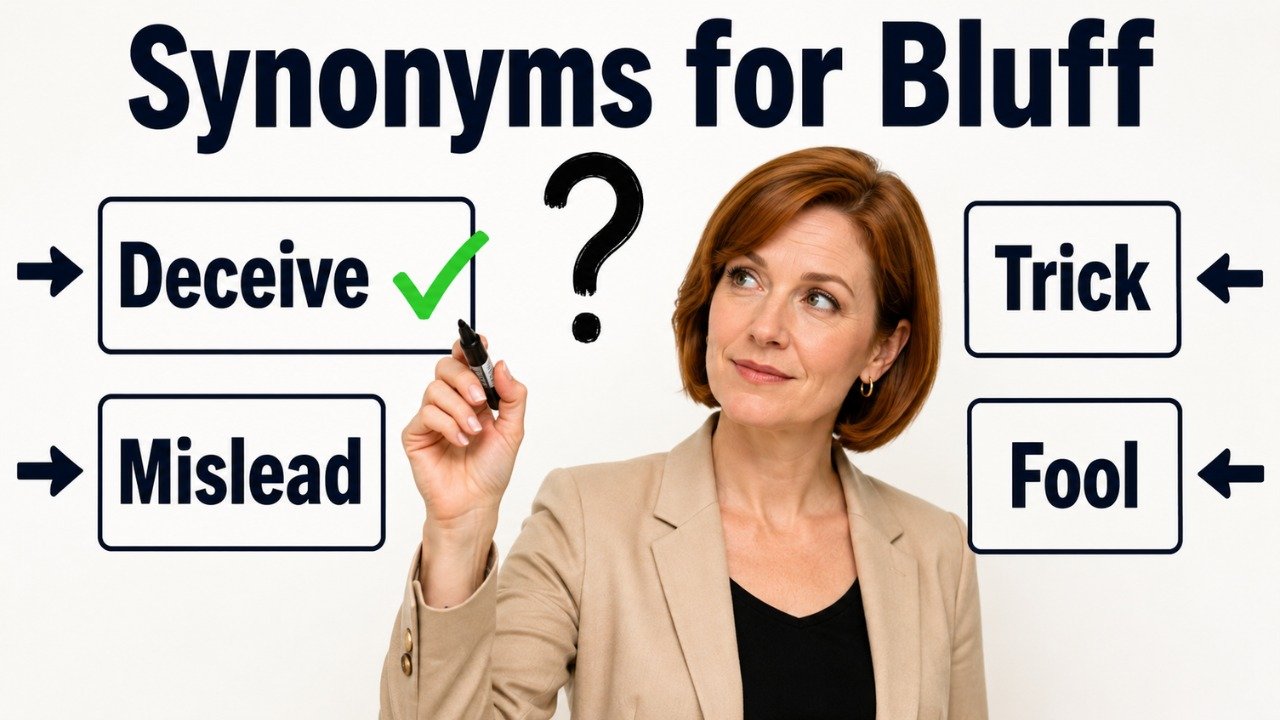
Quick Answer: The best synonyms for bluff include deceive, mislead, trick, fool, pretend, feign, intimidate, ruse, pretense, and sham. Use deceive or mislead when someone creates a false belief, trick or fool in casual conversation, and feign when someone pretends to have a feeling, ability, or condition. Intimidate fits situations involving false confidence or threats. Ruse, pretense, and sham are strong noun alternatives. When bluff describes a steep landform, cliff or escarpment is more accurate.
Pronunciation and Word Details
Word: Bluff.
Pronunciation: /blʌf/
Part of Speech: Verb, noun, and adjective.
Meaning: To deceive someone by pretending to have greater confidence, knowledge, strength, or ability than is actually true.
US Pronunciation:
UK Pronunciation:
What Does “Bluff” Mean?
Bluff usually means to deceive someone by acting more confident, powerful, informed, or prepared than you really are.
As a verb, bluff describes the act of making another person believe something that is not completely true. The deception often depends on confidence rather than detailed evidence.
Example: He bluffed the other players into believing that he had a strong hand.
As a noun, a bluff is a confident attempt to deceive, pressure, or frighten someone.
Example: Her threat was only a bluff.
Bluff also appears as an adjective describing someone who is direct, plainspoken, and sometimes rough but friendly.
Example: He had a bluff but good natured manner.
In geography, a bluff is a high, steep bank or cliff, usually beside a river, lake, or sea.
Example: The house stood on a bluff above the water.
These meanings are related only by spelling and pronunciation. The correct synonym depends on whether bluff refers to deception, confidence, directness, or a landform.
Meaning, Tone, and Context of “Bluff”
Bluff has a neutral to slightly negative tone when it refers to deception. It suggests that someone is trying to influence another person without revealing the truth.
In card games, negotiations, competitions, and tense conversations, bluff can describe a strategic attempt to appear stronger than reality.
Strategic Tone: She bluffed to make her opponent withdraw.
Deceptive Tone: He bluffed about his experience during the discussion.
Threatening Tone: The warning sounded serious, but it was a bluff.
Casual Tone: I think he is bluffing.
As an adjective, bluff has a more positive or neutral meaning. A bluff person may speak directly and avoid unnecessary politeness, but the person is not necessarily unkind.
Direct Tone: Her bluff manner surprised the new employees.
In geography, bluff is a neutral technical noun describing a steep natural feature.
Geographical Context: The path followed the top of the bluff.
Because the word has several meanings, readers should use a synonym that clearly matches the intended context.
When and How to Use “Bluff”
For Deception
Use bluff when someone tries to create a false belief through confidence, behavior, or an unsupported claim.
Example: He bluffed his competitors into believing that the deal was complete.
For False Confidence
Use bluff when someone pretends to be calmer, stronger, or more knowledgeable than they actually are.
Example: She bluffed her way through the interview despite knowing little about the subject.
For Threats
Use bluff when a person makes a threat that they may not be willing or able to carry out.
Example: The manager suspected that the resignation threat was a bluff.
For Card Games
Use bluff when a player behaves as though weak cards are strong or strong cards are weak.
Example: She bluffed successfully and won the round.
For Negotiations
Use bluff when one side hides weakness or exaggerates its position to influence the other side.
Example: The buyer bluffed by claiming that several better offers were available.
For Direct Behavior
Use bluff as an adjective for someone whose communication is direct, hearty, and slightly rough.
Example: His bluff style seemed unfriendly at first, but he was helpful.
For Geography
Use bluff as a noun for a steep bank, raised cliff, or high piece of land beside water.
Example: They watched the sunset from the top of the bluff.
Best Synonyms for Bluff
Deceive
Synonym: Deceive means to make someone believe something that is false.
Example: He tried to deceive the committee about his qualifications.
Mislead
Synonym: Mislead means to cause someone to form an incorrect belief or conclusion.
Example: The incomplete explanation could mislead readers.
Trick
Synonym: Trick means to deceive someone through a clever plan or action.
Example: She tricked him into revealing the answer.
Fool
Synonym: Fool means to make someone believe something untrue, often in casual speech.
Example: His confident expression fooled everyone.
Pretend
Synonym: Pretend means to behave as though something is true when it is not.
Example: He pretended to understand the complicated instructions.
Feign
Synonym: Feign means to deliberately pretend to have a feeling, condition, or quality.
Example: She feigned confidence before entering the room.
Intimidate
Synonym: Intimidate means to frighten or pressure someone into acting in a particular way.
Example: They tried to intimidate the witness with empty threats.
Ruse
Synonym: Ruse means a clever plan used to deceive someone.
Example: The urgent message was a ruse designed to gain entry.
Pretense
Synonym: Pretense means a false appearance, claim, or display.
Example: His confidence was only a pretense.
Sham
Synonym: Sham means something presented as genuine even though it is false.
Example: The impressive demonstration turned out to be a sham.
50 Synonyms for Bluff with Short Meanings
- Deceive: To make someone believe something false.
- Mislead: To guide someone toward a wrong belief.
- Trick: To deceive through a clever action or plan.
- Fool: To cause someone to accept something untrue.
- Dupe: To deceive someone who trusts the false claim.
- Hoodwink: To deceive someone through concealment or cleverness.
- Con: To persuade someone through dishonest claims.
- Delude: To cause someone to believe something unrealistic or false.
- Cheat: To gain an advantage through dishonesty.
- Swindle: To deceive someone, especially to obtain money or property.
- Defraud: To dishonestly deprive someone of money, rights, or property.
- Misdirect: To send attention or belief in the wrong direction.
- Manipulate: To influence someone unfairly or indirectly.
- Pretend: To act as though something is true.
- Feign: To deliberately display a false feeling or condition.
- Fake: To present something false as genuine.
- Simulate: To imitate the appearance or behavior of something.
- Masquerade: To appear in a false identity or form.
- Pose: To pretend to possess a quality or identity.
- Posture: To behave confidently in order to impress or threaten.
- Affect: To pretend to have a feeling, manner, or quality.
- Dissemble: To hide true feelings, intentions, or facts.
- Fabricate: To invent a false story, explanation, or claim.
- Lie: To make a statement known to be untrue.
- Fib: To tell a small or less serious lie.
- Exaggerate: To make something seem greater than it really is.
- Boast: To speak with excessive pride about an ability or achievement.
- Brag: To talk proudly in an annoying or exaggerated way.
- Intimidate: To frighten someone into submission or action.
- Threaten: To express an intention to cause harm or difficulty.
- Bully: To pressure or frighten someone weaker.
- Browbeat: To control someone through repeated pressure or harsh words.
- Pressure: To strongly influence someone to act.
- Cow: To frighten someone into obedience.
- Menace: To threaten or create a sense of danger.
- Scare: To cause fear or nervousness.
- Ruse: A clever plan used to deceive.
- Pretense: A false claim, appearance, or display.
- Deception: An act intended to create a false belief.
- Sham: Something falsely presented as real.
- Charade: An obvious or elaborate false display.
- Ploy: A calculated action used to gain an advantage.
- Gambit: A strategic move made to influence an outcome.
- Stratagem: A carefully planned method of deception.
- Falsehood: A statement or idea that is not true.
- Facade: A false outward appearance hiding reality.
- Blunt: Direct and lacking gentle wording.
- Frank: Open, honest, and straightforward.
- Cliff: A high, steep face of rock or land.
- Escarpment: A long, steep slope separating areas of land.
Read Also:
Synonyms for Citizens
Synonyms for Bluff by Context
When Bluff Means Deceive
When bluff means creating a false belief, suitable synonyms include deceive, mislead, trick, fool, dupe, and hoodwink.
Deceive: A broad formal word for causing someone to believe something false.
Example: She deceived the group about her real intentions.
Mislead: Best when information causes a person to reach the wrong conclusion.
Example: The unclear figures may mislead investors.
Trick: A natural choice when deception involves a clever plan.
Example: He tricked his opponent into making the first move.
Fool: A common conversational alternative.
Example: His serious tone fooled me completely.
When Bluff Means Pretend
When bluff refers to displaying false knowledge, feelings, confidence, or ability, use pretend, feign, fake, pose, posture, or dissemble.
Pretend: The simplest general alternative.
Example: She pretended to know the answer.
Feign: A more formal word for deliberately displaying a false emotion or condition.
Example: He feigned surprise when the result was announced.
Posture: Best when someone adopts a confident or aggressive position mainly for effect.
Example: The speaker postured as an expert without offering evidence.
Dissemble: Suitable when someone hides true motives or feelings behind a false appearance.
Example: She dissembled to prevent others from discovering her concern.
When Bluff Means Intimidate
When bluff involves empty threats or exaggerated power, use intimidate, threaten, bully, browbeat, pressure, cow, or menace.
Intimidate: Best when fear is used to influence someone.
Example: The larger company tried to intimidate its smaller competitor.
Threaten: Appropriate when possible harm or punishment is mentioned.
Example: He threatened to leave, but no one believed him.
Cow: A strong formal verb meaning to frighten someone into obedience.
Example: The harsh warning failed to cow the experienced negotiator.
Pressure: Best when forceful influence is involved without direct danger.
Example: They pressured her to accept the offer immediately.
When Bluff Means a False Strategy
When bluff is a noun describing a deceptive strategy, choose ruse, ploy, gambit, stratagem, pretense, sham, or charade.
Ruse: A clever plan designed to distract or deceive.
Example: The false delivery was a ruse to enter the building.
Ploy: A calculated move intended to gain an advantage.
Example: The sudden discount was a ploy to attract attention.
Gambit: A strategic opening move that carries some risk.
Example: His refusal was a negotiating gambit.
Pretense: A false appearance or claim maintained for a purpose.
Example: Their friendliness was only a pretense.
Sham: Something presented as real even though it lacks truth or value.
Example: The public competition was a sham.
When Bluff Means Direct or Plainspoken
As an adjective, bluff can describe someone who communicates in a direct and hearty manner. Suitable alternatives include blunt, frank, candid, direct, straightforward, and plainspoken.
Blunt: Direct in a way that may sound insensitive.
Example: Her blunt reply surprised the group.
Frank: Open and honest without unnecessary concealment.
Example: He gave a frank assessment of the problem.
Straightforward: Clear, honest, and uncomplicated.
Example: She offered a straightforward explanation.
Plainspoken: Using simple, direct language.
Example: His plainspoken manner appealed to the audience.
When Bluff Means a Steep Landform
When bluff refers to geography, use cliff, escarpment, steep bank, headland, ridge, or precipice depending on the shape and location.
Cliff: A high, nearly vertical face of rock or earth.
Example: Birds nested along the cliff.
Escarpment: A long, steep slope separating two levels of land.
Example: The road followed the base of the escarpment.
Steep Bank: A sharply rising area beside water.
Example: Trees covered the steep bank beside the river.
Headland: A high area of land extending into water.
Example: The lighthouse stood on the headland.
Another Word for Bluff
The best general replacement for bluff is deceive when the word is used as a verb. However, the most accurate alternative depends on whether the sentence describes dishonesty, pretending, intimidation, strategic behavior, direct speech, or geography.
Original: He tried to bluff the interviewers about his experience.
Better Option: He tried to deceive the interviewers about his experience.
Original: She bluffed confidence during the difficult presentation.
Better Option: She feigned confidence during the difficult presentation.
Original: The threat was clearly a bluff.
Better Option: The threat was clearly a pretense.
Original: They climbed the bluff above the river.
Better Option: They climbed the cliff above the river.
When Not to Use “Bluff”
When a More Precise Type of Dishonesty Is Known
Bluff is broad. Use lie, deceive, defraud, or fabricate when the exact dishonest action matters.
Weak: The applicant bluffed a false employment history.
Better: The applicant fabricated a false employment history.
When Money or Property Is Stolen
Use defraud, swindle, or cheat when deception causes financial loss.
Weak: The group bluffed several customers out of their savings.
Better: The group defrauded several customers of their savings.
When Someone Merely Pretends
Use pretend or feign when no other person is directly being challenged or pressured.
Weak: She bluffed that she was calm.
Better: She pretended that she was calm.
When the Threat Is Genuine
A bluff is normally uncertain, exaggerated, or false. Do not use bluff for a threat that the speaker clearly intends to carry out.
Weak: The official bluff was followed immediately by the promised action.
Better: The official threat was followed immediately by the promised action.
When Describing Honest Directness
Use blunt, frank, direct, or straightforward when the meaning concerns communication style.
Weak: She gave a bluff explanation of the mistake.
Better: She gave a frank explanation of the mistake.
When Describing a Specific Landform
Cliff, escarpment, ridge, or headland may be clearer for readers unfamiliar with the geographical meaning of bluff.
Weak: The village sat above a bluff.
Better: The village sat above a steep cliff.
When Repetition Makes the Sentence Unclear
Repeated use of bluff can confuse readers because the word can function as a verb, noun, and adjective.
Weak: He bluffed with a bluff manner, but everyone recognized the bluff.
Better: He deceived them with a confident manner, but everyone recognized the ruse.
Words Commonly Confused With Bluff
Bluff vs Lie: A lie is a false statement. A bluff is a broader deceptive act that often depends on confidence, appearance, or an implied threat.
Bluff vs Deceive: Deceive means creating any false belief. Bluff specifically suggests pretending to have more strength, knowledge, confidence, or ability than is real.
Bluff vs Pretend: Pretend means acting as though something is true. Bluff normally aims to influence another person’s decision or belief.
Bluff vs Boast: Boast means speaking proudly about achievements or abilities. Bluff may involve exaggerated claims, but its main purpose is deception or pressure.
Bluff vs Threaten: Threaten means expressing an intention to cause harm. A bluff may contain a threat that the speaker cannot or does not plan to carry out.
Bluff vs Blunt: Bluff can describe a direct, hearty manner. Blunt describes speech that is direct and sometimes insensitive.
Bluff vs Cliff: A bluff is a specific type of high, steep bank or landform. Cliff is the more general geographical term.
Bluff vs Ruse: Bluff can be the action of deceiving or the deceptive claim itself. A ruse is usually a planned trick designed to achieve a particular purpose.
Which Synonym Should You Choose?
Choose deceive when writing generally about making someone believe something false.
Choose mislead when incomplete, confusing, or selective information creates a wrong impression.
Choose trick or fool for natural, casual conversation about clever deception.
Choose dupe when the deceived person trusts or accepts the false claim.
Choose defraud or swindle when deception involves money, property, or legal rights.
Choose pretend when someone acts as though a condition or situation is true.
Choose feign when describing a deliberately false emotion, illness, reaction, or state.
Choose posture when someone displays exaggerated confidence, authority, or aggression.
Choose intimidate when fear or pressure is used to influence a decision.
Choose threaten when the speaker states that harm or punishment may follow.
Choose ruse when describing a clever plan designed to deceive.
Choose ploy when describing a calculated action intended to gain an advantage.
Choose gambit for a risky strategic move in negotiation, competition, or discussion.
Choose sham when something is falsely presented as real, fair, or valuable.
Choose frank or straightforward when bluff describes a direct communication style.
Choose cliff or escarpment when bluff refers to a steep geographical feature.
Real Life Examples of “Bluff” in Sentences
Original: He bluffed the interviewer into believing he had managed a large team.
Better Option: He deceived the interviewer into believing he had managed a large team.
Original: She tried to bluff her way through the technical discussion.
Better Option: She tried to fake her way through the technical discussion.
Original: The seller bluffed about having several other interested buyers.
Better Option: The seller misled us about having several other interested buyers.
Original: His angry warning was only a bluff.
Better Option: His angry warning was only an empty threat.
Original: The player bluffed with a weak hand.
Better Option: The player deceived the others with a weak hand.
Original: She bluffed confidence despite feeling extremely nervous.
Better Option: She feigned confidence despite feeling extremely nervous.
Original: The company attempted to bluff its smaller competitor.
Better Option: The company attempted to intimidate its smaller competitor.
Original: Their promise of immediate action was a bluff.
Better Option: Their promise of immediate action was a pretense.
Original: His bluff manner sometimes sounded unfriendly.
Better Option: His blunt manner sometimes sounded unfriendly.
Original: We stood on a bluff overlooking the river.
Better Option: We stood on a cliff overlooking the river.
Synonym Groups and Usage Differences
Deception Group
Deceive, mislead, trick, fool, dupe, hoodwink, and con all involve creating a false belief.
Deceive is the broadest formal choice. Mislead often involves false or incomplete information. Trick suggests a clever method, while dupe and hoodwink emphasize the victim’s trust or lack of awareness.
Example: The false report misled readers about the actual result.
Pretending Group
Pretend, feign, fake, simulate, pose, posture, affect, and dissemble involve presenting a false appearance.
Pretend is neutral and common. Feign suits emotions and conditions. Posture describes an exaggerated attitude, while dissemble emphasizes hiding true motives.
Example: He feigned confidence to hide his uncertainty.
Threat and Pressure Group
Intimidate, threaten, bully, browbeat, pressure, cow, menace, and scare involve fear or force.
Intimidate is useful when the goal is influence. Threaten involves a stated danger. Browbeat describes repeated verbal pressure, while cow suggests frightening someone into submission.
Example: The aggressive questions were intended to intimidate her.
Strategic Deception Group
Ruse, ploy, gambit, stratagem, charade, sham, and pretense describe plans or appearances used to influence others.
A ruse is a clever trick. A ploy is a calculated move. A gambit is a risky strategic action. A sham is something falsely presented as genuine.
Example: The sudden withdrawal was a negotiating gambit.
False Statement Group
Lie, fib, fabrication, falsehood, exaggeration, and boast relate to untrue or overstated claims.
Lie is the general word for a deliberate false statement. Fib sounds less serious. Fabrication suggests an invented account, while exaggeration stretches the truth without always replacing it completely.
Example: His story was an obvious fabrication.
Directness Group
Blunt, frank, candid, direct, straightforward, and plainspoken describe open communication.
Blunt may sound insensitive. Frank and candid emphasize honesty. Straightforward suggests clarity without complication.
Example: She gave a candid explanation of the failure.
Geography Group
Cliff, escarpment, steep bank, precipice, ridge, and headland describe raised or sharply sloping land.
Cliff is the broadest replacement. Escarpment usually refers to a long steep slope. Headland is land extending into water.
Example: The path ended near the edge of the cliff.
Antonyms of Bluff
The opposite of bluff changes according to whether the word refers to deception, false confidence, pressure, directness, or a landform.
Reveal: To make hidden information known.
Disclose: To share facts that were previously concealed.
Confess: To admit the truth about an action or belief.
Admit: To acknowledge that something is true.
Clarify: To make information easier to understand.
Explain: To provide truthful details or reasons.
Reassure: To reduce fear instead of creating it.
Withdraw: To stop making a claim, threat, or demand.
Surrender: To stop resisting or pretending to hold a stronger position.
Honesty: The quality of being truthful.
Sincerity: Genuine feeling or intention without pretense.
Truthfulness: The habit or quality of stating what is true.
Openness: Willingness to communicate without concealment.
Transparency: Clear and honest sharing of relevant information.
Gentleness: A mild manner that contrasts with bluff directness.
Valley: A low area of land between higher areas, contrasting with a raised bluff.
Comparison of Bluff and Related Words
Bluff vs Deceive
Deceive is a broad verb for causing any false belief. Bluff is more specific and usually involves false confidence, an exaggerated position, or an unsupported threat.
Example With Bluff: She bluffed the buyer into offering a higher price.
Example With Deceive: She deceived the buyer about the product’s condition.
Bluff vs Mislead
Bluff often involves deliberate performance or confidence. Mislead may happen through inaccurate, incomplete, or unclear information.
Example With Bluff: He bluffed about having another job offer.
Example With Mislead: The outdated chart misled the readers.
Bluff vs Pretend
Pretend describes acting as though something is true. Bluff adds the goal of influencing, deceiving, or pressuring another person.
Example With Bluff: She bluffed the panel into thinking she knew the answer.
Example With Pretend: She pretended to understand the question.
Bluff vs Feign
Bluff usually concerns ability, strength, knowledge, or intention. Feign commonly refers to false emotions, reactions, illnesses, or conditions.
Example With Bluff: He bluffed confidence during the negotiation.
Example With Feign: He feigned surprise when the decision was announced.
Bluff vs Lie
A lie is a false statement. A bluff may involve statements, gestures, silence, confidence, or implied power.
Example With Bluff: His willingness to walk away was a bluff.
Example With Lie: He lied about the amount of money available.
Bluff vs Threat
A threat expresses possible harm or punishment. A bluff is a threat or claim that may not be genuine.
Example With Bluff: Her promise to cancel the agreement was a bluff.
Example With Threat: Her promise to cancel the agreement was a serious threat.
Bluff vs Ruse
A bluff often relies on confidence and appearance. A ruse is usually a planned action or story designed to distract or deceive.
Example With Bluff: He acted as though he had stronger evidence.
Example With Ruse: He arranged a false meeting as a ruse.
Bluff vs Blunt
Bluff as an adjective describes a hearty but direct manner. Blunt describes language or behavior that is direct and may lack sensitivity.
Example With Bluff: His bluff friendliness made him easy to trust.
Example With Blunt: His blunt criticism upset the team.
Bluff vs Cliff
A bluff is often a steep bank beside water or a broad raised landform. A cliff is any high and sharply vertical rock or earth face.
Example With Bluff: Trees grew along the river bluff.
Example With Cliff: Waves struck the base of the sea cliff.
Common Phrases and Expressions With “Bluff”
Call Someone’s Bluff: To challenge someone to prove that a claim or threat is genuine.
Example: She called his bluff and asked him to provide evidence.
Bluff Your Way Through: To succeed by pretending to have knowledge or ability.
Example: He bluffed his way through the unfamiliar discussion.
Bluff It Out: To continue acting confidently until suspicion passes.
Example: She decided to bluff it out rather than admit her mistake.
Double Bluff: A deception in which the truth is presented in a way that appears false.
Example: His honest admission may have been a double bluff.
Pure Bluff: A claim or threat with no genuine strength behind it.
Example: The demand was pure bluff.
Empty Bluff: A threat that the speaker cannot or will not carry out.
Example: Everyone recognized the warning as an empty bluff.
Convincing Bluff: A deceptive performance that appears believable.
Example: Her calm expression created a convincing bluff.
Put Up a Bluff: To create a false appearance of strength or confidence.
Example: The small team put up a bluff to delay its opponent.
Bluff and Bluster: Loud, confident behavior that hides weakness or uncertainty.
Example: His speech contained more bluff and bluster than useful information.
Bluff Manner: A direct, hearty, and sometimes rough style of behavior.
Example: Beneath his bluff manner, he was patient and kind.
Common Mistakes to Avoid
Treating Every Bluff as a Lie
A bluff may include a lie, but it can also involve body language, silence, confidence, or an implied threat.
Less Accurate: His calm expression was a lie.
Better: His calm expression was a bluff.
Using Bluff for Serious Financial Fraud
Bluff is too general when money or property is deliberately taken through deception. Use defraud, swindle, or cheat.
Incorrect: They bluffed customers out of thousands of dollars.
Correct: They defrauded customers of thousands of dollars.
Confusing Bluff With Blunt
Bluff can describe a hearty, direct personality. Blunt usually focuses on speech that lacks softness or sensitivity.
Incorrect: Her bluff criticism offended everyone.
Correct: Her blunt criticism offended everyone.
Confusing the Verb and Noun Forms
Bluff can be an action or the deceptive claim itself.
Verb: He tried to bluff the committee.
Noun: The committee recognized his bluff.
Using Bluff When Pretend Is Enough
Use pretend when someone is acting falsely without attempting to pressure or defeat another person.
Awkward: The child bluffed that he was asleep.
Natural: The child pretended that he was asleep.
Using Bluff for a Genuine Threat
A genuine threat is not necessarily a bluff. Bluff implies uncertainty about whether the person can or will act.
Incorrect: The warning was a bluff, and the speaker immediately carried it out.
Correct: The warning was a genuine threat, and the speaker immediately carried it out.
Ignoring the Geographical Meaning
Readers may misunderstand bluff when the surrounding sentence does not make the landform meaning clear.
Unclear: They spent the afternoon near the bluff.
Clear: They spent the afternoon near the river bluff.
Choosing an Overly Informal Synonym
Con, fool, and fake may sound too casual in formal reports. Deceive, mislead, fabricate, or misrepresent may be more suitable.
Informal: The figures fooled the reviewers.
Formal: The figures misled the reviewers.
Repeating Bluff Too Often
Because bluff has several meanings, repetition can make a paragraph awkward or confusing.
Repetitive: His bluff manner helped him bluff the group, but they eventually saw through the bluff.
Improved: His direct manner helped him deceive the group, but they eventually recognized the ruse.
Conclusion
Synonyms for bluff include deceive, mislead, trick, fool, pretend, feign, intimidate, ruse, pretense, and sham. Deceive is the best general replacement, while feign suits false emotions or confidence. Use intimidate for pressure, ruse or ploy for a deceptive strategy, and frank or blunt for a direct manner. When bluff refers to land, cliff or escarpment is more precise. Choosing a context specific synonym makes your meaning clearer and prevents confusion between deception, behavior, threats, and geography.
FAQs About Synonyms for Bluff
What Is the Best Synonym for Bluff?
Deceive is the best general synonym when bluff is a verb. Ruse or pretense may be better when bluff is a noun.
What Is a Casual Synonym for Bluff?
Trick, fool, fake, and pretend are natural alternatives in casual conversation.
What Is a Formal Synonym for Bluff?
Deceive, mislead, dissemble, fabricate, intimidate, and stratagem are useful formal alternatives, depending on the context.
Is Bluff the Same as Lie?
Not exactly. A lie is a false statement, while a bluff may involve behavior, confidence, an exaggerated claim, or an empty threat.
What Is Another Word for a False Bluff?
Empty threat, sham, pretense, charade, and false claim can describe a bluff with no real strength behind it.
What Is a Synonym for Bluff in Card Games?
Deception, feint, ruse, strategic play, and false display can describe bluffing in card games.
What Is a Synonym for Bluff as a Landform?
Cliff, escarpment, steep bank, headland, and precipice are useful geographical alternatives.
