
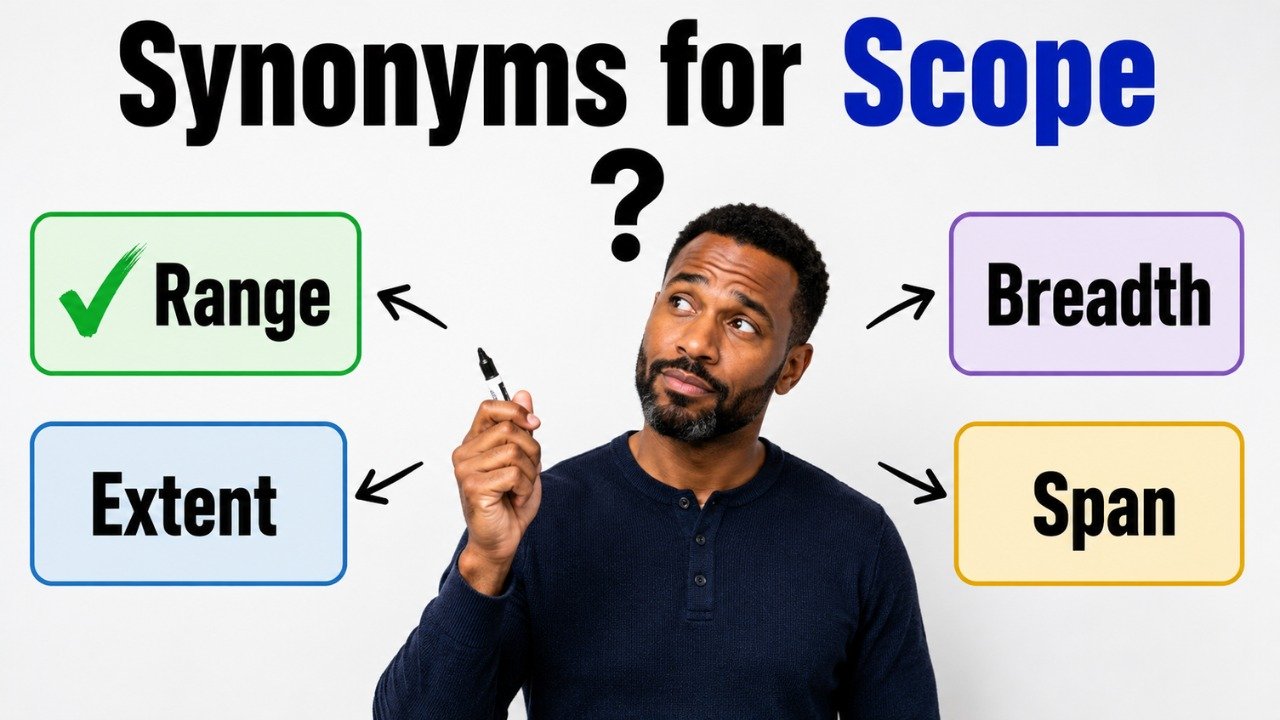
Quick Answer: The best synonyms for scope include range, extent, breadth, reach, field, purview, remit, domain, opportunity, and latitude. Use range or extent when discussing how much something covers, purview or remit for responsibility and authority, domain or field for an area of knowledge, opportunity for future possibilities, and latitude for freedom to act. The most accurate replacement depends on whether scope refers to size, boundaries, responsibility, subject matter, or potential.
Pronunciation and Word Details
Word: Scope.
Pronunciation: /skoʊp/
Part of Speech: Noun and verb.
Meaning: The range, extent, boundaries, responsibility, or opportunity included within an activity, subject, or plan.
US Pronunciation:
UK Pronunciation:
What Does “Scope” Mean?
Scope means the range, extent, or boundaries of a subject, activity, project, responsibility, or possibility.
As a noun, scope commonly describes how much something includes. For example, the scope of a project identifies the work, goals, limits, and responsibilities included in it.
Scope can also describe an area of authority. In the sentence “That decision falls within her scope,” it refers to her responsibility or control.
The word may also mean opportunity or room for development. In the sentence “There is scope for improvement,” it means improvement is possible.
As a verb, scope means to examine, assess, or define the size and requirements of something. For example, a team may scope a project before beginning the work.
Meaning, Tone, and Context of “Scope”
Scope is generally a neutral and versatile word. It appears frequently in professional, academic, technical, legal, medical, and everyday contexts.
Professional Tone: Scope is common in project plans, contracts, reports, proposals, and workplace discussions.
Academic Tone: Researchers use scope to define the subjects, periods, locations, or questions included in a study.
Technical Tone: In technical writing, scope may describe system boundaries, functions, variables, or areas of operation.
Formal Tone: Phrases such as scope of authority, scope of practice, and scope of responsibility sound precise and formal.
Conversational Tone: Scope also appears naturally in ordinary phrases such as “There is plenty of scope for creativity.”
The word is useful because it can refer to both what is included and what is excluded. However, its broad meaning can sometimes make a sentence unclear. A more precise synonym may be better when the intended meaning is range, authority, opportunity, or focus.
When and How to Use “Scope”
For Project Boundaries: Use scope to identify the work, goals, features, and responsibilities included in a project.
Example: The project scope includes research, design, testing, and final delivery.
For Range or Extent: Use scope when describing how broad or limited a subject, activity, or investigation is.
Example: The study has a broad scope covering several age groups.
For Responsibility: Use scope to define what someone is authorized or expected to handle.
Example: Budget approval is outside the scope of her role.
For Opportunity: Use scope when describing room for growth, change, creativity, or improvement.
Example: The position offers considerable scope for professional development.
For Academic Research: Use scope to establish the boundaries of a paper, study, or discussion.
Example: The scope of the research is limited to urban communities.
For Professional Practice: Use scope to explain the duties and activities permitted within a profession.
Example: The task falls within the specialist’s scope of practice.
For Evaluation: Use scope when explaining how much an examination, review, or assessment will cover.
Example: The review expanded its scope to include financial records.
For Planning: Use scope before beginning work to clarify expectations and prevent unnecessary additions.
Example: The team agreed on the scope before estimating the cost.
Best Synonyms for Scope
Range: The complete set or variety covered by something.
Example: The course covers a wide range of communication skills.
Extent: The amount, degree, or area to which something reaches.
Example: Investigators examined the full extent of the damage.
Breadth: The width, variety, or comprehensiveness of a subject.
Example: The breadth of her knowledge impressed the interviewers.
Reach: The distance, influence, or coverage something has.
Example: The program expanded its reach into rural communities.
Field: A particular area of study, work, or activity.
Example: He has extensive experience in the field of environmental science.
Purview: The area of responsibility, authority, or concern belonging to someone.
Example: Hiring decisions fall within the manager’s purview.
Remit: The responsibilities or authority officially assigned to a person or organization.
Example: Community outreach is part of the department’s remit.
Domain: A particular area of knowledge, activity, influence, or control.
Example: Data security belongs to the technical domain.
Opportunity: A favorable possibility or room for action and development.
Example: The new role provides an opportunity to develop leadership skills.
Latitude: Freedom to act, decide, or make changes within certain limits.
Example: The editor gave the writer considerable latitude in shaping the article.
50 Synonyms for Scope with Short Meanings
- Range: The variety or area covered.
- Extent: The amount or degree reached.
- Breadth: The width or variety of coverage.
- Reach: The distance or influence achieved.
- Span: The full distance or period covered.
- Compass: The complete range or limits of something.
- Coverage: The amount of a subject or area included.
- Sweep: A broad range or movement across something.
- Scale: The size or level of an activity.
- Magnitude: The great size, importance, or extent of something.
- Bounds: The outer limits of an area or subject.
- Boundaries: The lines defining what is included.
- Limits: The points beyond which something does not extend.
- Parameters: The conditions or limits controlling an activity.
- Confines: The restricted boundaries of something.
- Ambit: The range or limits of authority or influence.
- Purview: An area of responsibility or authority.
- Domain: A field of knowledge, activity, or control.
- Field: A particular area of work or study.
- Area: A specific subject, activity, or responsibility.
- Sphere: An area of activity, interest, or influence.
- Realm: A particular field of knowledge or experience.
- Province: An area of responsibility, knowledge, or concern.
- Territory: An area of activity, control, or knowledge.
- Jurisdiction: The official area of legal authority.
- Authority: The power or responsibility to make decisions.
- Responsibility: A duty or area someone must manage.
- Remit: An officially assigned area of responsibility.
- Mandate: Formal authority or instruction to perform a task.
- Brief: The responsibilities or instructions assigned for a task.
- Focus: The main point receiving attention.
- Subject: The matter being discussed or studied.
- Topic: The specific matter under consideration.
- Theme: The central idea or subject of a work.
- Concern: A matter involving someone’s attention or responsibility.
- Capacity: The ability or potential to do something.
- Room: Available space or opportunity for action.
- Opportunity: A possibility for progress or action.
- Potential: The possibility of future development.
- Possibility: Something that may happen or be achieved.
- Latitude: Freedom to act or make decisions.
- Leeway: Extra freedom within certain limits.
- Freedom: The ability to act without unnecessary restriction.
- Flexibility: The ability to adjust or make changes.
- Space: Room for action, development, or interpretation.
- Margin: A limited amount of freedom or possibility.
- Outlook: A general view or perspective on something.
- Perspective: A particular way of viewing a subject.
- View: What can be seen, considered, or understood.
- Field of View: The entire area visible from a particular position or instrument.
Read Also:
Synonyms for Collaborate Resume

Synonyms for Scope by Context
When Scope Means Range or Extent
Use these synonyms when describing how much an activity, study, project, or subject covers.
Range: Emphasizes variety or the distance between limits.
Example: The investigation covered a wide range of complaints.
Extent: Emphasizes the amount or degree involved.
Example: The full extent of the problem was not immediately clear.
Breadth: Emphasizes broad variety or comprehensive coverage.
Example: The breadth of the report makes it useful to several departments.
Span: Emphasizes a complete distance, period, or range.
Example: The research spans more than three decades.
Coverage: Emphasizes the amount of information or territory included.
Example: The guide offers thorough coverage of basic grammar rules.
When Scope Means Boundaries or Limits
These alternatives are useful when defining what is included or excluded.
Bounds: Refers to established outer limits.
Example: The discussion remained within the bounds of the original topic.
Boundaries: Refers to clear dividing lines.
Example: The agreement defines the boundaries of each person’s role.
Limits: Refers to the furthest permitted or possible point.
Example: The team must understand the limits of the available technology.
Parameters: Refers to rules or conditions that shape an activity.
Example: The manager established clear parameters for the assignment.
Confines: Refers to restrictive or narrow boundaries.
Example: The researchers worked within the confines of a limited budget.
When Scope Means Responsibility or Authority
Use these words for duties, professional roles, and decision making power.
Purview: The area under someone’s responsibility or authority.
Example: Contract approval is within the director’s purview.
Remit: An officially assigned area of responsibility.
Example: Training new employees falls under her remit.
Jurisdiction: Legal or official authority over a matter.
Example: The dispute is outside the court’s jurisdiction.
Mandate: Formal permission or instruction to act.
Example: The committee received a mandate to review workplace policies.
Brief: The specific instructions or responsibilities assigned to someone.
Example: Her brief includes preparing reports and coordinating meetings.
When Scope Means an Area of Knowledge or Activity
These synonyms are appropriate when discussing subjects, careers, or specializations.
Field: A recognized area of study or work.
Example: He works in the field of language education.
Domain: A particular area of knowledge, control, or expertise.
Example: Cybersecurity belongs to the technical domain.
Sphere: An area of activity, interest, or influence.
Example: The decision had consequences beyond the economic sphere.
Realm: A broad area of thought, experience, or activity.
Example: The idea once belonged to the realm of imagination.
Province: A subject or activity associated with a particular person or group.
Example: Financial forecasting is the province of the accounting team.
When Scope Means Opportunity or Potential
Use these alternatives when discussing room for growth, change, or future action.
Opportunity: A favorable chance to act or develop.
Example: The role provides an opportunity to learn new skills.
Potential: The possibility of future success or development.
Example: The plan has strong potential for long term growth.
Room: Available space for improvement or change.
Example: There is still room for improvement in the final section.
Latitude: Freedom to make decisions or adjustments.
Example: Employees have latitude to organize their own schedules.
Leeway: A limited amount of flexibility or freedom.
Example: The deadline gives us little leeway for unexpected delays.
When Scope Means Focus or Subject
Use these alternatives when identifying what a discussion, paper, or activity is about.
Focus: The main point receiving attention.
Example: The focus of the article is workplace communication.
Subject: The matter being studied or discussed.
Example: Climate change is the main subject of the report.
Topic: A specific matter within a broader discussion.
Example: The speaker introduced a new topic during the meeting.
Theme: The central idea explored in a creative or academic work.
Example: Personal growth is the central theme of the story.
Concern: A matter requiring attention or responsibility.
Example: Product safety is our primary concern.
Another Word for Scope
The best single replacement for scope is often range, but the ideal word depends on the intended meaning. Use range for coverage, extent for degree, remit for responsibility, opportunity for possibility, and focus for the main subject.
Original: The scope of the course is broad.
Better Option: The range of the course is broad.
Original: The issue is outside the scope of my position.
Better Option: The issue is outside the remit of my position.
Original: There is scope for further development.
Better Option: There is opportunity for further development.
Original: The report narrowed its scope to employee training.
Better Option: The report narrowed its focus to employee training.
When Not to Use “Scope”
Do not use scope when a more precise word would make the sentence easier to understand. Because scope has several meanings, readers may not immediately know whether it refers to size, responsibility, opportunity, or subject matter.
When Describing Physical Size
Scope may sound too abstract when actual size, distance, or dimensions are meant.
Weak: The scope of the building is impressive.
Better: The scale of the building is impressive.
When Referring to Legal Authority
Use jurisdiction when official legal power is the intended meaning.
Weak: The case is outside the scope of this court.
Better: The case is outside the jurisdiction of this court.
When Discussing a Main Subject
Use focus or topic when referring specifically to what a discussion is about.
Weak: The scope of today’s meeting is customer feedback.
Better: The focus of today’s meeting is customer feedback.
When Referring to Future Possibility
Use opportunity, potential, or room when the meaning is possibility.
Weak: The proposal has scope for success.
Better: The proposal has strong potential for success.
When Scope Becomes Repetitive
Avoid repeating scope several times within the same paragraph.
Weak: The project scope was revised because the original scope had a scope that was too broad.
Better: The project boundaries were revised because the original plan covered too much work.
Words Commonly Confused With Scope
Scope vs Scale: Scope describes what is included in an activity or project, while scale describes its size, level, or magnitude. A project can have a narrow scope but operate on a large scale.
Scope vs Range: Scope often includes boundaries, purpose, and responsibility. Range usually describes variety or the distance between two limits.
Scope vs Extent: Scope describes the overall coverage or boundaries of something. Extent emphasizes how far or how much something reaches.
Scope vs Remit: Scope can refer to any area or range. Remit specifically refers to officially assigned duties or authority.
Scope vs Purpose: Scope explains what is included. Purpose explains why something is being done.
Scope vs Field: Scope describes the limits or range within a subject. Field refers to the subject or professional area itself.
Scope vs Jurisdiction: Scope is broad and may describe informal responsibility. Jurisdiction refers to official or legal authority.
Scope vs Capacity: Scope describes the available range or opportunity. Capacity describes the ability to perform, contain, or achieve something.
Which Synonym Should You Choose?
Choose range when describing variety, coverage, or the distance between limits.
Choose extent when emphasizing how much, how far, or to what degree something reaches.
Choose breadth when highlighting comprehensive knowledge or wide coverage.
Choose scale when describing the size or magnitude of a project, event, or problem.
Choose boundaries when explaining what is included and excluded.
Choose parameters when describing rules, conditions, or limits that control an activity.
Choose purview for formal writing about responsibility or authority.
Choose remit when referring to officially assigned workplace duties.
Choose jurisdiction when discussing legal or governmental authority.
Choose field or domain when referring to an area of study, work, or knowledge.
Choose focus when identifying the central subject of an article, meeting, or discussion.
Choose opportunity when describing a favorable chance for action or development.
Choose potential when emphasizing possible future success.
Choose latitude when someone has freedom to make decisions.
Choose field of view when discussing the area visible through a lens, instrument, or observation point.
Real Life Examples of “Scope” in Sentences
Original: The scope of the project includes website design and content preparation.
Better Option: The project remit includes website design and content preparation.
Original: The study has a limited scope.
Better Option: The study has a limited range.
Original: The manager expanded the scope of the investigation.
Better Option: The manager expanded the extent of the investigation.
Original: That decision is outside the scope of my role.
Better Option: That decision is outside the purview of my role.
Original: The course offers considerable scope for creative work.
Better Option: The course offers considerable opportunity for creative work.
Original: The report covers a broad scope of topics.
Better Option: The report covers a broad range of topics.
Original: We need to define the scope before beginning the assignment.
Better Option: We need to define the project boundaries before beginning the assignment.
Original: The role gives employees scope to make independent decisions.
Better Option: The role gives employees latitude to make independent decisions.
Original: The article is outside the scope of this discussion.
Better Option: The article is outside the focus of this discussion.
Original: The problem is large in scope.
Better Option: The problem is large in scale.
Synonym Groups and Usage Differences
Range and Extent Group
Range, extent, breadth, span, and reach all describe how much something covers.
Range emphasizes variety or distance. Extent emphasizes degree. Breadth emphasizes wide coverage. Span emphasizes total distance or time. Reach emphasizes influence or accessibility.
Example: The program increased its reach without changing the range of services it offered.
Boundary Group
Bounds, boundaries, limits, parameters, and confines define where something begins and ends.
Boundaries are clear dividing lines. Limits are final points. Parameters are controlling conditions. Confines often suggest restriction.
Example: The project must remain within the agreed parameters.
Authority Group
Purview, remit, jurisdiction, mandate, and authority describe responsibility or decision making power.
Purview is a formal area of responsibility. Remit refers to assigned duties. Jurisdiction is legal authority. Mandate is formal permission or instruction.
Example: The matter falls within the committee’s remit but outside the court’s jurisdiction.
Knowledge Group
Field, domain, sphere, realm, and province refer to areas of study, work, or expertise.
Field is the most general choice. Domain often sounds technical. Sphere emphasizes activity or influence. Realm can be abstract or imaginative. Province suggests specialized responsibility.
Example: Language development is an important field within the broader domain of education.
Opportunity Group
Opportunity, potential, room, latitude, and leeway describe possibility or freedom.
Opportunity is a favorable chance. Potential refers to future capability. Room means available possibility. Latitude and leeway describe freedom within limits.
Example: The flexible schedule gives employees greater latitude and room for creative planning.
Subject Group
Focus, subject, topic, theme, and concern identify what receives attention.
Focus is the central point. Subject is the general matter. Topic is a specific issue. Theme is a central recurring idea. Concern is something requiring attention.
Example: The main topic of the meeting was safety, but its broader focus included employee wellbeing.
Antonyms of Scope
The opposite of scope depends on whether scope means range, freedom, authority, or opportunity.
Narrowness: A lack of breadth or variety.
Limitation: A condition that restricts possibility or action.
Restriction: A rule or condition that reduces freedom.
Constraint: Something that controls or prevents action.
Confinement: The state of being kept within narrow limits.
Exclusion: The act of leaving something outside a group or plan.
Boundary: A point beyond which something cannot extend.
Inflexibility: An inability to adjust or change.
Powerlessness: A lack of authority or control.
Impossibility: The absence of any realistic opportunity.
Comparison: Scope vs Related Words
Scope vs Range
Scope includes the overall coverage, purpose, responsibilities, and boundaries of something. Range mainly describes variety or the distance between limits.
Example With Scope: The scope of the course includes writing, grammar, and vocabulary.
Example With Range: The course offers a range of writing exercises.
Scope vs Extent
Scope identifies what an activity includes. Extent identifies how far or how much it reaches.
Example With Scope: The scope of the review includes all financial records.
Example With Extent: The review revealed the full extent of the losses.
Scope vs Scale
Scope describes included work or subject matter. Scale describes size or magnitude.
Example With Scope: The project scope includes three regional offices.
Example With Scale: The project operates on a national scale.
Scope vs Purview
Scope is a general term for range or boundaries. Purview is more formal and usually refers to authority or responsibility.
Example With Scope: Staff training is within the scope of the program.
Example With Purview: Staff discipline falls within the supervisor’s purview.
Scope vs Remit
Scope may refer to coverage, possibility, or responsibility. Remit specifically refers to assigned duties or authority.
Example With Scope: The scope of the review was expanded.
Example With Remit: Policy review is part of the committee’s remit.
Scope vs Purpose
Scope explains what is included. Purpose explains the intended goal or reason.
Example With Scope: The scope of the survey includes customer satisfaction and product quality.
Example With Purpose: The purpose of the survey is to identify areas for improvement.
Common Phrases and Expressions With “Scope”
Scope of Work: The tasks, responsibilities, and results included in a project.
Project Scope: The complete set of goals, work, requirements, and boundaries of a project.
Broad Scope: A wide range of subjects, activities, or responsibilities.
Narrow Scope: A limited range or clearly restricted focus.
Within Scope: Included in the agreed responsibilities or boundaries.
Outside the Scope: Not included in the subject, plan, or assigned duties.
Scope for Improvement: An opportunity to make something better.
Scope of Responsibility: The duties and decisions assigned to someone.
Scope of Practice: The activities a trained professional is authorized to perform.
Full Scope: The complete range, size, or extent of something.
Common Mistakes to Avoid
Using Scope and Scale Interchangeably: Scope describes what is included, while scale describes how large something is.
Incorrect: The scope of the event was enormous because thousands attended.
Correct: The scale of the event was enormous because thousands attended.
Writing “Scope of Works” Unnecessarily: Scope of work is the standard phrase for the tasks included in a project. Scope of works may appear in specialized settings, but it often sounds unnatural in general writing.
Repeating Scope Too Often: Replace repeated uses with boundaries, range, remit, focus, or extent when appropriate.
Choosing a Synonym Without Checking Context: Opportunity cannot replace scope when the sentence refers to responsibility. Jurisdiction cannot replace scope unless legal or official authority is involved.
Using Scope for a Vague Subject: When discussing the central idea of an article or meeting, focus or topic may be clearer.
Confusing Scope With Purpose: Scope identifies what a project includes. Purpose identifies why the project exists.
Ignoring What Falls Outside the Scope: Clear writing should identify exclusions as well as included work, especially in plans, agreements, and reports.
Using Overly Formal Alternatives: Purview, remit, and ambit may sound unnecessarily formal in casual conversation. Range, area, or responsibility is often more natural.
Conclusion
The most useful synonyms for scope include range, extent, breadth, purview, remit, domain, focus, opportunity, and latitude. Range and extent describe coverage, while purview and remit clarify responsibility. Domain and field identify areas of knowledge, focus points to a central subject, and opportunity expresses future possibility. When choosing among synonyms for scope, consider whether the sentence refers to boundaries, authority, size, subject matter, freedom, or potential. A precise alternative makes the intended meaning easier to understand.
FAQs About Synonyms for Scope
What Is the Best Synonym for Scope?
Range is the best general synonym when scope means coverage or extent. Purview is better for authority, remit for assigned responsibility, and opportunity for future possibility.
What Is Another Word for Scope in a Project?
Project boundaries, project range, remit, coverage, and parameters are useful alternatives. The best choice depends on whether you mean included work, assigned duties, or controlling conditions.
What Is a Formal Synonym for Scope?
Purview, remit, ambit, jurisdiction, and parameters are formal synonyms. Purview and remit are especially useful when discussing professional responsibility.
What Is a Synonym for Broad Scope?
Wide range, great breadth, extensive coverage, broad reach, and large compass can express the idea of broad scope.
What Is a Synonym for Scope of Work?
Remit, brief, responsibilities, project requirements, duties, and work boundaries can replace scope of work in suitable contexts.
Is Scale a Synonym for Scope?
Scale is a close alternative only when discussing size or magnitude. Scope describes what is included, while scale describes how large the activity is.
What Does Scope for Improvement Mean?
Scope for improvement means there is room, opportunity, or potential to make something better.
