
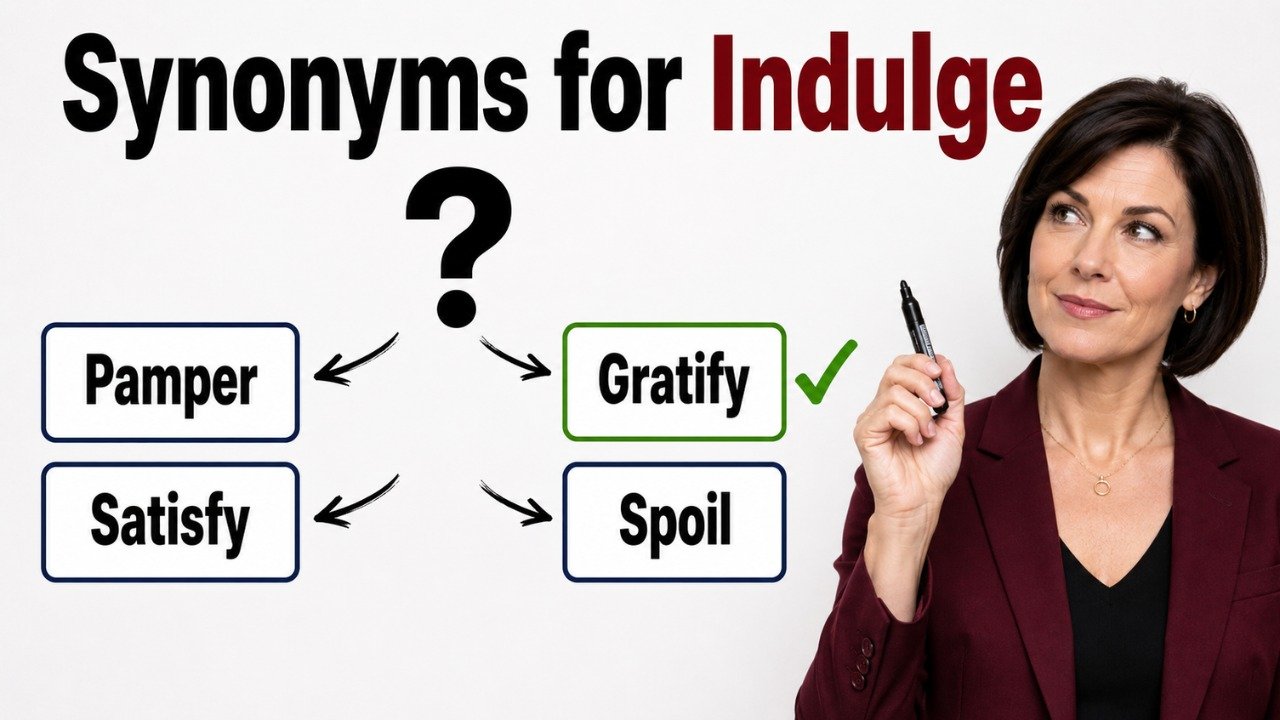
Quick Answer: The best synonyms for indulge include pamper, spoil, gratify, satisfy, humor, accommodate, treat, yield, savor, and splurge. Use pamper for giving someone special comfort, spoil when kindness becomes excessive, gratify for satisfying a desire, and humor for agreeing with someone to keep them pleased. Choose savor or enjoy for experiencing pleasure, yield when giving in to temptation, and splurge when spending freely on something enjoyable.
Pronunciation and Word Details
Word: Indulge
Pronunciation: /ɪnˈdʌldʒ/
Part of Speech: Verb
Meaning: To allow yourself or another person to enjoy a pleasure, satisfy a desire, or receive unusually generous treatment.
US Pronunciation:
UK Pronunciation:
What Does “Indulge” Mean?
Indulge means to allow yourself or another person to enjoy something pleasurable, especially when that pleasure is unnecessary, generous, or excessive.
Indulge is a verb that can describe satisfying a desire, enjoying a favorite activity, treating someone generously, or allowing behavior that might normally be limited.
A person may indulge in chocolate, shopping, entertainment, rest, or a favorite hobby. In these examples, indulge means to enjoy something freely or give in to a personal desire.
The word can also describe treating another person with special kindness.
Example: The grandparents often indulge their grandchildren with gifts.
In this sentence, indulge means to give the children more attention, treats, or privileges than usual.
Indulge can also mean to tolerate, humor, or temporarily accept another person’s wishes, ideas, or behavior.
Example: Please indulge me while I explain my unusual suggestion.
Here, indulge means to be patient, listen, or allow the speaker to continue.
The meaning of indulge therefore changes according to the sentence. It may refer to pleasure, generosity, temptation, tolerance, excess, or patient attention.
Meaning, Tone, and Context of “Indulge”
Indulge usually has a positive, playful, luxurious, or slightly critical tone. The exact tone depends on what is being enjoyed and whether the pleasure is considered reasonable or excessive.
In casual conversation, indulge often describes enjoying food, relaxation, shopping, entertainment, or another personal pleasure.
Example: I decided to indulge in a slice of cake after dinner.
This use sounds relaxed and positive. It suggests allowing oneself a special treat.
In lifestyle and descriptive writing, indulge can create a sense of comfort, luxury, and enjoyment.
Example: She indulged in a long bath after the exhausting journey.
When indulge describes excessive kindness toward another person, its tone can become critical.
Example: His parents indulge him whenever he complains.
This sentence suggests that the parents satisfy his wishes too easily and may be encouraging poor behavior.
In formal conversation, indulge can mean to show patience or allow someone to continue speaking.
Example: Indulge me for a moment while I explain the reasoning.
This use is polite but may sound slightly formal or theatrical.
In discussions about habits and self control, indulge can imply giving in to temptation.
Example: He frequently indulges his desire for expensive clothing.
Indulge is common in everyday speech, personal writing, reviews, descriptions, invitations, and discussions about behavior. It is less common in highly technical writing unless a precise behavioral meaning is intended.
When and How to Use “Indulge”
For Personal Pleasure
Use indulge when someone allows themselves to enjoy an activity, experience, or possession.
Explanation: The word suggests taking pleasure in something that may not be essential.
Example: She indulged in an afternoon of reading and quiet relaxation.
For Food and Drink
Use indulge when someone enjoys rich, sweet, luxurious, or favorite food.
Explanation: It often suggests eating for pleasure rather than hunger.
Example: We indulged in warm pastries after the long walk.
For Treating Yourself
Use indulge when someone gives themselves a special reward or luxury.
Explanation: This use is common when discussing rest, shopping, travel, beauty, or entertainment.
Example: He decided to indulge himself with a comfortable new chair.
For Pampering Another Person
Use indulge when someone gives another person special comfort, attention, gifts, or privileges.
Explanation: The treatment may be generous, affectionate, or excessive.
Example: Her family indulged her with thoughtful gifts on her birthday.
For Satisfying a Desire
Use indulge when someone acts on a wish, craving, curiosity, or impulse.
Explanation: It suggests allowing the desire instead of resisting it.
Example: She indulged her curiosity and opened the old wooden box.
For Giving In to Temptation
Use indulge when someone stops resisting something attractive.
Explanation: The word may suggest weak self control or a conscious decision to enjoy the temptation.
Example: He indulged his craving for dessert despite planning to avoid sweets.
For Allowing Certain Behavior
Use indulge when someone tolerates or encourages another person’s behavior.
Explanation: This meaning can carry criticism, especially when the behavior is unreasonable.
Example: The manager refused to indulge repeated excuses for unfinished work.
For Humor or Patience
Use indulge when asking someone to listen, wait, cooperate, or accept a temporary request.
Explanation: This use sounds polite and somewhat formal.
Example: Please indulge me while I provide one more example.
For Spending Freely
Use indulge when someone spends money on a luxury or enjoyable experience.
Explanation: It suggests choosing pleasure over strict financial restraint.
Example: They indulged in a luxurious meal during their anniversary trip.
For Enjoying an Interest
Use indulge when someone gives time and attention to a hobby, passion, or fascination.
Explanation: The activity is usually enjoyable and personally meaningful.
Example: The quiet weekend allowed him to indulge his interest in photography.
Best Synonyms for Indulge
Pamper
Synonym: Pamper means to give someone special care, comfort, and attention.
Example: The hotel staff pampered the guests with exceptional service.
Spoil
Synonym: Spoil means to treat someone too generously or satisfy too many of their wishes.
Example: The relatives spoiled the child with toys and sweets.
Gratify
Synonym: Gratify means to satisfy a desire, need, curiosity, or emotion.
Example: The explanation gratified her curiosity about the unusual discovery.
Satisfy
Synonym: Satisfy means to fulfill a desire, need, expectation, or craving.
Example: A light snack was enough to satisfy his hunger.
Humor
Synonym: Humor means to agree with someone or tolerate their wishes to keep them pleased.
Example: She humored her friend by listening to the story once again.
Accommodate
Synonym: Accommodate means to adjust to another person’s needs, wishes, or preferences.
Example: The organizer accommodated the guest’s request for a quieter seat.
Treat
Synonym: Treat means to provide someone with something enjoyable or special.
Example: She treated herself to a relaxing afternoon at home.
Yield
Synonym: Yield means to stop resisting a desire, pressure, or temptation.
Example: He finally yielded to the temptation to open the present early.
Savor
Synonym: Savor means to enjoy an experience, taste, or moment slowly and fully.
Example: They savored every moment of the peaceful vacation.
Splurge
Synonym: Splurge means to spend more money than usual on something enjoyable.
Example: She splurged on a beautifully made winter coat.
50 Synonyms for Indulge with Short Meanings
- Pamper: Give someone special care and comfort.
- Spoil: Treat someone too generously or permissively.
- Gratify: Satisfy a desire, feeling, or curiosity.
- Satisfy: Fulfill a need, wish, or craving.
- Please: Give enjoyment, approval, or satisfaction.
- Humor: Cooperate with someone to keep them pleased.
- Accommodate: Adjust to someone’s needs or preferences.
- Oblige: Do something as a favor or courtesy.
- Cater To: Provide what someone wants or enjoys.
- Yield To: Stop resisting a desire or pressure.
- Give In To: Allow a temptation or demand to succeed.
- Surrender To: Stop resisting a feeling or desire.
- Succumb To: Give way to temptation or pressure.
- Allow: Give permission for something to happen.
- Permit: Formally or willingly allow an action.
- Tolerate: Accept behavior without preventing it.
- Entertain: Consider or give attention to an idea.
- Encourage: Support behavior or make it more likely.
- Support: Give approval, help, or assistance.
- Foster: Help a habit, feeling, or behavior develop.
- Nurture: Encourage and care for something as it grows.
- Treat: Give someone something enjoyable or special.
- Reward: Give pleasure or recognition after an achievement.
- Lavish: Give something generously or in large amounts.
- Cosset: Treat someone with excessive care and protection.
- Coddle: Treat someone too gently or protectively.
- Mollycoddle: Give someone unnecessary care and protection.
- Baby: Treat someone as less capable than they are.
- Overprotect: Shield someone from too many difficulties.
- Overindulge: Allow or consume more pleasure than is sensible.
- Feast: Eat or enjoy something in generous amounts.
- Binge: Consume or do something excessively for a period.
- Gorge: Eat a large amount with little restraint.
- Overeat: Consume more food than the body needs.
- Consume: Eat, drink, or use something.
- Partake: Take part in or consume something offered.
- Savor: Enjoy a taste, feeling, or experience fully.
- Enjoy: Take pleasure in an activity or experience.
- Relish: Experience strong enjoyment or appreciation.
- Luxuriate: Enjoy comfort or pleasure in a relaxed way.
- Revel: Take great pleasure in a feeling or situation.
- Wallow: Remain absorbed in a pleasure or emotion.
- Splurge: Spend freely on something enjoyable.
- Gratify Oneself: Satisfy a personal wish or desire.
- Treat Oneself: Give oneself a special pleasure or reward.
- Give Oneself Up To: Become completely absorbed in a pleasure.
- Satisfy a Craving: Fulfill a strong desire for something.
- Indulge a Desire: Allow a wish to guide an action.
- Make Allowances For: Accept behavior with patience or understanding.
- Humor the Wishes Of: Agree with someone to keep them satisfied.
Read Also:
Synonyms for Delighted

Synonyms for Indulge by Context
When Indulge Means Pamper
Indulge can mean giving someone generous care, attention, comfort, gifts, or privileges.
Useful Synonyms: Pamper, spoil, cosset, coddle, baby, mollycoddle, lavish, and overprotect.
Example With Indulge: The family indulged their guests throughout the weekend.
Example With a Synonym: The family pampered their guests throughout the weekend.
Pamper is usually positive and suggests comfort or special care. Spoil often carries criticism because it implies excessive generosity. Coddle and mollycoddle suggest treating someone as weak or incapable.
When Indulge Means Satisfy a Desire
Indulge may mean fulfilling a wish, appetite, curiosity, preference, or emotional need.
Useful Synonyms: Gratify, satisfy, please, fulfill, accommodate, cater to, and oblige.
Example With Indulge: She indulged her curiosity by exploring the hidden passage.
Example With a Synonym: She gratified her curiosity by exploring the hidden passage.
Gratify works well with desire, curiosity, ambition, and appetite. Satisfy is broader and often sounds more neutral.
When Indulge Means Give In
Indulge may describe allowing temptation, pressure, or impulse to overcome self control.
Useful Synonyms: Yield to, give in to, surrender to, succumb to, and gratify.
Example With Indulge: He indulged his urge to purchase another expensive watch.
Example With a Synonym: He yielded to his urge to purchase another expensive watch.
Yield to is fairly neutral. Succumb to often suggests weakness or an undesirable result. Surrender to can sound dramatic or emotional.
When Indulge Means Enjoy
Indulge can mean taking pleasure in an experience, activity, taste, or interest.
Useful Synonyms: Enjoy, savor, relish, luxuriate, revel, partake, and feast.
Example With Indulge: They indulged in several hours of peaceful conversation.
Example With a Synonym: They enjoyed several hours of peaceful conversation.
Enjoy is the broadest and most neutral alternative. Savor suggests slow and careful appreciation. Revel communicates energetic or enthusiastic pleasure.
When Indulge Means Treat Yourself
Indulge is often used for giving yourself a luxury, reward, break, or enjoyable experience.
Useful Synonyms: Treat oneself, reward oneself, pamper oneself, splurge, luxuriate, and gratify oneself.
Example With Indulge: She indulged in a new outfit after completing the difficult project.
Example With a Synonym: She treated herself to a new outfit after completing the difficult project.
Treat oneself sounds positive and controlled. Splurge emphasizes spending more money than usual. Pamper oneself focuses on comfort and care.
When Indulge Means Eat Excessively
Indulge can describe eating or drinking for pleasure, especially in generous amounts.
Useful Synonyms: Feast, binge, gorge, overeat, consume, partake, and savor.
Example With Indulge: The guests indulged in rich desserts after dinner.
Example With a Synonym: The guests feasted on rich desserts after dinner.
Feast can sound celebratory. Gorge and binge are strongly negative because they suggest excessive consumption. Savor focuses on enjoyment rather than quantity.
When Indulge Means Tolerate
Indulge can mean accepting another person’s behavior, wishes, or ideas with patience.
Useful Synonyms: Humor, tolerate, accommodate, oblige, allow, permit, and make allowances for.
Example With Indulge: Please indulge his enthusiasm for a few more minutes.
Example With a Synonym: Please humor his enthusiasm for a few more minutes.
Humor is usually the closest synonym in this context. Tolerate sounds less warm and may suggest annoyance. Accommodate emphasizes adjusting to someone’s needs.
When Indulge Means Encourage Poor Behavior
Indulge may mean allowing behavior that should perhaps be corrected or limited.
Useful Synonyms: Enable, encourage, foster, support, permit, tolerate, and spoil.
Example With Indulge: The supervisor refused to indulge the employee’s repeated lateness.
Example With a Synonym: The supervisor refused to tolerate the employee’s repeated lateness.
Tolerate is suitable when behavior is merely accepted. Encourage and foster suggest actively helping the behavior continue.
When Indulge Means Consider an Idea
In polite or formal speech, indulge can mean giving an idea, explanation, or request temporary attention.
Useful Synonyms: Entertain, consider, humor, hear out, permit, and allow.
Example With Indulge: Indulge the possibility that the first assumption was incorrect.
Example With a Synonym: Consider the possibility that the first assumption was incorrect.
Consider is the clearest neutral option. Entertain works well when discussing a possibility or proposal.
Another Word for Indulge
Pamper is often the best single replacement for indulge when the word describes giving someone special attention, comfort, or generosity.
However, the best alternative depends on what the sentence means. Use gratify for satisfying a desire, savor for enjoying an experience, humor for patiently accepting someone’s wishes, yield for giving in to temptation, and splurge for spending freely.
Original: Her grandparents indulge her whenever she visits.
Better Option: Her grandparents pamper her whenever she visits.
Original: He indulged his curiosity and examined the mysterious package.
Better Option: He gratified his curiosity and examined the mysterious package.
Original: We indulged in the peaceful atmosphere of the garden.
Better Option: We savored the peaceful atmosphere of the garden.
Original: She indulged his request for one more story.
Better Option: She humored his request for one more story.
When Not to Use “Indulge”
When the Meaning Is Unclear
Indulge can refer to pleasure, food, generosity, temptation, tolerance, or excessive permission. Use a more specific synonym when readers might misunderstand the intended meaning.
Weak: She indulged him all afternoon.
Better: She humored his unusual requests all afternoon.
When the Pleasure Is Ordinary
Indulge may sound too luxurious or excessive for a simple everyday activity.
Weak: He indulged in drinking a glass of water.
Better: He drank a glass of water.
When Describing a Necessary Action
Indulge suggests pleasure or choice. It may be inaccurate when an activity is required.
Weak: She indulged in completing the required safety training.
Better: She completed the required safety training.
When Criticizing Excessive Behavior
Indulge may sound too gentle when the behavior is harmful or seriously excessive.
Weak: He indulged in food until he became ill.
Better: He overate until he became ill.
When Formal Writing Needs Precision
Indulge can sound emotional or vague in academic and professional writing.
Weak: The policy indulges repeated violations.
Better: The policy tolerates repeated violations.
When Someone Is Merely Being Kind
Indulge may wrongly suggest that the kindness is excessive.
Weak: The nurse indulged the patient by bringing water.
Better: The nurse assisted the patient by bringing water.
When the Word Becomes Repetitive
Repeating indulge can make writing sound artificial.
Weak: She indulged her guests, indulged their requests, and encouraged them to indulge in dessert.
Better: She pampered her guests, accommodated their requests, and encouraged them to enjoy dessert.
When a Neutral Word Is Better
Use enjoy when no sense of luxury, temptation, or excess is intended.
Weak: They indulged in a pleasant walk through the park.
Better: They enjoyed a pleasant walk through the park.
Words Commonly Confused With Indulge
Indulge vs Enjoy: Indulge often suggests special pleasure, temptation, luxury, or excess. Enjoy is neutral and simply means to take pleasure in something.
Indulge vs Pamper: Indulge can describe satisfying any desire or enjoying something personally. Pamper specifically means giving someone generous comfort and care.
Indulge vs Spoil: Indulge can be positive or negative. Spoil usually suggests that excessive generosity or permission is damaging someone’s behavior.
Indulge vs Gratify: Indulge describes allowing or enjoying a desire. Gratify focuses directly on satisfying that desire.
Indulge vs Satisfy: Indulge often carries an emotional or luxurious tone. Satisfy is more neutral and can refer to needs, standards, requirements, hunger, or curiosity.
Indulge vs Humor: Indulge has several meanings. Humor specifically means cooperating with someone’s wish or idea to keep them pleased.
Indulge vs Accommodate: Indulge may suggest unnecessary generosity. Accommodate means adjusting reasonably to someone’s needs or circumstances.
Indulge vs Tolerate: Indulge can involve patient acceptance or active encouragement. Tolerate means allowing something without necessarily approving of it.
Indulge vs Splurge: Indulge can involve any pleasure. Splurge specifically emphasizes spending a large or unusual amount of money.
Indulge vs Savor: Indulge means allowing oneself pleasure. Savor means enjoying that pleasure slowly and attentively.
Indulge vs Binge: Indulge may be moderate or excessive. Binge clearly describes excessive consumption or activity during a limited period.
Which Synonym Should You Choose?
Choose pamper when describing generous care, comfort, attention, or personal treatment.
Choose spoil when excessive kindness or permission may encourage selfish or irresponsible behavior.
Choose gratify when a desire, appetite, ambition, curiosity, or emotional need is satisfied.
Choose satisfy when writing neutrally about meeting a need, expectation, craving, or requirement.
Choose enjoy when the activity is pleasant but not necessarily luxurious or excessive.
Choose savor when someone appreciates a taste, experience, or moment slowly and fully.
Choose relish when someone takes energetic or obvious pleasure in an activity.
Choose luxuriate when describing relaxed enjoyment of comfort, beauty, or luxury.
Choose revel when someone takes enthusiastic pleasure in attention, success, freedom, or celebration.
Choose humor when someone agrees with another person’s wishes or ideas to keep them pleased.
Choose accommodate when adjusting to another person’s reasonable needs or preferences.
Choose tolerate when behavior is accepted without approval.
Choose permit or allow when the sentence is about permission rather than pleasure.
Choose yield to when someone stops resisting a desire, request, or pressure.
Choose succumb to when giving in has a negative or undesirable result.
Choose treat oneself when describing a controlled personal reward.
Choose splurge when someone spends freely on a luxury.
Choose feast when eating is abundant, enjoyable, and celebratory.
Choose gorge, binge, or overeat when consumption is clearly excessive.
Choose coddle or mollycoddle when someone receives too much protection or gentle treatment.
Choose entertain when considering an idea, proposal, possibility, or unusual thought.
Real Life Examples of “Indulge” in Sentences
Original: She decided to indulge in a quiet afternoon of reading.
Better Option: She decided to enjoy a quiet afternoon of reading.
Original: His grandparents indulge him with gifts whenever he visits.
Better Option: His grandparents pamper him with gifts whenever he visits.
Original: The manager refused to indulge unreasonable demands.
Better Option: The manager refused to accommodate unreasonable demands.
Original: Please indulge me while I explain the final point.
Better Option: Please humor me while I explain the final point.
Original: He indulged his curiosity and entered the abandoned building.
Better Option: He gratified his curiosity and entered the abandoned building.
Original: We indulged in a rich meal after the ceremony.
Better Option: We feasted on a rich meal after the ceremony.
Original: She indulged herself with a new pair of shoes.
Better Option: She treated herself to a new pair of shoes.
Original: The parents continued to indulge the child’s poor behavior.
Better Option: The parents continued to tolerate the child’s poor behavior.
Original: He indulged his craving for something sweet.
Better Option: He satisfied his craving for something sweet.
Original: They indulged in the beauty of the mountain view.
Better Option: They savored the beauty of the mountain view.
Synonym Groups and Usage Differences
Care and Comfort Group
This group includes pamper, cosset, coddle, mollycoddle, baby, and overprotect.
Pamper usually sounds warm and positive. Cosset suggests protective care and comfort. Coddle and mollycoddle often carry criticism because they imply unnecessary protection. Baby means treating an adult or capable person as helpless.
Example: The staff pampered the visitors without coddling them.
Desire and Satisfaction Group
This group includes gratify, satisfy, please, fulfill, cater to, and accommodate.
Gratify focuses on a desire or emotional wish. Satisfy is more neutral and can refer to practical needs. Please means to create happiness or approval. Cater to can suggest carefully serving someone’s preferences.
Example: The new arrangement satisfied practical needs and gratified the participants’ desire for privacy.
Temptation Group
This group includes yield to, give in to, surrender to, succumb to, and gratify oneself.
Yield to means to stop resisting. Give in to is natural in casual speech. Surrender to sounds more dramatic. Succumb to usually suggests weakness or a negative consequence.
Example: He eventually yielded to temptation and bought the expensive item.
Enjoyment Group
This group includes enjoy, savor, relish, luxuriate, revel, and partake.
Enjoy is broad and neutral. Savor suggests slow appreciation. Relish communicates strong enjoyment. Luxuriate emphasizes relaxed comfort. Revel suggests energetic or enthusiastic pleasure.
Example: She savored the meal and reveled in the cheerful atmosphere.
Excessive Consumption Group
This group includes binge, gorge, overeat, feast, overindulge, and consume.
Feast can be positive and celebratory. Overindulge suggests going beyond a sensible amount. Gorge and binge have stronger negative meanings. Consume is neutral and does not automatically imply excess.
Example: The guests feasted during the celebration, but no one wanted to overindulge.
Permission Group
This group includes allow, permit, tolerate, support, encourage, and foster.
Allow and permit communicate permission. Tolerate means accepting something without stopping it. Encourage and foster suggest helping behavior develop. Support may mean approving or assisting it.
Example: The rules permit creative discussion but do not tolerate disrespectful behavior.
Patience and Cooperation Group
This group includes humor, accommodate, oblige, entertain, and make allowances for.
Humor means cooperating to keep someone pleased. Accommodate means adjusting to a need or preference. Oblige means doing something as a favor. Entertain means considering an idea or possibility.
Example: She humored his request and entertained his proposal for a few minutes.
Personal Reward Group
This group includes treat oneself, reward oneself, splurge, pamper oneself, and luxuriate.
Treat oneself can describe a modest pleasure. Reward oneself connects the pleasure to an achievement. Splurge emphasizes unusually high spending. Luxuriate suggests relaxed enjoyment of comfort.
Example: After completing the project, she treated herself to dinner and luxuriated in a quiet evening.
Antonyms of Indulge
The opposite of indulge changes according to whether the word means enjoy, satisfy, permit, pamper, or give in.
Resist: Refuse to give in to a desire or temptation.
Deny: Refuse to provide or allow something.
Refuse: Decline a request, offer, or demand.
Reject: Dismiss or refuse to accept something.
Forbid: Order that an action must not happen.
Prohibit: Formally prevent an activity.
Restrict: Place limits on behavior or access.
Control: Keep a desire, action, or situation within limits.
Restrain: Prevent oneself or another person from acting freely.
Withhold: Keep back something wanted or expected.
Deprive: Prevent someone from having something necessary or enjoyable.
Discipline: Correct behavior through rules or consequences.
Correct: Address and improve unacceptable behavior.
Oppose: Act against an idea, request, or behavior.
Discourage: Make an action or behavior less likely.
Suppress: Prevent a desire, feeling, or action from being expressed.
Abstain: Deliberately avoid an activity or pleasure.
Refrain: Choose not to do something.
Economize: Reduce spending and avoid unnecessary expense.
Moderate: Keep an activity or desire within sensible limits.
Comparison Between Indulge and Related Words
Indulge vs Pamper
Indulge may mean allowing pleasure, satisfying a desire, or tolerating behavior. Pamper specifically means giving someone special comfort and care.
Example With Indulge: Her parents indulge her desire for expensive clothes.
Example With Pamper: The staff pampered her with a comfortable room and attentive service.
Indulge vs Spoil
Indulge can describe harmless pleasure or generosity. Spoil usually suggests excessive treatment that may damage behavior or expectations.
Example With Indulge: They indulged the children with an extra dessert.
Example With Spoil: They spoiled the children by granting every demand.
Indulge vs Gratify
Indulge emphasizes allowing a desire to be expressed. Gratify emphasizes satisfying that desire.
Example With Indulge: She indulged her curiosity by reading the letter.
Example With Gratify: Reading the letter gratified her curiosity.
Indulge vs Satisfy
Indulge often suggests pleasure, generosity, or temptation. Satisfy is neutral and simply means fulfilling a need or expectation.
Example With Indulge: He indulged his appetite with a rich meal.
Example With Satisfy: A simple meal satisfied his appetite.
Indulge vs Enjoy
Indulge suggests special, luxurious, unnecessary, or excessive pleasure. Enjoy describes any positive experience.
Example With Indulge: She indulged in an expensive weekend retreat.
Example With Enjoy: She enjoyed a walk through the park.
Indulge vs Savor
Indulge emphasizes allowing oneself a pleasure. Savor emphasizes appreciating that pleasure slowly and fully.
Example With Indulge: They indulged in a carefully prepared dessert.
Example With Savor: They savored every bite of the carefully prepared dessert.
Indulge vs Humor
Indulge has many meanings, including pleasure and generosity. Humor specifically means cooperating with someone’s wishes or ideas to keep them pleased.
Example With Indulge: Please indulge my unusual request.
Example With Humor: Please humor me while I test this unusual idea.
Indulge vs Accommodate
Indulge may imply unnecessary generosity or permissiveness. Accommodate usually means making a reasonable adjustment for someone.
Example With Indulge: The teacher refused to indulge every complaint.
Example With Accommodate: The teacher accommodated the student’s need for additional time.
Indulge vs Tolerate
Indulge can suggest active permission or encouragement. Tolerate means allowing something to continue without necessarily approving of it.
Example With Indulge: The supervisor indulged his repeated excuses.
Example With Tolerate: The supervisor tolerated the delay once but warned that it must not happen again.
Indulge vs Splurge
Indulge can involve food, rest, entertainment, generosity, or desire. Splurge specifically refers to spending freely or choosing an expensive pleasure.
Example With Indulge: She indulged in an evening of relaxation.
Example With Splurge: She splurged on an elegant new dining table.
Common Phrases and Expressions With Indulge
Indulge In: Take pleasure in an activity, experience, food, or habit.
Indulge Yourself: Allow yourself to enjoy a special pleasure or luxury.
Indulge a Craving: Satisfy a strong desire for food or another pleasure.
Indulge a Desire: Allow a personal wish to influence an action.
Indulge Your Curiosity: Explore something because you strongly want to know more.
Indulge Someone’s Wishes: Give someone what they request or prefer.
Indulge in Luxury: Enjoy expensive comfort, possessions, or experiences.
Indulge in a Treat: Enjoy something special that is not usually necessary.
Indulge Me for a Moment: Listen patiently or allow the speaker to continue briefly.
Indulge Every Whim: Satisfy every sudden desire, often excessively.
Common Mistakes to Avoid
Using Indulge Without the Correct Preposition
Use indulge in before an activity, pleasure, food, or experience.
Incorrect: She indulged on a rich dessert.
Correct: She indulged in a rich dessert.
Using Indulge In Before a Person
When someone receives excessive generosity, use indulge with a direct object rather than indulge in.
Incorrect: The grandparents indulged in their grandson.
Correct: The grandparents indulged their grandson.
Confusing Indulge With Enjoy
Indulge often suggests luxury, temptation, generosity, or excess. Do not use it for every pleasant activity.
Unnatural: He indulged in breathing the fresh air.
Natural: He enjoyed breathing the fresh air.
Choosing a Negative Synonym for a Positive Context
Binge, gorge, spoil, and mollycoddle carry negative meanings. They should not replace indulge when the experience is moderate and positive.
Incorrect: She binged on a peaceful evening of reading.
Correct: She enjoyed a peaceful evening of reading.
Choosing a Positive Synonym for Harmful Excess
Enjoy may sound too mild when the activity is clearly excessive.
Weak: He enjoyed food until he became uncomfortable.
Better: He overindulged in food until he became uncomfortable.
Repeating Indulge Too Often
Repeated use makes writing sound promotional or exaggerated.
Repetitive: Indulge in comfort, indulge in dessert, and indulge in an evening of entertainment.
Improved: Relax in comfort, savor a dessert, and enjoy an evening of entertainment.
Confusing Pampering With Permission
Pamper refers to comfort and attention. Permit refers to allowing an action.
Incorrect: The rules pamper visitors to enter before noon.
Correct: The rules permit visitors to enter before noon.
Ignoring the Critical Meaning
Indulge is not always positive. It can imply excessive kindness, weak discipline, or harmful permission.
Positive: She indulged in an hour of peaceful reading.
Critical: His supervisors indulged his irresponsible behavior for too long.
Using Indulge in Objective Reports
In formal reports, choose a precise word such as permit, tolerate, consume, spend, or satisfy.
Vague: Participants indulged in additional food.
Precise: Participants consumed additional food.
Conclusion
The best synonyms for indulge depend on whether the word refers to pleasure, generosity, desire, permission, or excess. Use pamper for special care, gratify or satisfy for fulfilling a desire, humor for patient cooperation, and savor or enjoy for pleasant experiences. Choose yield when someone gives in to temptation, splurge for unusually generous spending, and overindulge when enjoyment becomes excessive. Understanding these distinctions makes it easier to select natural and precise synonyms for indulge in conversations, essays, descriptions, and professional writing.
FAQs About Synonyms for Indulge
What Is the Best Synonym for Indulge?
Pamper is a strong general synonym when indulge means giving someone special care. Enjoy, gratify, humor, or satisfy may be better in other contexts.
What Is Another Word for Indulge Yourself?
Treat yourself is the most natural alternative. Pamper yourself, reward yourself, splurge, and luxuriate are also useful options.
Is Enjoy a Synonym for Indulge?
Yes, but enjoy is more neutral. Indulge often suggests special pleasure, luxury, temptation, generosity, or possible excess.
What Is a Formal Synonym for Indulge?
Gratify, accommodate, permit, entertain, and tolerate are formal alternatives. The correct choice depends on the sentence’s intended meaning.
What Is the Difference Between Indulge and Pamper?
Indulge can mean satisfying a desire, enjoying a pleasure, or tolerating behavior. Pamper specifically means giving someone generous comfort, care, and attention.
Can Indulge Have a Negative Meaning?
Yes. Indulge can suggest excessive consumption, weak discipline, or allowing unreasonable behavior. Spoil, coddle, enable, and overindulge express these negative meanings more clearly.
What Is the Opposite of Indulge?
Common opposites include resist, deny, restrict, refuse, abstain, discipline, and restrain. The best antonym depends on whether indulge means enjoy, permit, or give in.
