
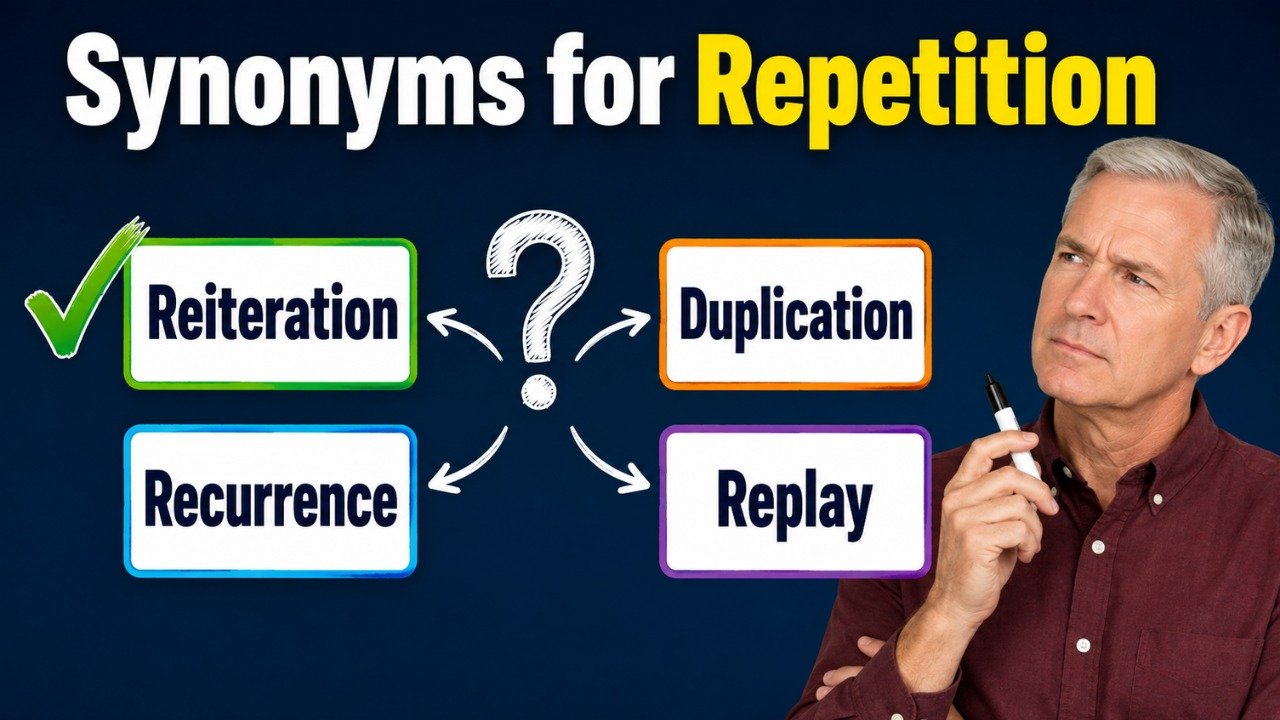
Quick Answer: The best synonyms for repetition include recurrence, reiteration, duplication, replication, restatement, redundancy, recurrence, rehearsal, routine, and iteration. Reiteration is best when an idea or statement is expressed again for clarity or emphasis. Recurrence suits events that happen repeatedly over time, while duplication refers to creating an identical copy. Rehearsal and practice describe repeated actions used to improve performance. Redundancy is appropriate when repetition is unnecessary, and iteration works well for repeated stages in a process.
Pronunciation and Word Details
Word: Repetition.
Pronunciation: /ˌrepəˈtɪʃən/
Part of Speech: Noun.
Meaning: The act of saying, doing, writing, or experiencing something again.
US Pronunciation:
UK Pronunciation:
What Does “Repetition” Mean?
Repetition means the act of saying, writing, doing, producing, or experiencing something more than once.
Repetition is a noun. It may describe a repeated word, sentence, action, sound, event, pattern, exercise, or process.
In writing and speech, repetition occurs when a word, phrase, or idea appears several times. It may be intentional and effective, especially when the writer wants to create emphasis, rhythm, clarity, or emotional impact.
Repetition can also be unnecessary. Repeating the same point without adding useful information may make writing sound weak, dull, or confusing. In this context, redundancy is often a better word.
In learning and training, repetition is usually positive. Repeating an exercise, movement, pronunciation, or skill can improve memory, confidence, accuracy, and performance.
In daily life, repetition may refer to routines, recurring events, familiar patterns, or actions that happen in cycles. The correct synonym depends on what is being repeated and why.
Meaning, Tone, and Context of “Repetition”
Repetition is a neutral and flexible word. It is common in education, writing, grammar, literature, music, public speaking, psychology, training, fitness, technology, and everyday conversation.
In academic and technical contexts, repetition often describes a repeated pattern, event, process, or linguistic feature. The tone is usually neutral and analytical.
In literary discussions, repetition may have a positive meaning. Writers use repeated sounds, words, phrases, and sentence structures to create rhythm, emphasis, unity, and emotional intensity.
In editing, repetition can have a negative tone. It may describe unnecessary wording, duplicated information, or an idea that appears too often.
In learning and physical training, repetition is usually practical and positive. It suggests deliberate practice intended to build skill, strength, memory, or accuracy.
In casual conversation, repetition may express annoyance or boredom when the same statement, behavior, or experience keeps occurring.
The word can therefore be neutral, positive, or negative depending on whether the repeated element is useful, intentional, excessive, or unwanted.
When and How to Use “Repetition”
For Repeated Wording: Use repetition when a word, phrase, sentence, or idea appears more than once.
Example: The paragraph contains unnecessary repetition of the same argument.
For Emphasis: Use repetition when repeated language strengthens an important message.
Example: The speaker used repetition to emphasize the need for change.
For Learning: Use repetition when an activity is performed several times to improve memory or understanding.
Example: Vocabulary becomes easier to remember through regular repetition.
For Physical Practice: Use repetition when a movement or exercise is completed several times.
Example: Each repetition should be performed slowly and correctly.
For Recurring Events: Use repetition when the same event or situation happens again.
Example: The repetition of the error suggested a deeper problem.
For Musical Structure: Use repetition when a melody, rhythm, chorus, or musical phrase returns.
Example: The repetition of the chorus makes the song memorable.
For Daily Routines: Use repetition when actions follow the same pattern regularly.
Example: The repetition of her morning routine helped her stay organized.
For Technical Processes: Use repetition when a process or operation is performed again.
Example: Repetition of the test produced similar results.
For Unnecessary Information: Use repetition when material is repeated without adding value.
Example: Removing repetition made the report shorter and clearer.
Best Synonyms for Repetition
Reiteration: The act of saying or explaining something again.
Example: Her reiteration of the main point helped the audience understand it.
Recurrence: The return of an event, condition, or experience.
Example: The recurrence of the problem required immediate attention.
Duplication: The creation or presence of an identical copy.
Example: The editor removed the duplication from the final document.
Replication: The process of reproducing something accurately.
Example: The researchers attempted a replication of the original experiment.
Restatement: The expression of the same idea in different or similar words.
Example: The final paragraph offers a clear restatement of the argument.
Repeat: An occurrence or performance that happens again.
Example: The second incident was almost an exact repeat of the first.
Redundancy: Unnecessary repetition of words, ideas, or information.
Example: Careful editing eliminated redundancy from the article.
Rehearsal: Repeated practice before a performance or event.
Example: The final rehearsal gave the actors greater confidence.
Routine: A regular sequence of repeated actions.
Example: Exercise became part of her daily routine.
Iteration: One repetition or version within a repeated process.
Example: Each iteration of the design improved its usability.
50 Synonyms for Repetition with Short Meanings
- Reiteration: Saying or expressing something again.
- Recurrence: The return of an event or condition.
- Duplication: The creation of an identical copy.
- Replication: Accurate reproduction of something.
- Restatement: Expressing the same idea again.
- Repeat: Something that happens or is performed again.
- Echo: A repeated sound, idea, or effect.
- Replay: A repeated performance, recording, or event.
- Reprise: The return of an earlier musical or dramatic section.
- Return: The reappearance of something after an absence.
- Reappearance: The act of appearing again.
- Reoccurrence: Another occurrence of the same event.
- Renewal: The act of beginning or continuing something again.
- Revival: The return of an activity, style, or interest.
- Rehearsal: Repeated practice before a performance.
- Practice: Repeated activity used to improve a skill.
- Drill: Repeated training intended to build accuracy.
- Exercise: An activity repeated for learning or development.
- Routine: A regularly repeated sequence of actions.
- Cycle: A series of events that repeats.
- Pattern: A repeated arrangement, behavior, or design.
- Loop: A sequence that continues to repeat.
- Rotation: A repeated movement or order.
- Iteration: One stage in a repeated process.
- Recitation: The act of repeating something aloud.
- Reproduction: The production of a copy or repeated version.
- Copy: A version made to match an original.
- Imitation: Reproduction of another action, style, or form.
- Redundancy: Unnecessary repetition of information.
- Tautology: Repetition of the same meaning in different words.
- Pleonasm: Use of more words than meaning requires.
- Overuse: Excessive repetition of something.
- Refrain: A line or phrase repeated regularly.
- Chorus: A repeated section of a song.
- Mantra: A word or phrase repeated frequently.
- Litany: A long or repeated series of statements.
- Chant: Repeated rhythmic words or sounds.
- Retelling: The act of telling a story again.
- Recounting: The act of describing events again.
- Rephrasing: Expressing the same idea in different words.
- Paraphrase: A rewritten version of the same meaning.
- Reminder: A repeated message that helps someone remember.
- Reinforcement: Repetition used to strengthen learning or belief.
- Revision: Review and repetition of material for improvement.
- Review: Repeated examination of information.
- Recycling: Reuse of the same material, idea, or content.
- Reduplication: Repetition of a word, sound, or element.
- Recapitulation: A brief repetition of the main points.
- Reaffirmation: Repeated confirmation of a belief or decision.
- Reassertion: Stating a position or claim again firmly.
Read Also:
Synonyms for Alignment

Synonyms for Repetition by Context
When Repetition Means Saying Something Again
Reiteration, restatement, rephrasing, paraphrase, recapitulation, reassertion, and reaffirmation are useful when words or ideas are expressed again.
Reiteration often repeats the same message for clarity or emphasis. Restatement presents an idea again, sometimes more simply. Rephrasing and paraphrase express the same meaning with different wording.
Example: The manager’s reiteration of the deadline showed that it was important.
Example: The conclusion provides a brief restatement of the main argument.
When Repetition Means an Event Happening Again
Recurrence, reoccurrence, return, reappearance, renewal, and revival describe events, conditions, styles, or activities that come back.
Recurrence is the most natural choice for problems, symptoms, events, and situations that happen repeatedly. Revival usually suggests that something becomes active or popular again after a period of decline.
Example: The recurrence of the fault caused further delays.
Example: The exhibition encouraged a revival of traditional painting methods.
When Repetition Means Making a Copy
Duplication, replication, reproduction, copy, and imitation describe the creation of another version.
Duplication usually means creating an identical or unnecessary copy. Replication often appears in scientific and technical contexts. Reproduction refers to producing a copy of an image, object, sound, or work.
Example: The system prevents accidental duplication of records.
Example: Successful replication strengthened confidence in the findings.
When Repetition Means Practice
Practice, rehearsal, drill, exercise, review, revision, and reinforcement describe repetition used for improvement.
Practice is the broadest option. Rehearsal is common before a performance, presentation, or event. Drill refers to strict and repeated training designed to improve speed or accuracy.
Example: Regular practice improved her pronunciation.
Example: The emergency drill prepared the staff for possible danger.
When Repetition Means a Regular Pattern
Routine, cycle, pattern, loop, sequence, and rotation describe actions or events that follow a repeated order.
Routine usually refers to regular daily behavior. Cycle describes a complete series that begins again. Loop is common when a sequence continues repeatedly.
Example: Reading before bed became part of his evening routine.
Example: The machine continued the same cycle throughout the day.
When Repetition Means Unnecessary Wording
Redundancy, tautology, pleonasm, overuse, duplication, and recycling describe repetition that weakens communication.
Redundancy is the strongest general term for unnecessary information. Tautology refers to repeating the same meaning in different words. Pleonasm describes the use of more words than necessary.
Example: The editor removed redundancy from the introduction.
Example: The phrase repeated the same idea and created a tautology.
When Repetition Creates Rhythm or Emphasis
Refrain, chorus, chant, mantra, echo, and reprise describe repeated language, music, or sound.
A refrain is a recurring line or phrase. A chorus is a repeated section of a song. A mantra is a phrase repeated for focus, motivation, belief, or meditation.
Example: The repeated refrain gave the poem a strong rhythm.
Example: The audience quickly remembered the chorus.
When Repetition Means Another Version
Iteration, replay, reprise, retelling, recounting, and revision describe another performance, version, or presentation.
Iteration is common in design, software, and development. Replay refers to an event or recording shown again. Retelling means presenting the same story in a new form.
Example: The latest iteration of the product includes several improvements.
Example: The novel is a modern retelling of an ancient story.
Another Word for Repetition
Reiteration is often the best single replacement for repetition when a statement, message, or idea is expressed again.
However, the correct alternative depends on the context. Use recurrence for repeated events, duplication for identical copies, practice for repeated training, redundancy for unnecessary wording, and routine for regular actions.
Original: The repetition of the warning showed its importance.
Better Option: The reiteration of the warning showed its importance.
Original: The repetition of the illness concerned the patient.
Better Option: The recurrence of the illness concerned the patient.
Original: The document contained unnecessary repetition.
Better Option: The document contained unnecessary redundancy.
Original: Repetition helped the musician improve.
Better Option: Regular practice helped the musician improve.
When Not to Use “Repetition”
Repetition can be too general when a more precise word explains the situation better.
Use recurrence when an event or problem returns. Use duplication when information or objects are copied. Use rehearsal when people practice for a performance. Use routine when actions occur regularly. Use redundancy when repeated information is unnecessary.
Avoid using repetition repeatedly within the same paragraph. This creates the exact writing problem being discussed and makes the text sound awkward.
Repetition is not always negative. Do not automatically replace it with redundancy when the repeated element creates emphasis, rhythm, learning, or clarity.
Weak: The repetition of the error was another repetition of an earlier problem.
Better: The recurrence of the error reflected an earlier problem.
Weak: The singer completed several repetitions before the concert.
Better: The singer completed several rehearsals before the concert.
Weak: The report included repetition of the same information.
Better: The report included unnecessary redundancy.
Weak: The daily repetition helped her organize her morning.
Better: The daily routine helped her organize her morning.
Words Commonly Confused With Repetition
Repetition vs Reiteration: Repetition is the general act of doing or saying something again. Reiteration usually refers specifically to repeating a statement, argument, instruction, or idea.
Repetition vs Recurrence: Repetition can describe any repeated action or element. Recurrence refers to an event, problem, condition, or experience that returns.
Repetition vs Duplication: Repetition means doing or presenting something again. Duplication means creating or including an identical copy.
Repetition vs Replication: Repetition is broad and general. Replication usually involves reproducing a process, experiment, object, or result as accurately as possible.
Repetition vs Redundancy: Repetition may be useful or intentional. Redundancy is repetition that is unnecessary and adds no value.
Repetition vs Practice: Repetition describes the repeated action itself. Practice is purposeful repetition intended to improve skill or performance.
Repetition vs Rehearsal: Repetition can occur in any context. Rehearsal refers to planned practice before a performance, speech, ceremony, or event.
Repetition vs Routine: Repetition is the act of doing something again. Routine is a regular and often organized pattern of repeated actions.
Repetition vs Iteration: Repetition means something happens again. Iteration usually refers to one repeated version or stage in a process of gradual improvement.
Repetition vs Tautology: Repetition is a broad term. Tautology specifically repeats the same meaning using different words.
Which Synonym Should You Choose?
Choose reiteration when a statement, warning, instruction, or argument is expressed again.
Choose recurrence when a condition, event, mistake, or problem returns.
Choose duplication when the same information, document, object, or record appears twice.
Choose replication when a process, experiment, result, or design is reproduced accurately.
Choose restatement when an idea is presented again for clarity.
Choose rephrasing when the same message is expressed using different words.
Choose redundancy when repeated information is unnecessary.
Choose practice when repeated action is intended to improve a skill.
Choose rehearsal when practicing for a performance, presentation, ceremony, or event.
Choose drill when repetition is structured, strict, and designed to build speed or accuracy.
Choose routine when an action is performed regularly as part of daily life.
Choose cycle when a series of stages repeats in the same order.
Choose pattern when repeated behavior, design, or arrangement can be recognized.
Choose loop when a process or sequence continues to repeat.
Choose iteration when referring to repeated stages of design, testing, development, or improvement.
Choose refrain or chorus for repeated sections in music or poetry.
Choose mantra for a phrase repeated frequently for focus, motivation, or belief.
Choose tautology when the same meaning is repeated unnecessarily in different words.
Choose recapitulation when briefly repeating the main points of a discussion or argument.
Real Life Examples of “Repetition” in Sentences
Original: The repetition of the same mistake frustrated the manager.
Better Option: The recurrence of the same mistake frustrated the manager.
Original: The article contains too much repetition.
Better Option: The article contains too much redundancy.
Original: Repetition helped the student remember the vocabulary.
Better Option: Regular practice helped the student remember the vocabulary.
Original: The repetition of the warning made everyone pay attention.
Better Option: The reiteration of the warning made everyone pay attention.
Original: The database contained repetition of several records.
Better Option: The database contained duplication of several records.
Original: The actors improved through repetition before opening night.
Better Option: The actors improved through rehearsal before opening night.
Original: The repetition of the same actions formed a habit.
Better Option: The routine of the same actions formed a habit.
Original: Each repetition of the design included small improvements.
Better Option: Each iteration of the design included small improvements.
Original: The song uses repetition to make its main line memorable.
Better Option: The song uses a refrain to make its main line memorable.
Original: The repetition of the experiment produced similar results.
Better Option: The replication of the experiment produced similar results.
Synonym Groups and Usage Differences
Statement Group
Reiteration, restatement, rephrasing, paraphrase, recapitulation, reassertion, and reaffirmation describe ideas or statements expressed again.
Reiteration often emphasizes importance. Restatement improves clarity. Rephrasing changes the wording. Recapitulation briefly reviews the main points.
Example: The conclusion offers a concise recapitulation of the evidence.
Event Group
Recurrence, reoccurrence, return, reappearance, renewal, and revival describe something that happens or appears again.
Recurrence is common for problems and events. Reappearance focuses on becoming visible again. Revival suggests renewed activity or popularity.
Example: The recurrence of the issue suggested that the repair was incomplete.
Copy Group
Duplication, replication, reproduction, copy, imitation, and recycling describe repeated or copied material.
Duplication suggests an identical copy. Replication emphasizes accuracy. Imitation copies the style or behavior of something else.
Example: The artist’s work was an imitation rather than an original creation.
Learning Group
Practice, rehearsal, drill, exercise, review, revision, and reinforcement describe repetition used to build knowledge or skill.
Practice is general. Drill is more structured. Revision and review focus on studying material again. Reinforcement strengthens learning through repeated exposure.
Example: Regular review provided useful reinforcement of the lesson.
Pattern Group
Routine, cycle, pattern, loop, rotation, and iteration describe organized or repeated sequences.
Routine concerns regular behavior. Cycle describes stages that repeat. Iteration is one version within a repeated process.
Example: Each iteration brought the team closer to a workable solution.
Unnecessary Wording Group
Redundancy, tautology, pleonasm, overuse, and duplication describe excessive or needless repetition.
Redundancy is the broadest option. Tautology repeats meaning. Pleonasm uses more words than necessary.
Example: Removing pleonasm made the sentence more direct.
Musical and Rhetorical Group
Refrain, chorus, chant, mantra, echo, and reprise describe repeated words, sounds, or musical sections.
Refrain and chorus are common in songs. Chant involves rhythmic repetition. Reprise brings back an earlier section later in a performance.
Example: The final reprise created a strong sense of completion.
Story and Content Group
Retelling, recounting, replay, paraphrase, recycling, and reproduction describe content presented again.
Retelling may change the style, setting, or viewpoint of a story. Recycling can carry a negative meaning when old ideas are reused without creativity.
Example: The film offers a creative retelling of a familiar story.
Antonyms of Repetition
The opposite of repetition depends on whether the word refers to repeated wording, events, actions, copies, or patterns.
Originality: The quality of being new and not copied.
Novelty: Something fresh, unusual, or newly introduced.
Variation: A change that prevents sameness.
Difference: A lack of exact similarity.
Change: The act of becoming different.
Uniqueness: The quality of being unlike anything else.
Innovation: The introduction of a new idea or method.
Spontaneity: Action that is not planned or routinely repeated.
Diversity: The presence of many different forms or elements.
Variety: A mixture of different choices or experiences.
Interruption: A break in a repeated action or sequence.
Cessation: The ending of an activity or pattern.
Discontinuation: The act of stopping something permanently or temporarily.
Single Occurrence: An event that happens only once.
Improvisation: Creation without following a fixed or repeated pattern.
Comparison: Repetition vs Related Words
Repetition vs Reiteration
Repetition is a broad term for saying, doing, or presenting something again. Reiteration specifically refers to repeating a statement or message, often for clarity or emphasis.
Example With Repetition: The poem uses repetition to create rhythm.
Example With Reiteration: Her reiteration of the rule removed any doubt.
Repetition vs Recurrence
Repetition describes any repeated action or feature. Recurrence refers to an event, problem, symptom, or condition that returns.
Example With Repetition: Repetition helped him learn the movement.
Example With Recurrence: The recurrence of the pain required further examination.
Repetition vs Duplication
Repetition means something is said or done again. Duplication usually means an identical copy has been created or included.
Example With Repetition: The speech contained repetition for emphasis.
Example With Duplication: The spreadsheet contained duplication of several entries.
Repetition vs Replication
Repetition is general and does not always require accuracy. Replication involves reproducing something carefully to achieve the same or similar result.
Example With Repetition: Repetition of the activity improved confidence.
Example With Replication: Replication of the experiment confirmed the result.
Repetition vs Redundancy
Repetition may be intentional and effective. Redundancy describes repetition that is unnecessary or adds no useful meaning.
Example With Repetition: Repetition made the slogan memorable.
Example With Redundancy: Redundancy made the report longer than necessary.
Repetition vs Practice
Repetition describes an action happening again. Practice is repeated activity performed with the goal of improvement.
Example With Repetition: The repetition of the sound became annoying.
Example With Practice: Daily practice improved her speaking skills.
Repetition vs Rehearsal
Repetition can be accidental or deliberate. Rehearsal is planned repetition before a performance or event.
Example With Repetition: The repetition of the sentence weakened the paragraph.
Example With Rehearsal: The final rehearsal prepared the cast for the performance.
Repetition vs Routine
Repetition is the act of doing something again. Routine is an established pattern of actions performed regularly.
Example With Repetition: Repetition of the task caused boredom.
Example With Routine: Her morning routine included reading and exercise.
Repetition vs Iteration
Repetition means doing the same thing again. Iteration often includes modification, testing, or gradual improvement.
Example With Repetition: Simple repetition did not solve the problem.
Example With Iteration: The next iteration included a clearer layout.
Repetition vs Tautology
Repetition includes any repeated language or action. Tautology occurs when different words repeat the same meaning unnecessarily.
Example With Repetition: The writer repeated the key phrase for emphasis.
Example With Tautology: The phrase “future plans” may sound tautological when the context already makes the future clear.
Common Phrases and Expressions With Repetition
Constant Repetition: Something repeated continuously or very frequently.
Frequent Repetition: An action or element that appears many times.
Unnecessary Repetition: Repeated information that adds no value.
Deliberate Repetition: Intentional repetition used for a specific effect.
Verbal Repetition: Repeating spoken words or phrases.
Word Repetition: Using the same word several times.
Repetition for Emphasis: Repeating language to make a point stronger.
Repetition for Effect: Repeating something to create rhythm, emotion, or impact.
Repetition of Ideas: Presenting the same thought more than once.
Repetition of Errors: Making the same mistake repeatedly.
Repetition of Sounds: Reusing similar sounds in speech, poetry, or music.
Repetition of Patterns: The recurrence of a recognizable arrangement.
Through Repetition: Achieving learning or improvement by doing something repeatedly.
Avoid Repetition: Remove unnecessary repeated words or ideas.
Use Repetition: Repeat an element intentionally to achieve a desired effect.
Common Mistakes to Avoid
Treating All Repetition as Negative
Repetition is not always a writing mistake. It can create emphasis, rhythm, unity, and emotional power.
Incorrect Advice: Never repeat a word or phrase in writing.
Better Advice: Remove accidental repetition but keep deliberate repetition that serves a clear purpose.
Confusing Repetition With Redundancy
Repetition can be useful, while redundancy is generally unnecessary.
Weak: The chorus contains redundancy that makes it memorable.
Better: The chorus uses repetition that makes it memorable.
Using Recurrence for Repeated Wording
Recurrence usually describes events, symptoms, or conditions rather than repeated words.
Incorrect: The paragraph contains recurrence of the same phrase.
Correct: The paragraph contains repetition of the same phrase.
Using Duplication for Every Repeated Action
Duplication refers mainly to copying or creating identical material.
Incorrect: Daily duplication improved her piano skills.
Correct: Daily practice improved her piano skills.
Confusing Practice With Rehearsal
Practice can improve any skill. Rehearsal normally prepares someone for a specific performance, speech, or event.
Incorrect: The athlete attended a rehearsal to improve general strength.
Correct: The athlete completed regular practice to improve general strength.
Repeating the Same Synonym Too Often
Replacing every instance of repetition with the same alternative may create another repetitive pattern.
Weak: The recurrence of the phrase and the recurrence of the idea created recurrence throughout the article.
Better: The repeated phrase and recurring idea created unnecessary redundancy throughout the article.
Choosing a Technical Word Without Context
Words such as pleonasm, tautology, replication, and reduplication have specific meanings. Use them only when they accurately fit the situation.
Incorrect: The daily pleonasm of exercise improved his fitness.
Correct: The daily repetition of exercise improved his fitness.
Assuming Iteration Means an Exact Copy
An iteration is often a new version that includes changes or improvements.
Incorrect: Every iteration was completely identical.
Better: Every duplication was completely identical.
Confusing Reappearance With Recurrence
Reappearance focuses on becoming visible or present again. Recurrence focuses on an event or condition happening again.
Example: The actor’s reappearance surprised the audience.
Example: The recurrence of the technical fault delayed production.
Using Repetition Vaguely
Repetition may be unclear when readers do not know what has been repeated.
Vague: The repetition caused a problem.
Clearer: The repeated submission of identical records caused a problem.
Conclusion
Synonyms for repetition include reiteration, recurrence, duplication, replication, restatement, redundancy, rehearsal, routine, and iteration. Reiteration suits repeated statements, while recurrence describes events or conditions that return. Duplication refers to identical copies, and redundancy identifies unnecessary wording. Practice, drill, and rehearsal describe repetition used for improvement. Routine, cycle, and pattern fit regularly repeated actions. Choosing the most precise alternative helps readers understand whether repetition is intentional, useful, excessive, creative, or simply part of a recurring process.
FAQs About Synonyms for Repetition
What Is the Best Synonym for Repetition?
Reiteration is the best synonym when a statement or idea is repeated. Recurrence is better for returning events, while redundancy suits unnecessary wording.
What Is Another Word for Repeating Something?
Repeat, reiteration, restatement, duplication, recurrence, and reproduction can describe repeating something. The best option depends on what is repeated.
What Is a Formal Synonym for Repetition?
Reiteration, recurrence, replication, recapitulation, reduplication, and reaffirmation are formal alternatives.
What Is a Negative Synonym for Repetition?
Redundancy, tautology, pleonasm, overuse, recycling, and duplication can describe repetition negatively when it is unnecessary or excessive.
What Is a Synonym for Repetition in Writing?
Reiteration, restatement, rephrasing, redundancy, tautology, refrain, and recapitulation are useful in writing contexts.
What Is the Difference Between Repetition and Recurrence?
Repetition means doing, saying, or presenting something again. Recurrence refers to an event, problem, or condition that returns over time.
Can Repetition Be a Positive Writing Technique?
Yes. Intentional repetition can create emphasis, rhythm, clarity, unity, and emotional impact. It becomes a problem when it is accidental, excessive, or unnecessary.
