
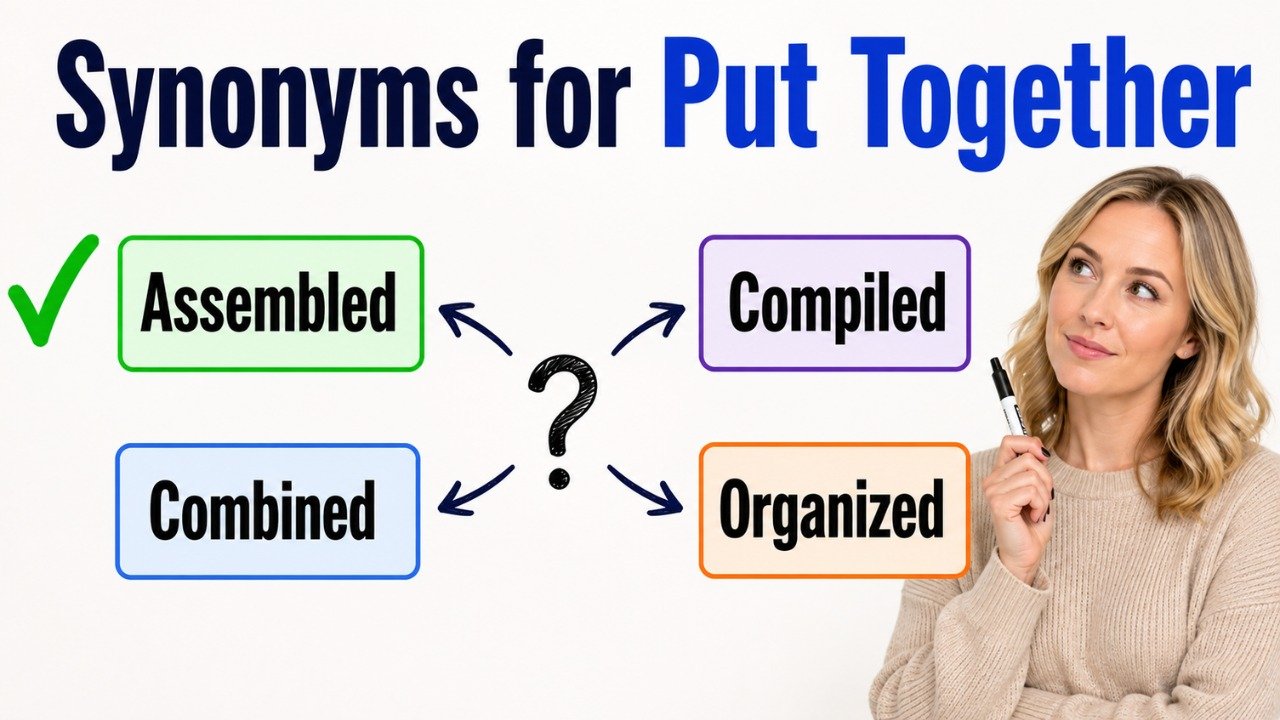
Quick Answer: The best synonyms for put together include assemble, construct, build, create, combine, compile, arrange, organize, prepare, and compose. Use assemble for joining physical parts, construct or build for making a structure, and create for producing something new. Choose compile when collecting information, arrange or organize when placing items in order, and combine when joining separate elements. Prepare works well for plans, meals, or presentations, while compose suits written, musical, or carefully designed material.
Pronunciation and Word Details
Word: Put together.
Pronunciation: /ˌpʊt təˈɡeðər/.
Part of Speech: Phrasal verb.
Meaning: To assemble, create, organize, combine, or understand something by joining separate parts.
US Pronunciation:
UK Pronunciation:
What Does “Put Together” Mean?
Put together means to join separate parts, create something, organize information, prepare materials, or bring people and ideas into one complete form. It is a phrasal verb made from the verb put and the adverb together.
When put together refers to physical objects, it means assembling parts to create a complete item.
Physical Assembly: She put together the new table.
The phrase can also describe creating a plan, report, meal, presentation, or other finished product.
Creation: The team put together a detailed proposal.
Put together may mean organizing people, information, or resources for a particular purpose.
Organization: He put together a group of experienced volunteers.
It can also describe understanding an event by connecting separate clues.
Understanding: The investigator put together what had happened.
In descriptions of appearance, well put together means neat, stylish, organized, or carefully presented.
Appearance: She always looks polished and well put together.
The correct synonym depends on whether the phrase refers to assembly, creation, organization, preparation, combination, understanding, or appearance.
Meaning, Tone, and Context of “Put Together”
Put together has a neutral and conversational tone. It is common in everyday speech, workplace communication, instructions, informal writing, and professional discussions.
Conversational Context: People often use put together when talking about furniture, meals, outfits, events, or plans.
Professional Context: It can describe preparing reports, presentations, teams, budgets, proposals, and schedules.
Creative Context: Put together may refer to producing a design, story, display, video, or performance.
Organizational Context: The phrase can mean arranging information, coordinating people, or gathering resources.
Analytical Context: It can describe reaching an understanding by connecting facts, evidence, or clues.
Appearance Context: Well put together describes someone or something that looks neat, coordinated, and carefully presented.
Formal Context: In academic or technical writing, assemble, compile, construct, formulate, or synthesize may sound more precise than put together.
Because put together has several uses, selecting a specific synonym often makes a sentence clearer and more professional.
When and How to Use “Put Together”
For Assembling Physical Parts
Use put together when separate pieces are joined to make a complete object.
Example: We put together the shelves by following the instructions.
For Creating Something
Use put together when producing a new item, document, plan, or piece of work.
Example: She put together an informative guide for new employees.
For Organizing Information
Use put together when facts, notes, images, or documents are arranged into a useful order.
Example: The researcher put together the results in a clear report.
For Forming a Team
Use put together when selecting and organizing people for a shared purpose.
Example: The manager put together a team of experienced designers.
For Preparing a Plan
Use put together when developing a proposal, schedule, budget, or strategy.
Example: They put together a practical plan for reducing costs.
For Combining Ideas
Use put together when separate ideas or elements are joined into one complete concept.
Example: The writer put together several observations to form a strong argument.
For Preparing Food
Use put together when making a quick meal from available ingredients.
Example: He put together a simple dinner after work.
For Understanding Clues
Use put together when someone connects facts and reaches a conclusion.
Example: She put together the clues and realized who had sent the message.
For Coordinating an Outfit
Use put together when selecting clothing and accessories that work well together.
Example: She put together a comfortable outfit for the event.
For Presenting Something Neatly
Use well put together when a person, design, document, or presentation appears organized and polished.
Example: The final report was clear, professional, and well put together.
Best Synonyms for Put Together
Assemble
Synonym: Assemble means to join separate physical parts or gather people in one place.
Example: The workers assembled the equipment before the event.
Construct
Synonym: Construct means to build something by joining materials or carefully developing its parts.
Example: Engineers constructed a temporary bridge across the river.
Build
Synonym: Build means to create a structure, system, relationship, or organization gradually.
Example: The team built a reliable system for tracking orders.
Create
Synonym: Create means to produce something new through imagination, effort, or planning.
Example: She created a detailed training program.
Combine
Synonym: Combine means to join two or more separate elements into one.
Example: The recipe combines fresh vegetables with mild spices.
Compile
Synonym: Compile means to collect information from several sources and arrange it into one document or collection.
Example: The editor compiled the research into a complete report.
Arrange
Synonym: Arrange means to place things in a particular order or prepare an event or activity.
Example: She arranged the photographs in chronological order.
Organize
Synonym: Organize means to arrange people, information, or activities systematically.
Example: The coordinator organized the materials by subject.
Prepare
Synonym: Prepare means to make something ready for use, presentation, or action.
Example: The committee prepared a proposal for the next meeting.
Compose
Synonym: Compose means to create something by combining words, sounds, images, or other elements.
Example: The student composed a thoughtful response to the question.
50 Synonyms for Put Together with Short Meanings
- Assemble: To join separate parts into a complete object.
- Construct: To build something through planned effort.
- Build: To create a structure, system, or organization.
- Make: To produce or create something.
- Create: To bring something new into existence.
- Form: To shape separate elements into a whole.
- Compose: To create something from several parts.
- Craft: To make something carefully and skillfully.
- Fabricate: To construct something from separate materials.
- Manufacture: To produce goods, often using machines.
- Design: To plan the appearance or structure of something.
- Engineer: To design and develop a practical solution.
- Fashion: To shape or create something carefully.
- Produce: To create or complete something.
- Develop: To create or improve something gradually.
- Devise: To create a plan, method, or solution.
- Formulate: To develop an idea, plan, or explanation carefully.
- Prepare: To make something ready for use.
- Arrange: To place things in a useful or attractive order.
- Organize: To structure people, materials, or information.
- Structure: To arrange parts according to a clear system.
- Configure: To arrange parts for a particular purpose.
- Set Up: To arrange or prepare something for use.
- Lay Out: To arrange elements in a planned position.
- Compile: To collect and arrange information into one work.
- Collate: To gather and organize related information.
- Collect: To bring separate items together.
- Gather: To bring people, objects, or information into one place.
- Combine: To join separate elements into one whole.
- Join: To connect two or more things.
- Unite: To bring separate people or parts together.
- Connect: To link separate objects, ideas, or people.
- Merge: To combine separate elements into one.
- Integrate: To combine parts into a complete and effective system.
- Consolidate: To unite several parts into a stronger whole.
- Synthesize: To combine ideas or information into a new whole.
- Coordinate: To organize separate activities so they work together.
- Group: To place people or items together by type or purpose.
- Bundle: To gather several items into one group.
- Bring Together: To unite people, ideas, or materials.
- Piece Together: To form a whole from separate parts or clues.
- Fit Together: To connect parts that match correctly.
- Assemble the Parts: To join individual pieces into a complete item.
- Put in Order: To arrange things systematically.
- Draft: To prepare an initial version of written material.
- Reconstruct: To rebuild something or determine what happened.
- Infer: To reach a conclusion from available evidence.
- Deduce: To discover an answer through logical reasoning.
- Work Out: To understand, plan, or solve something.
- Cobble Together: To make something quickly from available materials.
Read Also:
Synonyms for Repetition

Synonyms for Put Together by Context
When Put Together Means Assemble an Object
Use these alternatives when separate physical pieces are joined to create a complete item.
Assemble: To join parts according to instructions or a design.
Example: The technicians assembled the machine in the workshop.
Construct: To create a physical structure from materials.
Example: Workers constructed the stage before the performance.
Build: To produce a structure by joining parts gradually.
Example: The family built a small storage unit in the garden.
Fit Together: To connect parts that are shaped to match.
Example: The wooden pieces fit together without nails.
When Put Together Means Create Something
These alternatives work when someone produces a plan, document, product, or creative work.
Create: To bring something new into existence.
Example: The team created a guide for new customers.
Make: To produce something through action or effort.
Example: She made a detailed list of the required materials.
Craft: To create something carefully and skillfully.
Example: The writer crafted a convincing final paragraph.
Produce: To complete or generate a finished result.
Example: The department produced a comprehensive annual report.
When Put Together Means Prepare a Plan
Use these synonyms when developing a strategy, proposal, schedule, budget, or solution.
Devise: To create a clever or practical plan.
Example: The committee devised a strategy for reducing waste.
Formulate: To develop a plan or idea carefully.
Example: Researchers formulated a new explanation for the results.
Prepare: To make a plan or document ready.
Example: The manager prepared a schedule for the coming month.
Develop: To create and improve something over time.
Example: The team developed a plan for expanding the service.
When Put Together Means Organize Information
These alternatives are useful when collecting, arranging, or structuring facts and materials.
Compile: To collect information into one document or collection.
Example: She compiled the survey responses into a report.
Collate: To gather related information and arrange it systematically.
Example: The assistant collated the records by date.
Organize: To place information in a clear and useful order.
Example: He organized the notes into separate categories.
Structure: To arrange ideas so they follow a logical order.
Example: The student structured the essay around three main arguments.
When Put Together Means Combine Elements
Use these alternatives when separate ingredients, ideas, materials, or systems become one.
Combine: To join different elements.
Example: The design combines traditional shapes with modern materials.
Merge: To blend separate elements into one.
Example: The two documents were merged into a single file.
Integrate: To combine parts so they function effectively together.
Example: The organization integrated the new process into its existing system.
Synthesize: To combine ideas or evidence into a new conclusion.
Example: The essay synthesizes information from several studies.
When Put Together Means Form a Group
These alternatives describe selecting, gathering, or organizing people.
Gather: To bring people into one place.
Example: The organizer gathered the volunteers before the event.
Assemble: To bring people together for a particular purpose.
Example: The director assembled a group of experienced advisers.
Form: To establish a group, committee, or team.
Example: The residents formed a committee to discuss the issue.
Bring Together: To unite people with shared interests or goals.
Example: The program brought together students from different regions.
When Put Together Means Coordinate Activities
Use these words when separate tasks, schedules, or responsibilities must work together.
Coordinate: To organize activities so they support one another.
Example: She coordinated the speakers, location, and schedule.
Organize: To plan and control the details of an activity.
Example: The team organized the conference in less than a month.
Arrange: To make practical preparations for something.
Example: He arranged transportation for all participants.
Set Up: To prepare a system, event, or activity.
Example: The staff set up the room before the guests arrived.
When Put Together Means Understand From Clues
These alternatives work when someone forms an explanation by connecting facts or evidence.
Piece Together: To understand something by connecting separate clues.
Example: The police pieced together the events of the previous evening.
Reconstruct: To determine how something happened by examining available information.
Example: Researchers reconstructed the sequence of events.
Infer: To reach a likely conclusion from evidence.
Example: Readers can infer the character’s feelings from her actions.
Deduce: To reach a conclusion through careful reasoning.
Example: The investigator deduced that the door had been opened from inside.
When Put Together Means Create an Outfit
Use these alternatives when clothing, accessories, colors, or styles are selected to create a complete appearance.
Coordinate: To choose items that work well together.
Example: She coordinated the jacket with neutral trousers.
Style: To arrange clothing or appearance in a particular way.
Example: He styled the outfit with simple accessories.
Combine: To use different items together.
Example: She combined a plain dress with a patterned scarf.
Arrange: To select and place elements in a pleasing way.
Example: The designer arranged the display around a soft color palette.
Another Word for Put Together
Assemble is often the best general replacement for put together when joining physical parts. However, the strongest alternative depends on the intended meaning.
Use compile for information, organize for materials or activities, create for producing something new, combine for joining elements, and formulate for developing a plan or argument.
Original: She put together the new desk.
Better Option: She assembled the new desk.
Original: The researcher put together a detailed report.
Better Option: The researcher compiled a detailed report.
Original: The committee put together a practical strategy.
Better Option: The committee formulated a practical strategy.
Original: He put together the volunteers for the event.
Better Option: He organized the volunteers for the event.
When Not to Use “Put Together”
Put together may sound vague or informal when a more exact verb would explain the action clearly.
When Describing Technical Construction
Use assemble, construct, configure, or install when discussing technical equipment or structures.
Weak: The engineers put together the new system.
Better: The engineers configured the new system.
When Discussing Academic Research
Use compile, synthesize, analyze, or collate when describing formal research work.
Weak: The researcher put together information from several studies.
Better: The researcher synthesized information from several studies.
When Writing Formal Instructions
Use assemble, attach, connect, or install to make directions more precise.
Weak: Put together the two sections.
Better: Connect the two sections securely.
When Referring to a Detailed Plan
Use formulate, devise, develop, or prepare in formal writing.
Weak: The committee put together a new policy.
Better: The committee formulated a new policy.
When Explaining Group Formation
Use form, assemble, organize, or recruit when the process matters.
Weak: The director put together a new team.
Better: The director assembled a new team.
When the Phrase Becomes Repetitive
Repeating put together can make writing sound conversational and imprecise.
Weak: She put together the report, put together the images, and put together the presentation.
Better: She compiled the report, arranged the images, and prepared the presentation.
Words Commonly Confused With Put Together
Put Together vs Assemble: Put together is broad and conversational. Assemble usually refers to joining physical parts or gathering people.
Put Together vs Build: Put together may describe quick assembly or preparation. Build often suggests gradual construction, development, or growth.
Put Together vs Create: Put together emphasizes joining existing parts. Create emphasizes producing something new.
Put Together vs Compile: Put together may refer to any kind of preparation. Compile specifically means collecting and organizing information.
Put Together vs Organize: Put together can mean create or assemble. Organize focuses on arranging people, materials, or information systematically.
Put Together vs Combine: Put together may involve planning and arrangement. Combine focuses on joining separate elements.
Put Together vs Piece Together: Put together often means create or assemble. Piece together commonly means reconstructing something from clues or fragments.
Put Together vs Set Up: Put together means assemble or create. Set up usually means prepare something so it is ready to operate or be used.
Which Synonym Should You Choose?
Choose assemble when joining physical parts, furniture, equipment, or machinery.
Choose construct when creating a building, structure, argument, or carefully planned system.
Choose build when developing something gradually, such as a structure, team, business, or relationship.
Choose create when producing an original idea, design, plan, or piece of work.
Choose make for a simple and natural everyday alternative.
Choose craft when emphasizing skill, care, or creativity.
Choose compile when gathering information into a report, book, list, or collection.
Choose collate when arranging records or information systematically.
Choose organize when placing people, activities, or materials into an effective order.
Choose structure when arranging ideas, writing, or systems logically.
Choose formulate when developing a formal plan, policy, theory, or argument.
Choose devise when creating a clever solution, method, or strategy.
Choose combine when joining separate elements while they remain recognizable.
Choose merge when separate elements blend into one.
Choose integrate when parts must function together within a complete system.
Choose synthesize in essays and academic writing when combining evidence or ideas into a new conclusion.
Choose coordinate when organizing schedules, people, clothing, or activities so they work well together.
Choose form when establishing a team, group, committee, or organization.
Choose piece together when connecting clues, facts, or fragments.
Choose reconstruct when rebuilding an object or determining the sequence of past events.
Choose cobble together when something is made quickly from limited materials. This expression is informal and may suggest imperfect quality.
Real Life Examples of “Put Together” in Sentences
Original: We put together the cabinet in less than an hour.
Better Option: We assembled the cabinet in less than an hour.
Original: She put together a report from the survey results.
Better Option: She compiled a report from the survey results.
Original: The manager put together a new project team.
Better Option: The manager formed a new project team.
Original: They put together a plan for improving safety.
Better Option: They devised a plan for improving safety.
Original: He put together several ideas in the final paragraph.
Better Option: He synthesized several ideas in the final paragraph.
Original: The organizer put together the entire event.
Better Option: The organizer coordinated the entire event.
Original: She put together a quick meal from the remaining ingredients.
Better Option: She prepared a quick meal from the remaining ingredients.
Original: Investigators put together the sequence of events.
Better Option: Investigators reconstructed the sequence of events.
Original: The designer put together a balanced layout.
Better Option: The designer created a balanced layout.
Original: She put together a simple but elegant outfit.
Better Option: She coordinated a simple but elegant outfit.
Synonym Groups and Usage Differences
Assembly Group
Assemble, construct, build, fabricate, manufacture, and fit together relate to physical creation.
Assemble means joining prepared parts. Construct and build involve creating a structure. Fabricate and manufacture often describe technical or commercial production.
Example: Workers assembled the prepared sections and constructed the outer frame.
Creation Group
Create, make, craft, fashion, produce, and develop describe producing something new.
Create is broad. Make is conversational. Craft emphasizes care and skill, while develop often describes gradual improvement.
Example: The writer crafted a clear introduction and developed the argument carefully.
Planning Group
Devise, formulate, prepare, draft, design, and engineer relate to creating plans or solutions.
Devise suggests practical invention. Formulate is formal and systematic. Draft refers to an initial written version, while engineer emphasizes technical planning.
Example: The team devised a solution and drafted a plan for introducing it.
Organization Group
Arrange, organize, structure, configure, set up, and lay out describe placing elements in order.
Arrange focuses on position. Organize creates a usable system. Structure gives something a logical form. Configure is common in technical contexts.
Example: She organized the information and structured the report around its main findings.
Collection Group
Compile, collate, collect, and gather describe bringing information or materials together.
Compile creates a complete work from several sources. Collate emphasizes systematic order. Collect and gather are broader terms.
Example: The assistant gathered the records and collated them by date.
Combination Group
Combine, join, unite, connect, merge, integrate, and consolidate describe joining separate elements.
Combine and join are broad. Merge creates one blended whole. Integrate makes parts work together, while consolidate creates a stronger unified form.
Example: The organization merged two departments and integrated their systems.
Reasoning Group
Piece together, reconstruct, infer, deduce, and work out describe understanding information.
Piece together connects clues. Reconstruct explains a past sequence. Infer and deduce describe reaching conclusions from evidence.
Example: The reader can piece together the events and infer the character’s true intention.
Quick Creation Group
Cobble together, throw together, prepare, and make describe creating something quickly.
Cobble together may suggest limited resources or imperfect results. Prepare and make are more neutral.
Example: They cobbled together a temporary shelter from the available materials.
Antonyms of Put Together
The opposite of put together depends on whether the phrase means assemble, organize, combine, or understand.
Disassemble: To separate an object into its individual parts.
Dismantle: To take a structure or system apart.
Take Apart: To separate the pieces of something.
Break Apart: To divide or damage something into separate pieces.
Separate: To move or keep things apart.
Divide: To split something into sections or groups.
Disconnect: To remove a link between two parts.
Detach: To remove one object from another.
Scatter: To spread items in different directions.
Disperse: To cause a group to move apart.
Disorganize: To remove order or structure.
Destroy: To damage something so completely that it no longer exists or works.
Unravel: To separate connected threads or make a situation less organized.
Confuse: To make information difficult to understand.
Fragment: To break something into smaller separate parts.
Comparison: Put Together vs Related Words
Put Together vs Assemble
Put together is conversational and broad. Assemble is more precise when joining physical parts or gathering people.
Example With Put Together: We put together the table after lunch.
Example With Assemble: We assembled the table according to the instructions.
Put Together vs Build
Put together often suggests joining existing parts. Build may involve creating something gradually from materials or developing it over time.
Example With Put Together: She put together a temporary display.
Example With Build: She built a successful design business.
Put Together vs Create
Put together emphasizes combining available elements. Create emphasizes originality and producing something new.
Example With Put Together: He put together a presentation using the available research.
Example With Create: He created an original presentation format.
Put Together vs Compile
Put together can describe many kinds of preparation. Compile specifically means collecting information into one organized work.
Example With Put Together: She put together a list of useful resources.
Example With Compile: She compiled the research findings into a report.
Put Together vs Organize
Put together may mean create, assemble, or prepare. Organize focuses on creating order and structure.
Example With Put Together: They put together the conference in six weeks.
Example With Organize: They organized the conference schedule carefully.
Put Together vs Combine
Put together can involve planning and construction. Combine simply means joining two or more elements.
Example With Put Together: The editor put together the final publication.
Example With Combine: The editor combined the two short articles.
Put Together vs Piece Together
Put together normally means assemble or create. Piece together often means reaching an understanding from clues or incomplete information.
Example With Put Together: She put together a new training guide.
Example With Piece Together: She pieced together what had happened from the witness statements.
Put Together vs Set Up
Put together focuses on assembly or creation. Set up means arranging something so it is ready for use.
Example With Put Together: They put together the equipment.
Example With Set Up: They set up the equipment before the presentation.
Common Phrases and Expressions With “Put Together”
Put Together a Plan: To develop a method for achieving a goal.
Put Together a Team: To select and organize people for a shared purpose.
Put Together a Report: To collect and arrange information in written form.
Put Together a Presentation: To prepare slides, information, and visual material.
Put Together a Budget: To calculate and organize expected income and expenses.
Put Together a Meal: To prepare food, often quickly or simply.
Put Together an Outfit: To select clothing and accessories that work well together.
Put Together the Pieces: To connect information or objects to form a complete whole.
Well Put Together: Neat, attractive, organized, or carefully presented.
Quickly Put Together: Prepared in a short amount of time.
Common Mistakes to Avoid
Using Putted as the Past Tense
The past tense and past participle of put are both put. Putted is not correct for this meaning.
Incorrect: She putted together the report yesterday.
Correct: She put together the report yesterday.
Placing a Pronoun Incorrectly
When the object is a pronoun, it normally appears between put and together.
Incorrect: Please put together it.
Correct: Please put it together.
Using Put Together Too Vaguely
The phrase may not explain whether something was assembled, organized, created, or compiled.
Vague: She put together the information.
Clearer: She compiled the information into a report.
Using Put Together Repeatedly
Repeated use can make writing sound informal and monotonous.
Repetitive: He put together the team, put together the plan, and put together the schedule.
Improved: He formed the team, developed the plan, and organized the schedule.
Choosing Assemble for Abstract Ideas
Assemble usually works best for physical parts, people, or collections. It may sound unnatural for emotions or abstract conclusions.
Unnatural: The writer assembled a sense of hope.
Natural: The writer created a sense of hope.
Confusing Put Together With Piece Together
Put together generally refers to creation or assembly. Piece together often refers to understanding clues or incomplete information.
Incorrect Meaning: The investigator put together a new chair from the clues.
Correct: The investigator pieced together the events from the clues.
Using Cobble Together in Formal Writing
Cobble together is informal and may suggest rushed or imperfect work.
Informal: The committee cobbled together a policy.
Formal: The committee formulated a policy.
Confusing Put Together With Get Together
Put together means assemble, create, or organize. Get together means meet or gather socially.
Incorrect: We will put together at the café tomorrow.
Correct: We will get together at the café tomorrow.
Conclusion
The best synonyms for put together depend on what is being created, organized, combined, or understood. Assemble, construct, and build suit physical objects, while compile and collate work for information. Organize, arrange, and coordinate describe creating order. Formulate and devise are strong choices for plans, while synthesize suits ideas and evidence. Piece together and reconstruct describe understanding events from clues. Choosing the most precise synonyms for put together will make everyday, professional, and academic writing clearer and more natural.
FAQs About Synonyms for Put Together
What Is the Best Synonym for Put Together?
Assemble is the best general synonym when joining physical parts. Create, organize, compile, combine, or prepare may be more accurate in other contexts.
What Is a Formal Synonym for Put Together?
Useful formal alternatives include assemble, construct, compile, formulate, synthesize, organize, coordinate, and prepare.
What Is Another Word for Put Together a Plan?
Develop, devise, formulate, prepare, design, and create are strong alternatives for put together a plan.
What Is a Synonym for Put Together a Team?
Form, assemble, organize, recruit, gather, and bring together can replace put together when creating a team.
What Is Another Word for Put Together Information?
Compile is usually the best choice. Other useful alternatives include collate, organize, structure, collect, and synthesize.
What Does Well Put Together Mean?
Well put together means neat, organized, attractive, polished, or carefully presented. It can describe a person, outfit, report, room, or design.
Is Putted Together Correct?
No. The past tense of put is put. The correct sentence is, “She put together the presentation yesterday.”
