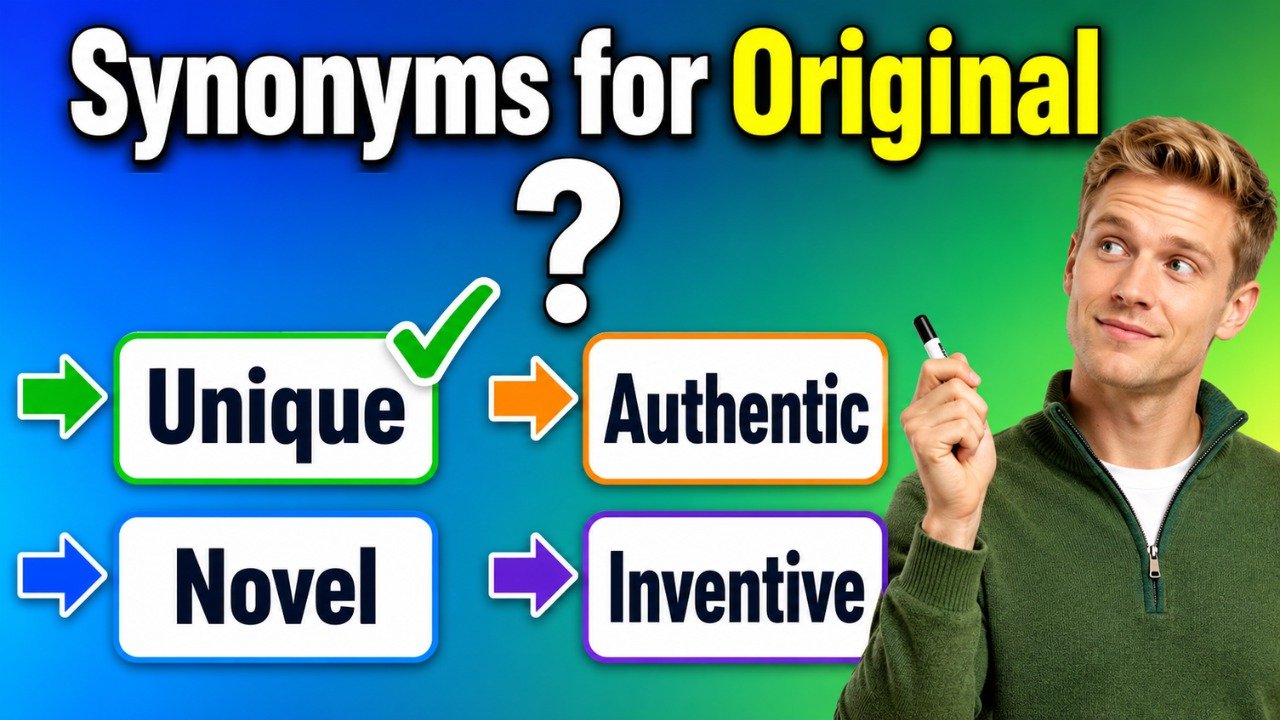
Quick Answer: The best synonyms for original include authentic, genuine, unique, creative, innovative, novel, initial, first, distinctive, and unaltered. Use authentic or genuine when something is real rather than copied. Choose initial or first when referring to the earliest version. Use creative, innovative, or novel for new ideas. Distinctive works when something has a recognizable quality, while unaltered describes something that remains in its first condition.
Pronunciation and Word Details
Word: Original
Pronunciation: /əˈrɪdʒ.ən.əl/
Part of Speech: Adjective and noun
Meaning: Something original is real, first, independently created, or noticeably different from copies and common ideas.
US Pronunciation:
UK Pronunciation:
What Does “Original” Mean?
Original means existing from the beginning, created independently, or not copied from another person or source. It can function as both an adjective and a noun.
As an adjective, original may describe the first form of something. An original document is the first genuine document rather than a later copy. The word can also describe a fresh or creative idea that is different from familiar ideas.
As a noun, an original is the first artwork, document, design, recording, or object from which copies are made.
The word changes slightly according to context. It may describe authenticity, creativity, ownership, history, condition, or the earliest version of something.
Meaning, Tone, and Context of “Original”
Original has a generally positive and neutral tone. It is commonly used in everyday conversation, formal writing, academic discussion, art, design, literature, research, history, business, and product descriptions.
When original means authentic, it emphasizes that something is real and not an imitation. When it means creative, it praises an idea for being fresh, imaginative, and independently developed.
In historical or technical writing, original often refers to the earliest version, source, condition, language, or owner. In creative contexts, it may describe a distinctive style, an inventive concept, or work that does not imitate familiar patterns.
The word can sound complimentary when describing talent or ideas. However, it can also be completely factual, as in “the original document” or “the original building.”
When and How to Use “Original”
For Authenticity: Use original when confirming that an object, document, artwork, or product is genuine rather than copied.
Example: The museum displayed the original painting.
For the First Version: Use original when discussing the earliest form of something before changes were made.
Example: The original plan included a larger garden.
For Creative Ideas: Use original to praise an idea that feels fresh, imaginative, or independently developed.
Example: Her original solution impressed the entire group.
For Creative Work: Use original when a person has created writing, music, art, or design independently.
Example: The collection contains several original poems.
For an Unchanged Condition: Use original when something remains close to the condition it had at the beginning.
Example: The house still has its original wooden doors.
For a Source Item: Use original as a noun when referring to the item from which copies or reproductions were made.
Example: The editor compared the copy with the original.
For a Distinctive Person: Use original to describe someone with unusual ideas, behavior, or personal style.
Example: He was an original thinker with a distinctive approach.
For Historical Ownership: Use original when describing the first owner, creator, location, or purpose.
Example: The original owner built the property as a family home.
Best Synonyms for Original
Authentic
Synonym: Authentic
Meaning: Real, genuine, and not copied or falsely presented.
Example: The expert confirmed that the signature was authentic.
Genuine
Synonym: Genuine
Meaning: Truly what something claims to be.
Example: The shop displayed a genuine handmade sculpture.
Unique
Synonym: Unique
Meaning: Unlike anything else or the only one of its kind.
Example: The designer developed a unique visual style.
Creative
Synonym: Creative
Meaning: Showing imagination and the ability to produce new ideas.
Example: She suggested a creative solution to the problem.
Innovative
Synonym: Innovative
Meaning: Introducing a new and improved method, idea, or design.
Example: The team presented an innovative learning method.
Novel
Synonym: Novel
Meaning: New, unusual, and different from familiar approaches.
Example: The researcher proposed a novel explanation.
Initial
Synonym: Initial
Meaning: Existing or happening at the beginning.
Example: The initial design was simpler than the final version.
First
Synonym: First
Meaning: Earliest in time, order, or development.
Example: The first edition contained a different introduction.
Distinctive
Synonym: Distinctive
Meaning: Having a recognizable quality that makes something different.
Example: The artist is known for a distinctive painting style.
Unaltered
Synonym: Unaltered
Meaning: Remaining unchanged from an earlier condition.
Example: The historic room remains largely unaltered.
50 Synonyms for Original with Short Meanings
- Authentic: Real and not copied or falsely presented.
- Genuine: Truly what something claims to be.
- Real: Existing as a true object, fact, or experience.
- True: Accurate, sincere, or faithful to the actual form.
- Bona Fide: Genuine and made without deception.
- Legitimate: Real, lawful, or properly accepted.
- Actual: Existing in fact rather than being imagined.
- Unaltered: Not changed from the earlier form.
- Unchanged: Remaining in the same condition.
- Intact: Complete and not damaged or modified.
- Pure: Free from additions, mixtures, or imitation.
- Natural: Existing without artificial changes.
- First: Earliest in time, order, or creation.
- Initial: Occurring or existing at the beginning.
- Earliest: Coming before all later versions.
- Primary: First or most important in position.
- Introductory: Belonging to the opening or beginning stage.
- Opening: Appearing at the beginning of something.
- Beginning: Connected with the first stage or form.
- Source: The point or item from which something develops.
- Prototype: The first model used to develop later versions.
- Master: The main version from which copies are produced.
- Archetype: The earliest or most typical model of something.
- Model: An example used as the basis for later versions.
- Root: The basic source or earliest cause.
- Native: Existing naturally or belonging to a place from the beginning.
- Unique: Being the only one of its kind.
- Distinctive: Clearly different and easily recognized.
- Individual: Having personal and separate qualities.
- Singular: Remarkably unusual or unlike others.
- Uncommon: Not frequently seen or experienced.
- Unusual: Different from what is normal or expected.
- One of a Kind: Completely unique and without an exact match.
- Creative: Showing imagination and fresh thinking.
- Inventive: Skilled at creating new ideas or solutions.
- Innovative: Introducing useful new ideas or methods.
- Imaginative: Showing strong creativity and mental vision.
- Ingenious: Cleverly designed or thoughtfully created.
- Inspired: Showing exceptional creativity or imagination.
- Novel: New and different from familiar ideas.
- Fresh: New, lively, and not overused.
- New: Recently created or previously unknown.
- Pioneering: Introducing ideas that others later follow.
- Trailblazing: Developing a new path or approach.
- Groundbreaking: Introducing an important new development.
- Unconventional: Different from traditional methods or expectations.
- Independent: Created without relying heavily on another source.
- Personal: Expressing an individual person’s ideas or character.
- Signature: Strongly connected with a particular creator or style.
- Characteristic: Showing a recognizable and identifying quality.
Read Also:
Synonyms for Mature
Synonyms for Original by Context
When Original Means Authentic
When original means real rather than copied, use authentic, genuine, real, true, bona fide, legitimate, or actual. These words are useful when discussing artwork, documents, signatures, objects, or historical materials.
Authentic emphasizes verified identity or origin. Genuine emphasizes that something is truly what it claims to be. Real is the simplest conversational choice.
Example With Original: The collector purchased an original sculpture.
Example With a Synonym: The collector purchased an authentic sculpture.
Example With Original: Investigators examined the original document.
Example With a Synonym: Investigators examined the genuine document.
When Original Means First or Earliest
When original describes the earliest version, choose first, initial, earliest, primary, opening, beginning, source, or prototype.
Initial is useful for plans, reactions, drafts, and stages. First is simple and direct. Prototype is appropriate for the first working model of a product or design.
Example With Original: The original proposal was rejected.
Example With a Synonym: The initial proposal was rejected.
Example With Original: The original model was made from wood.
Example With a Synonym: The first model was made from wood.
When Original Means Creative
When original praises creativity, use creative, inventive, innovative, imaginative, ingenious, inspired, novel, fresh, or pioneering.
Creative is broad and natural. Innovative often suggests a practical improvement. Novel describes an idea that is noticeably new. Ingenious emphasizes clever problem solving.
Example With Original: She developed an original teaching method.
Example With a Synonym: She developed an innovative teaching method.
Example With Original: His original idea transformed the project.
Example With a Synonym: His inventive idea transformed the project.
When Original Means Unique
When original describes something different from everything else, use unique, distinctive, individual, singular, uncommon, unusual, or one of a kind.
Unique means there is no exact equivalent. Distinctive focuses on recognizable qualities. Individual highlights personal character or style.
Example With Original: The building has an original appearance.
Example With a Synonym: The building has a distinctive appearance.
Example With Original: Her voice is completely original.
Example With a Synonym: Her voice is truly one of a kind.
When Original Means Unchanged
When original describes something that remains in its first condition, use unaltered, unchanged, intact, pure, or natural.
Unaltered means no deliberate changes were made. Intact means all important parts remain complete. Original condition may also be rewritten as initial condition or unchanged condition.
Example With Original: The room remains in its original condition.
Example With a Synonym: The room remains largely unaltered.
Example With Original: Most of the original structure survived.
Example With a Synonym: Most of the structure remained intact.
When Original Means the Source Version
When original refers to the item from which copies are made, use source, master, prototype, archetype, or model.
Master is commonly used for a main copy used to create other versions. Source is useful for documents, texts, images, and information. Prototype describes an early model used for further development.
Example With Original: The publisher safely stored the original.
Example With a Synonym: The publisher safely stored the master copy.
Another Word for Original
Authentic is often the best single replacement for original when the sentence refers to something genuine rather than copied. However, the most accurate alternative depends on whether original means authentic, first, creative, unique, or unchanged.
Original: The gallery displayed the original painting.
Better Option: The gallery displayed the authentic painting.
Original: We returned to the original plan.
Better Option: We returned to the initial plan.
Original: She introduced an original approach to the lesson.
Better Option: She introduced an innovative approach to the lesson.
Original: The apartment still has its original windows.
Better Option: The apartment still has its unaltered windows.
When Not to Use “Original”
Do not use original when the intended meaning is unclear. Readers may not know whether you mean authentic, earliest, creative, unique, or unchanged.
Choose a more specific word when precision matters.
Weak: We reviewed the original idea.
Better: We reviewed the initial idea.
The better sentence makes it clear that the idea was the first version rather than merely creative.
Avoid using original as automatic praise when creative or innovative would communicate the quality more clearly.
Weak: The team presented an original system.
Better: The team presented an innovative system that reduced unnecessary work.
Do not call something unique merely because it is new to you. A new experience is not necessarily original.
Weak: This is an original custom that I have never seen before.
Better: This is an unfamiliar custom that I have never seen before.
Avoid repeating original several times in the same paragraph.
Weak: The original owner kept the original furniture in its original position.
Better: The first owner kept the authentic furniture in its initial position.
Do not use original when genuine is required to distinguish a real item from a counterfeit one.
Weak: The expert confirmed that the watch was original.
Better: The expert confirmed that the watch was genuine.
Words Commonly Confused With Original
Original vs Authentic: Original may mean first, creative, or genuine. Authentic mainly means real and correctly identified. An original painting is the actual work created by the artist. An authentic style may accurately represent a culture, period, or tradition.
Original vs Genuine: Genuine means truly what something claims to be. Original has a broader meaning and may describe the first version or a creative idea. A genuine document is real, while an original document is the first physical document rather than a copy.
Original vs Unique: Original suggests independent creation or freshness. Unique means that something has no exact equivalent. An idea may be original without being completely unique.
Original vs Creative: Creative describes imagination and the ability to produce ideas. Original describes the new or independently developed result. A person can be creative, while a particular idea can be original.
Original vs Innovative: Innovative usually describes a useful new method, product, or improvement. Original is broader and can describe any fresh idea, whether practical or artistic.
Original vs Initial: Initial means first in time or order. Original may mean initial, but it can also mean authentic or creative. The initial plan is the first plan, while an original plan may be both new and imaginative.
Original vs Novel: Novel means new and unusual. Original often suggests independent creation. A novel method is unfamiliar, while an original method may have been created without copying another approach.
Original vs Unaltered: Unaltered specifically means unchanged. Original can describe something from the beginning even when parts have since been modified.
Which Synonym Should You Choose?
Choose authentic when discussing genuine artwork, objects, signatures, traditions, or historical materials.
Choose genuine when confirming that something is real and not falsely presented.
Choose real for simple and casual communication about authenticity.
Choose initial when referring to the first plan, reaction, stage, estimate, or version.
Choose first when you need a direct and easily understood alternative.
Choose prototype for the earliest working model of a product, machine, design, or system.
Choose creative when praising imagination or artistic thinking.
Choose innovative when an idea introduces a useful new method or improvement.
Choose inventive when someone develops clever solutions or devices.
Choose novel when an idea, theory, method, or approach is new and unusual.
Choose unique when something has no exact equivalent.
Choose distinctive when something has recognizable qualities that separate it from others.
Choose unaltered when an object, document, or building remains unchanged.
Choose intact when all important parts remain complete.
Choose source when discussing the first document, text, image, or location from which information comes.
Choose master when referring to the main version used to create copies.
Choose signature when a design, style, method, or quality strongly represents a particular creator.
Real Life Examples of “Original” in Sentences
Original: The original painting is kept in a secure room.
Better Option: The authentic painting is kept in a secure room.
Original: The original plan included three additional rooms.
Better Option: The initial plan included three additional rooms.
Original: She developed an original solution to the scheduling problem.
Better Option: She developed an inventive solution to the scheduling problem.
Original: The restaurant has retained its original design.
Better Option: The restaurant has retained its unaltered design.
Original: His writing style feels original and personal.
Better Option: His writing style feels distinctive and personal.
Original: The original model was difficult to manufacture.
Better Option: The prototype was difficult to manufacture.
Original: Please compare this copy with the original.
Better Option: Please compare this copy with the source document.
Original: The researcher presented an original theory.
Better Option: The researcher presented a novel theory.
Original: Most of the original building remains standing.
Better Option: Most of the initial structure remains intact.
Original: Her original artwork attracted immediate attention.
Better Option: Her unique artwork attracted immediate attention.
Synonym Groups and Usage Differences
Authenticity Group
Authentic, genuine, real, true, bona fide, legitimate, and actual all relate to truth and authenticity.
Authentic often suggests that identity or origin has been verified. Genuine emphasizes the absence of imitation or deception. Real is broader and more conversational.
Example: The specialist confirmed that the manuscript was authentic.
First Version Group
First, initial, earliest, primary, opening, beginning, source, and prototype describe something connected with the beginning.
Initial is suitable for plans, impressions, and stages. Prototype is mainly used for early models. Source identifies the starting material or point of origin.
Example: The initial proposal was significantly different from the final one.
Creativity Group
Creative, inventive, innovative, imaginative, ingenious, inspired, novel, and fresh describe new thinking.
Innovative suggests useful progress. Inventive suggests clever creation. Imaginative emphasizes mental creativity. Inspired suggests unusually strong creative quality.
Example: The architect proposed an imaginative use of the limited space.
Uniqueness Group
Unique, distinctive, individual, singular, uncommon, unusual, and one of a kind describe difference.
Unique is strongest because it suggests there is no exact match. Distinctive means easily recognized. Individual highlights personal qualities.
Example: The room has a distinctive character.
New Development Group
New, pioneering, trailblazing, groundbreaking, unconventional, and novel describe ideas that move beyond familiar approaches.
Groundbreaking suggests an important advance. Pioneering describes work that opens a new field or method. Unconventional simply means different from normal practice.
Example: The discovery introduced a groundbreaking method of analysis.
Unchanged Condition Group
Unaltered, unchanged, intact, pure, and natural describe something that has not been significantly modified.
Unaltered focuses on the absence of change. Intact emphasizes completeness. Pure means free from additions or mixtures.
Example: The document survived in an almost unaltered condition.
Personal Style Group
Independent, personal, signature, characteristic, and individual describe work connected with a particular creator.
Signature is useful for a recognizable style or feature. Personal emphasizes individual expression. Independent suggests that the work was created without copying.
Example: The curved doorway became a signature feature of her designs.
Antonyms of Original
The opposite of original depends on whether the word means authentic, creative, first, or unchanged.
Copy: Something produced to resemble another item.
Imitation: Something made to look like an existing object or style.
Duplicate: An exact or nearly exact additional copy.
Reproduction: A copy of an artwork, document, image, or object.
Counterfeit: A false item made to appear genuine.
Fake: Something falsely presented as real.
Derivative: Strongly based on existing ideas or styles.
Unoriginal: Lacking freshness, imagination, or independent thought.
Conventional: Following familiar or traditional methods.
Ordinary: Common and lacking distinctive qualities.
Altered: Changed from an earlier condition.
Modified: Adjusted or changed in some way.
Revised: Edited or improved after the first version.
Secondary: Coming after or depending on a primary source.
Later: Appearing after the earliest version.
Comparison of Original and Related Words
Original vs Authentic
Original can mean the first version, a genuine item, or a creative idea. Authentic mainly confirms that something is real and correctly identified.
Example With Original: The original letter was written in 1920.
Example With Authentic: Experts confirmed that the letter was authentic.
Original vs Genuine
Original may refer to the first item from which copies were made. Genuine means that something is not fake.
Example With Original: The original sculpture remains in the artist’s studio.
Example With Genuine: The dealer confirmed that the sculpture was genuine.
Original vs Unique
Original suggests freshness or independent creation. Unique means having no exact match.
Example With Original: She proposed an original solution.
Example With Unique: Each handmade bowl has a unique pattern.
Original vs Creative
Original describes a result that is fresh or independently created. Creative describes the imagination behind the result.
Example With Original: The essay presented an original argument.
Example With Creative: The student used a creative method to explain the argument.
Original vs Innovative
Original can describe any fresh idea. Innovative usually refers to a useful new development or improvement.
Example With Original: His original concept attracted attention.
Example With Innovative: His innovative system reduced processing time.
Original vs Initial
Original and initial can both refer to the beginning. Initial is more precise when discussing the first stage, reaction, draft, or version.
Example With Original: The original schedule included five sessions.
Example With Initial: The initial schedule included five sessions.
Original vs Novel
Original emphasizes independent creation. Novel emphasizes that something is new or unusual.
Example With Original: She developed an original interpretation of the poem.
Example With Novel: The study introduced a novel method of collecting information.
Original vs Unaltered
Original may refer to something from the beginning. Unaltered confirms that no changes have been made.
Example With Original: The room contains its original furniture.
Example With Unaltered: The room has remained unaltered for decades.
Common Phrases and Expressions With “Original”
Original Idea: A thought or concept developed independently.
Original Version: The first form before changes or revisions.
Original Copy: The main or first document rather than a duplicate.
Original Work: Creative material produced by its stated creator.
Original Design: A design developed independently rather than copied.
Original Source: The first document, person, place, or material providing information.
Original Condition: The state something had when it was first created or acquired.
Original Owner: The first person who legally possessed something.
Original Language: The language in which a text was first written.
Original Meaning: The earliest or first intended definition.
Common Mistakes to Avoid
A common mistake is using original without making the intended meaning clear. The word may refer to authenticity, creativity, age, condition, or the first version.
Use a more precise synonym when readers could misunderstand the sentence. Initial is clearer for a first plan, authentic is clearer for a genuine object, and innovative is clearer for a useful new method.
Avoid treating original and unique as perfect synonyms. Something can be independently created while still sharing qualities with other work. Unique makes a stronger claim because it suggests no exact equivalent exists.
Do not use original when you simply mean old. An old building may have been heavily modified and may no longer contain its original materials.
Avoid describing every new idea as groundbreaking. Groundbreaking should be reserved for developments that create an important change or advance.
Do not confuse the original with a reproduction. The original is the actual first item, while a reproduction is a later copy.
Avoid unnecessary repetition. Replace repeated uses of original with accurate alternatives such as initial, authentic, source, distinctive, or unaltered.
Conclusion
The best synonyms for original depend on whether you mean genuine, first, creative, unique, or unchanged. Use authentic and genuine for real items, initial and first for early versions, creative and innovative for fresh ideas, and distinctive or unique for noticeable qualities. Unaltered and intact work well when describing original condition, while source, master, and prototype identify foundational versions. Understanding these differences will help you use synonyms for original accurately in conversation, essays, descriptions, reports, and creative writing.
FAQs About Synonyms for Original
What Is the Best Synonym for Original?
Authentic is the best synonym when original means genuine. Initial works for the first version, while creative or innovative works for new ideas.
What Is Another Word for an Original Idea?
Creative idea, innovative concept, novel approach, inventive solution, and fresh perspective are useful alternatives.
Is Unique a Synonym for Original?
Unique can replace original when something is unlike anything else. However, unique makes a stronger claim because it suggests there is no exact equivalent.
What Is a Formal Synonym for Original?
Authentic, initial, primary, innovative, distinctive, unaltered, and source are useful formal alternatives in the correct context.
What Is the Difference Between Original and Authentic?
Original may mean first, creative, or genuine. Authentic mainly means real, correctly identified, and not falsely presented.
What Is the Opposite of Original?
Common opposites include copy, imitation, counterfeit, reproduction, derivative, unoriginal, altered, and revised.
Can Original Describe a Person?
Yes. An original person has unusual ideas, a distinctive personality, or an independent way of thinking.
