
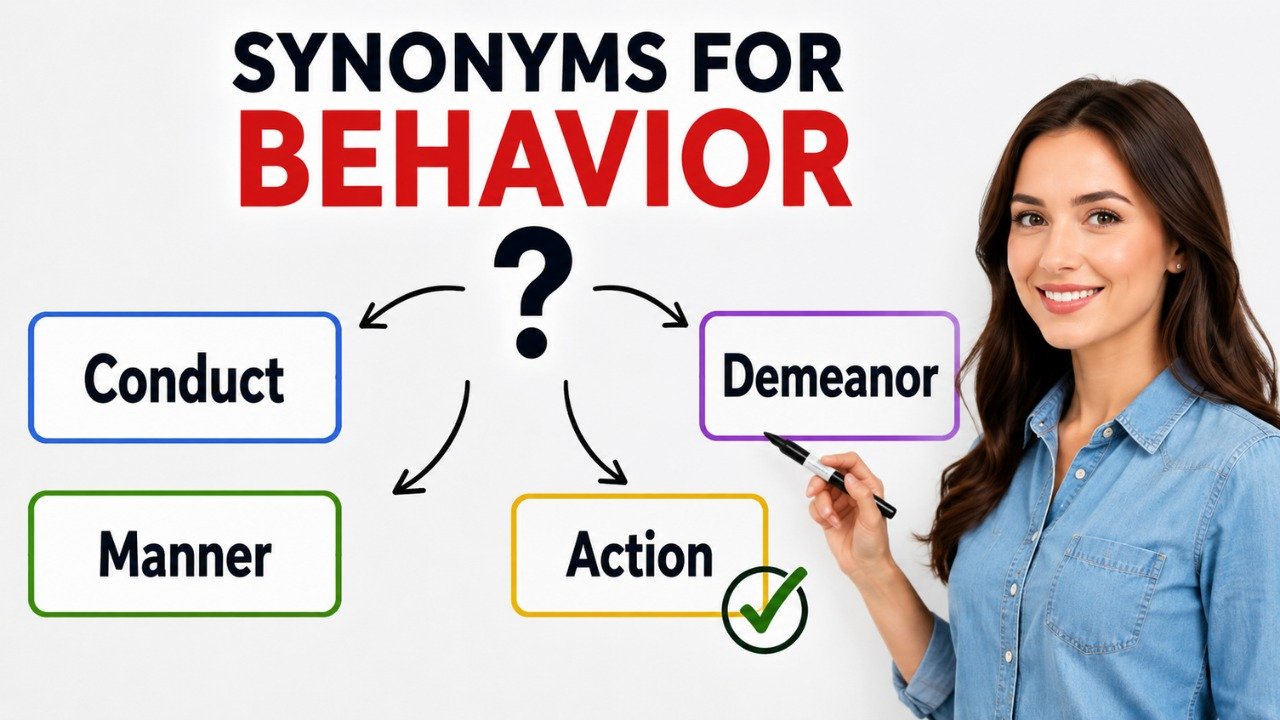
Quick Answer: The best synonyms for behavior include conduct, actions, manner, demeanor, attitude, response, habits, practices, deportment, and performance. Use conduct in formal, academic, legal, or workplace writing. Choose actions when describing what someone actually does and manner for the way a person acts. Demeanor refers to outward appearance and emotional presentation, while attitude describes thoughts or feelings that influence actions. Habits and practices suit repeated behavior, and response is best for behavior caused by a particular event or situation.
Pronunciation and Word Details
Word: Behavior.
Pronunciation: /bɪˈheɪ.vjɚ/
Part of Speech: Noun.
Meaning: The way a person, animal, group, machine, or substance acts or responds in a particular situation.
US Pronunciation:
UK Pronunciation:
What Does “Behavior” Mean?
Behavior means the way someone or something acts, responds, or functions.
Behavior is a noun. It can describe the actions of a person, the conduct of a group, the reactions of an animal, or the way a machine, material, or system operates.
When behavior refers to a person, it may describe visible actions, manners, habits, or reactions.
Example: The teacher praised the student’s respectful behavior.
When behavior refers to an animal, it describes natural, learned, or trained actions.
Example: The researchers observed the feeding behavior of the birds.
The word can also describe the way a material, machine, computer system, market, or scientific process functions under certain conditions.
Example: The engineers studied the behavior of the material under pressure.
Behavior may refer to one specific action, but it often describes a pattern of actions over time.
Specific Action: His behavior during the meeting surprised everyone.
Repeated Pattern: Her calm behavior helps others feel comfortable.
In formal writing, behavior is often used when discussing psychology, education, science, management, health, sociology, and animal studies.
In everyday conversation, it commonly refers to whether someone is acting politely, responsibly, strangely, or inappropriately.
Meaning, Tone, and Context of “Behavior”
Behavior usually has a neutral tone. The surrounding words determine whether it expresses approval, criticism, concern, or simple observation.
Neutral Tone: The report examined customer behavior.
Positive Tone: Her thoughtful behavior made the new student feel welcome.
Negative Tone: His disruptive behavior affected the entire class.
Concerned Tone: The sudden change in behavior worried her family.
Behavior can sound formal in academic, scientific, educational, psychological, or professional contexts.
Academic Context: Researchers examined how stress influences human behavior.
Scientific Context: Temperature affects the behavior of certain materials.
Professional Context: Employees are expected to follow clear standards of behavior.
The word is also common in ordinary speech.
Conversational Context: I do not understand his behavior today.
Behavior can refer to actions without explaining the thoughts or emotions behind them. A person may appear calm while feeling anxious, so visible behavior does not always reveal internal feelings.
The word may also refer to expected standards. Phrases such as good behavior, professional behavior, and acceptable behavior suggest that actions are being judged according to rules or social expectations.
Polite Context: Her courteous behavior impressed the guests.
Critical Context: The manager addressed the employee’s inappropriate behavior.
Technical Context: The program showed unexpected behavior after the update.
In psychology and education, behavior often refers to actions that can be observed and measured. In sociology, it may describe how people act within groups and communities. In science, it can describe how substances, organisms, or systems respond to changing conditions.
When and How to Use “Behavior”
For Personal Conduct
Use behavior when describing how a person acts in a particular situation.
Example: His behavior at the ceremony was respectful.
The word may refer to one event or to a general pattern of conduct.
For Social Manners
Use behavior when discussing politeness, courtesy, respect, or social expectations.
Example: Good behavior includes listening when another person is speaking.
Manners or etiquette may be more specific when the focus is politeness.
For Repeated Actions
Use behavior when actions occur regularly and form a recognizable pattern.
Example: Her habit of checking every detail became part of her working behavior.
Habits, tendencies, or practices may offer greater precision.
For Emotional Reactions
Use behavior when feelings influence visible actions.
Example: His quiet behavior suggested that he was uncomfortable.
Demeanor may be better when describing outward appearance, while reaction may suit one immediate response.
For Children and Students
Use behavior when evaluating conduct in a home, school, or learning environment.
Example: The teacher discussed the child’s classroom behavior with the parents.
Conduct is more formal, while manners may focus specifically on politeness.
For Workplace Actions
Use behavior when discussing professional conduct, cooperation, communication, and responsibility.
Example: Respectful workplace behavior creates a healthier environment.
Professional conduct is a strong formal alternative.
For Group Activity
Use behavior when explaining how members of a group act collectively.
Example: The researchers studied crowd behavior during emergencies.
Collective action or group conduct may provide more detail.
For Animal Actions
Use behavior when describing natural, learned, social, feeding, hunting, or protective actions in animals.
Example: The scientist recorded the nesting behavior of the birds.
Behavior is the standard general term in this context.
For Scientific Processes
Use behavior when explaining how a material, substance, organism, or physical system responds to conditions.
Example: The experiment revealed the behavior of the gas at low temperatures.
Response, activity, or functioning may work in more specific sentences.
For Machines and Technology
Use behavior when a device, system, or program operates in a particular way.
Example: The technician investigated the unusual behavior of the machine.
Performance or functioning may be clearer when discussing speed, reliability, or efficiency.
For Markets and Consumers
Use behavior when studying choices, purchasing patterns, reactions, and decision making.
Example: The survey examined consumer behavior during periods of rising prices.
Habits, preferences, and purchasing patterns may be more specific alternatives.
For Rules and Discipline
Use behavior when evaluating whether someone follows expectations or instructions.
Example: The coach introduced rules for acceptable team behavior.
Conduct, discipline, and compliance may fit formal policies.
Best Synonyms for Behavior
Conduct
Synonym: The way a person behaves, especially in a formal, professional, moral, or public setting.
Example: The organization expects professional conduct from every employee.
Conduct is one of the strongest synonyms for behavior. It is especially useful in workplace policies, academic writing, legal discussions, and formal reports.
Actions
Synonym: Things that a person or group does.
Example: Her actions showed that she cared about the community.
Actions is clear and direct. It focuses on actual deeds rather than general character or attitude.
Manner
Synonym: The particular way in which someone acts, speaks, or completes an activity.
Example: His calm manner helped reduce the tension.
Manner often describes style, tone, or the way an action is performed.
Demeanor
Synonym: A person’s outward appearance, expression, and visible way of behaving.
Example: Her confident demeanor reassured the nervous team.
Demeanor is useful when describing how someone appears emotionally or socially.
Attitude
Synonym: A way of thinking or feeling that influences behavior.
Example: His positive attitude improved his approach to the task.
Attitude is related to behavior but is not identical. It describes an internal viewpoint that may shape visible actions.
Response
Synonym: An action or reaction caused by an event, question, feeling, or situation.
Example: Her calm response prevented the disagreement from becoming worse.
Response is best when behavior occurs because of a specific cause.
Habits
Synonym: Actions that a person performs regularly, often without conscious thought.
Example: Healthy study habits can improve concentration.
Habits describe repeated behavior rather than one isolated action.
Practices
Synonym: Regular or accepted ways of doing something.
Example: The office introduced safer working practices.
Practices is common in professional, educational, cultural, and organizational contexts.
Deportment
Synonym: The way a person carries and conducts themselves, especially in a formal setting.
Example: The student’s excellent deportment was recognized at the ceremony.
Deportment is formal and less common in everyday conversation.
Performance
Synonym: The way a person, machine, organization, or system carries out a task.
Example: The manager reviewed the employee’s performance.
Performance is suitable when behavior is connected to ability, results, or effectiveness.
50 Synonyms for Behavior with Short Meanings
- Conduct: The way a person acts, especially in formal situations.
- Actions: Things that a person, group, or organization does.
- Manner: The particular way someone acts or speaks.
- Manners: Socially accepted ways of behaving politely.
- Demeanor: A person’s outward appearance and visible conduct.
- Attitude: A way of thinking or feeling that affects actions.
- Response: An action caused by a particular situation.
- Reaction: An immediate action or feeling caused by an event.
- Habits: Actions repeated regularly over time.
- Practices: Usual or accepted ways of doing things.
- Deportment: Formal conduct and the way a person carries themselves.
- Comportment: A person’s manner of behaving or presenting themselves.
- Bearing: The way someone stands, moves, or presents themselves.
- Performance: The way someone or something completes a task.
- Functioning: The way a person, system, or machine operates.
- Activity: Actions or processes taking place.
- Interaction: The way people, animals, or systems act toward one another.
- Treatment: The way someone behaves toward another person.
- Approach: A particular way of handling a situation.
- Style: A recognizable way of acting or doing something.
- Way: A general method or manner of acting.
- Pattern: A repeated or recognizable form of action.
- Routine: A regular sequence of actions.
- Tendencies: Usual directions or patterns in someone’s actions.
- Disposition: A person’s usual emotional nature or tendency.
- Character: The qualities that influence how a person acts.
- Temperament: A person’s natural emotional style.
- Etiquette: Accepted rules for polite social behavior.
- Civility: Polite and respectful conduct.
- Courtesy: Behavior that shows politeness and consideration.
- Decorum: Proper and respectful behavior in a formal setting.
- Discipline: Controlled behavior that follows rules or standards.
- Obedience: Behavior that follows instructions or authority.
- Cooperation: Behavior involving helpful joint action.
- Engagement: Active attention, interest, or participation.
- Participation: The act of taking part in an activity.
- Expression: The outward display of thoughts or feelings.
- Communication: Behavior used to share information or emotion.
- Body Language: Physical movements that communicate feelings or intentions.
- Conduct Pattern: A repeated way of acting.
- Behavioral Pattern: A recognizable sequence of actions or reactions.
- Social Conduct: Behavior toward other people in social settings.
- Personal Conduct: The way an individual chooses to act.
- Professional Conduct: Behavior expected in a workplace or profession.
- Classroom Conduct: The way a student acts in a learning environment.
- Workplace Conduct: Behavior shown while performing professional duties.
- Response Pattern: A repeated way of reacting to similar situations.
- Mode of Action: A particular method of acting or operating.
- Way of Acting: The manner in which someone behaves.
- Way of Responding: The manner in which someone reacts to events.
Read Also:
Synonyms for Original
Synonyms for Behavior by Context
When Behavior Means General Conduct
Conduct, actions, way of acting, personal conduct, and manner are useful general alternatives.
Conduct: Best for formal descriptions of how a person behaves.
Example: The committee reviewed the official’s conduct.
Actions: Best when discussing specific things someone did.
Example: Her actions demonstrated honesty and courage.
Manner: Best when emphasizing the way an action was performed.
Example: His polite manner made the conversation easier.
Way of Acting: Best for simple explanations in everyday language.
Example: Her way of acting changed after the disagreement.
When Behavior Means Social Manners
Manners, etiquette, civility, courtesy, decorum, and social conduct fit situations involving politeness and social expectations.
Manners: Describes polite or impolite social habits.
Example: The children were taught good manners at home.
Etiquette: Refers to accepted rules for behavior in particular social settings.
Example: Formal dining etiquette requires consideration for other guests.
Civility: Emphasizes respectful conduct during disagreement or discussion.
Example: The debate continued with patience and civility.
Courtesy: Refers to polite actions that show respect for others.
Example: She treated every visitor with courtesy.
Decorum: Describes proper behavior in serious or formal settings.
Example: The chairperson asked everyone to maintain decorum.
When Behavior Means Outward Appearance
Demeanor, bearing, deportment, comportment, body language, and expression describe how behavior appears to others.
Demeanor: Combines facial expression, tone, and visible conduct.
Example: His relaxed demeanor helped the patient feel comfortable.
Bearing: Focuses on posture, movement, and physical presence.
Example: Her confident bearing attracted attention.
Deportment: Refers to formal conduct and physical presentation.
Example: The students were evaluated on discipline and deportment.
Body Language: Describes gestures, posture, and movement that communicate emotion.
Example: His body language suggested that he felt uncertain.
Expression: Focuses on the outward display of thoughts or feelings.
Example: Her expression revealed surprise.
When Behavior Means Attitude or Personality
Attitude, disposition, temperament, character, and tendencies describe internal qualities that influence actions.
Attitude: Best for a person’s viewpoint or emotional position.
Example: His cooperative attitude helped the group finish early.
Disposition: Describes a person’s usual emotional nature.
Example: She has a calm and patient disposition.
Temperament: Refers to natural emotional patterns and reactions.
Example: The child has an energetic temperament.
Character: Describes moral and personal qualities shown through actions.
Example: His honest behavior reflected strong character.
Tendencies: Refers to actions or reactions that someone is likely to repeat.
Example: The report identified several concerning tendencies.
These words are related to behavior, but they often explain what may influence it rather than describing the action itself.
When Behavior Means a Reaction
Response, reaction, response pattern, expression, and interaction are useful when behavior follows a particular event.
Response: Best for a considered or observable action after something happens.
Example: Her response to criticism was calm and professional.
Reaction: Often describes a more immediate emotional or physical result.
Example: His first reaction was surprise.
Response Pattern: Describes repeated reactions to similar situations.
Example: The counselor noticed a consistent response pattern.
Expression: Shows how a feeling appears outwardly.
Example: His expression changed when he heard the result.
When Behavior Means Repeated Habits
Habits, practices, routine, pattern, behavioral pattern, and conduct pattern describe repeated actions.
Habits: Best for personal actions performed regularly.
Example: Her reading habits developed at an early age.
Practices: Suitable for professional, cultural, or organized methods.
Example: The company improved its safety practices.
Routine: Describes a regular sequence of actions.
Example: Exercise became part of his morning routine.
Pattern: Refers to repeated actions that form a recognizable structure.
Example: The teacher noticed a pattern of late arrivals.
Behavioral Pattern: A formal phrase used for recurring behavior.
Example: The study examined behavioral patterns among young children.
When Behavior Means Professional Conduct
Professional conduct, workplace conduct, performance, practices, discipline, and cooperation suit employment settings.
Professional Conduct: Describes behavior that meets workplace or ethical standards.
Example: Professional conduct requires honesty and respect.
Workplace Conduct: Refers to actions within an employment environment.
Example: The policy explains acceptable workplace conduct.
Performance: Focuses on how effectively duties are completed.
Example: Her performance improved after additional training.
Practices: Describes usual working methods.
Example: Responsible working practices reduce mistakes.
Cooperation: Emphasizes working effectively with others.
Example: Cooperation between departments improved the final result.
When Behavior Means Student Conduct
Classroom conduct, discipline, participation, engagement, obedience, and manners are useful in educational contexts.
Classroom Conduct: Describes how students act during lessons.
Example: The student’s classroom conduct improved significantly.
Discipline: Refers to controlled action and respect for rules.
Example: Good discipline helps maintain a productive learning environment.
Participation: Describes involvement in activities or discussions.
Example: Her active participation strengthened the class discussion.
Engagement: Refers to interest, attention, and involvement.
Example: Student engagement increased during the practical activity.
Obedience: Describes following instructions or authority.
Example: Obedience alone does not always show genuine understanding.
When Behavior Means Interaction With Others
Interaction, treatment, communication, cooperation, civility, and social conduct describe actions toward other people.
Interaction: Best for two way social or professional contact.
Example: Their friendly interaction created a positive atmosphere.
Treatment: Focuses on how one person acts toward another.
Example: His respectful treatment of junior employees earned trust.
Communication: Includes spoken, written, and nonverbal behavior.
Example: Clear communication reduced confusion.
Cooperation: Describes helpful joint behavior.
Example: The project required cooperation from every department.
When Behavior Refers to Animals
Activity, response, reaction, habits, interaction, and behavioral pattern fit animal contexts.
Activity: Describes observable movement or action.
Example: The researchers recorded the animals’ nighttime activity.
Response: Describes an action caused by a sound, object, animal, or environmental change.
Example: The dog’s response to the unfamiliar sound was immediate.
Habits: Describes regular feeding, sleeping, or nesting behavior.
Example: Seasonal changes affected the birds’ feeding habits.
Interaction: Refers to behavior between animals or between animals and humans.
Example: The study examined interaction within the group.
Behavioral Pattern: Describes repeated and observable animal actions.
Example: The scientists identified a new behavioral pattern.
When Behavior Refers to Machines or Systems
Functioning, performance, activity, response, and mode of action are useful technical alternatives.
Functioning: Describes whether a machine or system operates correctly.
Example: The technician checked the functioning of the motor.
Performance: Focuses on speed, reliability, efficiency, or results.
Example: The test measured the performance of the new system.
Response: Describes how a system reacts to input or changing conditions.
Example: The program’s response became slower as demand increased.
Activity: Refers to processes taking place within a system.
Example: The monitor detected unusual network activity.
Mode of Action: Describes the method through which something operates.
Example: The researchers examined the substance’s mode of action.
When Behavior Refers to Scientific Materials
Response, functioning, activity, properties, and performance may replace behavior when discussing substances or materials.
Response: Best when a material changes because of heat, pressure, or another condition.
Example: The material’s response to heat was carefully measured.
Performance: Best when evaluating how well a material works.
Example: The test compared the performance of several materials.
Activity: Useful when discussing chemical or biological processes.
Example: The scientists measured the activity of the compound.
Functioning: Suitable when describing the operation of a biological or mechanical system.
Example: The study examined the functioning of the cell membrane.
Another Word for Behavior
Conduct is usually the best single replacement for behavior in formal writing. Both words describe how a person acts, especially in public, professional, academic, or social settings.
However, the best alternative depends on the intended meaning. Use actions for specific deeds, demeanor for outward presentation, manners for politeness, response for a reaction, and habits for repeated actions.
Original: The manager praised her professional behavior.
Better Option: The manager praised her professional conduct.
Original: His behavior showed that he was willing to help.
Better Option: His actions showed that he was willing to help.
Original: Her calm behavior reassured the visitors.
Better Option: Her calm demeanor reassured the visitors.
Original: The child’s behavior at the table was polite.
Better Option: The child’s manners at the table were polite.
When Not to Use “Behavior”
When Referring to a Specific Action
Behavior may sound too broad when one exact action is being discussed.
Weak: His behavior was to close the door before leaving.
Better: His action was to close the door before leaving.
When Describing Internal Thoughts
Behavior refers mainly to visible actions. Use attitude, belief, opinion, or feeling for internal states.
Weak: Her behavior toward the proposal was negative before she spoke.
Better: Her attitude toward the proposal was negative before she spoke.
When Describing Physical Appearance Alone
Use appearance, expression, posture, or body language when no action is involved.
Weak: His behavior looked tired.
Better: His appearance looked tired.
When Discussing Politeness Specifically
Manners, courtesy, or etiquette may be more precise.
Weak: The child showed good behavior by saying thank you.
Better: The child showed good manners by saying thank you.
When Evaluating Work Results
Performance is more accurate when discussing productivity, skill, speed, or quality.
Weak: The machine’s behavior improved after repair.
Better: The machine’s performance improved after repair.
When Describing a Single Immediate Reaction
Reaction or response is often clearer.
Weak: Her behavior to the announcement was surprise.
Better: Her reaction to the announcement was surprise.
When Describing a Permanent Personality Trait
Use character, temperament, or disposition when discussing lasting personal qualities.
Weak: Patience is part of her behavior.
Better: Patience is part of her character.
When the Sentence Is Too Vague
Behavior can hide the exact action that matters.
Weak: The employee’s behavior caused concern.
Better: The employee’s repeated refusal to follow safety instructions caused concern.
When Writing Technical Instructions
Functioning, response, or performance may sound more precise than behavior.
Weak: Observe the behavior of the device after restarting it.
Better: Observe the functioning of the device after restarting it.
When Behavior Sounds Repetitive
Use a suitable synonym when behavior appears several times in one paragraph.
Weak: The report examined student behavior and explained how behavior affected learning behavior.
Better: The report examined student conduct and explained how repeated actions affected learning.
Words Commonly Confused With Behavior
Behavior vs Conduct: Behavior is a broad word for actions or responses. Conduct usually refers to behavior judged according to formal, moral, professional, or social standards.
Behavior vs Attitude: Behavior is what someone does. Attitude is how someone thinks or feels about a person, subject, or situation.
Behavior vs Character: Behavior may change from one situation to another. Character refers to deeper personal and moral qualities.
Behavior vs Personality: Behavior describes observable actions. Personality includes lasting emotional, social, and mental qualities.
Behavior vs Manners: Behavior covers all types of action. Manners specifically concern politeness and accepted social customs.
Behavior vs Habits: Behavior may be a single action or a pattern. Habits are actions repeated regularly.
Behavior vs Reaction: Behavior is broad and may occur without an obvious trigger. A reaction is caused by a particular event or stimulus.
Behavior vs Response: Behavior includes many types of action. A response is an action or answer produced by a specific situation.
Behavior vs Demeanor: Behavior includes what a person does. Demeanor describes the outward impression created by expression, posture, tone, and visible conduct.
Behavior vs Temperament: Behavior is observable. Temperament is a natural emotional tendency that influences reactions.
Behavior vs Performance: Behavior describes actions generally. Performance focuses on how successfully a task or function is completed.
Behavior vs Etiquette: Behavior includes any action. Etiquette refers to rules and customs for polite conduct in a particular setting.
Which Synonym Should You Choose?
Choose conduct for formal writing about workplace standards, ethics, rules, public actions, or professional expectations.
Choose actions when you want to identify specific things a person, group, or organization did.
Choose manner when describing the way someone speaks, moves, works, or handles a situation.
Choose manners when the focus is politeness, courtesy, or social expectations.
Choose demeanor when describing a person’s outward emotional appearance.
Choose attitude when referring to thoughts or feelings that influence actions.
Choose response for a considered action caused by a question, event, or situation.
Choose reaction for an immediate emotional, physical, or mental result.
Choose habits when describing actions repeated regularly by an individual.
Choose practices when discussing established methods within a workplace, culture, institution, or profession.
Choose deportment for formal writing about posture, presentation, and conduct.
Choose bearing when describing posture, movement, confidence, or physical presence.
Choose etiquette for accepted social rules in formal or cultural settings.
Choose civility when emphasizing respect and politeness during discussion or disagreement.
Choose decorum when describing proper behavior in a serious or formal environment.
Choose discipline when the focus is controlled conduct and respect for rules.
Choose cooperation when several people or groups work together helpfully.
Choose interaction when describing actions between people, animals, or systems.
Choose treatment when explaining how someone acts toward another person.
Choose performance when discussing ability, productivity, efficiency, or results.
Choose functioning when explaining how a machine, system, organ, or process operates.
Choose activity when observing movement or processes without judging them.
Choose behavioral pattern for academic, psychological, or scientific writing about repeated actions.
Choose classroom conduct for student behavior during lessons.
Choose workplace conduct for actions within a professional environment.
Choose social conduct for behavior toward others in community or social settings.
Real Life Examples of “Behavior” in Sentences
Original: The teacher praised the student’s good behavior.
Better Option: The teacher praised the student’s respectful conduct.
Original: His behavior during the meeting surprised the entire team.
Better Option: His actions during the meeting surprised the entire team.
Original: Her calm behavior helped everyone relax.
Better Option: Her calm demeanor helped everyone relax.
Original: The child’s behavior at dinner was polite.
Better Option: The child’s manners at dinner were polite.
Original: His behavior toward criticism became defensive.
Better Option: His response to criticism became defensive.
Original: The researcher studied the animal’s behavior at night.
Better Option: The researcher studied the animal’s nighttime activity.
Original: The manager discussed her behavior at work.
Better Option: The manager discussed her workplace conduct.
Original: The machine showed unusual behavior during the test.
Better Option: The machine showed unusual functioning during the test.
Original: Repeated behavior can become difficult to change.
Better Option: Repeated habits can become difficult to change.
Original: Their friendly behavior created a welcoming environment.
Better Option: Their friendly interaction created a welcoming environment.
Synonym Groups and Usage Differences
General Action Group
Conduct, actions, manner, way, approach, and style belong to this group.
Conduct is formal and often involves standards. Actions refers to specific deeds. Manner describes how something is done. Approach explains how a person handles a situation.
Example: Her thoughtful approach and respectful conduct improved the discussion.
Social Manners Group
Manners, etiquette, civility, courtesy, decorum, and social conduct describe behavior in relation to social rules.
Manners is the most conversational option. Etiquette refers to accepted customs. Civility emphasizes respectful interaction. Decorum suits serious settings.
Example: The guests showed courtesy and observed the expected etiquette.
Outward Presentation Group
Demeanor, deportment, comportment, bearing, expression, and body language describe the visible side of behavior.
Demeanor combines facial expression, tone, and manner. Bearing emphasizes posture and physical presence. Body language communicates feelings without words.
Example: Her confident bearing and calm demeanor impressed the interviewers.
Internal Influence Group
Attitude, disposition, temperament, character, and tendencies describe qualities that influence behavior.
Attitude may change quickly. Disposition and temperament are more stable. Character includes moral qualities. Tendencies describe likely patterns.
Example: His patient disposition influenced the way he handled conflict.
Reaction Group
Response, reaction, expression, and response pattern describe actions caused by events or conditions.
Response may be considered and controlled. Reaction is often immediate. A response pattern develops when similar reactions occur repeatedly.
Example: Her immediate reaction was fear, but her later response was calm.
Repeated Action Group
Habits, practices, routine, pattern, conduct pattern, and behavioral pattern refer to recurring behavior.
Habits are personal and repeated. Practices are often organized or professional. Routine follows a regular order. Pattern describes repeated actions that can be recognized.
Example: The counselor helped him recognize an unhealthy behavioral pattern.
Professional Group
Professional conduct, workplace conduct, performance, discipline, cooperation, and practices fit employment settings.
Conduct concerns standards and ethics. Performance concerns results. Cooperation describes teamwork. Practices refer to accepted working methods.
Example: Strong performance should be supported by responsible professional conduct.
Educational Group
Classroom conduct, participation, engagement, discipline, obedience, and manners describe student behavior.
Participation means taking part. Engagement includes attention and interest. Discipline involves control and respect for rules.
Example: The teacher noticed greater engagement and improved classroom conduct.
Interaction Group
Interaction, communication, treatment, cooperation, courtesy, and civility describe how people act toward one another.
Treatment focuses on how one person behaves toward another. Communication includes verbal and nonverbal actions. Cooperation emphasizes shared effort.
Example: Respectful communication improved interaction between the two groups.
Technical Group
Functioning, performance, activity, response, and mode of action describe the behavior of machines, materials, substances, and systems.
Functioning explains operation. Performance evaluates effectiveness. Response explains what happens after a condition changes.
Example: The engineers measured the system’s response and overall performance.
Antonyms of Behavior
Behavior does not have one direct opposite because it is a general word for action. Its antonyms depend on whether the context refers to good conduct, activity, cooperation, order, or politeness.
Misbehavior: Conduct that breaks rules or accepted standards.
Misconduct: Improper, unethical, or unacceptable behavior.
Inaction: The absence of action when action is possible or expected.
Passivity: A lack of active response or participation.
Disobedience: Refusal to follow instructions or authority.
Noncompliance: Failure to follow a rule, request, or standard.
Disorder: A lack of control, organization, or proper conduct.
Indiscipline: A lack of controlled behavior or respect for rules.
Rudeness: Impolite or disrespectful conduct.
Discourtesy: Behavior that lacks politeness or consideration.
Hostility: Unfriendly, aggressive, or opposing conduct.
Aggression: Forceful or harmful behavior toward others.
Withdrawal: Avoidance of interaction or participation.
Uncooperativeness: Refusal or unwillingness to work with others.
Impropriety: Behavior that is unsuitable or socially unacceptable.
Comparison: Behavior vs Related Words
Behavior vs Conduct
Behavior is a broad term for actions and responses. Conduct is more formal and often suggests that actions are being judged according to rules or standards.
Example With Behavior: The teacher observed the student’s behavior during group work.
Example With Conduct: The school reviewed the student’s conduct after the complaint.
Behavior vs Actions
Behavior may describe a general pattern. Actions usually refer to specific things someone did.
Example With Behavior: Her behavior changed after the meeting.
Example With Actions: Her actions helped resolve the problem.
Behavior vs Manner
Behavior describes what someone does. Manner describes the way the person does it.
Example With Behavior: His behavior was respectful.
Example With Manner: He answered in a respectful manner.
Behavior vs Manners
Behavior includes every kind of action. Manners are habits and customs connected to politeness.
Example With Behavior: The child’s behavior improved during the lesson.
Example With Manners: The child showed good manners at the table.
Behavior vs Demeanor
Behavior includes actions and responses. Demeanor describes the outward impression created by someone’s expression, tone, posture, and manner.
Example With Behavior: Her behavior remained professional throughout the discussion.
Example With Demeanor: Her calm demeanor reassured the group.
Behavior vs Attitude
Behavior is visible action. Attitude is a thought or feeling that may influence action.
Example With Behavior: His behavior toward the new employee was helpful.
Example With Attitude: His positive attitude made him willing to help.
Behavior vs Character
Behavior can change according to the situation. Character refers to deeper qualities that guide choices and actions.
Example With Behavior: Returning the lost wallet was responsible behavior.
Example With Character: Returning the lost wallet showed honest character.
Behavior vs Personality
Behavior is what a person does. Personality is the broader combination of emotional, mental, and social qualities that make a person distinctive.
Example With Behavior: Her behavior became quiet in the unfamiliar room.
Example With Personality: She has a naturally outgoing personality.
Behavior vs Habits
Behavior may happen once or repeatedly. Habits are actions performed regularly.
Example With Behavior: His behavior during the interview was confident.
Example With Habits: His study habits helped him prepare effectively.
Behavior vs Reaction
Behavior is broad and may not have an obvious cause. A reaction is an immediate result of an event or stimulus.
Example With Behavior: The animal’s behavior changed throughout the day.
Example With Reaction: The animal’s reaction to the loud noise was immediate.
Behavior vs Response
Behavior includes many actions. A response is an action, answer, or change caused by something specific.
Example With Behavior: The program displayed unusual behavior.
Example With Response: The program’s response to the command was delayed.
Behavior vs Performance
Behavior describes how someone or something acts. Performance describes how well a task or function is completed.
Example With Behavior: The employee’s behavior toward colleagues was respectful.
Example With Performance: The employee’s performance exceeded expectations.
Common Phrases and Expressions With “Behavior”
Good Behavior: Actions that follow rules and accepted standards.
Example: The child received praise for good behavior.
Bad Behavior: Actions that are disruptive, harmful, rude, or unacceptable.
Example: The coach addressed the player’s bad behavior.
Human Behavior: The actions, reactions, and habits of people.
Example: Psychology explores many aspects of human behavior.
Social Behavior: Actions shown during interaction with other people.
Example: Children develop social behavior through observation and experience.
Learned Behavior: An action acquired through experience, teaching, or observation.
Example: Using polite greetings is often learned behavior.
Aggressive Behavior: Actions intended to threaten, dominate, or cause harm.
Example: The counselor investigated the cause of the aggressive behavior.
Acceptable Behavior: Conduct that meets expected rules or social standards.
Example: The policy explains acceptable behavior in the workplace.
Inappropriate Behavior: Conduct that is unsuitable for a particular setting.
Example: The manager responded promptly to the inappropriate behavior.
Behavior Pattern: A repeated and recognizable way of acting.
Example: The teacher noticed a behavior pattern linked to frustration.
Behavior Change: A shift in a person’s usual actions or habits.
Example: Positive encouragement supported lasting behavior change.
Common Mistakes to Avoid
Treating Behavior and Attitude as Identical
Attitude describes thoughts or feelings. Behavior describes actions.
Incorrect: Her behavior about the new rule was negative.
Correct: Her attitude toward the new rule was negative.
Correct Alternative: Her behavior after the new rule was introduced became uncooperative.
Using Behavior When Actions Is Clearer
Behavior may sound vague when specific deeds matter.
Vague: His behavior helped the injured person.
Clear: His actions helped the injured person.
Using Manners for Every Type of Behavior
Manners only refers to social politeness and accepted customs.
Incorrect: The machine displayed unusual manners.
Correct: The machine displayed unusual behavior.
Confusing Behavior With Personality
A single action does not always reveal a person’s complete personality.
Weak: One rude comment proved that she had a rude personality.
Better: One rude comment showed inappropriate behavior.
Describing Feelings as Behavior
Feelings may influence behavior, but they are not always visible actions.
Incorrect: Sadness is a behavior.
Correct: Sadness is an emotion that can influence behavior.
Using Demeanor for Hidden Thoughts
Demeanor refers to outward appearance and presentation.
Incorrect: His demeanor secretly disagreed with the decision.
Correct: His attitude toward the decision was negative.
Correct Alternative: His tense demeanor suggested disagreement.
Confusing Reaction With Long Term Behavior
A reaction is usually immediate, while behavior may continue over time.
Weak: Her reaction remained unchanged for several years.
Better: Her behavior remained unchanged for several years.
Repeating Behavior Too Often
Repeated use can make writing sound mechanical.
Repetitive: The report discussed employee behavior, customer behavior, and management behavior.
Better: The report discussed employee conduct, customer actions, and management practices.
Using a Formal Synonym in Casual Speech
Deportment and comportment may sound unnatural in ordinary conversation.
Unnatural: I did not like his deportment at lunch.
Natural: I did not like his behavior at lunch.
Using a Casual Phrase in Academic Writing
Way of acting is clear, but conduct or behavioral pattern may sound more precise in formal analysis.
Casual: The study examined the children’s way of acting.
Formal: The study examined the children’s behavioral patterns.
Using Behavior Without Context
Behavior can be too broad if the reader does not know what happened.
Vague: The student’s behavior was a problem.
Clear: The student repeatedly interrupted others and refused to follow instructions.
Assuming Behavior Always Reflects Character
People may act differently because of stress, fear, confusion, illness, or social pressure.
Weak: His nervous behavior proved that he was dishonest.
Better: His nervous behavior suggested discomfort, but it did not prove dishonesty.
Conclusion
The best synonyms for behavior include conduct, actions, manner, demeanor, attitude, response, habits, practices, and performance. Conduct suits formal or professional writing, while actions identifies specific deeds. Use demeanor for outward presentation, manners for politeness, response for reactions, and habits for repeated actions. Performance and functioning are stronger choices for machines or systems. Understanding these differences helps you choose synonyms for behavior that clearly match the person, setting, action, and intended tone.
FAQs About Synonyms for Behavior
What Is the Best Synonym for Behavior?
Conduct is the best general synonym in formal writing. Actions is often better when referring to specific things someone did.
What Is Another Word for Good Behavior?
Good conduct, proper conduct, respectful actions, good manners, civility, courtesy, and discipline are useful alternatives.
What Is a Formal Synonym for Behavior?
Conduct, deportment, comportment, demeanor, and professional conduct are formal alternatives. The best choice depends on the context.
Is Attitude a Synonym for Behavior?
Attitude is closely related but not identical. Attitude describes thoughts or feelings, while behavior describes visible actions.
What Is a Synonym for Bad Behavior?
Misbehavior, misconduct, inappropriate conduct, indiscipline, rudeness, and unacceptable actions can replace bad behavior.
What Is a Synonym for Behavior in Psychology?
Conduct, response, reaction, activity, behavioral pattern, and response pattern are useful alternatives in psychological contexts.
What Is a Synonym for Animal Behavior?
Activity, habits, response, reaction, interaction, and behavioral pattern are suitable alternatives when describing animals.
