
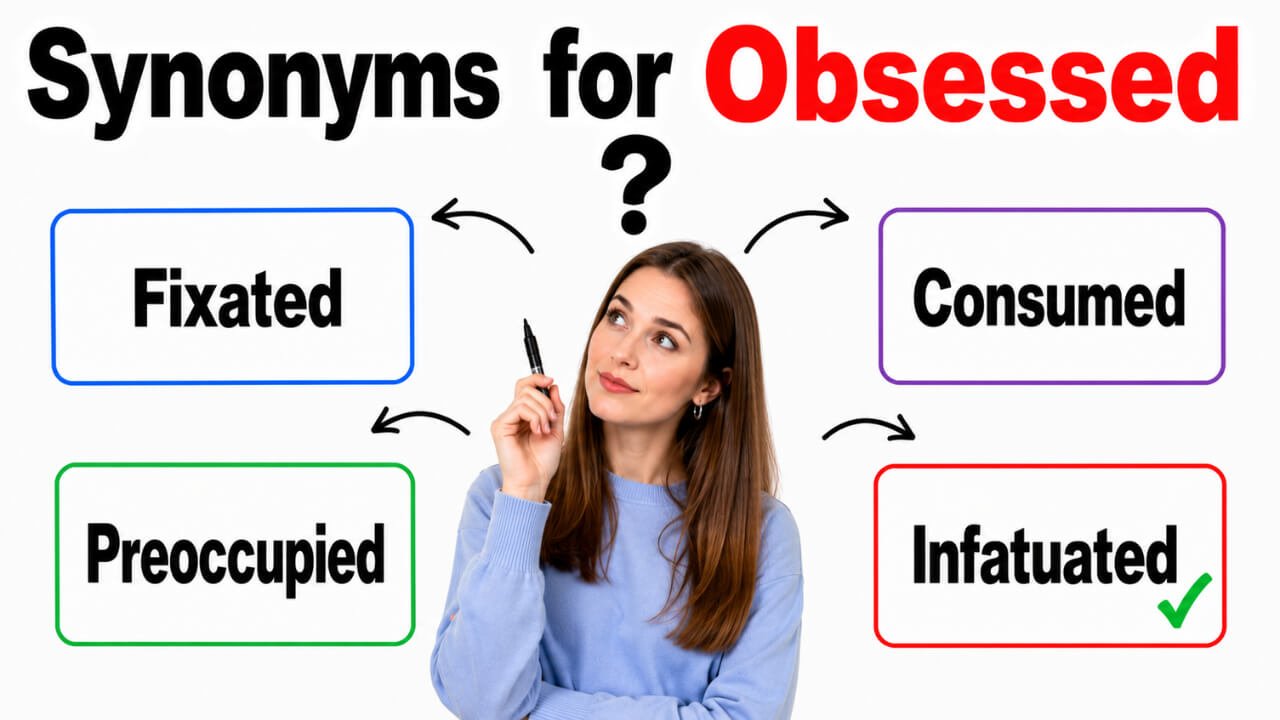
Quick Answer: The best synonyms for obsessed are fixated, preoccupied, consumed, absorbed, engrossed, captivated, infatuated, devoted, fanatical, and hooked. Use fixated when someone cannot stop thinking about one subject, preoccupied when a thought takes most of their attention, and absorbed or engrossed for deep concentration. Infatuated is best for powerful romantic attraction, while devoted describes strong loyalty. Fanatical and hooked are stronger choices that may suggest excessive, compulsive, or unhealthy interest.
Pronunciation and Word Details
Word: Obsessed
Pronunciation: /əbˈsest/
Part of Speech: Adjective and past participle of the verb obsess
Meaning: Unable to stop thinking about, feeling strongly about, or giving excessive attention to someone or something.
US Pronunciation:
UK Pronunciation:
What Does “Obsessed” Mean?
Obsessed means thinking about someone or something so intensely that it becomes difficult to focus on anything else. The word usually functions as an adjective, although it is also the past participle of the verb obsess.
Someone may be obsessed with success, appearance, perfection, money, a hobby, a person, or a particular idea. The word can describe strong interest, deep attraction, constant worry, extreme dedication, or unhealthy fixation.
In casual conversation, obsessed is often used positively to express strong enjoyment.
Example: I am obsessed with this new recipe.
In serious contexts, the word can sound negative because it suggests that a thought, desire, or activity is controlling someone’s attention.
Example: He became obsessed with proving that he was right.
The intended meaning depends on the context, tone, and subject being described.
Meaning, Tone, and Context of “Obsessed”
Obsessed normally has a strong and emotionally intense tone. It can be casual, dramatic, humorous, romantic, critical, or negative depending on how it is used.
In casual speech, people often use obsessed as an exaggerated way to say that they love or greatly enjoy something.
Casual Tone: She is obsessed with mystery novels.
In romantic contexts, obsessed may describe powerful attraction or constant thoughts about another person. However, it can sound unhealthy or possessive when the attention is unwanted or excessive.
Romantic Tone: He seemed completely obsessed with her.
In professional or academic writing, obsessed may sound too emotional or judgmental. Words such as focused, preoccupied, fixated, devoted, or consumed may communicate the intended meaning more precisely.
Formal Tone: The researcher remained intensely focused on the unresolved question.
Obsessed can also describe ambition or dedication, but it may imply a lack of balance. Devoted, committed, passionate, and driven are usually more positive alternatives.
When and How to Use “Obsessed”
For Constant Thoughts
Use obsessed when a person cannot stop thinking about a subject, problem, goal, or individual.
Example: She became obsessed with discovering the truth.
For Intense Enjoyment
In casual conversation, obsessed can express powerful enjoyment or enthusiasm.
Example: We are obsessed with the new design of our garden.
For Deep Attraction
Use obsessed when someone feels extremely attracted to or emotionally focused on another person.
Example: He appeared obsessed with someone he had only recently met.
For Excessive Attention
Obsessed can describe attention that has become unreasonable or unhealthy.
Example: The manager was obsessed with controlling every small detail.
For Strong Ambition
The word may describe someone who gives nearly all their energy to a particular goal.
Example: She was obsessed with becoming the best player on the team.
For Repeated Worry
Obsessed can refer to a thought or fear that repeatedly occupies someone’s mind.
Example: He was obsessed with the possibility of making a mistake.
For Casual Emphasis
Use obsessed informally when you want to emphasize how much you enjoy an object, activity, style, or idea.
Example: I am completely obsessed with this book.
Best Synonyms for Obsessed
Fixated
Synonym: Unable to stop focusing on one person, subject, or idea.
Example: He became fixated on a minor error in the report.
Preoccupied
Synonym: Thinking so much about something that other matters receive less attention.
Example: She seemed preoccupied with the upcoming interview.
Consumed
Synonym: Completely controlled or occupied by a powerful thought, feeling, or desire.
Example: He was consumed by the need to succeed.
Absorbed
Synonym: Giving complete attention to an activity or subject.
Example: The child was absorbed in the puzzle.
Engrossed
Synonym: So interested in something that little else is noticed.
Example: She was engrossed in the final chapter of the novel.
Captivated
Synonym: Strongly attracted, interested, or delighted by something.
Example: The audience was captivated by the speaker’s story.
Infatuated
Synonym: Experiencing intense but often temporary romantic attraction.
Example: He was infatuated with his new classmate.
Devoted
Synonym: Deeply loyal, committed, and emotionally attached.
Example: She remained devoted to her family and career.
Fanatical
Synonym: Showing extreme and sometimes unreasonable enthusiasm or dedication.
Example: He was fanatical about maintaining perfect order.
Hooked
Synonym: Strongly interested in or unable to stop enjoying something.
Example: She became hooked on historical fiction.
50 Synonyms for Obsessed with Short Meanings
- Fixated: Unable to stop focusing on one subject.
- Preoccupied: Mentally occupied by a repeated thought or concern.
- Consumed: Completely controlled by a feeling, desire, or idea.
- Absorbed: Giving full attention to an activity or subject.
- Engrossed: Deeply interested and unaware of surrounding events.
- Captivated: Strongly attracted or fascinated.
- Fascinated: Extremely interested or curious.
- Infatuated: Filled with intense romantic attraction.
- Enamored: Strongly attracted to or delighted by someone or something.
- Smitten: Suddenly and strongly attracted to someone.
- Besotted: Foolishly or excessively in love with someone.
- Devoted: Deeply loyal and committed.
- Dedicated: Giving considerable time and effort to something.
- Committed: Firmly attached to a goal, belief, or person.
- Passionate: Showing powerful interest, emotion, or enthusiasm.
- Enthusiastic: Expressing strong excitement and interest.
- Fervent: Showing intense and sincere feeling.
- Zealous: Extremely energetic and devoted to a cause.
- Fanatical: Excessively enthusiastic or devoted.
- Compulsive: Driven by an urge that feels difficult to control.
- Addicted: Unable to stop using, doing, or seeking something.
- Dependent: Relying heavily on someone or something.
- Hooked: Extremely interested in or attached to something.
- Driven: Strongly motivated to achieve a goal.
- Determined: Firmly decided and unwilling to give up.
- Focused: Directing close attention toward one purpose.
- Intent: Giving serious and concentrated attention.
- Immersed: Deeply involved in an activity or experience.
- Involved: Giving considerable attention, effort, or emotion.
- Wrapped Up: Completely occupied with a thought or activity.
- Taken With: Strongly attracted to or impressed by something.
- Attached: Emotionally connected to someone or something.
- Possessive: Wanting excessive control over a person or object.
- Haunted: Repeatedly troubled by a memory, thought, or fear.
- Troubled: Mentally disturbed by persistent concerns.
- Plagued: Continuously affected by an unwanted thought or worry.
- Dominated: Controlled by a powerful idea, emotion, or desire.
- Controlled: Directed by an overpowering urge or interest.
- Gripped: Strongly affected by emotion, fear, or interest.
- Spellbound: Completely fascinated and unable to look away.
- Mesmerized: Holding complete attention through fascination.
- Enthralled: Deeply interested, delighted, or captivated.
- Enchanted: Charmed and strongly attracted.
- Riveted: Giving complete attention to something exciting.
- Single Minded: Completely focused on one purpose.
- Relentless: Continuing with intense determination.
- Consumed By: Completely occupied by a powerful feeling or thought.
- Preoccupied With: Constantly thinking about a particular matter.
- Crazy About: Extremely fond of or excited about something.
- Absorbed In: Giving full concentration to an activity or subject.
Read Also:
Synonyms for Gratitude

Synonyms for Obsessed by Context
When Obsessed Means Unable to Stop Thinking
Fixated, preoccupied, consumed, haunted, plagued, and dominated describe thoughts that repeatedly occupy someone’s mind.
Example: She became fixated on finding the missing document.
Fixated is one of the closest alternatives when attention is narrow and difficult to redirect. Preoccupied is usually milder and may describe temporary worry. Consumed suggests that the thought or emotion has taken over nearly all of someone’s attention.
Example: He was consumed by regret after the argument.
Haunted and plagued are best when the repeated thought is disturbing or unwanted.
Example: She was haunted by memories of the accident.
When Obsessed Means Deeply Interested
Absorbed, engrossed, immersed, fascinated, riveted, and captivated describe powerful interest or concentration.
Example: The students were engrossed in the science experiment.
Absorbed and engrossed usually have a neutral or positive meaning. They indicate deep concentration without necessarily suggesting unhealthy behavior.
Example: He was absorbed in his work and did not hear the door open.
Captivated and fascinated emphasize attraction, curiosity, or delight.
Example: The visitors were captivated by the ancient paintings.
When Obsessed Means Romantically Attracted
Infatuated, enamored, smitten, besotted, taken with, and attached are useful when the subject is romantic or emotional attraction.
Example: She was infatuated with a person she barely knew.
Infatuated often describes an intense attraction that may not be based on deep knowledge. Enamored is warmer and may describe lasting attraction or admiration. Smitten suggests a sudden and powerful romantic feeling.
Example: He was immediately smitten with her cheerful personality.
Besotted is stronger and may suggest foolish or excessive affection.
Example: The character was completely besotted with his new partner.
When Obsessed Means Extremely Dedicated
Devoted, dedicated, committed, driven, determined, passionate, and single minded work when strong attention is connected with a goal or responsibility.
Example: She was dedicated to improving educational opportunities.
These words are generally more positive than obsessed. Devoted emphasizes loyalty, while dedicated focuses on effort. Driven suggests powerful ambition, and single minded describes complete concentration on one objective.
Example: His single minded pursuit of excellence helped him improve quickly.
When Obsessed Suggests Unhealthy Behavior
Compulsive, addicted, possessive, fanatical, dependent, and controlled describe excessive interest or behavior that may be difficult to manage.
Example: His compulsive need to check every detail slowed the project.
Compulsive suggests repeated behavior driven by a strong urge. Addicted is stronger and should be used carefully because it may suggest serious dependence. Possessive is appropriate when excessive attachment involves control over another person.
Example: Her possessive behavior made the friendship uncomfortable.
Fanatical suggests extreme enthusiasm that may be unreasonable or unbalanced.
Example: He became fanatical about following every rule perfectly.
When Obsessed Means Extremely Excited
Hooked, crazy about, enthusiastic, passionate, enchanted, and enthralled work in casual or positive communication.
Example: The children were crazy about the new playground.
Hooked is informal and suggests that someone wants to continue an activity. Crazy about is conversational and may express strong enjoyment or attraction.
Example: I became hooked on gardening after planting my first flowers.
Another Word for Obsessed
Fixated is often the best single replacement for obsessed when someone cannot stop thinking about one subject. However, the most suitable word depends on whether the sentence describes concentration, enjoyment, attraction, ambition, worry, or unhealthy behavior.
Original: He was obsessed with proving his theory.
Better Option: He was fixated on proving his theory.
Original: She was obsessed with the book.
Better Option: She was engrossed in the book.
Original: He was obsessed with his new partner.
Better Option: He was infatuated with his new partner.
Original: The athlete was obsessed with improving.
Better Option: The athlete was dedicated to improving.
When Not to Use “Obsessed”
Avoid using obsessed when a milder word would describe the situation more accurately. The word can sound dramatic, critical, or judgmental.
Weak: She was obsessed with finishing her homework before dinner.
Better: She was focused on finishing her homework before dinner.
Do not use obsessed when you simply mean that someone enjoys something.
Weak: He is obsessed with taking an evening walk.
Better: He enjoys taking an evening walk.
Avoid using obsessed in formal reports when focused, preoccupied, fixated, or excessively concerned would provide clearer meaning.
Weak: The director was obsessed with production numbers.
Better: The director was excessively focused on production numbers.
Do not use obsessed when describing healthy commitment unless you deliberately want to suggest imbalance.
Weak: She is obsessed with caring for her children.
Better: She is devoted to caring for her children.
Avoid using addicted as a casual replacement when there is no serious dependence. It can make a harmless interest sound more severe than intended.
Weak: I am addicted to comfortable chairs.
Better: I am very fond of comfortable chairs.
Obsessed may also sound inappropriate when describing another person’s emotions without enough evidence.
Weak: He is obsessed with her because he sent two messages.
Better: He seems interested in her because he sent two messages.
Words Commonly Confused With Obsessed
Obsessed vs Passionate: Obsessed suggests that an interest may be controlling or excessive. Passionate usually describes strong but positive enthusiasm.
Obsessed vs Addicted: Obsessed mainly refers to repeated thoughts or extreme attention. Addicted suggests a powerful dependence that is difficult to stop.
Obsessed vs Focused: Obsessed may imply unhealthy or unbalanced attention. Focused usually describes purposeful and controlled concentration.
Obsessed vs Fascinated: Obsessed suggests persistent and overpowering interest. Fascinated means highly interested or curious without necessarily losing balance.
Obsessed vs Infatuated: Obsessed can describe any subject or person. Infatuated normally describes intense romantic attraction.
Obsessed vs Devoted: Obsessed may carry a negative tone. Devoted emphasizes loyalty, love, and commitment.
Obsessed vs Engrossed: Obsessed describes a repeated or continuing mental fixation. Engrossed usually describes temporary deep attention to an activity.
Obsessed vs Possessive: Obsessed means constantly thinking about someone or something. Possessive means wanting excessive ownership or control.
Obsessed vs Determined: Obsessed suggests uncontrolled attention. Determined describes a firm decision to reach a goal.
Which Synonym Should You Choose?
Choose fixated when someone cannot move their attention away from one subject, idea, mistake, or goal.
Choose preoccupied when worry or thought temporarily occupies most of a person’s attention.
Choose consumed when an emotion, desire, or ambition controls nearly every thought.
Choose absorbed when someone is concentrating deeply on an activity.
Choose engrossed when a book, conversation, task, or event holds someone’s full attention.
Choose fascinated when the main idea is strong curiosity or interest.
Choose captivated when something attracts and holds attention through beauty, charm, or excitement.
Choose infatuated when describing intense romantic attraction.
Choose enamored when expressing warm attraction or admiration.
Choose devoted when describing loyalty to a person, responsibility, belief, or cause.
Choose dedicated when emphasizing effort and commitment.
Choose passionate when strong enthusiasm is positive and controlled.
Choose driven when ambition motivates continuous action.
Choose fanatical when enthusiasm has become extreme or unreasonable.
Choose compulsive when repeated behavior is driven by an urge that is difficult to control.
Choose hooked in casual conversation when someone strongly enjoys an activity and wants to continue it.
Choose focused in reports, essays, emails, and professional communication when attention is purposeful rather than unhealthy.
Real Life Examples of “Obsessed” in Sentences
Original: She was obsessed with solving the difficult puzzle.
Better Option: She was fixated on solving the difficult puzzle.
Original: He became obsessed with the historical documentary.
Better Option: He became engrossed in the historical documentary.
Original: The child was obsessed with learning about space.
Better Option: The child was fascinated by learning about space.
Original: She was obsessed with her new classmate.
Better Option: She was infatuated with her new classmate.
Original: He was obsessed with becoming successful.
Better Option: He was driven to become successful.
Original: The designer was obsessed with every small detail.
Better Option: The designer was intensely focused on every small detail.
Original: I am obsessed with this mystery novel.
Better Option: I am completely captivated by this mystery novel.
Original: She became obsessed with the possibility of failure.
Better Option: She became preoccupied with the possibility of failure.
Original: He was obsessed with protecting his reputation.
Better Option: He was consumed by the need to protect his reputation.
Original: They are obsessed with improving customer service.
Better Option: They are dedicated to improving customer service.
Synonym Groups and Usage Differences
Fixation Group
Fixated, preoccupied, consumed, dominated, haunted, and plagued describe thoughts that repeatedly control attention.
Fixated usually focuses on one idea or object. Preoccupied may be temporary, while consumed is emotionally stronger. Haunted and plagued are most appropriate when the thought is unwanted or disturbing.
Example: She was preoccupied with the decision throughout the day.
Concentration Group
Absorbed, engrossed, immersed, riveted, intent, and focused describe deep attention.
These alternatives are more neutral than obsessed. They are useful when someone is concentrating strongly without showing unhealthy behavior.
Example: The audience remained riveted throughout the performance.
Attraction Group
Infatuated, enamored, smitten, besotted, captivated, and taken with describe emotional or romantic attraction.
Infatuated may be temporary, while enamored can sound warmer and more thoughtful. Smitten often refers to sudden attraction. Besotted suggests excessive affection.
Example: He was completely taken with her confidence and humor.
Dedication Group
Devoted, dedicated, committed, passionate, driven, and determined describe strong effort or loyalty.
These words usually carry a positive meaning. They are better than obsessed when discipline and commitment remain healthy and purposeful.
Example: She was committed to completing the project successfully.
Extreme Interest Group
Fanatical, zealous, fervent, relentless, and single minded describe unusually powerful enthusiasm or determination.
Fanatical can sound negative because it suggests unreasonable intensity. Zealous and fervent often relate to beliefs, causes, or principles.
Example: The campaigner was zealous in defending the cause.
Compulsion Group
Compulsive, addicted, dependent, hooked, controlled, and possessive suggest behavior that may be difficult to manage.
Compulsive focuses on repeated urges. Dependent and addicted are stronger and should not be used merely for variety. Possessive is mainly connected with control and attachment.
Example: His compulsive checking made it difficult for him to relax.
Fascination Group
Fascinated, spellbound, mesmerized, enthralled, enchanted, and captivated describe attention created by wonder, beauty, or excitement.
These words are generally more positive than obsessed and do not automatically suggest unhealthy interest.
Example: The children were spellbound by the storyteller.
Antonyms of Obsessed
The opposite of obsessed depends on whether the intended meaning involves interest, concentration, attachment, ambition, or emotional involvement.
Indifferent: Having no strong interest, concern, or preference.
Uninterested: Not wanting to know about or participate in something.
Detached: Emotionally separate and not deeply involved.
Unconcerned: Not worried or emotionally affected.
Casual: Relaxed and not intensely committed.
Relaxed: Free from excessive worry, pressure, or fixation.
Balanced: Giving reasonable attention to different parts of life.
Moderate: Avoiding extreme interest or behavior.
Dispassionate: Not influenced by strong emotion.
Impartial: Not strongly attached to one side or preference.
Uncommitted: Not firmly devoted to a person, belief, or goal.
Distracted: Unable to maintain close attention on one subject.
Comparison of Obsessed and Related Words
Obsessed vs Fixated
Obsessed describes an intense and often excessive interest in someone or something. Fixated emphasizes attention that remains stuck on one particular subject.
Example With Obsessed: She was obsessed with achieving a perfect result.
Example With Fixated: She was fixated on one small mistake in the result.
Obsessed vs Passionate
Obsessed can suggest a lack of balance or control. Passionate usually describes strong enthusiasm that remains positive and productive.
Example With Obsessed: He was obsessed with winning at any cost.
Example With Passionate: He was passionate about helping young athletes improve.
Obsessed vs Focused
Obsessed suggests overpowering attention. Focused describes controlled concentration directed toward a goal.
Example With Obsessed: She was obsessed with checking every possible outcome.
Example With Focused: She was focused on completing the analysis accurately.
Obsessed vs Fascinated
Obsessed suggests persistent thoughts that may be difficult to control. Fascinated describes strong interest, wonder, or curiosity.
Example With Obsessed: He was obsessed with discovering every detail of the case.
Example With Fascinated: He was fascinated by the history of the case.
Obsessed vs Addicted
Obsessed relates primarily to thoughts, attention, or emotional fixation. Addicted describes a stronger form of dependence involving difficulty stopping a behavior or use.
Example With Obsessed: She was obsessed with reading reviews before buying anything.
Example With Addicted: He described himself as addicted to the constant excitement of gambling.
Obsessed vs Infatuated
Obsessed can relate to a person, idea, object, goal, or activity. Infatuated normally relates to intense romantic attraction.
Example With Obsessed: He was obsessed with improving his public image.
Example With Infatuated: He was infatuated with someone he had recently met.
Obsessed vs Devoted
Obsessed may imply excessive or unhealthy attention. Devoted expresses loyal, caring, and positive commitment.
Example With Obsessed: She was obsessed with controlling every family decision.
Example With Devoted: She was devoted to supporting her family.
Obsessed vs Engrossed
Obsessed usually describes a continuing fixation. Engrossed describes being deeply interested in a particular activity at a certain time.
Example With Obsessed: He was obsessed with collecting rare books.
Example With Engrossed: He was engrossed in a rare book all afternoon.
Common Phrases and Expressions With Obsessed
Obsessed With: Extremely interested in or constantly thinking about something.
Completely Obsessed: Giving nearly all attention to one person, object, or idea.
Totally Obsessed: An informal expression of powerful interest or enjoyment.
Deeply Obsessed: Strongly and emotionally controlled by a particular thought.
Become Obsessed: Gradually develop an excessive interest or fixation.
Seem Obsessed: Appear to think about something more than is reasonable.
Almost Obsessed: Showing interest that is close to becoming excessive.
Obsessed With Detail: Giving extreme attention to small features or facts.
Obsessed With Success: Constantly thinking about achievement or status.
Obsessed With Perfection: Unable to accept anything that seems imperfect.
Common Mistakes to Avoid
A common grammar mistake is using the wrong preposition after obsessed. The standard construction is obsessed with someone or something.
Incorrect: She is obsessed about becoming famous.
Correct: She is obsessed with becoming famous.
The verb obsess commonly appears with over when describing repeated worry or thought.
Correct: He tends to obsess over minor mistakes.
Do not treat passionate as an exact synonym in every sentence. Passionate is usually positive, while obsessed may suggest excessive or unhealthy attention.
Unclear: The manager was passionate about controlling every conversation.
Clearer: The manager was obsessed with controlling every conversation.
Avoid replacing obsessed with addicted when the sentence only describes enthusiasm. Addicted is much stronger and may change the meaning.
Unnatural: She is addicted to the color blue.
Natural: She is crazy about the color blue.
Do not use infatuated for interests that are not romantic or emotionally attractive.
Incorrect: He was infatuated with completing the financial report.
Correct: He was focused on completing the financial report.
Avoid repeating obsessed several times in one paragraph. Use fixated, preoccupied, absorbed, devoted, or fascinated when those words communicate the exact meaning.
Do not assume every intense interest is unhealthy. Focused, dedicated, passionate, and absorbed may be more respectful and accurate.
Avoid using obsessed as a vague exaggeration in formal writing. State whether the person is deeply focused, excessively concerned, emotionally attached, or unable to stop thinking about the issue.
Conclusion
The most useful synonyms for obsessed include fixated, preoccupied, consumed, absorbed, engrossed, captivated, infatuated, devoted, fanatical, and hooked. Choose fixated for repeated thoughts, engrossed for deep concentration, infatuated for romantic attraction, and devoted for positive commitment. Use compulsive or fanatical only when the interest appears excessive or difficult to control. Understanding these differences helps you use synonyms for obsessed naturally while keeping your writing precise, balanced, and appropriate for each context.
FAQs About Synonyms for Obsessed
What Is the Best Synonym for Obsessed?
Fixated is often the closest general synonym. However, engrossed, preoccupied, infatuated, or devoted may be better in specific contexts.
What Is a Positive Synonym for Obsessed?
Passionate, dedicated, devoted, absorbed, enthusiastic, and fascinated are positive alternatives when the interest is healthy.
What Is a Formal Word for Obsessed?
Fixated, preoccupied, consumed, engrossed, and excessively focused work well in formal writing.
Is Passionate the Same as Obsessed?
No. Passionate usually describes strong positive enthusiasm, while obsessed may suggest excessive attention or a lack of balance.
What Is a Romantic Synonym for Obsessed?
Infatuated, enamored, smitten, besotted, and captivated are useful romantic alternatives.
What Is the Difference Between Obsessed and Addicted?
Obsessed mainly describes overpowering thoughts or attention. Addicted suggests a stronger dependence and difficulty stopping a behavior.
What Is the Opposite of Obsessed?
Indifferent, uninterested, detached, casual, relaxed, balanced, and dispassionate are common opposites.
