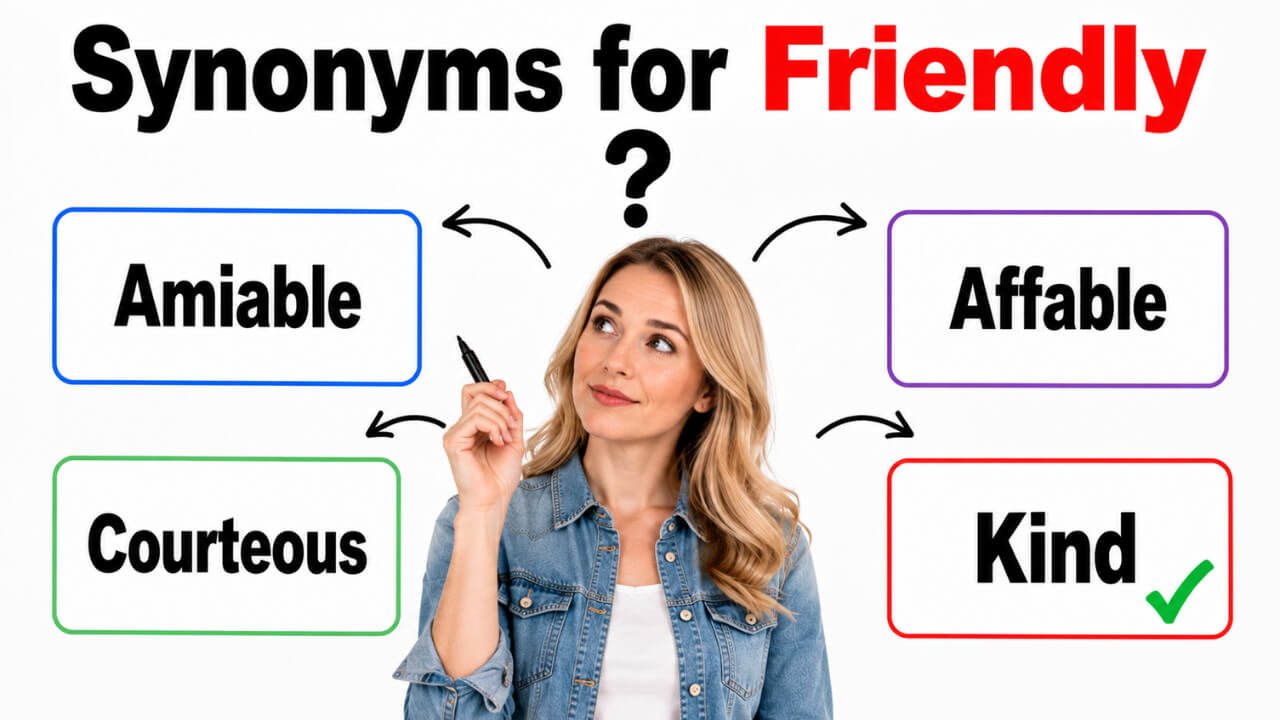
Quick Answer: The best synonyms for friendly are amiable, affable, approachable, warm, cordial, genial, kind, welcoming, sociable, and personable. Use amiable or genial for a pleasant personality, approachable for someone who is easy to speak with, cordial for polite formal communication, sociable for someone who enjoys company, welcoming for places or behavior, and kind for caring actions. Learning synonyms for friendly helps you describe people, conversations, relationships, environments, and attitudes more precisely.
Pronunciation and Word Details
Word: Friendly
Pronunciation: /ˈfrend.li/
Part of Speech: Adjective
Meaning: Friendly describes someone or something that is kind, pleasant, welcoming, helpful, or easy to interact with.
US Pronunciation:
UK Pronunciation:
What Does “Friendly” Mean?
Friendly means behaving in a kind, pleasant, welcoming, or supportive way toward another person. It is mainly used as an adjective to describe people, expressions, conversations, relationships, places, and actions.
A friendly person makes others feel comfortable and accepted.
Personality: The new teacher is friendly and easy to approach.
Friendly can also describe polite communication.
Communication: She sent a friendly message to welcome the new employee.
It may describe a peaceful relationship between people or groups.
Relationship: The two neighbors have maintained friendly relations for years.
The word can also describe a place or atmosphere that feels comfortable and inviting.
Environment: The small café has a friendly atmosphere.
In other contexts, friendly can mean easy to understand, safe to use, or suitable for a particular group.
Usability: The instructions are friendly for beginners.
Its exact meaning depends on whether the sentence focuses on kindness, openness, politeness, cooperation, comfort, or peaceful relations.
Meaning, Tone, and Context of “Friendly”
Friendly usually has a positive, warm, and neutral tone. It is common in everyday conversation, workplace communication, descriptions, reviews, instructions, and formal writing.
In casual speech, friendly often describes someone who smiles, talks openly, or helps others feel relaxed.
Casual: Our new neighbor is very friendly.
In professional communication, cordial, courteous, approachable, and cooperative may sound more precise.
Professional: The manager remained cordial throughout the discussion.
In descriptions of personality, amiable, affable, genial, sociable, and personable provide more detail.
Personality: Her affable manner helped everyone feel comfortable.
Friendly can also describe relationships that are peaceful rather than close.
Relationship: The former colleagues remained on friendly terms.
For a welcoming environment, hospitable, inviting, warm, and inclusive may be better alternatives.
Environment: The office has a warm and welcoming atmosphere.
When and How to Use “Friendly”
For a Pleasant Personality
Use friendly to describe someone who behaves warmly and makes others feel comfortable.
Example: The receptionist was friendly and answered every question patiently.
For Easy Communication
Use friendly when someone is comfortable to approach, speak with, or ask for help.
Example: Our supervisor is friendly and willing to listen.
For Polite Behavior
Friendly can describe communication that is pleasant without being deeply personal.
Example: They exchanged a friendly greeting before the meeting.
For Welcoming Places
Use friendly to describe an environment that feels comfortable, open, or inviting.
Example: The library provides a friendly space for young readers.
For Peaceful Relationships
Friendly can describe people or groups that have a positive and cooperative relationship.
Example: The two teams maintained friendly relations after the competition.
For Helpful Communication
Use friendly when instructions, explanations, or messages are easy to understand and considerate of the reader.
Example: The guide uses friendly language that beginners can understand.
For Supportive Actions
Friendly may describe behavior intended to help, encourage, or reassure someone.
Example: She offered a friendly suggestion instead of harsh criticism.
Best Synonyms for Friendly
Amiable
Synonym: Pleasant, kind, and easy to like.
Example: His amiable personality made him popular with the entire team.
Affable
Synonym: Warm, polite, and easy to speak with.
Example: The affable host greeted every visitor personally.
Approachable
Synonym: Friendly and easy to talk to or ask for help.
Example: The professor is approachable and welcomes questions.
Warm
Synonym: Showing sincere kindness, affection, or enthusiasm.
Example: She gave us a warm welcome when we arrived.
Cordial
Synonym: Polite, pleasant, and respectful, especially in formal situations.
Example: The discussion remained cordial despite their different opinions.
Genial
Synonym: Cheerful, pleasant, and naturally friendly.
Example: His genial manner helped reduce tension in the room.
Kind
Synonym: Caring, helpful, and considerate toward others.
Example: It was kind of her to help the lost visitor.
Welcoming
Synonym: Making someone feel accepted, comfortable, and valued.
Example: The staff created a welcoming environment for new members.
Sociable
Synonym: Enjoying conversation and spending time with other people.
Example: She is sociable and enjoys meeting new colleagues.
Personable
Synonym: Pleasant in appearance, behavior, and communication.
Example: The personable assistant communicated confidently with every guest.
50 Synonyms for Friendly with Short Meanings
- Amiable: Pleasant, kind, and easy to like.
- Affable: Warm and easy to talk to.
- Approachable: Comfortable to speak with or ask for help.
- Warm: Showing sincere kindness and affection.
- Cordial: Polite and pleasant, especially in formal situations.
- Genial: Cheerful, pleasant, and naturally welcoming.
- Kind: Caring and considerate toward others.
- Welcoming: Making people feel comfortable and accepted.
- Sociable: Enjoying conversation and the company of others.
- Personable: Pleasant and appealing in behavior.
- Pleasant: Enjoyable, polite, and agreeable.
- Agreeable: Pleasant and easy to cooperate with.
- Congenial: Pleasant because of shared interests or qualities.
- Companionable: Friendly and enjoyable to spend time with.
- Neighborly: Helpful and kind toward people nearby.
- Hospitable: Generous and welcoming toward guests.
- Gracious: Polite, kind, and considerate.
- Courteous: Showing good manners and respect.
- Polite: Behaving with respect and consideration.
- Civil: Reasonably polite and respectful.
- Good Natured: Naturally cheerful, patient, and pleasant.
- Kindhearted: Having a caring and generous nature.
- Warmhearted: Showing genuine affection and kindness.
- Caring: Showing concern for another person’s needs.
- Considerate: Thinking carefully about other people’s feelings.
- Thoughtful: Showing attention, kindness, and care.
- Helpful: Willing to provide support or assistance.
- Supportive: Giving encouragement, help, or emotional strength.
- Encouraging: Giving confidence, hope, or motivation.
- Sympathetic: Understanding another person’s feelings or difficulties.
- Compassionate: Showing concern for people who are suffering.
- Benevolent: Kind and willing to help others.
- Cooperative: Willing to work peacefully with others.
- Accommodating: Willing to adjust in order to help someone.
- Receptive: Open to ideas, communication, or suggestions.
- Open: Willing to communicate honestly and comfortably.
- Easygoing: Relaxed, calm, and pleasant to be around.
- Cheerful: Noticeably happy, positive, and pleasant.
- Chatty: Enjoying relaxed and informal conversation.
- Engaging: Pleasant and able to hold someone’s interest.
- Accessible: Easy to approach, understand, or communicate with.
- Familiar: Relaxed and informal because of an established connection.
- Amicable: Peaceful, polite, and free from conflict.
- Harmonious: Peaceful and cooperative.
- Peaceful: Calm and free from hostility.
- Favorable: Positive, supportive, or approving.
- Inclusive: Making different people feel accepted and involved.
- Respectful: Showing consideration and regard for others.
- Good Humored: Cheerful and able to respond pleasantly.
- Easy to Talk To: Comfortable and pleasant to communicate with.
Read Also:
Synonyms for Necessary
Synonyms for Friendly by Context
When Friendly Means Kind
Kind, caring, considerate, compassionate, thoughtful, and kindhearted describe someone who treats others with concern and respect.
Example: The kind nurse stayed with the patient until help arrived.
Example: Her thoughtful response made the new student feel included.
Example: He was considerate of everyone’s time during the meeting.
When Friendly Means Approachable
Approachable, affable, open, accessible, personable, and easy to talk to describe someone who makes communication feel comfortable.
Example: The manager is approachable and welcomes honest feedback.
Example: Her affable personality helped nervous visitors relax.
Example: The instructor remained open to questions throughout the session.
When Friendly Means Sociable
Sociable, outgoing, chatty, companionable, engaging, and genial describe someone who enjoys interacting with others.
Example: He is sociable and enjoys attending community events.
Example: Her engaging manner kept the conversation interesting.
Example: Our genial guide shared several amusing stories.
When Friendly Means Welcoming
Welcoming, hospitable, warm, gracious, inclusive, and neighborly describe behavior or places that make people feel accepted.
Example: The host provided a warm welcome to every guest.
Example: The center creates an inclusive environment for all visitors.
Example: Their neighborly behavior helped the family settle into the area.
When Friendly Means Polite
Cordial, courteous, polite, civil, respectful, and gracious work well for professional or formal communication.
Example: The conversation remained cordial from beginning to end.
Example: The assistant gave a courteous response to the complaint.
Example: Both speakers remained respectful despite their disagreement.
When Friendly Means Peaceful
Amicable, harmonious, cooperative, peaceful, and favorable describe relationships without hostility or conflict.
Example: They reached an amicable agreement after a brief discussion.
Example: The departments developed a cooperative working relationship.
Example: Both sides hoped to maintain peaceful relations.
When Friendly Means Helpful
Helpful, supportive, accommodating, encouraging, and receptive describe someone who willingly offers assistance or responds positively.
Example: The staff were helpful when we requested additional information.
Example: Her encouraging words gave the team more confidence.
Example: The coordinator was accommodating when the schedule changed.
Another Word for Friendly
Amiable is one of the best single replacements for friendly when describing a pleasant personality. However, the best alternative depends on the intended meaning.
Use approachable for someone who is easy to speak with, cordial for polite formal behavior, sociable for someone who enjoys company, welcoming for a comfortable environment, and kind for caring actions.
Original: The new teacher is friendly.
Better Option: The new teacher is approachable.
Original: We had a friendly conversation after the meeting.
Better Option: We had a cordial conversation after the meeting.
Original: The hotel staff were friendly.
Better Option: The hotel staff were welcoming.
Original: She has a friendly personality.
Better Option: She has an amiable personality.
When Not to Use “Friendly”
Friendly is useful, but it can sound vague when a more specific word would explain the exact quality being described.
Avoid friendly when you mean that someone follows good manners rather than showing personal warmth.
Weak: The employee gave a friendly response to the formal complaint.
Better: The employee gave a courteous response to the formal complaint.
Do not use friendly when you specifically mean that a person enjoys frequent social interaction.
Weak: She is very friendly and attends every gathering.
Better: She is very sociable and attends every gathering.
Friendly may also be too casual for formal relationships or official communication.
Weak: The representatives held friendly discussions.
Better: The representatives held cordial discussions.
Avoid using friendly repeatedly in the same paragraph.
Weak: The friendly manager welcomed us into the friendly office and introduced us to the friendly staff.
Better: The approachable manager welcomed us into the inviting office and introduced us to the courteous staff.
Friendly can also be unclear when describing products, instructions, or systems.
Weak: The instructions are friendly.
Better: The instructions are clear and easy to understand.
Words Commonly Confused With Friendly
Friendly vs Kind: Friendly describes pleasant and welcoming behavior. Kind focuses more strongly on caring actions and concern for others.
Friendly vs Polite: Friendly suggests warmth and openness. Polite means following good manners and showing respect, even without personal warmth.
Friendly vs Sociable: Friendly describes how someone treats others. Sociable describes someone who enjoys meeting and talking with people.
Friendly vs Approachable: Friendly is broad. Approachable specifically means that people feel comfortable starting a conversation or asking for help.
Friendly vs Cordial: Friendly can be informal and warm. Cordial is usually polite, controlled, and suitable for professional situations.
Friendly vs Amicable: Friendly often describes people and behavior. Amicable commonly describes peaceful relationships, discussions, agreements, or separations.
Friendly vs Helpful: Friendly behavior feels pleasant and welcoming. Helpful behavior provides useful assistance or support.
Friendly vs Hospitable: Friendly describes general warmth. Hospitable specifically refers to treating visitors or guests generously.
Which Synonym Should You Choose?
Choose amiable when describing a pleasant and likable personality.
Choose affable when someone is warm, relaxed, and easy to speak with.
Choose approachable when people feel comfortable asking questions or requesting help.
Choose warm when describing sincere affection, enthusiasm, or kindness.
Choose cordial for professional discussions, formal greetings, business communication, or polite relationships.
Choose genial when someone has a cheerful and naturally pleasant manner.
Choose sociable when describing someone who enjoys talking and spending time with others.
Choose welcoming for places, hosts, environments, greetings, and behavior that make people feel accepted.
Choose kind when someone acts with care, generosity, or concern.
Choose courteous for respectful and well mannered communication.
Choose amicable for peaceful agreements, relationships, discussions, or separations.
Choose supportive when someone gives help, encouragement, or emotional strength.
Choose hospitable when describing generous treatment of guests or visitors.
Choose personable when someone communicates pleasantly and creates a positive impression.
Real Life Examples of “Friendly” in Sentences
Original: The receptionist was friendly when we arrived.
Better Option: The receptionist was welcoming when we arrived.
Original: Our new supervisor is friendly and listens to everyone.
Better Option: Our new supervisor is approachable and listens to everyone.
Original: They had a friendly conversation about the problem.
Better Option: They had a cordial conversation about the problem.
Original: She is friendly and enjoys meeting new people.
Better Option: She is sociable and enjoys meeting new people.
Original: The neighbors were friendly during our first week.
Better Option: The neighbors were kind and helpful during our first week.
Original: The office has a friendly atmosphere.
Better Option: The office has a warm and welcoming atmosphere.
Original: Both groups reached a friendly agreement.
Better Option: Both groups reached an amicable agreement.
Original: He gave me some friendly advice.
Better Option: He gave me some thoughtful advice.
Original: The speaker had a friendly manner.
Better Option: The speaker had an affable manner.
Original: The staff gave us friendly assistance.
Better Option: The staff gave us courteous and helpful assistance.
Synonym Groups and Usage Differences
Warm Personality Group
Amiable, affable, genial, warm, personable, and good natured describe people with naturally pleasant personalities.
Amiable means easy to like. Affable emphasizes comfortable conversation. Genial suggests cheerfulness, while personable often describes someone who creates a positive impression.
Example: His genial personality made the formal event feel relaxed.
Kindness Group
Kind, caring, thoughtful, considerate, compassionate, kindhearted, and warmhearted describe concern for other people.
Kind is broad and natural. Considerate emphasizes awareness of feelings. Compassionate is stronger and often relates to suffering or difficulty.
Example: Her compassionate response helped the family feel supported.
Social Group
Sociable, outgoing, chatty, companionable, and engaging describe people who enjoy interaction and conversation.
Sociable is the most neutral choice. Outgoing suggests confidence. Chatty is informal and may imply frequent talking.
Example: The outgoing student introduced himself to everyone in the group.
Welcoming Group
Welcoming, hospitable, gracious, inclusive, neighborly, and warm describe behavior or environments that make people feel accepted.
Hospitable is especially suitable for hosts. Inclusive emphasizes acceptance and participation. Neighborly describes practical kindness between people in a community.
Example: The hosts were hospitable and made every visitor feel comfortable.
Formal Politeness Group
Cordial, courteous, polite, civil, and respectful describe pleasant behavior in professional or formal situations.
Cordial adds controlled warmth. Courteous emphasizes good manners. Civil may suggest basic politeness despite disagreement.
Example: Both participants remained civil during the difficult discussion.
Peaceful Relationship Group
Amicable, harmonious, peaceful, cooperative, and favorable describe relationships or situations without hostility.
Amicable is common for agreements and discussions. Harmonious suggests smooth cooperation. Cooperative focuses on people working together.
Example: The two organizations developed a harmonious partnership.
Support Group
Helpful, supportive, encouraging, accommodating, receptive, and benevolent describe positive assistance or willingness to help.
Helpful refers to practical assistance. Supportive may include emotional help. Accommodating means being willing to adjust for another person.
Example: The coordinator was accommodating when we requested a different time.
Antonyms of Friendly
The opposite of friendly depends on whether the sentence refers to personality, behavior, relationships, communication, or atmosphere.
Unfriendly: Not pleasant, welcoming, or kind.
Hostile: Showing anger, opposition, or aggression.
Cold: Lacking warmth, affection, or emotional openness.
Distant: Emotionally reserved or unwilling to become familiar.
Rude: Showing poor manners or disrespect.
Impolite: Failing to show expected courtesy.
Unapproachable: Difficult or uncomfortable to speak with.
Antisocial: Avoiding interaction or behaving against social cooperation.
Reserved: Quiet and unwilling to express feelings openly.
Aloof: Emotionally distant and uninterested in interaction.
Aggressive: Ready to argue, threaten, or attack.
Unwelcoming: Making people feel uncomfortable or excluded.
Inhospitable: Not welcoming or generous toward visitors.
Uncooperative: Unwilling to work or communicate with others.
Adversarial: Involving conflict, opposition, or competition.
Comparison Friendly vs Related Words
Friendly vs Kind
Friendly describes a pleasant and welcoming manner. Kind focuses more on caring behavior and helpful actions.
Example With Friendly: The new employee greeted everyone with a friendly smile.
Example With Kind: The new employee kindly helped a colleague complete the task.
Friendly vs Approachable
Friendly is a broad description of pleasant behavior. Approachable means that someone appears comfortable to speak with or ask for assistance.
Example With Friendly: Our instructor is friendly with every student.
Example With Approachable: Our instructor is approachable whenever students need guidance.
Friendly vs Sociable
Friendly refers to how someone treats people. Sociable means that someone enjoys spending time and communicating with others.
Example With Friendly: He gave the visitors a friendly greeting.
Example With Sociable: He is sociable and regularly attends community gatherings.
Friendly vs Cordial
Friendly often feels warm and informal. Cordial is more controlled, polite, and suitable for formal communication.
Example With Friendly: We had a friendly chat over lunch.
Example With Cordial: The managers held a cordial discussion about the agreement.
Friendly vs Polite
Friendly suggests genuine warmth or openness. Polite means showing proper manners and respect.
Example With Friendly: She welcomed us with a friendly smile.
Example With Polite: She gave a polite response to the formal request.
Friendly vs Amicable
Friendly often describes people, behavior, or expressions. Amicable commonly describes peaceful relationships, discussions, settlements, and agreements.
Example With Friendly: The two colleagues had a friendly conversation.
Example With Amicable: The two colleagues reached an amicable solution.
Common Phrases and Expressions With “Friendly”
Friendly Face: A person whose expression appears warm and welcoming.
Friendly Smile: A pleasant smile that helps another person feel comfortable.
Friendly Tone: A warm and polite manner of speaking or writing.
Friendly Reminder: A polite message that encourages someone to remember something.
Friendly Advice: Helpful guidance offered in a kind manner.
Friendly Conversation: A relaxed and pleasant exchange of ideas.
Friendly Relationship: A positive connection without hostility.
Friendly Atmosphere: An environment that feels warm, relaxed, and welcoming.
Friendly Competition: Competition conducted with respect and good feelings.
Friendly Gesture: A small action that shows kindness or goodwill.
Common Mistakes to Avoid
One common mistake is using friendly as an exact replacement for kind. Friendly describes pleasant interaction, while kind often refers to caring actions.
Unclear: She was friendly enough to pay for the stranger’s meal.
Better: She was kind enough to pay for the stranger’s meal.
Another mistake is using friendly when cordial would be more suitable in formal writing.
Less Precise: The two officials held a friendly discussion.
More Precise: The two officials held a cordial discussion.
Do not assume that sociable and friendly mean exactly the same thing. A quiet person can be friendly without enjoying frequent social events.
Avoid repeating friendly throughout a description. Replace it only with words that express the intended quality.
Repetitive: The friendly host introduced us to the friendly guests in a friendly room.
Improved: The hospitable host introduced us to the pleasant guests in a welcoming room.
Do not use amicable to describe a person’s general personality. It is more natural for relationships, discussions, agreements, and separations.
Unnatural: She is an amicable woman.
Natural: She is an amiable woman.
Do not use chatty as a formal synonym for friendly. Chatty specifically means talkative and has an informal tone.
Conclusion
Understanding synonyms for friendly helps you describe warmth, kindness, politeness, cooperation, and social behavior more accurately. Use amiable or affable for a pleasant personality, approachable for easy communication, cordial for formal politeness, sociable for someone who enjoys company, and welcoming for comfortable places or greetings. Kind and considerate emphasize caring behavior, while amicable works best for peaceful relationships and agreements. Choose the alternative that matches the person, action, tone, or situation you want to describe.
FAQs About Synonyms for Friendly
What Is the Best Synonym for Friendly?
Amiable is a strong general synonym for a pleasant personality. Approachable, warm, kind, and welcoming may be better in specific contexts.
What Is a Formal Synonym for Friendly?
Cordial is a suitable formal alternative. It describes communication or behavior that is polite, pleasant, and respectful.
What Is a Casual Synonym for Friendly?
Nice, warm, kind, and easy to talk to are natural choices in casual conversation.
What Word Describes a Friendly Person?
Amiable, affable, approachable, genial, personable, and sociable can all describe a friendly person.
Are Friendly and Kind the Same?
They are related but not identical. Friendly describes pleasant interaction, while kind focuses more on caring and helpful behavior.
What Is a Synonym for a Friendly Relationship?
Amicable, harmonious, cooperative, and peaceful are useful alternatives for a friendly relationship.
What Is the Opposite of Friendly?
Common opposites include unfriendly, hostile, cold, distant, rude, unapproachable, and unwelcoming.
