
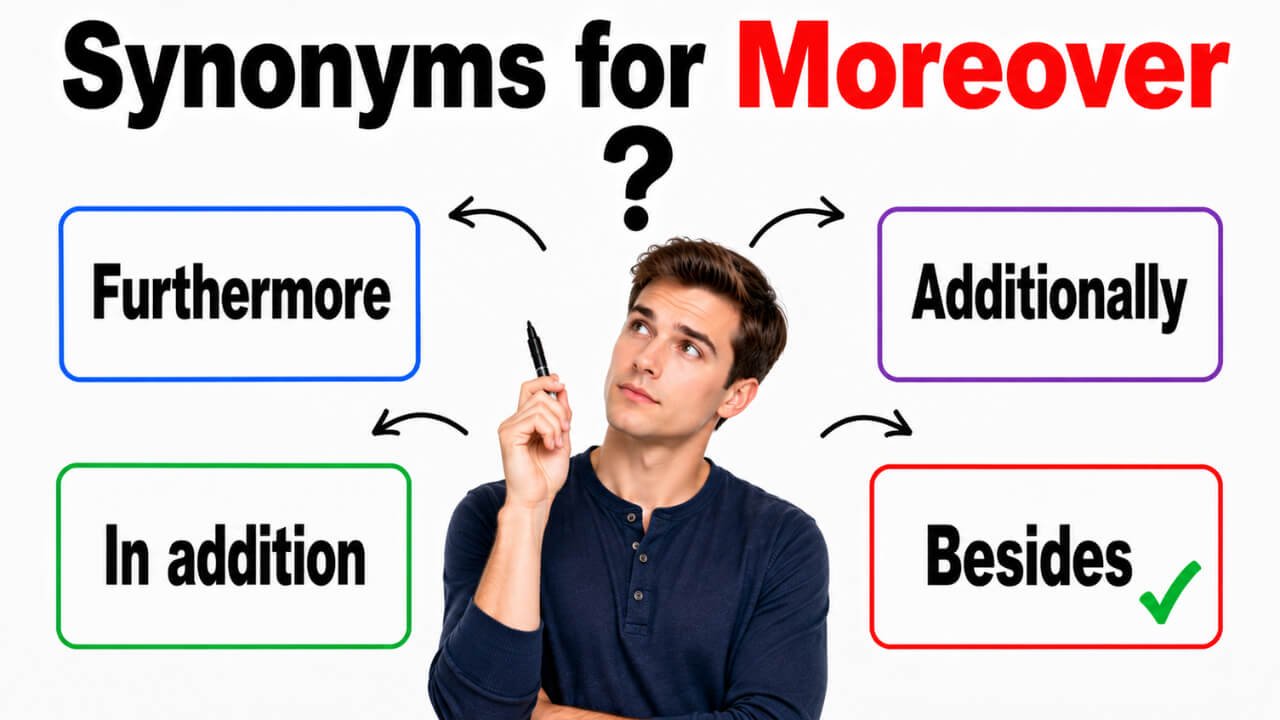
Quick Answer: The best synonyms for moreover include furthermore, additionally, in addition, also, besides, what is more, more importantly, on top of that, further, and equally important. Use furthermore in formal arguments, additionally in reports and instructions, and in addition in most professional writing. Also is the simplest everyday choice, while besides and on top of that suit casual conversation. Use more importantly when the next point deserves greater attention rather than merely adding equal information.
Pronunciation and Word Details
Word: Moreover
Pronunciation: /mɔːrˈoʊ.vɚ/
Part of Speech: Conjunctive adverb
Meaning: Used to add another related fact, reason, or point that supports what has already been stated.
US Pronunciation:
UK Pronunciation:
What Does “Moreover” Mean?
Moreover means in addition to what has already been said. It introduces another fact, reason, detail, or argument that supports or strengthens a previous statement.
Moreover is a conjunctive adverb. It connects related ideas across sentences or independent clauses. Writers commonly use it in essays, reports, explanations, proposals, articles, and formal correspondence.
The word usually appears at the beginning of a sentence, followed by a comma. It can also appear in the middle of a sentence when the writer wants to add emphasis.
Example: The course is affordable. Moreover, it provides practical training.
In this example, moreover introduces a second benefit that supports the first statement.
Meaning, Tone, and Context of “Moreover”
Moreover has a formal, neutral, and logical tone. It is more common in academic, professional, analytical, and persuasive writing than in everyday conversation.
The word signals that the next idea is relevant and adds weight to the previous point. It is particularly useful when presenting several reasons, advantages, findings, or pieces of evidence.
In casual speech, moreover may sound stiff or overly formal. Words such as also, besides, and plus usually sound more natural in conversation.
Moreover does not show contrast, cause, or result. It simply adds another supporting point. Therefore, it should not replace words such as however, because, consequently, or instead.
When and How to Use “Moreover”
For Adding Supporting Information: Use moreover to introduce another fact that supports an earlier statement.
Example: The software is easy to use. Moreover, it requires very little training.
For Strengthening an Argument: Use moreover when the new point makes an argument more convincing.
Example: The proposal will reduce costs. Moreover, it will improve productivity.
For Presenting Another Benefit: Use moreover to add an advantage to a list of positive features.
Example: The apartment is spacious. Moreover, it is located near public transportation.
For Academic Writing: Use moreover to connect related claims, evidence, findings, or explanations.
Example: The results support the original theory. Moreover, they reveal an additional pattern.
For Formal Reports: Use moreover when presenting another important observation or conclusion.
Example: Customer satisfaction increased. Moreover, the number of complaints declined.
For Persuasive Writing: Use moreover to introduce another reason why the reader should accept a position.
Example: The policy protects employees. Moreover, it creates a safer working environment.
Best Synonyms for Moreover
Furthermore: Adds another formal point that supports the previous statement.
Example: The method is efficient. Furthermore, it produces reliable results.
Additionally: Introduces extra information in a clear and professional way.
Example: The package includes accommodation. Additionally, breakfast is provided.
In Addition: Adds another related fact, feature, reason, or benefit.
Example: The device is affordable. In addition, it uses very little energy.
Also: Adds information in a simple and natural way.
Example: She manages the budget and also prepares monthly reports.
Besides: Adds another reason or point, often in less formal communication.
Example: The journey is too long. Besides, the weather may become worse.
What Is More: Introduces an additional and often impressive point.
Example: The service is fast. What is more, it is available every day.
More Importantly: Adds a point that deserves greater attention than the previous one.
Example: The solution is inexpensive. More importantly, it is safe.
On Top of That: Adds another surprising, difficult, or beneficial detail in casual language.
Example: The room was small, and on top of that, it had no windows.
Further: Adds another point in a compact and formal way.
Example: Further, the evidence confirms the original conclusion.
Equally Important: Adds a point that has the same level of importance as the previous one.
Example: The plan must be affordable. Equally important, it must be practical.
50 Synonyms for Moreover with Short Meanings
- Furthermore: In addition to what has been stated.
- Additionally: As another related point.
- In Addition: Used to add more information.
- Also: As another fact or detail.
- Besides: In addition to another reason or point.
- What Is More: Used to introduce another notable point.
- More Importantly: Used to add a more significant idea.
- On Top of That: In addition to something already mentioned.
- As Well: In addition to another thing.
- Too: Also or in addition.
- Likewise: In a similar or related way.
- Similarly: In a comparable way.
- Along With That: Together with the point already mentioned.
- Added to This: Used to introduce another supporting detail.
- Added to That: In addition to the previous fact.
- Beyond That: Used to add information extending the discussion.
- Apart From That: Besides the point already discussed.
- Not Only That: Used to add a stronger or surprising point.
- Another Point Is: Introduces an additional idea.
- Another Consideration Is: Adds a factor that deserves attention.
- Equally Important: Introduces a point of similar importance.
- Of Equal Importance: Having the same significance as another point.
- To Add to This: Used to provide another related detail.
- To Add to That: Introduces an additional supporting fact.
- Further: Adds another point in formal writing.
- In Addition to This: Adds information connected to the current subject.
- In Addition to That: Introduces another related fact.
- On Top of This: Adds another detail to the current situation.
- Coupled With This: Combined with the fact already mentioned.
- Together With This: Added alongside the previous point.
- Over and Above That: In addition to what is already available or required.
- As an Additional Point: Introduces extra information formally.
- As Another Point: Adds a new but related idea.
- Another Factor Is: Introduces an additional cause or consideration.
- Another Reason Is: Adds further support for an opinion or decision.
- Another Advantage Is: Introduces an additional benefit.
- Another Benefit Is: Adds a positive feature or result.
- Another Issue Is: Introduces an additional problem or concern.
- Another Detail Is: Adds more specific information.
- One More Point Is: Introduces one additional idea.
- By the Same Token: Adds a related idea based on similar reasoning.
- Equally: Adds a point with similar value or importance.
- As Well as That: Adds another fact or feature.
- Plus: Adds information in casual speech or writing.
- Beyond This: Extends the discussion with another point.
- There Is Also: Introduces another existing fact or feature.
- It Is Also Worth Noting: Draws attention to another useful point.
- It Should Also Be Noted: Introduces an important additional observation.
- In the Same Vein: Adds a related idea with a similar theme.
- Further Still: Introduces another point beyond those already given.
Read Also:
Synonyms for Values
Synonyms for Moreover by Context
When Moreover Adds Formal Information
Furthermore, additionally, in addition, further, and it should also be noted are strong choices for reports, essays, proposals, and formal explanations.
Example: The new system reduces processing time. Furthermore, it improves accuracy.
Example: The policy applies to all employees. Additionally, it covers temporary workers.
When Moreover Adds an Important Point
More importantly, equally important, of equal importance, and it is also worth noting help show the significance of the added information.
Example: The building is attractive. More importantly, it meets all safety requirements.
Example: The plan must be affordable. Equally important, it must serve the entire community.
When Moreover Adds a Casual Point
Also, besides, plus, too, and on top of that sound natural in casual conversation and informal writing.
Example: The restaurant is nearby. Besides, the food is reasonably priced.
Example: The bag is spacious. Plus, it is easy to carry.
When Moreover Adds Another Benefit
Another advantage is, another benefit is, in addition, and what is more work well when discussing products, services, plans, or decisions.
Example: The program saves time. Another benefit is that it reduces paperwork.
Example: The hotel offers free parking. What is more, breakfast is included.
When Moreover Adds Another Reason
Another reason is, another factor is, besides, and not only that help develop persuasive arguments.
Example: The project should continue because it creates jobs. Another reason is that it supports local businesses.
Example: The route is shorter. Not only that, it is also safer.
When Moreover Adds a Similar Idea
Likewise, similarly, by the same token, and in the same vein connect ideas that share a similar meaning or pattern.
Example: Exercise improves physical health. Likewise, it can support emotional wellbeing.
Example: Reading develops vocabulary. Similarly, regular writing improves communication skills.
Another Word for Moreover
Furthermore is often the best direct replacement for moreover because both words add a formal supporting point. However, the best alternative depends on the tone, sentence structure, and relationship between the ideas.
Use additionally in reports and instructions, in addition in general professional writing, and also in simple or conversational sentences. Use more importantly when the second point has greater significance.
Original: The course is affordable. Moreover, it offers flexible class times.
Better Option: The course is affordable. Furthermore, it offers flexible class times.
Original: The report contains financial data. Moreover, it includes customer feedback.
Better Option: The report contains financial data. Additionally, it includes customer feedback.
Original: The shop is close to my home. Moreover, it stays open late.
Better Option: The shop is close to my home. Also, it stays open late.
Original: The plan will reduce costs. Moreover, it will protect essential services.
Better Option: The plan will reduce costs. More importantly, it will protect essential services.
When Not to Use “Moreover”
Do not use moreover in very casual conversation when also, besides, or plus would sound more natural. It may make a simple statement feel unnecessarily formal.
Avoid using moreover when the second idea contrasts with the first. Use however, nevertheless, or on the other hand instead.
Do not use moreover to show a result. Words such as therefore, consequently, and as a result are more accurate when one event causes another.
Moreover can also become repetitive when used at the beginning of several consecutive sentences. Vary your transitions to improve flow.
Weak: I bought some bread. Moreover, I bought some milk.
Better: I bought some bread and also bought some milk.
Weak: The plan is affordable. Moreover, it may create serious risks.
Better: The plan is affordable. However, it may create serious risks.
Weak: The roads were flooded. Moreover, the event was cancelled.
Better: The roads were flooded. Therefore, the event was cancelled.
Weak: Moreover, the service is fast. Moreover, it is affordable. Moreover, it is reliable.
Better: The service is fast. In addition, it is affordable and reliable.
Words Commonly Confused With Moreover
Moreover vs Furthermore: Both add supporting information and are common in formal writing. Furthermore often sounds slightly more direct, while moreover may place greater emphasis on the added point.
Moreover vs Additionally: Moreover strengthens an argument, while additionally often introduces neutral extra information in reports, instructions, or lists.
Moreover vs Also: Moreover is formal and usually connects complete statements. Also is more flexible and natural in both speech and writing.
Moreover vs Besides: Moreover has a formal and logical tone. Besides is more conversational and may introduce an extra reason that makes further discussion unnecessary.
Moreover vs However: Moreover adds a similar supporting point. However introduces contrast or disagreement.
Moreover vs Therefore: Moreover adds information. Therefore introduces a conclusion or result caused by the previous statement.
Moreover vs Similarly: Moreover adds another point. Similarly introduces an idea that resembles or parallels the previous one.
Moreover vs More Importantly: Moreover adds a supporting point of similar value. More importantly shows that the next point deserves greater attention.
Which Synonym Should You Choose?
Choose furthermore when adding another formal argument, reason, or piece of evidence.
Choose additionally when presenting extra information in reports, instructions, descriptions, and professional documents.
Choose in addition when you need a clear alternative that works in most formal and neutral contexts.
Choose also for everyday writing, simple sentences, emails, and conversation.
Choose besides when adding another reason in casual or moderately formal communication.
Choose what is more when the added point is impressive, surprising, or especially persuasive.
Choose more importantly when the second point carries greater significance than the first.
Choose on top of that when adding an extra difficulty, advantage, or surprising detail in informal language.
Choose likewise or similarly when the second idea follows a comparable pattern.
Choose another advantage is or another benefit is when explaining the positive features of a product, service, proposal, or decision.
Real Life Examples of “Moreover” in Sentences
Original: The office is easy to reach. Moreover, it has free parking.
Better Option: The office is easy to reach. In addition, it has free parking.
Original: The candidate has relevant experience. Moreover, she has excellent communication skills.
Better Option: The candidate has relevant experience. Furthermore, she has excellent communication skills.
Original: The device is compact. Moreover, it is affordable.
Better Option: The device is compact. Additionally, it is affordable.
Original: The trip will be expensive. Moreover, it will take several days.
Better Option: The trip will be expensive. On top of that, it will take several days.
Original: The course teaches practical skills. Moreover, it provides individual feedback.
Better Option: The course teaches practical skills. Another benefit is that it provides individual feedback.
Original: The proposal will create jobs. Moreover, it will improve local services.
Better Option: The proposal will create jobs. What is more, it will improve local services.
Original: The room is clean. Moreover, it has a pleasant view.
Better Option: The room is clean. Also, it has a pleasant view.
Original: The method saves time. Moreover, it reduces the chance of errors.
Better Option: The method saves time. More importantly, it reduces the chance of errors.
Original: The team completed the project early. Moreover, it remained within budget.
Better Option: The team completed the project early. Additionally, it remained within budget.
Original: The book is informative. Moreover, it is easy to understand.
Better Option: The book is informative. Besides, it is easy to understand.
Synonym Groups and Usage Differences
Formal Addition Group
Furthermore, additionally, in addition, further, and beyond this add information in essays, reports, proposals, and professional documents.
Example: The findings are consistent. Furthermore, they support the original prediction.
Conversational Addition Group
Also, besides, plus, too, and on top of that are more natural in speech and informal communication.
Example: The café is nearby. Plus, it serves breakfast all day.
Importance Group
More importantly, equally important, of equal importance, and it is also worth noting help writers indicate the value of the added point.
Example: The process is faster. More importantly, it is safer.
Supporting Argument Group
Another reason is, another factor is, not only that, and what is more strengthen persuasive explanations.
Example: The plan deserves support because it saves money. Another reason is that it benefits local families.
Benefit Group
Another advantage is, another benefit is, and in addition are useful when presenting positive qualities.
Example: The system is simple to operate. Another advantage is that it requires little maintenance.
Similarity Group
Likewise, similarly, by the same token, and in the same vein introduce related ideas that follow a comparable pattern.
Example: Clear goals improve individual performance. Likewise, they help teams work more effectively.
Antonyms of Moreover
Moreover does not have one exact antonym because it functions as an additive transition. However, several contrasting transitions perform the opposite role by limiting, opposing, or replacing an idea.
However: Introduces a contrasting point.
Nevertheless: Adds a contrast despite the previous statement.
Conversely: Introduces an opposite situation or relationship.
Instead: Replaces one idea, action, or option with another.
Otherwise: Introduces an alternative condition or result.
On the Contrary: Strongly rejects a previous claim.
In Contrast: Highlights a clear difference.
Rather: Corrects or replaces a previous idea.
Alternatively: Presents another possible choice.
On the Other Hand: Introduces a different perspective.
Yet: Shows contrast despite what was previously stated.
But: Connects two opposing or different ideas.
Comparison: Moreover vs Related Words
Moreover vs Furthermore
Both words introduce additional supporting information. Moreover often emphasizes the strength of the added point, while furthermore commonly continues a formal argument.
Example With Moreover: The solution is affordable. Moreover, it is environmentally responsible.
Example With Furthermore: The solution is affordable. Furthermore, it can be implemented quickly.
Moreover vs Additionally
Moreover strengthens an existing argument. Additionally often adds neutral information without suggesting that it is more persuasive.
Example With Moreover: The evidence is reliable. Moreover, it comes from several independent observations.
Example With Additionally: The report includes sales figures. Additionally, it contains customer comments.
Moreover vs In Addition
Both introduce another related idea. In addition is slightly more flexible and commonly appears in both formal and neutral writing.
Example With Moreover: The policy will reduce waste. Moreover, it will lower operating costs.
Example With In Addition: The policy will reduce waste. In addition, it will simplify the recycling process.
Moreover vs Also
Moreover usually connects complete statements in formal writing. Also can appear in many sentence positions and is natural in everyday language.
Example With Moreover: The building is secure. Moreover, it is monitored throughout the day.
Example With Also: The building is secure and also has a reception area.
Moreover vs Besides
Moreover adds logical support in a formal tone. Besides often introduces an extra reason in conversation.
Example With Moreover: The applicant is qualified. Moreover, she has extensive leadership experience.
Example With Besides: We should leave now. Besides, the weather is getting worse.
Moreover vs More Importantly
Moreover adds another supporting point. More importantly signals that the new point has greater value or significance.
Example With Moreover: The system is quick. Moreover, it is easy to operate.
Example With More Importantly: The system is quick. More importantly, it protects sensitive information.
Moreover vs However
Moreover adds information that supports the previous idea. However introduces a point that contrasts with it.
Example With Moreover: The design is attractive. Moreover, it is practical.
Example With However: The design is attractive. However, it is expensive to produce.
Common Phrases and Expressions With “Moreover”
Moreover, It Is Important to Note: Introduces an additional point that deserves attention.
Moreover, the Evidence Shows: Adds another conclusion supported by facts.
Moreover, the Results Indicate: Introduces an additional finding or observation.
Moreover, This Suggests: Adds another interpretation based on earlier information.
Moreover, the Plan Includes: Introduces another feature of a proposal or arrangement.
Moreover, There Is Evidence: Adds further support to an argument.
Moreover, Another Factor Is: Introduces an additional cause or consideration.
Moreover, It Should Be Noted: Draws attention to another relevant detail.
Moreover, the Argument Demonstrates: Adds another conclusion supported by reasoning.
Moreover, the Study Reveals: Introduces an additional research finding.
Common Mistakes to Avoid
A common mistake is using moreover when the ideas have no clear connection. The second sentence should add information that directly supports or develops the first.
Writers also confuse moreover with contrast and result transitions. Use however for contrast and therefore for a result. Moreover should only introduce an additional related point.
Avoid placing moreover between two independent clauses with only a comma. Use a period or semicolon before it and a comma after it.
Incorrect: The service is affordable, moreover, it is reliable.
Correct: The service is affordable. Moreover, it is reliable.
Do not overuse moreover in essays and reports. Repeating it in every paragraph makes writing sound mechanical. Use alternatives such as furthermore, additionally, in addition, and also when they fit the tone.
Conclusion
Synonyms for moreover allow writers to add information without sounding repetitive. Furthermore is ideal for formal arguments, while additionally works well in reports and instructions. In addition is flexible and professional, and also is best for simple or conversational writing. Use more importantly when the new point deserves extra attention, besides for another casual reason, and what is more for a persuasive addition. Selecting the right transition improves sentence flow, logical connection, tone, and clarity.
FAQs About Synonyms for Moreover
What Is the Best Synonym for Moreover?
Furthermore is the closest formal synonym for moreover. In addition and additionally are also strong alternatives.
Is Moreover a Formal Word?
Yes. Moreover is mainly used in formal, academic, professional, and persuasive writing.
Can I Use Also Instead of Moreover?
Yes. Also works well in simple and conversational sentences, but it is less formal than moreover.
What Is a Casual Alternative to Moreover?
Besides, plus, also, and on top of that are natural casual alternatives.
What Is the Difference Between Moreover and However?
Moreover adds a supporting point, while however introduces contrast or disagreement.
Can a Sentence Start With Moreover?
Yes. Moreover commonly appears at the beginning of a sentence and is usually followed by a comma.
What Can I Use Instead of Moreover in an Essay?
You can use furthermore, additionally, in addition, equally important, or it should also be noted, depending on the context.
