
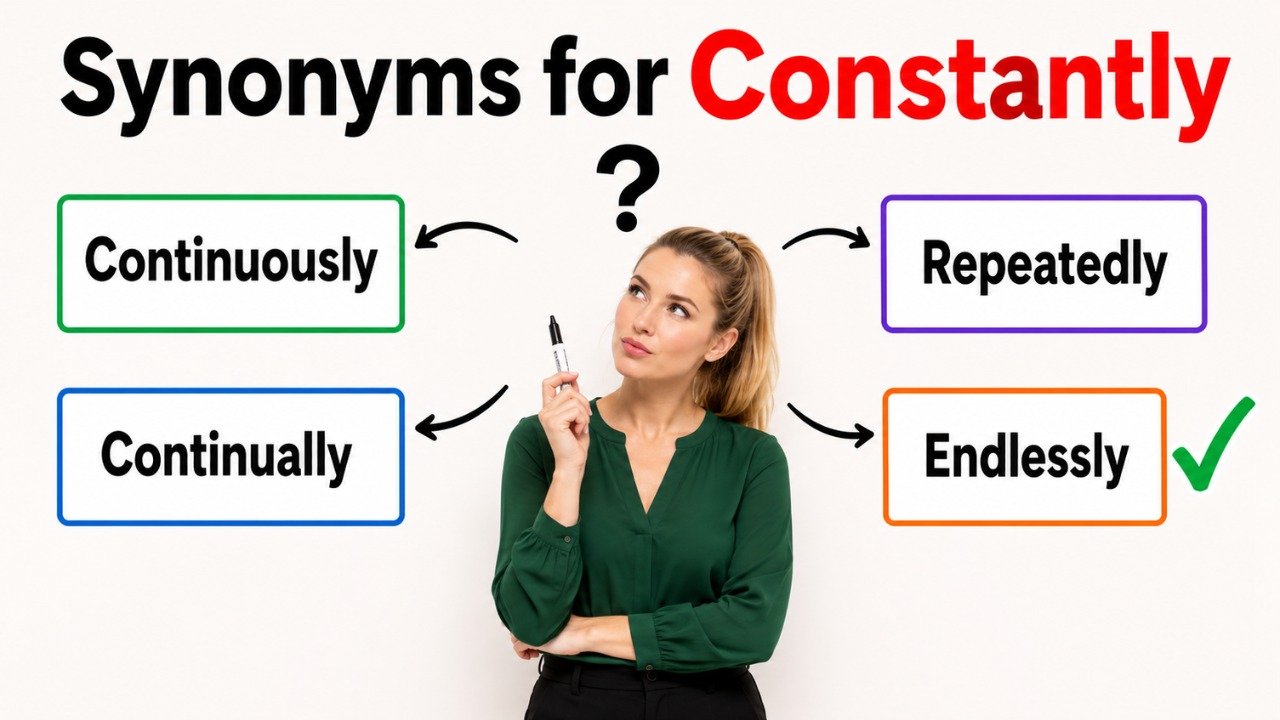
Quick Answer: The best synonyms for constantly include continually, continuously, always, perpetually, repeatedly, persistently, consistently, incessantly, regularly, and ceaselessly. Use continuously when an action happens without interruption, repeatedly when something occurs many times, and regularly when it follows a routine. Persistently suits determined action, consistently emphasizes a stable pattern, and incessantly often describes something annoying that does not seem to stop.
Pronunciation and Word Details
Word: Constantly.
Pronunciation: /ˈkɑːn.stənt.li/
Part of Speech: Adverb.
Meaning: Happening all the time, very frequently, or repeatedly over a period.
US Pronunciation:
UK Pronunciation:
What Does “Constantly” Mean?
Constantly means all the time, without much interruption, or very frequently. It is an adverb that modifies a verb, adjective, or entire statement by explaining how regularly something happens.
In the sentence “The machine runs constantly,” the word suggests that the machine operates without stopping. In “He constantly checks his messages,” it means that he checks them very frequently or repeatedly.
The word does not always mean that an action happens every second. In everyday conversation, it often means that something happens so frequently that it seems continuous.
Constantly can describe actions, habits, conditions, thoughts, sounds, changes, or repeated behavior. Its exact meaning depends on whether the action is uninterrupted, frequent, habitual, or persistent.
Meaning, Tone, and Context of “Constantly”
Constantly is a neutral and widely used word. It appears naturally in formal writing, casual speech, academic explanations, workplace communication, technical descriptions, and personal conversations.
The word can have a positive, neutral, or negative tone. “She is constantly improving” sounds positive because it describes continuing progress. “The alarm is constantly ringing” sounds negative because the repeated noise is annoying.
In technical or scientific contexts, constantly may suggest that something remains active or unchanged over time. In ordinary conversation, it often emphasizes that an action happens very frequently.
The word can also express frustration or exaggeration. A person who says, “You are constantly interrupting me,” may not mean that interruptions occur every second. The speaker means that they happen too often.
When and How to Use “Constantly”
For Uninterrupted Action
Use: Use constantly when an activity continues with little or no interruption.
Example: The cooling system operates constantly during the summer.
For Frequent Repetition
Use: Use constantly when something happens many times within a period.
Example: She constantly checks the oven while baking.
For Regular Habits
Use: Use constantly to describe a behavior that someone performs very often.
Example: He is constantly looking for ways to improve his writing.
For Continuing Change
Use: Use constantly when a situation develops or changes over time.
Example: Language is constantly changing.
For Persistent Effort
Use: Use constantly when someone continues working toward a goal.
Example: The team constantly searches for better solutions.
For Annoying Behavior
Use: Use constantly when repeated behavior causes irritation or frustration.
Example: The neighbor’s dog is constantly barking.
For Ongoing Conditions
Use: Use constantly when a condition remains present for a long time.
Example: The room must be constantly monitored.
Best Synonyms for Constantly
Continually: Happening repeatedly with occasional pauses.
Example: The teacher continually reminded the class about the deadline.
Continuously: Happening without stopping or interruption.
Example: The engine ran continuously for twelve hours.
Always: At every time or on every occasion.
Example: She always arrives before the meeting begins.
Perpetually: Continuing for a very long time or seeming never to end.
Example: He appeared perpetually dissatisfied with the results.
Repeatedly: Happening many times.
Example: The warning message appeared repeatedly on the screen.
Persistently: Continuing firmly despite difficulty or opposition.
Example: She persistently asked for a clear explanation.
Consistently: Happening in a stable and dependable way.
Example: The company consistently meets its quality standards.
Incessantly: Continuing without stopping, often in an annoying way.
Example: The phone rang incessantly throughout the afternoon.
Regularly: Happening according to a pattern or routine.
Example: The equipment is regularly inspected for damage.
Ceaselessly: Continuing without ending or resting.
Example: The waves moved ceaselessly toward the shore.
50 Synonyms for Constantly with Short Meanings
- Continually: Repeatedly over a period, sometimes with pauses.
- Continuously: Without stopping or interruption.
- Always: At all times or on every occasion.
- Perpetually: Continuing indefinitely or seeming endless.
- Incessantly: Without stopping, often annoyingly.
- Endlessly: Continuing without an apparent end.
- Ceaselessly: Without pausing or finishing.
- Unceasingly: In a way that never stops.
- Persistently: With continued determination or repetition.
- Repeatedly: Many times in succession.
- Regularly: According to a usual pattern or schedule.
- Frequently: Many times or at short intervals.
- Often: On many occasions.
- Habitually: As a regular personal habit.
- Routinely: As part of a normal routine.
- Invariably: In every case or on every occasion.
- Consistently: In a steady and dependable manner.
- Steadily: At a continuous and even rate.
- Nonstop: Without any break or pause.
- Uninterruptedly: Without being stopped or disturbed.
- Unremittingly: Without becoming weaker or less intense.
- Relentlessly: Without stopping or becoming less determined.
- Chronically: Repeatedly or continuously over a long period.
- Recurrently: In a way that returns repeatedly.
- Repetitively: By doing or saying the same thing many times.
- Customarily: According to a usual practice.
- Usually: In most situations or on most occasions.
- Commonly: Frequently or in many situations.
- Forever: For all future time or an extremely long period.
- Eternally: Without beginning or end.
- Permanently: In a lasting and continuing way.
- Ongoingly: In a continuing manner.
- Unfailingly: Without exception or failure.
- Dependably: In a reliable and regular way.
- Systematically: According to a fixed and organized method.
- Daily: Every day.
- Nightly: Every night.
- Hourly: Every hour or very frequently.
- All the time: During the entire period or very frequently.
- At all times: On every occasion.
- Around the clock: Throughout the entire day and night.
- Day and night: Continuously throughout each day.
- Without interruption: With no break in activity.
- Without stopping: In a continuous manner.
- Without pause: Without taking a break.
- Without ceasing: Without coming to an end.
- Again and again: Repeatedly over time.
- Over and over: Many times in the same way.
- Time and again: On many repeated occasions.
- Day after day: Repeatedly over many days.
Read Also:
Synonyms for Regarding

Synonyms for Constantly by Context
When Constantly Means Without Stopping
Use continuously, ceaselessly, unceasingly, nonstop, uninterruptedly, or without pause when an action has no meaningful break.
Example: The generator operated continuously during the power failure.
Example: Rain fell ceaselessly throughout the night.
Example: The support line remains open around the clock.
When Constantly Means Repeatedly
Use repeatedly, continually, recurrently, repetitively, again and again, or over and over when something happens many times.
Example: He repeatedly asked the same question.
Example: The error message appeared again and again.
Example: She continually returned to the main point.
When Constantly Means Regularly
Use regularly, routinely, habitually, consistently, daily, or customarily when an action follows a pattern or established habit.
Example: The records are regularly reviewed.
Example: She routinely prepares her schedule the night before.
Example: He consistently completes his work on time.
When Constantly Means Persistently
Use persistently, relentlessly, unremittingly, or steadily when someone continues an effort despite difficulty.
Example: The researcher persistently searched for an explanation.
Example: The team worked relentlessly to meet the deadline.
Example: Sales improved steadily throughout the year.
When Constantly Expresses Annoyance
Use incessantly, endlessly, perpetually, or chronically when the repeated action feels excessive, frustrating, or difficult to escape.
Example: The child complained incessantly during the journey.
Example: He is perpetually late for appointments.
Example: The system is chronically overloaded.
Another Word for Constantly
Continually is often the best general replacement for constantly. It describes something that happens repeatedly over a period, although brief pauses may occur.
The best alternative depends on the intended meaning. Use continuously for an action that never stops, repeatedly for an action that occurs many times, and consistently for a dependable pattern.
Original: She constantly asks for updates.
Better Option: She continually asks for updates.
Original: The machine runs constantly.
Better Option: The machine runs continuously.
Original: He constantly makes the same mistake.
Better Option: He repeatedly makes the same mistake.
Original: The student constantly produces excellent work.
Better Option: The student consistently produces excellent work.
When Not to Use “Constantly”
Do not use constantly when a more precise word can explain the frequency, duration, or emotional tone of an action.
Use continuously when something truly happens without any pause. Use repeatedly when the number of occurrences matters. Use regularly when an action follows a schedule. Use persistently when determination is the main idea.
Constantly may also sound exaggerated when an action happens only occasionally. A more accurate frequency word can make the sentence clearer.
Weak: We constantly hold a meeting every Friday.
Better: We regularly hold a meeting every Friday.
Weak: The light constantly remained on for three hours.
Better: The light remained on continuously for three hours.
Weak: She constantly called him three times yesterday.
Better: She called him repeatedly yesterday.
Weak: He constantly continued despite several rejections.
Better: He persistently continued despite several rejections.
Weak: The report is constantly submitted at the end of each month.
Better: The report is routinely submitted at the end of each month.
Words Commonly Confused With Constantly
Constantly vs Continually: Constantly can mean all the time or very frequently. Continually usually means repeatedly, with possible breaks between occurrences.
Constantly vs Continuously: Constantly may allow brief pauses, especially in everyday speech. Continuously means without interruption.
Constantly vs Consistently: Constantly describes frequency or duration. Consistently describes stability, reliability, or the same standard over time.
Constantly vs Regularly: Constantly suggests very frequent activity. Regularly suggests a predictable routine or schedule.
Constantly vs Repeatedly: Constantly may describe an ongoing condition. Repeatedly focuses on an action occurring many separate times.
Constantly vs Persistently: Constantly emphasizes how often something happens. Persistently emphasizes determination and refusal to stop.
Constantly vs Always: Constantly usually describes continuing or frequent action. Always can mean on every occasion or without exception.
Constantly vs Incessantly: Constantly is usually neutral. Incessantly often carries a negative tone and suggests an irritating lack of pause.
Which Synonym Should You Choose?
Choose continuously when an action occurs without interruption.
Choose continually when an action happens repeatedly with occasional pauses.
Choose repeatedly when something happens several separate times.
Choose regularly when the action follows a routine or schedule.
Choose consistently when performance, behavior, or quality remains stable.
Choose persistently when someone continues despite difficulty or resistance.
Choose incessantly when repeated activity is annoying or exhausting.
Choose always when something happens on every occasion.
Choose perpetually when a situation seems endless or permanent.
Choose steadily when something progresses at an even and continuing rate.
Choose routinely in reports, instructions, policies, or workplace communication.
Choose frequently when you mean often but do not want to suggest uninterrupted activity.
Real Life Examples of “Constantly” in Sentences
Original: The software is constantly receiving updates.
Better Option: The software is continually receiving updates.
Original: Water constantly flows through the pipe.
Better Option: Water continuously flows through the pipe.
Original: She constantly checks her work for errors.
Better Option: She repeatedly checks her work for errors.
Original: The team constantly delivers strong results.
Better Option: The team consistently delivers strong results.
Original: He constantly practices his speaking skills.
Better Option: He regularly practices his speaking skills.
Original: The baby was constantly crying during the journey.
Better Option: The baby was crying incessantly during the journey.
Original: She constantly requested another opportunity.
Better Option: She persistently requested another opportunity.
Original: The price is constantly increasing.
Better Option: The price is steadily increasing.
Original: The office constantly reviews its safety procedures.
Better Option: The office routinely reviews its safety procedures.
Original: New ideas are constantly appearing during the discussion.
Better Option: New ideas are continually appearing during the discussion.
Synonym Groups and Usage Differences
Continuous Action Group
Continuously, ceaselessly, uninterruptedly, nonstop, and unceasingly describe an action that does not stop.
Example: The pump worked continuously throughout the night.
Frequent Repetition Group
Repeatedly, continually, frequently, again and again, and time and again describe something that happens many times.
Example: She repeatedly explained the instructions.
Regular Habit Group
Regularly, routinely, habitually, daily, and customarily describe actions performed according to a habit or pattern.
Example: The equipment is routinely inspected.
Persistent Effort Group
Persistently, relentlessly, steadily, and unremittingly describe continued effort or pressure.
Example: He persistently worked toward his goal.
Dependable Pattern Group
Consistently, invariably, unfailingly, and dependably describe actions or results that remain reliable.
Example: The employee consistently meets every deadline.
Endless Duration Group
Perpetually, endlessly, eternally, and forever describe something that continues for an extremely long time or appears never to end.
Example: The character seemed perpetually confused.
Annoying Repetition Group
Incessantly, endlessly, repetitively, and chronically can suggest that an action happens too often or causes frustration.
Example: The device beeped incessantly.
Antonyms of Constantly
The opposite of constantly depends on whether the word means continuously, frequently, or regularly.
Occasionally: Happening from time to time.
Rarely: Not happening often.
Seldom: Happening on very few occasions.
Sometimes: Happening on certain occasions but not regularly.
Intermittently: Happening with pauses between periods of activity.
Sporadically: Happening irregularly and unpredictably.
Infrequently: Not occurring very often.
Temporarily: Continuing for only a limited period.
Briefly: Lasting for a short time.
Once: Happening a single time.
Never: Not happening at any time.
Irregularly: Without a consistent schedule or pattern.
Comparison: Constantly vs Related Words
Constantly vs Continually
Constantly suggests something happens all the time or extremely often. Continually describes repeated action that may include short breaks.
Example With Constantly: She is constantly thinking about her next project.
Example With Continually: She continually returns to the project to make improvements.
Constantly vs Continuously
Constantly is flexible and may describe frequent repetition. Continuously specifically means that no interruption occurs.
Example With Constantly: He constantly checks the temperature.
Example With Continuously: The sensor continuously measures the temperature.
Constantly vs Repeatedly
Constantly can describe an ongoing action or condition. Repeatedly describes separate occurrences of the same action.
Example With Constantly: The room is constantly warm.
Example With Repeatedly: The heater repeatedly turns itself on.
Constantly vs Consistently
Constantly focuses on frequency. Consistently focuses on reliability, uniformity, or stable performance.
Example With Constantly: She constantly submits new ideas.
Example With Consistently: She consistently submits high quality ideas.
Constantly vs Regularly
Constantly suggests an action happens very often. Regularly suggests that it happens according to a pattern.
Example With Constantly: He constantly visits the library.
Example With Regularly: He regularly visits the library every Saturday.
Constantly vs Persistently
Constantly describes frequency or duration. Persistently describes determined action despite difficulty.
Example With Constantly: She constantly asks questions.
Example With Persistently: She persistently asks for an answer despite being ignored.
Constantly vs Incessantly
Constantly is usually neutral. Incessantly often communicates annoyance, discomfort, or frustration.
Example With Constantly: The system is constantly processing information.
Example With Incessantly: The alarm rang incessantly for an hour.
Common Phrases and Expressions With Constantly
Constantly Changing: Developing or becoming different very frequently.
Constantly Growing: Increasing continuously over time.
Constantly Evolving: Gradually developing through ongoing changes.
Constantly Improving: Becoming better through continued effort.
Constantly Moving: Remaining physically active or changing position.
Constantly Thinking: Having a thought remain active in the mind.
Constantly Reminded: Being made to remember something repeatedly.
Constantly Updated: Receiving new information or changes very frequently.
Constantly Complaining: Expressing dissatisfaction too frequently.
Constantly Worried: Feeling concern for much of the time.
Common Mistakes to Avoid
One common mistake is using constantly when regularly is more accurate. A weekly appointment happens regularly, not constantly.
Writers also confuse constantly with continuously. Continuously means without any pause, while constantly may simply mean very frequently.
Avoid using constantly several times in the same paragraph. Repetition can make the writing sound dull or exaggerated. Replace it with continually, repeatedly, regularly, persistently, or consistently when those words better fit the meaning.
Do not choose a synonym only because it sounds formal. Incessantly can introduce annoyance, while perpetually may suggest that a situation feels endless. These words can change the tone of a sentence.
Be careful with always. It makes an absolute statement and may be inaccurate when exceptions exist. Frequently or regularly may express the intended meaning more precisely.
Also avoid placing constantly in an unnatural position. It usually appears before the main verb but after a form of the verb be.
Correct: She constantly reviews her notes.
Correct: She is constantly reviewing her notes.
Unnatural: She reviews constantly her notes.
Conclusion
The best synonyms for constantly depend on whether an action is uninterrupted, repeated, regular, persistent, or dependable. Use continuously for activity without breaks, repeatedly for separate occurrences, regularly for routines, and consistently for stable performance. Persistently emphasizes determination, while incessantly often expresses annoyance. By choosing among these synonyms for constantly carefully, you can communicate frequency and duration more accurately while improving the clarity, tone, and variety of your writing.
FAQs About Synonyms for Constantly
What Is the Best Synonym for Constantly?
Continually is the best general synonym. However, continuously is better for an action that never stops, while repeatedly suits separate recurring actions.
Does Constantly Mean Continuously?
Not always. Constantly may mean very frequently, while continuously means without any interruption.
Is Always a Synonym for Constantly?
Yes, but always is more absolute. It means at every time or on every occasion, while constantly can mean extremely frequently.
What Is a Formal Synonym for Constantly?
Continually, consistently, perpetually, persistently, and unremittingly are useful formal alternatives. The correct choice depends on context.
What Is a Negative Synonym for Constantly?
Incessantly is a strong negative synonym because it often describes annoying or exhausting repetition.
What Is the Difference Between Constantly and Regularly?
Constantly suggests very frequent or continuing action. Regularly describes something that follows a predictable pattern or schedule.
Can Constantly Describe Positive Actions?
Yes. Sentences such as “She is constantly learning” and “The service is constantly improving” use the word positively.
