
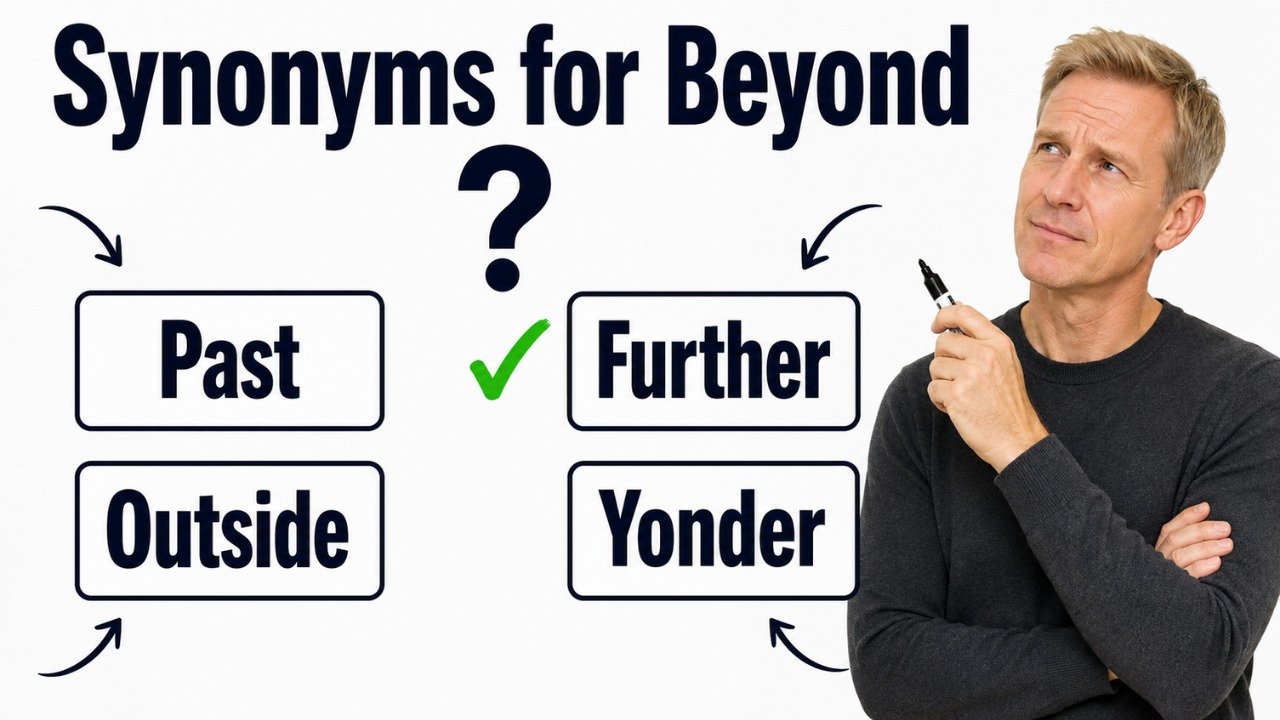
Quick Answer: The best synonyms for beyond include past, outside, above, over, exceeding, surpassing, farther than, after, besides, and out of reach. Use past for physical movement or time, outside for limits and scope, exceeding for numbers or expectations, and surpassing for performance. After works for time, besides introduces additional information, while out of reach describes something unavailable or impossible to access.
Pronunciation and Word Details
Word: Beyond.
Pronunciation: /bɪˈjɒnd/.
Part of Speech: Preposition, adverb, and noun.
Meaning: Beyond means farther away, later than, outside a limit, or greater than a particular amount, level, or ability.
US Pronunciation:
UK Pronunciation:
What Does “Beyond” Mean?
Beyond means farther than a particular place, outside a stated limit, later than a certain time, or greater than an expected level. It can function as a preposition, adverb, or noun.
As a preposition, beyond is followed by a noun or pronoun.
Example: The village lies beyond the mountains.
As an adverb, beyond refers to a place or condition farther away.
Example: We could see the fields and the hills beyond.
As a noun, it can describe an unknown place, distant region, or existence outside ordinary life.
Example: The story explored mysteries of the beyond.
Beyond can describe physical distance, time, understanding, control, ability, quantity, expectations, and emotional intensity. Its exact meaning depends on the words surrounding it.
Meaning, Tone, and Context of “Beyond”
Beyond usually has a neutral and flexible tone. It appears naturally in formal writing, academic discussions, reports, stories, instructions, and ordinary conversation.
Physical Context: Beyond describes something located on the farther side of a place, object, or boundary.
Example: A quiet forest stood beyond the river.
Limit Context: It shows that something has passed a rule, boundary, amount, or acceptable level.
Example: The cost rose beyond the approved budget.
Time Context: It refers to a point later than a particular date, hour, or period.
Example: The offer will not remain available beyond Friday.
Ability Context: It describes something too difficult for a person to understand, control, perform, or achieve.
Example: The technical explanation was beyond my understanding.
Degree Context: It emphasizes that something is greater, stronger, or more extreme than expected.
Example: The final result was beyond our expectations.
Additional Context: Beyond can mean besides or in addition to something already mentioned.
Example: Beyond improving speed, the changes reduced operating costs.
The tone becomes emotional or emphatic in expressions such as beyond belief, beyond repair, and beyond words.
When and How to Use “Beyond”
For Physical Distance: Use beyond when something is on the farther side of a place, object, or boundary.
Example: Their house is located beyond the old bridge.
For Movement: Use beyond when a person or object passes a particular point.
Example: The cyclist continued beyond the finish area.
For Time: Use beyond when something continues after a stated date, hour, age, or period.
Example: The meeting continued beyond noon.
For Limits: Use beyond when something exceeds an accepted boundary, rule, or amount.
Example: The repairs went beyond the original budget.
For Expectations: Use beyond when a result is greater or better than anticipated.
Example: Her performance went beyond everyone’s expectations.
For Understanding: Use beyond when an idea is too difficult to understand or explain.
Example: The reason for his decision was beyond my understanding.
For Control: Use beyond when a situation cannot be managed or influenced.
Example: The sudden weather change was beyond our control.
For Ability: Use beyond when a task is too difficult for someone’s current skills.
Example: The advanced calculation was beyond the students’ ability.
For Additional Information: Use beyond to introduce another point or benefit.
Example: Beyond saving money, the new system saves time.
Best Synonyms for Beyond
Past: Farther than a particular place, point, or time.
Example: Walk past the library and turn right.
Outside: Not within a boundary, group, range, or subject.
Example: That request falls outside my responsibilities.
Above: Higher than a level, amount, standard, or position.
Example: Temperatures remained above normal throughout the week.
Over: More than a stated number, amount, distance, or limit.
Example: The project cost over ten thousand dollars.
Exceeding: Being greater than a limit, amount, or expectation.
Example: Applications exceeding the word limit will be shortened.
Surpassing: Performing better than or becoming greater than something else.
Example: Her results were surpassing all previous records.
Farther Than: At a greater physical distance than a stated point.
Example: The campsite is farther than we originally thought.
After: Later than a particular time, date, or event.
Example: Requests received after Monday may be delayed.
Besides: In addition to something already mentioned.
Example: Besides experience, the position requires patience.
Out of Reach: Too distant, difficult, or unavailable to obtain.
Example: The expensive property remained out of reach for many buyers.
50 Synonyms for Beyond with Short Meanings
- Past: Farther than a place, point, limit, or time.
- Over: More than a particular amount, number, or limit.
- Above: Higher than a stated level, position, or standard.
- Outside: Not within a boundary, group, subject, or range.
- Farther Than: At a greater physical distance than something.
- Further Than: Extending to a greater distance, degree, or stage.
- On the Far Side of: Located after or across a particular boundary.
- On the Other Side of: Positioned across or past something.
- Across: On or toward the opposite side of an area.
- Away From: At a distance from a person, place, or point.
- Out Past: Farther along than a particular location.
- Ahead of: Farther forward in position, time, or progress.
- Farther Ahead: At a more distant forward position.
- Further On: At a later point in distance, time, or progress.
- In the Distance: Located far away from the observer.
- Remote From: Far removed from a place, condition, or idea.
- Outside the Boundary of: Not contained within a stated border.
- Outside the Range of: Not included within an available or acceptable range.
- Out of Reach of: Too far away or difficult to access.
- Past the Edge of: Located farther than an outer boundary.
- Exceeding: Going above a stated amount, rule, or standard.
- Surpassing: Becoming greater, better, or more successful than something.
- Transcending: Rising above ordinary limits or categories.
- Outstripping: Developing or performing faster or better than another.
- Outdoing: Performing better than a previous effort or competitor.
- Eclipsing: Becoming more impressive or important than something else.
- Greater Than: Larger, stronger, higher, or more important than something.
- More Than: Exceeding a particular amount, degree, or description.
- In Excess of: Greater than an allowed or expected amount.
- Over and Above: Additional to or greater than what is required.
- Outside the Limits of: Not contained within accepted boundaries.
- Past the Point of: Having moved beyond a particular stage or condition.
- Too Great For: More difficult, powerful, or extensive than something can manage.
- After: Later than a stated time, date, or event.
- Later Than: Occurring following a particular time.
- Following: Coming after something in time or order.
- Subsequent To: Happening after a particular event or period.
- Afterward: At a later time following an event.
- Thereafter: From a stated time onward.
- From Then On: Continuing after a particular moment.
- Besides: In addition to or apart from something.
- Apart From: Besides, except for, or separate from something.
- Other Than: Except for or different from something mentioned.
- Except For: Not including a particular person, thing, or condition.
- In Addition To: Used to introduce another fact, quality, or benefit.
- As Well As: Together with something already mentioned.
- Outside Of: Not included within a place, group, or subject.
- Incomprehensible To: Too difficult for someone to understand.
- Outside the Understanding of: Not able to be understood by someone.
- Outside the Control of: Not able to be managed, changed, or prevented.
Read Also:
Synonyms for Attack

Synonyms for Beyond by Context
When Beyond Means Farther Away
Past, farther than, further than, on the far side of, across, and out past work well when beyond describes physical location or movement.
Example: The village is past the railway station.
Example: A narrow path continues farther than the visible trail.
Example: Their farm lies on the far side of the river.
Past is the most natural replacement when someone or something moves farther than a known point. Farther than emphasizes measurable physical distance. On the far side of is useful when a landmark separates two locations.
When Beyond Means Outside a Limit
Outside, exceeding, above, over, in excess of, and outside the limits of describe something that has passed a boundary, amount, or rule.
Example: The expense was outside the approved budget.
Example: The vehicle was traveling above the permitted speed.
Example: Charges in excess of the agreed amount require approval.
Outside is useful for scope, responsibility, or authority. Exceeding sounds formal and works well with amounts and limits. Over is more common in everyday language.
When Beyond Means Greater Than Expected
Surpassing, transcending, outstripping, outdoing, and eclipsing describe results that are stronger, better, or more impressive than expected.
Example: Her performance surpassed our expectations.
Example: The new design outstripped the earlier version in efficiency.
Example: His latest achievement eclipsed his previous success.
Surpassing is suitable for expectations, goals, and standards. Outstripping often compares progress, growth, or performance. Eclipsing suggests that one success makes another appear less impressive.
When Beyond Means Later in Time
After, later than, following, subsequent to, thereafter, and from then on work when beyond refers to time.
Example: Applications received after Friday will be reviewed later.
Example: No changes can be made subsequent to approval.
Example: The policy was introduced in May and remained in effect thereafter.
After is the clearest everyday choice. Subsequent to is more formal and common in official writing. Thereafter refers to everything that happens following a stated moment.
When Beyond Means Outside Understanding or Control
Incomprehensible to, outside the understanding of, outside the control of, and out of reach describe things that cannot be understood, managed, or achieved.
Example: The scientific explanation was incomprehensible to beginners.
Example: The delay resulted from circumstances outside our control.
Example: The required amount remained out of reach for the small organization.
These alternatives make the exact limitation clearer. Incomprehensible relates to understanding, while outside the control of relates to management or influence.
When Beyond Means In Addition To
Besides, apart from, in addition to, and as well as work when beyond introduces another fact, benefit, or consideration.
Example: Besides reducing waste, the process saves energy.
Example: In addition to teaching, she writes educational materials.
Example: The program supports adults as well as younger learners.
Besides is natural in conversation. In addition to is suitable for formal writing. As well as connects two related ideas without strongly emphasizing either one.
Another Word for Beyond
Past is often the best single replacement for beyond when discussing physical movement or location. However, no single synonym works in every sentence. Outside is better for scope and limits, exceeding works for amounts, after works for time, and surpassing works for performance or expectations.
Original: The shop is beyond the traffic lights.
Better Option: The shop is past the traffic lights.
Original: The request is beyond my authority.
Better Option: The request is outside my authority.
Original: The final cost was beyond the agreed amount.
Better Option: The final cost exceeded the agreed amount.
Original: Her achievement went beyond our expectations.
Better Option: Her achievement surpassed our expectations.
When Not to Use “Beyond”
Avoid beyond when it creates an unclear or overly broad meaning. A more specific synonym can explain whether you mean distance, time, quantity, ability, or scope.
Weak: The problem is beyond.
Better: The problem is outside the scope of this discussion.
Do not use beyond when a precise measurement is available.
Weak: The temperature rose beyond the normal level.
Better: The temperature rose five degrees above the normal level.
Avoid beyond when the reader may not know which boundary has been crossed.
Weak: The work continued beyond.
Better: The work continued after the scheduled closing time.
Beyond may sound overly dramatic when describing a simple difficulty.
Weak: Completing the form was beyond my abilities.
Better: I needed assistance to complete the form.
Do not replace every use of over with beyond. Over is usually more natural for simple numbers and quantities.
Weak: Beyond fifty people attended the event.
Better: Over fifty people attended the event.
Avoid using beyond and its synonym together when they repeat the same idea.
Weak: The cost went beyond and exceeded the limit.
Better: The cost exceeded the limit.
Words Commonly Confused With Beyond
Beyond vs Past: Beyond can describe distance, limits, understanding, expectations, or time. Past mainly describes movement, position, or time after a particular point.
Beyond vs Above: Beyond means farther than or outside a limit. Above usually describes a higher physical position, number, level, or rank.
Beyond vs Over: Beyond often emphasizes crossing a boundary. Over commonly describes a higher position or an amount greater than a number.
Beyond vs Outside: Beyond may suggest movement farther than a point. Outside means not contained within a place, group, range, or subject.
Beyond vs Exceeding: Beyond is flexible and common in many contexts. Exceeding is more formal and specifically means being greater than a limit or amount.
Beyond vs Besides: Beyond can mean in addition to, but it has several other meanings. Besides mainly introduces another point or exception.
Beyond vs After: Beyond may refer to time, distance, degree, or limits. After refers specifically to a later time, position, or order.
Which Synonym Should You Choose?
Choose past when describing movement or location after a landmark.
Choose farther than when emphasizing measurable physical distance.
Choose outside when something is not included within a boundary, subject, responsibility, or authority.
Choose above when referring to a higher level, number, position, or standard.
Choose over for numbers, quantities, ages, distances, and ordinary comparisons.
Choose exceeding in formal reports, rules, applications, or financial documents.
Choose surpassing when performance or results are better than expectations.
Choose transcending when something rises above ordinary limits, categories, or experiences.
Choose after when referring to a later time, date, or event.
Choose subsequent to when formal writing requires a precise time sequence.
Choose besides when adding another point in casual or conversational language.
Choose in addition to in essays, reports, emails, and professional writing.
Choose out of reach when something is unavailable, unaffordable, or impossible to obtain.
Choose incomprehensible when an idea is too difficult to understand.
Choose outside the control of when a situation cannot be managed or prevented.
Real Life Examples of “Beyond” in Sentences
Original: The walking trail continues beyond the lake.
Better Option: The walking trail continues past the lake.
Original: The final bill was beyond our budget.
Better Option: The final bill exceeded our budget.
Original: The decision was beyond my authority.
Better Option: The decision was outside my authority.
Original: The meeting continued beyond five o’clock.
Better Option: The meeting continued after five o’clock.
Original: Her kindness went beyond our expectations.
Better Option: Her kindness surpassed our expectations.
Original: The explanation was beyond my understanding.
Better Option: The explanation was incomprehensible to me.
Original: The situation quickly moved beyond our control.
Better Option: The situation quickly moved outside our control.
Original: The mountains beyond were covered with snow.
Better Option: The distant mountains were covered with snow.
Original: Beyond its attractive design, the device is easy to operate.
Better Option: In addition to its attractive design, the device is easy to operate.
Original: The cost of the course placed it beyond her reach.
Better Option: The cost of the course placed it out of her reach.
Synonym Groups and Usage Differences
Distance Group
Past, farther than, further than, across, ahead of, and on the far side of describe location or movement.
Past is usually the simplest choice after a landmark. Farther than compares physical distance. Across emphasizes being on an opposite side.
Example: The restaurant is past the bank on the left.
Limit Group
Outside, exceeding, over, above, in excess of, and outside the limits of describe boundaries, quantities, and standards.
Outside works with scope and authority. Exceeding works with formal limits. Over is natural with numbers and amounts.
Example: The final response exceeded the permitted word count.
Achievement Group
Surpassing, outstripping, outdoing, transcending, and eclipsing describe superior performance or remarkable results.
Surpassing is the most neutral option. Outdoing compares one achievement with another. Transcending suggests rising above ordinary limits.
Example: The team surpassed its annual target.
Time Group
After, later than, following, subsequent to, thereafter, and from then on describe events occurring at a later time.
After is suitable for most sentences. Subsequent to is more formal. Thereafter refers to the period following a stated event.
Example: No entries will be accepted after the closing date.
Additional Information Group
Besides, apart from, in addition to, and as well as introduce another fact or consideration.
Besides sounds natural in speech. In addition to has a more formal tone. Apart from can mean either besides or except for, depending on context.
Example: In addition to reducing costs, the update improved performance.
Difficulty Group
Out of reach, incomprehensible to, outside the understanding of, and too great for describe limitations involving access, ability, or understanding.
Out of reach can be physical or figurative. Incomprehensible specifically refers to understanding.
Example: The technical instructions were incomprehensible to new users.
Antonyms of Beyond
The opposite of beyond depends on whether the word describes location, time, limits, quantity, understanding, or accessibility.
Before: Earlier than a particular time, event, or position.
Within: Inside a particular boundary, range, period, or limit.
Inside: Located in the inner part of a place or group.
Below: Lower than a particular level, position, number, or standard.
Under: Less than a stated number, amount, age, or limit.
Near: Located at a short distance from something.
Closer Than: At a shorter distance than another point.
Short of: Not reaching a particular point, amount, or standard.
Limited To: Restricted within a particular subject, group, or amount.
Reachable: Able to be accessed, achieved, or contacted.
Understandable: Clear enough to be understood.
Controllable: Able to be managed, directed, or limited.
Included: Contained within a group, range, or subject.
Up To: Extending as far as a stated limit but not farther.
Comparison: Beyond vs Related Words
Beyond vs Past
Beyond has a broader meaning and can refer to limits, abilities, expectations, time, or distance. Past mainly refers to movement or position after a particular point.
Example With Beyond: The issue is beyond the authority of this department.
Example With Past: Walk past the department office and turn left.
Beyond vs Above
Beyond suggests crossing or existing outside a boundary. Above refers to a higher physical position, amount, level, or rank.
Example With Beyond: The final expense was beyond the approved budget.
Example With Above: The final expense was above the estimated amount.
Beyond vs Over
Beyond often emphasizes being outside a limit or farther than a point. Over is more natural for simple quantities, ages, and measurements.
Example With Beyond: The matter goes beyond financial concerns.
Example With Over: Over two hundred people completed the survey.
Beyond vs Outside
Beyond may suggest being farther away or exceeding something. Outside simply means not within a particular place, subject, range, or group.
Example With Beyond: The village lies beyond the hills.
Example With Outside: The equipment must remain outside the building.
Beyond vs Exceeding
Beyond is common in both formal and casual language. Exceeding is more precise when something is greater than a stated amount or limit.
Example With Beyond: The cost was beyond what we expected.
Example With Exceeding: Expenses exceeding the limit require written approval.
Beyond vs Surpassing
Beyond describes a position or condition outside a limit. Surpassing emphasizes being better, greater, or more successful than something else.
Example With Beyond: The results were beyond our expectations.
Example With Surpassing: The results surpassed our expectations.
Common Phrases and Expressions With Beyond
Beyond Doubt: Completely certain and not open to reasonable disagreement.
Beyond Belief: So surprising or extreme that it is difficult to believe.
Beyond Repair: Too badly damaged to be fixed.
Beyond Recognition: Changed so greatly that the original appearance is difficult to identify.
Beyond Control: Unable to be managed, influenced, or prevented.
Beyond Compare: Better or more impressive than anything similar.
Beyond Expectations: Better, greater, or more successful than anticipated.
Beyond Reach: Too far away, expensive, difficult, or unavailable to obtain.
Beyond Measure: Extremely great and impossible to calculate accurately.
Beyond Question: Completely certain and not open to doubt.
Common Mistakes to Avoid
A common mistake is treating beyond as a synonym for over in every context. Over is generally more natural before simple numbers and quantities.
Incorrect: Beyond twenty students attended the lesson.
Correct: Over twenty students attended the lesson.
Do not use beyond without making the relevant limit, place, or point clear.
Unclear: The discussion went beyond.
Clear: The discussion went beyond the original topic.
Avoid confusing farther with further. Farther usually refers to physical distance, while further can describe physical or figurative development.
Physical: The village is farther than the lake.
Figurative: The investigation went further than expected.
Do not use beyond when after provides a clearer time reference.
Unclear: The office will remain closed beyond Monday.
Clear: The office will remain closed after Monday.
Avoid choosing outside when movement past a point is the intended meaning.
Unnatural: Walk outside the bank and turn right.
Natural: Walk past the bank and turn right.
Do not repeat beyond too often in one paragraph. Use specific alternatives such as past, outside, exceeding, after, or surpassing to improve clarity and variety.
Be careful with apart from because it can mean besides or except for. The surrounding sentence must make the intended meaning clear.
Conclusion
Synonyms for beyond vary according to distance, time, limits, degree, and understanding. Past works best for movement and physical location, while outside suits scope, authority, and boundaries. Use exceeding for formal limits, surpassing for impressive results, and after for time. Besides and in addition to introduce extra information, while out of reach describes something inaccessible. Choosing a context specific replacement makes each sentence clearer, more natural, and more precise.
FAQs About Synonyms for Beyond
What Is the Best Synonym for Beyond?
Past is the best general synonym for physical distance. Outside, exceeding, after, and surpassing are better in other contexts.
What Is Another Word for Beyond a Place?
Past, farther than, on the far side of, across, and out past can describe a location beyond another place.
What Is a Formal Synonym for Beyond?
Exceeding, surpassing, subsequent to, transcending, and outside the limits of are suitable formal alternatives.
What Is a Synonym for Beyond Expectations?
Surpassing expectations, exceeding expectations, outperforming expectations, and doing better than expected are natural alternatives.
Can Past Replace Beyond?
Past can replace beyond when referring to physical movement, location, or time. It may not work when beyond means outside a limit or greater than expected.
What Is the Opposite of Beyond?
Common opposites include before, within, inside, below, under, near, limited to, and short of.
Is Beyond a Preposition or an Adverb?
Beyond can function as a preposition, an adverb, or occasionally a noun. Its role depends on how it is used in the sentence.
