
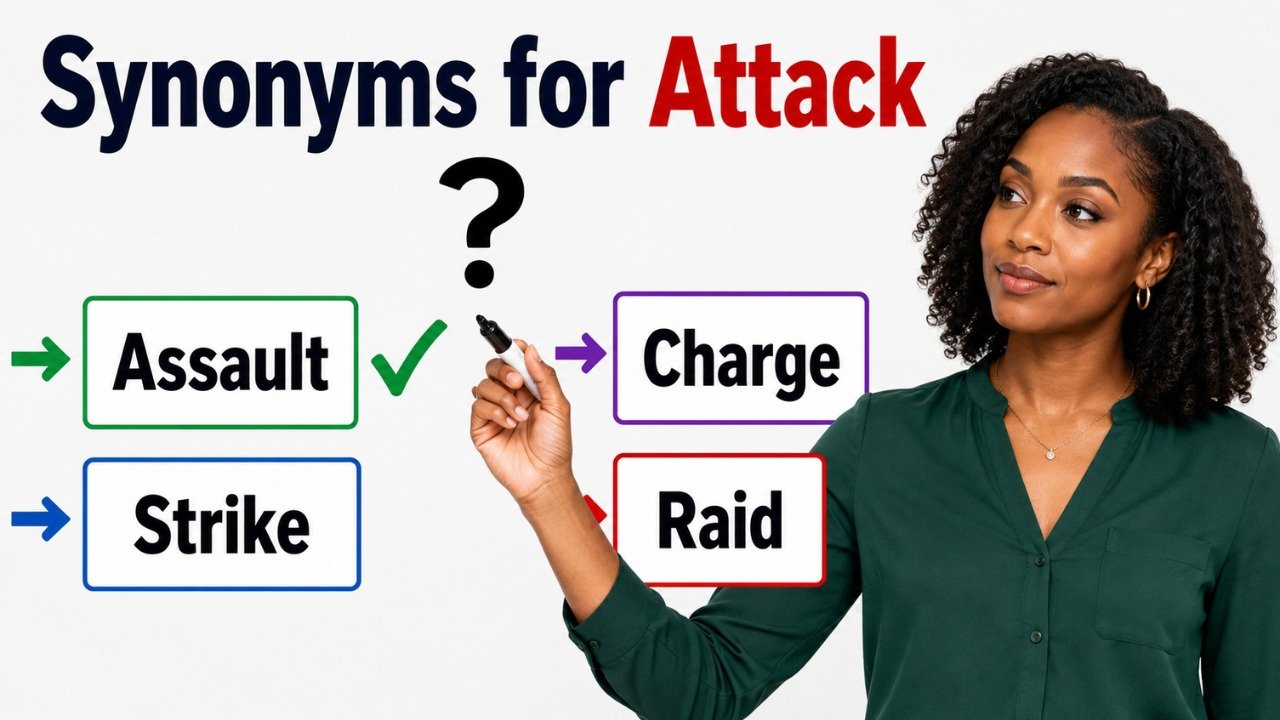
Quick Answer: The best synonyms for attack include assault, strike, charge, raid, offensive, onslaught, target, criticize, condemn, and challenge. Use assault for a forceful physical attack, strike for a sudden action, raid for an organized surprise entry, and offensive for a planned campaign. In speech or writing, criticize, condemn, and challenge are more accurate. When illness attacks the body, affect, afflict, or overwhelm may fit better.
Pronunciation and Word Details
Word: Attack.
Pronunciation: /əˈtæk/.
Part of Speech: Noun and verb.
Meaning: To act aggressively against someone or something, or a forceful action intended to cause harm, defeat opposition, or criticize an idea.
US Pronunciation:
UK Pronunciation:
What Does “Attack” Mean?
Attack means to act aggressively against a person, place, group, idea, system, or problem.
As a verb, attack can describe physical aggression, strong criticism, determined action, or the harmful effect of an illness.
Example: The speaker attacked the proposal during the debate.
As a noun, an attack is an aggressive action, sudden criticism, medical episode, or organized attempt to defeat opposition.
Example: The article contained a harsh attack on the new policy.
Attack can also describe determined efforts against a difficult task.
Example: The team attacked the problem with fresh ideas.
In sports, attack refers to an attempt to score or place pressure on an opponent.
Example: The players launched a quick attack near the end of the match.
The intended meaning depends on whether the sentence concerns conflict, criticism, competition, illness, technology, or problem solving.
Meaning, Tone, and Context of “Attack”
Attack is usually a strong and serious word. It can sound aggressive, urgent, emotional, military, medical, technical, or critical depending on the sentence.
In physical contexts, attack describes forceful action against a person, animal, location, or group.
Example: The guard raised the alarm when the animal began to attack.
In formal discussions, attack can mean strongly criticizing a person, argument, policy, or decision.
Example: Several members attacked the proposal as impractical.
In sports, attack has a neutral technical meaning. It describes forward movement intended to score.
Example: The team strengthened its attack after the break.
In medical language, attack may describe a sudden episode, such as an asthma attack or panic attack.
Example: She followed the recommended steps when the attack began.
In technology, an attack means an attempt to damage, disrupt, or gain unauthorized access to a system.
Example: The security update reduced the risk of an online attack.
Because attack is forceful, a milder synonym may be more suitable when the situation involves disagreement rather than aggression.
When and How to Use “Attack”
For Physical Aggression
Use attack when someone or something acts violently or aggressively toward another person, animal, place, or group.
Example: The frightened animal did not attack anyone.
For Strong Criticism
Use attack when a person harshly challenges someone’s ideas, actions, character, or decisions.
Example: The writer attacked the policy for ignoring public concerns.
For Organized Action
Use attack when a group begins a planned effort against an opponent or position.
Example: The opposition began a coordinated attack before dawn.
For Sports
Use attack when a team or player moves forward to create a scoring opportunity.
Example: The team built its attack through accurate passing.
For Problem Solving
Use attack informally when approaching a difficult task with energy and determination.
Example: Let us attack the most urgent problem first.
For Illness or Symptoms
Use attack when a medical condition causes a sudden and intense episode.
Example: The patient experienced a severe allergy attack.
For Technology
Use attack when a person or program attempts to disrupt, damage, or enter a digital system without permission.
Example: The organization improved its defenses against a network attack.
Best Synonyms for Attack
Assault
Synonym: A forceful or violent action against a person or place.
Example: The court reviewed evidence related to the assault.
Strike
Synonym: A sudden and forceful action against a target.
Example: The storm struck the coast during the night.
Charge
Synonym: A rapid forward movement toward an opponent.
Example: The players made a determined charge toward the goal.
Raid
Synonym: A sudden organized entry intended to seize, inspect, or disrupt.
Example: Officials conducted a raid after receiving reliable information.
Offensive
Synonym: A planned series of actions against an opponent.
Example: The team began an offensive in the final period.
Onslaught
Synonym: A powerful and overwhelming attack or flow of criticism.
Example: The proposal faced an onslaught of objections.
Target
Synonym: To direct criticism, pressure, or harmful action toward someone or something.
Example: The report targeted inefficient procedures.
Criticize
Synonym: To point out faults or weaknesses.
Example: Reviewers criticized the unclear instructions.
Condemn
Synonym: To express strong disapproval of an action or idea.
Example: Community leaders condemned the unfair decision.
Challenge
Synonym: To question, oppose, or test an idea, claim, or position.
Example: The researcher challenged the earlier conclusion.
50 Synonyms for Attack with Short Meanings
- Assault: A forceful action intended to harm.
- Strike: A sudden and powerful action against a target.
- Charge: A rapid movement toward an opponent.
- Raid: A sudden organized entry or operation.
- Offensive: A planned series of aggressive actions.
- Onslaught: A powerful and overwhelming attack.
- Advance: Forward movement against opposition.
- Ambush: A surprise attack from a hidden position.
- Invasion: Entry into a place by force or without permission.
- Incursion: A sudden entry into another area.
- Assail: To attack physically or with harsh words.
- Strike at: To direct force or criticism toward something.
- Charge at: To rush aggressively toward a target.
- Rush: To move forward quickly and forcefully.
- Storm: To enter or move against a place with force.
- Bombard: To attack repeatedly with force or questions.
- Besiege: To surround or pressure continuously.
- Overrun: To spread across or defeat through superior force.
- Invade: To enter a place aggressively or without permission.
- Engage: To enter into conflict or competition.
- Confront: To face someone or something directly.
- Challenge: To question, oppose, or compete against.
- Oppose: To act against an idea, action, or person.
- Target: To direct action or criticism toward something.
- Criticize: To identify faults or weaknesses.
- Condemn: To express strong disapproval.
- Denounce: To criticize publicly and strongly.
- Accuse: To claim that someone did something wrong.
- Blame: To hold someone responsible for a problem.
- Rebuke: To express sharp disapproval.
- Reproach: To criticize someone for disappointing behavior.
- Censure: To express formal and serious disapproval.
- Disparage: To speak about someone in a disrespectful way.
- Vilify: To describe someone as extremely bad.
- Malign: To make harmful and unfair statements about someone.
- Question: To express doubt about an idea or claim.
- Dispute: To argue against the truth or accuracy of something.
- Contest: To oppose or challenge a claim or decision.
- Refute: To prove that a statement is false.
- Counter: To respond with opposing action or argument.
- Combat: To take action against a problem or threat.
- Fight: To struggle against opposition or difficulty.
- Tackle: To deal directly with a difficult problem.
- Address: To take action regarding an issue.
- Approach: To begin dealing with a task or problem.
- Afflict: To cause pain, illness, or suffering.
- Affect: To produce a harmful or noticeable effect.
- Overwhelm: To affect someone with sudden force or intensity.
- Plague: To trouble repeatedly or continuously.
- Damage: To harm the condition, value, or function of something.
Read Also:
Synonyms for Prosperity

Synonyms for Attack by Context
When Attack Means Physical Aggression
Assault, strike, charge, assail, rush, and confront describe forceful action against a person, animal, or target.
Example: The animal rushed toward the fence.
Example: The witness reported that the man was assaulted.
Assault is formal and serious. Strike describes a sudden action, while charge emphasizes rapid forward movement.
When Attack Means an Organized Operation
Raid, offensive, advance, incursion, invasion, and siege describe coordinated action against a location or opponent.
Example: The group began a planned offensive.
Example: The unexpected incursion increased regional tension.
Raid usually suggests a sudden and limited operation. Offensive is broader and may include several connected actions.
When Attack Means Strong Criticism
Criticize, condemn, denounce, rebuke, censure, disparage, and reproach fit verbal or written disagreement.
Example: The committee condemned the decision.
Example: The editor criticized the report’s unsupported claims.
Criticize may be constructive or negative. Condemn and denounce express much stronger disapproval.
When Attack Means Challenging an Idea
Challenge, question, dispute, contest, counter, and refute work in debates, essays, reports, and academic writing.
Example: The new evidence challenges the original theory.
Example: The author refuted the inaccurate claim.
Challenge is useful when testing an argument. Refute should be used only when evidence proves a claim wrong.
When Attack Means Dealing With a Problem
Tackle, address, combat, confront, approach, and fight describe determined action against a difficulty.
Example: The committee plans to tackle rising costs.
Example: The new program addresses gaps in employee training.
Tackle is direct and conversational. Address is neutral and professional. Combat is stronger and suits serious problems.
When Attack Refers to Illness
Afflict, affect, overwhelm, strike, and plague describe illnesses, symptoms, or difficult conditions.
Example: The illness affected his breathing.
Example: Severe headaches plagued her for several days.
Strike emphasizes sudden onset. Plague suggests repeated or continuing difficulty.
When Attack Refers to Sports
Advance, charge, offensive, rush, challenge, and forward movement describe attempts to score or pressure opponents.
Example: The team launched a quick offensive.
Example: Their final advance created a scoring opportunity.
Another Word for Attack
Assault is often the strongest direct replacement for attack when the sentence refers to physical aggression. However, the best alternative depends on context. Use criticize for negative comments, challenge for disagreement, offensive for organized action, and tackle for problem solving.
Original: The animal tried to attack the handler.
Better Option: The animal tried to assail the handler.
Original: The article attacks the new policy.
Better Option: The article criticizes the new policy.
Original: The team began an attack in the final minutes.
Better Option: The team began an offensive in the final minutes.
Original: We should attack the budget problem immediately.
Better Option: We should tackle the budget problem immediately.
When Not to Use “Attack”
Avoid attack when the sentence describes mild or respectful disagreement.
Weak: She attacked my suggestion during the meeting.
Better: She questioned my suggestion during the meeting.
Do not use attack when criticism is constructive and measured.
Weak: The editor attacked several unclear sentences.
Better: The editor criticized several unclear sentences.
Attack may sound too violent when discussing ordinary business competition.
Weak: The company attacked a new customer group.
Better: The company targeted a new customer group.
Avoid attack when a problem is being examined rather than fought.
Weak: The researchers attacked the question from several angles.
Better: The researchers approached the question from several angles.
Do not use assault as a casual synonym for verbal disagreement because assault commonly suggests serious physical harm.
Weak: The reviewer assaulted the argument.
Better: The reviewer challenged the argument.
Avoid calling every medical symptom an attack. Use episode, flare, reaction, or event when those terms are more accurate.
Weak: He experienced a tiredness attack.
Better: He experienced a sudden episode of extreme fatigue.
Words Commonly Confused With Attack
Attack vs Assault: Attack is broad and can describe physical, verbal, technical, or medical action. Assault usually refers to serious physical aggression or a legally defined offense.
Attack vs Strike: Attack is any aggressive action. Strike usually emphasizes sudden force, impact, or a specific action against a target.
Attack vs Raid: Attack may be broad or prolonged. Raid is usually a sudden, organized, and limited operation.
Attack vs Offensive: Attack may be one action. Offensive describes a planned series of actions intended to gain an advantage.
Attack vs Criticize: Attack suggests harsh or aggressive criticism. Criticize simply means identifying faults and may be constructive.
Attack vs Condemn: Attack can include arguments against something. Condemn means expressing strong moral or formal disapproval.
Attack vs Challenge: Attack opposes something aggressively. Challenge questions its truth, strength, fairness, or validity.
Attack vs Refute: Attack may criticize a claim without disproving it. Refute means showing through evidence or logic that it is false.
Attack vs Tackle: Attack sounds aggressive. Tackle is more natural when dealing directly with a problem or task.
Which Synonym Should You Choose?
Choose assault when referring to a serious physical attack.
Choose strike when the action is sudden and forceful.
Choose charge when someone or something rushes forward aggressively.
Choose raid for a sudden and organized entry or operation.
Choose offensive for a planned series of competitive or military actions.
Choose onslaught for an overwhelming attack, flood of criticism, or intense pressure.
Choose criticize when identifying faults in an idea, action, or piece of work.
Choose condemn when expressing strong moral disapproval.
Choose denounce when criticism is public, forceful, and formal.
Choose challenge when questioning an argument, belief, decision, or authority.
Choose dispute when disagreeing with a statement or claim.
Choose refute when evidence clearly proves an argument false.
Choose counter when responding to an opposing argument or action.
Choose tackle for practical efforts against a difficult task.
Choose address in reports, essays, and professional communication about solving a problem.
Choose combat when taking strong action against a serious threat or harmful condition.
Choose affect when illness or a problem influences someone or something.
Choose afflict when a condition causes pain or suffering.
Real Life Examples of “Attack” in Sentences
Original: The speaker attacked the proposal during the meeting.
Better Option: The speaker criticized the proposal during the meeting.
Original: The essay attacks the belief that success depends only on talent.
Better Option: The essay challenges the belief that success depends only on talent.
Original: The committee attacked the inaccurate claim.
Better Option: The committee refuted the inaccurate claim.
Original: The animal attacked the gate.
Better Option: The animal charged at the gate.
Original: The team started an attack after gaining possession.
Better Option: The team started an offensive after gaining possession.
Original: The article attacks dishonest advertising.
Better Option: The article condemns dishonest advertising.
Original: We need to attack the problem before it becomes worse.
Better Option: We need to tackle the problem before it becomes worse.
Original: The illness attacked his immune system.
Better Option: The illness affected his immune system.
Original: Critics attacked the decision from every direction.
Better Option: Critics denounced the decision from every direction.
Original: The lawyer attacked the witness’s version of events.
Better Option: The lawyer challenged the witness’s version of events.
Synonym Groups and Usage Differences
Physical Action Group
Assault, strike, charge, assail, rush, invade, and ambush describe aggressive physical action.
Assault is serious and formal. Charge emphasizes fast movement, while ambush means a surprise attack from concealment.
Example: The animal charged when it felt threatened.
Organized Action Group
Raid, offensive, invasion, incursion, advance, and onslaught describe coordinated action against a target or position.
Raid is sudden and limited. Offensive is planned and sustained. Onslaught emphasizes overwhelming force or pressure.
Example: The opposition began a sustained offensive.
Criticism Group
Criticize, condemn, denounce, rebuke, reproach, censure, and disparage describe negative judgment.
Criticize is the most neutral. Condemn and denounce are much stronger. Censure is often formal.
Example: The board censured the official for misconduct.
Debate Group
Challenge, question, dispute, contest, refute, and counter are useful in essays, reports, debates, and discussions.
Challenge tests an idea. Dispute rejects its accuracy. Refute proves it wrong.
Example: The researcher challenged the common assumption.
Problem Solving Group
Tackle, address, combat, confront, approach, and fight describe action against a difficulty.
Address is formal and neutral. Tackle is practical and direct. Combat is strong and suits serious threats.
Example: The plan addresses several long standing concerns.
Medical Effect Group
Afflict, affect, strike, overwhelm, and plague describe illness, symptoms, or emotional distress.
Afflict suggests suffering. Strike suggests sudden onset. Plague means repeated or continuing trouble.
Example: The condition affected her ability to sleep.
Antonyms of Attack
The opposite of attack depends on whether the word refers to aggression, criticism, competition, or problem solving.
Defend: To protect someone or something from harm or criticism.
Protect: To keep a person, place, or object safe.
Guard: To watch over and prevent harm.
Shield: To provide protection from danger or criticism.
Support: To help, approve, or strengthen someone or something.
Praise: To express approval or admiration.
Commend: To formally or sincerely express approval.
Approve: To accept or view something favorably.
Endorse: To publicly support an idea, person, or plan.
Retreat: To move away from conflict or opposition.
Withdraw: To remove oneself from an activity or position.
Surrender: To stop resisting an opponent.
Avoid: To stay away from conflict or difficulty.
Ignore: To give no attention to something.
Reconcile: To restore friendly relations after disagreement.
Comparison: Attack vs Related Words
Attack vs Assault
Attack is a broad word for aggressive physical, verbal, digital, or organized action. Assault usually refers to serious physical aggression.
Example With Attack: The dog tried to attack the fence.
Example With Assault: The witness reported the assault to the authorities.
Attack vs Strike
Attack describes aggressive action in general. Strike emphasizes a sudden blow, movement, or impact.
Example With Attack: The group prepared to attack the position.
Example With Strike: Lightning struck the tree during the storm.
Attack vs Raid
Attack can be prolonged or general. Raid describes a sudden and organized entry carried out for a specific purpose.
Example With Attack: The attack continued for several hours.
Example With Raid: The raid ended after the required evidence was collected.
Attack vs Criticize
Attack suggests harsh, personal, or aggressive criticism. Criticize can be neutral and constructive.
Example With Attack: The article attacked the leader’s character.
Example With Criticize: The report criticized the leader’s decision.
Attack vs Condemn
Attack may involve opposing an idea or person. Condemn means expressing complete and strong disapproval.
Example With Attack: Several writers attacked the proposal.
Example With Condemn: Community leaders condemned the act of cruelty.
Attack vs Challenge
Attack is aggressive opposition. Challenge is a direct question or test of a claim, decision, or ability.
Example With Attack: The speaker attacked the opposing argument.
Example With Challenge: The speaker challenged the argument with new evidence.
Attack vs Refute
Attack may weaken or criticize an argument. Refute means proving it false with evidence or reasoning.
Example With Attack: The essay attacked the popular theory.
Example With Refute: The new findings refuted the earlier theory.
Attack vs Tackle
Attack sounds aggressive and forceful. Tackle is more suitable for dealing with a task or problem.
Example With Attack: We must attack the problem quickly.
Example With Tackle: We must tackle the problem carefully.
Common Phrases and Expressions With “Attack”
Personal Attack: Criticism directed at a person rather than an idea.
Verbal Attack: Harsh or aggressive spoken criticism.
Physical Attack: Forceful action intended to cause bodily harm.
Sudden Attack: An aggressive action or medical episode that begins unexpectedly.
Full Scale Attack: A large and highly organized offensive action.
Launch an Attack: To begin aggressive action or criticism.
Come Under Attack: To become the target of aggression or criticism.
Attack a Problem: To approach a difficulty with determination.
Panic Attack: A sudden episode of intense fear and physical distress.
Cyber Attack: An attempt to damage, disrupt, or enter a digital system without authorization.
Common Mistakes to Avoid
A common mistake is using attack for every disagreement. In professional writing, challenge, question, dispute, or criticize may sound more accurate and less emotional.
Do not use refute when a writer has only disagreed with a claim. Refute means the claim has been disproved through evidence or logic.
Incorrect: She refuted the opinion by saying she disliked it.
Correct: She challenged the opinion by presenting contrary evidence.
Avoid using assault for mild verbal criticism. Assault usually suggests serious physical aggression or a specific legal meaning.
Do not confuse attack with affect in medical writing.
Unclear: The illness attacked several organs.
Clear: The illness affected several organs.
Avoid personal attack when discussing an argument. Focus on the idea, evidence, or reasoning rather than the individual.
Weak: The writer attacks the researcher.
Better: The writer challenges the researcher’s conclusion.
Use the correct preposition when necessary.
Correct: The animal attacked the fence.
Correct: The article launched an attack on the policy.
Avoid repeating attack several times in the same paragraph. Use offensive, criticism, challenge, assault, strike, or action when the meaning allows.
Conclusion
Understanding synonyms for attack helps you choose language that matches physical aggression, criticism, competition, illness, or problem solving. Use assault for serious physical action, strike for sudden force, offensive for organized action, and onslaught for overwhelming pressure. In writing and debate, criticize, challenge, condemn, and refute are often more precise. Tackle and address work better for problems, while affect or afflict may suit medical contexts. Choosing the right alternative makes your meaning clearer, more accurate, and appropriate for the situation.
FAQs About Synonyms for Attack
What Is the Best Synonym for Attack?
Assault is the closest synonym for a serious physical attack. Criticize, challenge, strike, or offensive may be better in other contexts.
What Is a Formal Synonym for Attack?
Assault, offensive, incursion, condemn, denounce, censure, and challenge are useful formal alternatives, depending on the meaning.
What Is Another Word for Verbal Attack?
Criticism, condemnation, denunciation, rebuke, censure, and personal criticism can describe a verbal attack.
What Is a Synonym for Attack an Idea?
Challenge, question, criticize, dispute, contest, and refute are suitable alternatives.
Can Tackle Replace Attack?
Tackle can replace attack when the sentence refers to dealing with a problem, task, or challenge rather than harming someone.
What Is Another Word for a Sudden Attack?
Strike, charge, raid, assault, onslaught, episode, or flare may fit, depending on whether the context is physical, organized, or medical.
What Is the Opposite of Attack?
Common opposites include defend, protect, support, praise, retreat, withdraw, and reconcile.
