
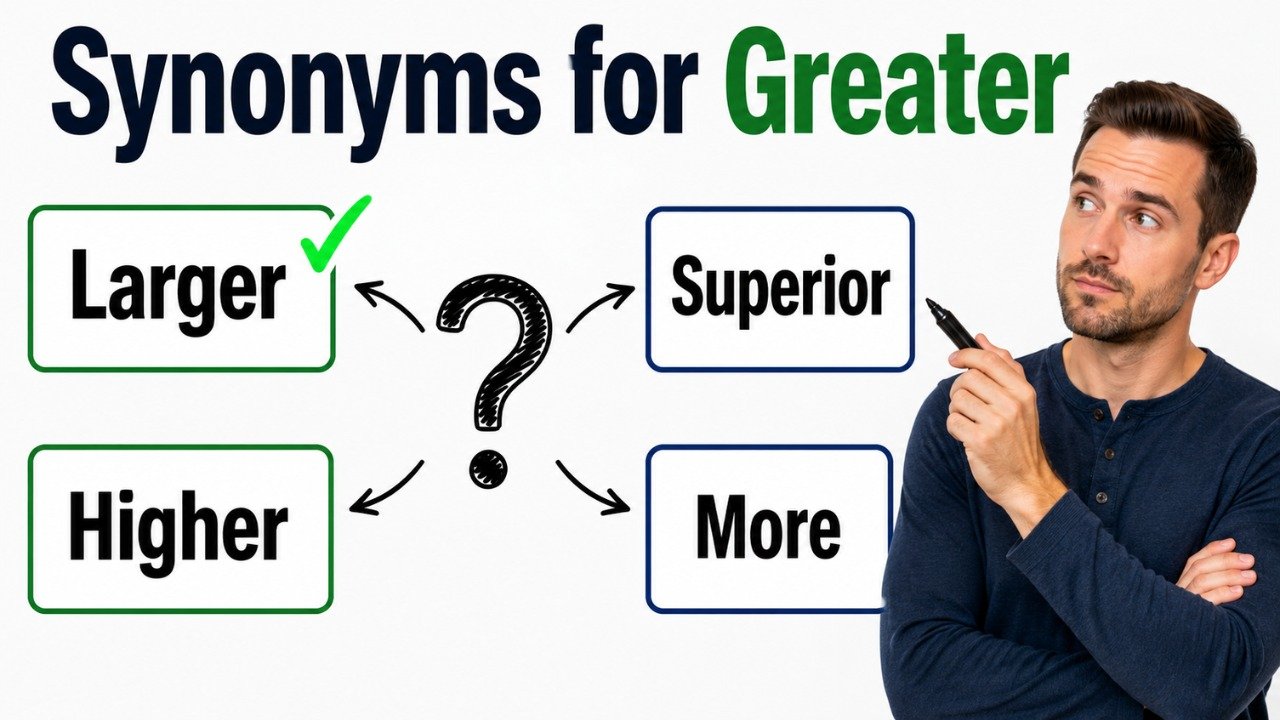
Quick Answer: Synonyms for greater include larger, bigger, higher, superior, better, stronger, increased, more substantial, more significant, and more important. Use larger or bigger for physical size, higher for levels and numbers, superior or better for quality, stronger for power or intensity, and more significant for importance or effect. Increased works well for measurable growth, while more substantial describes something greater in amount, value, strength, or importance.
Pronunciation and Word Details
Word: Greater.
Pronunciation: /ˈɡreɪ.tər/
Part of Speech: Adjective.
Meaning: Larger, higher, better, stronger, or more important when compared with something else.
US Pronunciation:
UK Pronunciation:
What Does “Greater” Mean?
Greater means larger, higher, stronger, better, or more important than another person, object, amount, or situation. It is the comparative form of the adjective great.
The exact meaning changes according to context. Greater can describe physical size, numerical value, emotional intensity, social importance, quality, influence, or effect.
A greater distance is longer than another distance. Greater confidence means a higher level of confidence. A greater achievement is more impressive or important than another achievement.
The word usually introduces a comparison, even when the second item is not directly stated.
Example: Regular practice can lead to greater confidence.
This sentence suggests that confidence will become stronger or higher than it was before.
Meaning, Tone, and Context of “Greater”
Greater has a neutral and flexible tone. It appears naturally in formal writing, academic explanations, professional communication, reports, essays, and everyday conversation.
In formal contexts, greater often describes importance, value, responsibility, influence, efficiency, or impact.
Example: The new process provides greater accuracy.
In everyday speech, people may prefer bigger or better when describing simple comparisons.
Example: We need a bigger table.
Greater would sound less natural in that sentence because the comparison concerns ordinary physical size.
The word can also carry a positive or serious tone. Phrases such as greater freedom, greater success, and greater understanding suggest improvement. Expressions such as greater danger or greater pressure describe a stronger negative condition.
When and How to Use “Greater”
For Size
Use greater when describing a larger overall size, extent, or scale, especially in formal writing.
Example: The second region covers a greater area.
For Amount
Use greater for an amount, quantity, number, or measurable increase.
Example: This method requires a greater amount of preparation.
For Importance
Use greater when one issue, responsibility, or priority is more important than another.
Example: Public safety is of greater importance during severe conditions.
For Quality
Use greater when describing improved value, excellence, ability, or effectiveness.
Example: Careful planning can produce greater results.
For Intensity
Use greater for stronger emotions, pressure, force, risk, or difficulty.
Example: The final stage requires greater concentration.
For Influence
Use greater when a person, decision, or event has more power or effect.
Example: Clear communication gives leaders greater influence.
For Mathematical Comparisons
Use greater when one number or value is larger than another.
Example: Twelve is greater than eight.
Best Synonyms for Greater
Larger
Synonym: Greater in physical size, amount, area, or quantity.
Example: The organization moved into a larger office.
Bigger
Synonym: Larger in size, importance, or effect, especially in casual language.
Example: Finishing the project became a bigger challenge than expected.
Higher
Synonym: Greater in level, position, value, price, or degree.
Example: The advanced course requires a higher level of concentration.
Superior
Synonym: Greater in quality, ability, effectiveness, or rank.
Example: The revised method produced superior results.
Better
Synonym: Greater in quality, usefulness, suitability, or performance.
Example: Careful preparation creates a better experience.
Stronger
Synonym: Greater in power, intensity, influence, or effectiveness.
Example: The evidence became stronger after further investigation.
Increased
Synonym: Greater in amount, number, level, or degree than before.
Example: The program received increased public attention.
More Substantial
Synonym: Greater in amount, value, size, importance, or strength.
Example: The final report included more substantial evidence.
More Significant
Synonym: Greater in meaning, importance, effect, or consequence.
Example: The second discovery had a more significant impact.
More Important
Synonym: Greater in priority, value, relevance, or consequence.
Example: Accuracy is more important than speed in this task.
50 Synonyms for Greater with Short Meanings
- Larger: Greater in physical size, area, amount, or quantity.
- Bigger: Greater in size, importance, scale, or effect.
- Higher: Greater in level, position, number, value, or degree.
- Superior: Greater in quality, ability, rank, or performance.
- Better: Greater in quality, usefulness, suitability, or condition.
- Stronger: Greater in power, intensity, influence, or resistance.
- Increased: Made greater in amount, number, level, or degree.
- Enhanced: Improved to provide greater quality, value, or effectiveness.
- Expanded: Made greater in size, range, scope, or capacity.
- Broader: Greater in range, coverage, meaning, or variety.
- Wider: Greater in physical width, range, availability, or influence.
- More Extensive: Greater in area, scope, amount, or coverage.
- More Substantial: Greater in size, value, strength, or importance.
- More Considerable: Greater in size, degree, value, or significance.
- More Significant: Greater in meaning, importance, effect, or consequence.
- More Important: Greater in priority, relevance, value, or influence.
- More Influential: Greater in the ability to affect people or decisions.
- More Powerful: Greater in force, control, authority, or effectiveness.
- More Intense: Greater in strength, emotion, force, or concentration.
- Deeper: Greater in depth, seriousness, emotion, or understanding.
- Heavier: Greater in weight, pressure, burden, or intensity.
- Fuller: Greater in detail, completeness, richness, or development.
- Richer: Greater in quality, variety, value, color, or meaning.
- Grander: Greater in scale, appearance, ambition, or importance.
- Loftier: Greater in rank, ambition, purpose, or moral importance.
- Mightier: Greater in strength, authority, influence, or power.
- Amplified: Made greater in strength, volume, scale, or effect.
- Elevated: Raised to a greater level, position, standard, or status.
- Advanced: Greater in development, knowledge, complexity, or progress.
- More Developed: Greater in growth, detail, maturity, or organization.
- More Capable: Greater in ability, skill, competence, or potential.
- More Valuable: Greater in usefulness, financial worth, or importance.
- More Beneficial: Greater in usefulness, advantage, or positive effect.
- More Favorable: Greater in advantage, suitability, support, or promise.
- More Prominent: Greater in visibility, importance, status, or attention.
- More Notable: Greater in importance, interest, quality, or recognition.
- More Distinguished: Greater in achievement, respect, excellence, or status.
- More Eminent: Greater in fame, authority, rank, or professional importance.
- More Exceptional: Greater in quality or distinctiveness than what is ordinary.
- More Impressive: Greater in the ability to create admiration or respect.
- More Remarkable: Greater in unusualness, importance, quality, or interest.
- More Serious: Greater in importance, danger, difficulty, or consequence.
- More Severe: Greater in harshness, intensity, seriousness, or difficulty.
- More Profound: Greater in depth, meaning, understanding, or emotional effect.
- More Numerous: Greater in number.
- More Abundant: Greater in quantity, availability, or supply.
- More Plentiful: Available in greater amounts or numbers.
- More Comprehensive: Greater in completeness, coverage, detail, or scope.
- More Dominant: Greater in power, influence, strength, or visibility.
- More Consequential: Greater in importance, effect, or possible results.
Read Also:
Synonyms for Consent

Synonyms for Greater by Context
When Greater Means Larger in Size
Larger and bigger are the most natural alternatives when greater describes physical size. Larger is neutral and works in both formal and casual writing. Bigger sounds more conversational.
Example With Greater: The new building has a greater floor area.
Example With Larger: The new building has a larger floor area.
Example With Bigger: They moved into a bigger building.
When Greater Means Higher in Amount
Use higher, increased, more abundant, more numerous, or more plentiful when discussing measurable amounts.
Example With Greater: The second group reported greater attendance.
Example With Higher: The second group reported higher attendance.
Example With Increased: The second group reported increased attendance.
When Greater Means Better in Quality
Use better, superior, enhanced, or more exceptional when comparing quality, performance, usefulness, or effectiveness.
Example With Greater: The updated system offers greater performance.
Example With Better: The updated system offers better performance.
Example With Superior: The updated system offers superior performance.
When Greater Means More Important
Use more important, more significant, more notable, more prominent, or more consequential when discussing importance or impact.
Example With Greater: The policy had greater importance than expected.
Example With More Significant: The policy had a more significant effect than expected.
When Greater Means Stronger
Use stronger, more powerful, more intense, amplified, or mightier when describing force, emotion, authority, or influence.
Example With Greater: The final argument had greater force.
Example With Stronger: The final argument had stronger force.
Example With More Powerful: The final argument was more powerful.
When Greater Means Broader in Scope
Use broader, wider, expanded, more extensive, or more comprehensive when discussing range, coverage, or variety.
Example With Greater: The course provides greater coverage of the subject.
Example With Broader: The course provides broader coverage of the subject.
Example With More Comprehensive: The course provides more comprehensive coverage of the subject.
Another Word for Greater
Larger is often the best single replacement for greater when discussing size, amount, area, or quantity. However, the best alternative depends on what is being compared.
Use better for quality, higher for levels and numbers, stronger for intensity, and more significant for importance or effect.
Original: The second room offers greater space.
Better Option: The second room offers more space.
Original: The new method provides greater accuracy.
Better Option: The new method provides higher accuracy.
Original: This issue has greater importance.
Better Option: This issue has more significance.
Original: She developed greater confidence.
Better Option: She developed stronger confidence.
When Not to Use “Greater”
Greater should not replace every comparative adjective. It may sound vague, overly formal, or unnatural when a more specific word is available.
Avoid using greater directly before a plural countable noun. Use more instead.
Weak: Greater students attended the workshop.
Better: More students attended the workshop.
Do not use greater when better clearly describes quality.
Weak: This version has greater writing.
Better: This version has better writing.
Avoid using greater when discussing ordinary physical objects in casual conversation.
Weak: I need a greater suitcase.
Better: I need a bigger suitcase.
Do not combine greater with another comparative form.
Weak: The result was more greater than expected.
Better: The result was much greater than expected.
Use a specific synonym when greater does not clearly show what has increased.
Weak: The project created greater outcomes.
Better: The project created more beneficial outcomes.
Words Commonly Confused With Greater
Greater vs Great: Great describes something large, important, excellent, or intense. Greater compares it with something else.
Example: It was a great achievement.
Example: It was a greater achievement than the previous one.
Greater vs Greatest: Greater compares two or more things. Greatest identifies the highest degree within a complete group.
Example: This task requires greater concentration.
Example: This task requires the greatest concentration of all.
Greater vs Bigger: Greater is more formal and can describe importance, amount, value, or intensity. Bigger commonly describes physical size and casual comparisons.
Greater vs Higher: Greater has a broad meaning. Higher is more precise for levels, positions, prices, rates, scores, and measurements.
Greater vs Better: Greater usually concerns amount, size, importance, or degree. Better concerns quality, suitability, condition, or performance.
Greater vs More: Greater normally modifies a noun such as importance, value, or influence. More can directly modify plural nouns and many adjectives.
Example: The decision has greater importance.
Example: More people supported the decision.
Greater vs Larger: Greater can describe abstract and physical comparisons. Larger mainly describes size, area, amount, or quantity.
Which Synonym Should You Choose?
Choose larger when discussing physical size, space, area, quantity, or capacity.
Choose bigger for casual speech and simple comparisons involving size, problems, opportunities, or changes.
Choose higher when discussing prices, levels, scores, rates, positions, standards, or measurements.
Choose better when comparing quality, suitability, health, performance, or results.
Choose superior when making a formal comparison about quality, ability, rank, or effectiveness.
Choose stronger when discussing force, evidence, confidence, influence, emotions, or arguments.
Choose increased when a measurable amount, level, number, or rate has risen.
Choose more substantial when discussing evidence, support, value, size, or importance.
Choose more significant for academic writing, reports, essays, research, and discussions of importance or impact.
Choose more important when you need a clear and direct alternative that readers can understand immediately.
Choose broader or more comprehensive when discussing range, scope, coverage, or detail.
Choose more consequential when emphasizing serious effects or future results.
Real Life Examples of “Greater” in Sentences
Original: The new position gives her greater responsibility.
Better Option: The new position gives her increased responsibility.
Original: We need greater space for the equipment.
Better Option: We need more space for the equipment.
Original: The second plan offers greater value.
Better Option: The second plan offers better value.
Original: He showed greater confidence during the presentation.
Better Option: He showed stronger confidence during the presentation.
Original: This problem presents a greater risk.
Better Option: This problem presents a more serious risk.
Original: The updated report provides greater detail.
Better Option: The updated report provides fuller detail.
Original: The discovery had greater importance than expected.
Better Option: The discovery had more significance than expected.
Original: The advanced course requires greater effort.
Better Option: The advanced course requires more substantial effort.
Original: The second candidate has greater experience.
Better Option: The second candidate has broader experience.
Original: Clear instructions can produce greater understanding.
Better Option: Clear instructions can produce deeper understanding.
Synonym Groups and Usage Differences
Size and Quantity Group
Larger, bigger, expanded, more numerous, more abundant, and more plentiful describe physical dimensions or measurable quantities.
Larger is more formal than bigger. More numerous refers specifically to number, while more abundant and more plentiful describe supply or availability.
Example: The region received a more abundant water supply.
Quality and Superiority Group
Better, superior, enhanced, more exceptional, and more impressive describe improved quality or performance.
Better is the most common general choice. Superior is more formal and suggests a clear advantage. Enhanced indicates that something has been improved.
Example: The revised design provides superior performance.
Importance and Influence Group
More important, more significant, more prominent, more influential, and more consequential describe importance, visibility, power, or effect.
More significant is common in formal and academic writing. More consequential emphasizes serious results.
Example: The decision had more consequential effects than expected.
Strength and Intensity Group
Stronger, more powerful, more intense, amplified, more severe, and deeper describe increased force, pressure, emotion, or seriousness.
Stronger has the widest use. More severe is best for pain, weather, punishment, damage, or serious conditions.
Example: The region experienced more severe rainfall.
Scope and Completeness Group
Broader, wider, expanded, more extensive, fuller, and more comprehensive describe increased range, coverage, or detail.
Broader and wider describe range. More comprehensive suggests that nearly every important part is included.
Example: The final guide offers more comprehensive information.
Status and Achievement Group
Elevated, advanced, more distinguished, more eminent, grander, and loftier describe greater rank, progress, achievement, or ambition.
More distinguished emphasizes respected achievement. More eminent refers to a highly respected or important person.
Example: She became a more distinguished figure in her profession.
Antonyms of Greater
The opposite of greater depends on whether the word refers to size, quality, amount, strength, or importance.
Smaller: Lower in physical size, amount, area, or quantity.
Lesser: Lower in importance, degree, value, or rank.
Lower: Below another level, amount, position, rate, or value.
Inferior: Lower in quality, ability, rank, or effectiveness.
Worse: Lower in quality, condition, suitability, or performance.
Weaker: Lower in strength, influence, force, or intensity.
Reduced: Made smaller or lower in amount, number, or degree.
Diminished: Decreased in size, strength, value, or importance.
Minor: Less serious, important, or influential.
Insignificant: Not important or large enough to have a meaningful effect.
Limited: Restricted in size, scope, quantity, or ability.
Narrower: Smaller in width, range, meaning, or coverage.
Comparison Between Greater and Related Words
Greater vs Larger
Greater can describe size, amount, importance, intensity, value, or quality. Larger mainly refers to physical size, area, or quantity.
Example With Greater: The decision created greater public concern.
Example With Larger: The family needs a larger vehicle.
Greater vs Bigger
Greater sounds more formal and works well with abstract ideas. Bigger is conversational and common for physical size or ordinary challenges.
Example With Greater: The position involves greater responsibility.
Example With Bigger: This box is bigger than the other one.
Greater vs Higher
Greater is a general comparative word. Higher is more specific for measurable levels, scores, rates, prices, standards, and positions.
Example With Greater: The project created greater interest.
Example With Higher: The second applicant received a higher score.
Greater vs Better
Greater usually compares amount, scale, importance, or degree. Better compares quality, condition, usefulness, or performance.
Example With Greater: The role requires greater patience.
Example With Better: This method produces better results.
Greater vs Superior
Greater has a broad and neutral meaning. Superior specifically suggests that something has better quality, ability, rank, or effectiveness.
Example With Greater: The second task requires greater effort.
Example With Superior: The new material offers superior durability.
Greater vs Greatest
Greater is comparative and usually compares two things. Greatest is superlative and identifies the highest degree within a group.
Example With Greater: This route presents a greater challenge.
Example With Greatest: This route presents the greatest challenge of all.
Common Phrases and Expressions With “Greater”
Greater Than: Larger, higher, or more important than something else.
Greater Good: A benefit shared by a larger community or group.
Greater Importance: A higher level of significance or priority.
Greater Value: More usefulness, worth, or benefit.
Greater Impact: A stronger or more significant effect.
Greater Extent: A larger degree, range, area, or amount.
Greater Degree: A higher level or intensity.
Greater Number: A larger quantity of countable people or things.
Greater Understanding: Deeper or more complete knowledge.
Greater Responsibility: A higher level of duty or accountability.
Common Mistakes to Avoid
Using More Greater
Greater is already a comparative adjective, so it should not be combined with more.
Incorrect: This opportunity is more greater than the last one.
Correct: This opportunity is greater than the last one.
Confusing Greater With Greatest
Use greater for comparisons and greatest for the highest position within an entire group.
Incorrect: This is the greater achievement of his career.
Correct: This is the greatest achievement of his career.
Using Greater Before Plural Nouns
Greater cannot directly replace more before most plural countable nouns.
Incorrect: Greater employees joined the meeting.
Correct: More employees joined the meeting.
Choosing Greater Instead of Better
Use better when the comparison concerns quality, suitability, health, or performance.
Unnatural: She wrote a greater conclusion.
Natural: She wrote a better conclusion.
Creating an Unclear Comparison
Readers should understand what two things are being compared.
Unclear: The new method is greater.
Clear: The new method provides greater accuracy than the previous method.
Repeating Greater Too Often
Repeated use can make writing sound vague or mechanical. Replace it with larger, higher, stronger, better, broader, or more significant when those words express the intended meaning more precisely.
Using Greater for Every Increase
Greater is not always the most natural word for measurable changes. Use increased, higher, longer, wider, or more when appropriate.
Vague: The event attracted a greater audience.
Natural: The event attracted a larger audience.
Conclusion
Synonyms for greater vary according to the type of comparison being made. Larger and bigger describe size, higher suits levels and measurements, and better or superior compares quality. Stronger and more intense express power, while more significant and more important emphasize value or impact. Increased works well for measurable growth, and broader describes expanded scope. Choosing a precise synonym makes comparisons clearer, improves sentence variety, and helps readers understand exactly what has become larger, stronger, better, or more important.
FAQs About Synonyms for Greater
What Is the Best Synonym for Greater?
Larger is a strong general synonym when greater refers to size or amount. Better, higher, stronger, or more important may be more suitable in other contexts.
Is Bigger a Synonym for Greater?
Yes. Bigger is a synonym when greater describes size, scale, importance, or effect. Bigger is usually more conversational.
Can Better Replace Greater?
Better can replace greater when comparing quality, usefulness, performance, or suitability. It should not replace greater when discussing size or amount.
What Is a Formal Synonym for Greater?
Superior, more substantial, more significant, and more considerable are useful formal alternatives. The best choice depends on the intended meaning.
What Is Another Word for Greater Importance?
More significance, higher priority, increased importance, and greater consequence are suitable alternatives.
What Is the Difference Between Greater and Greatest?
Greater compares two or more things, while greatest identifies the highest level within an entire group.
What Is the Opposite of Greater?
Common opposites include smaller, lesser, lower, inferior, weaker, and reduced. The correct antonym depends on the context.
