
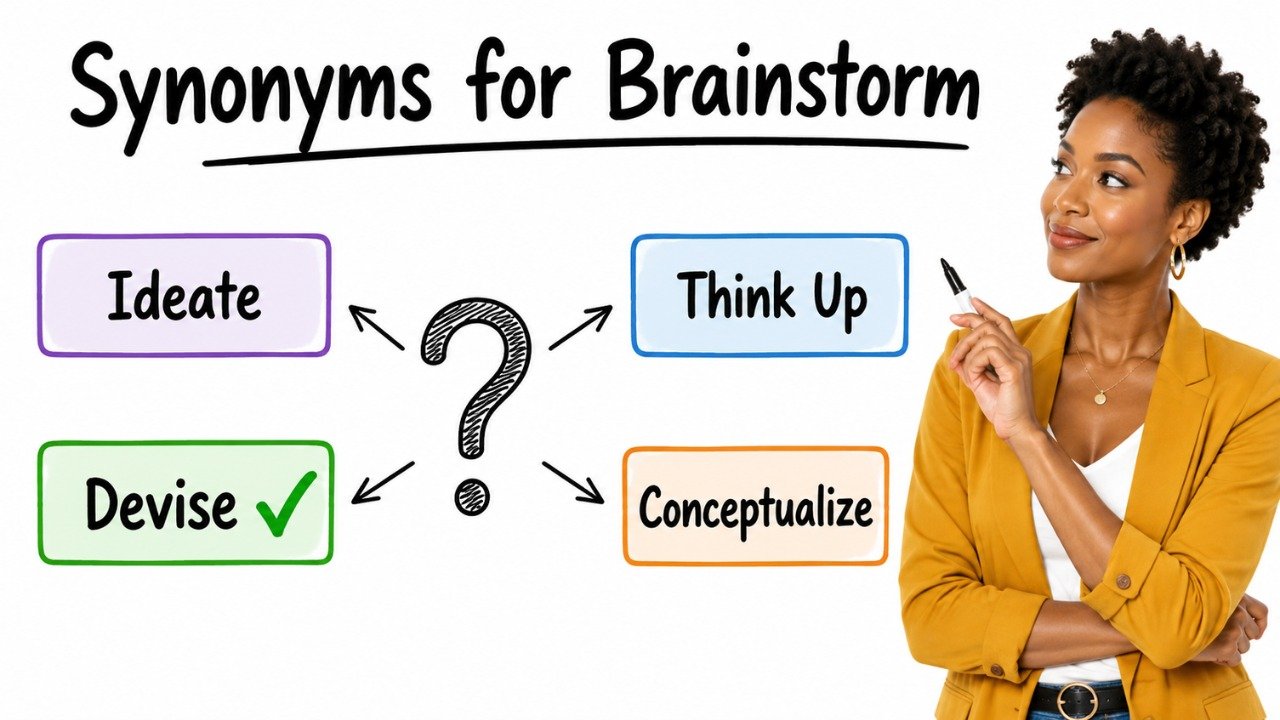
Quick Answer: Common synonyms for brainstorm include ideate, generate ideas, think up, conceptualize, devise, discuss, collaborate, workshop, plan, and mind map. Generate ideas is the clearest replacement in everyday communication. Ideate works well in formal or professional writing, while think up and dream up suit casual conversation. Collaborate and discuss are useful for group sessions. Devise, strategize, and troubleshoot are better when the purpose is to develop a plan or solve a specific problem.
Pronunciation and Word Details
Word: Brainstorm.
Pronunciation: /ˈbreɪn.stɔːrm/
Part of Speech: Noun and verb.
Meaning: To produce, explore, and discuss ideas, usually to solve a problem or create something.
US Pronunciation:
UK Pronunciation:
What Does “Brainstorm” Mean?
Brainstorm means to generate and explore a variety of ideas before selecting the most useful option.
As a verb, brainstorm describes the action of thinking creatively, either alone or with a group. People may brainstorm names, solutions, topics, designs, plans, or strategies.
As a noun, a brainstorm can mean a sudden useful idea or an organized session in which people suggest possible ideas.
Verb Example: The team will brainstorm possible themes for the event.
Noun Example: Her sudden brainstorm helped solve the scheduling problem.
The word often suggests open thinking. During a brainstorming process, ideas are usually collected before they are judged, rejected, or developed further.
Meaning, Tone, and Context of “Brainstorm”
Brainstorm has a neutral and conversational tone. It is common in professional, academic, creative, and everyday settings.
The word can sound energetic because it suggests active thinking and the rapid production of ideas. It is frequently used when people want to encourage creativity without immediately limiting the available choices.
Professional Context: Teams brainstorm strategies, project names, solutions, and campaign ideas.
Academic Context: Students brainstorm essay topics, research questions, and presentation themes.
Creative Context: Writers, artists, and designers brainstorm characters, concepts, layouts, and visual details.
Personal Context: Individuals brainstorm meal ideas, travel plans, gifts, or ways to organize their time.
Brainstorm is less formal than formulate, conceptualize, or deliberate. However, it remains appropriate in most workplace discussions, meetings, emails, reports, and educational materials.
When and How to Use “Brainstorm”
For Generating Creative Ideas
Use brainstorm when you want to produce several original possibilities without immediately judging them.
Example: We need to brainstorm creative names for the new community project.
For Group Discussion
Use brainstorm when several people share suggestions and build on one another’s ideas.
Example: The committee met to brainstorm ways to improve the annual event.
For Solving Problems
Use brainstorm when exploring different answers to a challenge.
Example: The technicians brainstormed possible causes of the recurring error.
For Planning
Use brainstorm when developing early ideas before creating a detailed plan.
Example: Let us brainstorm the main sections before writing the report.
For Writing
Use brainstorm when collecting topics, arguments, examples, or supporting details.
Example: She brainstormed several examples before drafting her essay.
For Naming Something
Use brainstorm when developing possible names, titles, headings, or labels.
Example: The students brainstormed titles for their class magazine.
For Independent Thinking
Brainstorm does not always require a group. One person can brainstorm privately by writing or organizing ideas.
Example: I spent the afternoon brainstorming possible solutions in my notebook.
Best Synonyms for Brainstorm
Ideate
Synonym: To form, develop, or produce ideas.
Example: The design team met to ideate possible improvements to the layout.
Generate Ideas
Synonym: To produce a range of thoughts, suggestions, or possibilities.
Example: The workshop helped participants generate ideas for future projects.
Think Up
Synonym: To create an idea through thought or imagination.
Example: Can you think up a memorable title for the article?
Conceptualize
Synonym: To form a clear idea or mental concept.
Example: The architect conceptualized a flexible space for community activities.
Devise
Synonym: To create a method, plan, or solution through careful thought.
Example: The group devised a practical way to reduce unnecessary delays.
Discuss
Synonym: To talk about a subject and consider different ideas.
Example: The teachers discussed possible topics for the next lesson.
Collaborate
Synonym: To work with others to develop ideas or complete a task.
Example: The writers collaborated on the main structure of the story.
Workshop
Synonym: To develop an idea through active discussion, testing, and revision.
Example: The editors workshopped several headlines before choosing the strongest one.
Strategize
Synonym: To develop a thoughtful plan for reaching a goal.
Example: The organizers strategized ways to attract more volunteers.
Mind Map
Synonym: To arrange related ideas visually around a central subject.
Example: She used a large sheet of paper to mind map her research topics.
50 Synonyms for Brainstorm with Short Meanings
- Ideate: Produce or develop ideas.
- Generate Ideas: Create several possible thoughts or suggestions.
- Think Up: Produce an idea through thought.
- Dream Up: Imagine an unusual or creative idea.
- Conceive: Form an idea in the mind.
- Imagine: Create a mental picture or possibility.
- Envision: Imagine a possible future result.
- Invent: Create something original.
- Create: Bring a new idea or concept into existence.
- Devise: Develop a plan, method, or solution.
- Formulate: Develop an idea carefully and clearly.
- Conceptualize: Form a structured mental concept.
- Originate: Produce an idea for the first time.
- Innovate: Introduce a new idea or method.
- Explore Ideas: Examine several possible concepts.
- Develop Ideas: Expand and improve initial thoughts.
- Suggest: Present an idea for consideration.
- Propose: Put forward a plan or possibility.
- Pitch: Present an idea persuasively.
- Contribute Ideas: Add suggestions to a discussion.
- Share Ideas: Communicate thoughts with other people.
- Exchange Ideas: Give and receive suggestions.
- Bounce Ideas Around: Discuss possibilities informally.
- Discuss: Talk about a subject in detail.
- Confer: Exchange opinions before making a decision.
- Consult: Seek ideas, information, or advice.
- Collaborate: Work with others to create ideas.
- Deliberate: Consider possibilities carefully.
- Workshop: Develop an idea through discussion and revision.
- Free Associate: Produce connected thoughts without strict limits.
- Mind Map: Organize ideas in a visual structure.
- Reflect: Think carefully about a subject.
- Ponder: Consider something deeply.
- Consider: Think about a possible choice or action.
- Speculate: Explore possible explanations or outcomes.
- Examine: Study an idea or issue carefully.
- Investigate: Explore a question to find possible answers.
- Analyze: Separate a subject into parts for closer study.
- Evaluate: Judge the usefulness of different ideas.
- Rethink: Consider an idea again from a different perspective.
- Troubleshoot: Search for the cause and solution to a problem.
- Solve Problems: Develop answers to difficulties.
- Plan: Decide what actions should be taken.
- Strategize: Develop a plan for achieving a goal.
- Outline: Arrange the main ideas in order.
- Map Out: Organize a plan or process clearly.
- Sketch Out: Describe an early idea in a simple form.
- Hatch: Create or develop an idea or plan.
- Cook Up: Invent an idea informally.
- Generate Options: Produce several possible choices.
Read Also:
Synonyms for Greater

Synonyms for Brainstorm by Context
When Brainstorm Means Generate Creative Ideas
These alternatives emphasize imagination, originality, and the creation of new possibilities.
Ideate: To actively produce original concepts.
Example: The students ideated several themes for their final project.
Dream Up: To imagine something creative or unusual.
Example: She dreamed up a playful concept for the children’s story.
Invent: To create something that did not previously exist.
Example: The group invented a new game for the school celebration.
Originate: To be the first person to develop an idea.
Example: He originated the idea of holding the event outdoors.
Create: To produce a new concept, plan, or work.
Example: They created several possible layouts for the room.
When Brainstorm Means Discuss Ideas as a Group
These alternatives focus on communication, participation, and shared thinking.
Discuss: To talk about ideas and possible choices.
Example: The members discussed ways to welcome new participants.
Collaborate: To work together on an idea or project.
Example: The two departments collaborated on the event plan.
Confer: To exchange opinions before deciding what to do.
Example: The managers conferred about the proposed changes.
Exchange Ideas: To share different thoughts and suggestions.
Example: The session allowed teachers to exchange ideas about classroom activities.
Bounce Ideas Around: To discuss possible ideas in a relaxed way.
Example: We bounced ideas around until we found a suitable theme.
When Brainstorm Means Develop a Plan
These alternatives work when ideas are being organized into a practical course of action.
Plan: To decide how something will be completed.
Example: The volunteers planned the main stages of the project.
Strategize: To create a plan designed to achieve a particular goal.
Example: The team strategized ways to complete the work efficiently.
Devise: To develop a thoughtful method or solution.
Example: They devised a schedule that suited every participant.
Map Out: To arrange the main steps of a process.
Example: We mapped out the entire presentation before creating the slides.
Formulate: To develop something carefully and systematically.
Example: The committee formulated a clear response to the concern.
When Brainstorm Means Solve a Problem
These alternatives are useful when the goal is to identify causes, options, and solutions.
Troubleshoot: To identify and correct the cause of a problem.
Example: The support team troubleshot the connection issue.
Analyze: To examine a problem in separate parts.
Example: The researchers analyzed the results to identify possible errors.
Investigate: To explore a problem in order to discover an answer.
Example: The committee investigated several reasons for the delay.
Rethink: To reconsider an existing idea or method.
Example: We need to rethink how the information is organized.
Generate Options: To create several possible solutions.
Example: The group generated options for reducing the waiting time.
When Brainstorm Means Think Independently
These alternatives describe careful or imaginative thinking performed by one person.
Reflect: To think carefully about an experience or issue.
Example: She reflected on several possible directions for her career.
Ponder: To consider something deeply.
Example: He pondered how the ending of the story should change.
Imagine: To form possible situations in the mind.
Example: Imagine several ways the room could be arranged.
Envision: To picture a possible future result.
Example: She envisioned a simpler and more accessible design.
Consider: To think about a possible option.
Example: Consider different formats before choosing the final structure.
Another Word for Brainstorm
Generate ideas is the clearest general replacement for brainstorm. It directly explains the process and works in professional, academic, creative, and conversational contexts.
Ideate is a more concise formal alternative. Discuss is better when the focus is communication, while devise is stronger when the goal is to create a practical solution.
Original: We need to brainstorm possible article topics.
Better Option: We need to generate ideas for possible article topics.
Original: The committee brainstormed solutions to the problem.
Better Option: The committee devised solutions to the problem.
Original: The designers brainstormed several visual concepts.
Better Option: The designers ideated several visual concepts.
Original: Let us brainstorm the proposal together.
Better Option: Let us discuss and develop the proposal together.
When Not to Use “Brainstorm”
Brainstorm may sound too general when the intended action is more specific. A stronger synonym can tell readers whether people are planning, discussing, analyzing, solving, or creating.
When a Decision Has Already Been Made
Brainstorm suggests that options are still open. Do not use it when people are finalizing a confirmed choice.
Weak: We brainstormed the final approved schedule.
Better: We finalized the approved schedule.
When Careful Analysis Is Required
Brainstorm emphasizes idea generation rather than detailed examination.
Weak: The researchers brainstormed the laboratory results.
Better: The researchers analyzed the laboratory results.
When a Detailed Plan Is Being Created
Use plan, strategize, formulate, or map out when ideas are being organized into specific actions.
Weak: The manager brainstormed the complete delivery schedule.
Better: The manager mapped out the complete delivery schedule.
When Only a Conversation Occurred
Use discuss when people talked about a subject but did not actively generate new ideas.
Weak: We brainstormed the updated policy during lunch.
Better: We discussed the updated policy during lunch.
When Repetition Makes the Writing Vague
Using brainstorm repeatedly can make professional writing sound imprecise.
Weak: We brainstormed the topic, brainstormed solutions, and brainstormed the final plan.
Better: We explored the topic, generated solutions, and formulated the final plan.
Words Commonly Confused With Brainstorm
Brainstorm vs Ideate: Brainstorm means generating many possible ideas, often through an open discussion. Ideate specifically means forming or developing ideas and usually sounds more formal.
Brainstorm vs Discuss: Brainstorm focuses on producing new ideas. Discuss means talking about a subject and may not involve creating anything new.
Brainstorm vs Plan: Brainstorm takes place during the early idea stage. Plan means organizing selected ideas into actions, dates, responsibilities, or steps.
Brainstorm vs Strategize: Brainstorm produces possibilities. Strategize develops a focused approach for reaching a goal.
Brainstorm vs Mind Map: Brainstorm describes the general process of generating ideas. Mind mapping is a specific visual method for arranging those ideas.
Brainstorm vs Workshop: Brainstorming produces initial ideas. Workshopping develops, tests, and revises an existing idea.
Brainstorm vs Collaborate: Brainstorming is one activity people can perform together. Collaboration is the broader process of working together on a shared goal.
Brainstorm vs Deliberate: Brainstorming encourages many possibilities before judgment. Deliberating involves carefully comparing options before making a decision.
Which Synonym Should You Choose?
Choose generate ideas when you need a clear and natural replacement that works in nearly every context.
Choose ideate for formal, professional, academic, or creative writing about producing concepts.
Choose think up for relaxed conversation and simple everyday instructions.
Choose dream up when the idea is imaginative, unusual, or playful.
Choose conceptualize when forming a detailed mental model or central concept.
Choose discuss when people are talking about existing information rather than producing new ideas.
Choose collaborate when several people are working together and sharing responsibility.
Choose devise when creating a practical method, answer, or solution.
Choose strategize when developing a focused plan for achieving a goal.
Choose troubleshoot when identifying the cause of a technical or practical problem.
Choose mind map when arranging connected ideas visually.
Choose workshop when revising and improving an idea through group feedback.
Choose formulate for reports, essays, policies, proposals, and other formal documents.
Choose map out when arranging steps, stages, or responsibilities.
Choose pitch when presenting an idea persuasively to other people.
Real Life Examples of “Brainstorm” in Sentences
Original: The students brainstormed ideas for their science presentation.
Better Option: The students generated ideas for their science presentation.
Original: We should brainstorm a new name for the event.
Better Option: We should think up a new name for the event.
Original: The writers brainstormed possible endings for the story.
Better Option: The writers imagined possible endings for the story.
Original: The committee brainstormed ways to improve attendance.
Better Option: The committee discussed ways to improve attendance.
Original: The engineers brainstormed a solution to the design problem.
Better Option: The engineers devised a solution to the design problem.
Original: The organizers brainstormed their approach to the campaign.
Better Option: The organizers strategized their approach to the campaign.
Original: She brainstormed the main sections of her essay.
Better Option: She outlined the main sections of her essay.
Original: The technicians brainstormed possible reasons for the failure.
Better Option: The technicians investigated possible reasons for the failure.
Original: The artists brainstormed the appearance of the central character.
Better Option: The artists conceptualized the appearance of the central character.
Original: The two teams brainstormed the project together.
Better Option: The two teams collaborated on the project.
Synonym Groups and Usage Differences
Creative Idea Group
This group includes ideate, imagine, invent, originate, create, dream up, and conceptualize. These words focus on forming something original.
Ideate sounds formal, while dream up sounds imaginative and conversational. Conceptualize suggests developing a clearer or more organized central idea.
Example: The team conceptualized a welcoming and accessible public space.
Group Discussion Group
This group includes discuss, collaborate, confer, consult, exchange ideas, and bounce ideas around.
Discuss is neutral and broad. Confer sounds more formal. Bounce ideas around is informal and suggests a relaxed exchange.
Example: The editors conferred before selecting the final article topics.
Planning Group
This group includes plan, strategize, formulate, map out, outline, and sketch out.
Plan is the broadest word. Strategize emphasizes reaching a goal. Formulate suggests careful development, while outline presents the main points in an organized form.
Example: The coordinator mapped out each stage of the training program.
Problem Solving Group
This group includes devise, troubleshoot, analyze, investigate, rethink, and solve problems.
Devise means creating a solution. Troubleshoot focuses on identifying and correcting a problem. Analyze involves detailed examination.
Example: The technicians troubleshot the system before replacing any equipment.
Reflective Thinking Group
This group includes reflect, ponder, consider, speculate, envision, and examine.
These alternatives are more thoughtful and less energetic than brainstorm. They are useful when one person is considering an issue carefully.
Example: She pondered several possible responses before sending her message.
Idea Presentation Group
This group includes suggest, propose, pitch, contribute ideas, and share ideas.
Suggest is neutral. Propose is more formal and often presents a developed option. Pitch means presenting an idea in a persuasive way.
Example: He proposed a simpler method for recording the information.
Antonyms of Brainstorm
The opposite of brainstorm depends on whether the word refers to generating ideas, keeping options open, or working with other people.
Finalize: Complete the last version rather than generate new possibilities.
Decide: Select one option instead of continuing to explore ideas.
Conclude: Bring a discussion or thinking process to an end.
Narrow: Reduce the number of available possibilities.
Reject: Refuse to accept an idea or suggestion.
Dismiss: Treat an idea as unworthy of consideration.
Suppress: Prevent ideas from being expressed.
Ignore: Give no attention to an idea or problem.
Restrict: Limit the range of possible ideas.
Abandon: Stop developing an idea or plan.
Copy: Reproduce an existing idea instead of creating something original.
Follow: Use an established direction instead of exploring new options.
Comparison: Brainstorm vs Related Words
Brainstorm vs Ideate
Brainstorm means producing a variety of ideas, often in a group. Ideate means forming ideas and usually has a more formal or professional tone.
Example With Brainstorm: Let us brainstorm possible themes for the workshop.
Example With Ideate: The creative team will ideate several visual concepts.
Brainstorm vs Discuss
Brainstorming aims to produce new possibilities. Discussing involves talking about a subject and may focus on existing facts or decisions.
Example With Brainstorm: The teachers brainstormed new classroom activities.
Example With Discuss: The teachers discussed the updated classroom policy.
Brainstorm vs Plan
Brainstorming happens before a clear direction has been selected. Planning organizes selected ideas into a practical course of action.
Example With Brainstorm: We brainstormed possible locations for the event.
Example With Plan: We planned the schedule for the selected location.
Brainstorm vs Strategize
Brainstorming creates multiple ideas. Strategizing selects and organizes ideas to achieve a particular result.
Example With Brainstorm: The volunteers brainstormed ways to attract participants.
Example With Strategize: The volunteers strategized how to reach local residents.
Brainstorm vs Collaborate
Brainstorming is a particular idea generation activity. Collaborating is the wider process of working together.
Example With Brainstorm: The writers brainstormed possible chapter titles.
Example With Collaborate: The writers collaborated on the complete manuscript.
Brainstorm vs Workshop
Brainstorming produces early possibilities. Workshopping develops an existing idea through discussion, testing, and feedback.
Example With Brainstorm: The group brainstormed several opening scenes.
Example With Workshop: The group workshopped the strongest opening scene.
Brainstorm vs Mind Map
Brainstorming can be spoken, written, or visual. Mind mapping specifically arranges ideas in connected branches around one central subject.
Example With Brainstorm: She brainstormed possible subjects for her article.
Example With Mind Map: She mind mapped the relationships between the main subjects.
Brainstorm vs Devise
Brainstorming generates many possibilities. Devising usually produces a specific method, answer, or plan.
Example With Brainstorm: The team brainstormed possible responses to the delay.
Example With Devise: The team devised a practical response to the delay.
Common Phrases and Expressions With Brainstorm
Brainstorm Ideas: Produce a variety of possible thoughts or suggestions.
Brainstorm Solutions: Generate possible answers to a problem.
Brainstorm Together: Work with another person or group to create ideas.
Brainstorm Possibilities: Explore several outcomes or choices.
Brainstorm Names: Think of possible names or titles.
Brainstorm Topics: Generate possible subjects for writing or discussion.
Brainstorm Strategies: Explore different approaches to reaching a goal.
Brainstorm Questions: Create questions for research, interviews, or discussion.
Brainstorm Session: An organized period devoted to generating ideas.
Group Brainstorm: An idea generation activity involving several participants.
Quick Brainstorm: A brief period used to collect immediate ideas.
Creative Brainstorm: A session focused on original and imaginative possibilities.
Common Mistakes to Avoid
Using Brainstorm for Every Thinking Activity
Not every form of thinking is brainstorming. Use analyze for detailed examination, reflect for careful personal thought, and decide for choosing between options.
Confusing Brainstorming With Planning
Brainstorming creates possible ideas. Planning selects and organizes those ideas. Use the correct term to show the stage of the process.
Assuming Brainstorming Requires a Group
One person can brainstorm independently. A group is common, but it is not required.
Repeating Brainstorm Too Often
Repeated use can make writing sound vague or monotonous. Replace it with ideate, discuss, devise, outline, formulate, or strategize when those words express the action more accurately.
Choosing a Synonym With the Wrong Tone
Think up and cook up sound casual. Conceptualize and formulate sound more formal. Choose a word that matches the audience and purpose.
Using Discuss When New Ideas Are Required
Discuss may only mean talking about existing information. Use generate ideas, ideate, or invent when the main purpose is to create something new.
Using Brainstorm After the Final Decision
Brainstorm suggests that several options remain open. Use finalize, approve, decide, or confirm when the selection has already been made.
Judging Ideas Too Early
In a true brainstorming process, people usually collect possibilities before evaluating them. Early criticism may prevent useful ideas from being expressed.
Conclusion
The most suitable synonyms for brainstorm depend on the purpose of the thinking process. Generate ideas is the clearest general replacement, while ideate suits formal creative work. Discuss and collaborate are useful for group conversations. Devise and troubleshoot work well for solving problems, while plan, strategize, and map out describe organized action. By understanding these synonyms for brainstorm, you can describe creative thinking, discussion, planning, and problem solving with greater clarity and accuracy.
FAQs About Synonyms for Brainstorm
What Is the Best Synonym for Brainstorm?
Generate ideas is the clearest general synonym. It works naturally in professional, academic, creative, and everyday contexts.
Is Ideate the Same as Brainstorm?
The meanings are similar, but ideate is more formal. Brainstorm often suggests producing many ideas openly, while ideate simply means forming or developing ideas.
Can Discuss Replace Brainstorm?
Discuss can replace brainstorm when people are exchanging thoughts. However, discuss does not always mean that new ideas are being created.
What Is a Formal Word for Brainstorm?
Ideate, conceptualize, formulate, deliberate, and devise are useful formal alternatives. The best choice depends on whether the context involves ideas, plans, decisions, or solutions.
What Is a Casual Synonym for Brainstorm?
Think up, dream up, bounce ideas around, and cook up are casual alternatives. Think up is usually the clearest choice for everyday conversation.
What Is Another Word for a Brainstorming Session?
An idea session, planning session, creative workshop, discussion, ideation session, or strategy meeting may be suitable, depending on the purpose.
Can One Person Brainstorm Alone?
Yes. A person can brainstorm independently by listing ideas, free associating, making an outline, or creating a mind map.
