
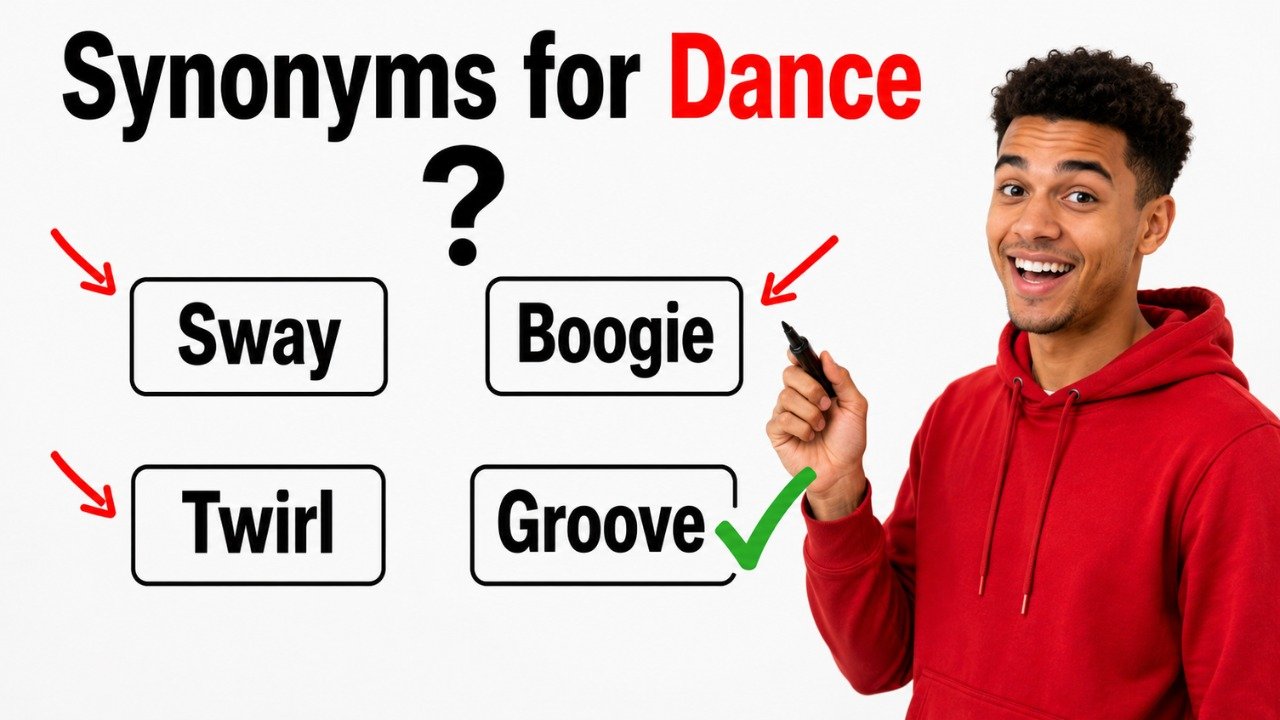
Quick Answer: The best synonyms for dance include sway, twirl, spin, groove, move, jig, waltz, boogie, perform, and prance. Use sway for gentle movement, twirl or spin for circular motion, and groove for relaxed movement to music. Jig and waltz describe particular dance styles, while perform is suitable for a planned stage presentation. Prance suggests lively or playful steps. The best alternative depends on whether dance refers to rhythmic movement, a formal performance, a social activity, or a specific style.
Pronunciation and Word Details
Word: Dance.
Pronunciation: /dæns/.
Part of Speech: Noun and verb.
Meaning: To move the body rhythmically, usually to music, or a series of movements performed for enjoyment or expression.
US Pronunciation:
UK Pronunciation:
What Does “Dance” Mean?
Dance means to move the body in a rhythmic, expressive, or organized way, often while music is playing.
As a verb, dance describes the action of moving through steps, turns, gestures, or body movements.
Example: The children danced happily during the celebration.
As a noun, dance can refer to the activity itself, a planned performance, a particular style, or a social event.
Example: The audience enjoyed the final dance of the evening.
Dance may be formal and carefully rehearsed, or it may be casual and spontaneous. Ballet, tango, waltz, and traditional folk movement are organized forms, while swaying or grooving may happen naturally when someone hears music.
The word can also describe quick, light, or lively movement that is not performed by a person.
Example: Sunlight danced across the surface of the water.
Meaning, Tone, and Context of “Dance”
Dance is a neutral and expressive word. It can sound joyful, artistic, romantic, energetic, graceful, playful, or ceremonial depending on the sentence.
In casual conversation, dance often refers to moving freely to music for enjoyment.
Example: Everyone began to dance when the music started.
In artistic contexts, dance is a performing art that uses movement, rhythm, posture, expression, and technique to communicate feelings or ideas.
In formal writing, dance may refer to choreography, performance, cultural tradition, physical discipline, or artistic expression.
In social contexts, a dance can be an organized event where people gather to move to music.
In figurative writing, dance can describe anything that moves lightly, rapidly, or unpredictably.
Example: Flames danced in the fireplace.
Technical or artistic terms such as choreography, routine, movement, and footwork may be more precise when discussing how a dance is created or performed.
When and How to Use “Dance”
For Rhythmic Movement: Use dance when someone moves their body in time with music.
Example: They danced together in the center of the room.
For Stage Performance: Use dance for a rehearsed artistic presentation.
Example: The final dance expressed the character’s sadness and hope.
For Social Enjoyment: Use dance when people move to music during a celebration or gathering.
Example: The guests danced until the event ended.
For a Dance Style: Use dance when referring to a recognized form such as ballet, tango, or waltz.
Example: She studies several forms of dance.
For Cultural Expression: Use dance when movement reflects the traditions or identity of a community.
Example: The ceremony included a traditional dance.
For Playful Movement: Use dance when someone moves lightly, excitedly, or joyfully.
Example: The child danced around the garden.
For Figurative Motion: Use dance when an object, light, flame, or shadow appears to move in a lively way.
Example: Shadows danced along the wall.
Best Synonyms for Dance
Sway: To move gently from side to side.
Example: The crowd began to sway with the music.
Twirl: To turn around quickly and lightly.
Example: She twirled across the stage in a flowing dress.
Spin: To turn rapidly around a central point.
Example: The performer spun gracefully before stopping.
Groove: To move naturally and confidently to music.
Example: Everyone started to groove when the rhythm became stronger.
Move: To change body position, especially in response to rhythm.
Example: He moved smoothly to the beat.
Jig: To perform a quick and lively dance.
Example: The musicians played while the guests danced a jig.
Waltz: To perform a smooth dance in a regular three beat rhythm.
Example: The couple waltzed slowly across the floor.
Boogie: To dance energetically to popular music.
Example: The children boogied around the room.
Perform: To present a prepared dance before an audience.
Example: The group performed a traditional routine.
Prance: To move with lively, high, or playful steps.
Example: She pranced happily across the garden.
50 Synonyms for Dance with Short Meanings
- Sway: To move gently from side to side.
- Twirl: To turn around lightly and quickly.
- Whirl: To spin rapidly in a circular motion.
- Spin: To turn around a central point.
- Move: To change position or make bodily motions.
- Groove: To move confidently and naturally to music.
- Boogie: To dance in an energetic and informal way.
- Jig: To perform a lively dance with quick steps.
- Waltz: To perform a smooth dance with flowing steps.
- Tango: To perform a dramatic partner dance.
- Ballet: To perform a formal dance using controlled technique.
- Shuffle: To dance using sliding or dragging steps.
- Shimmy: To shake the shoulders or body rhythmically.
- Glide: To move smoothly and gracefully.
- Prance: To move with lively and exaggerated steps.
- Leap: To jump strongly or gracefully through the air.
- Hop: To make a short and light jump.
- Skip: To move lightly with alternating steps and hops.
- Bounce: To move up and down with rhythm.
- Swing: To move freely from side to side.
- Rock: To move backward and forward rhythmically.
- Stomp: To step heavily and forcefully.
- Pirouette: To turn on one foot in a controlled motion.
- Promenade: To move forward with formal dance steps.
- Frolic: To move or play in a cheerful way.
- Caper: To jump or dance playfully.
- Gambol: To leap or move about joyfully.
- Cavort: To dance or jump around energetically.
- Romp: To move around in a lively and playful manner.
- Revel: To celebrate with energetic enjoyment.
- Perform: To present a prepared dance to an audience.
- Move Rhythmically: To make body movements in time with a beat.
- Sway Rhythmically: To move from side to side with music.
- Step to the Music: To move the feet in time with a song.
- Trip the Light Fantastic: To dance in a lively or graceful way.
- Cut a Rug: To dance energetically and enthusiastically.
- Choreography: A planned arrangement of dance movements.
- Routine: A prepared sequence of dance steps.
- Performance: A presentation of dance before an audience.
- Movement: A physical action used in dance.
- Footwork: The way the feet move during a dance.
- Sequence: A connected series of dance movements.
- Number: A prepared dance or musical performance.
- Recital: A formal presentation of practiced dances.
- Show: An organized performance for an audience.
- Celebration: A joyful event that may include dancing.
- Festivity: A cheerful occasion involving entertainment and movement.
- Social: A gathering where people meet and dance.
- Ball: A formal social event centered on dancing.
- Revelry: Lively celebration that may include music and dance.
Read Also:
Synonyms for Connected
Synonyms for Dance by Context
When Dance Means Moving to Music
Sway, groove, boogie, move, rock, bounce, shuffle, and shimmy are useful when someone responds naturally to music.
Sway suggests gentle movement. Groove and boogie are more casual and energetic. Shuffle describes sliding foot movements, while shimmy focuses on movement through the shoulders or upper body.
Example: The audience began to sway when the singer started the slow song.
Example: The guests grooved to the lively rhythm.
When Dance Means Turning
Twirl, whirl, spin, and pirouette describe circular movement.
Twirl sounds light and graceful. Whirl suggests faster motion. Spin is neutral and widely used, while pirouette is a precise dance term for turning on one foot.
Example: She twirled across the floor.
Example: The dancer completed a perfect pirouette.
When Dance Means Lively Movement
Prance, caper, cavort, gambol, romp, leap, hop, and skip describe energetic or playful movement.
Prance can sound proud or playful. Caper and cavort suggest excitement. Gambol is often used for joyful movement, especially by children or animals.
Example: The children skipped around the garden.
Example: The performers cavorted across the stage.
When Dance Means a Formal Style
Waltz, tango, ballet, jig, and promenade describe recognized styles or structured movements.
Waltz is smooth and flowing. Tango is dramatic and expressive. Ballet requires formal training and controlled technique. A jig is fast and lively.
Example: The couple performed a graceful waltz.
Example: She trained in ballet for several years.
When Dance Means a Stage Presentation
Performance, routine, number, recital, show, choreography, and sequence are useful when discussing planned dance.
Performance refers to the complete presentation. Routine means a prepared set of movements. Choreography is the design and arrangement of those movements.
Example: The final performance received enthusiastic applause.
Example: The routine included several difficult turns.
When Dance Means a Social Event
Ball, social, celebration, festivity, and revelry may replace dance when the word refers to an organized gathering.
A ball is formal. A social is a general community event. Celebration and festivity are broader and may involve food, music, and dancing.
Example: The school organized a formal ball.
Example: Music and dancing were part of the celebration.
When Dance Is Used Figuratively
Flicker, shimmer, flutter, skip, dart, and play may describe light, flames, shadows, or reflections that appear to dance.
These words do not describe literal dancing. They recreate the impression of lively, shifting movement.
Example: Reflections shimmered across the lake.
Example: The flames flickered in the evening air.
Another Word for Dance
Move rhythmically is the best general replacement for dance because it clearly describes bodily movement in time with music. However, the strongest alternative depends on the type, speed, purpose, and style of movement.
Original: The guests danced when the music began.
Better Option: The guests moved rhythmically when the music began.
Original: She danced gently beside her partner.
Better Option: She swayed gently beside her partner.
Original: The performer danced across the stage.
Better Option: The performer glided across the stage.
Original: The children danced excitedly around the room.
Better Option: The children cavorted excitedly around the room.
When Not to Use “Dance”
Do not use dance when a more precise term can describe the movement or style.
Weak: She danced around in a circle.
Better: She twirled in a circle.
Avoid dance when describing a formal stage presentation if performance or routine would be clearer.
Weak: The final dance lasted ten minutes and included four sections.
Better: The final performance lasted ten minutes and included four sections.
Do not use dance when you mean only one technical movement.
Weak: The dancer completed a difficult dance on one foot.
Better: The dancer completed a difficult pirouette on one foot.
Avoid dance when the movement is not rhythmic or expressive.
Weak: He danced quickly toward the door when the alarm sounded.
Better: He ran quickly toward the door when the alarm sounded.
Do not use dance for every lively movement in formal writing. Figurative use may sound poetic and unsuitable for technical descriptions.
Weak: The particles danced rapidly inside the container.
Better: The particles moved rapidly inside the container.
Avoid repeating dance several times in one paragraph.
Weak: The dancers danced a dance that included several dance styles.
Better: The performers presented a routine that combined several styles.
Words Commonly Confused With Dance
Dance vs Movement: Dance is expressive or rhythmic bodily motion. Movement is a broader term for any change in position.
Dance vs Choreography: Dance is the activity or performance. Choreography is the planned arrangement of the movements.
Dance vs Routine: Dance can be spontaneous or prepared. A routine is a practiced sequence of steps.
Dance vs Performance: Dance is one form of movement or art. Performance is the complete presentation given to an audience.
Dance vs Ballet: Dance is the broad category. Ballet is a formal style requiring specific training and technique.
Dance vs Rhythm: Dance is physical movement. Rhythm is the repeated pattern of beats that may guide the movement.
Dance vs Footwork: Dance involves the whole body. Footwork describes the positioning and movement of the feet.
Dance vs Groove: Dance is broad and neutral. Groove usually suggests relaxed, natural, and confident movement to music.
Which Synonym Should You Choose?
Choose sway when the movement is gentle and side to side.
Choose twirl when someone turns lightly and gracefully.
Choose spin when the movement is a fast circular turn.
Choose groove for relaxed and confident movement to music.
Choose boogie for energetic and informal dancing.
Choose jig for a quick dance with lively steps.
Choose waltz for smooth partner dancing with flowing movement.
Choose tango for dramatic and controlled partner dancing.
Choose ballet for formal artistic dancing that uses trained technique.
Choose prance for lively, playful, or exaggerated steps.
Choose glide when someone moves smoothly across a floor or stage.
Choose cavort when the movement is energetic, cheerful, and playful.
Choose routine for a prepared sequence of dance movements.
Choose choreography when discussing the design and arrangement of a dance.
Choose performance for a complete presentation before an audience.
Choose ball when referring to a formal social dancing event.
Choose movement in academic or technical discussions of bodily action.
Real Life Examples of “Dance” in Sentences
Original: The couple danced slowly across the room.
Better Option: The couple waltzed slowly across the room.
Original: The children danced happily in the garden.
Better Option: The children frolicked happily in the garden.
Original: She danced in a circle when she heard the news.
Better Option: She twirled in a circle when she heard the news.
Original: Everyone danced to the strong rhythm.
Better Option: Everyone grooved to the strong rhythm.
Original: The performer danced smoothly across the stage.
Better Option: The performer glided smoothly across the stage.
Original: The group danced for the audience.
Better Option: The group performed for the audience.
Original: He danced with quick sliding steps.
Better Option: He shuffled with quick sliding steps.
Original: The child danced around the room with excitement.
Better Option: The child skipped around the room with excitement.
Original: The flames danced in the fireplace.
Better Option: The flames flickered in the fireplace.
Original: The school held a dance at the end of the term.
Better Option: The school held a social at the end of the term.
Synonym Groups and Usage Differences
Gentle Movement Group
Sway, glide, rock, and swing describe smooth or controlled movement.
Sway moves from side to side. Glide suggests effortless forward movement. Rock moves backward and forward, while swing often follows a wider path.
Example: The dancers glided silently across the floor.
Turning Group
Twirl, whirl, spin, and pirouette describe circular movement.
Twirl is light and graceful. Whirl is faster and more energetic. Pirouette is a formal dance movement performed on one foot.
Example: She completed a pirouette before moving into the next position.
Energetic Movement Group
Boogie, jig, bounce, stomp, shimmy, and groove describe lively rhythmic movement.
Boogie and groove are informal. Jig refers to quick foot movements. Stomp emphasizes force, while shimmy describes shaking motions.
Example: The crowd began to bounce in time with the music.
Playful Movement Group
Prance, frolic, caper, gambol, cavort, romp, hop, and skip describe cheerful or playful action.
These words are useful when movement is spontaneous rather than formally performed.
Example: The children cavorted around the open field.
Formal Dance Group
Ballet, waltz, tango, promenade, and recital are linked to organized dancing.
Ballet is a broad trained discipline. Waltz and tango are partner styles. Promenade describes formal walking steps used in some dances.
Example: The dancers performed a tango with dramatic precision.
Performance Group
Routine, choreography, performance, number, sequence, recital, and show relate to planned presentations.
Routine refers to practiced movements. Choreography describes how they are arranged. A number is one section of a larger show.
Example: The closing number combined music, dance, and dramatic lighting.
Celebration Group
Celebration, festivity, revelry, ball, and social describe occasions where dancing may take place.
These words replace dance only when dance refers to an event rather than the physical action.
Example: The annual ball brought together guests from across the region.
Antonyms of Dance
The opposite of dance depends on whether dance refers to movement, celebration, or performance.
Stand Still: To remain without moving.
Stop: To end an action or movement.
Freeze: To become completely motionless.
Rest: To stop physical activity and relax.
Sit: To remain in a seated position.
Remain Motionless: To make no bodily movement.
Pause: To stop briefly before continuing.
Stagnate: To remain still or inactive.
March: To move with regular and controlled steps rather than expressive rhythm.
Walk: To move normally on foot without dancing.
Mourn: To express sadness rather than celebrate.
Withdraw: To move away from social activity.
Refrain: To choose not to participate.
Stillness: A complete absence of movement.
Inactivity: A state of not moving or participating.
Comparison: Dance vs Related Words
Dance vs Sway
Dance is a broad term for rhythmic movement. Sway specifically means moving gently from side to side.
Example With Dance: They danced together during the celebration.
Example With Sway: They swayed gently to the slow music.
Dance vs Twirl
Dance may include many steps and movements. Twirl describes a light circular turn.
Example With Dance: She danced across the stage.
Example With Twirl: She twirled across the stage.
Dance vs Groove
Dance is neutral and can be formal or casual. Groove suggests relaxed, confident, and natural movement to music.
Example With Dance: The guests danced after dinner.
Example With Groove: The guests grooved to the lively beat.
Dance vs Choreography
Dance is the actual movement or activity. Choreography is the planning and arrangement of those movements.
Example With Dance: The dance lasted five minutes.
Example With Choreography: The choreography included turns, jumps, and lifts.
Dance vs Routine
Dance can be spontaneous. A routine is prepared and practiced before it is performed.
Example With Dance: They began to dance when the music started.
Example With Routine: They practiced the routine for several weeks.
Dance vs Performance
Dance refers to the movement or art form. Performance refers to the complete presentation before an audience.
Example With Dance: Her dance expressed joy and freedom.
Example With Performance: Her performance received warm applause.
Dance vs Ballet
Dance is the larger category. Ballet is one formal and highly technical type of dance.
Example With Dance: She studies dance at an arts school.
Example With Ballet: She studies ballet with a trained instructor.
Common Phrases and Expressions With “Dance”
Dance Floor: An open area where people dance.
Dance Routine: A prepared sequence of movements.
Dance Performance: A presentation of dance before an audience.
Dance Class: A lesson in dance technique or style.
Dance Partner: A person who dances with another person.
Dance Steps: Specific foot and body movements used in a dance.
Dance to the Music: To move rhythmically while music plays.
Dance Around: To move playfully or avoid discussing something directly.
Dance with Joy: To move happily and express excitement.
Dance the Night Away: To continue dancing for much of the night.
Common Mistakes to Avoid
A common mistake is treating every type of movement as dance. Dance normally involves rhythm, expression, music, or organized steps.
Incorrect: He danced down the hallway because he was late.
Correct: He ran down the hallway because he was late.
Do not confuse dance with choreography. A person performs a dance, while a choreographer creates or arranges the choreography.
Incorrect: She wrote the dance for the performance.
Correct: She created the choreography for the performance.
Avoid using a specific style as a synonym when the context does not support it.
Incorrect: Everyone began to waltz to the fast modern rhythm.
Correct: Everyone began to dance to the fast modern rhythm.
Do not confuse a dance with a social event. A dance may mean an event, but ball, social, or celebration may be clearer.
Vague: We attended a dance on Saturday.
Clearer: We attended a formal ball on Saturday.
Avoid repeating dance and dancer too often.
Repetitive: The dancer danced a dance with other dancers.
Improved: The performer presented a routine with the rest of the group.
Use figurative language carefully. Dance can create vivid imagery, but it may sound unsuitable in technical writing.
Poetic: Dust danced in the sunlight.
Technical: Dust particles moved through the beam of light.
Finally, choose synonyms that match the strength and style of movement. Sway is gentle, stomp is forceful, twirl is circular, and groove is relaxed.
Conclusion
The best synonyms for dance include sway, twirl, spin, groove, boogie, jig, waltz, glide, perform, and prance. Choose sway for gentle motion, twirl for graceful turning, and groove for relaxed movement to music. Routine, choreography, and performance are more suitable for planned stage work, while ball and social describe dancing events. Understanding the purpose, energy, style, and setting of the movement will help you choose the most natural alternative among these synonyms for dance.
FAQs About Synonyms for Dance
What Is the Best Synonym for Dance?
Move rhythmically is the best general alternative. Sway, groove, twirl, or perform may be more precise in specific contexts.
What Is Another Word for Dancing Happily?
Frolicking, cavorting, grooving, prancing, and skipping can describe happy and energetic dancing.
What Is a Formal Synonym for Dance?
Performance, choreography, routine, movement, and recital are useful formal alternatives.
What Is a Synonym for Slow Dancing?
Swaying, gliding, rocking, and waltzing can describe slow and gentle dancing.
What Is Another Word for Dancing Energetically?
Boogieing, bouncing, stomping, grooving, cavorting, and jigging are suitable alternatives.
Can Choreography Replace Dance?
Choreography can replace dance only when referring to the planned arrangement of movements. It does not mean the same as dancing itself.
What Is the Opposite of Dance?
Common opposites include stand still, freeze, rest, stop, remain motionless, and sit.
