
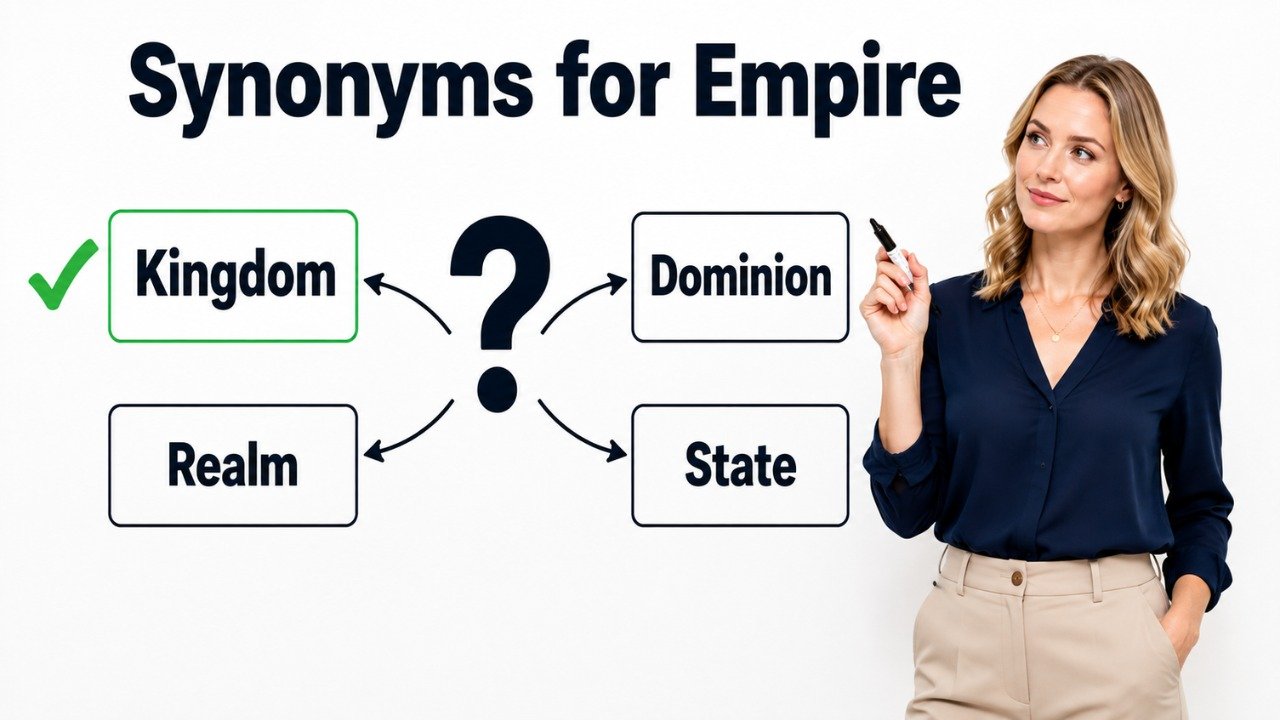
Quick Answer: The best synonyms for empire include kingdom, realm, dominion, dynasty, sovereignty, federation, territory, domain, superpower, and conglomerate. Use kingdom for land ruled by a monarch, realm for a broad territory or area of influence, and dominion for control over people or land. Dynasty suits a ruling family, superpower describes a highly influential nation, and conglomerate works for a large business empire.
Pronunciation and Word Details
Word: Empire.
Pronunciation: /ˈempaɪər/.
Part of Speech: Noun.
Meaning: A large territory, organization, or sphere of influence controlled by one ruler, government, family, or powerful group.
US Pronunciation:
UK Pronunciation:
What Does “Empire” Mean?
Empire means a large group of territories, nations, businesses, or institutions controlled by one central authority. It is mainly used as a noun.
In history and politics, an empire consists of several regions or peoples ruled by an emperor, monarch, government, or dominant state. Such control may be political, military, economic, or cultural.
In business, empire can describe a large collection of companies, properties, products, or investments controlled by one person or organization.
The word may also describe a broad sphere of influence. A media empire, property empire, or commercial empire does not involve a traditional ruler, but it still suggests extensive control, wealth, and power.
Meaning, Tone, and Context of “Empire”
Empire usually has a formal, powerful, and historical tone. It often suggests authority, expansion, influence, wealth, and control.
Historical Context: Empire describes a large political system that governs different territories and populations.
Political Context: The word can refer to a powerful state that controls regions outside its original borders.
Business Context: Empire describes a large commercial organization or collection of businesses controlled by one owner.
Cultural Context: It may refer to a wide network of cultural, religious, artistic, or intellectual influence.
Negative Context: Empire can suggest conquest, exploitation, inequality, or excessive control.
Positive Context: In business or personal success, it may suggest impressive growth, ambition, organization, and achievement.
The meaning changes with context. A kingdom usually centers on one monarch and one main territory, while an empire often includes multiple territories, cultures, or institutions under central control.
When and How to Use “Empire”
For Historical Rule: Use empire when describing a large group of territories ruled by one central authority.
Example: The empire controlled several important trade routes.
For Political Power: Use empire when a state exercises strong control over distant lands or nations.
Example: Military expansion increased the empire’s political influence.
For Business Growth: Use empire when one person or organization controls many successful companies or properties.
Example: She built a retail empire from a single local store.
For Property Ownership: The word can describe a large collection of buildings, land, or investments.
Example: The family created a property empire across several cities.
For Media Influence: Use empire for a large network of publications, channels, studios, or communication businesses.
Example: The entrepreneur expanded his media empire through several acquisitions.
For Figurative Power: Empire can describe any large and influential system built around control or authority.
Example: The organization developed an empire of educational institutions.
Best Synonyms for Empire
Kingdom: A country or territory ruled by a king or queen.
Example: The kingdom prospered under a peaceful ruler.
Realm: A territory, field, or sphere under a particular authority.
Example: The ruler expanded his realm through alliances.
Dominion: Control over land, people, or an area of influence.
Example: The state extended its dominion across the coast.
Dynasty: A succession of rulers from the same family.
Example: The dynasty governed the region for several generations.
Sovereignty: Supreme authority over a state or territory.
Example: The nation fought to protect its sovereignty.
Federation: A group of states or regions united under one central government.
Example: The federation gave each region limited independence.
Territory: An area of land controlled by a ruler, government, or organization.
Example: The army defended the northern territory.
Domain: An area of land, knowledge, influence, or control.
Example: Trade became an important part of the ruler’s domain.
Superpower: A nation with exceptional military, political, or economic influence.
Example: The country emerged as a global superpower.
Conglomerate: A large corporation made up of several different businesses.
Example: The family transformed its company into an international conglomerate.
50 Synonyms for Empire with Short Meanings
- Kingdom: A country or territory ruled by a monarch.
- Realm: A territory or sphere controlled by an authority.
- Dominion: Control over land, people, or institutions.
- Dynasty: A line of rulers from the same family.
- Sovereignty: Supreme authority over a state or territory.
- Federation: A union of regions under one central government.
- Territory: An area controlled by a ruler or government.
- Domain: An area of control, ownership, or influence.
- Superpower: A nation with exceptional global influence.
- Conglomerate: A large corporation containing several businesses.
- State: An organized political territory with a government.
- Nation: A country or community united under one government.
- Monarchy: A political system ruled by a monarch.
- Imperium: Supreme authority or imperial power.
- Principality: A territory ruled by a prince or princess.
- Sultanate: A state or territory ruled by a sultan.
- Caliphate: A state governed by a caliph.
- Commonwealth: A political community joined by shared interests.
- Confederation: A group of regions or states joined together.
- Union: A group of territories or organizations combined as one.
- Realm of Influence: An area affected or controlled by someone.
- Sphere of Influence: A region where power or influence is exercised.
- Sphere: A particular area of control, activity, or interest.
- Jurisdiction: An area where legal authority can be exercised.
- Authority: The power to control, command, or govern.
- Rule: Control exercised by a ruler or government.
- Command: Authority over people, land, or resources.
- Control: The power to direct or manage something.
- Supremacy: The condition of having the highest power.
- Hegemony: Dominance over other states, groups, or institutions.
- Ascendancy: A position of increasing power or influence.
- Dominance: Control or superiority over others.
- Reign: The period or authority of a ruler.
- Regime: A system or government exercising political power.
- Colonial Power: A state controlling territories outside its borders.
- Imperial Power: A nation or ruler exercising broad control.
- World Power: A nation with major international influence.
- Great Power: A highly influential and powerful state.
- Power Bloc: A group of states united by shared power.
- Alliance: A union formed for mutual support or control.
- Network: A connected system of people or organizations.
- Organization: A structured group working under common leadership.
- Enterprise: A large business or commercial operation.
- Corporation: A legally recognized business organization.
- Business Group: A collection of companies under shared control.
- Commercial Powerhouse: A highly successful and influential business.
- Industrial Giant: A very large and powerful industrial company.
- Business Dynasty: A family that controls businesses across generations.
- Power Base: The main source of authority and influence.
- Establishment: A powerful and organized group within society.
Read Also:
Synonyms for Dance

Synonyms for Empire by Context
When Empire Means a Ruled Territory
Kingdom, realm, dominion, territory, state, and principality work well when empire refers to land governed by a ruler or central authority.
Example: The kingdom controlled fertile land near the river.
Example: The ruler expanded his dominion through military victories.
Example: The northern territory remained loyal to the central government.
Kingdom is best when a king or queen rules the land. Dominion emphasizes control, while territory focuses mainly on the geographical area.
When Empire Means a Powerful State
Superpower, world power, great power, imperial power, and colonial power suit political and historical contexts.
Example: The nation became a major world power.
Example: The imperial power controlled several overseas regions.
Example: The country emerged as a superpower after years of economic growth.
Superpower suggests exceptional global influence. Colonial power specifically refers to a nation controlling distant territories.
When Empire Means Political Control
Sovereignty, authority, rule, supremacy, dominance, hegemony, and ascendancy describe control or superior influence.
Example: The government strengthened its authority across the region.
Example: The state maintained political dominance over its neighbors.
Example: Economic hegemony allowed the nation to influence regional trade.
Hegemony is useful in formal political writing. Supremacy suggests the highest position of power, while authority is broader and more neutral.
When Empire Means a Business Organization
Conglomerate, corporation, enterprise, business group, commercial powerhouse, and industrial giant are useful when empire describes commercial success.
Example: The company became a global conglomerate.
Example: Her small enterprise developed into a commercial powerhouse.
Example: The manufacturer grew into an industrial giant.
Conglomerate is the strongest formal alternative when several different companies operate under shared ownership.
When Empire Means a Family Legacy
Dynasty, business dynasty, ruling house, and family establishment describe power passed through generations.
Example: The dynasty remained influential for more than a century.
Example: The family built a business dynasty through careful expansion.
Dynasty is suitable for royal, political, and commercial families that maintain control over several generations.
When Empire Means a Sphere of Influence
Domain, sphere, realm of influence, network, and power base describe influence without direct political rule.
Example: Education became an important part of her professional domain.
Example: The organization expanded its sphere of influence.
Example: The capital served as the ruler’s main power base.
These alternatives are useful when empire is figurative rather than territorial.
Another Word for Empire
Kingdom is one of the best single replacements for empire when the sentence refers to land ruled by a monarch. Realm is broader and can describe territory, authority, or an area of activity. Conglomerate is better when empire refers to a large business structure.
The best replacement depends on whether the sentence concerns history, politics, territory, business, or influence.
Original: The ruler expanded his empire across the valley.
Better Option: The ruler expanded his kingdom across the valley.
Original: She built a successful business empire.
Better Option: She built a successful business conglomerate.
Original: The nation became a powerful empire.
Better Option: The nation became a powerful world power.
Original: Education was part of his intellectual empire.
Better Option: Education was part of his intellectual sphere of influence.
When Not to Use “Empire”
Avoid empire when the organization or territory is too small to justify such a powerful word.
Weak: He created an empire by opening two small shops.
Better: He created a growing retail business by opening two small shops.
Do not use empire when kingdom is historically or politically more accurate.
Weak: The queen ruled a small empire within one territory.
Better: The queen ruled a small kingdom within one territory.
Empire may sound exaggerated in ordinary business writing.
Weak: The designer created an empire of three freelance projects.
Better: The designer created a successful freelance business.
Avoid empire when the sentence only refers to influence rather than direct control.
Weak: Her kindness created an emotional empire.
Better: Her kindness created a strong positive influence.
The word may also sound insensitive when discussing conquest, colonization, or exploitation without acknowledging the historical consequences.
Weak: The empire simply brought progress everywhere.
Better: The empire expanded its influence, although its rule also created conflict and inequality.
Words Commonly Confused With Empire
Empire vs Kingdom: A kingdom is usually ruled by a king or queen and may involve one main territory. An empire often controls several territories, cultures, or nations.
Empire vs Dynasty: An empire is a political or territorial system. A dynasty is a family line that holds power across generations.
Empire vs Realm: Realm can mean territory, authority, or an area of knowledge. Empire usually suggests greater political, commercial, or military control.
Empire vs Dominion: Dominion refers to control or authority. Empire refers to the larger system or territory under that control.
Empire vs Federation: An empire is usually governed from a powerful center. A federation joins regions that may retain some local authority.
Empire vs Superpower: An empire directly controls territories or institutions. A superpower has great influence but does not necessarily govern other lands.
Empire vs Conglomerate: Empire is a broad figurative term for large business control. Conglomerate is a more precise business term for a corporation containing several companies.
Which Synonym Should You Choose?
Choose kingdom when a king or queen rules a single country or territory.
Choose realm when referring to territory, authority, imagination, knowledge, or influence.
Choose dominion when emphasizing control over land, people, or institutions.
Choose dynasty when power remains within the same family for several generations.
Choose sovereignty when discussing a state’s right to govern itself.
Choose federation when several regions share a central government while keeping some local power.
Choose superpower when describing a nation with major global influence.
Choose hegemony in formal political or academic writing about dominance.
Choose territory when the geographical area matters more than the ruling system.
Choose conglomerate when describing a large business made up of several companies.
Choose commercial powerhouse for a highly successful and influential business.
Choose sphere of influence when control is indirect, cultural, economic, or political.
Choose network when describing a connected system of organizations or institutions.
Real Life Examples of “Empire” in Sentences
Original: The emperor expanded the empire through military campaigns.
Better Option: The emperor expanded his dominion through military campaigns.
Original: The ancient empire controlled several trade routes.
Better Option: The ancient realm controlled several trade routes.
Original: She built a fashion empire from one small store.
Better Option: She built a fashion conglomerate from one small store.
Original: The family’s property empire continued to grow.
Better Option: The family’s property business continued to grow.
Original: The empire became a major force in regional politics.
Better Option: The state became a major regional power.
Original: The ruler struggled to protect his empire.
Better Option: The ruler struggled to protect his kingdom.
Original: Their publishing empire reached readers across the country.
Better Option: Their publishing network reached readers across the country.
Original: The company expanded its empire into new industries.
Better Option: The company expanded its business group into new industries.
Original: The empire maintained control over distant lands.
Better Option: The imperial power maintained control over distant territories.
Original: He created an empire based on property investments.
Better Option: He created a commercial powerhouse based on property investments.
Synonym Groups and Usage Differences
Political Territory Group
Kingdom, realm, territory, state, principality, sultanate, and caliphate describe organized lands ruled by a central authority.
Kingdom is connected with monarchy. Principality refers to land ruled by a prince, while sultanate and caliphate belong to specific political traditions.
Example: The principality remained independent for many years.
Power and Control Group
Dominion, sovereignty, authority, supremacy, hegemony, ascendancy, and dominance describe political or social control.
Sovereignty means independent governing authority. Hegemony describes dominance over other groups, while supremacy suggests the highest position of power.
Example: The nation defended its sovereignty against foreign control.
International Influence Group
Superpower, world power, great power, colonial power, and imperial power describe states with significant influence.
Superpower is the strongest modern term. Colonial power emphasizes overseas control, while great power is broader and more historical.
Example: The state developed into an influential world power.
Business Group
Conglomerate, corporation, enterprise, business group, commercial powerhouse, and industrial giant describe large commercial organizations.
Conglomerate is precise when one parent company controls businesses in different industries. Enterprise is broader and can describe a single commercial operation.
Example: The corporation acquired several smaller companies.
Family Power Group
Dynasty, business dynasty, ruling family, and family establishment describe influence passed through generations.
Dynasty can apply to royal families, political families, and wealthy commercial families.
Example: The business dynasty remained powerful for decades.
Influence Group
Domain, sphere, realm of influence, network, and power base describe indirect authority or influence.
These words are more suitable than empire when there is no direct rule over territory.
Example: The organization expanded its network of schools.
Antonyms of Empire
The opposite of empire depends on whether the sentence concerns political control, territory, influence, or business size.
Colony: A territory controlled by another state rather than ruling independently.
Dependency: A region that relies on or is controlled by another power.
Province: A smaller administrative region within a larger state.
Locality: A small and limited geographical area.
Community: A group connected by shared place or interests without imperial control.
Republic: A state governed by elected representatives rather than an emperor.
Democracy: A political system in which citizens participate in government.
Independence: Freedom from external control or rule.
Autonomy: The ability to govern or manage oneself.
Weakness: A lack of power, strength, or influence.
Subordination: A condition of being placed under another authority.
Fragmentation: Division into smaller and less unified parts.
Small Business: A limited commercial operation rather than a large corporate network.
Individual Enterprise: A business operated on a relatively small scale.
Comparison: Empire vs Related Words
Empire vs Kingdom
A kingdom is usually ruled by a king or queen and may contain one main nation. An empire often contains several territories, peoples, or nations under one authority.
Example With Empire: The empire controlled lands across several regions.
Example With Kingdom: The kingdom was ruled by a hereditary monarch.
Empire vs Dynasty
Empire refers to a political or commercial system. Dynasty refers to the family that holds power across generations.
Example With Empire: The empire expanded through military victories.
Example With Dynasty: The dynasty ruled for more than two centuries.
Empire vs Realm
Empire suggests large scale control and power. Realm may simply mean territory or an area of activity.
Example With Empire: The empire governed several distant provinces.
Example With Realm: The law applies throughout the entire realm.
Empire vs Dominion
Empire is the territory or system being controlled. Dominion is the power or authority exercised over it.
Example With Empire: The empire included several coastal regions.
Example With Dominion: The ruler established dominion over the coast.
Empire vs Superpower
An empire governs or controls other territories. A superpower influences global politics, economics, or military affairs without necessarily ruling foreign lands.
Example With Empire: The empire collected taxes from distant provinces.
Example With Superpower: The country became a leading global superpower.
Empire vs Conglomerate
Empire is a figurative and dramatic term in business. Conglomerate is a formal term for a company that owns several different businesses.
Example With Empire: She created a successful retail empire.
Example With Conglomerate: The conglomerate owns companies in several industries.
Common Phrases and Expressions With Empire
Ancient Empire: A large political power from an earlier historical period.
Colonial Empire: A state controlling overseas lands and populations.
Business Empire: A large collection of companies controlled by one owner.
Commercial Empire: A broad network of profitable businesses and investments.
Media Empire: A large group of communication or publishing businesses.
Property Empire: A large collection of land and buildings owned for profit.
Global Empire: A political or commercial system operating across many regions.
Expanding Empire: A territory or business becoming larger and more influential.
Fallen Empire: A once powerful political system that has collapsed.
Empire Building: The process of increasing control, territory, wealth, or influence.
Common Mistakes to Avoid
A common mistake is using empire as an exact synonym for kingdom. A kingdom may be small and culturally unified, while an empire usually contains several territories or populations.
Avoid using dynasty for the territory itself. Dynasty refers to the ruling family, not the land under its authority.
Do not call every large business a conglomerate. A conglomerate specifically owns companies in different industries. A large company operating in one industry may be better described as a corporation or commercial powerhouse.
Avoid repeating empire several times in the same paragraph. Use realm, dominion, territory, power, network, or conglomerate when the meaning allows.
Do not use empire when sphere of influence is more accurate. Influence does not always involve direct control.
Be careful with positive descriptions of historical empires. Their expansion may have involved conquest, forced rule, displacement, or exploitation. Choose balanced wording when discussing historical consequences.
Avoid exaggeration in casual business writing. A small collection of shops may be a growing business, not an empire.
Conclusion
Synonyms for empire vary according to history, politics, business, territory, and influence. Kingdom and realm work well for ruled lands, while dominion and sovereignty emphasize authority. Dynasty refers to a powerful family line, and superpower describes a highly influential nation. In business writing, conglomerate, corporation, and commercial powerhouse are often more precise. Choosing the right synonym helps readers understand whether empire refers to land, government, control, family power, or commercial success.
FAQs About Synonyms for Empire
What Is the Best Synonym for Empire?
Kingdom is a strong general synonym for a ruled territory. Realm, dominion, superpower, and conglomerate may be better in other contexts.
Is Kingdom the Same as Empire?
Not exactly. A kingdom is usually ruled by a monarch, while an empire often controls several kingdoms, territories, or peoples.
What Is a Synonym for Business Empire?
Conglomerate, corporation, business group, commercial powerhouse, enterprise, and industrial giant are useful alternatives.
What Is a Formal Synonym for Empire?
Imperium, dominion, sovereignty, hegemony, federation, and imperial power are suitable formal choices.
What Is Another Word for a Powerful Nation?
Superpower, world power, great power, and imperial power can describe a highly influential nation.
Can Dynasty Replace Empire?
Dynasty can replace empire only when the sentence refers to a ruling family or a family controlled business legacy.
What Is the Opposite of Empire?
Possible opposites include colony, dependency, province, republic, independence, autonomy, small business, and individual enterprise.
