
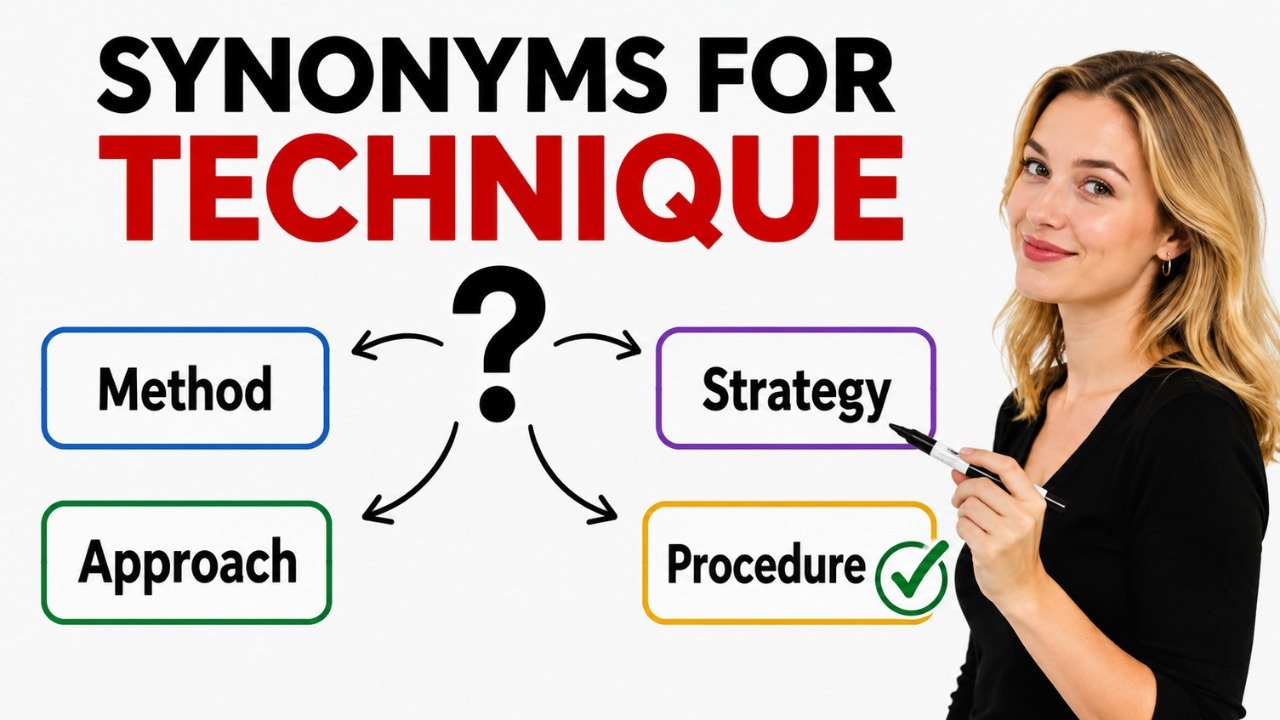
Quick Answer: The best synonyms for technique are method, approach, procedure, process, strategy, system, skill, practice, craft, and methodology. Use method for an organized way of completing a task, approach for a general way of dealing with a subject, and procedure for a fixed series of steps. Process suits connected stages of work, while strategy describes a planned way to achieve a goal. Skill, craft, and practice emphasize ability developed through experience. Methodology is most suitable for formal, academic, scientific, and research contexts.
Pronunciation and Word Details
Word: Technique
Pronunciation: /tekˈniːk/
Part of Speech: Noun
Meaning: A particular method, skill, or way of performing a task or achieving a result.
US Pronunciation:
UK Pronunciation:
What Does “Technique” Mean?
Technique means a particular way of performing an activity, completing a task, or producing a desired result. It is a noun and commonly refers to both the method being used and the skill involved in using it successfully.
A cooking technique is a way of preparing food. A writing technique is a method used to communicate an idea or create an effect. A painting technique describes how an artist applies materials, while a study technique helps a learner understand and remember information.
Technique can also refer to practical ability. When someone has excellent technique, they perform an activity with control, knowledge, and precision. The word is widely used in education, art, sport, science, business, medicine, music, communication, and professional training.
Meaning, Tone, and Context of “Technique”
Technique is a neutral and moderately formal word. It can be used naturally in both everyday conversation and professional writing.
In casual contexts, technique often describes a useful way of doing something. Someone may discuss a cleaning technique, breathing technique, study technique, or cooking technique.
In professional and academic contexts, the word can describe a structured method used to collect information, solve a problem, complete an experiment, or perform a specialized task. Research technique, analytical technique, and teaching technique are common formal uses.
Technique can also carry a positive meaning when it refers to ability. Saying that a musician has strong technique suggests control, training, accuracy, and practiced skill.
The word does not always mean the same thing as talent. Talent may be natural, while technique is usually developed through instruction, repetition, observation, and experience.
When and How to Use “Technique”
For Performing a Task: Use technique when describing a particular way of completing an activity.
Example: The chef demonstrated a simple technique for cutting vegetables evenly.
For Practical Skill: Use technique when someone performs an activity with trained control and precision.
Example: Her swimming technique improved after several months of practice.
For Problem Solving: Use technique for a method that helps resolve a difficulty or reach a result.
Example: The teacher introduced a new technique for solving complex equations.
For Creative Work: Use technique when discussing methods used in writing, painting, music, design, or performance.
Example: The painter developed a technique that created soft layers of color.
For Research: Use technique for a structured way of gathering, measuring, examining, or interpreting information.
Example: The researchers used an observation technique to study behavior.
For Communication: Use technique for a method that improves speaking, writing, listening, or persuasion.
Example: Asking open questions is an effective interviewing technique.
For Learning: Use technique for a planned way of understanding, practicing, or remembering information.
Example: Regular review is a useful study technique.
For Physical Movement: Use technique for controlled movement in exercise, dance, sport, or manual work.
Example: Correct lifting technique can reduce unnecessary strain.
Best Synonyms for Technique
Method: An organized way of doing or completing something.
Example: This method makes the calculation easier to understand.
Approach: A general way of thinking about or dealing with a task.
Example: The instructor used a practical approach to teaching grammar.
Procedure: A recognized or fixed series of steps.
Example: Everyone must follow the correct safety procedure.
Process: A connected series of actions or stages that produces a result.
Example: Editing is an important part of the writing process.
Strategy: A carefully planned way of achieving a goal.
Example: The team created a strategy for improving customer satisfaction.
System: An organized set of methods, rules, or connected parts.
Example: She developed a system for managing daily responsibilities.
Skill: An ability developed through learning and practice.
Example: Clear communication is an essential professional skill.
Practice: A customary method or repeated activity used to improve ability.
Example: Regular practice helped him improve his drawing.
Craft: A trained ability used to create or perform something well.
Example: She spent years mastering the craft of storytelling.
Methodology: An organized set of methods used in a field of study or activity.
Example: The report clearly explained the research methodology.
50 Synonyms for Technique With Short Meanings
- Method: An organized way of doing something.
- Approach: A general way of handling a task or subject.
- Procedure: A fixed or accepted series of steps.
- Process: A sequence of actions that produces a result.
- Strategy: A planned method for achieving a goal.
- System: An organized arrangement of methods or rules.
- Practice: A customary or repeated way of performing an activity.
- Skill: An ability gained through learning and experience.
- Craft: A trained ability used to make or perform something.
- Expertise: Advanced knowledge and skill in a particular area.
- Proficiency: A high level of ability or competence.
- Ability: The power or skill needed to do something.
- Art: A developed skill in performing an activity effectively.
- Manner: The particular way in which something is done.
- Way: A means or method of completing an action.
- Mode: A particular form or manner of operation.
- Means: A method or resource used to achieve a result.
- Tactic: A specific action used to support a larger plan.
- Formula: An established method for producing a result.
- Routine: A regular and familiar method of doing something.
- Operation: A method or action involved in carrying out work.
- Protocol: An official or accepted set of procedures.
- Methodology: A structured system of methods used in a field.
- Framework: An organized structure that guides action or thought.
- Mechanism: A process or method through which something works.
- Style: A recognizable way of performing or expressing something.
- Execution: The way a plan, movement, or task is carried out.
- Application: The practical use of a method, idea, or skill.
- Handling: The way a person manages or performs a task.
- Performance: The manner in which an activity is carried out.
- Workmanship: The quality and skill shown in completed work.
- Craftsmanship: Exceptional skill and care in making something.
- Mastery: Complete control or advanced ability in a subject.
- Competence: The ability to perform a task effectively.
- Dexterity: Skill and control, especially in physical movement.
- Know How: Practical knowledge of how to perform something.
- Plan: A prepared method for completing an objective.
- Pattern: A repeated or recognizable way of doing something.
- Discipline: A trained method supported by regular practice.
- Maneuver: A controlled movement or planned action.
- Device: A method or creative means used to produce an effect.
- Tool: A practical method or resource used for a purpose.
- Convention: An accepted way of doing something in a field.
- Custom: A commonly followed practice or method.
- Habit: A regular way of behaving or performing an action.
- Recipe: A set method for producing a particular result.
- Instruction: Guidance explaining how to perform a task.
- Method of Operation: The usual way a person or system works.
- Course of Action: A planned set of steps for reaching a goal.
- Working Method: A practical way of organizing and completing work.
Read Also:
Synonyms for Behavior
Synonyms for Technique by Context
When Technique Means Method
Method, way, manner, mode, approach, means, formula, and working method describe how an activity is performed.
Method is the strongest general replacement. Approach describes a broader way of thinking or acting, while formula suggests a method that can be repeated to produce a similar result.
Example: The teacher used a different method to explain the difficult concept.
When Technique Means Procedure
Procedure, process, protocol, routine, operation, instruction, and course of action describe organized steps used to complete a task.
Procedure is best when the steps are fixed or officially accepted. Process emphasizes connected stages, while protocol is commonly used for formal rules and professional practices.
Example: The laboratory follows a strict procedure for handling samples.
When Technique Means Skill
Skill, ability, proficiency, expertise, mastery, competence, dexterity, craft, and know how describe the ability needed to perform something successfully.
Skill is the most flexible choice. Expertise suggests advanced knowledge, while dexterity mainly describes controlled and precise physical movement.
Example: Her technical skill allowed her to complete the detailed work accurately.
When Technique Means Strategy
Strategy, tactic, plan, maneuver, approach, device, and course of action describe planned methods for achieving an objective.
Strategy refers to the overall plan. Tactic describes a specific action within that plan. Maneuver often refers to a controlled movement or carefully planned action.
Example: Offering a free demonstration was an effective sales tactic.
When Technique Means Creative Style
Style, craft, art, device, execution, performance, workmanship, and craftsmanship describe how creative or skilled work is produced.
Style emphasizes recognizable expression. Craft and craftsmanship focus on learned ability and care. Device is often used for a creative method that produces a particular effect.
Example: Repetition is a writing device that can strengthen an important message.
When Technique Means an Organized System
System, methodology, framework, mechanism, pattern, discipline, and practice describe an organized structure or collection of methods.
Methodology is most suitable for research and formal study. Framework provides a structure for decision making, while mechanism explains how a result is produced.
Example: The researcher selected a methodology that matched the purpose of the study.
Another Word for Technique
The best general replacement for technique is method because both words describe a particular way of completing a task. However, the best alternative depends on whether the sentence focuses on a process, skill, strategy, procedure, or creative style.
Original: She learned a new technique for organizing her notes.
Better Option: She learned a new method for organizing her notes.
Original: His piano technique has improved considerably.
Better Option: His piano skill has improved considerably.
Original: The team used a technique designed to increase participation.
Better Option: The team used a strategy designed to increase participation.
Original: The laboratory technique requires several careful steps.
Better Option: The laboratory procedure requires several careful steps.
When Not to Use “Technique”
Do not use technique when a more precise word would explain the meaning more clearly. Technique can refer to a method, practical skill, procedure, or style, so it may sound vague without enough context.
Use procedure when the sentence describes official steps that must be followed.
Weak: Employees must follow the correct technique during an emergency.
Better: Employees must follow the correct procedure during an emergency.
Use strategy when describing a long term plan designed to achieve a particular goal.
Weak: The organization created a technique for increasing membership.
Better: The organization created a strategy for increasing membership.
Use skill when the focus is a person’s ability rather than the method being used.
Weak: Her communication technique makes her an excellent leader.
Better: Her communication skill makes her an excellent leader.
Use process when discussing several connected stages rather than one specific method.
Weak: Publishing a book involves a detailed technique.
Better: Publishing a book involves a detailed process.
Avoid using technique for a natural talent that has not been learned or practiced. Technique generally suggests training, control, and repeated application.
Weak: His natural technique allowed him to recognize musical notes instantly.
Better: His natural ability allowed him to recognize musical notes instantly.
Words Commonly Confused With Technique
Technique vs Method: Technique often includes both the method and the skill needed to perform it. Method mainly describes an organized way of completing a task.
Technique vs Skill: Technique is the way an activity is performed. Skill is the ability to perform it successfully.
Technique vs Strategy: Technique is usually a specific way of doing something. Strategy is a broader plan designed to achieve a goal.
Technique vs Procedure: Technique may be adapted according to personal ability or preference. Procedure usually follows a fixed order of steps.
Technique vs Process: Technique describes a particular method. Process refers to a complete series of connected stages.
Technique vs Tactic: Technique describes how an action is performed. Tactic is a specific action selected to support a strategy.
Technique vs Methodology: Technique is one practical method. Methodology is the complete system of methods and principles used in a field or study.
Technique vs Technology: Technique is a way of performing an activity. Technology refers to tools, machines, systems, and knowledge created for practical purposes.
Which Synonym Should You Choose?
Choose method when referring to a clear and organized way of doing something.
Choose approach when describing a general attitude or way of dealing with a subject.
Choose procedure when a task requires fixed, official, or ordered steps.
Choose process when several connected stages produce a final result.
Choose strategy when discussing a planned way to achieve a major objective.
Choose tactic when describing one specific action within a larger strategy.
Choose system when several connected methods, rules, or parts work together.
Choose skill when the main focus is a person’s learned ability.
Choose proficiency when describing a high level of ability in formal writing.
Choose expertise when someone has advanced knowledge and experience.
Choose craft when discussing trained creative or practical ability.
Choose dexterity when describing controlled movement of the hands or body.
Choose methodology for research, academic study, and formal analysis.
Choose protocol when referring to officially accepted professional steps.
Choose style when discussing a recognizable way of writing, designing, performing, or creating.
Choose craftsmanship when emphasizing exceptional care and skill in completed work.
Real Life Examples of “Technique” in Sentences
Original: The teacher introduced a new technique for improving memory.
Better Option: The teacher introduced a new method for improving memory.
Original: Her interview technique helped candidates feel comfortable.
Better Option: Her interview approach helped candidates feel comfortable.
Original: The laboratory uses a reliable testing technique.
Better Option: The laboratory uses a reliable testing procedure.
Original: The manager developed a technique for reducing delays.
Better Option: The manager developed a strategy for reducing delays.
Original: His drawing technique improved through daily practice.
Better Option: His drawing skill improved through daily practice.
Original: The writer used a technique to create suspense.
Better Option: The writer used a device to create suspense.
Original: The surgeon explained the technique before beginning.
Better Option: The surgeon explained the procedure before beginning.
Original: This technique involves three connected stages.
Better Option: This process involves three connected stages.
Original: The athlete adjusted her running technique.
Better Option: The athlete adjusted her running form and method.
Original: The researchers selected an appropriate technique for collecting data.
Better Option: The researchers selected an appropriate methodology for collecting data.
Synonym Groups and Usage Differences
Method Group
Method, approach, way, manner, mode, means, and formula describe a particular way of completing an activity.
Method is clear and widely applicable. Approach is broader and often includes attitude or perspective. Formula suggests a repeatable method that usually produces a predictable result.
Example: The new approach encouraged students to participate more actively.
Procedure Group
Procedure, process, protocol, routine, operation, and instruction describe organized actions or stages.
Procedure focuses on ordered steps. Protocol is more formal and often includes professional rules. Routine describes a familiar method performed regularly.
Example: The assistant followed the established protocol before recording the results.
Skill Group
Skill, ability, proficiency, expertise, mastery, competence, dexterity, and know how describe a person’s capacity to perform an activity.
Ability is broad, while proficiency suggests a developed level of success. Mastery describes complete or exceptional control.
Example: Years of practice helped her achieve mastery of the instrument.
Creative Craft Group
Craft, art, style, workmanship, craftsmanship, execution, and performance describe the quality or manner of creative and practical work.
Craft refers to learned creative ability. Workmanship describes the quality visible in a completed object, while execution refers to how an idea or plan is carried out.
Example: The furniture displayed impressive craftsmanship and careful attention to detail.
Planning Group
Strategy, tactic, plan, maneuver, device, and course of action describe methods selected to achieve an objective.
Strategy is the overall direction. Tactic is one action within it. A course of action is a selected set of steps used to respond to a situation.
Example: The first tactic supported the team’s wider growth strategy.
Research Group
Methodology, framework, procedure, mechanism, protocol, and system are useful in academic, scientific, and analytical writing.
Methodology describes the complete reasoning and collection of methods behind a study. Framework organizes ideas, while mechanism explains how something causes a particular result.
Example: The study used a clear analytical framework to organize the findings.
Regular Practice Group
Practice, routine, discipline, habit, custom, convention, and pattern describe repeated or accepted ways of acting.
Practice may refer to repeated training or an accepted professional method. Convention is a commonly accepted way of doing something, while habit is a repeated personal behavior.
Example: Careful documentation is a standard professional practice.
Antonyms of Technique
Technique does not have one perfect opposite because it can mean method, skill, order, or trained performance. The opposite depends on the intended meaning.
Inexperience: A lack of practical knowledge or training.
Incompetence: An inability to perform a task successfully.
Ineptitude: A lack of skill or effectiveness.
Clumsiness: Poor control or awkward physical performance.
Carelessness: Failure to perform something with proper attention.
Disorder: A lack of organized method or structure.
Randomness: Action without a planned or consistent method.
Improvisation: Performance without a prepared method or plan.
Guesswork: Decision making without enough knowledge or a reliable method.
Confusion: A lack of clear understanding or organization.
Inefficiency: Use of a method that wastes time, effort, or resources.
Unpreparedness: A lack of readiness, planning, or practice.
Amateurism: Work performed without advanced professional ability.
Awkwardness: A lack of smoothness, confidence, or control.
Poor Execution: Unsuccessful performance of a plan or method.
Comparison of Technique and Related Words
Technique vs Method
Technique often emphasizes the practical way and skill used to complete an activity. Method focuses more directly on the organized way itself.
Example With Technique: Her painting technique creates soft and realistic shadows.
Example With Method: Her teaching method makes difficult ideas easier to understand.
Technique vs Skill
Technique is how someone performs an action. Skill is how capable that person is at performing it.
Example With Technique: He adjusted his breathing technique during the exercise.
Example With Skill: His communication skill helped resolve the disagreement.
Technique vs Strategy
Technique is usually a specific method used during an activity. Strategy is an overall plan created to achieve a larger goal.
Example With Technique: Asking follow up questions is a useful interviewing technique.
Example With Strategy: The organization created a strategy for attracting qualified applicants.
Technique vs Procedure
Technique may vary according to a person’s training or preference. Procedure usually requires a fixed sequence of actions.
Example With Technique: Each artist develops a personal shading technique.
Example With Procedure: The technician followed the testing procedure carefully.
Technique vs Process
Technique refers to one method used within an activity. Process includes all the stages that lead from the beginning to the final result.
Example With Technique: The editor used a technique for identifying repeated words.
Example With Process: The editing process included reviewing structure, grammar, and clarity.
Technique vs Tactic
Technique describes the way an action is performed. Tactic describes an action chosen to achieve an immediate objective.
Example With Technique: The speaker practiced a breathing technique before the presentation.
Example With Tactic: The speaker opened with a question as a tactic for gaining attention.
Technique vs Methodology
Technique is a practical method or action. Methodology is the complete system and reasoning behind the methods used in formal research.
Example With Technique: Observation was one data collection technique used in the study.
Example With Methodology: The methodology explained why observation and interviews were selected.
Technique vs Technology
Technique is a method or skilled way of doing something. Technology includes tools, equipment, systems, and scientific knowledge used for practical purposes.
Example With Technique: The photographer used a lighting technique to reduce harsh shadows.
Example With Technology: Modern camera technology allows images to be captured in low light.
Common Phrases and Expressions With “Technique”
Breathing Technique: A controlled method of breathing for calmness, exercise, or performance.
Writing Technique: A method used to communicate ideas or create an effect in writing.
Teaching Technique: A method used to help learners understand information.
Study Technique: A planned way of learning, reviewing, or remembering material.
Communication Technique: A method used to express ideas or understand others effectively.
Relaxation Technique: A method designed to reduce physical or mental tension.
Research Technique: A structured way of collecting or examining information.
Painting Technique: A particular way of applying color, texture, or materials.
Problem Solving Technique: A method used to understand and resolve a difficulty.
Interview Technique: A planned method for asking questions and gathering information.
Training Technique: A method used to improve ability, knowledge, or performance.
Proper Technique: The correct and controlled way of performing an activity.
Common Mistakes to Avoid
Using Technique and Skill as Exact Synonyms: Technique describes how an action is performed. Skill describes the level of ability behind that performance.
Using Technique for an Entire Strategy: A technique is usually specific, while a strategy covers a wider plan and long term objective.
Confusing Technique With Technology: Technique means a method or way of performing something. Technology refers to practical tools, machines, and technical systems.
Using Procedure for Personal Style: A procedure follows ordered steps, while a personal technique may vary according to preference, experience, or creativity.
Using Methodology for One Simple Method: Methodology refers to a full system of methods and the reasoning behind them. Use method or technique for one practical action.
Repeating Technique Too Often: Repetition can make a paragraph sound vague. Use method, procedure, strategy, skill, process, or approach according to the meaning.
Choosing a Broad Synonym Without Context: Way and method are useful, but they may lose the sense of specialized training contained in technique.
Ignoring Formality: Know how is conversational, while methodology, protocol, and procedure are more suitable for formal writing.
Using Tactic for a Neutral Physical Method: Tactic usually involves planning and goals. Technique is more natural for movements, creative methods, and practical performance.
Conclusion
Understanding synonyms for technique helps you describe methods, skills, procedures, strategies, and creative practices more precisely. Method is the strongest general replacement, while approach suits a broader way of handling a subject. Procedure and protocol fit ordered professional steps, while process describes connected stages. Strategy and tactic are best for planning. Skill, expertise, proficiency, and mastery describe developed ability. Craft, style, and craftsmanship suit creative work. Choosing the right synonym makes your writing clearer, more natural, and better suited to its context.
FAQs About Synonyms for Technique
What Is the Best Synonym for Technique?
Method is the best general synonym for technique. Approach, procedure, skill, strategy, and process may be more accurate in particular contexts.
What Is a Formal Synonym for Technique?
Methodology, procedure, protocol, process, framework, and mechanism are useful formal synonyms.
Is Technique the Same as Skill?
Not exactly. Technique is the way an activity is performed, while skill is the ability to perform it successfully.
What Is Another Word for a Learning Technique?
Study method, learning strategy, practice, approach, system, and learning process are natural alternatives.
What Is a Synonym for Professional Technique?
Expertise, proficiency, competence, mastery, craftsmanship, and professional practice may suit this meaning.
What Is Another Word for a Research Technique?
Research method, methodology, procedure, analytical process, data collection method, and research approach are suitable alternatives.
What Is the Opposite of Technique?
Technique has no single exact opposite. Inexperience, clumsiness, disorder, guesswork, incompetence, and poor execution can express contrasting meanings.
