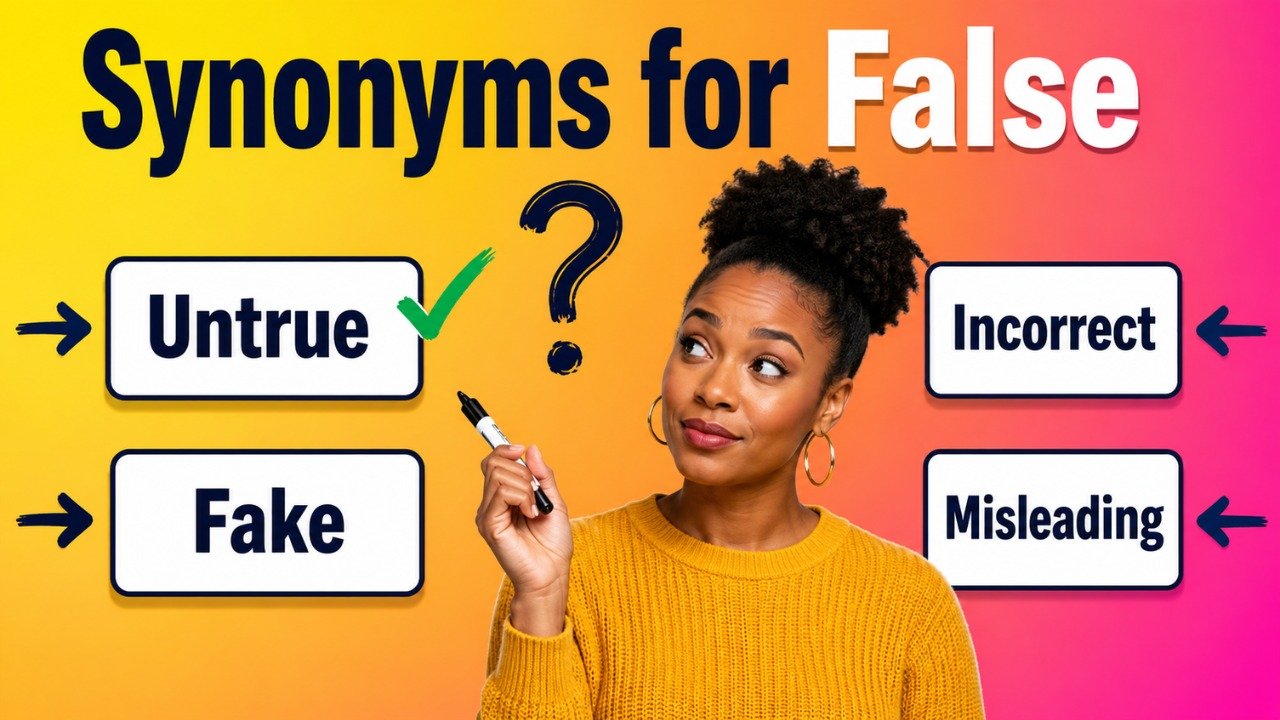
Quick Answer: The best synonyms for false are untrue, incorrect, inaccurate, misleading, deceptive, fake, counterfeit, fictitious, invalid, and insincere. Use untrue for a general claim that does not match reality, incorrect for a wrong answer, and inaccurate for faulty facts, figures, or measurements. Misleading and deceptive describe information that creates a wrong belief. Fake and counterfeit suit imitation objects, while fictitious describes invented stories or identities. Invalid works well for arguments, documents, and conclusions, while insincere describes feelings or behavior that are not genuine.
Pronunciation and Word Details
Word: False
Pronunciation: /fɔːls/
Part of Speech: Adjective
Meaning: Not true, correct, genuine, honest, or based on reality.
US Pronunciation:
UK Pronunciation:
What Does “False” Mean?
False means not true, not correct, or not genuine. It is mainly used as an adjective to describe information, beliefs, statements, objects, identities, emotions, and appearances that do not match reality.
A false statement contains information that is untrue. A false answer is incorrect. A false product is not genuine, while a false smile does not express sincere happiness. The word can also describe something that creates a mistaken impression, such as false hope or a false sense of safety.
The precise meaning of false depends on the noun it describes. In formal writing, it may refer to inaccurate data, invalid conclusions, or fraudulent claims. In everyday conversation, it commonly means wrong, fake, or untrue.
Meaning, Tone, and Context of “False”
False is generally a neutral but strong word. It clearly states that something is not true, accurate, or genuine. However, its tone can change depending on the context.
In academic, legal, scientific, and professional writing, false often describes inaccurate information, unsupported claims, invalid results, or incorrect assumptions. In these contexts, the word can sound formal and precise.
In conversation, false may describe a rumor, accusation, belief, alarm, or identity. Calling a person’s statement false can sound serious because it may suggest dishonesty. When there is no evidence that the person intended to deceive, incorrect, mistaken, or inaccurate may sound fairer.
False can also describe artificial objects, such as false teeth or false eyelashes. In these cases, it does not necessarily carry a negative meaning. It simply means that the item is not natural or original.
When and How to Use “False”
For Untrue Information: Use false when a statement, report, rumor, or claim does not match the facts.
Example: The article contained several false claims about the event.
For Incorrect Answers: Use false when an answer, calculation, or conclusion is wrong.
Example: Her first assumption proved false after the results arrived.
For Deceptive Communication: Use false when someone deliberately presents information that is not true.
Example: The seller made false promises to attract customers.
For Imitation Objects: Use false for something designed to look real or natural.
Example: The costume included false jewels and an imitation crown.
For Artificial Emotions: Use false when a reaction or feeling appears insincere.
Example: His false enthusiasm did not convince the audience.
For Unsupported Beliefs: Use false when an idea is based on incorrect reasoning or weak evidence.
Example: The decision was influenced by a false assumption.
For Invalid Warnings: Use false when an alarm or signal indicates a problem that does not exist.
Example: The smoke detector produced a false alarm.
Best Synonyms for False
Untrue: Not agreeing with facts or reality.
Example: The accusation was completely untrue.
Incorrect: Not right or factually correct.
Example: The address printed on the letter was incorrect.
Inaccurate: Containing mistakes or lacking precision.
Example: The report gave an inaccurate description of the damage.
Misleading: Likely to create a wrong impression.
Example: The advertisement used misleading language.
Deceptive: Intended or able to make someone believe something untrue.
Example: The document contained deceptive statements about the agreement.
Fake: Made to look real but not genuine.
Example: She immediately recognized the fake signature.
Counterfeit: Illegally copied to appear authentic.
Example: The officers discovered counterfeit currency.
Fictitious: Invented rather than real.
Example: The writer created a fictitious town for the story.
Invalid: Not logically, legally, or officially acceptable.
Example: The argument was based on an invalid comparison.
Insincere: Not expressing genuine feelings or intentions.
Example: His apology sounded insincere.
50 Synonyms for False With Short Meanings
- Untrue: Not based on truth or fact.
- Incorrect: Not right or accurate.
- Inaccurate: Containing errors or lacking precision.
- Wrong: Not correct or appropriate.
- Erroneous: Based on an error or mistaken belief.
- Mistaken: Founded on an incorrect understanding.
- Misleading: Creating an incorrect impression.
- Deceptive: Causing someone to believe something untrue.
- Deceitful: Deliberately dishonest or misleading.
- Dishonest: Not truthful or trustworthy.
- Fraudulent: Intended to deceive for personal gain.
- Fabricated: Invented and presented as true.
- Invented: Created rather than discovered or experienced.
- Fictitious: Existing only in an invented account.
- Fictional: Related to an imagined story or character.
- Imaginary: Existing only in the mind.
- Counterfeit: Copied to appear genuine or valuable.
- Fake: Not real, genuine, or authentic.
- Bogus: False and presented as legitimate.
- Sham: Pretended or made to deceive.
- Spurious: Seemingly valid but actually false.
- Phony: Informally describing something fake or dishonest.
- Forged: Copied or created without authorization.
- Falsified: Deliberately changed to hide the truth.
- Doctored: Improperly altered to create a misleading result.
- Manipulated: Changed or controlled in a misleading way.
- Distorted: Presented in an unfair or inaccurate form.
- Fallacious: Based on faulty reasoning.
- Invalid: Not logically, legally, or officially acceptable.
- Unsound: Not supported by good judgment or evidence.
- Baseless: Having no factual foundation.
- Groundless: Unsupported by evidence or reason.
- Unfounded: Not based on facts or reliable proof.
- Unsubstantiated: Not supported by enough evidence.
- Unproven: Not yet shown to be true.
- Dubious: Doubtful or unlikely to be trustworthy.
- Questionable: Open to doubt or suspicion.
- Unreliable: Not consistently accurate or trustworthy.
- Insincere: Not expressing genuine feelings.
- Hypocritical: Claiming values that one’s behavior does not reflect.
- Artificial: Made by people rather than occurring naturally.
- Imitation: Made to resemble something genuine.
- Mock: Made as a copy for practice, display, or amusement.
- Pseudo: Appearing genuine while lacking the real qualities.
- Pretended: Claimed or displayed without being genuine.
- Feigned: Deliberately presented as real when it is not.
- Specious: Appearing convincing but actually incorrect.
- Illusory: Based on an illusion rather than reality.
- Delusive: Likely to create a false belief or hope.
- Apocryphal: Widely repeated but probably untrue.
Read Also:
Synonyms for For
Synonyms for False by Context
When False Means Untrue or Incorrect
Untrue, incorrect, inaccurate, wrong, erroneous, and mistaken describe information that does not agree with reality.
Use untrue for claims and statements. Incorrect works well for answers, details, and decisions. Inaccurate is more precise when facts, measurements, descriptions, or records contain errors.
Example: The initial report was inaccurate because several figures had been entered incorrectly.
When False Means Deliberately Deceptive
Deceptive, deceitful, dishonest, fraudulent, fabricated, falsified, and misleading suggest that someone may be hiding or changing the truth.
Misleading does not always prove deliberate dishonesty. Information may be misleading because it lacks context. Fraudulent is much stronger and normally involves intentional deception for money, access, or another benefit.
Example: The investigation uncovered fraudulent documents and fabricated evidence.
When False Means Fake or Counterfeit
Fake, counterfeit, bogus, sham, phony, forged, artificial, and imitation describe objects or materials that are not genuine.
Fake is common in casual speech. Counterfeit is more formal and often describes unauthorized copies of money, documents, or valuable products. Artificial can be neutral when describing something created to replace a natural item.
Example: The collector discovered that the painting was a skillfully made imitation.
When False Means Unsupported or Invalid
Baseless, groundless, unfounded, unsubstantiated, fallacious, invalid, unsound, and specious describe ideas that lack evidence or logical support.
Baseless and unfounded work well for accusations and rumors. Fallacious describes faulty reasoning, while invalid is suitable for conclusions, arguments, documents, and procedures.
Example: The claim was dismissed as baseless because no reliable evidence supported it.
When False Means Insincere
Insincere, pretended, feigned, hypocritical, artificial, and sham describe emotions, actions, or behavior that are not genuine.
Use insincere for apologies, compliments, and promises. Feigned often describes an emotion or condition that someone deliberately pretends to have.
Example: Her feigned surprise could not hide the fact that she already knew the news.
Another Word for False
The best general replacement for false is untrue because it clearly describes something that does not match the facts. However, the most accurate alternative depends on whether you are describing an error, lie, imitation, unsupported claim, or artificial emotion.
Original: The statement about the meeting was false.
Better Option: The statement about the meeting was untrue.
Original: The measurements in the report were false.
Better Option: The measurements in the report were inaccurate.
Original: The document contained a false signature.
Better Option: The document contained a forged signature.
Original: He gave the audience false information to influence them.
Better Option: He gave the audience misleading information to influence them.
When Not to Use “False”
Do not use false when a more precise word can explain exactly what is wrong. False is broad and may leave readers unsure whether something is inaccurate, deliberately dishonest, artificial, invalid, or counterfeit.
Avoid false when describing a minor factual mistake if incorrect or inaccurate would sound fairer. Calling information false may suggest intentional dishonesty, even when the speaker was simply mistaken.
Weak: The survey results were false.
Better: The survey results were inaccurate because several responses were counted twice.
Use counterfeit rather than false when discussing an unauthorized copy of money or an official item.
Weak: The cashier received a false banknote.
Better: The cashier received a counterfeit banknote.
Use fictitious or fictional when describing invented people, places, or stories.
Weak: The novel takes place in a false kingdom.
Better: The novel takes place in a fictional kingdom.
Use insincere when the subject is an emotion, compliment, promise, or apology.
Weak: His apology felt false.
Better: His apology felt insincere.
Words Commonly Confused With False
False vs Incorrect: False means not true or genuine, while incorrect usually means that an answer, detail, or choice contains an error. Incorrect is often less accusatory.
False vs Inaccurate: False may suggest that something is entirely untrue. Inaccurate means that it contains errors or lacks precision, although some parts may still be correct.
False vs Fake: False can describe information, beliefs, appearances, and objects. Fake mainly describes something made or presented to appear genuine.
False vs Misleading: False information is not true. Misleading information creates a wrong impression and may include technically true details that lack important context.
False vs Fictional: False describes something wrongly presented as real or true. Fictional describes people, places, and events created for a story.
False vs Fraudulent: False is a general description. Fraudulent specifically suggests intentional deception, usually for personal, legal, or financial gain.
False vs Invalid: False concerns truth or genuineness. Invalid means that something is not logically, legally, technically, or officially acceptable.
Which Synonym Should You Choose?
Choose untrue when you need a direct and neutral replacement for a statement that does not match reality.
Choose incorrect for wrong answers, addresses, instructions, calculations, and factual details.
Choose inaccurate when discussing data, measurements, reports, descriptions, estimates, or records that contain errors.
Choose misleading when information creates a wrong impression or leaves out important context.
Choose deceptive when a message, appearance, or action seems designed to fool someone.
Choose fabricated for invented stories, evidence, quotations, or explanations presented as fact.
Choose counterfeit for unauthorized copies of money, documents, tickets, or valuable objects.
Choose fictitious for invented names, characters, places, accounts, and identities.
Choose invalid for arguments, conclusions, documents, licenses, procedures, or claims that are not acceptable.
Choose insincere for emotions, compliments, apologies, promises, and expressions that are not genuine.
Choose fake in casual conversation when describing an object, identity, reaction, or appearance that is not real.
Real Life Examples of “False” in Sentences
Original: The witness gave a false account of the accident.
Better Option: The witness gave an inaccurate account of the accident.
Original: A false rumor spread throughout the neighborhood.
Better Option: An unfounded rumor spread throughout the neighborhood.
Original: The application included a false signature.
Better Option: The application included a forged signature.
Original: The article created a false impression of the situation.
Better Option: The article created a misleading impression of the situation.
Original: She used a false name when making the reservation.
Better Option: She used a fictitious name when making the reservation.
Original: The investigation exposed several false invoices.
Better Option: The investigation exposed several fraudulent invoices.
Original: His false smile disappeared when the meeting ended.
Better Option: His insincere smile disappeared when the meeting ended.
Original: The calculation produced a false result.
Better Option: The calculation produced an incorrect result.
Original: The argument depends on a false assumption.
Better Option: The argument depends on a mistaken assumption.
Original: The store unknowingly accepted false currency.
Better Option: The store unknowingly accepted counterfeit currency.
Synonym Groups and Usage Differences
Truth and Accuracy Group
Untrue, incorrect, inaccurate, wrong, erroneous, and mistaken describe information that does not agree with facts.
Incorrect identifies a clear error, while inaccurate suggests a lack of precision. Untrue is the closest general alternative to false.
Example: The date was incorrect, but the rest of the announcement was accurate.
Deception Group
Misleading, deceptive, deceitful, dishonest, fraudulent, fabricated, and falsified relate to hiding, changing, or inventing the truth.
Fraudulent and falsified strongly suggest deliberate wrongdoing. Misleading may describe communication that creates confusion without directly stating a lie.
Example: The edited chart was misleading because it excluded important data.
Imitation Group
Fake, counterfeit, bogus, sham, phony, forged, artificial, and imitation describe things that are not original or genuine.
Counterfeit normally refers to an unauthorized copy. Artificial may simply mean human made and does not always imply deception.
Example: The necklace used imitation stones rather than genuine diamonds.
Evidence and Logic Group
Baseless, groundless, unfounded, unsubstantiated, fallacious, invalid, unsound, and specious describe claims or reasoning without reliable support.
Fallacious is best for logical errors. Baseless and unfounded are more natural for accusations, fears, and rumors.
Example: The conclusion was invalid because it relied on fallacious reasoning.
Sincerity Group
Insincere, hypocritical, pretended, feigned, artificial, and sham describe feelings or actions that are not genuine.
Feigned usually suggests that someone deliberately performs an emotion. Insincere is a broader and more common choice.
Example: His feigned concern sounded polite but lacked genuine sympathy.
Antonyms of False
The opposite of false depends on whether the word refers to truth, correctness, authenticity, honesty, or validity.
True: Agreeing with reality or fact.
Correct: Free from mistakes or errors.
Accurate: Exact and factually reliable.
Factual: Based on proven information.
Genuine: Truly being what something claims to be.
Authentic: Original and not copied or imitated.
Real: Existing in reality rather than being imagined.
Honest: Truthful and free from deliberate deception.
Sincere: Expressing genuine feelings or intentions.
Valid: Logically, legally, or officially acceptable.
Reliable: Consistently accurate and trustworthy.
Proven: Supported by clear evidence.
Comparison: False vs Related Words
False vs Untrue
False and untrue both describe something that does not match reality. Untrue is often more neutral, while false can sound stronger and may suggest deliberate dishonesty.
Example With False: The witness made a false statement during the interview.
Example With Untrue: The witness later admitted that the statement was untrue.
False vs Incorrect
False can describe claims, objects, identities, and emotions. Incorrect normally describes an answer, detail, action, or belief that is wrong.
Example With False: The report made a false claim about the company’s history.
Example With Incorrect: The report listed an incorrect date.
False vs Inaccurate
False may mean completely untrue. Inaccurate usually means partly wrong, incomplete, or imprecise.
Example With False: The accusation was false and had no factual basis.
Example With Inaccurate: The summary was inaccurate because it omitted two important events.
False vs Misleading
False information directly contradicts reality. Misleading information causes a wrong belief, possibly through missing context, selective wording, or confusing presentation.
Example With False: The notice contained a false statement about the deadline.
Example With Misleading: The notice was misleading because it did not mention the additional fee.
False vs Fake
False has a wider meaning and can describe statements, alarms, beliefs, identities, or emotions. Fake usually describes an object, person, appearance, or reaction presented as genuine.
Example With False: The employee provided false information on the form.
Example With Fake: The collector purchased a fake painting.
False vs Fraudulent
False simply means not true or genuine. Fraudulent suggests intentional deception for personal advantage or unlawful gain.
Example With False: The form contained a false address.
Example With Fraudulent: The investigation uncovered a fraudulent insurance claim.
False vs Fictional
False describes something wrongly claimed to be real. Fictional describes something intentionally created for storytelling or imagination.
Example With False: The speaker gave a false account of the incident.
Example With Fictional: The author created a fictional account inspired by historical events.
Common Phrases and Expressions With “False”
False Alarm: A warning about a danger that does not exist.
False Claim: A statement presented as true without factual support.
False Accusation: An untrue allegation that someone did something wrong.
False Impression: An incorrect belief created by appearance or incomplete information.
False Information: Details that are untrue or inaccurate.
False Identity: A name or personal identity used to hide someone’s real identity.
False Hope: Confidence in an outcome that is unlikely or impossible.
False Positive: A result that incorrectly indicates that a condition is present.
False Start: An unsuccessful beginning or an attempt that begins too early.
False Promise: A commitment that someone does not intend or cannot reasonably expect to fulfill.
False Sense of Security: An unjustified belief that a situation is safe.
False Assumption: A belief accepted without accurate evidence.
Common Mistakes to Avoid
Using False for Every Kind of Error: False is broad. Choose incorrect for a wrong answer, inaccurate for faulty data, and mistaken for an incorrect belief.
Suggesting Dishonesty Without Evidence: Calling someone’s statement false may sound accusatory. Use mistaken or incorrect when the person may have made an honest error.
Confusing False With Fictional: A fictional character is intentionally invented for a story. A false identity is presented as real to hide the truth.
Using Fake in Formal Writing: Fake is natural in conversation, but counterfeit, fraudulent, fabricated, or falsified may be more precise in professional writing.
Calling All Copies Counterfeit: A counterfeit item is normally made to deceive people into believing it is authentic. An imitation may openly copy the appearance of another item without pretending to be original.
Overusing False in One Paragraph: Repeating false can make writing sound blunt and monotonous. Use accurate alternatives based on the intended meaning.
Ignoring the Strength of Synonyms: Incorrect may describe an innocent mistake, while fraudulent suggests deliberate wrongdoing. Choose a synonym that reflects the evidence and seriousness of the situation.
Conclusion
Understanding synonyms for false helps you describe errors, deception, imitation, and unsupported ideas more precisely. Untrue is the strongest general replacement, while incorrect and inaccurate suit answers, facts, measurements, and reports. Misleading and deceptive describe communication that creates a wrong belief. Fake, counterfeit, and forged work well for objects or documents, while fictitious describes invented people and places. For arguments and accusations, invalid, baseless, or unfounded may be more accurate. The right synonym makes your meaning clearer and prevents unfair or confusing claims.
FAQs About Synonyms for False
What Is the Best Synonym for False?
Untrue is the best general synonym for false. However, incorrect, inaccurate, fake, misleading, or invalid may be more precise in specific contexts.
What Is a Formal Synonym for False?
Erroneous, inaccurate, misleading, fraudulent, fallacious, and invalid are useful formal alternatives. The best choice depends on what is false.
Is Incorrect the Same as False?
Not always. Incorrect usually describes a mistake, while false can describe something untrue, deceptive, artificial, or not genuine.
What Is Another Word for False Information?
Untrue information, inaccurate information, misleading information, fabricated information, and misinformation are possible alternatives. Choose based on whether the error was intentional.
What Is a Synonym for a False Person?
Dishonest, deceitful, insincere, hypocritical, fraudulent, and untrustworthy can describe a person who is not truthful or genuine.
What Is a Synonym for a False Object?
Fake, counterfeit, imitation, artificial, bogus, sham, phony, and forged can describe an object that is not genuine.
What Is the Opposite of False?
Common opposites include true, correct, accurate, genuine, authentic, honest, factual, sincere, and valid.
