
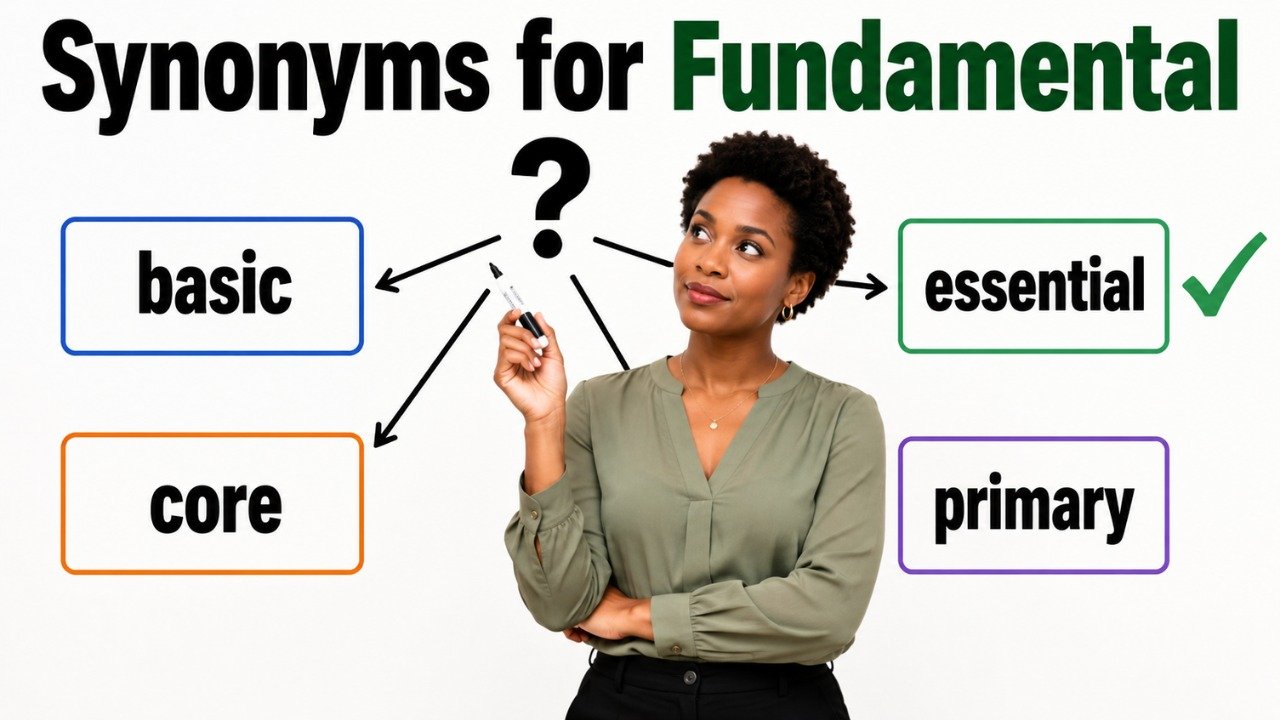
Quick Answer: The best synonyms for fundamental include basic, essential, primary, foundational, central, core, principal, underlying, vital, and crucial. Use basic for simple ideas or starting knowledge, essential for something necessary, foundational for something that supports future development, and underlying for a hidden cause or principle. Primary and principal suit main priorities, while core and central describe the most important part of a subject, system, belief, or problem.
Pronunciation and Word Details
Word: Fundamental
Pronunciation: /ˌfʌn.dəˈmen.təl/
Part of Speech: Adjective and noun
Meaning: Forming the basic, essential, or most important part of something.
US Pronunciation:
UK Pronunciation:
What Does “Fundamental” Mean?
Fundamental means basic, essential, or necessary to the nature, structure, or success of something. It is most commonly used as an adjective, although it can also be used as a noun when referring to a basic principle or skill.
As an adjective, fundamental describes something that forms the foundation of an idea, process, system, or subject.
Example: Trust is fundamental to a healthy relationship.
As a noun, a fundamental is a basic rule, principle, fact, or skill that must be understood first.
Example: Students must learn the fundamentals of grammar.
The word can describe basic knowledge, essential rights, central beliefs, underlying problems, or important changes. Its exact meaning depends on whether the sentence focuses on simplicity, necessity, structure, importance, or origin.
Meaning, Tone, and Context of “Fundamental”
Fundamental has a neutral to formal tone. It is common in academic writing, professional communication, education, science, politics, philosophy, law, mathematics, economics, and everyday discussions about important ideas.
Formal Context: Fundamental is useful when describing principles, rights, responsibilities, requirements, and major structural issues.
Academic Context: Teachers and researchers use the word for basic theories, concepts, methods, and facts that support advanced understanding.
Professional Context: Fundamental can describe necessary business practices, workplace values, technical requirements, or organizational priorities.
Conversational Context: In everyday speech, the word emphasizes that something is extremely important or basic.
Strong Tone: Fundamental often carries more weight than simple words such as basic. It suggests that something is necessary to the existence, success, or proper operation of a larger whole.
Technical Context: In science and mathematics, fundamental may identify a primary law, quantity, force, theorem, or principle.
When and How to Use “Fundamental”
For Basic Knowledge
Use fundamental when referring to the first ideas, skills, or principles someone needs to understand.
Example: Reading is a fundamental skill for academic success.
For Essential Requirements
Use fundamental when something is necessary and cannot be ignored without affecting the outcome.
Example: Clear communication is fundamental to effective teamwork.
For Main Principles
Use fundamental for beliefs, rules, or ideas that support a system or argument.
Example: Equality is a fundamental principle of fair treatment.
For Underlying Causes
Use fundamental when describing a deep cause behind a visible problem.
Example: The report identified a fundamental weakness in the planning process.
For Major Change
Use fundamental when a change affects the basic nature or structure of something.
Example: The organization needs a fundamental change in its leadership approach.
For Rights and Freedoms
Use fundamental for rights considered basic, necessary, and important.
Example: Access to justice is a fundamental right.
For Technical Concepts
Use fundamental when discussing primary laws, theories, quantities, or forces.
Example: Energy conservation is a fundamental concept in physics.
Best Synonyms for Fundamental
Basic
Synonym: Forming the simplest or most necessary part of something.
Example: The course teaches basic writing skills.
Essential
Synonym: Completely necessary for success, existence, or completion.
Example: Water is essential for life.
Primary
Synonym: First or most important in rank, order, or purpose.
Example: Safety is our primary concern.
Foundational
Synonym: Providing the base upon which something develops.
Example: Vocabulary is foundational to language learning.
Central
Synonym: Having the greatest importance within a subject or situation.
Example: Trust plays a central role in strong relationships.
Core
Synonym: Belonging to the most important or central part.
Example: Respect is one of the organization’s core values.
Principal
Synonym: First or most important among several things.
Example: Cost was the principal reason for the decision.
Underlying
Synonym: Existing beneath the surface as a cause or supporting idea.
Example: The discussion revealed an underlying disagreement.
Vital
Synonym: Extremely important or necessary for success or survival.
Example: Regular exercise is vital for long term health.
Crucial
Synonym: Extremely important to a decision, event, or result.
Example: Careful preparation is crucial for success.
50 Synonyms for Fundamental with Short Meanings
- Basic: Forming the simplest or most necessary level.
- Essential: Completely necessary for success or existence.
- Primary: First or most important in purpose or order.
- Foundational: Providing a base for future growth or development.
- Central: Positioned at the heart of an idea or situation.
- Core: Belonging to the most important part of something.
- Principal: Most important among several possibilities.
- Underlying: Existing beneath the surface as a cause or basis.
- Vital: Necessary for success, health, or survival.
- Crucial: Extremely important to a result or decision.
- Key: Having major importance or influence.
- Main: More important than other related things.
- Elementary: Related to the simplest facts or principles.
- Rudimentary: Basic and not yet fully developed.
- Root: Connected with the original source or cause.
- Cardinal: Having the greatest importance within a system.
- Indispensable: So necessary that it cannot be replaced.
- Necessary: Required for a purpose or result.
- Critical: Extremely important to success or safety.
- Intrinsic: Naturally belonging to the basic nature of something.
- Inherent: Existing as a permanent or natural quality.
- Structural: Connected with the basic arrangement of a system.
- Constitutional: Relating to the essential structure or governing principles.
- Elemental: Relating to the simplest or most basic forces.
- Initial: Occurring at the beginning of a process.
- Original: Existing from the beginning or earliest stage.
- First: Coming before everything else in order or importance.
- Base: Forming the lowest or supporting level.
- Bedrock: The strongest basic foundation of an idea or system.
- Cornerstone: An essential part upon which something depends.
- Pivotal: Having a major effect on future events or results.
- Dominant: More important or powerful than other influences.
- Leading: Most important, successful, or influential.
- Chief: Highest in importance, position, or concern.
- Foremost: More important or noticeable than anything else.
- Paramount: More important than all other considerations.
- Major: Large or important in degree, effect, or influence.
- Significant: Important enough to deserve attention.
- Integral: Necessary for the completeness of something.
- Requisite: Required for a particular purpose.
- Prerequisite: Required before another action can happen.
- Preliminary: Coming before and preparing for later work.
- Introductory: Providing basic information at the beginning.
- Simple: Easy to understand and free from complexity.
- Basal: Forming or belonging to the base of something.
- Radical: Affecting the root, origin, or basic nature.
- Basis: The main reason, principle, or support for something.
- Foundation: The supporting idea or structure upon which something develops.
- Groundwork: Basic preparation that supports future progress.
- Principle: A basic rule, belief, or truth guiding a system.
Read Also:
Synonyms for Precise
Synonyms for Fundamental by Context
When Fundamental Means Basic
Use these alternatives when referring to simple knowledge, introductory ideas, or beginning skills.
Useful Synonyms: Basic, elementary, rudimentary, introductory, simple, initial, and preliminary.
Example: Students begin by learning the basic rules of sentence structure.
Example: The guide provides an introductory explanation of the subject.
When Fundamental Means Essential
Use these words when something is completely necessary for success, existence, safety, or completion.
Useful Synonyms: Essential, vital, indispensable, necessary, critical, requisite, and integral.
Example: Clean water is essential for public health.
Example: Accurate information is vital to responsible decision making.
When Fundamental Means Most Important
Use these alternatives when identifying the main priority, issue, reason, or concern.
Useful Synonyms: Primary, principal, main, central, core, chief, foremost, and paramount.
Example: Customer safety remains the company’s primary concern.
Example: Honesty is a core value in effective leadership.
When Fundamental Means Foundational
Use these words when something provides support for future development.
Useful Synonyms: Foundational, base, bedrock, cornerstone, foundation, basis, and groundwork.
Example: Early literacy provides the foundation for later learning.
Example: Mutual respect is the cornerstone of a successful partnership.
When Fundamental Means Underlying
Use these alternatives for deep causes, hidden principles, or natural qualities.
Useful Synonyms: Underlying, root, intrinsic, inherent, structural, elemental, and radical.
Example: The investigation revealed the root cause of the failure.
Example: Curiosity is intrinsic to meaningful learning.
When Fundamental Means a Basic Principle
Use these alternatives when referring to an important rule, truth, belief, or concept.
Useful Synonyms: Principle, basis, foundation, cornerstone, essential, and fundamental rule.
Example: Fairness is a guiding principle of the selection process.
Example: The argument is based on the principle of equal treatment.
Another Word for Fundamental
Basic is the most common general replacement for fundamental. However, essential is often better when the sentence emphasizes necessity, while foundational suits ideas or skills that support future development.
Use primary for the most important concern, underlying for a hidden cause, core for a central value, and principal for the main reason.
Original: Students need a fundamental understanding of grammar.
Better Option: Students need a basic understanding of grammar.
Original: Trust is fundamental to a strong relationship.
Better Option: Trust is essential to a strong relationship.
Original: Reading is fundamental to educational development.
Better Option: Reading is foundational to educational development.
Original: The report identified a fundamental problem.
Better Option: The report identified an underlying problem.
When Not to Use “Fundamental”
Fundamental is useful, but it can sound too formal, broad, or forceful in some sentences. A more precise synonym may communicate the intended meaning more clearly.
When You Mean Simple
Use basic when describing easy instructions, beginner knowledge, or an uncomplicated process.
Weak: The guide explains the fundamental steps for opening the file.
Better: The guide explains the basic steps for opening the file.
When You Mean Necessary
Use essential when the main point is that something cannot be omitted.
Weak: Water is fundamental for human survival.
Better: Water is essential for human survival.
When You Mean the Main Reason
Use principal or primary when identifying the most important reason among several.
Weak: Cost was the fundamental reason for the delay.
Better: Cost was the principal reason for the delay.
When You Mean a Hidden Cause
Use underlying or root when discussing a problem beneath the visible symptoms.
Weak: The team failed to address the fundamental cause.
Better: The team failed to address the underlying cause.
When the Word Sounds Too Strong
Fundamental may exaggerate the importance of a minor detail.
Weak: Choosing a font is fundamental to writing a short personal note.
Better: Choosing a clear font is helpful when writing a short personal note.
When Repetition Reduces Readability
Avoid repeating fundamental throughout the same paragraph.
Weak: Fundamental knowledge supports fundamental skills and fundamental progress.
Better: Basic knowledge supports essential skills and steady progress.
Words Commonly Confused With Fundamental
Fundamental vs Basic: Basic refers to the simplest or beginning level. Fundamental often suggests that something is both basic and deeply important.
Fundamental vs Essential: Essential means completely necessary. Fundamental may refer to something necessary, but it can also mean foundational or related to basic principles.
Fundamental vs Foundational: Foundational describes something that provides support for later growth. Fundamental can mean foundational, essential, basic, or central.
Fundamental vs Primary: Primary means first or most important. Fundamental describes something that forms a basic part of a system or idea.
Fundamental vs Principal: Principal means most important among several things. Fundamental often describes the underlying structure or basic nature of something.
Fundamental vs Underlying: Underlying describes a hidden cause, idea, or condition beneath the surface. Fundamental can describe that cause, but it can also refer to an essential principle or skill.
Fundamental vs Elementary: Elementary means simple and suitable for beginners. Fundamental may describe basic material that remains important even at advanced levels.
Fundamental vs Core: Core describes the central or most important part. Fundamental often emphasizes the basic support upon which the whole depends.
Which Synonym Should You Choose?
Choose basic when discussing simple instructions, beginner knowledge, or the first level of learning.
Choose essential when something is completely necessary for success, survival, or completion.
Choose foundational when describing knowledge, skills, or principles that support later development.
Choose primary when identifying the first or most important concern.
Choose principal when referring to the main reason, person, issue, or source.
Choose central when something has a major role within a discussion, system, or situation.
Choose core when describing values, beliefs, subjects, features, or responsibilities at the heart of something.
Choose underlying when discussing a hidden cause, condition, belief, or problem.
Choose vital when emphasizing strong practical importance.
Choose crucial when an action or decision may determine the final result.
Choose elementary when discussing simple concepts taught to beginners.
Choose cornerstone when describing an essential part upon which a system, relationship, or idea depends.
Real Life Examples of “Fundamental” in Sentences
Original: Communication is fundamental to good teamwork.
Better Option: Communication is essential to good teamwork.
Original: Students must understand the fundamental rules of grammar.
Better Option: Students must understand the basic rules of grammar.
Original: Honesty is a fundamental value in our organization.
Better Option: Honesty is a core value in our organization.
Original: The report revealed a fundamental problem in the system.
Better Option: The report revealed an underlying problem in the system.
Original: Reading is fundamental to academic development.
Better Option: Reading is foundational to academic development.
Original: Safety is a fundamental concern during construction.
Better Option: Safety is a primary concern during construction.
Original: Equality is a fundamental principle of justice.
Better Option: Equality is a central principle of justice.
Original: The company needs a fundamental change in strategy.
Better Option: The company needs a radical change in strategy.
Original: Patience is fundamental when teaching young children.
Better Option: Patience is vital when teaching young children.
Original: Understanding customer needs is fundamental to business growth.
Better Option: Understanding customer needs is crucial to business growth.
Synonym Groups and Usage Differences
Basic Knowledge Group
Basic, elementary, rudimentary, introductory, and simple describe beginning knowledge or the least complicated level of a subject.
Example: The lesson introduces the basic principles of financial planning.
Necessity Group
Essential, vital, necessary, indispensable, critical, and requisite describe something required for success, survival, or completion.
Example: Careful testing is essential before the product is released.
Importance Group
Primary, principal, key, main, chief, foremost, and paramount identify something with high importance or priority.
Example: Public safety is the primary concern.
Foundation Group
Foundational, foundation, basis, bedrock, cornerstone, groundwork, and base describe support upon which something else develops.
Example: Trust is the foundation of a healthy partnership.
Central Meaning Group
Core, central, integral, intrinsic, and inherent describe something belonging to the heart, nature, or completeness of a subject.
Example: Creativity is an integral part of effective problem solving.
Cause and Structure Group
Underlying, root, structural, elemental, basal, and radical relate to deep causes, original sources, or basic arrangements.
Example: The organization must address the root problem rather than its visible symptoms.
Antonyms of Fundamental
The opposite of fundamental depends on whether the word means basic, essential, central, or underlying.
Advanced: More complex or developed than a basic level.
Optional: Available by choice rather than necessary.
Unnecessary: Not needed for a particular purpose.
Nonessential: Not required for success or existence.
Secondary: Less important than the main concern.
Peripheral: Located away from the center or main issue.
Minor: Limited in importance, size, or effect.
Superficial: Existing only at the surface rather than the deeper level.
Additional: Added to the main or necessary parts.
Incidental: Occurring as a less important part of something else.
Trivial: Having very little importance or value.
Decorative: Added mainly for appearance rather than essential function.
Comparison: Fundamental vs Related Words
Fundamental vs Basic
Fundamental describes something basic and highly important. Basic mainly refers to the simplest level or necessary starting point.
Example With Fundamental: Respect is fundamental to a healthy workplace.
Example With Basic: The course teaches basic computer skills.
Fundamental vs Essential
Fundamental often refers to a supporting principle, structure, or basic feature. Essential emphasizes that something is absolutely necessary.
Example With Fundamental: Trust is fundamental to strong leadership.
Example With Essential: Water is essential for survival.
Fundamental vs Foundational
Fundamental has a broader meaning that includes basic, essential, and central. Foundational specifically describes something that supports future growth or development.
Example With Fundamental: Clear writing is a fundamental professional skill.
Example With Foundational: Early reading practice is foundational to language development.
Fundamental vs Primary
Fundamental describes the basic nature or structure of something. Primary identifies what comes first in importance, order, or purpose.
Example With Fundamental: Fairness is a fundamental principle.
Example With Primary: Safety is our primary concern.
Fundamental vs Underlying
Fundamental may describe a basic or essential issue. Underlying specifically points to something hidden beneath the surface.
Example With Fundamental: The plan contains a fundamental weakness.
Example With Underlying: The conflict has an underlying financial cause.
Fundamental vs Core
Fundamental emphasizes basic support or necessity. Core refers to the central part, value, activity, or belief.
Example With Fundamental: Communication is fundamental to cooperation.
Example With Core: Respect is one of our core values.
Fundamental vs Crucial
Fundamental describes something basic or essential to the whole. Crucial describes something extremely important at a particular moment or for a particular result.
Example With Fundamental: Literacy is fundamental to education.
Example With Crucial: The final interview was crucial to her selection.
Common Phrases and Expressions With “Fundamental”
Fundamental Principle: A basic rule or belief supporting a system.
Fundamental Right: A basic freedom or protection considered essential.
Fundamental Change: A major change affecting the basic nature of something.
Fundamental Difference: A deep and important distinction between two things.
Fundamental Problem: A serious issue within the basic structure of a system.
Fundamental Concept: A basic idea required for understanding a subject.
Fundamental Skill: An essential ability needed for future development.
Fundamental Question: A basic and important issue requiring an answer.
Fundamental Value: A central belief that guides actions or decisions.
Fundamental Understanding: Knowledge of the most important principles of a subject.
Common Mistakes to Avoid
Using Fundamental for Every Important Thing
Not every important detail is fundamental. The word should describe something basic, essential, or central to the whole.
Unclear: The color of the folder is fundamental to the meeting.
Clearer: The accuracy of the report is fundamental to the meeting.
Confusing Fundamental With Elementary
Elementary describes beginning level knowledge. Fundamental describes knowledge that is basic and important, even for advanced learners.
Incorrect: Advanced engineers no longer use fundamental principles.
Better: Advanced engineers continue to apply fundamental principles.
Using Basic When Essential Is More Accurate
Basic may sound too weak when something is absolutely necessary.
Weak: Reliable data is basic for accurate research.
Better: Reliable data is essential for accurate research.
Using Fundamental With an Unclear Noun
The sentence should identify what is basic or essential.
Vague: This is fundamental.
Better: This principle is fundamental to fair decision making.
Repeating Fundamental Too Often
Repeated use can make a paragraph sound mechanical.
Repetitive: Fundamental skills require fundamental knowledge of fundamental principles.
Improved: Essential skills require a basic understanding of core principles.
Choosing an Overly Formal Word
Fundamental may sound heavy in casual instructions.
Unnatural: Follow these fundamental steps to turn on the lamp.
Better: Follow these basic steps to turn on the lamp.
Confusing Fundamental With Foundational
Foundational usually describes support for later development. Fundamental has a wider meaning and may emphasize necessity, importance, or basic nature.
Incorrect: Water is foundational for immediate survival.
Better: Water is essential for immediate survival.
Conclusion
Synonyms for fundamental include basic, essential, primary, foundational, central, core, principal, underlying, vital, and crucial. Choose basic for beginner knowledge, essential for necessity, foundational for long term development, and underlying for hidden causes. Primary and principal identify main priorities, while core and central describe the heart of an idea or system. Selecting the most precise alternative makes your writing clearer and helps readers understand whether you mean simple, necessary, important, structural, or deeply rooted.
FAQs About Synonyms for Fundamental
What Is the Best Synonym for Fundamental?
Basic is the best general synonym. Essential, foundational, primary, and core may be more precise depending on the sentence.
What Is a Formal Synonym for Fundamental?
Foundational, essential, intrinsic, principal, and paramount are useful formal alternatives.
Does Fundamental Mean Important?
Yes. Fundamental can mean extremely important, especially when something supports the basic structure, success, or existence of something else.
What Is Another Word for Fundamental Knowledge?
Basic knowledge, foundational knowledge, essential understanding, and core knowledge are natural alternatives.
Can Essential Replace Fundamental?
Essential can replace fundamental when the sentence emphasizes necessity. It may not work when fundamental means introductory, underlying, or foundational.
What Is the Difference Between Fundamental and Basic?
Basic describes the simplest or beginning level. Fundamental often suggests that something is basic and essential to a larger system or purpose.
What Is the Opposite of Fundamental?
Common opposites include optional, secondary, minor, peripheral, superficial, advanced, and nonessential.
