
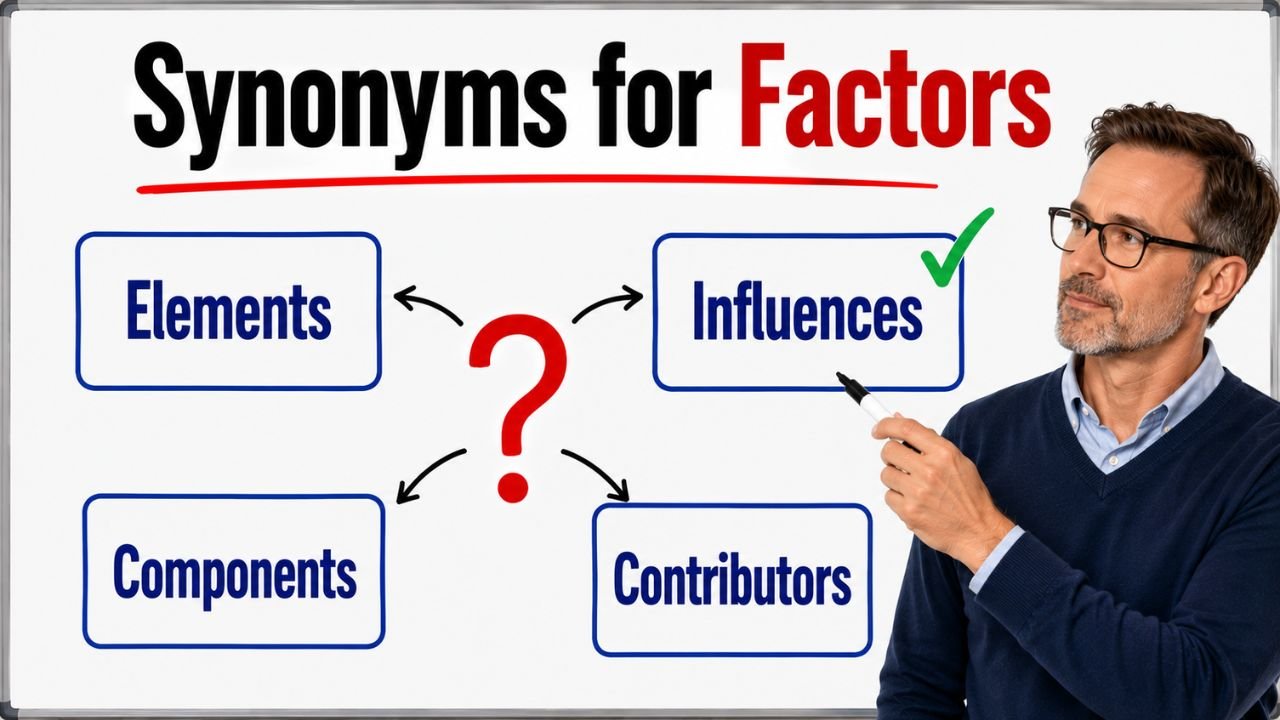
Quick Answer: The best synonyms for factors include elements, causes, influences, variables, considerations, components, determinants, circumstances, aspects, and conditions. Use causes when referring to reasons behind an event, variables in research or analysis, components for parts of a system, and considerations for points that affect a decision. Determinants suits formal or academic writing, while influences works well when describing people, conditions, or forces that shape a result.
Pronunciation and Word Details
Word: Factors
Pronunciation: /ˈfæk.tərz/
Part of Speech: Plural noun
Meaning: Elements, conditions, or causes that influence a situation, decision, event, or result.
US Pronunciation:
UK Pronunciation:
What Does “Factors” Mean?
Factors are elements, conditions, causes, or circumstances that contribute to a particular result. The word is the plural form of factor and is most commonly used as a noun.
In everyday language, factors are things that influence what happens. Price, quality, location, and convenience may all be factors in a buying decision.
In research, factors may be variables or conditions being studied. In mathematics, factors are numbers or quantities that can be multiplied together to produce another number.
The meaning therefore changes slightly according to context, but it always refers to something that contributes to, influences, or forms part of a larger result.
Meaning, Tone, and Context of “Factors”
Factors is a neutral and widely used word. It appears naturally in everyday conversation, business communication, academic writing, reports, research, mathematics, science, economics, and decision making.
Formal Context: Factors is suitable for reports, essays, studies, proposals, and professional discussions.
Academic Context: Researchers use factors to describe variables, influences, determinants, and conditions connected with an outcome.
Conversational Context: People use factors when discussing choices, problems, plans, and personal decisions.
Technical Context: In mathematics, science, and statistics, factors can have specialized meanings related to quantities, variables, or measurable conditions.
Emotional Tone: The word is generally neutral. It describes influences without expressing approval, criticism, excitement, or disappointment.
When and How to Use “Factors”
For Causes
Use factors when several conditions contribute to an event or result.
Example: Several factors contributed to the decline in sales.
For Decision Making
Use factors for points that must be considered before making a choice.
Example: Cost and reliability are important factors in our decision.
For Research
Use factors to describe variables or conditions being examined.
Example: The study examined the factors affecting student performance.
For Components
Use factors when referring to elements that form part of a larger situation.
Example: Communication is one of the main factors in a successful partnership.
For Risk
Use factors to describe conditions that increase or reduce the possibility of a particular outcome.
Example: Poor visibility and heavy traffic were major risk factors.
For Mathematics
Use factors for numbers that divide another number without leaving a remainder.
Example: Two, three, four, and six are factors of twelve.
Best Synonyms for Factors
Elements
Synonym: Parts or features that contribute to a complete situation.
Example: Several elements made the event successful.
Causes
Synonym: Reasons that directly produce an event or condition.
Example: Experts investigated the causes of the equipment failure.
Influences
Synonym: People, forces, or conditions that shape an outcome.
Example: Family and education are powerful influences on personal development.
Variables
Synonym: Conditions or quantities that can change and affect a result.
Example: The researchers controlled several variables during the experiment.
Considerations
Synonym: Points that should be carefully thought about before a decision.
Example: Safety and cost were our main considerations.
Components
Synonym: Individual parts of a larger system or structure.
Example: Trust and communication are essential components of teamwork.
Determinants
Synonym: Conditions that strongly influence or decide an outcome.
Example: Income and education are important determinants of consumer behavior.
Circumstances
Synonym: Conditions surrounding an event, action, or decision.
Example: The decision was understandable under the circumstances.
Aspects
Synonym: Particular parts or features of a subject.
Example: The report examines several aspects of workplace safety.
Conditions
Synonym: Situations or states that influence what happens.
Example: Weather conditions affected the travel schedule.
50 Synonyms for Factors with Short Meanings
- Elements: Basic parts that influence a complete situation.
- Causes: Reasons that produce a particular result.
- Influences: Forces or people that shape an outcome.
- Variables: Conditions or quantities that can change.
- Considerations: Points that require careful thought.
- Components: Separate parts of a larger whole.
- Determinants: Conditions that strongly decide an outcome.
- Circumstances: Surrounding conditions that affect a situation.
- Aspects: Particular features or parts of a subject.
- Conditions: Situations that influence an event or result.
- Reasons: Explanations for why something happens.
- Forces: Powerful influences that produce change.
- Features: Noticeable qualities or parts of something.
- Parts: Individual pieces of a complete structure.
- Ingredients: Necessary elements within a process or result.
- Contributors: People or things that help produce an outcome.
- Drivers: Main forces that cause progress or change.
- Agents: People, things, or forces that create an effect.
- Criteria: Standards used to judge or decide something.
- Parameters: Limits or conditions that define a process.
- Inputs: Resources or information added to a system.
- Indicators: Signs that reveal a condition or trend.
- Attributes: Qualities or characteristics of something.
- Characteristics: Distinguishing qualities of a person or thing.
- Issues: Important subjects or problems requiring attention.
- Matters: Subjects or concerns being considered.
- Points: Individual details included in a discussion.
- Details: Specific pieces of information.
- Facts: Known pieces of information affecting a judgment.
- Grounds: Reasons supporting a decision or belief.
- Motives: Reasons behind a person’s actions.
- Sources: Places or causes from which something begins.
- Origins: Starting points or underlying causes.
- Triggers: Events or conditions that start a reaction.
- Catalysts: Things that encourage or speed up change.
- Pressures: Forces that influence actions or decisions.
- Constraints: Limits that restrict possible choices.
- Requirements: Necessary conditions that must be met.
- Dimensions: Different parts or areas of a complex subject.
- Facets: Individual sides or features of a situation.
- Concerns: Matters that require thought or attention.
- Dynamics: Changing forces within a situation or relationship.
- Mechanisms: Processes through which an effect occurs.
- Predictors: Conditions that help forecast an outcome.
- Incentives: Benefits or pressures that encourage action.
- Coefficients: Numerical values connected with variables.
- Multipliers: Numbers or forces that increase another quantity.
- Divisors: Numbers that divide another number evenly.
- Quantities: Measurable amounts used in calculations.
- Terms: Numbers or expressions within a mathematical operation.
Read Also:
Synonyms for Accurate
Synonyms for Factors by Context
When Factors Means Causes
Use these alternatives when discussing why something happened.
Useful Synonyms: Causes, reasons, triggers, origins, sources, drivers, catalysts, and motives.
Example: Several causes contributed to the unexpected delay.
Example: High demand was the main driver of price growth.
When Factors Means Influences
Use these words for forces that shape behavior, development, or results.
Useful Synonyms: Influences, forces, pressures, determinants, contributors, agents, and incentives.
Example: Cultural influences shape the way people communicate.
Example: Financial pressure affected their final choice.
When Factors Means Components
Use these alternatives for parts that form a larger whole.
Useful Synonyms: Elements, components, parts, ingredients, features, aspects, and facets.
Example: Patience is an essential element of effective teaching.
Example: Security is a key component of the new system.
When Factors Means Considerations
Use these words for points that should be examined before making a decision.
Useful Synonyms: Considerations, criteria, concerns, issues, matters, details, facts, and requirements.
Example: Affordability was an important consideration.
Example: Experience is one of the main selection criteria.
When Factors Means Research Variables
Use these alternatives in academic, scientific, or analytical writing.
Useful Synonyms: Variables, parameters, indicators, predictors, inputs, attributes, and conditions.
Example: The researchers measured several environmental variables.
Example: Age was a strong predictor of the response.
When Factors Has a Mathematical Meaning
Use these terms when discussing multiplication or division.
Useful Synonyms: Divisors, multipliers, quantities, coefficients, and terms.
Example: Three and four are factors of twelve.
Example: The coefficient changes the value of the variable.
Another Word for Factors
Elements is often the best general replacement for factors because it can describe different parts that contribute to a situation. However, the most accurate alternative depends on the sentence.
Use causes when discussing why something happened, variables in research, components for parts of a system, and considerations for points involved in a decision.
Original: Several factors affected the project.
Better Option: Several influences affected the project.
Original: We considered many factors before choosing a supplier.
Better Option: We considered many criteria before choosing a supplier.
Original: Social factors may influence behavior.
Better Option: Social conditions may influence behavior.
Original: Trust is one of the main factors in teamwork.
Better Option: Trust is one of the main elements of teamwork.
When Not to Use “Factors”
Factors can sound vague when the sentence does not explain what the factors actually are. A more precise synonym often improves clarity.
When You Mean Direct Causes
Use causes when certain conditions directly produced the outcome.
Weak: The factors of the accident were investigated.
Better: The causes of the accident were investigated.
When You Mean Physical Parts
Use components or parts when describing objects, machines, or systems.
Weak: The machine contains several electronic factors.
Better: The machine contains several electronic components.
When You Mean Decision Standards
Use criteria when discussing standards used to make a judgment.
Weak: Experience and education are hiring factors.
Better: Experience and education are hiring criteria.
When You Mean Changing Research Conditions
Use variables when referring to measurable conditions in an experiment.
Weak: The researchers changed several factors.
Better: The researchers changed several variables.
When Repetition Reduces Clarity
Avoid using factors repeatedly in nearby sentences.
Weak: Several factors affected production. These factors included cost factors and labor factors.
Better: Several conditions affected production, including material costs and labor shortages.
Words Commonly Confused With Factors
Factors vs Causes: Causes directly produce an event, while factors may only contribute to or influence it.
Factors vs Variables: Variables are measurable conditions that can change. Factors is a broader term that may include variables, causes, circumstances, or considerations.
Factors vs Elements: Elements are parts of a whole. Factors are things that influence an outcome. An element can also be a factor when it contributes to a result.
Factors vs Components: Components are physical or structural parts of a system. Factors may be physical, social, financial, environmental, or psychological influences.
Factors vs Criteria: Criteria are standards used to evaluate something. Factors are broader points that may affect a choice or result.
Factors vs Conditions: Conditions describe the state or environment surrounding an event. Factors can include conditions along with causes, influences, and variables.
Factors vs Reasons: Reasons explain why an action, belief, or event occurred. Factors may be one or several conditions contributing to that explanation.
Which Synonym Should You Choose?
Choose elements when referring generally to parts that contribute to a situation.
Choose causes when explaining what directly produced an event.
Choose influences when describing forces that shape behavior, development, or results.
Choose variables when discussing research, experiments, statistics, or changing quantities.
Choose considerations when describing points involved in a decision.
Choose components when referring to parts of a machine, system, plan, or structure.
Choose determinants in formal, academic, economic, or social analysis.
Choose circumstances when referring to surrounding conditions.
Choose criteria when discussing standards for selection or evaluation.
Choose drivers when describing forces behind growth, progress, demand, or change.
Choose divisors or multipliers when discussing mathematical factors.
Real Life Examples of “Factors” in Sentences
Original: Several factors influenced her career choice.
Better Option: Several considerations influenced her career choice.
Original: Weather was an important factor in the delay.
Better Option: Weather was an important cause of the delay.
Original: Cost is one of the main factors in our decision.
Better Option: Cost is one of the main considerations in our decision.
Original: Researchers examined the factors affecting sleep quality.
Better Option: Researchers examined the variables affecting sleep quality.
Original: Communication is a major factor in successful teamwork.
Better Option: Communication is a major element of successful teamwork.
Original: Economic factors influenced customer demand.
Better Option: Economic conditions influenced customer demand.
Original: Several factors increased the risk of failure.
Better Option: Several conditions increased the risk of failure.
Original: Education is an important factor in social development.
Better Option: Education is an important determinant of social development.
Original: The company studied the factors behind its growth.
Better Option: The company studied the drivers behind its growth.
Original: Experience was a deciding factor in the selection process.
Better Option: Experience was a deciding criterion in the selection process.
Synonym Groups and Usage Differences
Cause Group
Causes, reasons, triggers, sources, and origins explain why something happens. Causes is the strongest choice when a direct relationship exists.
Example: Investigators identified the main cause of the fire.
Influence Group
Influences, forces, pressures, agents, and drivers describe things that shape change or behavior without necessarily producing the result alone.
Example: Economic pressures changed consumer spending habits.
Component Group
Elements, components, parts, ingredients, aspects, and facets describe pieces of a larger whole.
Example: Clear communication is an essential component of leadership.
Decision Group
Considerations, criteria, concerns, issues, matters, and requirements describe points examined before making a choice.
Example: Reliability was our most important consideration.
Research Group
Variables, parameters, predictors, indicators, inputs, and attributes are common in research and data analysis.
Example: The study controlled several variables.
Mathematical Group
Divisors, multipliers, coefficients, quantities, and terms are related to numerical or algebraic contexts.
Example: Two and five are factors of ten.
Antonyms of Factors
The opposite of factors depends on how the word is being used. Factors usually refer to causes, influences, components, or changing conditions.
Outcome: The final result produced by several factors.
Result: What happens because of contributing conditions.
Effect: A consequence created by a cause or influence.
Consequence: Something that follows from an action or condition.
Whole: A complete object rather than its individual elements.
Constant: A value or condition that does not change.
Irrelevance: Something that has no meaningful connection to the result.
Nonissue: A matter that does not require consideration.
Certainty: A fixed or definite state rather than a changing influence.
Independence: Freedom from outside influences or conditions.
Comparison: Factors vs Related Words
Factors vs Causes
Factors contribute to a result, while causes directly produce it. A situation may involve many factors but only one primary cause.
Example With Factors: Several factors increased the likelihood of an accident.
Example With Causes: Mechanical failure caused the accident.
Factors vs Variables
Factors is a broad word for influences or conditions. Variables are measurable values or conditions that can change.
Example With Factors: Social factors influence purchasing decisions.
Example With Variables: The experiment included three independent variables.
Factors vs Elements
Factors affect an outcome, while elements are parts of a complete subject, object, or system.
Example With Factors: Cost and quality were important factors.
Example With Elements: Color and shape are important elements of the design.
Factors vs Components
Factors may be abstract influences, but components are normally identifiable parts of a larger system.
Example With Factors: Training is a factor in employee performance.
Example With Components: The battery is an essential component of the device.
Factors vs Criteria
Factors are influences or considerations. Criteria are standards used for judgment or selection.
Example With Factors: Location influenced our choice.
Example With Criteria: Applicants must meet all selection criteria.
Factors vs Circumstances
Factors contribute to a result, while circumstances describe the surrounding situation.
Example With Factors: Several financial factors affected the decision.
Example With Circumstances: Under the circumstances, postponement was sensible.
Common Phrases and Expressions With “Factors”
Contributing Factors: Conditions that help produce a result.
Key Factors: The most important influences in a situation.
Major Factors: Conditions with a strong effect on an outcome.
Deciding Factor: The point that determines the final choice.
Risk Factors: Conditions that increase the possibility of harm or failure.
Environmental Factors: Natural or surrounding conditions that influence something.
Economic Factors: Financial conditions affecting people, organizations, or markets.
Social Factors: Conditions connected with society, relationships, and communities.
External Factors: Influences coming from outside a person, organization, or system.
Internal Factors: Influences originating within a person, organization, or system.
Common Mistakes to Avoid
Using Factors Too Vaguely
Do not use factors without explaining which conditions or influences you mean.
Unclear: Many factors caused the problem.
Clearer: Poor planning, limited funding, and staff shortages contributed to the problem.
Treating Every Factor as a Direct Cause
A factor may influence a result without directly causing it. Use cause only when the connection is direct.
Incorrect: Lack of sleep was one factor that directly created every mistake.
Better: Lack of sleep was one factor that increased the likelihood of mistakes.
Confusing Factors With Criteria
Criteria are standards used for judgment, while factors are broader influences.
Incorrect: Applicants must satisfy all hiring factors.
Better: Applicants must satisfy all hiring criteria.
Using Components for Abstract Influences
Components usually refer to parts of a system, object, or structure.
Unnatural: Stress was a component in his decision.
Better: Stress was a factor in his decision.
Repeating the Same Word
Repeated use of factors can make writing sound mechanical. Replace it with a precise synonym where appropriate.
Repetitive: Several factors affected demand, and these factors also affected prices.
Improved: Several conditions affected demand, and these influences also changed prices.
Choosing an Overly Technical Word
Determinants, parameters, coefficients, and predictors may sound too technical in casual writing. Use simpler alternatives such as causes, elements, or influences when specialist language is unnecessary.
Conclusion
Synonyms for factors include elements, causes, influences, variables, considerations, components, determinants, circumstances, aspects, and conditions. The best choice depends on the intended meaning. Use causes for direct reasons, variables for research, components for structural parts, considerations for decisions, and determinants for formal analysis. Factors remains a useful general word, but selecting a more precise alternative can make a sentence clearer, more natural, and easier for readers to understand.
FAQs About Synonyms for Factors
What Is the Best Synonym for Factors?
Elements is the best general synonym, but causes, influences, variables, and considerations may be more accurate in specific contexts.
What Is Another Word for Important Factors?
Useful alternatives include key elements, major influences, primary considerations, main causes, and significant determinants.
Can Causes Replace Factors?
Causes can replace factors when something directly produces an event. Factors may only contribute to the result, so the words are not always interchangeable.
What Is a Formal Synonym for Factors?
Determinants is a strong formal synonym. Variables, parameters, criteria, and considerations also work in academic or professional writing.
What Is a Synonym for Factors in Research?
Variables is usually the best choice in research. Parameters, predictors, indicators, conditions, and determinants may also be appropriate.
What Is a Synonym for Factors in Decision Making?
Considerations and criteria are the strongest alternatives. Concerns, requirements, issues, and priorities may also fit particular decisions.
What Does Deciding Factor Mean?
A deciding factor is the condition or consideration that has the greatest influence on the final choice or outcome.
