
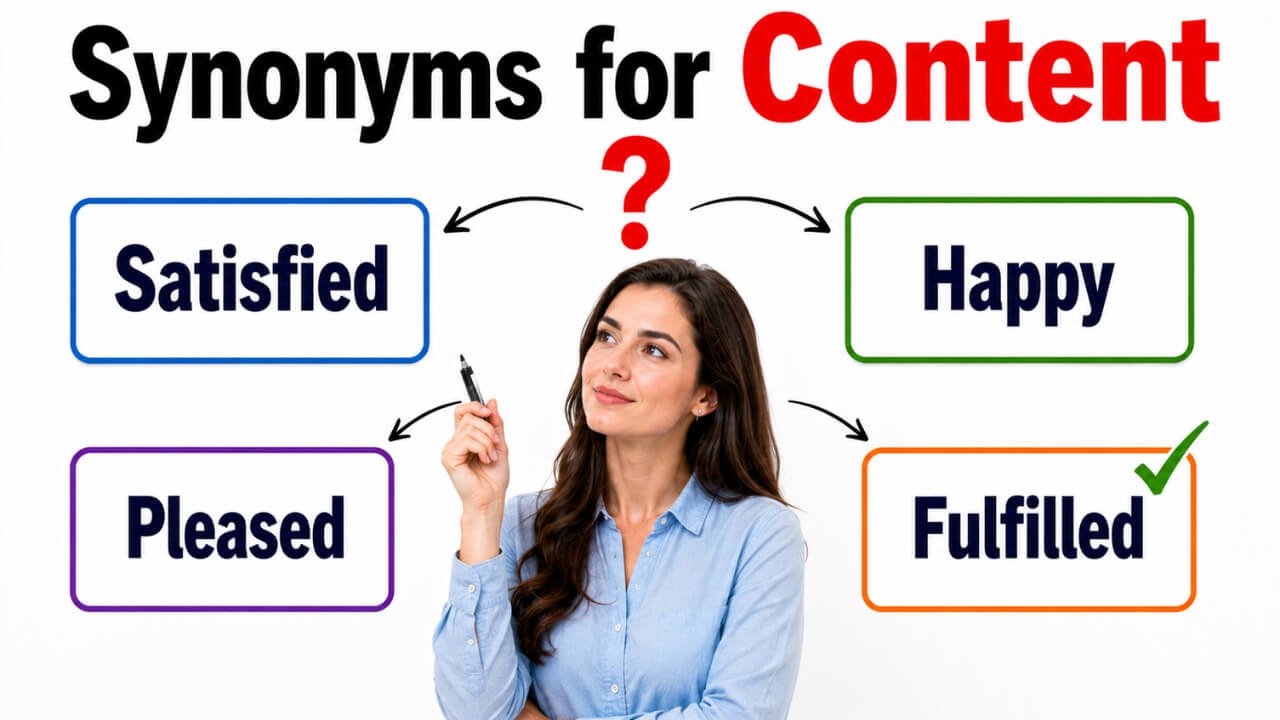
Quick Answer: Synonyms for content include material, information, subject matter, substance, text, message, details, contents, satisfaction, and contentment. Use material for written, visual, or educational resources. Information works best for facts and useful knowledge, while subject matter refers to the main topic being discussed. Substance emphasizes meaningful ideas, and contents describes what is inside a container. When content describes a feeling of happiness or satisfaction, satisfied, pleased, and fulfilled are more accurate choices.
Pronunciation and Word Details
Word: Content.
Pronunciation: /ˈkɑːn.tent/ as a noun and /kənˈtent/ as an adjective.
Part of Speech: Noun and adjective.
Meaning: Content can mean information or material, everything contained inside something, or a feeling of satisfaction.
US Pronunciation:
UK Pronunciation:
What Does “Content” Mean?
Content means information, ideas, images, sounds, or other material presented through writing, speech, education, or entertainment. It can also refer to everything contained inside an object, document, package, or container.
As a noun, content commonly means written, visual, or spoken material.
Example: The guide contains useful educational content.
The plural form, contents, usually describes the things inside a container, book, bag, or document.
Example: She checked the contents of the package.
As an adjective, content means satisfied, peaceful, or happy with a situation.
Example: He felt content with his simple lifestyle.
The pronunciation changes according to meaning. The noun places stress on the first syllable, while the adjective places stress on the second syllable.
Meaning, Tone, and Context of “Content”
Content is generally a neutral and flexible word. It appears in everyday conversation, academic writing, publishing, education, marketing, communication, technology, and entertainment.
Informational Context: Content refers to facts, explanations, guidance, or knowledge shared with an audience.
Example: The course provides detailed content about grammar.
Written Context: Content can mean the words and ideas included in an article, report, book, or document.
Example: The editor reviewed the content of the report.
Visual Context: The word may describe photographs, illustrations, diagrams, or recorded material.
Example: The presentation includes both written and visual content.
Container Context: Contents refers to the objects, ingredients, or materials found inside something.
Example: The contents of the box were carefully packed.
Emotional Context: As an adjective, content describes a calm feeling of satisfaction.
Example: She was content with the final result.
Professional Context: Content often sounds natural in reports, education, communication, and business writing. However, a more specific word such as information, text, data, or material may sometimes improve clarity.
When and How to Use “Content”
For Written Material
Use content when discussing the words, ideas, and information found in an article, document, book, or publication.
Example: The writer revised the content before publication.
For Educational Information
Use content for lessons, instructions, explanations, and resources created to teach a subject.
Example: The training content is suitable for beginners.
For Visual or Recorded Material
Content can describe images, videos, recordings, presentations, and other forms of communication.
Example: The lesson combines visual content with written explanations.
For Subject Matter
Use content when referring to the main ideas, themes, or topics included in a discussion or work.
Example: The content of the speech focused on personal responsibility.
For Things Inside Something
Use contents when describing the objects or materials contained in a box, bag, room, book, or container.
Example: The contents of the envelope were confidential.
For Meaningful Substance
Content can refer to the depth, value, or importance of ideas.
Example: The speech had style but lacked content.
For Satisfaction
Use content as an adjective when someone feels satisfied and does not strongly desire a different situation.
Example: He seemed content with his decision.
Best Synonyms for Content
Material: Information, ideas, images, or resources prepared for a particular purpose.
Example: The teacher prepared additional reading material.
Information: Facts or knowledge communicated to someone.
Example: The booklet provides helpful information about the course.
Subject Matter: The main topic or ideas discussed in a work.
Example: The subject matter of the book is suitable for mature readers.
Substance: The important meaning, value, or ideas within something.
Example: Her argument had clarity and substance.
Text: Written words in a document, article, book, or message.
Example: The editor corrected several errors in the text.
Message: The main idea or meaning being communicated.
Example: The message of the speech was clear and encouraging.
Details: Specific pieces of information about a subject.
Example: The report includes important details about the project.
Contents: Everything found inside a container, document, or collection.
Example: He examined the contents of the package.
Satisfaction: A feeling of happiness with a situation or result.
Example: She looked at her completed work with satisfaction.
Contentment: A peaceful feeling of being satisfied with what one has.
Example: He found contentment in a quiet and balanced life.
50 Synonyms for Content with Short Meanings
- Material: Information or resources prepared for use.
- Information: Facts or knowledge that are communicated.
- Subject Matter: The main topic discussed or presented.
- Substance: The important meaning or value within something.
- Matter: A subject or material being considered.
- Text: Written words in a document or publication.
- Copy: Written material prepared for publication.
- Message: The central idea being communicated.
- Details: Specific pieces of information.
- Data: Facts or figures collected for examination.
- Facts: Statements known or shown to be true.
- Ideas: Thoughts, concepts, or suggestions.
- Meaning: The idea or message expressed by something.
- Theme: The main idea running through a work.
- Topic: The subject being discussed.
- Subject: The main area of thought or discussion.
- Narrative: A spoken or written account of events.
- Discussion: An examination of a subject through words.
- Explanation: Information that makes something clear.
- Description: Words that explain what something is like.
- Account: A spoken or written description of an event.
- Report: An organized presentation of information.
- Article: A piece of writing about a subject.
- Writing: Words composed for communication or publication.
- Communication: Information exchanged between people.
- Presentation: Information arranged and shown to an audience.
- Documentation: Written information used as evidence or guidance.
- Record: Stored information about events or facts.
- Coverage: The amount or range of a subject discussed.
- Commentary: Opinions or explanations about a subject.
- Analysis: Detailed examination of information or ideas.
- Instruction: Information explaining how to do something.
- Guidance: Advice or information that provides direction.
- Knowledge: Information and understanding gained through learning.
- Body: The main written section of a document.
- Gist: The central meaning of something.
- Essence: The most important quality or idea.
- Core: The central and most important part.
- Contents: Everything included inside something.
- Filling: Material placed inside an object or space.
- Ingredients: Substances used to create a mixture or product.
- Components: Parts that form a complete object or system.
- Elements: Basic parts of a larger whole.
- Constituents: Parts or members that make up something.
- Cargo: Goods carried inside a vehicle or vessel.
- Load: An amount carried by a person, machine, or vehicle.
- Payload: Material carried or delivered by a vehicle or system.
- Satisfaction: Pleasure caused by achieving or receiving something.
- Contentment: Peaceful acceptance of one’s situation.
- Fulfillment: Satisfaction gained from meeting a need or goal.
Read Also:
Synonyms for Grace
Synonyms for Content by Context
When Content Means Written Material
Material, text, copy, writing, article, and body are useful when discussing words prepared for readers.
Example With Content: The content needs further editing.
Example With Text: The text needs further editing.
Example With Material: The written material needs further editing.
When Content Means Information
Information, facts, data, details, knowledge, and documentation are appropriate when content communicates something useful or factual.
Example With Content: The document contains important content about workplace safety.
Example With Information: The document contains important information about workplace safety.
When Content Means Subject Matter
Subject matter, topic, subject, theme, and matter describe what a work, lesson, speech, or discussion is about.
Example With Content: The content of the lecture was difficult.
Example With Subject Matter: The subject matter of the lecture was difficult.
When Content Means a Central Message
Message, meaning, gist, essence, and core describe the main idea communicated by a statement or work.
Example With Content: The content of his speech encouraged unity.
Example With Message: The message of his speech encouraged unity.
When Content Means Meaningful Substance
Substance, depth, value, analysis, and insight emphasize the quality or importance of ideas.
Example With Content: The argument lacks content.
Example With Substance: The argument lacks substance.
When Content Means Things Inside Something
Contents, filling, ingredients, components, elements, cargo, load, and payload describe objects or materials contained within something.
Example With Content: The content of the box was damaged.
Example With Contents: The contents of the box were damaged.
When Content Means Satisfaction
Satisfaction, contentment, fulfillment, happiness, and peace describe a positive emotional state.
Example With Content: She felt content with her progress.
Example With Satisfied: She felt satisfied with her progress.
Another Word for Content
Material is often the best general replacement when content means written, visual, educational, or informational resources. However, the best alternative depends on the context. Use information for facts, text for written words, subject matter for a main topic, substance for meaningful ideas, contents for things inside something, and contentment for satisfaction.
Original: The course content is easy to understand.
Better Option: The course material is easy to understand.
Original: The content of the email was unclear.
Better Option: The message in the email was unclear.
Original: The article contains useful content.
Better Option: The article contains useful information.
Original: He was content with the outcome.
Better Option: He was satisfied with the outcome.
When Not to Use “Content”
Content is a broad word. It may sound vague, repetitive, or less accurate when a more specific synonym is available.
When Information Is More Precise
Use information when the sentence refers specifically to facts, instructions, or knowledge.
Weak: The guide gives content about applying for the program.
Better: The guide gives information about applying for the program.
When Text Is More Accurate
Use text when referring only to written words rather than images, sounds, or ideas.
Weak: Please correct the content in the final paragraph.
Better: Please correct the text in the final paragraph.
When Subject Matter Is Clearer
Use subject matter when discussing the topic or nature of a book, lesson, or presentation.
Weak: The content of the book may upset younger readers.
Better: The subject matter of the book may upset younger readers.
When Contents Is Grammatically Required
Use contents when referring to several objects inside a container.
Weak: The content of the suitcase was placed on the floor.
Better: The contents of the suitcase were placed on the floor.
When Substance Expresses Depth
Use substance when evaluating the quality, importance, or depth of ideas.
Weak: The proposal has attractive design but little content.
Better: The proposal has attractive design but little substance.
When Satisfied Sounds More Natural
When content is an adjective, satisfied or pleased may sound clearer in everyday communication.
Weak: The customer appeared content with the service.
Better: The customer appeared satisfied with the service.
When Repetition Weakens the Sentence
Repeating content can make writing vague and monotonous.
Weak: The content writer reviewed the content and improved the content quality.
Better: The writer reviewed the article and improved the quality of its information.
Words Commonly Confused With Content
Content vs Contents: Content usually refers to information, meaning, or material as a general idea. Contents refers to several things contained inside something.
Content vs Information: Content may include words, images, sounds, ideas, or entertainment. Information mainly refers to facts or knowledge.
Content vs Material: Content describes what is communicated or contained. Material often describes resources prepared for reading, teaching, or presentation.
Content vs Text: Content can include many forms of communication. Text refers specifically to written words.
Content vs Copy: Content is a broad term for material. Copy usually refers to words written for publication, promotion, or communication.
Content vs Subject Matter: Content includes all material presented. Subject matter identifies the central topic being discussed.
Content vs Substance: Content may refer to any material, while substance emphasizes meaningful depth, importance, or value.
Content vs Context: Content is the material or information itself. Context is the situation or background that helps explain its meaning.
Content vs Contentment: Content may describe satisfaction as an adjective. Contentment is the noun for the peaceful feeling of being satisfied.
Which Synonym Should You Choose?
Choose material when referring to written, visual, educational, or instructional resources.
Choose information when discussing facts, explanations, knowledge, or practical details.
Choose text when referring specifically to written words in a document, book, or message.
Choose copy when describing prepared wording for publication, advertising, or communication.
Choose subject matter when identifying what a book, lesson, speech, or discussion is about.
Choose topic or subject when naming the main area of discussion.
Choose message when emphasizing the central idea that someone wants to communicate.
Choose substance when judging whether writing, speech, or an argument has meaningful depth.
Choose data when discussing collected facts, figures, measurements, or research results.
Choose details when referring to specific pieces of information.
Choose contents when describing objects or materials inside a container, book, package, or document.
Choose satisfaction when referring to pleasure with a result.
Choose contentment when describing a calm and lasting sense of satisfaction.
Choose fulfillment when satisfaction comes from achieving a purpose or meeting an important need.
Real Life Examples of “Content” in Sentences
Original: The website contains useful content for new learners.
Better Option: The website contains useful information for new learners.
Original: The teacher updated the course content.
Better Option: The teacher updated the course material.
Original: The content of the letter surprised everyone.
Better Option: The message in the letter surprised everyone.
Original: The content of the book focuses on family relationships.
Better Option: The subject matter of the book focuses on family relationships.
Original: The report has good design but weak content.
Better Option: The report has good design but little substance.
Original: Please review the content for grammar mistakes.
Better Option: Please review the text for grammar mistakes.
Original: The content of the package was missing.
Better Option: The contents of the package were missing.
Original: The presentation included detailed content about the results.
Better Option: The presentation included detailed information about the results.
Original: She felt content with her progress.
Better Option: She felt satisfied with her progress.
Original: He found content in a peaceful routine.
Better Option: He found contentment in a peaceful routine.
Synonym Groups and Usage Differences
Information Group
Information, data, facts, details, knowledge, and documentation describe material that communicates something useful or factual.
Example: The report provides accurate information about recent results.
Written Material Group
Text, copy, writing, article, body, and material describe words prepared for reading, publication, teaching, or communication.
Example: The editor improved the text before publication.
Subject Group
Subject matter, topic, subject, theme, and matter identify what a discussion, lesson, book, or presentation is about.
Example: The subject matter requires careful explanation.
Central Meaning Group
Message, meaning, gist, essence, and core emphasize the central idea or purpose of a work.
Example: The main message of the story is forgiveness.
Depth and Quality Group
Substance, analysis, commentary, explanation, and discussion describe meaningful or developed ideas.
Example: Her argument contains both evidence and substance.
Container Group
Contents, filling, ingredients, components, elements, cargo, load, and payload refer to things placed inside or carried by something.
Example: The contents of the container were inspected.
Satisfaction Group
Satisfaction, contentment, fulfillment, pleasure, and peace describe positive emotional states connected with being content.
Example: She experienced a sense of fulfillment after completing the project.
Antonyms of Content
The opposite of content depends on whether the word means information, meaningful substance, contained material, or satisfaction.
Emptiness: The state of containing nothing.
Vacancy: An empty condition or unoccupied space.
Absence: A lack of something expected or needed.
Nothingness: A complete lack of material or substance.
Silence: The absence of spoken or communicated information.
Meaninglessness: A lack of purpose or understandable meaning.
Superficiality: A lack of depth or serious thought.
Vagueness: A lack of clear or specific information.
Ignorance: A lack of knowledge or information.
Dissatisfaction: Unhappiness with a situation or result.
Discontent: A feeling of unhappiness or lack of satisfaction.
Restlessness: An inability to feel calm or satisfied.
Frustration: Annoyance caused by unmet needs or goals.
Unhappiness: A state of sadness or dissatisfaction.
Comparison: Content vs Related Words
Content vs Information
Content can include information, images, sounds, opinions, and entertainment. Information mainly means facts or knowledge.
Example With Content: The lesson includes written and visual content.
Example With Information: The guide provides information about the application process.
Content vs Material
Content is the message or substance being communicated. Material refers to resources prepared or used for a purpose.
Example With Content: The content of the speech was inspiring.
Example With Material: The teacher distributed reading material.
Content vs Text
Content includes every element presented to an audience. Text refers only to written words.
Example With Content: The presentation combines images, sounds, and written content.
Example With Text: The text beneath the image is difficult to read.
Content vs Copy
Content is a broad term for communicative material. Copy usually refers to wording created for publication, promotion, or persuasion.
Example With Content: The article contains educational content.
Example With Copy: The editor revised the promotional copy.
Content vs Subject Matter
Content describes everything included in a work. Subject matter identifies its central topic.
Example With Content: The course content includes readings and exercises.
Example With Subject Matter: The subject matter of the course is language development.
Content vs Substance
Content can be any presented material. Substance means meaningful depth or importance.
Example With Content: The document contains several pages of content.
Example With Substance: The argument lacks evidence and substance.
Content vs Contents
Content generally means material, information, or meaning. Contents means separate objects or parts found inside something.
Example With Content: The content of the article was informative.
Example With Contents: The contents of the drawer were removed.
Content vs Context
Content is what is said, written, shown, or contained. Context is the surrounding situation that helps explain it.
Example With Content: The content of the message was brief.
Example With Context: Without context, the message could be misunderstood.
Content vs Contentment
Content can be an adjective meaning satisfied. Contentment is the noun describing that feeling.
Example With Content: He felt content with his life.
Example With Contentment: He experienced deep contentment.
Common Phrases and Expressions With “Content”
Written Content: Information communicated through written words.
Visual Content: Information or ideas presented through images or illustrations.
Educational Content: Material created to teach or explain a subject.
Informational Content: Material intended to provide facts or knowledge.
Original Content: Material created independently rather than copied.
Course Content: Lessons, topics, exercises, and resources included in a course.
Content Quality: The usefulness, clarity, accuracy, and value of material.
Content of a Message: The information or meaning communicated in a message.
Table of Contents: A list showing the sections of a book or document.
Contents of a Package: The objects or materials inside a package.
Feel Content: To experience calm satisfaction.
Perfectly Content: Completely satisfied with a situation.
Common Mistakes to Avoid
Confusing Content and Contents
Use content for information, material, or meaning. Use contents when referring to several objects or sections inside something.
Incorrect: The content of the bag fell onto the floor.
Correct: The contents of the bag fell onto the floor.
Using Content When Information Is Clearer
Content may sound vague when the sentence refers directly to facts or instructions.
Vague: The page gives content about the event.
Clear: The page gives information about the event.
Confusing Content With Context
These words have different meanings. Content is the actual material, while context is the surrounding situation.
Incorrect: The sentence is difficult to understand without content.
Correct: The sentence is difficult to understand without context.
Using Unique Content Without a Clear Meaning
Unique means completely unlike anything else. Use original, useful, detailed, or specialized when those words express the intended quality more accurately.
Vague: The guide contains unique content.
Better: The guide contains detailed original material.
Repeating Content Too Often
Excessive repetition can make writing sound mechanical.
Repetitive: The content team created content and checked the content quality.
Better: The writing team created the material and checked its quality.
Using the Wrong Pronunciation
The noun content places stress on the first syllable. The adjective content places stress on the second syllable.
Noun Example: The content of the lesson was useful.
Adjective Example: She was content with the result.
Treating Material and Information as Identical
Material can include exercises, images, text, and resources. Information mainly refers to facts or knowledge.
Example: A course may contain reading material, practice activities, and useful information.
Conclusion
Synonyms for content depend on the word’s intended meaning. Material is a strong general choice for educational, written, or visual resources. Information works best for facts and knowledge, while text refers specifically to written words. Subject matter identifies the main topic, and substance emphasizes meaningful depth. Use contents for objects inside something. When content describes an emotional state, satisfied, contentment, and fulfillment are more accurate. Selecting a precise synonym makes every sentence clearer, more natural, and easier to understand.
FAQs About Synonyms for Content
What Is the Best Synonym for Content?
Material is the best general synonym for written, visual, or educational content. Information is better when referring specifically to facts or knowledge.
Is Information a Synonym for Content?
Yes. Information is a suitable synonym when content communicates facts, instructions, explanations, or knowledge.
What Is Another Word for Written Content?
Text, copy, writing, material, article, and written information are useful alternatives.
What Is Another Word for Educational Content?
Learning material, instructional material, course material, information, guidance, and resources are suitable choices.
What Is the Difference Between Content and Contents?
Content refers to information, meaning, or material. Contents refers to the separate things found inside a container, document, or collection.
What Is a Synonym for Meaningful Content?
Substance, depth, insight, value, analysis, and useful information are strong alternatives.
What Is a Synonym for Feeling Content?
Satisfied, pleased, fulfilled, peaceful, comfortable, and happy can describe the feeling of being content.
