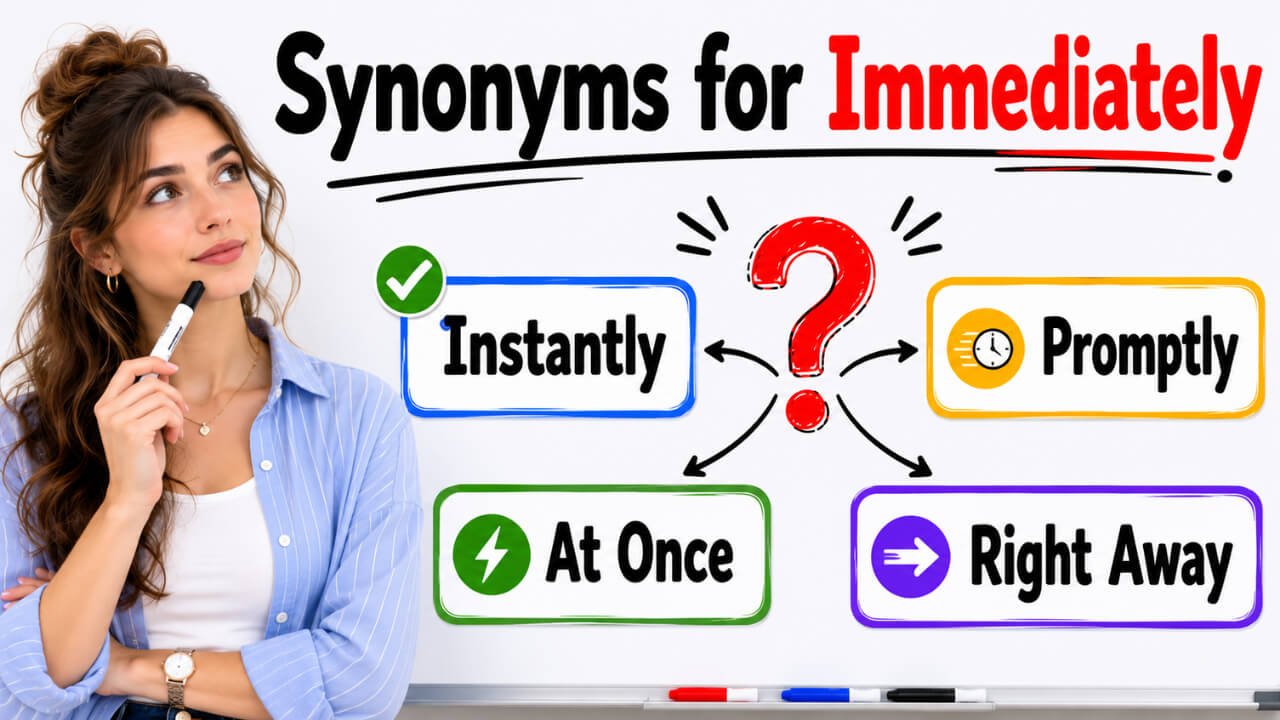
Quick Answer: Common synonyms for immediately include instantly, promptly, at once, right away, straightaway, directly, without delay, forthwith, now, and urgently. Use instantly when something happens in a single moment, promptly for a timely response, and at once for a firm instruction. Right away is natural in casual speech, while forthwith and without delay suit formal writing. Directly is useful when one event follows another, and urgently emphasizes that action is necessary because the matter is important.
Pronunciation and Word Details
Word: Immediately
Pronunciation: /ɪˈmiːdiətli/
Part of Speech: Adverb
Meaning: At once, without delay, or directly after a particular event.
US Pronunciation:
UK Pronunciation:
What Does “Immediately” Mean?
Immediately means at once, without waiting, or directly after something happens. It is an adverb that describes when an action, event, response, or change takes place.
The word can show that something happens in the present moment. For example, a person may be asked to leave immediately. It can also connect two events that happen very close together, as in immediately after the meeting.
Immediately often adds urgency, speed, or a clear time relationship to a sentence. It may modify a verb, an adjective, or a complete statement.
Immediate Action: She answered the message immediately.
Direct Sequence: The lights went out immediately after the storm began.
Urgent Instruction: Contact the manager immediately.
Instant Reaction: He immediately understood the problem.
Meaning, Tone, and Context of “Immediately”
Immediately has a neutral to formal tone, although it is also common in everyday conversation. Its strength depends on the situation in which it appears.
In instructions and warnings, immediately sounds firm and urgent. It tells someone that no delay is acceptable. In narratives, it can show that one event happened directly after another. In professional communication, it may communicate priority, responsibility, or a need for quick action.
The word is common in emails, reports, notices, instructions, essays, conversations, stories, and workplace communication. It can sound stronger than soon or shortly because those words allow some delay.
Right away and straightaway are more conversational. Promptly sounds polite and professional. Forthwith is highly formal. Instantly emphasizes that almost no time passes before something occurs.
When and How to Use “Immediately”
For Urgent Action: Use immediately when someone must act without waiting.
Example: Please report the safety issue immediately.
For Instant Reactions: Use immediately when a thought, feeling, or physical response occurs in a moment.
Example: She immediately recognized her former teacher.
For Direct Sequence: Use immediately when one event follows another with almost no time between them.
Example: The audience stood immediately after the speech ended.
For Firm Instructions: Immediately can make an order sound clear and serious.
Example: Return the equipment immediately.
For Quick Responses: Use immediately when a person responds as soon as information is received.
Example: He replied immediately after reading the request.
For Sudden Changes: Immediately can describe a condition that changes very quickly.
Example: The room became quiet immediately.
For Professional Communication: Use immediately to communicate that a task has the highest priority.
Example: The error must be corrected immediately.
For Storytelling: Immediately helps establish the order and speed of events.
Example: She opened the letter and immediately called her sister.
Best Synonyms for Immediately
Instantly: At the exact moment or with almost no passage of time.
Example: The child instantly recognized the familiar song.
Promptly: Without unnecessary delay and at the expected time.
Example: The assistant promptly answered the customer’s question.
At Once: Without waiting, often used in firm instructions.
Example: The doctor asked the patient to sit down at once.
Right Away: Immediately, expressed in a natural conversational style.
Example: I will complete the task right away.
Straightaway: Without pausing or delaying.
Example: She went straightaway to speak with the manager.
Directly: Immediately after something or without an intervening event.
Example: The discussion began directly after lunch.
Without Delay: With no waiting or postponement.
Example: The damaged equipment should be replaced without delay.
Forthwith: Immediately, especially in formal instructions or official writing.
Example: The payment must be returned forthwith.
Now: At the present moment.
Example: We need to make a decision now.
Urgently: In a way that requires immediate attention or action.
Example: The building urgently needs structural repairs.
50 Synonyms for Immediately with Short Meanings
- Instantly: At the exact moment.
- Promptly: Without unnecessary delay.
- At Once: Without waiting.
- Right Away: Immediately in casual language.
- Straightaway: Without pausing or delaying.
- Directly: At once or directly afterward.
- Without Delay: With no waiting.
- Forthwith: Immediately in formal language.
- Now: At the present moment.
- Right Now: At this exact time.
- This Instant: At the present second.
- This Minute: At the present moment.
- This Moment: At exactly the current time.
- This Very Moment: At the precise present moment.
- Here and Now: At the current place and time.
- On the Spot: Immediately at the place where something occurs.
- Then and There: At that exact time and place.
- There and Then: Immediately in that particular situation.
- Without Waiting: With no period of delay.
- Without Pause: Without stopping before acting.
- Without Hesitation: Without delaying because of uncertainty.
- Without Further Delay: Without allowing any more waiting.
- Without a Moment’s Delay: With no delay at all.
- Without Further Ado: Without more discussion or preparation.
- On the Double: Very quickly and without delay.
- Posthaste: With great speed and urgency.
- Pronto: Immediately in casual speech.
- Stat: Immediately, especially in urgent situations.
- Urgently: With a need for quick action.
- Speedily: In a fast and efficient manner.
- Swiftly: Very quickly.
- Rapidly: At a fast rate.
- Quickly: With speed and little delay.
- Expeditiously: Quickly and efficiently.
- Instantaneously: In an instant.
- In an Instant: Within a single moment.
- In a Flash: Extremely quickly.
- In No Time: Very quickly.
- In a Heartbeat: Almost instantly.
- In the Blink of an Eye: In an extremely short time.
- Straight After: Directly following an event.
- Right After: Very soon following something.
- Directly After: With nothing occurring between two events.
- Directly Afterwards: At the next moment.
- Right Afterwards: Very soon after an event.
- The Moment: As soon as something happens.
- As Soon As: At the earliest moment following an event.
- Thereupon: Immediately after the event just mentioned.
- Straight Off: Immediately and without preparation.
- In Short Order: Quickly and without a long delay.
Read Also:
Synonyms for Content

Synonyms for Immediately by Context
When Immediately Means Without Delay
At once, right away, straightaway, without delay, and forthwith are useful when an action must begin without waiting.
At Once: Strong and direct, especially in commands.
Example: Stop the machine at once.
Right Away: Natural in everyday conversation.
Example: I will check the information right away.
Without Delay: Clear and professional.
Example: The damaged cable must be repaired without delay.
Forthwith: Highly formal and suitable for official instructions.
Example: The documents must be submitted forthwith.
When Immediately Means Instantly
Instantly, instantaneously, in an instant, in a flash, and in a heartbeat emphasize that almost no time passes.
Instantly: The most natural choice for immediate reactions or changes.
Example: She instantly understood the meaning.
Instantaneously: A technical or formal word for something happening in a single instant.
Example: The signal was transmitted instantaneously.
In a Flash: An expressive choice that emphasizes great speed.
Example: The bird disappeared in a flash.
In a Heartbeat: An informal expression for something happening extremely quickly.
Example: I would accept that opportunity in a heartbeat.
When Immediately Means at the Present Moment
Now, right now, this instant, this minute, and here and now focus on the current time.
Now: The simplest and most direct alternative.
Example: We need to leave now.
Right Now: Stronger than now and common in conversation.
Example: I cannot discuss the matter right now.
This Instant: A forceful expression often used in commands.
Example: Come back inside this instant.
Here and Now: Emphasizes the present time and place.
Example: The issue must be resolved here and now.
When Immediately Means Directly After
Directly, straight after, right after, directly afterwards, thereupon, and the moment are useful when one event follows another.
Directly After: Clearly expresses the order of two events.
Example: The interview began directly after the presentation.
Right After: A natural conversational alternative.
Example: We went home right after dinner.
The Moment: Shows that the second action begins as soon as the first event happens.
Example: Call me the moment you arrive.
Thereupon: A formal word meaning directly after the event mentioned.
Example: The decision was announced, and thereupon the meeting ended.
When Immediately Shows Urgency
Urgently, promptly, posthaste, stat, and on the double communicate that speed is necessary.
Urgently: Focuses on the serious need for action.
Example: The roof urgently requires repairs.
Promptly: Professional and polite without sounding overly forceful.
Example: Please respond promptly to the request.
Posthaste: An expressive and somewhat formal way to indicate great urgency.
Example: The message was delivered posthaste.
On the Double: An informal command meaning very quickly.
Example: Bring the documents here on the double.
Another Word for Immediately
Instantly is often the best single replacement for immediately when something happens in a moment. However, promptly may be better for timely responses, while right away is more natural in casual conversation.
Original: She immediately noticed the spelling error.
Better Option: She instantly noticed the spelling error.
Original: Please answer the request immediately.
Better Option: Please answer the request promptly.
Original: I will begin the work immediately.
Better Option: I will begin the work right away.
Original: The rule became active immediately after approval.
Better Option: The rule became active directly after approval.
When Not to Use “Immediately”
Avoid immediately when the action does not truly happen without delay. Soon, shortly, later, or eventually may be more accurate when some waiting is expected.
The word can also sound too forceful in polite requests. Promptly or at your earliest convenience may create a more respectful tone when the situation is not urgent.
Do not combine immediately with another expression that has the same meaning. Phrases such as immediately right away are repetitive.
Avoid using immediately repeatedly in the same paragraph. Choose instantly, promptly, directly, or at once when those alternatives fit the intended meaning.
Weak: The report will be completed immediately next week.
Better: The report will be completed next week.
Weak: Please respond immediately at your earliest convenience.
Better: Please respond at your earliest convenience.
Weak: She immediately answered right away.
Better: She answered immediately.
Weak: The long process ended immediately after several hours.
Better: The long process ended after several hours.
Words Commonly Confused With Immediately
Immediately vs Instantly: Immediately means without delay, while instantly emphasizes that something happens in a single moment.
Immediately vs Promptly: Immediately allows no waiting. Promptly means quickly and within an appropriate amount of time.
Immediately vs Directly: Immediately can refer to present action or direct sequence. Directly often means that one event follows another without anything between them.
Immediately vs Soon: Immediately means at once. Soon means after a short but unspecified period.
Immediately vs Shortly: Immediately allows almost no delay. Shortly allows a brief period before the action occurs.
Immediately vs Currently: Immediately describes when an action begins. Currently describes a condition that is happening at present.
Immediately vs Urgently: Immediately describes timing. Urgently describes the importance or seriousness of acting quickly.
Immediately vs Eventually: Immediately means without delay. Eventually means after an uncertain or possibly long period.
Which Synonym Should You Choose?
Choose instantly when describing a reaction, realization, change, or result that occurs in a single moment.
Choose promptly for professional replies, services, payments, appointments, and responsibilities completed without unnecessary delay.
Choose at once when giving a strong order or urgent instruction.
Choose right away for natural, casual speech and friendly communication.
Choose without delay for formal notices, warnings, policies, and professional instructions.
Choose forthwith for highly formal or official writing.
Choose now or right now when emphasizing the present moment.
Choose directly after when explaining the exact order of two events.
Choose urgently when the need for action matters more than the exact timing.
Choose swiftly or rapidly when describing speed rather than an exact starting time.
Choose expeditiously in formal reports when an action must be completed quickly and efficiently.
Real Life Examples of “Immediately” in Sentences
Original: She immediately recognized the familiar voice.
Better Option: She instantly recognized the familiar voice.
Original: Please send the completed form immediately.
Better Option: Please send the completed form promptly.
Original: He left the building immediately.
Better Option: He left the building at once.
Original: I will contact the supplier immediately.
Better Option: I will contact the supplier right away.
Original: The manager acted immediately after receiving the complaint.
Better Option: The manager acted directly after receiving the complaint.
Original: The error must be corrected immediately.
Better Option: The error must be corrected without delay.
Original: The patient required help immediately.
Better Option: The patient urgently required help.
Original: The room became silent immediately.
Better Option: The room became silent in an instant.
Original: She called me immediately after the meeting.
Better Option: She called me right after the meeting.
Original: We need to discuss the issue immediately.
Better Option: We need to discuss the issue now.
Synonym Groups and Usage Differences
Instant Action Group
Instantly, instantaneously, in an instant, in a flash, and in the blink of an eye describe actions or changes that happen within almost no time.
Instantly is the most natural general choice. Instantaneously sounds more technical, while in a flash creates a more vivid image.
Example: The screen changed instantly.
Prompt Response Group
Promptly, without delay, expeditiously, and speedily describe actions completed quickly and responsibly.
Promptly is polite and professional. Expeditiously emphasizes both efficiency and speed.
Example: The customer’s concern was handled promptly.
Firm Instruction Group
At once, this instant, forthwith, and on the double are often used for commands.
At once is direct but widely understood. This instant is forceful, while forthwith is highly formal.
Example: Return to your seat at once.
Casual Speech Group
Right away, right now, pronto, in no time, and straight off are common in relaxed speech.
Right away is the most widely useful. Pronto is playful or forceful depending on tone.
Example: I will call you right away.
Direct Sequence Group
Directly after, right after, straight after, directly afterwards, and thereupon show that one event follows another.
Right after is conversational. Directly after is clearer in formal explanations, while thereupon has a literary or formal tone.
Example: The discussion began directly after the presentation.
Antonyms of Immediately
The opposite of immediately depends on whether the word refers to timing, speed, urgency, or sequence.
Later: At a time after the present.
Eventually: At an uncertain time in the future.
Gradually: Slowly over a period of time.
Slowly: Without speed.
Afterwards: At a later time following an event.
Subsequently: At a later stage in a sequence.
Belatedly: Later than expected or required.
Hesitantly: With uncertainty that causes delay.
Leisurely: Without urgency or haste.
Delayed: Made to happen later than planned.
Deferred: Postponed until a later time.
Postponed: Moved to a future time or date.
Paused: Temporarily stopped before continuing.
Eventually: After some time has passed.
In Due Course: At an appropriate future time rather than at once.
Comparison: Immediately vs Related Words
Immediately vs Instantly
Immediately means without delay. Instantly places stronger emphasis on something occurring in a single moment.
Example With Immediately: She immediately began working on the solution.
Example With Instantly: She instantly recognized the correct solution.
Immediately vs Promptly
Immediately suggests no waiting at all. Promptly suggests that an action is performed quickly and within an appropriate time.
Example With Immediately: Leave the area immediately.
Example With Promptly: Please arrive promptly for the appointment.
Immediately vs Right Away
Both expressions mean without delay. Immediately is neutral to formal, while right away is more conversational.
Example With Immediately: The problem must be reported immediately.
Example With Right Away: I will tell him right away.
Immediately vs Directly
Immediately can describe action at the present moment or after another event. Directly is especially useful when showing that one event follows another.
Example With Immediately: Please contact the office immediately.
Example With Directly: The ceremony began directly after the speech.
Immediately vs Soon
Immediately means at once. Soon means after a short but uncertain period.
Example With Immediately: The alarm must be checked immediately.
Example With Soon: The technician will arrive soon.
Immediately vs Urgently
Immediately focuses on when an action should occur. Urgently focuses on why quick action is important.
Example With Immediately: Send the information immediately.
Example With Urgently: We urgently need additional information.
Common Phrases and Expressions With “Immediately”
Immediately Available: Ready for use without waiting.
Immediately After: Directly following an event.
Immediately Before: Directly preceding an event.
Effective Immediately: Beginning at the present moment.
Respond Immediately: Give an answer without delay.
Act Immediately: Take action at once.
Leave Immediately: Go away without waiting.
Contact Immediately: Communicate with someone at once.
Immediately Noticeable: Easy to recognize at the first moment.
Immediately Clear: Understood without further explanation.
Immediately Recognizable: Identified as soon as it is seen or heard.
Immediately Following: Occurring directly after something.
Common Mistakes to Avoid
A common mistake is using immediately when soon would be more accurate. If an action will occur after several minutes, hours, or days, immediately may create an unrealistic expectation.
Avoid combining immediately with right away, at once, or instantly in the same phrase. These combinations repeat the same meaning.
Do not write very immediately. Immediately already expresses the strongest sense of timing. Use almost immediately when a small delay occurs.
Place immediately near the action it modifies so the sentence remains clear.
Unclear: Immediately, after the meeting, the manager reviewed the report.
Clear: Immediately after the meeting, the manager reviewed the report.
Be careful when replacing immediately with directly. Directly can also mean in a straight manner, personally, or honestly, so the intended meaning should remain clear.
Use promptly instead of immediately when you want to sound professional and polite without creating extreme urgency.
Conclusion
Understanding synonyms for immediately helps you express urgency, speed, present action, and direct sequence more precisely. Use instantly for momentary reactions, promptly for timely professional responses, and at once for firm instructions. Right away works naturally in casual speech, while without delay and forthwith suit formal communication. Directly after is useful for explaining the order of events. The best alternative depends on whether you are emphasizing exact timing, quick action, urgency, or a close connection between two events.
FAQs About Synonyms for Immediately
What Is the Best Synonym for Immediately?
Instantly is a strong general synonym, but promptly, at once, and right away may be better depending on the context.
What Is a Formal Synonym for Immediately?
Forthwith, without delay, promptly, and expeditiously are suitable formal alternatives.
What Is a Casual Synonym for Immediately?
Right away, right now, pronto, and straightaway are natural choices in casual conversation.
What Is the Difference Between Immediately and Instantly?
Immediately means without delay. Instantly emphasizes that something happens within a single moment.
Can Promptly Replace Immediately?
Promptly can replace immediately when an action must happen quickly, although it may allow slightly more time than immediately.
What Is Another Word for Immediately After?
Directly after, right after, straight after, thereupon, and the moment are useful alternatives.
Is Immediately an Adverb?
Yes. Immediately is an adverb that describes when an action occurs or how closely one event follows another.
