
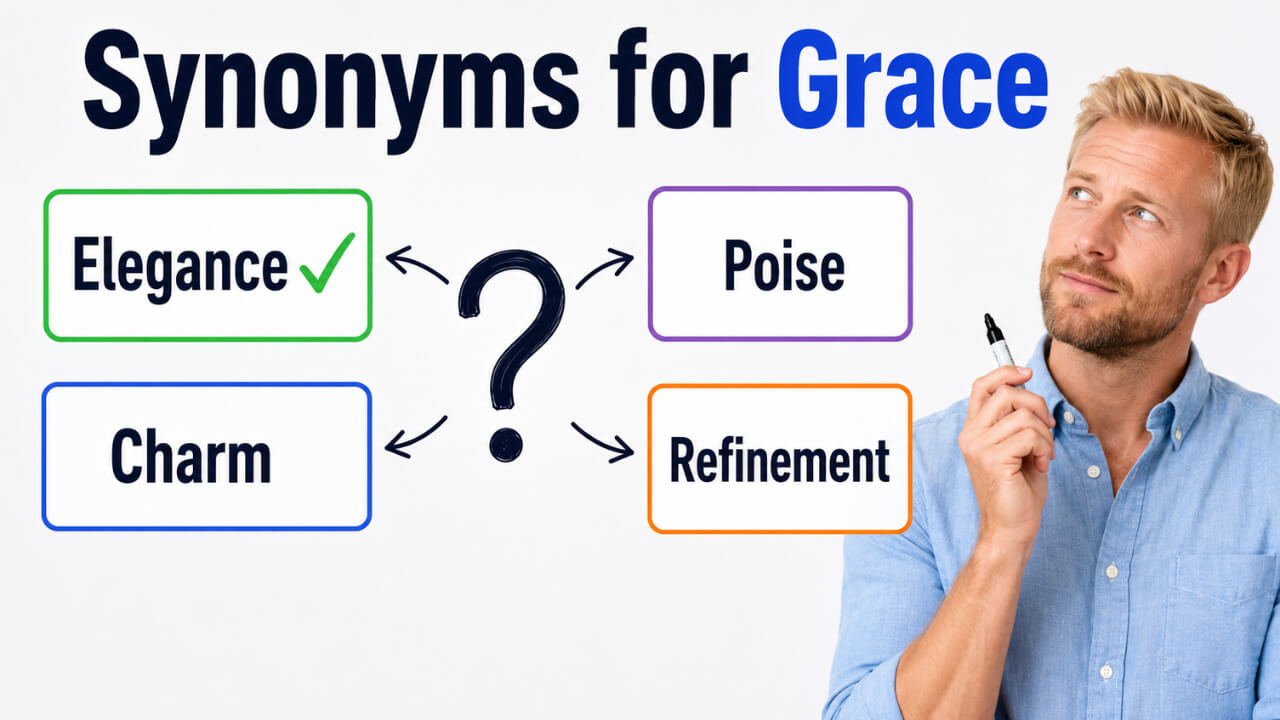
Quick Answer: Synonyms for grace include elegance, poise, refinement, charm, dignity, kindness, mercy, favor, blessing, and forgiveness. Elegance and poise are best for graceful movement or appearance. Kindness and graciousness describe considerate behavior. Mercy and clemency suit forgiveness or compassion, while favor and blessing work well in spiritual, formal, or supportive contexts. The most accurate synonym depends on whether grace refers to beauty, behavior, divine favor, prayer, or extra time.
Pronunciation and Word Details
Word: Grace
Pronunciation: /ɡreɪs/
Part of Speech: Noun and verb
Meaning: Grace means elegant movement, polite kindness, undeserved favor, a short prayer, or additional time allowed to complete something.
US Pronunciation:
UK Pronunciation:
What Does “Grace” Mean?
Grace means elegance, kindness, favor, forgiveness, or a pleasing quality in someone’s behavior or appearance.
As a noun, grace can describe smooth and attractive movement. A dancer may move with grace, meaning that the person moves in an elegant, controlled, and natural way.
Grace can also refer to kindness, patience, and respectful behavior. A person who accepts criticism with grace remains calm, polite, and dignified.
In religious contexts, grace means divine favor, spiritual help, or a blessing that is freely given. It can also mean a short prayer of thanks spoken before or after a meal.
Grace may additionally describe extra time given before a payment, task, or responsibility becomes overdue. In this context, an extension, allowance, or period of additional time may be a more precise alternative.
As a verb, grace means to honor, decorate, or improve a place or occasion through one’s presence.
Meaning, Tone, and Context of “Grace”
Grace is generally a positive and respectful word. Its tone can be elegant, emotional, spiritual, formal, or appreciative depending on the context.
When referring to movement or appearance, grace suggests beauty, balance, control, and ease. It is commonly used to describe dancers, athletes, performers, animals, and people who move smoothly.
When referring to personality, grace suggests kindness, patience, dignity, forgiveness, and emotional control. It often describes how someone behaves during a difficult, embarrassing, or disappointing situation.
In spiritual language, grace has a deeper and more formal meaning. It refers to divine favor, mercy, goodness, or spiritual assistance.
Grace can also appear in professional and financial contexts. A grace period is an additional amount of time allowed before a deadline, payment, or obligation must be completed.
When and How to Use “Grace”
For Elegant Movement: Use grace when someone moves smoothly, naturally, and beautifully.
Example: The dancer crossed the stage with remarkable grace.
For Polite Behavior: Use grace when someone behaves with patience, dignity, and consideration.
Example: She accepted the criticism with grace.
For Kindness: Use grace to describe a person’s gentle and compassionate treatment of others.
Example: His grace toward the new employees made everyone feel welcome.
For Forgiveness: Use grace when someone chooses understanding or mercy instead of anger or punishment.
Example: The teacher showed grace by allowing the student to correct the mistake.
For Spiritual Favor: Use grace when referring to divine goodness, favor, or assistance.
Example: They believed that grace gave them strength during difficult times.
For Prayer: Use grace for a short prayer of gratitude, especially before a meal.
Example: The family said grace before dinner.
For Additional Time: Use grace when a person receives extra time before a deadline or payment.
Example: The company provided a five day grace period for late payments.
For Honoring an Occasion: Use grace as a verb when someone’s presence makes an event more special.
Example: The respected author graced the ceremony with her presence.
Best Synonyms for Grace
Elegance: Attractive beauty shown through movement, appearance, or style.
Example: Her elegance made the simple performance memorable.
Poise: Calm confidence and controlled movement or behavior.
Example: He answered every difficult question with poise.
Refinement: Polished manners, taste, or appearance.
Example: The room was decorated with simplicity and refinement.
Charm: A pleasing quality that attracts or delights others.
Example: Her warmth and charm made the guests feel comfortable.
Dignity: Calm, honorable, and respectful behavior.
Example: He handled the disappointing result with dignity.
Graciousness: Kind, polite, and considerate behavior toward other people.
Example: The host welcomed every visitor with graciousness.
Mercy: Compassion shown by reducing punishment or forgiving someone.
Example: The judge showed mercy because of the unusual circumstances.
Favor: Approval, support, kindness, or special assistance.
Example: She asked her colleague for a small favor.
Blessing: Something that brings happiness, support, or spiritual benefit.
Example: The unexpected opportunity felt like a blessing.
Clemency: Formal mercy shown toward someone facing punishment.
Example: The prisoner requested clemency from the authorities.
50 Synonyms for Grace with Short Meanings
- Elegance: Attractive beauty in movement, style, or appearance.
- Poise: Calm and controlled confidence.
- Refinement: Polished behavior, taste, or appearance.
- Charm: A pleasing quality that attracts others.
- Beauty: A quality that gives visual or emotional pleasure.
- Dignity: Calm and honorable behavior.
- Finesse: Skillful and delicate handling of something.
- Fluidity: Smooth and continuous movement.
- Smoothness: An even and effortless quality.
- Polish: A refined and professionally developed quality.
- Composure: Calm control of feelings and behavior.
- Decorum: Proper and respectful conduct.
- Tact: Sensitivity when speaking or dealing with others.
- Sophistication: Refined knowledge, style, or behavior.
- Delicacy: Gentle beauty, sensitivity, or carefulness.
- Artistry: Creative skill and expressive ability.
- Graciousness: Warm, polite, and considerate behavior.
- Kindness: Friendly and caring treatment of others.
- Mercy: Compassion that reduces punishment or suffering.
- Compassion: Concern for someone who is suffering.
- Goodwill: Friendly and helpful feelings toward others.
- Favor: Kindness, approval, or special support.
- Benevolence: A sincere desire to help others.
- Generosity: Willingness to give or help freely.
- Courtesy: Polite and respectful behavior.
- Forgiveness: The decision to stop blaming someone.
- Clemency: Formal mercy toward a person facing punishment.
- Leniency: Reduced strictness or punishment.
- Blessing: A source of happiness, protection, or benefit.
- Goodness: Moral kindness and positive character.
- Virtue: Morally good behavior or character.
- Holiness: Spiritual goodness or sacredness.
- Divine Favor: Spiritual kindness or approval from a higher power.
- Providence: Protective spiritual care or guidance.
- Benediction: A formal prayer asking for blessing.
- Prayer: Words directed toward a higher power.
- Thanksgiving: An expression of gratitude.
- Invocation: A formal request for spiritual help or blessing.
- Gratitude: Appreciation for kindness or benefits received.
- Devotion: Deep commitment, love, or spiritual dedication.
- Reprieve: Temporary relief from punishment or difficulty.
- Respite: A short period of rest or relief.
- Extension: Additional time allowed to complete something.
- Deferment: An official delay of an obligation.
- Postponement: The act of moving something to a later time.
- Allowance: Additional freedom, time, or consideration.
- Honor: Respect or distinction given to someone.
- Distinction: A quality that makes someone respected or notable.
- Adornment: Something that adds beauty or decoration.
- Enhancement: An improvement that adds beauty or value.
Read Also:
Synonyms for Find

Synonyms for Grace by Context
When Grace Means Elegance
When grace describes appearance or movement, the best synonyms are elegance, poise, fluidity, beauty, finesse, and smoothness. These words suggest controlled and attractive movement without visible effort.
Example: The gymnast performed with remarkable grace.
Alternative: The gymnast performed with remarkable fluidity.
Example: She carried herself with grace throughout the ceremony.
Alternative: She carried herself with elegance throughout the ceremony.
When Grace Means Kindness
When grace refers to considerate behavior, suitable synonyms include graciousness, kindness, goodwill, benevolence, generosity, and courtesy. These words describe how someone treats other people with warmth and respect.
Example: She showed grace toward the nervous speaker.
Alternative: She showed kindness toward the nervous speaker.
Example: His grace made the disagreement easier to resolve.
Alternative: His graciousness made the disagreement easier to resolve.
When Grace Means Mercy
When grace involves forgiveness or reduced punishment, use mercy, clemency, leniency, compassion, forgiveness, or reprieve.
Example: The manager showed grace after hearing the employee’s explanation.
Alternative: The manager showed leniency after hearing the employee’s explanation.
Example: He asked for grace after admitting his mistake.
Alternative: He asked for forgiveness after admitting his mistake.
When Grace Means Spiritual Favor
In spiritual contexts, grace can be replaced by divine favor, blessing, goodness, providence, holiness, or mercy. The correct choice depends on whether the sentence emphasizes support, protection, forgiveness, or sacred goodness.
Example: She viewed the recovery as an act of grace.
Alternative: She viewed the recovery as a blessing.
Example: They trusted in grace during uncertain times.
Alternative: They trusted in divine favor during uncertain times.
When Grace Means a Prayer
When grace refers to words spoken before a meal, prayer, blessing, thanksgiving, benediction, or invocation may be suitable.
Example: The family offered grace before eating.
Alternative: The family offered a prayer before eating.
Example: He was invited to say grace at dinner.
Alternative: He was invited to give the blessing at dinner.
When Grace Means Additional Time
When grace refers to extra time, the best alternatives include extension, allowance, deferment, postponement, respite, and reprieve.
Example: Customers received a grace period before the fee applied.
Alternative: Customers received an extension before the fee applied.
Example: The lender allowed ten days of grace.
Alternative: The lender allowed a ten day deferment.
Another Word for Grace
Elegance is often the best general replacement for grace when discussing movement, appearance, or style. However, the best alternative depends on the meaning of the sentence.
Use poise for calm and confident behavior. Use kindness or graciousness for considerate treatment. Use mercy for forgiveness, blessing for spiritual benefit, and extension for additional time.
Original: The performer moved with grace.
Better Option: The performer moved with elegance.
Original: She responded to the complaint with grace.
Better Option: She responded to the complaint with poise.
Original: The coach gave him grace after the mistake.
Better Option: The coach showed him mercy after the mistake.
Original: We were given a week of grace to complete the payment.
Better Option: We were given a one week extension to complete the payment.
When Not to Use “Grace”
Do not use grace when the intended meaning is unclear. Because the word can refer to elegance, kindness, spiritual favor, prayer, or extra time, readers may misunderstand a vague sentence.
Weak: The manager gave us grace.
Better: The manager gave us an extension.
Avoid grace when a more precise word is necessary in reports, agreements, instructions, or financial documents.
Weak: Customers will receive some grace after the deadline.
Better: Customers will receive a five day extension after the deadline.
Do not use grace repeatedly when describing a person’s appearance and behavior. Choose a more specific alternative to improve variety.
Weak: She moved with grace and accepted the award with grace.
Better: She moved with elegance and accepted the award with poise.
Avoid using grace as a replacement for beauty when the sentence refers only to physical appearance.
Weak: The painting was admired for its grace.
Better: The painting was admired for its beauty and refinement.
Do not use grace when mercy, forgiveness, or leniency communicates the intended meaning more directly.
Weak: The teacher gave the student grace for breaking the rule.
Better: The teacher showed the student leniency for breaking the rule.
Words Commonly Confused With Grace
Grace vs Elegance: Grace often describes natural beauty in movement or behavior, while elegance more commonly describes refined appearance, design, or style.
Grace vs Poise: Grace suggests smoothness, beauty, and kindness. Poise emphasizes calm confidence and emotional control.
Grace vs Charm: Grace describes elegance or gracious behavior, while charm is the ability to attract and delight people.
Grace vs Mercy: Grace can include kindness or forgiveness, but mercy specifically means compassion shown by reducing punishment or suffering.
Grace vs Favor: Grace can mean freely given kindness, while favor may refer to approval, support, or a helpful act.
Grace vs Blessing: Grace may describe spiritual favor or help. A blessing can be spiritual support, a prayer, or anything considered fortunate.
Grace vs Forgiveness: Grace is broader and can include kindness, dignity, or favor. Forgiveness specifically means releasing blame or resentment.
Grace vs Graciousness: Grace has several meanings, while graciousness specifically describes polite, generous, and considerate behavior.
Which Synonym Should You Choose?
Choose elegance when describing attractive movement, appearance, fashion, design, or style.
Choose poise when describing calm confidence during pressure, criticism, or public attention.
Choose refinement when discussing polished manners, culture, taste, decoration, or presentation.
Choose graciousness when describing a person who behaves warmly, politely, and thoughtfully.
Choose kindness for simple and direct descriptions of caring behavior.
Choose mercy when someone avoids giving a severe punishment.
Choose clemency in formal writing about legal or official forgiveness.
Choose favor when referring to approval, support, or a helpful action.
Choose blessing when discussing spiritual benefit, good fortune, or something deeply appreciated.
Choose prayer when grace refers to words of gratitude spoken before a meal.
Choose extension when writing about additional time for a payment, task, or deadline.
Choose fluidity when describing smooth physical movement in sports, dance, or performance.
Real Life Examples of “Grace” in Sentences
Original: The dancer moved across the floor with grace.
Better Option: The dancer moved across the floor with elegance.
Original: She handled the rude comment with grace.
Better Option: She handled the rude comment with poise.
Original: His grace toward the new student was admirable.
Better Option: His kindness toward the new student was admirable.
Original: The leader showed grace after the team made a mistake.
Better Option: The leader showed mercy after the team made a mistake.
Original: They considered the safe journey an example of grace.
Better Option: They considered the safe journey a blessing.
Original: The family said grace before beginning the meal.
Better Option: The family offered a prayer before beginning the meal.
Original: The bank gave customers a short period of grace.
Better Option: The bank gave customers a short extension.
Original: She accepted defeat with grace.
Better Option: She accepted defeat with dignity.
Original: His presence graced the formal celebration.
Better Option: His presence honored the formal celebration.
Original: Fresh flowers graced the entrance.
Better Option: Fresh flowers adorned the entrance.
Synonym Groups and Usage Differences
Elegance Group
Elegance, poise, refinement, fluidity, finesse, and smoothness describe attractive movement, polished appearance, or skillful performance. Elegance is broad, while fluidity focuses specifically on continuous movement.
Example: Her poise and elegance impressed the audience.
Kindness Group
Kindness, graciousness, goodwill, courtesy, generosity, and benevolence describe positive treatment of other people. Graciousness emphasizes polite warmth, while benevolence suggests a sincere wish to help.
Example: His graciousness helped every guest feel valued.
Mercy Group
Mercy, forgiveness, clemency, compassion, and leniency describe understanding shown toward someone who has done something wrong. Clemency is more formal and often appears in legal contexts.
Example: The official granted clemency after reviewing the case.
Spiritual Group
Blessing, divine favor, providence, holiness, goodness, and virtue relate to spiritual support or moral goodness. Blessing is common in everyday speech, while providence sounds more formal.
Example: They regarded the unexpected help as a blessing.
Prayer Group
Prayer, thanksgiving, benediction, and invocation refer to spoken or silent spiritual expressions. Thanksgiving emphasizes gratitude, while invocation asks for assistance or blessing.
Example: The gathering began with a short invocation.
Additional Time Group
Extension, deferment, postponement, allowance, respite, and reprieve describe additional time or temporary relief. Extension is the clearest word for deadlines, while deferment often refers to an officially delayed obligation.
Example: The student requested an extension for the assignment.
Antonyms of Grace
The opposite of grace changes according to the intended meaning. Awkwardness is the opposite of elegant movement, while cruelty and harshness oppose kindness or mercy.
Awkwardness: A lack of smooth, controlled, or elegant movement.
Clumsiness: Poor physical control or careless movement.
Inelegance: A lack of beauty, refinement, or style.
Crudeness: Rough, offensive, or unrefined behavior.
Rudeness: Impolite or disrespectful conduct.
Harshness: Severe and unkind treatment.
Cruelty: Deliberate behavior that causes pain or suffering.
Mercilessness: A complete lack of compassion or forgiveness.
Disfavor: A lack of approval or support.
Condemnation: Strong blame or formal disapproval.
Punishment: A penalty given for wrongdoing.
Disgrace: A loss of honor or respect.
Impatience: An unwillingness to wait or show understanding.
Ingratitude: A failure to appreciate kindness or benefits.
Rigidness: Unwillingness to allow flexibility or additional time.
Comparison Grace vs Related Words
Grace vs Elegance
Grace describes natural beauty in movement, conduct, or character. Elegance focuses more strongly on refined style, appearance, or design.
Example With Grace: She walked across the room with grace.
Example With Elegance: The room was furnished with understated elegance.
Grace vs Poise
Grace suggests beauty, smoothness, or gracious behavior. Poise emphasizes calm confidence and control, especially in difficult situations.
Example With Grace: She accepted the compliment with grace.
Example With Poise: She answered the challenging questions with poise.
Grace vs Mercy
Grace is a broad word that may mean elegance, kindness, favor, or forgiveness. Mercy specifically refers to compassion shown toward someone who could be punished.
Example With Grace: The supervisor treated the mistake with grace.
Example With Mercy: The supervisor showed mercy and reduced the penalty.
Grace vs Kindness
Grace may refer to elegant behavior as well as kindness. Kindness directly describes caring and helpful treatment.
Example With Grace: She showed grace during the disagreement.
Example With Kindness: She showed kindness to the upset customer.
Grace vs Charm
Grace is connected with elegance, dignity, and smoothness. Charm is a pleasing personal quality that makes someone attractive or enjoyable.
Example With Grace: The actor performed the difficult scene with grace.
Example With Charm: The actor won the audience with his charm.
Grace vs Blessing
Grace can refer to spiritual favor or mercy. A blessing may mean spiritual protection, a prayer, or a fortunate event.
Example With Grace: They relied on grace during the difficult period.
Example With Blessing: The support of their neighbors was a blessing.
Common Phrases and Expressions With “Grace”
With Grace: In an elegant, calm, or dignified manner.
Example: She accepted the decision with grace.
Saving Grace: A positive quality that makes a difficult situation more acceptable.
Example: The comfortable seating was the event’s saving grace.
Fall From Grace: To lose respect, approval, or an important position.
Example: The dishonest decision caused his fall from grace.
Grace Period: Additional time allowed before a deadline or penalty.
Example: Customers receive a seven day grace period.
Good Graces: A state of receiving someone’s approval or favor.
Example: He worked hard to remain in the director’s good graces.
By the Grace of God: Through divine favor or assistance.
Example: They believed they had succeeded by the grace of God.
Say Grace: To offer a short prayer before a meal.
Example: The family asked their guest to say grace.
Social Graces: Polite manners used in social situations.
Example: The course taught communication and social graces.
Grace Under Pressure: Calm and dignified behavior during difficulty.
Example: Her grace under pressure inspired the entire team.
Grace the Occasion: To honor an event by being present.
Example: Several respected guests graced the occasion.
Common Mistakes to Avoid
A common mistake is treating every synonym for grace as interchangeable. Elegance, mercy, blessing, and extension represent very different meanings.
Use elegance for movement or style, mercy for forgiveness, blessing for spiritual benefit, and extension for additional time.
Another mistake is using grace in a vague sentence without enough context.
Unclear: They gave her grace.
Clear: They gave her additional time to complete the payment.
Avoid confusing grace with graciousness. Grace can describe beauty, prayer, favor, or mercy, while graciousness refers specifically to kind and polite behavior.
Do not use clumsy expressions such as “very full of grace” when a clearer adjective is available.
Unnatural: She was very full of grace while dancing.
Natural: She danced gracefully.
Avoid repeating grace several times in one paragraph. Replace it with poise, elegance, kindness, dignity, or mercy when the meaning remains accurate.
Always check whether the selected synonym matches the intended context. A person may move with elegance, behave with dignity, offer kindness, receive mercy, or request an extension.
Conclusion
Synonyms for grace vary because grace can describe elegant movement, dignified behavior, kindness, forgiveness, spiritual favor, prayer, or additional time. Elegance, poise, and fluidity work best for movement and appearance. Graciousness, kindness, and courtesy describe polite behavior. Mercy, forgiveness, and clemency express compassion, while blessing and divine favor suit spiritual contexts. For deadlines or payments, extension and deferment are clearer choices. Selecting the synonym that matches the intended meaning makes every sentence more precise, natural, and useful.
FAQs About Synonyms for Grace
What Is the Best Synonym for Grace?
Elegance is the best general synonym when grace refers to movement or appearance. Kindness, mercy, blessing, or extension may be better in other contexts.
What Is Another Word for Graceful Movement?
Elegance, fluidity, poise, smoothness, and finesse can all describe graceful movement.
What Is a Synonym for Graceful Behavior?
Poise, dignity, graciousness, courtesy, and refinement are suitable alternatives for graceful behavior.
Is Mercy a Synonym for Grace?
Yes. Mercy is a synonym when grace means forgiveness, compassion, or reduced punishment.
Is Blessing Another Word for Grace?
Blessing can replace grace in spiritual contexts, especially when referring to divine support, protection, or a fortunate benefit.
What Is Another Word for a Grace Period?
Extension, deferment, allowance, postponement, and additional time are useful alternatives for a grace period.
What Is the Opposite of Grace?
Awkwardness, clumsiness, rudeness, cruelty, harshness, and disgrace are possible opposites, depending on the meaning of grace.
