
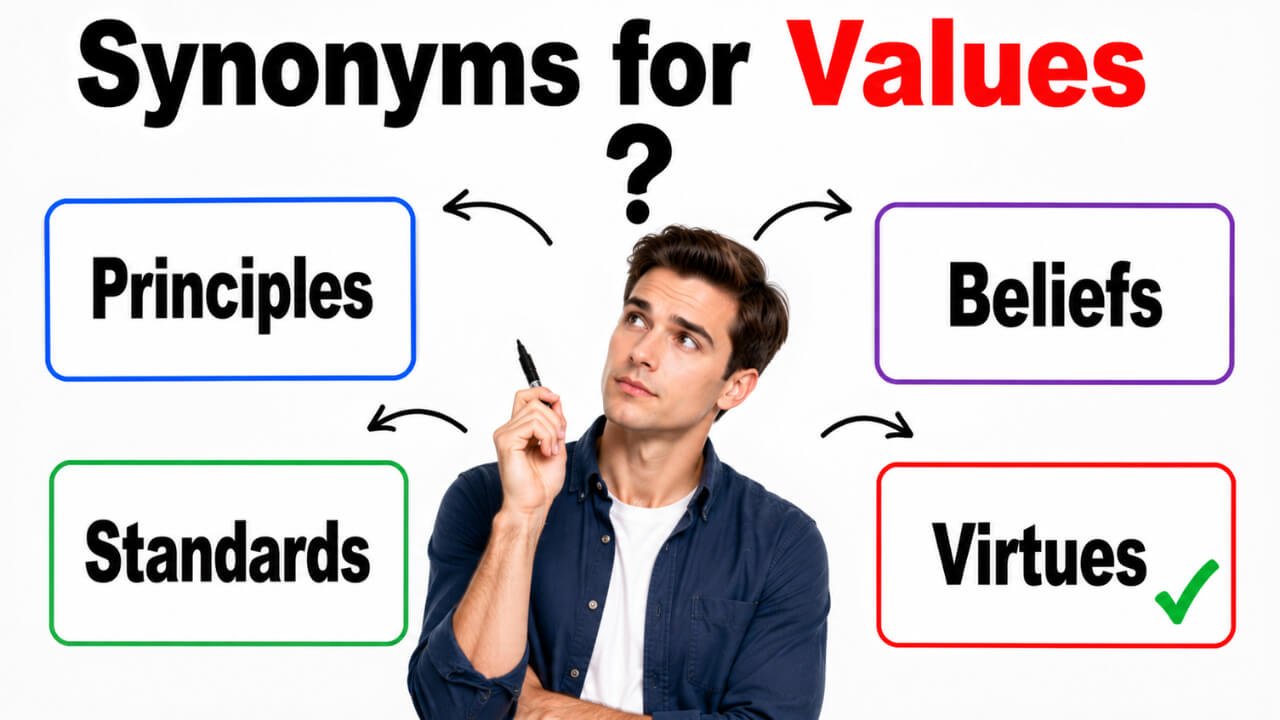
Quick Answer: Common synonyms for values include principles, beliefs, standards, morals, ethics, ideals, virtues, convictions, priorities, and tenets. Use principles for rules that guide behavior, beliefs for ideas someone accepts as true, morals for judgments about right and wrong, ethics for professional or social conduct, and ideals for qualities people hope to achieve. The best synonym depends on whether values refers to personal character, cultural expectations, professional standards, importance, usefulness, or financial worth.
Pronunciation and Word Details
Word: Values
Pronunciation: /ˈvæl.juːz/
Part of Speech: Plural noun and third person singular verb
Meaning: Values are principles, beliefs, standards, or judgments about what is important, right, useful, or worthwhile.
US Pronunciation:
UK Pronunciation:
What Does “Values” Mean?
Values are the principles, beliefs, and standards that influence how people think, behave, and make decisions. The word is most commonly used as a plural noun.
Personal values may include honesty, kindness, responsibility, fairness, and courage. Cultural values are shared ideas about appropriate behavior within a community. Professional values may include reliability, respect, accuracy, and accountability.
Values can also refer to the importance, usefulness, or financial worth of something. In mathematics, values are numbers or amounts represented by variables or expressions.
As a verb, values means considers something important or estimates its worth. For example, a manager values honesty, while an expert values a property.
Meaning, Tone, and Context of “Values”
Values usually has a neutral, thoughtful, and serious tone. It is common in personal development, education, philosophy, psychology, business communication, cultural discussions, and academic writing.
When values refers to moral principles, the word often carries a positive or ethical tone. A person with strong values is usually understood to have clear standards that guide decisions and conduct.
In professional settings, values may describe the qualities that shape workplace behavior, leadership, teamwork, and customer service. In social discussions, the word can describe shared beliefs, traditions, and expectations.
The word is also technical in mathematics, economics, finance, and property assessment. In these contexts, values may refer to numbers, prices, measurements, or estimated worth rather than moral principles.
When and How to Use “Values”
For Personal Principles: Use values when describing the beliefs that guide someone’s choices and behavior.
Example: Honesty and compassion are central to her personal values.
For Moral Standards: Use values when discussing ideas about right and wrong.
Example: His values prevented him from accepting an unfair offer.
For Cultural Beliefs: Use values when describing ideas shared by a community or society.
Example: Family loyalty is important in many cultural values.
For Professional Conduct: Use values when explaining standards that shape workplace behavior.
Example: Respect and accountability are essential professional values.
For Priorities: Use values when identifying what a person or group considers most important.
Example: The organization’s values include safety, quality, and service.
For Worth: Use values when discussing the price or estimated importance of objects.
Example: Property values increased throughout the area.
For Numbers: Use values in mathematics when referring to quantities represented by symbols.
Example: Substitute the known values into the equation.
Best Synonyms for Values
Principles: Basic rules or beliefs that guide behavior and decisions.
Example: Her principles would not allow her to deceive a customer.
Beliefs: Ideas or opinions accepted as true or important.
Example: His beliefs strongly influence the way he treats others.
Standards: Accepted levels of quality, behavior, or achievement.
Example: The school maintains high standards of academic honesty.
Morals: Beliefs about right, wrong, good, and bad behavior.
Example: Her morals guided her through a difficult decision.
Ethics: Rules or principles governing proper conduct.
Example: Medical ethics require professionals to protect patient privacy.
Ideals: Excellent qualities, goals, or conditions people hope to achieve.
Example: Freedom and equality are important democratic ideals.
Virtues: Positive moral qualities such as honesty, courage, and patience.
Example: Kindness and generosity are widely respected virtues.
Convictions: Strongly held beliefs or opinions.
Example: He defended his convictions despite strong criticism.
Priorities: Matters considered more important than others.
Example: Health and family are among her highest priorities.
Tenets: Fundamental beliefs held by a group, system, or philosophy.
Example: Respect is one of the central tenets of the program.
50 Synonyms for Values with Short Meanings
- Principles: Rules or beliefs that guide behavior.
- Beliefs: Ideas accepted as true or important.
- Standards: Expected levels of conduct or quality.
- Morals: Beliefs about right and wrong.
- Ethics: Principles governing acceptable behavior.
- Ideals: Excellent qualities or goals worth pursuing.
- Virtues: Positive moral qualities or strengths.
- Convictions: Firmly held beliefs or opinions.
- Priorities: Matters considered especially important.
- Tenets: Basic beliefs of a system or group.
- Codes: Organized rules of behavior or conduct.
- Norms: Commonly accepted patterns of behavior.
- Precepts: Rules intended to guide moral conduct.
- Doctrines: Established beliefs taught by a group.
- Philosophies: General systems of thought or belief.
- Creeds: Statements expressing shared beliefs.
- Attitudes: Ways of thinking or feeling about something.
- Views: Personal opinions or ways of understanding.
- Outlooks: General attitudes toward life or events.
- Guidelines: Recommendations that direct behavior or decisions.
- Rules: Instructions controlling actions or conduct.
- Criteria: Standards used for judgment or decisions.
- Benchmarks: Reference standards used for comparison.
- Expectations: Beliefs about proper behavior or results.
- Customs: Traditional ways of behaving within a group.
- Traditions: Beliefs or practices passed through generations.
- Commitments: Strong promises or dedication to principles.
- Responsibilities: Duties people are expected to fulfill.
- Duties: Moral, legal, or professional obligations.
- Loyalties: Strong feelings of support or faithfulness.
- Preferences: Choices favored over other possibilities.
- Interests: Matters that receive attention or concern.
- Concerns: Issues considered important or worthy of care.
- Aims: Intended purposes or desired results.
- Goals: Results that someone works to achieve.
- Qualities: Features or characteristics someone considers important.
- Merits: Positive qualities that make something valuable.
- Worth: The importance, usefulness, or price of something.
- Importance: The quality of being meaningful or significant.
- Significance: The meaning or importance of something.
- Usefulness: The ability to serve a practical purpose.
- Utility: Practical value or usefulness.
- Benefit: An advantage or positive result.
- Price: The amount of money something costs.
- Valuation: An estimate of financial worth.
- Appraisal: A professional judgment of value or quality.
- Esteem: Respect and admiration for someone or something.
- Regard: Respect, attention, or consideration.
- Appreciation: Recognition of worth or importance.
- Importance Ratings: Judgments about how much something matters.
Read Also:
Synonyms for Obsessed
Synonyms for Values by Context
When Values Means Principles
Use principles, morals, ethics, virtues, precepts, or standards when describing rules that guide conduct.
Example: Honesty is one of her strongest principles.
Example: Professional ethics require fair and responsible behavior.
When Values Means Beliefs
Use beliefs, convictions, tenets, doctrines, creeds, or philosophies when discussing ideas accepted as true or meaningful.
Example: His convictions remained firm throughout the debate.
Example: Compassion is a central tenet of their philosophy.
When Values Means Priorities
Use priorities, concerns, interests, aims, goals, or commitments when describing what matters most to a person or group.
Example: Education remains one of the community’s highest priorities.
Example: Environmental protection is a major concern for local residents.
When Values Means Social Standards
Use norms, customs, traditions, expectations, codes, or guidelines when discussing shared behavior within a group.
Example: Social norms can change over time.
Example: Respect for elders is an important cultural tradition.
When Values Means Worth
Use worth, importance, significance, merit, benefit, usefulness, or utility when describing how valuable or meaningful something is.
Example: The practical value of the course lies in its clear exercises.
Example: The historical significance of the building is widely recognized.
When Values Means Financial Amounts
Use prices, valuations, appraisals, estimates, or worth when referring to money or property.
Example: Property valuations increased after the neighborhood improvements.
Example: The expert completed an appraisal of the antique furniture.
Another Word for Values
Principles is often the best single replacement for values when discussing the beliefs that guide a person’s behavior. However, the strongest alternative depends on the intended meaning.
Use beliefs for accepted ideas, morals for right and wrong, standards for expected conduct, priorities for important goals, and worth for importance or price.
Original: Her values influence every important decision.
Better Option: Her principles influence every important decision.
Original: The community protects its traditional values.
Better Option: The community protects its traditional beliefs and customs.
Original: Quality and honesty are our main values.
Better Option: Quality and honesty are our main standards.
Original: Property values have risen recently.
Better Option: Property prices have risen recently.
When Not to Use “Values”
Avoid using values when the meaning is unclear. The word can refer to beliefs, morals, standards, numbers, prices, or importance, so readers may need a more precise term.
Weak: The report explains the values of the organization.
Better: The report explains the principles and professional standards of the organization.
Do not use values as a vague replacement for qualities.
Weak: Patience is one of his best values.
Better: Patience is one of his strongest qualities.
Avoid using moral synonyms when the sentence refers to financial worth.
Weak: The morals of local properties have increased.
Better: The values of local properties have increased.
Do not describe every preference as a value. A preference is usually a personal choice, while a value is a deeper belief about importance or proper behavior.
Weak: Her favorite color is one of her personal values.
Better: Her favorite color is a personal preference.
Words Commonly Confused With Values
Values vs Principles: Values are broad beliefs about what matters, while principles are rules that guide actions.
Values vs Beliefs: Values describe what someone considers important, while beliefs describe what someone accepts as true.
Values vs Morals: Values may include any important personal priority, while morals focus specifically on right and wrong.
Values vs Ethics: Values may be personal or cultural, while ethics often refers to formal standards of conduct within a profession or group.
Values vs Standards: Values express importance and belief, while standards define expected levels of quality or behavior.
Values vs Virtues: Values are guiding ideas, while virtues are positive qualities shown through behavior.
Values vs Priorities: Values influence long term choices, while priorities identify what needs attention first.
Values vs Worth: Values can mean principles, but worth refers mainly to importance, usefulness, or price.
Which Synonym Should You Choose?
Choose principles when discussing rules that guide personal conduct or important decisions.
Choose beliefs when describing ideas someone accepts as true.
Choose morals when the context focuses on right and wrong behavior.
Choose ethics when discussing professional, academic, medical, or social conduct.
Choose ideals when referring to excellent qualities or conditions people hope to achieve.
Choose standards when describing expected behavior, performance, or quality.
Choose virtues when referring to admirable personal qualities such as courage and patience.
Choose convictions when describing beliefs held with strong confidence.
Choose priorities when identifying goals or responsibilities that receive the most attention.
Choose tenets when discussing the central beliefs of a philosophy, system, or group.
Choose worth when values refers to importance, usefulness, or financial price.
Choose criteria when values refers to standards used for evaluation or judgment.
Real Life Examples of “Values” in Sentences
Original: Her values guide the way she treats other people.
Better Option: Her principles guide the way she treats other people.
Original: The school teaches values such as honesty and respect.
Better Option: The school teaches virtues such as honesty and respect.
Original: Their family values emphasize kindness and responsibility.
Better Option: Their family beliefs emphasize kindness and responsibility.
Original: The organization’s values shape its daily decisions.
Better Option: The organization’s standards shape its daily decisions.
Original: He refused the offer because it conflicted with his values.
Better Option: He refused the offer because it conflicted with his morals.
Original: These cultural values have existed for generations.
Better Option: These cultural traditions have existed for generations.
Original: Safety and reliability are important company values.
Better Option: Safety and reliability are important professional priorities.
Original: The values in the table must be checked carefully.
Better Option: The numbers in the table must be checked carefully.
Original: Property values are lower in rural areas.
Better Option: Property prices are lower in rural areas.
Original: She values honesty in every relationship.
Better Option: She appreciates honesty in every relationship.
Synonym Groups and Usage Differences
Moral Principles Group
Principles, morals, ethics, virtues, and precepts relate to ideas about proper conduct. Principles are general rules, morals concern right and wrong, and ethics often apply to professional behavior.
Example: Respect and fairness are important ethical principles.
Personal Beliefs Group
Beliefs, convictions, views, attitudes, outlooks, and philosophies describe ideas or perspectives held by individuals.
Example: Her beliefs about education influenced her career choice.
Shared Culture Group
Norms, customs, traditions, expectations, and codes describe behavior accepted or encouraged within a community.
Example: Hospitality is a valued tradition in many communities.
Goals and Priorities Group
Priorities, commitments, aims, goals, interests, and concerns describe matters that receive attention, effort, or importance.
Example: Improving public safety is one of the council’s main priorities.
Quality and Importance Group
Merit, worth, importance, significance, usefulness, and benefit describe why something deserves attention or appreciation.
Example: The practical usefulness of the tool makes it valuable.
Financial Worth Group
Price, valuation, appraisal, and worth relate to the amount of money something may cost or receive in a sale.
Example: The appraisal placed the property at a higher value than expected.
Antonyms of Values
The opposite of values depends on whether the word refers to principles, importance, appreciation, or financial worth.
Disregard: Lack of attention, respect, or concern.
Indifference: Lack of interest or importance.
Neglect: Failure to give proper care or attention.
Disrespect: Lack of respect for principles, people, or standards.
Immorality: Behavior that opposes accepted moral principles.
Corruption: Dishonest conduct that violates ethical standards.
Worthlessness: Lack of usefulness, importance, or value.
Insignificance: Lack of meaningful importance.
Uselessness: Lack of practical purpose or benefit.
Devaluation: A reduction in financial worth or importance.
Rejection: Refusal to accept a belief or principle.
Disloyalty: Failure to remain faithful to a person, group, or cause.
Comparison of Values and Related Words
Values vs Principles
Values are beliefs about what is important. Principles are rules created from those beliefs and used to guide behavior.
Example With Values: Honesty is one of her most important values.
Example With Principles: Her principles prevent her from telling lies.
Values vs Beliefs
Values concern importance and preference, while beliefs concern what someone considers true.
Example With Values: He values fairness and respect.
Example With Beliefs: He believes that every person deserves equal treatment.
Values vs Morals
Values can include ambition, loyalty, creativity, or success. Morals focus more directly on judgments about right and wrong.
Example With Values: Achievement is one of his personal values.
Example With Morals: His morals prevented him from cheating.
Values vs Ethics
Values may be personal, cultural, or professional. Ethics usually refers to organized standards that govern conduct.
Example With Values: Compassion is one of her personal values.
Example With Ethics: Professional ethics require honest reporting.
Values vs Standards
Values express what matters, while standards define the level of behavior or quality expected.
Example With Values: The team values accuracy.
Example With Standards: The team follows strict accuracy standards.
Values vs Priorities
Values are lasting beliefs, while priorities can change depending on time, circumstances, and immediate needs.
Example With Values: Family is central to her values.
Example With Priorities: Completing the urgent assignment is her current priority.
Common Phrases and Expressions With Values
Core Values: The most important principles guiding a person or group.
Personal Values: Individual beliefs about what matters in life.
Family Values: Principles and expectations connected with family life.
Cultural Values: Beliefs and standards shared by a cultural group.
Moral Values: Principles concerning right and wrong behavior.
Professional Values: Standards that guide conduct in a workplace or career.
Traditional Values: Beliefs and practices passed through generations.
Shared Values: Principles held in common by several people.
Human Values: Qualities such as dignity, fairness, compassion, and respect.
Property Values: Estimated financial worth of land or buildings.
Common Mistakes to Avoid
Confusing Values With Valuables: Values are beliefs, standards, numbers, or estimates of worth. Valuables are expensive or important possessions.
Incorrect: She placed her values in a locked drawer.
Correct: She placed her valuables in a locked drawer.
Using Values When You Mean Preferences: A value is a meaningful guiding belief, while a preference is simply something someone likes more.
Incorrect: Chocolate is one of my strongest values.
Correct: Chocolate is one of my favorite preferences.
Using Values Too Vaguely: Explain whether you mean principles, standards, prices, numbers, or importance.
Vague: Their values changed.
Clearer: Their priorities and professional standards changed.
Confusing Values and Virtues: Values are beliefs about importance, while virtues are positive qualities demonstrated through behavior.
Incorrect: Honesty is a value she regularly demonstrates.
Better: Honesty is a virtue she regularly demonstrates.
Repeating Values Too Often: Use precise alternatives when they improve clarity.
Weak: The organization’s values reflect its values about ethical values.
Better: The organization’s principles reflect its commitment to ethical conduct.
Ignoring the Verb Meaning: Values can also mean appreciates or considers important.
Example: She values open communication.
Conclusion
Synonyms for values help clarify whether you mean personal principles, moral beliefs, professional standards, priorities, importance, or financial worth. Principles and beliefs work well in general contexts, while morals and ethics suit discussions of conduct. Ideals describe desired qualities, priorities identify what matters most, and worth expresses importance or price. Choosing the most accurate alternative makes your writing clearer and prevents confusion between personal beliefs, social expectations, measurable amounts, and financial estimates.
FAQs About Synonyms for Values
What Is the Best Synonym for Values?
Principles is the best general synonym when values refers to beliefs that guide behavior and decisions.
What Is Another Word for Personal Values?
Personal principles, beliefs, morals, convictions, ideals, and priorities are useful alternatives.
What Is a Formal Synonym for Values?
Principles, standards, ethics, tenets, criteria, and convictions are suitable formal alternatives.
Are Values and Morals the Same?
Not exactly. Values include anything considered important, while morals focus specifically on right and wrong behavior.
What Is Another Word for Core Values?
Core principles, fundamental beliefs, guiding standards, and central tenets are natural replacements.
What Is a Synonym for Financial Values?
Prices, valuations, appraisals, estimates, and worth are useful alternatives in financial contexts.
Can Beliefs Replace Values?
Beliefs can replace values when discussing accepted ideas, but values more specifically describe what someone considers important.
