
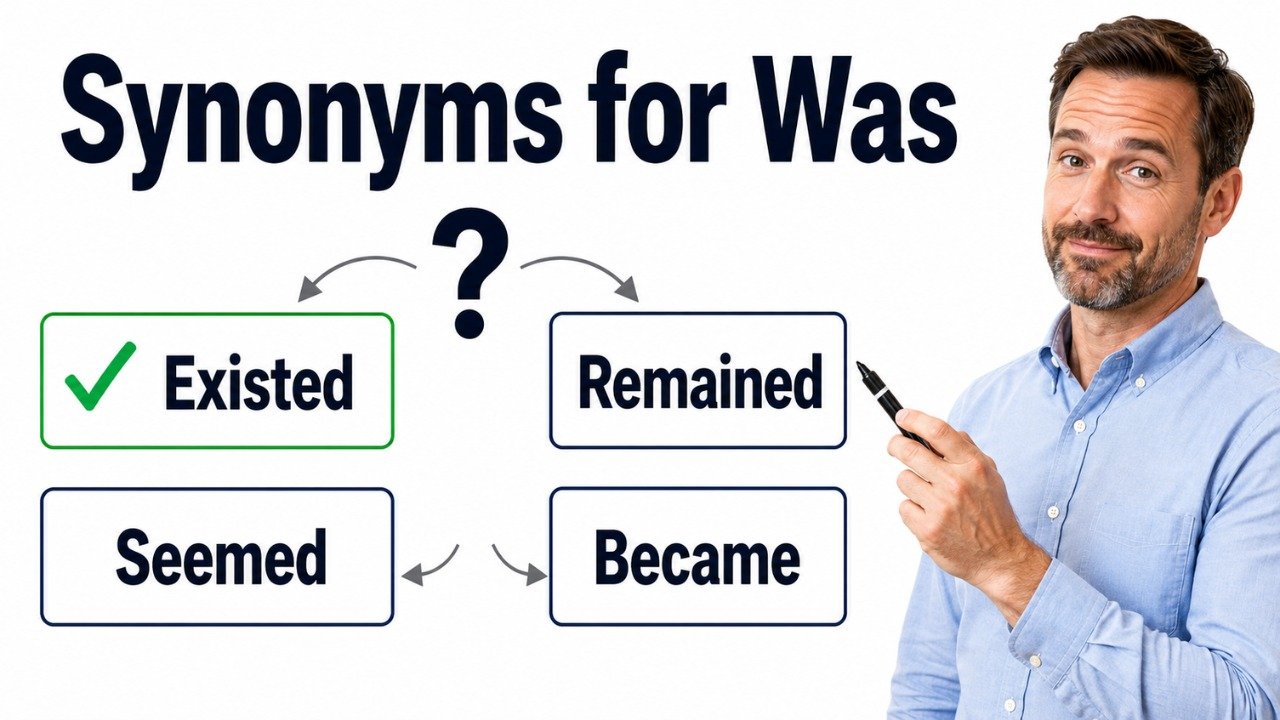
Quick Answer: The best synonyms for was include existed, remained, became, seemed, appeared, stood, stayed, lived, occurred, and served as. Synonyms for was depend on context because was is the past form of be. Use existed for presence, remained for continuation, became for change, seemed for impression, appeared for observation, occurred for events, and served as for roles or functions.
Pronunciation and Word Details
Word: Was.
Pronunciation: /wəz/ or /wʌz/.
Part of Speech: Verb.
Meaning: Was is the past tense form of be, used with I, he, she, it, or a singular noun to show existence, condition, identity, location, or action in the past.
US Pronunciation:
UK Pronunciation:
What Does “Was” Mean?
Direct Answer: Was means existed, happened, or had a certain state, identity, place, or condition in the past.
Was is a verb and the past tense form of be. It is used with singular subjects such as I, he, she, it, the person, the place, or the idea. In a sentence, was can show what someone felt, where something existed, what something seemed like, or what role someone had. For example, “She was tired” shows condition, while “He was a teacher” shows identity. Because was has many uses, its synonym must match the exact sentence meaning.
Meaning, Tone, and Context of “Was”
Was is a neutral, common, and highly flexible verb. It is used in everyday speech, formal writing, academic writing, storytelling, reports, descriptions, and explanations. The word itself is not emotional or strong, but the sentence around it can create emotion or detail.
In writing, was often works as a linking verb. It connects the subject to more information, such as a noun, adjective, location, or phrase. However, overusing was can make writing sound flat. Stronger alternatives like existed, remained, became, appeared, or occurred can add clarity, movement, and precision.
When and How to Use “Was”
For Past Existence: Use was when something existed in the past.
Example: There was a small garden behind the house.
For Past Condition: Use was when describing how someone or something felt, looked, or seemed.
Example: The room was quiet after the meeting.
For Past Identity: Use was when naming what someone or something used to be.
Example: She was the team leader last year.
For Past Location: Use was when saying where someone or something existed before.
Example: The book was on the table.
For Past Events: Use was when describing something that happened or took place.
Example: The ceremony was in the evening.
For Passive Voice: Use was before a past participle when the subject receives an action.
Example: The letter was written carefully.
Best Synonyms for Was
Existed: Was present or real in the past.
Example: A narrow path existed behind the old building.
Remained: Continued in the same state or place.
Example: The answer remained unclear until the end.
Became: Changed into a new state or condition.
Example: The sky became dark before the storm.
Seemed: Gave the impression of being something.
Example: His explanation seemed honest.
Appeared: Looked or seemed in a certain way.
Example: The plan appeared simple at first.
Stood: Was located or positioned in a place.
Example: A tall tree stood near the gate.
Stayed: Continued to be in a place or condition.
Example: The child stayed calm during the test.
Lived: Existed as a living person or thing.
Example: An old writer lived in that cottage.
Occurred: Happened or took place.
Example: The error occurred during the final step.
Served As: Had a role, purpose, or function.
Example: The room served as a study area.
50 Synonyms for Was with Short Meanings
- Existed: Was real or present.
- Remained: Continued in the same state.
- Stayed: Continued in a place or condition.
- Lived: Had life or stayed in a place.
- Stood: Was positioned or located.
- Sat: Was placed or positioned somewhere.
- Lay: Was resting or placed flat.
- Rested: Was placed or supported.
- Occurred: Happened in the past.
- Happened: Took place.
- Took Place: Occurred at a time or location.
- Came About: Happened or developed.
- Appeared: Seemed or became visible.
- Seemed: Gave a certain impression.
- Looked: Appeared in a certain way.
- Felt: Had a certain feeling or quality.
- Sounded: Gave a certain impression through sound or wording.
- Became: Changed into something.
- Turned: Changed into a different state.
- Grew: Became gradually different.
- Proved: Was shown to be true.
- Ended Up: Finally became or resulted in something.
- Functioned As: Worked in a certain role.
- Served As: Had a role or purpose.
- Acted As: Performed a role.
- Worked As: Had a job or function.
- Operated As: Functioned in a particular way.
- Represented: Stood for or symbolized something.
- Meant: Had a particular meaning.
- Signified: Expressed or indicated meaning.
- Equaled: Was the same in value or amount.
- Matched: Was equal or similar to something.
- Constituted: Formed or counted as something.
- Formed: Made up or created part of something.
- Made Up: Formed the parts of something.
- Amounted To: Was equal to or resulted in.
- Belonged: Was owned by or connected to someone.
- Came From: Had an origin or source.
- Originated: Began or came into existence.
- Started: Began in the past.
- Reminded: Made someone think of something.
- Reflected: Showed or expressed something.
- Showed: Made something clear or visible.
- Indicated: Pointed to or suggested something.
- Suggested: Gave an idea or impression.
- Marked: Showed an important point or event.
- Defined: Gave identity or meaning.
- Identified As: Was recognized as something.
- Known As: Was called or recognized by a name.
- Considered: Was thought of in a certain way.
Read Also:
Synonyms for Useful

Synonyms for Was by Context
When Was Means Existed
Use these synonyms when was means something existed, lived, or was present in the past.
Existed: A small village existed near the river.
Lived: A famous poet lived in that house.
Stood: An old bridge stood across the stream.
Rested: The vase rested on the wooden shelf.
When Was Means Seemed
Use these synonyms when was describes an impression, appearance, or feeling.
Seemed: The task seemed difficult at first.
Appeared: The answer appeared correct.
Looked: The garden looked peaceful.
Felt: The air felt cold in the morning.
When Was Means Became
Use these synonyms when was points to change, result, or development.
Became: The problem became serious.
Turned: The weather turned cold.
Grew: The room grew silent.
Ended Up: The plan ended up successful.
When Was Means Happened
Use these synonyms when was refers to an event, meeting, action, or situation.
Occurred: The mistake occurred during editing.
Happened: The accident happened at night.
Took Place: The meeting took place in the hall.
Came About: The change came about slowly.
When Was Means Served As
Use these synonyms when was describes a role, job, function, or purpose.
Served As: The old room served as a library.
Functioned As: The table functioned as a desk.
Acted As: He acted as the group leader.
Worked As: She worked as a nurse.
Another Word for Was
Another word for was depends on the meaning of the sentence. The best single replacement is often existed when was shows presence, seemed when it shows impression, became when it shows change, and occurred when it describes an event.
Original: There was a small shop near the station.
Better Option: A small shop existed near the station.
Original: The room was cold.
Better Option: The room felt cold.
Original: The idea was useful.
Better Option: The idea proved useful.
Original: The meeting was yesterday.
Better Option: The meeting took place yesterday.
When Not to Use “Was”
Do not overuse was when a stronger verb can make the sentence clearer. Was can sound weak when it replaces a more specific action, condition, or change. In formal writing, repeated use of was may make paragraphs feel plain or passive.
Weak: The report was about climate patterns.
Better: The report examined climate patterns.
Weak: The room was very quiet.
Better: The room remained silent.
Weak: The answer was correct.
Better: The answer proved correct.
Weak: The event was in the main hall.
Better: The event took place in the main hall.
Words Commonly Confused With Was
Was vs Were: Was is used with singular subjects such as I, he, she, it, and one noun. Were is used with plural subjects such as we, you, they, and plural nouns.
Was vs Is: Was refers to the past. Is refers to the present.
Was vs Had Been: Was usually describes a simple past state. Had been describes a state that happened before another past action.
Was vs Became: Was shows a past state. Became shows a change into a new state.
Was vs Seemed: Was states something more directly. Seemed shows an impression or possibility.
Was vs Existed: Was is general. Existed focuses on being real or present.
Which Synonym Should You Choose?
Choose existed when writing about something that was present, real, or available in the past.
Choose remained when the subject continued in the same state, place, or condition.
Choose became when the sentence shows a change from one condition to another.
Choose seemed when you want to express an impression rather than a certain fact.
Choose appeared when something looked a certain way or became visible.
Choose occurred when describing an event, mistake, issue, or incident.
Choose served as when writing about a role, purpose, or function.
Choose stood when describing where a building, tree, object, or person was located.
Choose proved when the sentence means something was shown to be true.
Choose represented when was means symbolized, showed, or stood for an idea.
Real Life Examples of “Was” in Sentences
Original: The answer was correct.
Better Option: The answer proved correct.
Original: There was a park near our school.
Better Option: A park existed near our school.
Original: The child was calm during the exam.
Better Option: The child remained calm during the exam.
Original: The sky was dark before the rain.
Better Option: The sky became dark before the rain.
Original: The meeting was in the conference room.
Better Option: The meeting took place in the conference room.
Original: The old chair was beside the window.
Better Option: The old chair stood beside the window.
Original: Her voice was soft.
Better Option: Her voice sounded soft.
Original: The rule was important for safety.
Better Option: The rule proved important for safety.
Original: The room was used for study.
Better Option: The room served as a study space.
Original: His face was tired.
Better Option: His face appeared tired.
Synonym Groups and Usage Differences
Existence Group
This group includes existed, lived, stood, rested, and stayed. Use these words when was means something existed, remained, or had a place in the past.
Example: A stone wall stood around the garden.
Condition Group
This group includes remained, stayed, felt, looked, and seemed. Use these words when describing feelings, states, or appearances.
Example: The room felt warm after sunset.
Change Group
This group includes became, turned, grew, and ended up. Use these words when a subject changes from one state to another.
Example: The discussion grew tense.
Event Group
This group includes occurred, happened, took place, and came about. Use these words when was points to an event or situation.
Example: The festival took place in spring.
Role Group
This group includes served as, worked as, acted as, functioned as, and operated as. Use these words when was shows a job, function, or purpose.
Example: The hall served as a shelter.
Meaning Group
This group includes meant, signified, represented, indicated, and reflected. Use these words when was shows meaning, symbolism, or message.
Example: The color represented peace.
Antonyms of Was
Was has different opposites depending on meaning. Since was often shows past existence, identity, or condition, its antonyms usually show absence, nonexistence, change, or future time.
Was Not: Shows the negative past form of was.
Did Not Exist: Means something was not real or present.
Disappeared: Means something stopped being visible or present.
Ceased: Means something stopped existing or continuing.
Ended: Means something came to a close.
Vanished: Means something disappeared completely.
Became Not: Means changed away from a former state.
Will Be: Refers to future existence instead of past existence.
Is: Refers to present existence instead of past existence.
Were Not: Negative past form used with plural subjects.
Comparison: Was vs Related Words
Was vs Existed
Was is broader and can describe identity, location, condition, or action. Existed focuses only on being real or present.
Example With Was: There was a small library in the village.
Example With Existed: A small library existed in the village.
Was vs Became
Was describes a past state. Became describes a change into that state.
Example With Was: The water was cold.
Example With Became: The water became cold after sunset.
Was vs Seemed
Was sounds more certain. Seemed shows impression, appearance, or uncertainty.
Example With Was: The answer was simple.
Example With Seemed: The answer seemed simple at first.
Was vs Occurred
Was can describe an event in a general way. Occurred directly means happened.
Example With Was: The issue was during the test.
Example With Occurred: The issue occurred during the test.
Was vs Remained
Was simply states a past condition. Remained shows that the condition continued.
Example With Was: The door was open.
Example With Remained: The door remained open all night.
Was vs Served As
Was can show identity or role. Served as is clearer when describing purpose or function.
Example With Was: The room was a study area.
Example With Served As: The room served as a study area.
Common Phrases and Expressions With Was
Was Able To: Had the ability to do something.
Was Going To: Planned to do something in the past.
Was Supposed To: Was expected or required to do something.
Was Meant To: Was intended for a purpose.
Was Known As: Had a name or reputation.
Was Considered: Was thought of in a certain way.
Was Located: Existed in a specific place.
Was Based On: Came from an idea, fact, or source.
Was Made Of: Had a certain material.
Was Part Of: Belonged to a larger thing or group.
Common Mistakes to Avoid
A common mistake is replacing was with a synonym that does not match the sentence meaning. For example, existed works for presence, but not for feelings. “She existed happy” is incorrect. Say “She was happy” or “She seemed happy.”
Another mistake is using was too often in descriptive writing. Repetition can make sentences sound flat. Replace some uses with stronger verbs such as became, remained, appeared, occurred, or served as.
Avoid confusing was with were. Use was with singular subjects and were with plural subjects. Also avoid using became when there is no change. “The wall became white” means it changed color, while “The wall was white” simply describes its state.
Conclusion
Synonyms for was are useful when you want clearer, stronger, and more exact writing. The best choices depend on the sentence meaning. Use existed for past presence, remained for continued condition, became for change, seemed or appeared for impression, occurred for events, and served as for roles. Was is correct and natural in many sentences, but replacing it carefully can make writing more vivid, precise, and polished.
FAQs About Synonyms for Was
What are the best synonyms for was?
The best synonyms for was are existed, remained, became, seemed, appeared, stood, stayed, lived, occurred, and served as. The best choice depends on context.
What is another word for was in writing?
Another word for was in writing can be existed, became, seemed, remained, occurred, or served as. Choose the word that matches the sentence meaning.
Can I always replace was with a synonym?
No, you cannot always replace was. It is a grammar word, so some sentences need it naturally. Replace it only when another verb improves clarity.
What is a formal synonym for was?
Formal synonyms for was include existed, occurred, constituted, represented, functioned as, and served as. These work well in reports, essays, and academic writing.
What is a simple synonym for was?
Simple synonyms for was include existed, stayed, became, seemed, looked, felt, and happened. These are easy to understand and common in everyday writing.
What is the difference between was and were?
Was is used with singular subjects such as I, he, she, it, and one noun. Were is used with plural subjects such as we, you, they, and plural nouns.
Why should I avoid repeating was too much?
Repeating was too much can make writing sound weak or plain. Stronger verbs such as remained, became, appeared, occurred, and served as can make sentences clearer and more engaging.
