
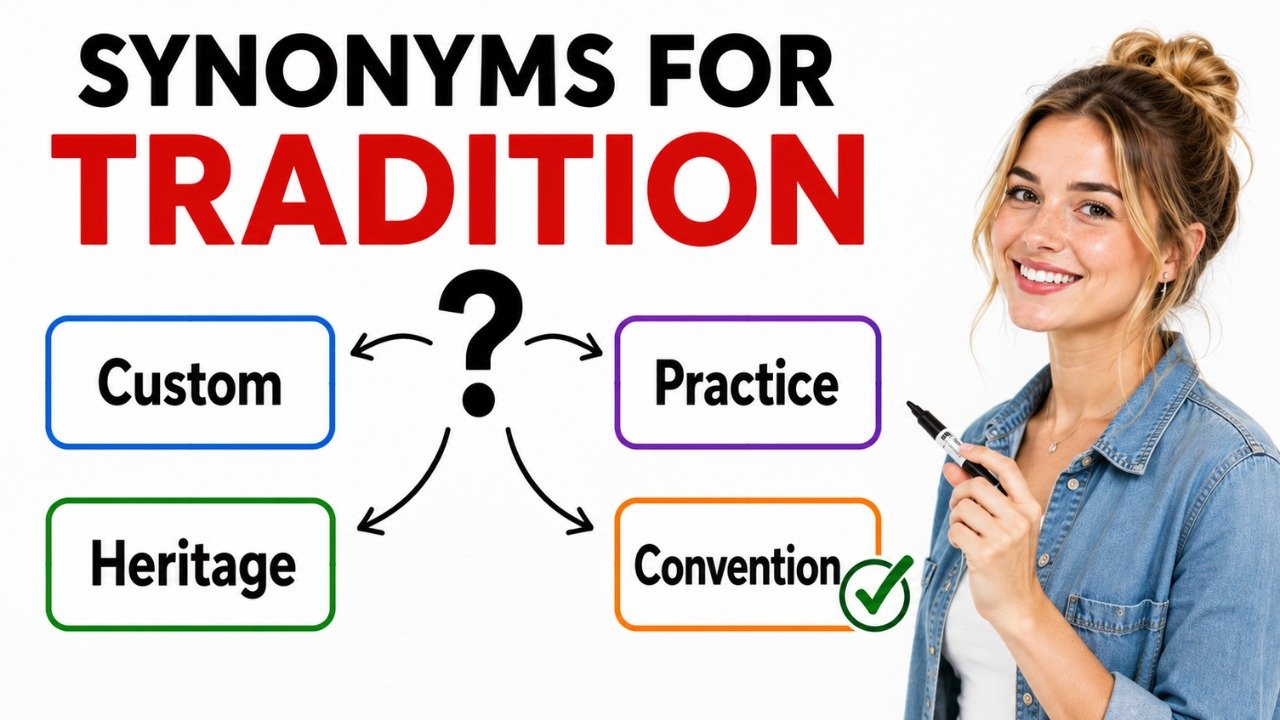
Quick Answer: The best synonyms for tradition are custom, heritage, convention, practice, ritual, legacy, culture, observance, belief, and folklore. Use custom for a familiar social or family practice, heritage for values and culture received from earlier generations, convention for an accepted social behavior, and ritual for a repeated symbolic act. Legacy suits something valuable passed down, while folklore describes traditional stories, beliefs, and knowledge.
Pronunciation and Word Details
Word: Tradition.
Pronunciation: /trəˈdɪʃ.ən/
Part of Speech: Noun.
Meaning: A belief, custom, practice, or way of behaving that is passed from one generation to another.
US Pronunciation:
UK Pronunciation:
What Does “Tradition” Mean?
Tradition means a custom, belief, practice, story, or way of life that people preserve and pass down over time. It is a noun commonly used when discussing families, communities, cultures, religions, institutions, and historical practices.
A tradition may be a simple family activity, such as preparing a special meal for a celebration. It may also be a formal cultural practice, religious observance, ceremony, or shared belief.
The word can refer to one specific custom or to a complete body of inherited practices.
Specific Custom: Lighting candles during a yearly celebration is a family tradition.
Cultural Practice: Traditional clothing forms an important part of the community’s tradition.
Established Method: The school has a long tradition of encouraging creative learning.
Inherited Belief: The story has remained alive through oral tradition.
Tradition often connects the present with the past. It can create identity, belonging, continuity, and shared meaning.
Meaning, Tone, and Context of “Tradition”
Tradition has a generally neutral and respectful tone. It often carries positive associations with cultural identity, family connection, history, stability, and shared values. However, its tone may change depending on the context.
Formal Context: Tradition is common in historical, academic, cultural, and religious writing.
Conversational Context: People use it naturally when discussing family celebrations, food, clothing, or annual activities.
Emotional Context: The word may express nostalgia, pride, comfort, belonging, or respect for earlier generations.
Cultural Context: It describes customs, stories, ceremonies, art, music, values, and practices shared by a group.
Critical Context: Tradition can sometimes refer to an old practice that people believe should be questioned or changed.
The word is suitable for essays, reports, speeches, descriptions, invitations, personal stories, and everyday conversations.
When and How to Use “Tradition”
For Family Customs
Use tradition to describe an activity or practice that family members repeat and preserve over time.
Example: Baking the same cake every winter has become a family tradition.
For Cultural Heritage
Use tradition when discussing practices, knowledge, clothing, music, art, or beliefs inherited from previous generations.
Example: The dance is an important part of the region’s cultural tradition.
For Religious Practices
Tradition can describe ceremonies, rituals, teachings, and observances connected with faith or spiritual life.
Example: The ceremony follows a religious tradition practiced for generations.
For Annual Celebrations
Use the word for repeated activities connected with holidays, festivals, reunions, or important dates.
Example: The yearly community dinner is a cherished tradition.
For Established Institutional Practices
Tradition can describe a practice followed by a school, organization, profession, or community for many years.
Example: The college has a tradition of recognizing outstanding students.
For Inherited Ideas
The word may refer to a body of beliefs, knowledge, stories, or artistic methods passed down through teaching or storytelling.
Example: The poem belongs to a long literary tradition.
Best Synonyms for Tradition
Custom
Synonym: A familiar way of behaving that is accepted by a family, group, or society.
Example: Removing shoes before entering the home is a local custom.
Heritage
Synonym: The culture, values, history, and practices received from earlier generations.
Example: The museum helps preserve the community’s cultural heritage.
Convention
Synonym: A socially accepted rule, practice, or way of behaving.
Example: Formal greetings remain an important social convention.
Practice
Synonym: An activity or method that people regularly follow.
Example: Sharing food with visitors is a common practice in the village.
Ritual
Synonym: A repeated act that has symbolic, cultural, personal, or religious meaning.
Example: Drinking tea together became their evening ritual.
Legacy
Synonym: Something valuable, influential, or meaningful passed down from the past.
Example: Her dedication to education remains an inspiring legacy.
Culture
Synonym: The shared beliefs, customs, values, arts, and way of life of a group.
Example: Storytelling plays an important role in the local culture.
Observance
Synonym: A formal act or practice connected with an important event, belief, or occasion.
Example: The annual observance includes music, prayers, and a shared meal.
Belief
Synonym: An idea or principle accepted as true and sometimes passed between generations.
Example: The belief has remained strong within the community.
Folklore
Synonym: Traditional stories, legends, customs, and beliefs shared by a culture.
Example: The mysterious creature appears frequently in regional folklore.
50 Synonyms for Tradition with Short Meanings
- Custom: A familiar practice accepted by a group.
- Heritage: Culture and values inherited from the past.
- Convention: An accepted social rule or behavior.
- Practice: An activity regularly followed.
- Ritual: A repeated act with symbolic meaning.
- Legacy: Something meaningful passed down over time.
- Culture: The shared way of life of a community.
- Observance: A formal practice connected with an occasion.
- Belief: An accepted idea or principle.
- Folklore: Traditional stories, customs, and beliefs.
- Ceremony: A formal activity performed on a special occasion.
- Rite: A formal cultural or religious act.
- Habit: A behavior repeated regularly.
- Usage: An accepted way of doing or expressing something.
- Institution: A long established social practice or system.
- Norm: A behavior considered normal within a group.
- Precedent: An earlier practice used as a model.
- Routine: A regular and repeated way of doing something.
- Lore: Traditional knowledge and stories about a subject.
- Inheritance: Something received from previous generations.
- Doctrine: A set of beliefs taught by a group.
- Ethos: The guiding values and character of a community.
- Principle: A basic belief that guides behavior.
- Value: A belief about what is important or desirable.
- Code: A shared system of rules or standards.
- Rule: An accepted instruction for behavior.
- Way: A customary method of acting or living.
- Pattern: A repeated form of behavior or activity.
- Manner: An established way of doing something.
- Ceremonial: A practice involving formal symbolic actions.
- Social Custom: A behavior commonly accepted by society.
- Cultural Practice: An activity connected with a group’s culture.
- Ancestral Practice: A custom received from earlier generations.
- Family Custom: A repeated practice within a family.
- Religious Observance: A practice connected with religious belief.
- Traditional Practice: An established activity preserved over time.
- Folk Custom: A traditional practice followed by ordinary people.
- Oral Tradition: Knowledge passed through spoken stories.
- Cultural Heritage: Shared history, customs, and creative expression.
- Established Practice: A method followed for a long period.
- Common Practice: A behavior regularly followed by many people.
- Accepted Practice: An activity considered proper or normal.
- Customary Practice: A familiar activity followed by convention.
- Historical Practice: A custom associated with an earlier period.
- Inherited Belief: An idea received from previous generations.
- Time Honored Practice: A respected custom followed for many years.
- Handed Down Practice: A custom passed between generations.
- Established Order: A long accepted system or arrangement.
- Social Convention: A shared expectation about proper behavior.
- Cultural Convention: An accepted practice within a cultural group.
Read Also:
Synonyms for Obtain

Synonyms for Tradition by Context
When Tradition Means a Social Custom
Custom, convention, norm, usage, and social practice work well when tradition describes accepted behavior within a community.
Example: It is a local custom to welcome guests with a shared meal.
Example: Polite introductions are an important social convention.
When Tradition Means Cultural Heritage
Heritage, culture, legacy, folklore, lore, and inheritance emphasize the history and identity passed down through generations.
Example: Traditional music forms a valuable part of the region’s heritage.
Example: The legend has survived through centuries of local folklore.
When Tradition Means a Ceremony
Ritual, observance, ceremony, and rite are suitable when the practice includes formal or symbolic actions.
Example: The candle lighting ritual marks the beginning of the celebration.
Example: The annual observance brings the entire community together.
When Tradition Means an Established Practice
Practice, routine, precedent, pattern, and established method describe activities followed regularly over time.
Example: Recognizing volunteers has become an established practice.
Example: The earlier decision created a precedent for future ceremonies.
When Tradition Means an Inherited Belief
Belief, doctrine, principle, ethos, value, and teaching work when tradition refers to ideas passed down through education, religion, or family life.
Example: Respect for elders remains a central cultural value.
Example: The community’s ethos emphasizes generosity and cooperation.
Another Word for Tradition
The best single alternative to tradition is usually custom. Both words describe a familiar practice followed by a family, community, or culture. However, the strongest replacement depends on the intended meaning.
Choose heritage when emphasizing history and identity. Choose ritual for a repeated symbolic action. Choose legacy for something influential passed from the past. Choose convention for accepted social behavior.
Original: Preparing this meal is an important family tradition.
Better Option: Preparing this meal is an important family custom.
Original: These songs preserve the musical tradition of the region.
Better Option: These songs preserve the musical heritage of the region.
Original: They followed the tradition before every important event.
Better Option: They followed the ritual before every important event.
Original: Her teaching tradition continues through her former students.
Better Option: Her teaching legacy continues through her former students.
When Not to Use “Tradition”
Tradition is not always the most accurate word. Avoid it when the action is new, accidental, temporary, or performed only once. A practice normally needs time, repetition, or inherited meaning before it can reasonably be called a tradition.
The word may also sound vague when a more specific term would communicate the intended meaning clearly.
Weak: They followed the tradition during the formal service.
Better: They followed the ceremonial ritual during the formal service.
Weak: Wearing formal clothing is a tradition in many professional settings.
Better: Wearing formal clothing is a social convention in many professional settings.
Weak: The old building represents the town’s tradition.
Better: The old building represents the town’s cultural heritage.
Weak: She has a tradition of drinking water every morning.
Better: She has a habit of drinking water every morning.
Do not call a personal routine a tradition unless it carries emotional, family, cultural, or symbolic significance.
Words Commonly Confused With Tradition
Tradition vs Custom: Tradition is usually passed down or maintained over a long period. A custom is any accepted practice within a particular group or situation.
Tradition vs Culture: Tradition is one practice or body of practices. Culture includes the complete set of beliefs, values, language, art, customs, and behaviors of a group.
Tradition vs Habit: A tradition has shared, historical, or symbolic meaning. A habit is a repeated personal behavior that may have no cultural importance.
Tradition vs Ritual: A tradition is a preserved custom or belief. A ritual is a structured series of actions performed repeatedly for symbolic, personal, or religious reasons.
Tradition vs Heritage: Tradition focuses on practices and beliefs. Heritage includes history, identity, places, objects, language, art, and customs inherited from the past.
Tradition vs Legacy: Tradition is something people continue to practice. Legacy is the lasting influence or result left by a person, community, or historical period.
Tradition vs Convention: Tradition often comes from history and inheritance. Convention refers to behavior accepted because society considers it normal or appropriate.
Which Synonym Should You Choose?
Choose custom when describing a familiar family, local, or social practice.
Choose heritage when discussing cultural identity, history, language, art, or inherited values.
Choose ritual when referring to a repeated action with symbolic or emotional meaning.
Choose convention when describing an accepted social rule or expected behavior.
Choose legacy when emphasizing the lasting influence of a person, movement, or earlier generation.
Choose observance for formal religious, cultural, or memorial activities.
Choose folklore when referring to legends, stories, superstitions, and traditional knowledge.
Choose practice for a regular method followed by a group or institution.
Choose habit for a repeated personal action without deep cultural importance.
Choose precedent when an earlier event or decision guides future behavior.
In essays and reports, heritage, cultural practice, observance, and convention often provide greater precision. In everyday conversation, custom, ritual, practice, and habit sound more natural.
Real Life Examples of “Tradition” in Sentences
Original: The family continued its tradition of gathering every spring.
Better Option: The family continued its custom of gathering every spring.
Original: The festival celebrates the artistic tradition of the region.
Better Option: The festival celebrates the artistic heritage of the region.
Original: Their morning tradition helps everyone begin the day peacefully.
Better Option: Their morning ritual helps everyone begin the day peacefully.
Original: The school has a tradition of honoring excellent teachers.
Better Option: The school has an established practice of honoring excellent teachers.
Original: This tradition requires guests to dress formally.
Better Option: This social convention requires guests to dress formally.
Original: The stories belong to a rich local tradition.
Better Option: The stories belong to a rich body of local folklore.
Original: The ceremony follows an ancient tradition.
Better Option: The ceremony follows an ancient rite.
Original: Her commitment to kindness created a family tradition.
Better Option: Her commitment to kindness created a lasting family legacy.
Original: The community protects its musical tradition.
Better Option: The community protects its musical culture.
Original: Lighting the lamps is an important tradition.
Better Option: Lighting the lamps is an important observance.
Synonym Groups and Usage Differences
Custom and Convention Group
Custom, convention, norm, and usage describe behaviors accepted by a family, society, or community. Custom often feels cultural or local, while convention emphasizes social expectations.
Example: Offering refreshments to visitors is a familiar local custom.
Heritage and Legacy Group
Heritage, inheritance, and legacy connect people with the past. Heritage describes shared cultural possessions and identity, while legacy focuses on lasting influence.
Example: The craft remains an important part of the community’s heritage.
Ritual and Ceremony Group
Ritual, rite, ceremony, and observance refer to organized or symbolic actions. Ritual may be personal or formal, while ceremony usually describes a complete formal event.
Example: The closing ritual included music and candlelight.
Practice and Routine Group
Practice, routine, habit, and pattern describe repeated behavior. Practice is suitable for professional or social methods, while routine and habit often describe everyday actions.
Example: Reviewing every document carefully is standard practice.
Belief and Principle Group
Belief, doctrine, principle, value, and ethos describe ideas that guide people or communities. Doctrine is more formal, while value and principle are broader.
Example: Hospitality is a central value within the community.
Folklore and Lore Group
Folklore, lore, and oral tradition refer to stories, knowledge, legends, and beliefs transmitted between people over time.
Example: The tale has been preserved through oral tradition.
Antonyms of Tradition
The opposite of tradition depends on whether the word refers to age, continuity, social acceptance, or inherited practices.
Innovation: The introduction of a new idea or method.
Modernity: Current ideas, styles, and ways of living.
Novelty: Something new or unfamiliar.
Change: The process of becoming different.
Departure: A movement away from an established practice.
Break: An interruption in continuity.
Reform: An improvement that changes an existing system.
Originality: The quality of being new and independently created.
Experimentation: The process of trying unfamiliar methods or ideas.
Unconventionality: Behavior that does not follow accepted customs.
Disruption: A major interruption of an established pattern.
Reinvention: The act of creating a significantly different form of something.
Comparison: Tradition vs Related Words
Tradition vs Custom
Tradition usually has a stronger connection with history, inheritance, and continuity. Custom may simply describe an accepted way of behaving in a particular group.
Example With Tradition: The family preserves a tradition begun by their grandparents.
Example With Custom: It is a local custom to greet every visitor personally.
Tradition vs Heritage
Tradition describes a belief or practice that continues over time. Heritage refers to the wider culture, history, objects, values, and identity inherited from the past.
Example With Tradition: Preparing the dish together is a family tradition.
Example With Heritage: The recipe forms part of the family’s cultural heritage.
Tradition vs Ritual
Tradition is a custom preserved over time. Ritual is a repeated action performed in a particular order, often with symbolic meaning.
Example With Tradition: The yearly gathering is a cherished tradition.
Example With Ritual: Lighting a candle begins the yearly ritual.
Tradition vs Legacy
Tradition is something people continue to do. Legacy is something a person or generation leaves behind.
Example With Tradition: The community continues its storytelling tradition.
Example With Legacy: The writer left a powerful literary legacy.
Tradition vs Habit
Tradition usually has shared meaning and historical continuity. Habit is a repeated personal action.
Example With Tradition: The family shares a special meal every year.
Example With Habit: He reads for thirty minutes before sleeping.
Tradition vs Convention
Tradition develops through repetition and inheritance. Convention exists because people agree that a behavior is normal or appropriate.
Example With Tradition: The song has opened the celebration for generations.
Example With Convention: Formal clothing is the convention at the ceremony.
Common Phrases and Expressions With Tradition
Family Tradition: A custom preserved within a family.
Cultural Tradition: A practice connected with a group’s identity and history.
Long Standing Tradition: A custom that has existed for many years.
Rich Tradition: A varied and meaningful cultural or historical practice.
Ancient Tradition: A custom originating in the distant past.
Local Tradition: A practice associated with a particular place or community.
Oral Tradition: Stories or knowledge passed through speech.
Religious Tradition: Beliefs and practices connected with a faith.
Literary Tradition: Writing styles, themes, and methods passed between writers.
Artistic Tradition: Creative methods and values preserved across generations.
Time Honored Tradition: A respected custom followed for a long period.
Break With Tradition: To stop following an established practice.
Common Mistakes to Avoid
One common mistake is using tradition for any repeated action. A personal activity performed regularly may be a habit or routine rather than a tradition. Tradition usually suggests shared meaning, historical continuity, or inheritance.
Avoid repeating tradition several times in one paragraph. Use custom, heritage, practice, ritual, observance, or legacy when those words express the meaning more precisely.
Do not treat culture and tradition as perfect synonyms. Culture is broader and includes language, beliefs, art, social behavior, values, and customs.
Be careful when replacing tradition with ritual. A ritual normally involves repeated actions performed in a particular way, while a tradition may be an activity, belief, story, or value.
Avoid vague phrases such as old tradition when ancient tradition, family custom, cultural heritage, or established practice would provide clearer information.
Also avoid assuming that every tradition is positive or unchangeable. In analytical writing, explain what the practice involves and why people preserve, question, or change it.
Conclusion
The most useful synonyms for tradition include custom, heritage, convention, ritual, practice, legacy, observance, culture, and folklore. Custom is the best general replacement for an accepted social or family practice. Heritage highlights history and identity, while ritual describes repeated symbolic actions. Convention suits social expectations, and legacy emphasizes lasting influence. Understanding these differences will help you use synonyms for tradition naturally and choose language that accurately reflects cultural practices, inherited beliefs, ceremonies, and established ways of life.
FAQs About Synonyms for Tradition
What Is the Best Synonym for Tradition?
Custom is the best general synonym for tradition. Heritage, ritual, practice, and convention may be better in more specific contexts.
Is Heritage Another Word for Tradition?
Heritage can replace tradition when discussing culture, history, identity, and values inherited from earlier generations. It is broader than one particular tradition.
What Is a Synonym for Family Tradition?
Family custom, family practice, inherited custom, household ritual, and family heritage are useful alternatives.
What Is a Formal Synonym for Tradition?
Convention, observance, cultural practice, established practice, and heritage are suitable formal alternatives.
Are Tradition and Ritual the Same?
No. A tradition is a belief or practice preserved over time, while a ritual is a repeated series of symbolic or formal actions.
What Is the Opposite of Tradition?
Innovation, modernity, novelty, change, reform, and unconventionality can be opposites of tradition, depending on the context.
Can Habit Be Used as a Synonym for Tradition?
Habit can be used when describing repeated personal behavior. It is not a strong replacement when the practice has cultural, historical, family, or symbolic meaning.
